
HUMAN RESOURCE What is appraisal What is assessment




- Slides: 25
HUMAN RESOURCE What is appraisal? What is assessment? Edited by Fabio Emanuele Noia, Link Campus University of Malta, 2006 Chapter 8 Appraisal and Performance Freely Inspired from Bratton J. , Gold J. , Human Resource Management, Theory and Practice, Palgrave, 2003 http: //www. palgrave. com/business/brattonandgold/
Appraisal ______ A process that provides an analysis of a person’s overall capabilities and potential, allowing informed decisions to be made for particular purposes. Freely Inspired from Bratton J. , Gold J. , Human Resource Management, Theory and Practice, Palgrave, 2003
Assessment ______ An important part of the appraisal process, whereby data on an individual’s past and current work, behavior and performance are collected and reviewed. Freely Inspired from Bratton J. , Gold J. , Human Resource Management, Theory and Practice, Palgrave, 2003
PMS ______ Integrated Performance Management Systems, often based on a competency framework, provide vital data for rational, objective and efficient decision making relating to improving performance, identifying training needs, managing careers and setting levels of reward. Freely Inspired from Bratton J. , Gold J. , Human Resource Management, Theory and Practice, Palgrave, 2003
Purpose of appraisal ______ • Improve individual performance • Improving motivation and morale • Clarifying expectations and reducing ambiguity about performance • Determining rewards • Identifying training and development opportunities • Improving communication • Selecting people for promotion • Managing careers • Counselling • Discipline • Planning remedial actions • Setting goals and targets Freely Inspired from Bratton J. , Gold J. , Human Resource Management, Theory and Practice, Palgrave, 2003
Features of Performance management ______ • Objective setting and review • Annual appraisal • Personal development plan • Self appraisal • Performance related pay • Coaching/mentoring • Career management • Competence assessment • Twice-yearly appraisal • Subordinate appraisal • Continuous assessment • Rolling appraisal • 360° appraisal • Peer appraisal • Balanced scorecards Freely Inspired from Bratton J. , Gold J. , Human Resource Management, Theory and Practice, Palgrave, 2003
Main Purpose of appraisal ______ 1. The making of administrative decisions concerning pay, promotions and careers, and work responsibilities – the judgement purpose 2. The improvement of performance through the discussion of development needs, identifying training opportunities and the planning of action – the development purpose Freely Inspired from Bratton J. , Gold J. , Human Resource Management, Theory and Practice, Palgrave, 2003
Findings (Meyer et al. , 1965) ______ • Criticism often has a negative effect on motivation and performance • Praise has little effect • Performance improves with specific goals • Participation by the employee in goal-setting helps to produce favorable results • Interviews designed primarily to improve performance should not at the same time weigh salary or promotion in the balance • Coaching by managers should be day to day rather than just once a year Freely Inspired from Bratton J. , Gold J. , Human Resource Management, Theory and Practice, Palgrave, 2003
Multisource feedback ______ Feedback is received from all around a job (360°) allowing for more balance and objectivity than a single view from a line manager (cost increases) Freely Inspired from Bratton J. , Gold J. , Human Resource Management, Theory and Practice, Palgrave, 2003
Competencies ______ Competencies have also been seen as a way of facilitating the review process, linking personal development plans (PDPs) to strategy and to pay. Freely Inspired from Bratton J. , Gold J. , Human Resource Management, Theory and Practice, Palgrave, 2003
Criticism ______ • Employees are able to accept criticism if it is useful and relevant to them and the work they are doing. • Feedback provides a chance of improving performance and an opportunity of continuing dialogue between managers and employees out of which will emerge a joint understanding of individual development needs and aspirations. • Continuous appraisal will work better. Freely Inspired from Bratton J. , Gold J. , Human Resource Management, Theory and Practice, Palgrave, 2003
A control paradigm ________ Define work Set measurable targets Perform Assess against targets Freely Inspired from Bratton J. , Gold J. , Human Resource Management, Theory and Practice, Palgrave, 2003
Effectiveness Some of the research evidence has indicated that the reality of appraisal may be less than effective. The problem may be due to the way in which appraisal processes are formulated, based on an explicit or implicit performance control orientation. May contrast with high trust-high commitment-high productivity of High Performance paradigm of HRM Freely Inspired from Bratton J. , Gold J. , Human Resource Management, Theory and Practice, Palgrave, 2003
From control to development ______ The crucial contribution towards creating commitment, pride and trust is, however, management’s devotion to nurturing a culture that supports the long -term development of people (Gratton, 1997). Assessment and appraisal can serve as the fulcrum of such a process, while accomodating for control needs. Freely Inspired from Bratton J. , Gold J. , Human Resource Management, Theory and Practice, Palgrave, 2003
Alternatives to get useful information • The performance of work task can be presented as a relationship between means (attributes, skills, knowledge, attitudes applied to tasks) and ends (results, measurements, standards) - Ouchi, 1979. • Between means and ends lies the behavior of the individual in a transformation process. • Through attention to the behavior of an employee in the transformation process data can be provided for a whole gamut of develomental decisions over time, starting with adjustments to reach minimum Standard and then addressing career changes and progression. Freely Inspired from Bratton J. , Gold J. , Human Resource Management, Theory and Practice, Palgrave, 2003
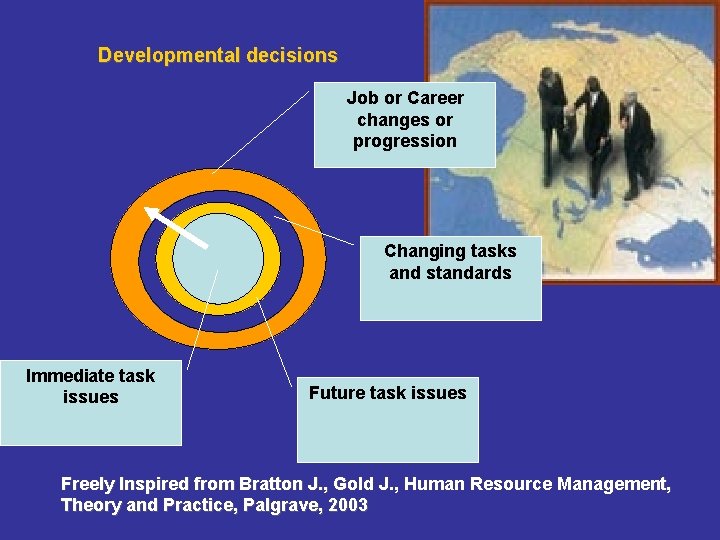
Developmental decisions Job or Career changes or progression Changing tasks and standards Immediate task issues Future task issues Freely Inspired from Bratton J. , Gold J. , Human Resource Management, Theory and Practice, Palgrave, 2003
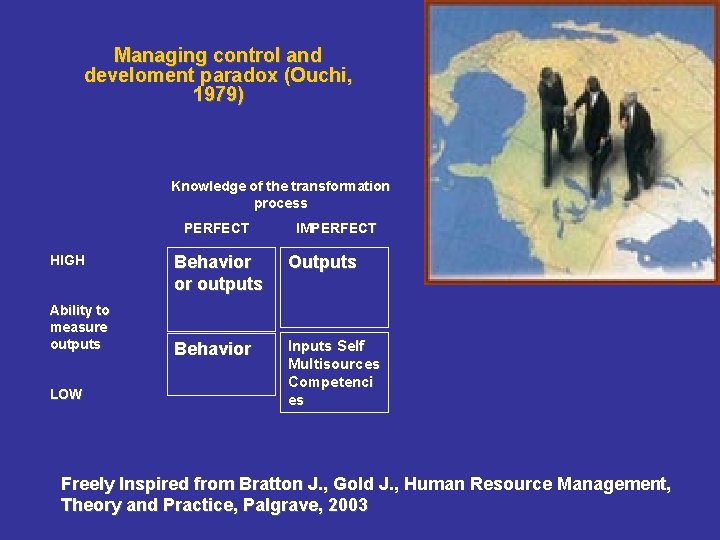
Managing control and develoment paradox (Ouchi, 1979) Knowledge of the transformation process PERFECT HIGH Ability to measure outputs LOW IMPERFECT Behavior or outputs Outputs Behavior Inputs Self Multisources Competenci es Freely Inspired from Bratton J. , Gold J. , Human Resource Management, Theory and Practice, Palgrave, 2003
To reconcile the opposite needs of control and development PMSs have been developed, strategically integrated with HRM processes. Freely Inspired from Bratton J. , Gold J. , Human Resource Management, Theory and Practice, Palgrave, 2003
Best value framework in public sector (customer/citizen oriented – quality driven approach): • Strategic objectives • Cost/efficiency • Service delivery outcome • Quality • Fair access Freely Inspired from Bratton J. , Gold J. , Human Resource Management, Theory and Practice, Palgrave, 2003
Goal setting and development need diagnosis The attitude of management are crucial as they are the key actors in the implementation of the various HR processes. Freely Inspired from Bratton J. , Gold J. , Human Resource Management, Theory and Practice, Palgrave, 2003
PMS A PMS might incorporate a development center (same as assessment centers), a performance development plan (PDP), and goal setting. Freely Inspired from Bratton J. , Gold J. , Human Resource Management, Theory and Practice, Palgrave, 2003
Performance Management Cycle Performance and Development Plan End of year review including multisource appraisal Ongoing support coaching training First Review Second Review Third Review Freely Inspired from Bratton J. , Gold J. , Human Resource Management, Theory and Practice, Palgrave, 2003
Forms of appraisal • Top Down • Upward • Peer to Peer • 360° • Self Freely Inspired from Bratton J. , Gold J. , Human Resource Management, Theory and Practice, Palgrave, 2003
Performance Ratings • • • Inputs (dependability, loyalty, decisiveness, resorcefulness and stability – difficult to define, low reliability) Results and outcomes (production, sales, satisfied costomers, … more objective) Behavior in performance (“give praise to employees”, …. rated from excellent to unacceptable) Freely Inspired from Bratton J. , Gold J. , Human Resource Management, Theory and Practice, Palgrave, 2003
Exercise Appraisal and performance in University education. • Is the appraisal process effective and fair? • What are the main appraisal problems? • How might you suggest improving the appraisal process?