
Human Resource Training N 6 Module 1 Competencybased

Human Resource Training N 6
Module 1: Competency-based training DEFINITIONS Competence means to have the ability to do something. Elements of competence: These are actions, behaviour or outcomes that a person must be able to demonstrate. Performance criteria: These are descriptions of previously set standards against which the performance of the person is measured and judged. Conditions under which the performance is required: The controlled situation under which the trainee is being trained. www. futuremanagers. com
Module 1: The integrated role of management (continued) CHARACTERISTICS OF COMPENCY-BASED MODULAR TRAINING Some of the characteristics of CBMT are not limited to: • Trainees receive continuous and positive feedback. • The competency is directly task-related. • Trainees can proceed at their own pace. • Trainers facilitate (help) and motivate the trainees positively. • Competency is measured against previously set standards. • Different training methods are used to achieve competency. www. futuremanagers. com
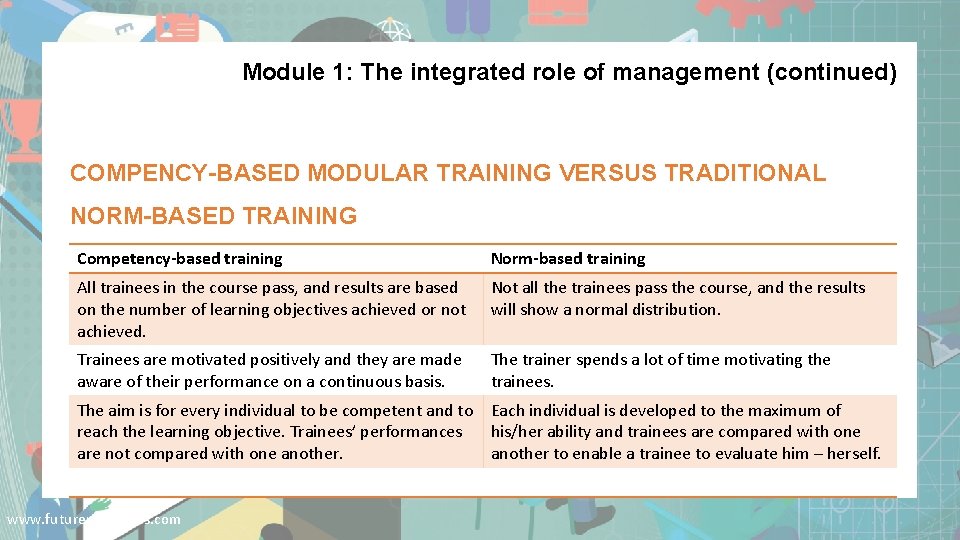
Module 1: The integrated role of management (continued) COMPENCY-BASED MODULAR TRAINING VERSUS TRADITIONAL NORM-BASED TRAINING Competency-based training Norm-based training All trainees in the course pass, and results are based on the number of learning objectives achieved or not achieved. Not all the trainees pass the course, and the results will show a normal distribution. Trainees are motivated positively and they are made aware of their performance on a continuous basis. The trainer spends a lot of time motivating the trainees. The aim is for every individual to be competent and to Each individual is developed to the maximum of reach the learning objective. Trainees’ performances his/her ability and trainees are compared with one are not compared with one another to enable a trainee to evaluate him – herself. www. futuremanagers. com
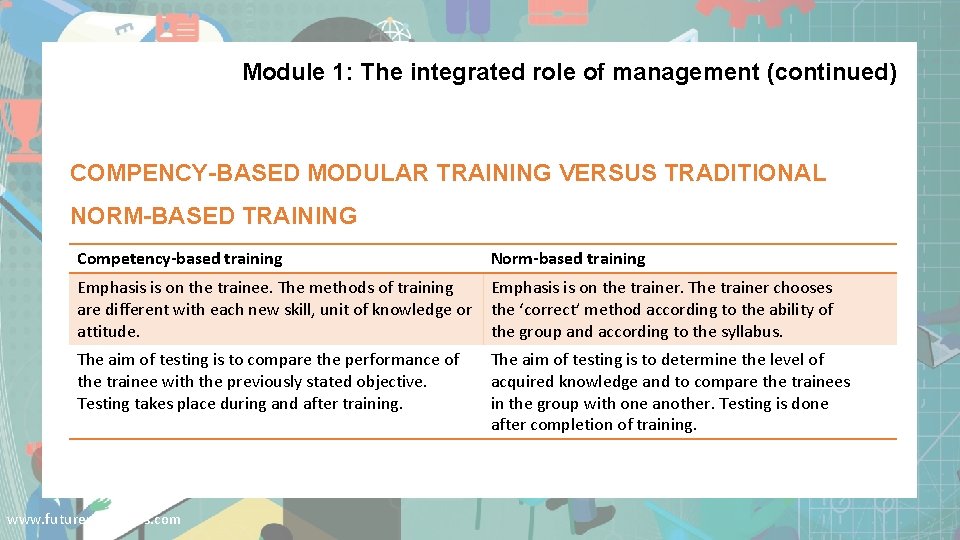
Module 1: The integrated role of management (continued) COMPENCY-BASED MODULAR TRAINING VERSUS TRADITIONAL NORM-BASED TRAINING Competency-based training Norm-based training Emphasis is on the trainee. The methods of training are different with each new skill, unit of knowledge or attitude. Emphasis is on the trainer. The trainer chooses the ‘correct’ method according to the ability of the group and according to the syllabus. The aim of testing is to compare the performance of the trainee with the previously stated objective. Testing takes place during and after training. The aim of testing is to determine the level of acquired knowledge and to compare the trainees in the group with one another. Testing is done after completion of training. www. futuremanagers. com

Module 1: The integrated role of management (continued) COMPENCY-BASED MODULAR TRAINING VERSUS TRADITIONAL NORM-BASED TRAINING Competency-based training Norm-based training Test results will determine whether a trainee continues to the next objective or whether remedial attention, repetition or practice is necessary. Test results are compared with the group’s results. Trainees with low results have to receive remedial attention, repetition or practice. Trainees must achieve competency to continue to the next objective. Trainees are allowed to continue with a higher level, as long as they have achieved the minimum level of competency. Learning time is varied. A trainee is allowed limited repetition of tests to achieve competency. Learning time is kept constant (the same). www. futuremanagers. com
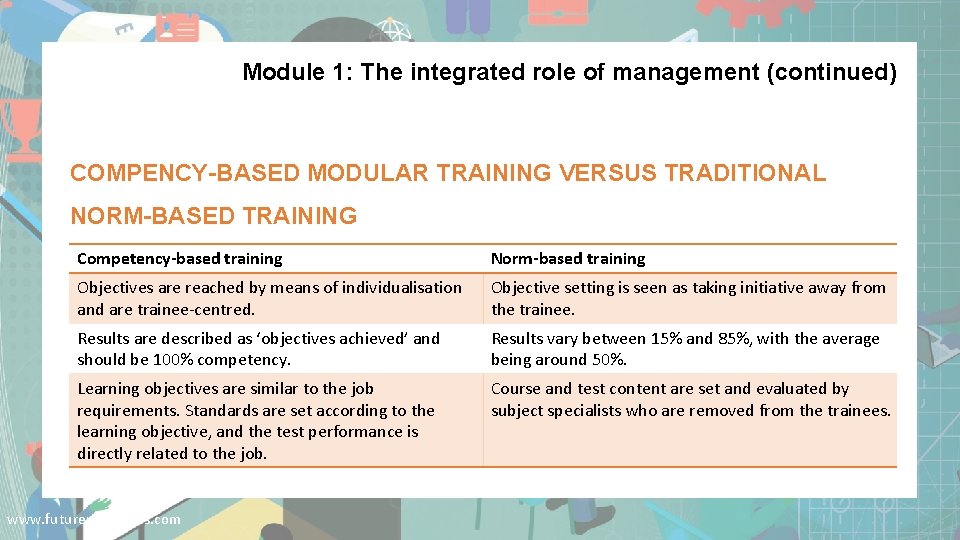
Module 1: The integrated role of management (continued) COMPENCY-BASED MODULAR TRAINING VERSUS TRADITIONAL NORM-BASED TRAINING Competency-based training Norm-based training Objectives are reached by means of individualisation and are trainee-centred. Objective setting is seen as taking initiative away from the trainee. Results are described as ‘objectives achieved’ and should be 100% competency. Results vary between 15% and 85%, with the average being around 50%. Learning objectives are similar to the job requirements. Standards are set according to the learning objective, and the test performance is directly related to the job. Course and test content are set and evaluated by subject specialists who are removed from the trainees. www. futuremanagers. com
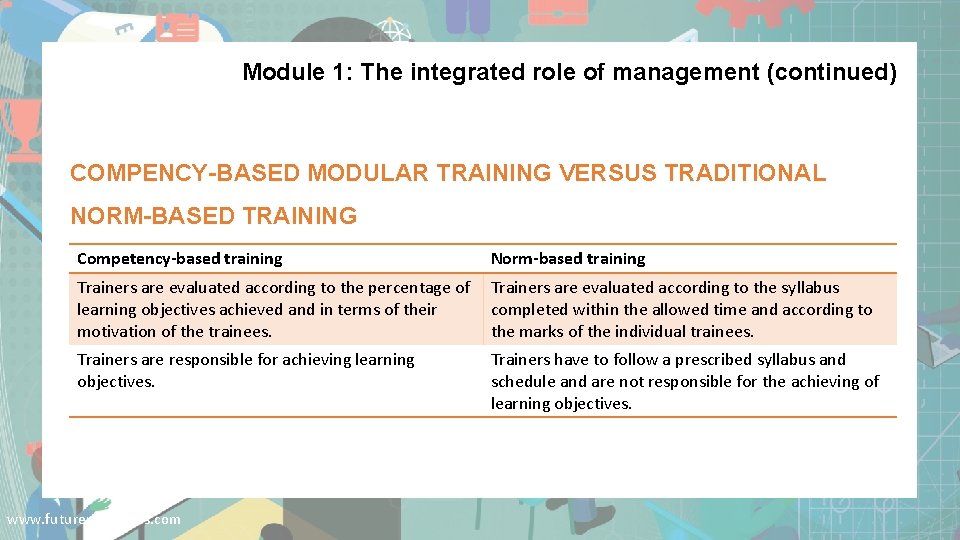
Module 1: The integrated role of management (continued) COMPENCY-BASED MODULAR TRAINING VERSUS TRADITIONAL NORM-BASED TRAINING Competency-based training Norm-based training Trainers are evaluated according to the percentage of learning objectives achieved and in terms of their motivation of the trainees. Trainers are evaluated according to the syllabus completed within the allowed time and according to the marks of the individual trainees. Trainers are responsible for achieving learning objectives. Trainers have to follow a prescribed syllabus and schedule and are not responsible for the achieving of learning objectives. www. futuremanagers. com
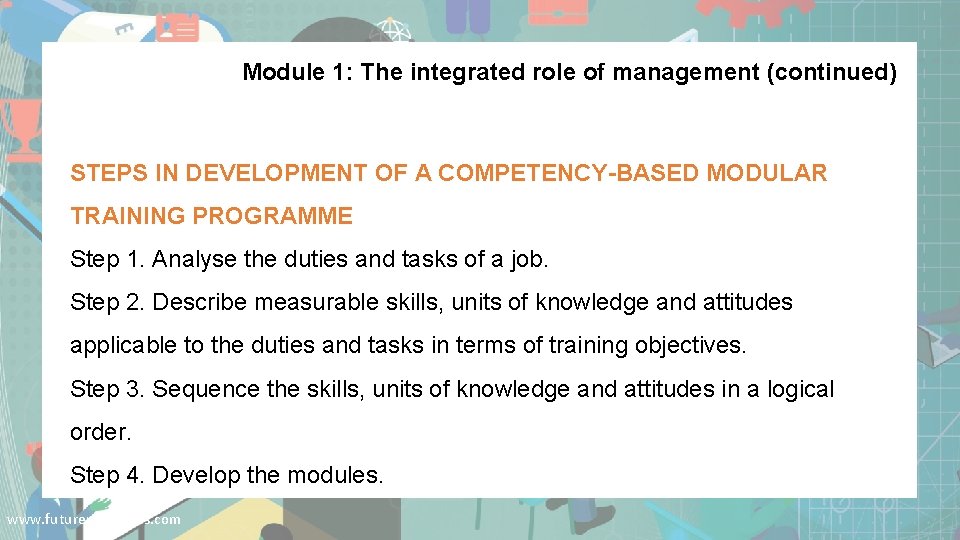
Module 1: The integrated role of management (continued) STEPS IN DEVELOPMENT OF A COMPETENCY-BASED MODULAR TRAINING PROGRAMME Step 1. Analyse the duties and tasks of a job. Step 2. Describe measurable skills, units of knowledge and attitudes applicable to the duties and tasks in terms of training objectives. Step 3. Sequence the skills, units of knowledge and attitudes in a logical order. Step 4. Develop the modules. www. futuremanagers. com
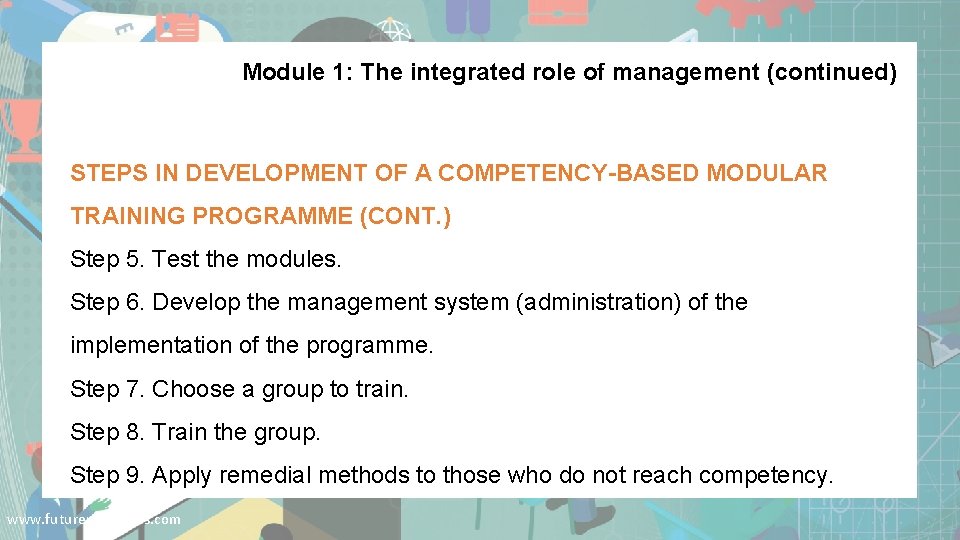
Module 1: The integrated role of management (continued) STEPS IN DEVELOPMENT OF A COMPETENCY-BASED MODULAR TRAINING PROGRAMME (CONT. ) Step 5. Test the modules. Step 6. Develop the management system (administration) of the implementation of the programme. Step 7. Choose a group to train. Step 8. Train the group. Step 9. Apply remedial methods to those who do not reach competency. www. futuremanagers. com
Module 2: Facilitation skills DEFINITION Traditionally, a trainer is the source and conveyor of facts to trainees. A facilitator will act as a leverage to get a problem solved and he/she allows the learning process to begin and to grow without becoming involved in the same manner as a traditional teacher or lecturer. Facilitation is part of a process where all participants are involved in the action as a group. www. futuremanagers. com
Module 2: Facilitation skills (continued) ROLE OF THE FACILITATOR The facilitator guides the learning process. The facilitator needs to set up the session in order for all members to experience the discussion positively. Facilitators are used in situations where groups are experiencing problems, or where a decision needs to be taken. The facilitator will help the group to generate accurate facts and will provide support and obtain input, as well as keeping management informed of progress. www. futuremanagers. com
Module 2: Facilitation skills (continued) FACILITATION SKILLS/TOOLS Non-verbal skills include: • Maintaining eye-contact. • Being open and approachable. • Appearing relaxed and not openly nervous or agitated. Verbal skills include: Minimal prompts and probing as well as paraphrasing and summarising. Open- and close-ended questions. www. futuremanagers. com
Module 2: Facilitation skills (continued) FACILITATION TECHNIQUES Specific facilitation techniques are: • Complimenting an interesting or well-thought out statement. • Adding to statements by means of examples. • Suggesting alternatives to statements to stimulate further discussion. • Immediately diffusing a contentious statement. • Putting ideas together to show the group can reach a solution. • Summarising and writing down the final ideas from the discussion. www. futuremanagers. com
Module 3: Designing and developing a training programme DETERMINING NEEDS Three broad steps need to be followed when training needs are determined: • Determine what the aim and objective of the enterprise are. • Determine the job description of every employee and describe the desired performance/output. • Determine where a specific problem area in terms of the ‘performance gap’ of every employee is. www. futuremanagers. com
Module 3: Designing and developing a training programme (continued) DETERMINING TRAINING PROGRAMME Guidelines in the development of a training programme are that it should: • Be developed systematically; • Standardise the steps of the development and relevant to the enterprise; • Be comprehensive (do not leave anything out) and effective; • Ensure internal consistency (linking units); • Be reliable and job-related; and • Be applicable to jobs, people, and training needs. www. futuremanagers. com
Module 3: Designing and developing a training programme (continued) SELECTING CONTENT Steps in the selection of content include: • Examine each learning objective and decide which knowledge, skills and attitudes need to be included. • Submit the outline to subject experts to check for validity and accuracy. • Revise the outline and prepare detailed content. • Compare rewritten content with performance objectives. • Make final revisions. www. futuremanagers. com
Module 3: Designing and developing a training programme (continued) SELECTING METHODS/TECHNIQUES/INSTRUCTIONAL STRATEGIES The following factors must be considered when choosing a training method: • The objective of the training session; • The participants, trainer; senses; and time; • The combination of techniques; • The nature of knowledge, skills, or attitudes; • The culture of the enterprise; and • The cost-effectiveness. www. futuremanagers. com
Module 3: Designing and developing a training programme (continued) SELECTING TRAINING MEDIA Factors/guidelines in the selection of training media include: • Reason for using training media; • Audience characteristics; • Trainer factors and training objectives and environment; • Production; • Cost-effectiveness; and • Unique characteristics of each medium. www. futuremanagers. com
Module 3: Designing and developing a training programme (continued) DEVELOPING MATERIALS Materials that are to be used during training must be designed in such a way as to enhance the training process. Materials must facilitate the acquiring of new knowledge, skills and attitudes. Two of the most common materials used are: • Transparencies/flip-charts/‘blackboard’; and • Printed matter. www. futuremanagers. com
Module 4: Presenting a training programme in practice FACILITIES, EQUIPMENT AND MATERIALS Equipment and media support complement a training programme. It is vital that a presentation room is checked thoroughly before the presentation to ensure that the necessary equipment is present and that it works. www. futuremanagers. com
Module 4: Presenting a training programme in practice (continued) OPERATING THE PROGRAMME A training process is made up of three phases: • Before the programme, the trainer should ensure that all aspects of the programme are in place. This is an essential phase of preparation. • The programme itself, during which the trainer should be aware of any issues related to the trainees, the environment, or the equipment. • The closing of the programme, which is planned and summarises and consolidates the training. www. futuremanagers. com
Module 4: Presenting a training programme in practice (continued) COPING WITH STRESS Stress is a condition in which an individual is confronted with a demand related to what he/she desires and for which the outcome is perceived to be both uncertain and important. Stress can be managed from two angles: Individual approaches: Where a person takes personal responsibility for reducing his/her own stress level; and Enterprise approaches: Where the management changes stress-inducing factors. www. futuremanagers. com
Module 5: Evaluating training programmes DEFINITION The evaluation of all training interventions and development is essential. A training programme is not complete until the performance of the trainee has been evaluated in terms of skills, expansion of knowledge and perceptible (obvious) development of suitable and positive working attitudes after the completion of training. www. futuremanagers. com
Module 5: Evaluating training programmes (continued) PURPOSES OF EVALUATION Different reasons for evaluation include: • Feedback which proves that something happened during training; • Control which helps ensure quality training; and • Research which begins when the training needs are determined after a problem area has been identified and ends when the relevance of the actual training is evaluated. www. futuremanagers. com
Module 5: Evaluating training programmes (continued) STRATEGIES FOR EVALUATION • Systems approach (Von Bertalanffy): Emphasis should fall on the outcome of the training programme. • Goal-based approach (management by objectives): Often used in the process of performance appraisal and employee development. www. futuremanagers. com
Module 5: Evaluating training programmes (continued) LEVELS OF EVALUATION Reactions can be converted to numerical ratings if a scale is followed: Excellent = 1, Very good = 2, Good = 3, Fair = 4, Poor = 5. Methods to evaluate learning are the following: Classroom performance or paper-and-pencil tests. Evaluation can also be seen in evaluation behaviour, job performance and results, and the impact on the enterprise. www. futuremanagers. com
Module 5: Evaluating training programmes (continued) DEVELOPING EVALUATION INSTRUMENTS • Observation: The responses and behaviour can be documented. • Interviews: Held with trainees after training course. • Questionnaires: Measures reaction of trainees/trainers. • Tests/examinations: Tests the range of the trainee’s knowledge and insight. • Records: Should be kept on a continuous basis. Any development then can be seen during comparison. www. futuremanagers. com
Module 6: Managing a training system COSTING OF TRAINING Training is very often one of the more expensive items/parts of any enterprise’s budget. A training budget is necessary because costs that relate to training must be controlled, otherwise the enterprise might find that it has wasted vast amounts of money. It is also very easy to overspend a training budget, as there are so many hidden factors involved. Training budgets are usually drawn up bi-annually or annually, but should be flexible to provide for unknown factors. www. futuremanagers. com
Module 6: Managing a training system (continued) TRAINING STATISTICS Statistics in training refer to past or previous data that are used as the basis for decisions that will influence future training interventions. Training statistics will alert the training manager about various aspects, e. g. frequency of attendance of a particular intervention, cost of development of an intervention, feedback on quality and efficiency of an intervention, etc. Statistics must be collected in a controlled manner by a trained person to be objective and usable. www. futuremanagers. com
Module 6: Managing a training system (continued) TRAINING RESEARCH Research is the systematic continuous and scientific gathering of information. Two distinct types of research exist. These are: • Basic or exploratory research; and • Operational or applied research. www. futuremanagers. com
Module 6: Managing a training system (continued) COMPUTERISED TRAINING-MANAGEMENT SYSTEMS An employee in a training department will follow the following four activities to transform data into information: • Obtain data. • Analyse data. • Organise data. • Store, retrieve and process data to information. www. futuremanagers. com
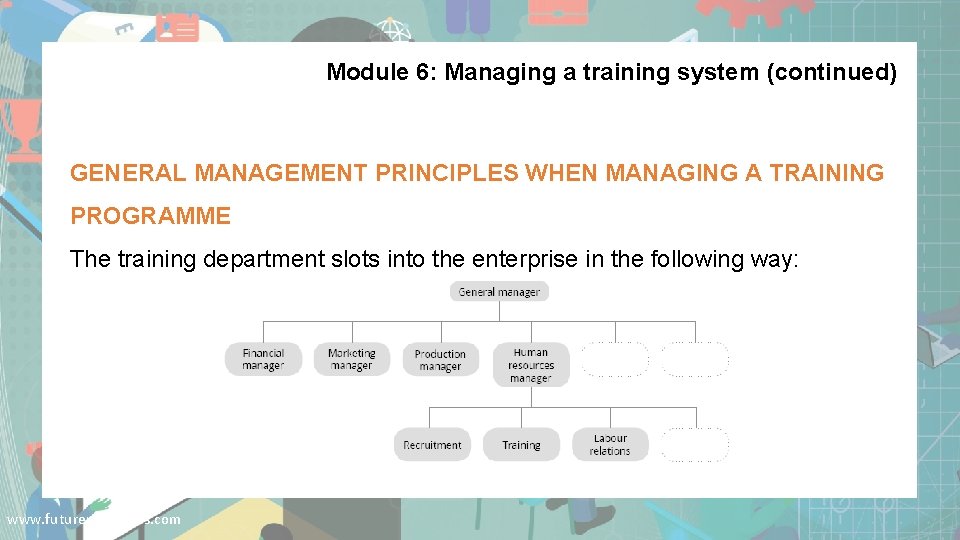
Module 6: Managing a training system (continued) GENERAL MANAGEMENT PRINCIPLES WHEN MANAGING A TRAINING PROGRAMME The training department slots into the enterprise in the following way: www. futuremanagers. com
- Slides: 33