
Human Resource Management What is it all about
Human Resource Management What is it all about?

Here are the ‘answers’ 1 Workforce planning 2 Motivation theories 3 Recruitment Process 4 Training 5 Employee Relations 6 Appraisal 7 Legislation affecting the workplace
2 – Motivation (what makes people work) Write down 3 reasons why people work
2 – Motivation (what makes people work) Look for an Internet story about how organisations motivate their staff

2 – Motivation (what makes people work) • • • Money Security Job Satisfaction To make friends To make progress To make use of talents Why is it important for a business to be aware of this?

2 – Motivation Question! A motivated workforce can lead to …. . ? • Better quality of customer service • Better relationships between staff • Improved time-keeping • Reduced absenteeism • Reduced labour turnover
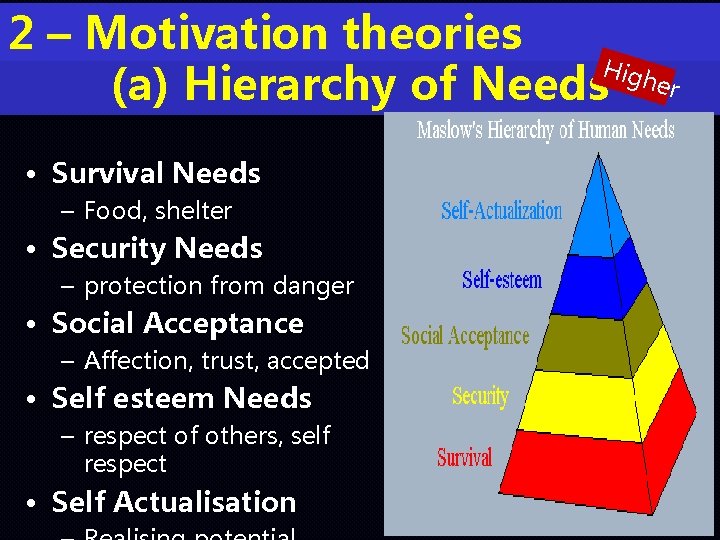
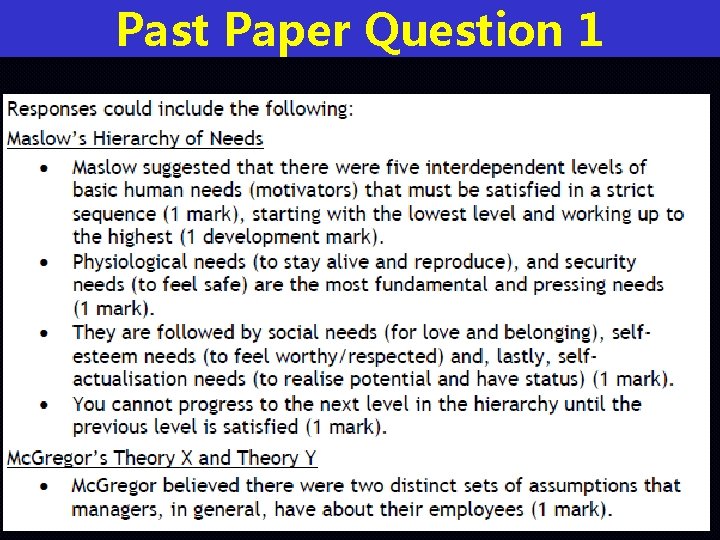
2 – Motivation theories High (a) Hierarchy of Needs er • Survival Needs – Food, shelter • Security Needs – protection from danger • Social Acceptance – Affection, trust, accepted • Self esteem Needs – respect of others, self respect • Self Actualisation
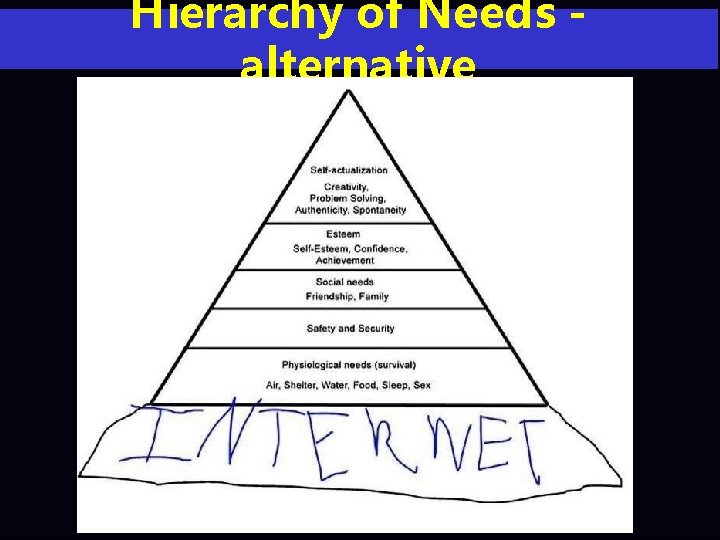
Hierarchy of Needs alternative
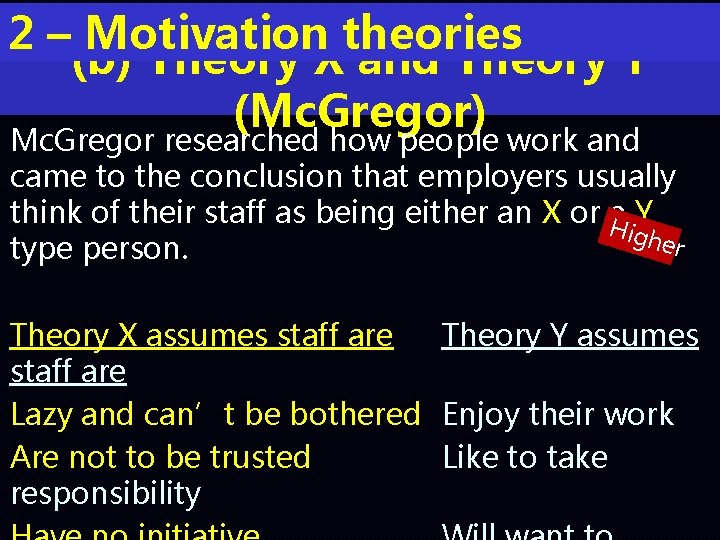
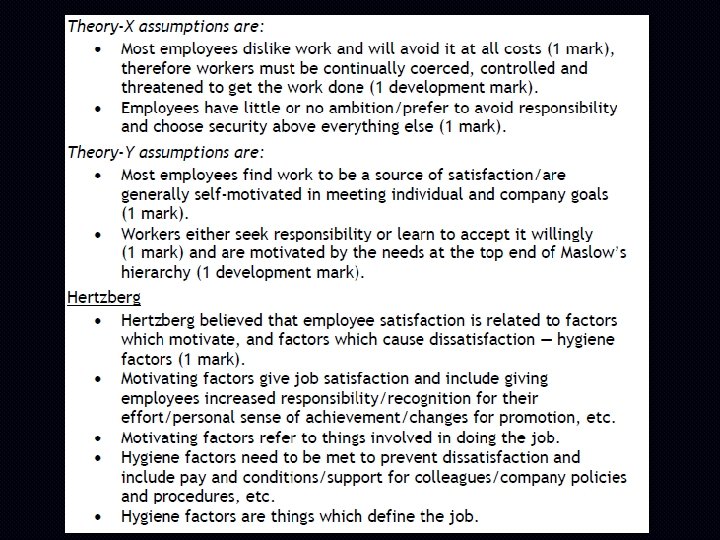
2 – Motivation theories (b) Theory X and Theory Y (Mc. Gregor) Mc. Gregor researched how people work and came to the conclusion that employers usually think of their staff as being either an X or H a. Y ighe r type person. Theory X assumes staff are Theory Y assumes staff are Lazy and can’t be bothered Enjoy their work Are not to be trusted Like to take responsibility
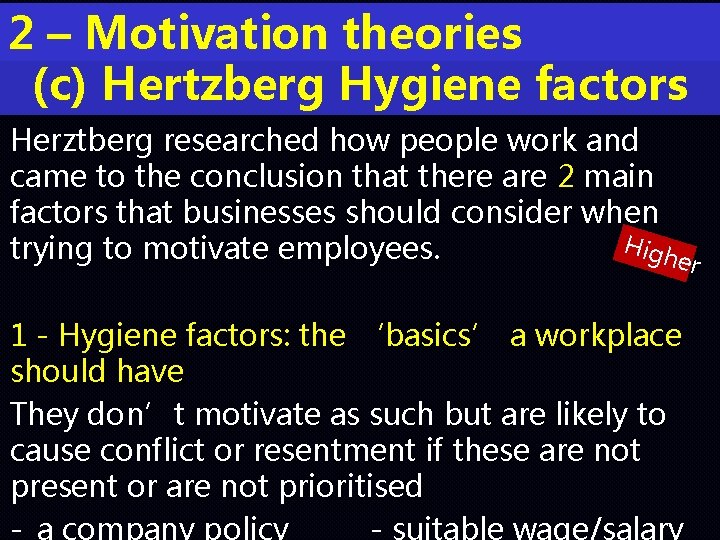
2 – Motivation theories (c) Hertzberg Hygiene factors Herztberg researched how people work and came to the conclusion that there are 2 main factors that businesses should consider when High trying to motivate employees. er 1 - Hygiene factors: the ‘basics’ a workplace should have They don’t motivate as such but are likely to cause conflict or resentment if these are not present or are not prioritised
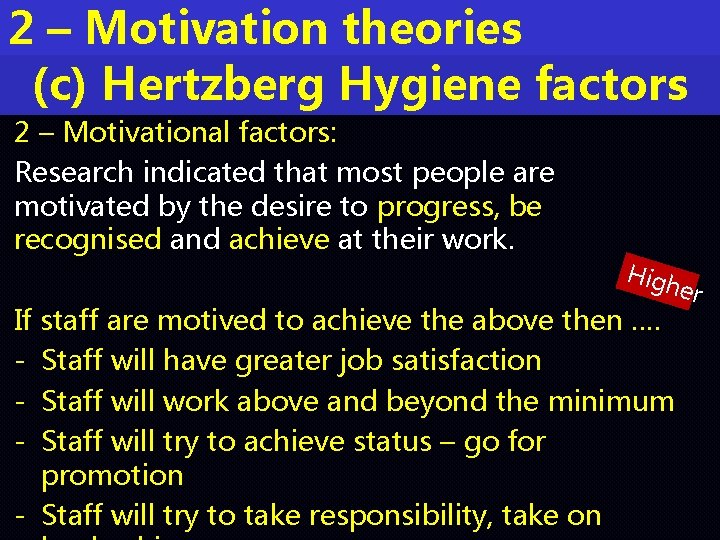
2 – Motivation theories (c) Hertzberg Hygiene factors 2 – Motivational factors: Research indicated that most people are motivated by the desire to progress, be recognised and achieve at their work. High If staff are motived to achieve the above then …. - Staff will have greater job satisfaction - Staff will work above and beyond the minimum - Staff will try to achieve status – go for promotion - Staff will try to take responsibility, take on er
2 – Motivation theories (d) Mayo – Hawthorne Studies (1927) Mayo researched the physical and environmental influences of the workplace (e. g. brightness of lights, humidity) and later, moved into the psychological aspects (e. g. breaks, group pressure, High working hours, managerial leadership). e In summary he proposed that what motivates staff are: - Their work colleagues - Group norms (what the group ‘accepts’ as good or bad, hard work or lazy…) r
Questions - 1 1. Why do people work? 2. What is motivation? 3. What advantages are there in having a motivated workforce? 4. Explain Maslow’s Hierarchy of Needs and try to use your own needs when doing so.
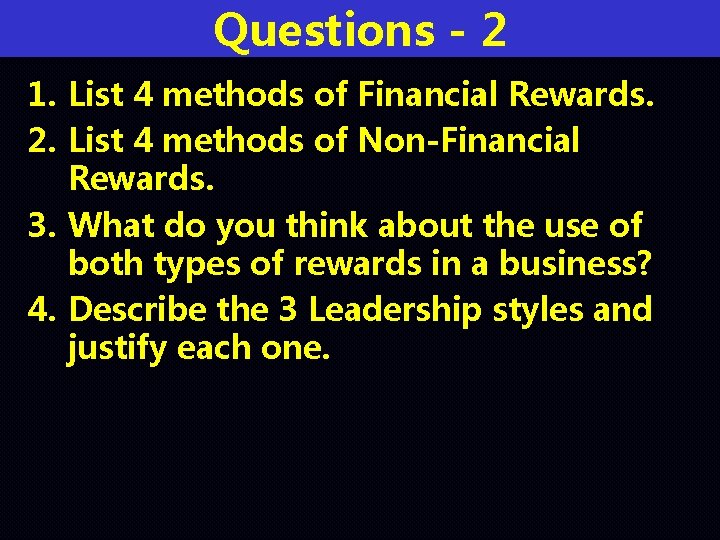
3 – Motivational methods (1) Financial methods Time rate £x per hour. At least the Minimum Wage Piece rate £x per unit produced. (not as common now) Commission % of a sale added to basic pay Overtime and a half, double time eg weekends Performance related pay a bonus if targets are achieved Profit sharing employees share profits
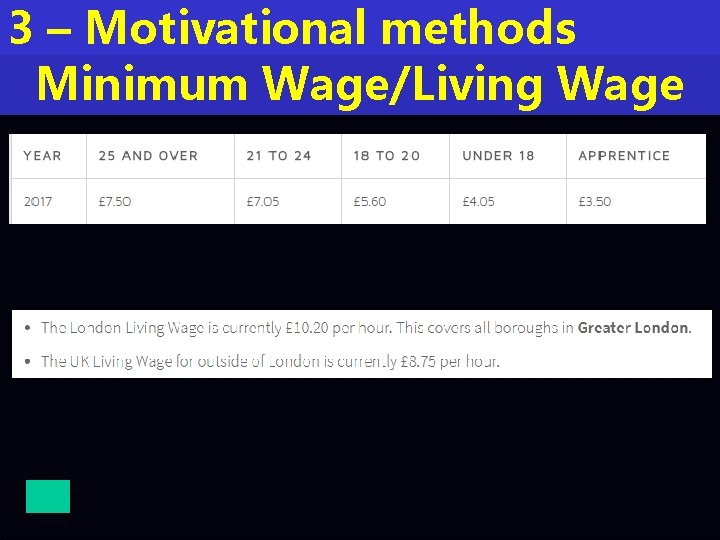
3 – Motivational methods Minimum Wage/Living Wage
3 – Motivational methods (2) Non-Financial methods Pension/insurance joining company scheme Employee rewards employee/dept of month Work environment modern IT, café, sports/leisure facility Company car use of car for business/personal use Leadership opportunities eg leading working groups/projects Job rotation working in different areas Quality circles regular discussion to improve standard
4 – Motivation: Leadership Arguably styles one of the most influential factors is how an employee is treated or how their ‘boss’ communicates with them. 1 Autocratic Their way or no way! Dictating instructions Lack of consultation Staff feel they are being controlled Don’t feel valued May create ‘them and us’ vibe Doesn’t encourage independent thinking May be appropriate when:
4 – Motivation: Leadership Arguably styles one of the most influential factors is how an employee is treated or how their ‘boss’ communicates with them. 2 Democratic Employees views sought Feedback is part of ethos Encourages independence Promotes togetherness Promotes a can-do attitude Encourages openness Could generate more ‘meetings’ and slow decision making
4 – Motivation: Leadership Arguably styles one of the most influential factors is how an employee is treated or how their ‘boss’ communicates with them. 3 Laissez-faire Employees given much more responsibility Less direction from the ‘manager’ Promotes personal responsibility May prove ineffective: Projects/targets could drift/lack focus without direction With less supervision this may result in less
Questions - 2 1. List 4 methods of Financial Rewards. 2. List 4 methods of Non-Financial Rewards. 3. What do you think about the use of both types of rewards in a business? 4. Describe the 3 Leadership styles and justify each one.
Class Activities 1. Scholar Resources and Quizzes under Motivation 2. School Website – Motivation Theory Quizzes 3. BBC Bitesize Video on Motivation and compile notes 4. Past Paper Questions
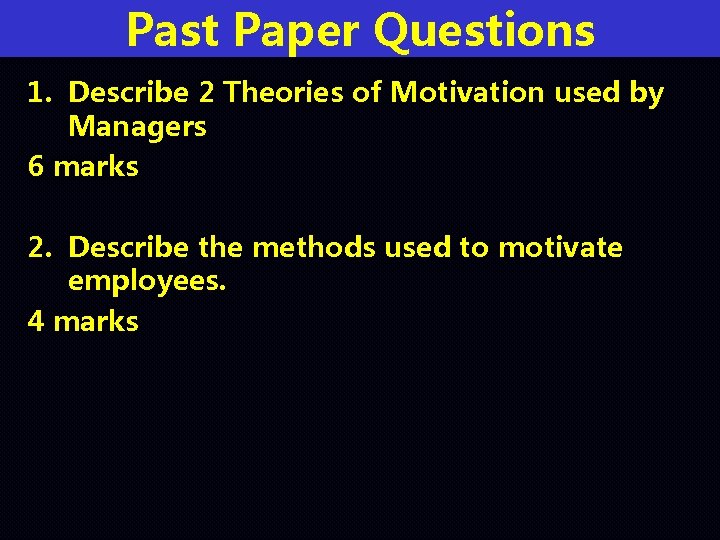
Past Paper Questions 1. Describe 2 Theories of Motivation used by Managers 6 marks 2. Describe the methods used to motivate employees. 4 marks
Past Paper Question 1
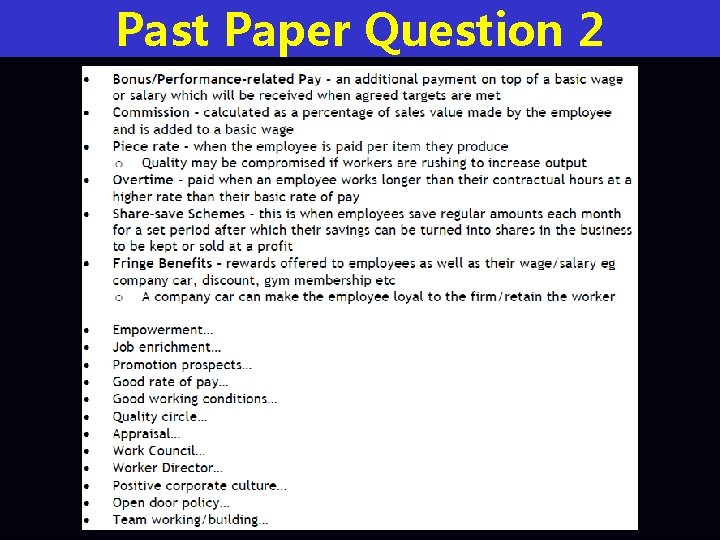
Past Paper Question 2
- Slides: 25