
Human Resource Management SECTION 1 Nature of Human
- Slides: 21
Human Resource Management SECTION 1 Nature of Human Resource Management TENTH EDITON Robert L. Mathis John H. Jackson Chapter 1 Changing Nature of Human Resource Management © 2003 Southwestern College Publishing. All rights reserved. © 2002 Southwestern College Publishing. All rights reserved. Power. Point Presentation by Charlie Cook
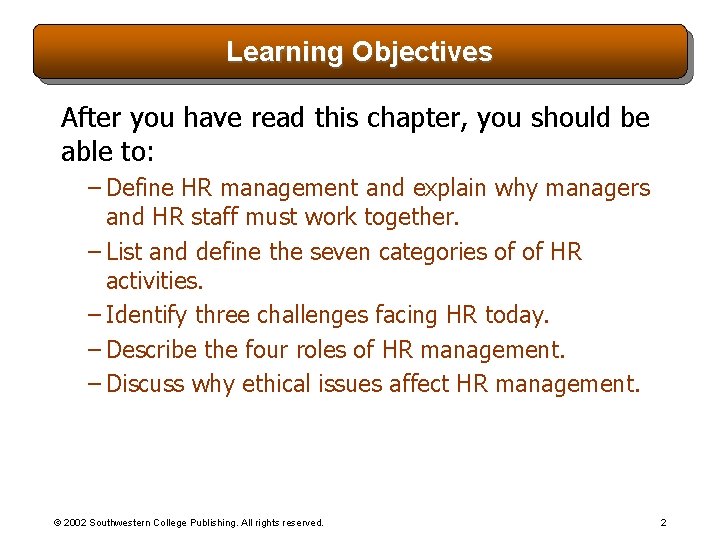
Learning Objectives After you have read this chapter, you should be able to: – Define HR management and explain why managers and HR staff must work together. – List and define the seven categories of of HR activities. – Identify three challenges facing HR today. – Describe the four roles of HR management. – Discuss why ethical issues affect HR management. © 2002 Southwestern College Publishing. All rights reserved. 2
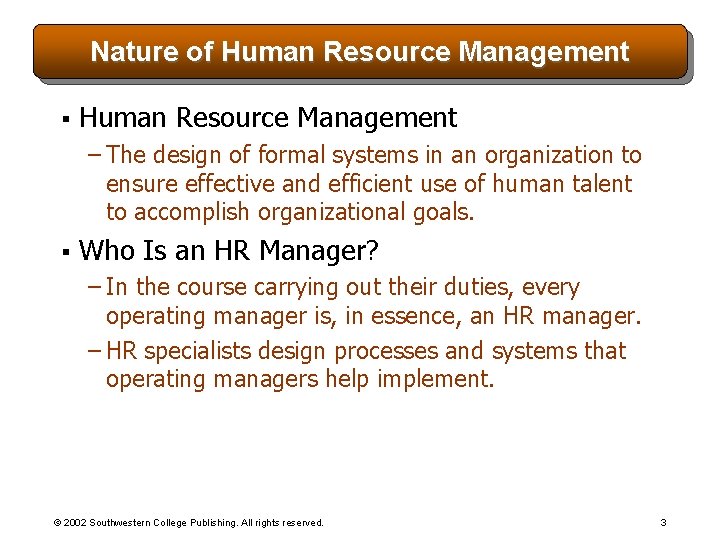
Nature of Human Resource Management § Human Resource Management – The design of formal systems in an organization to ensure effective and efficient use of human talent to accomplish organizational goals. § Who Is an HR Manager? – In the course carrying out their duties, every operating manager is, in essence, an HR manager. – HR specialists design processes and systems that operating managers help implement. © 2002 Southwestern College Publishing. All rights reserved. 3
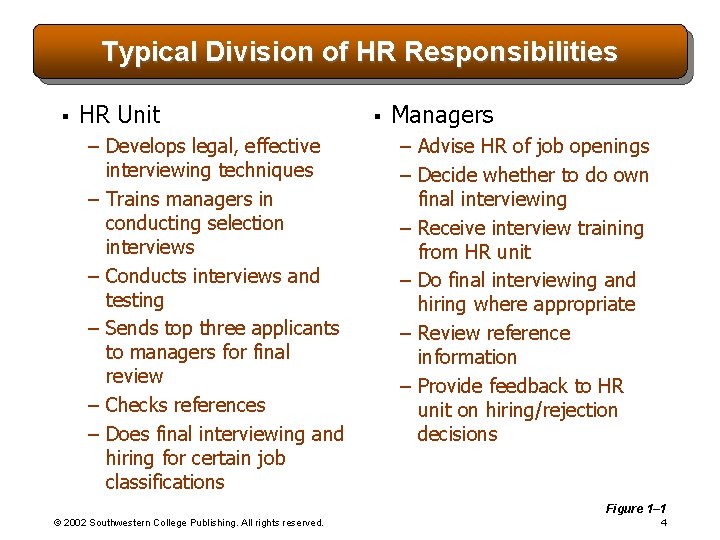
Typical Division of HR Responsibilities § HR Unit – Develops legal, effective interviewing techniques – Trains managers in conducting selection interviews – Conducts interviews and testing – Sends top three applicants to managers for final review – Checks references – Does final interviewing and hiring for certain job classifications § Managers – Advise HR of job openings – Decide whether to do own final interviewing – Receive interview training from HR unit – Do final interviewing and hiring where appropriate – Review reference information – Provide feedback to HR unit on hiring/rejection decisions Figure 1– 1 © 2002 Southwestern College Publishing. All rights reserved. 4
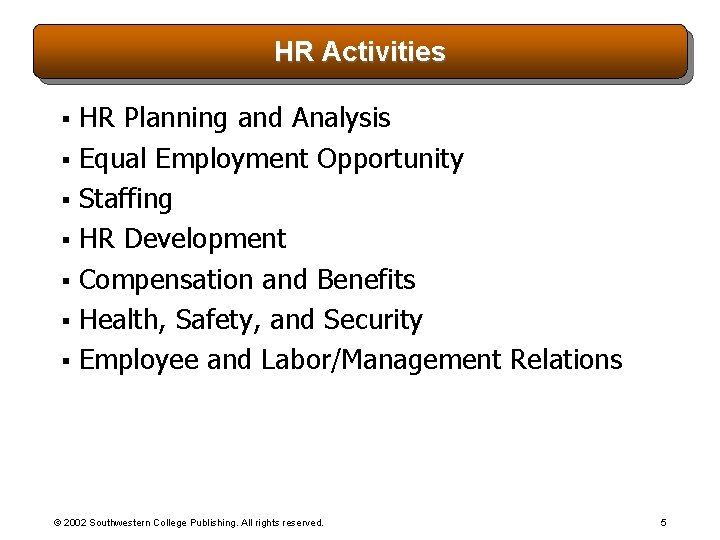
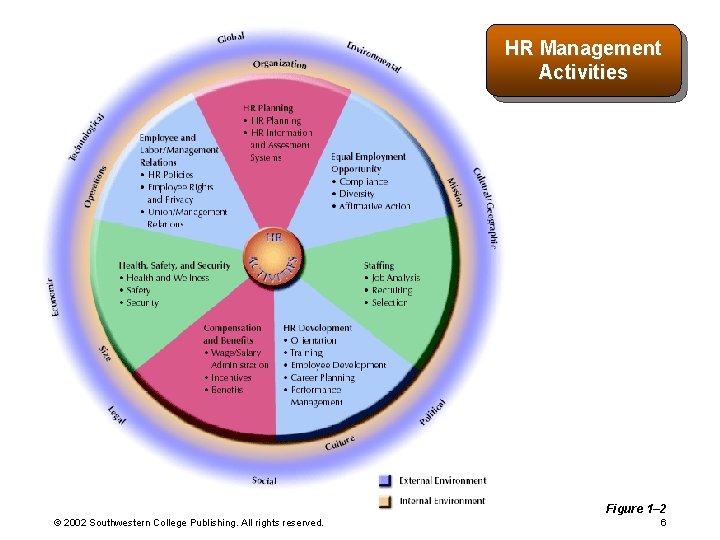
HR Activities HR Planning and Analysis § Equal Employment Opportunity § Staffing § HR Development § Compensation and Benefits § Health, Safety, and Security § Employee and Labor/Management Relations § © 2002 Southwestern College Publishing. All rights reserved. 5
HR Management Activities Figure 1– 2 © 2002 Southwestern College Publishing. All rights reserved. 6
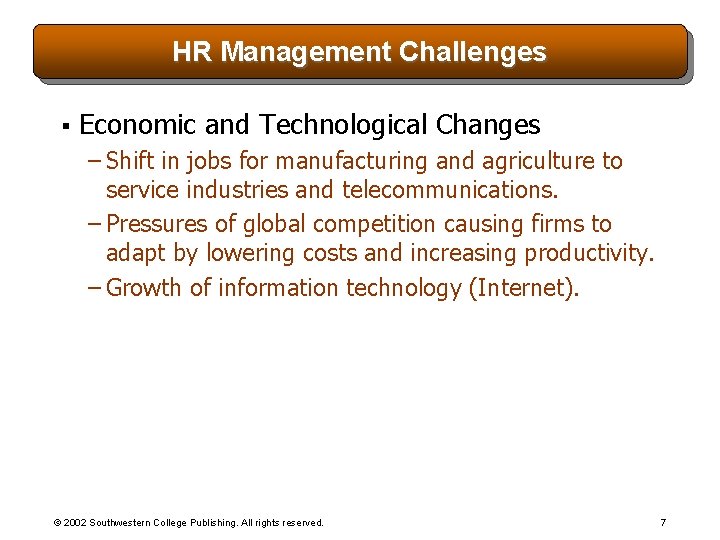
HR Management Challenges § Economic and Technological Changes – Shift in jobs for manufacturing and agriculture to service industries and telecommunications. – Pressures of global competition causing firms to adapt by lowering costs and increasing productivity. – Growth of information technology (Internet). © 2002 Southwestern College Publishing. All rights reserved. 7
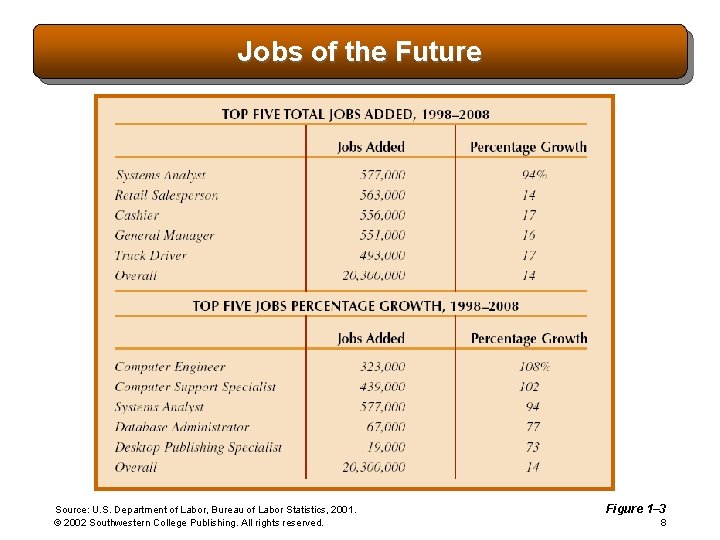
Jobs of the Future Source: U. S. Department of Labor, Bureau of Labor Statistics, 2001. © 2002 Southwestern College Publishing. All rights reserved. Figure 1– 3 8
HR Management Challenges § Workforce Availability and Quality – Inadequate supply of workers with needed skills for “knowledge jobs” – Education of workers in basic skills § Growth in Contingent Workforce – Increases in temporary workers, independent contractors, leased employees, and part-timers caused by: • Need for flexibility in staffing levels • Increased difficulty in firing regular employees. • Reduced legal liability from contract employees © 2002 Southwestern College Publishing. All rights reserved. 9
HR Management Challenges § Demographics and Diversity Issues – More diversity of race, gender, age, and ethnicity in the U. S. workforce § Balancing Work and Family – Dual-career couples – Single-parent households – Decline in the “traditional family” – Working mothers and family/childcare – Single employee “backlash” against family-oriented programs. © 2002 Southwestern College Publishing. All rights reserved. 10
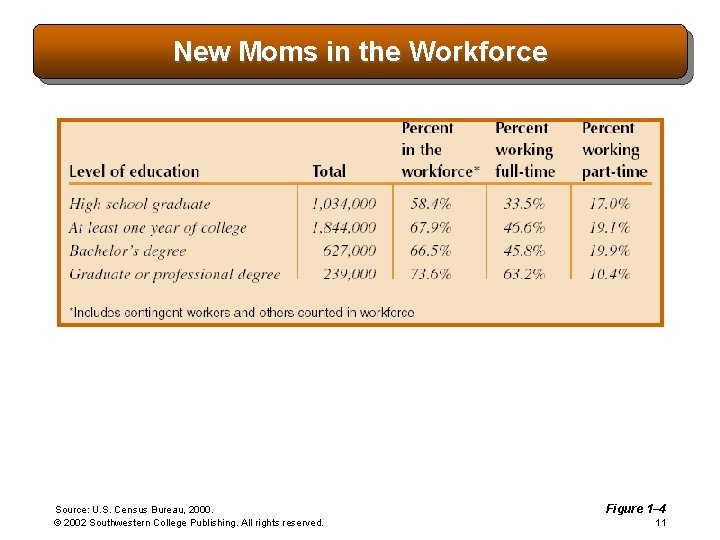
New Moms in the Workforce Source: U. S. Census Bureau, 2000. © 2002 Southwestern College Publishing. All rights reserved. Figure 1– 4 11
HR Management Challenges § Organizational Restructuring, Mergers, and Acquisitions – “Right-sizing”—eliminating of layers of management, closing facilities, merging with other organizations, and outplacing workers • Intended results are flatter organizations, increases in productivity, quality, service and lower costs. • Costs are survivor mentality, loss of employee loyalty, and turnover of valuable employees. – HR managers must work toward ensuring cultural compatibility in mergers. © 2002 Southwestern College Publishing. All rights reserved. 12
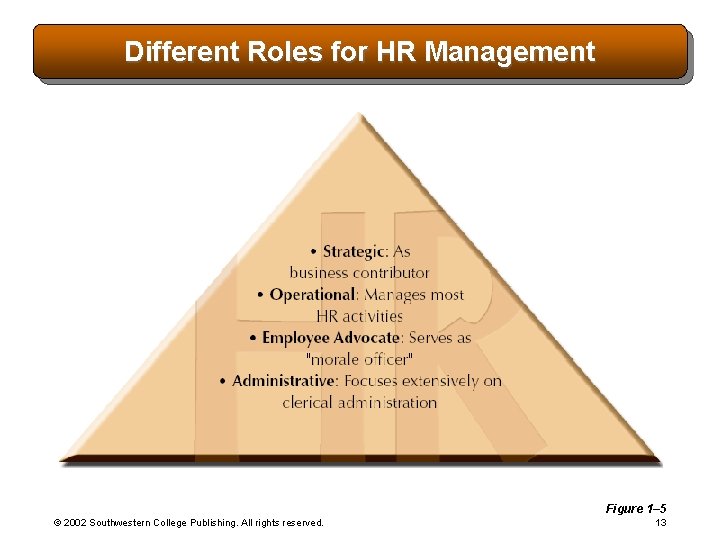
Different Roles for HR Management Figure 1– 5 © 2002 Southwestern College Publishing. All rights reserved. 13
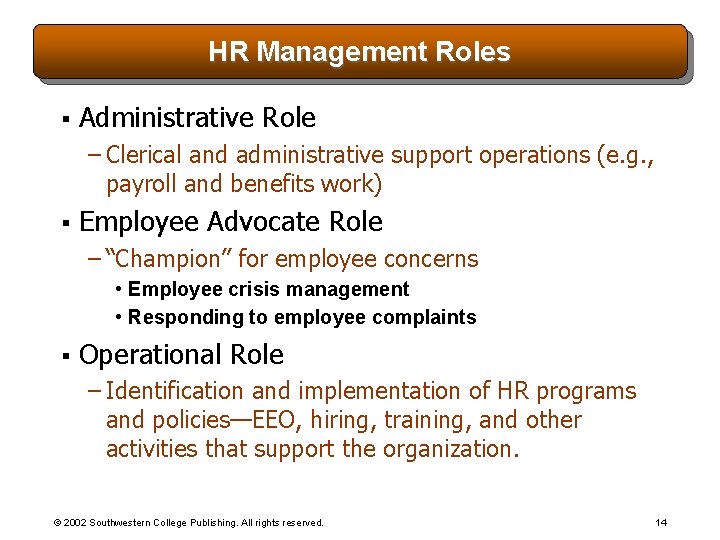
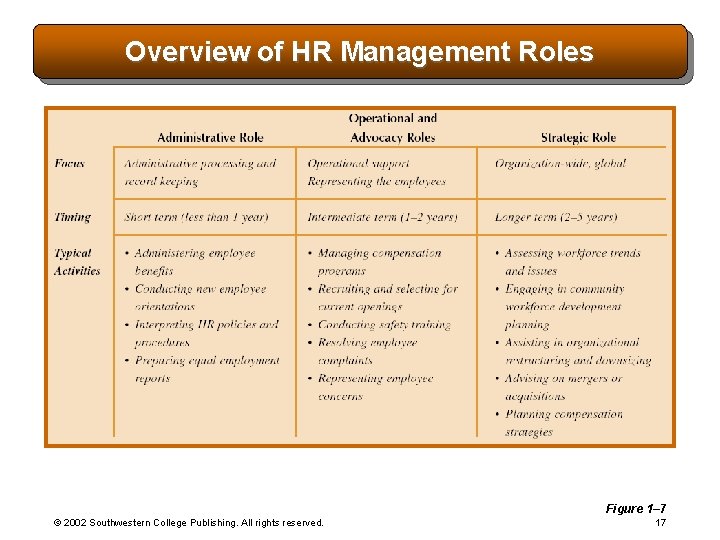
HR Management Roles § Administrative Role – Clerical and administrative support operations (e. g. , payroll and benefits work) § Employee Advocate Role – “Champion” for employee concerns • Employee crisis management • Responding to employee complaints § Operational Role – Identification and implementation of HR programs and policies—EEO, hiring, training, and other activities that support the organization. © 2002 Southwestern College Publishing. All rights reserved. 14
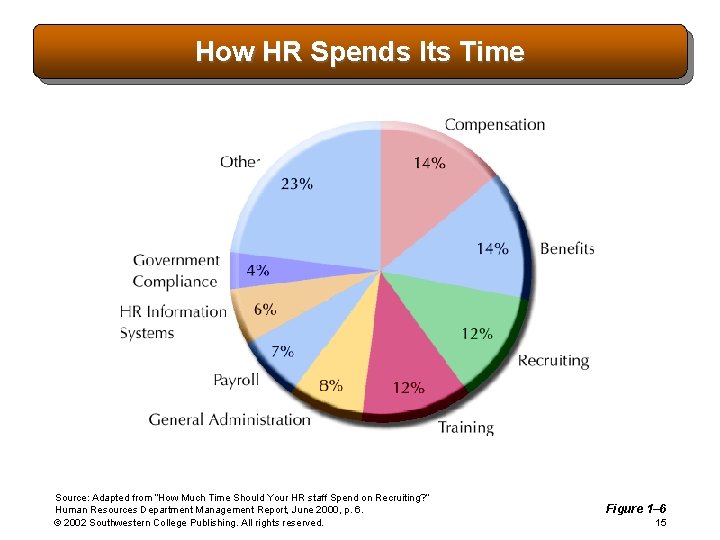
How HR Spends Its Time Source: Adapted from “How Much Time Should Your HR staff Spend on Recruiting? ” Human Resources Department Management Report, June 2000, p. 6. © 2002 Southwestern College Publishing. All rights reserved. Figure 1– 6 15
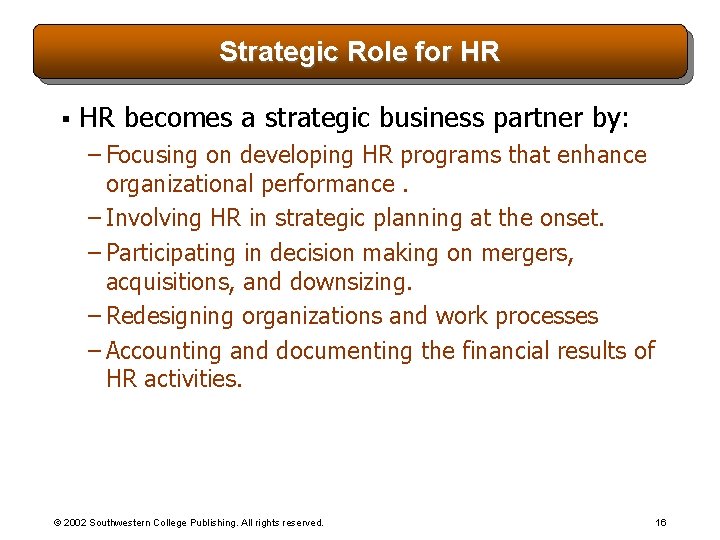
Strategic Role for HR § HR becomes a strategic business partner by: – Focusing on developing HR programs that enhance organizational performance. – Involving HR in strategic planning at the onset. – Participating in decision making on mergers, acquisitions, and downsizing. – Redesigning organizations and work processes – Accounting and documenting the financial results of HR activities. © 2002 Southwestern College Publishing. All rights reserved. 16
Overview of HR Management Roles Figure 1– 7 © 2002 Southwestern College Publishing. All rights reserved. 17
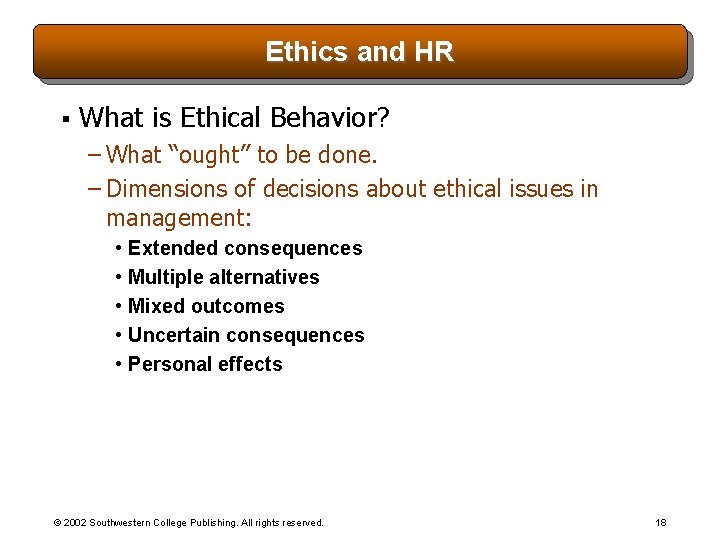
Ethics and HR § What is Ethical Behavior? – What “ought” to be done. – Dimensions of decisions about ethical issues in management: • • • Extended consequences Multiple alternatives Mixed outcomes Uncertain consequences Personal effects © 2002 Southwestern College Publishing. All rights reserved. 18
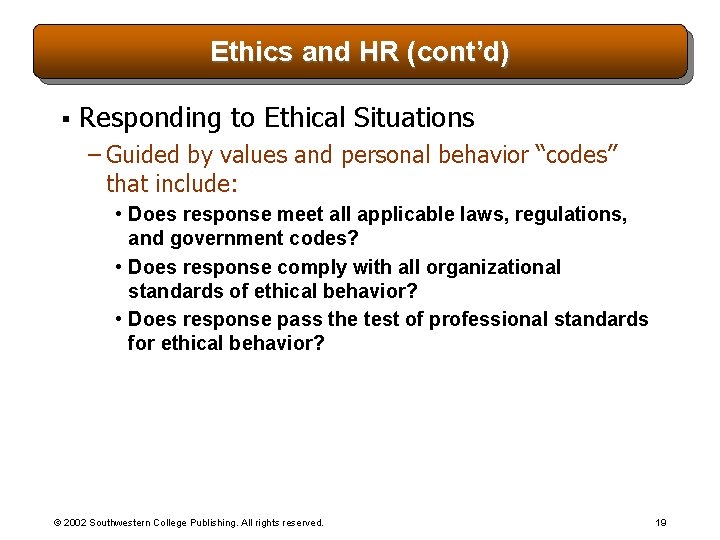
Ethics and HR (cont’d) § Responding to Ethical Situations – Guided by values and personal behavior “codes” that include: • Does response meet all applicable laws, regulations, and government codes? • Does response comply with all organizational standards of ethical behavior? • Does response pass the test of professional standards for ethical behavior? © 2002 Southwestern College Publishing. All rights reserved. 19
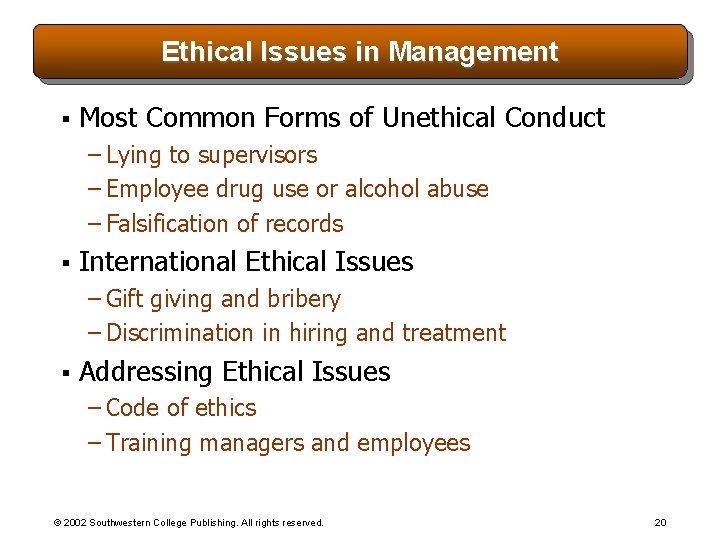
Ethical Issues in Management § Most Common Forms of Unethical Conduct – Lying to supervisors – Employee drug use or alcohol abuse – Falsification of records § International Ethical Issues – Gift giving and bribery – Discrimination in hiring and treatment § Addressing Ethical Issues – Code of ethics – Training managers and employees © 2002 Southwestern College Publishing. All rights reserved. 20
HR Management Competencies and Careers § HR Generalist – A person with responsibility for performing a variety of HR activities. § HR Specialist – A person with in-depth knowledge and expertise in a limited area of HR. § Important HR Capabilities: – Knowledge of business and organization – Influence and change management – Specific HR knowledge and expertise © 2002 Southwestern College Publishing. All rights reserved. 21