
Human Resource Management N 6 Module 1 Motivation
- Slides: 23
Human Resource Management N 6
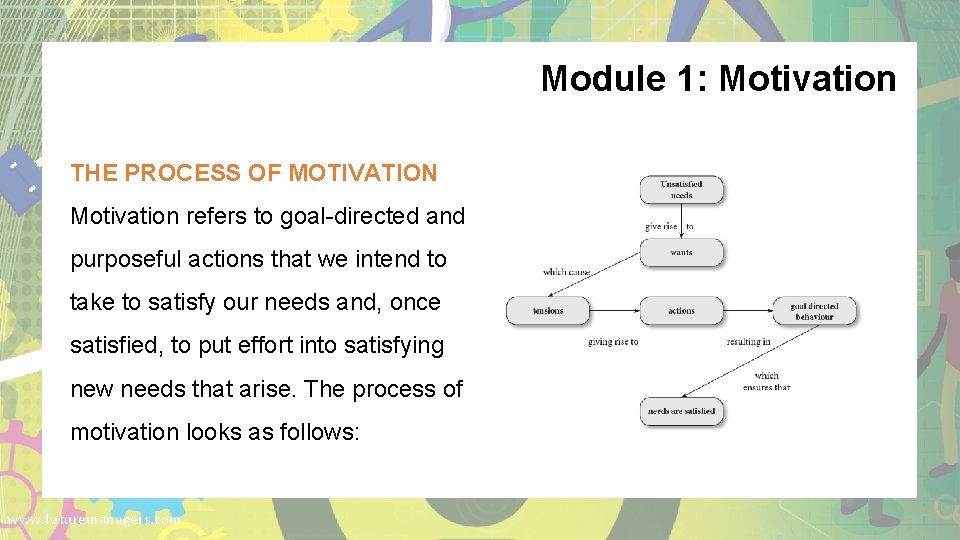
Module 1: Motivation THE PROCESS OF MOTIVATION Motivation refers to goal-directed and purposeful actions that we intend to take to satisfy our needs and, once satisfied, to put effort into satisfying new needs that arise. The process of motivation looks as follows: www. futuremanagers. com
Module 1: Motivation (continued) PRACTICAL IMPLICATIONS OF MOTIVATION FOR MANAGEMENT One of the key principles in leading and managing people in the world of work is to inspire them to perform more effectively. The best organisations in the world: • Constantly measure employee satisfaction using attitude surveys. • Reward the performance of their people by linking pay to performance. • Promote their people from within whenever possible. • Spend a high percentage of their payroll on training their employees. www. futuremanagers. com
Module 1: Motivation (continued) MOTIVATIONAL THEORIES Theories of motivation are divided into two groups. Content theories of motivation help us answer the question “What motivates people? ” Content theories include those of Maslow and Herzberg. Process theories concentrate on the way in which human behaviour starts, is controlled, sustained (kept going) and how and what stops behaviour. Process theories include those of Vroom and Adams. www. futuremanagers. com
Module 1: Motivation (continued) MOTIVATIONAL STRATEGIES Job Design refers to the way in which work is structured into the different tasks and responsibilities required to execute a particular job. Management by objectives (MBO) is a method of performance management, which is often used in the process of performance appraisal and employee development. Gain-sharing rewards the efforts of employees within specific departments. www. futuremanagers. com
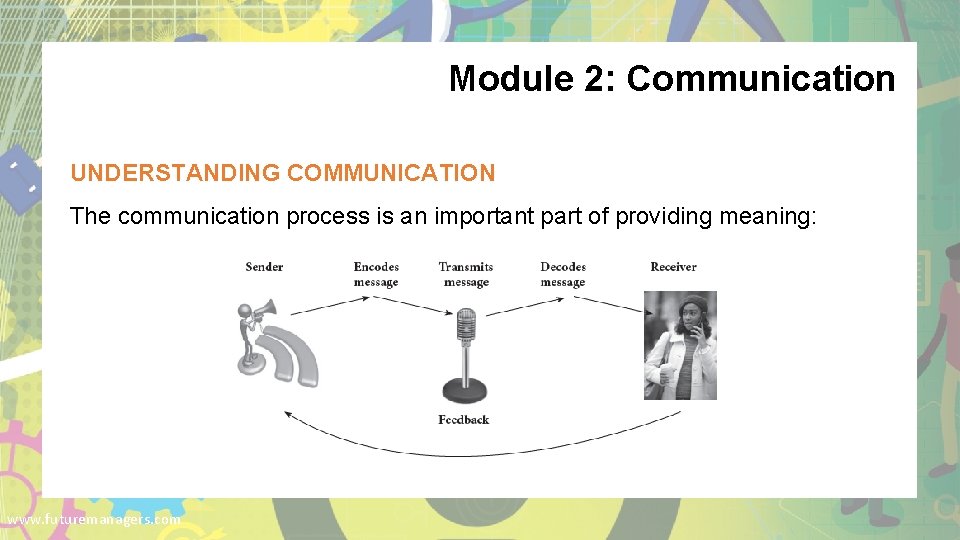
Module 2: Communication UNDERSTANDING COMMUNICATION The communication process is an important part of providing meaning: www. futuremanagers. com
Module 2: Communication (continued) BARRIERS TO COMMUNICATION The problems which prevent the process from being successful can: • Noise (distortion); • Reference groups; • Filtering; • Non-verbal- • Selective perception; communication; • Emotions; • Physical environment; • Language; • Fear and threat of www. futuremanagers. com change; • Time pressure; • Communication overload.
Module 2: Communication (continued) IMPROVING COMMUNICATION There a number of techniques that can improve communication: • Choosing the correct communication channel; • Commitment to the importance of 2 -way communication; • Action taking to match the message; • Personalised communication; • Dealing positively with bad news; • Shaping the message for the audience. www. futuremanagers. com
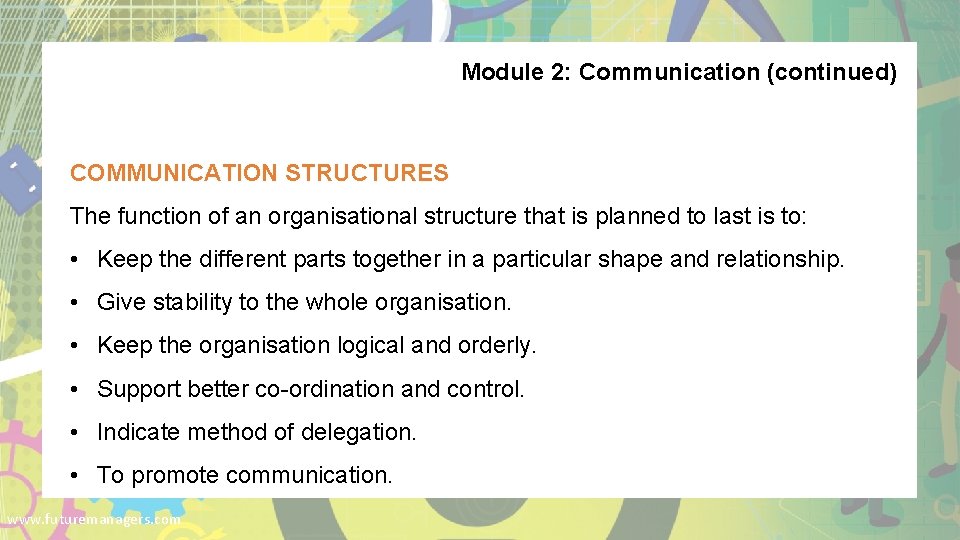
Module 2: Communication (continued) COMMUNICATION STRUCTURES The function of an organisational structure that is planned to last is to: • Keep the different parts together in a particular shape and relationship. • Give stability to the whole organisation. • Keep the organisation logical and orderly. • Support better co-ordination and control. • Indicate method of delegation. • To promote communication. www. futuremanagers. com
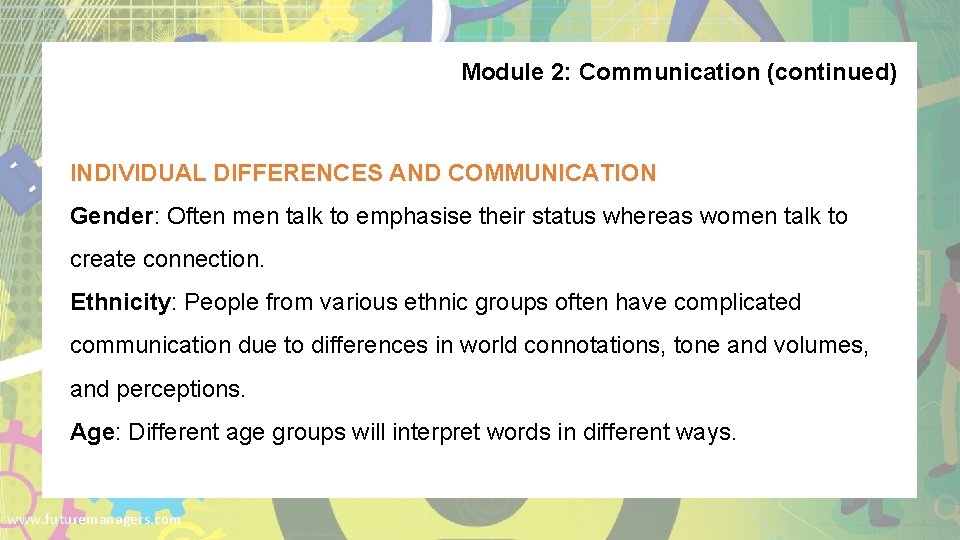
Module 2: Communication (continued) INDIVIDUAL DIFFERENCES AND COMMUNICATION Gender: Often men talk to emphasise their status whereas women talk to create connection. Ethnicity: People from various ethnic groups often have complicated communication due to differences in world connotations, tone and volumes, and perceptions. Age: Different age groups will interpret words in different ways. www. futuremanagers. com
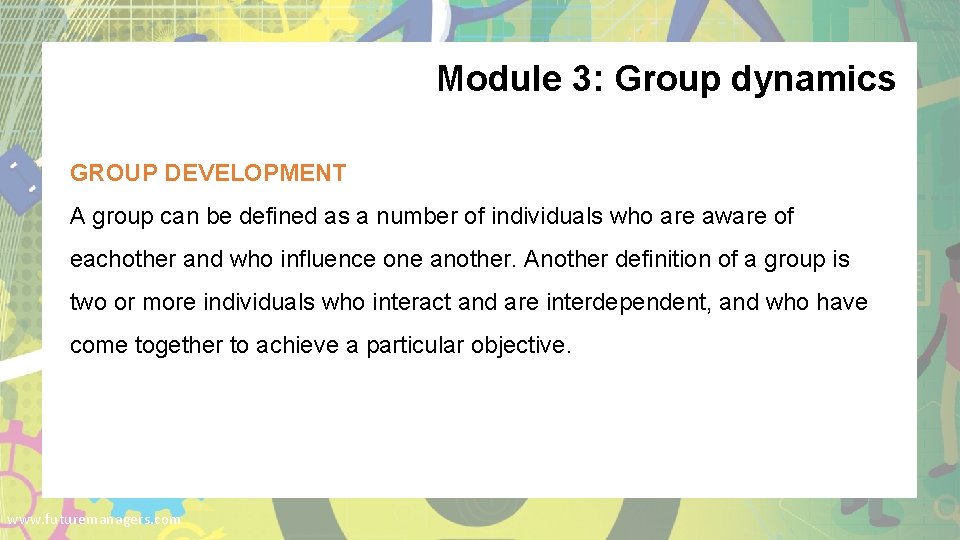
Module 3: Group dynamics GROUP DEVELOPMENT A group can be defined as a number of individuals who are aware of eachother and who influence one another. Another definition of a group is two or more individuals who interact and are interdependent, and who have come together to achieve a particular objective. www. futuremanagers. com
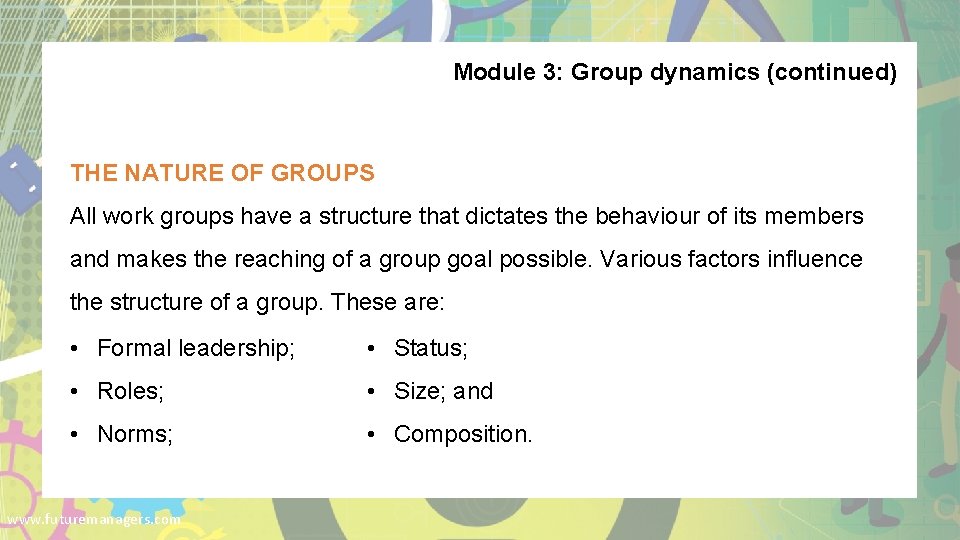
Module 3: Group dynamics (continued) THE NATURE OF GROUPS All work groups have a structure that dictates the behaviour of its members and makes the reaching of a group goal possible. Various factors influence the structure of a group. These are: • Formal leadership; • Status; • Roles; • Size; and • Norms; • Composition. www. futuremanagers. com
Module 3: Group dynamics (continued) GROUP EFFECTIVENESS The effectiveness of all groups is influenced by the extent to which they satisfy the needs of individual members, the extent to which they are allowed to play a meaningful role in helping the organisation to achieve its objectives and are cohesive. www. futuremanagers. com
Module 3: Group dynamics (continued) HOW GROUPS FUNCTION IN THE WORKPLACE Groups can function either in a positive or in a negative way in an organisation. Effective leadership is essential to ensure positive group process where the aim is to develop a group into a real ‘team’. www. futuremanagers. com
Module 4: Leadership DEFINING LEADERSHIP “Leadership is the ability to inspire other people to work enthusiastically and effectively in order to accomplish objectives”. www. futuremanagers. com
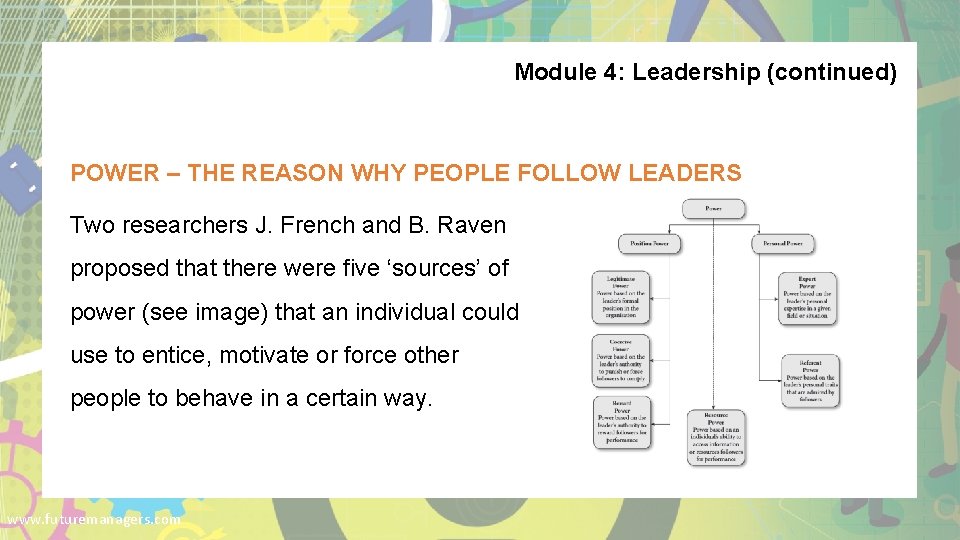
Module 4: Leadership (continued) POWER – THE REASON WHY PEOPLE FOLLOW LEADERS Two researchers J. French and B. Raven proposed that there were five ‘sources’ of power (see image) that an individual could use to entice, motivate or force other people to behave in a certain way. www. futuremanagers. com
Module 4: Leadership (continued) THE DIFFERENCE BETWEEN LEADERSHIP AND MANAGEMENT • Managers administer – leaders innovate. • Managers ask how and when – leaders ask what and why. • Managers focus on systems – leaders focus on people. • Managers maintain – leaders develop. • Managers rely on control – leaders inspire trust. • Managers have a short-term perspective – leaders a long-term one. • Managers eye the ‘bottom-line’ – leaders eye the horizon. www. futuremanagers. com
Module 4: Leadership (continued) THEORIES OF LEADERSHIP Trait theories focuses on the idea that all leaders possess certain characteristics. The Ohio State studies identified two broad dimensions of leadership behaviour; Initiating Structure and Consideration. The leadership grid indicates whether a particular manager is naturally more inclined to focus on people needs or on results (output) requirements. www. futuremanagers. com
Module 4: Leadership (continued) DECISION MAKING Decision-making is an integral part of every major managerial task. However, uncertainty is an inherent characteristic of decision-making so having a clear decision-making process is very helpful in ensuring quality decisions are made. www. futuremanagers. com
Module 5: Using information systems to manage human resources COMPUTERISED INFORMATION SYSTEMS Computer technology today makes it possible to handle large amounts of data unprocessed , and therefore not yet manipulated, in order to generate information – which is processed and manipulated and thus now relevant for decision-making available to a large number of people in real time. www. futuremanagers. com
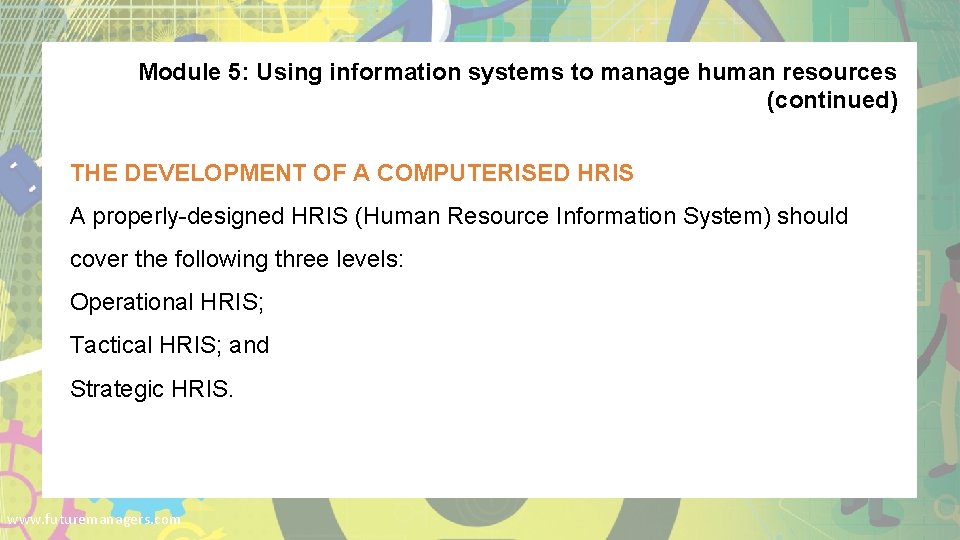
Module 5: Using information systems to manage human resources (continued) THE DEVELOPMENT OF A COMPUTERISED HRIS A properly-designed HRIS (Human Resource Information System) should cover the following three levels: Operational HRIS; Tactical HRIS; and Strategic HRIS. www. futuremanagers. com
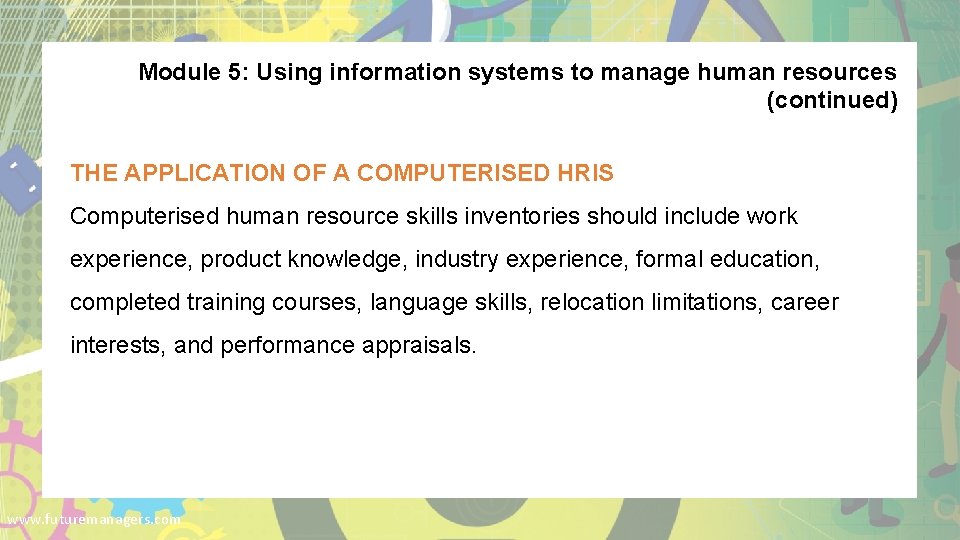
Module 5: Using information systems to manage human resources (continued) THE APPLICATION OF A COMPUTERISED HRIS Computerised human resource skills inventories should include work experience, product knowledge, industry experience, formal education, completed training courses, language skills, relocation limitations, career interests, and performance appraisals. www. futuremanagers. com
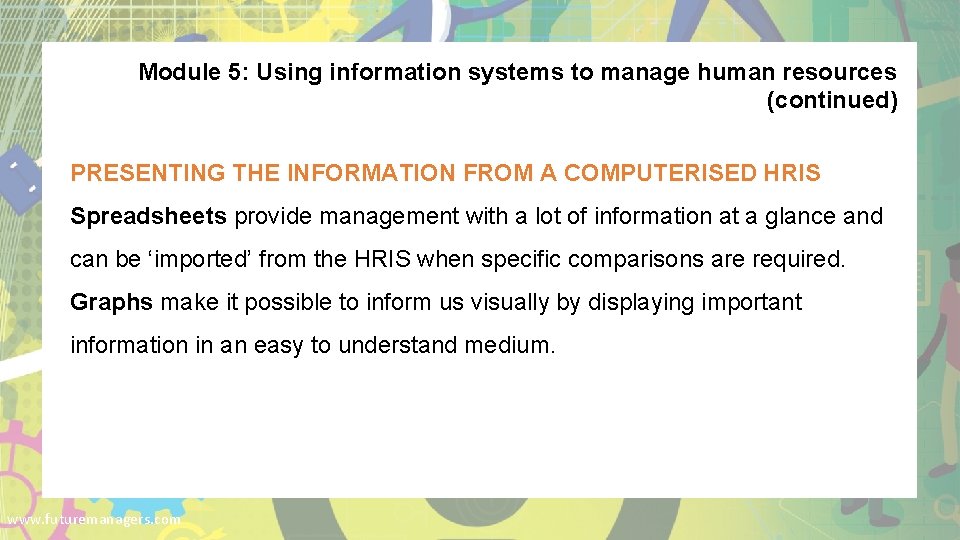
Module 5: Using information systems to manage human resources (continued) PRESENTING THE INFORMATION FROM A COMPUTERISED HRIS Spreadsheets provide management with a lot of information at a glance and can be ‘imported’ from the HRIS when specific comparisons are required. Graphs make it possible to inform us visually by displaying important information in an easy to understand medium. www. futuremanagers. com