
Human Resource Management in the Service Sector Introduction
- Slides: 13
Human Resource Management in the Service Sector Introduction to the service sector Nick Kinnie
Objectives • Outline the importance of the service sector in modern economies • Identify the key characteristics of service work and the areas of the sector for detailed study: knowledge intensive work • Outline the research in the area • Introduce the HRM challenges posed by knowledge based service sector working 2
Introduction • Service sector dominates employment in advanced industrial societies • Consequence of the move towards the ‘post-industrial society’ • Around three quarters of employment in this sector and evidence of fast growth in recent years • Major employers in this area – with important influence on the global economy • However, the concepts and metaphors of much of the debate in the area are based around the manufacturing sector 3
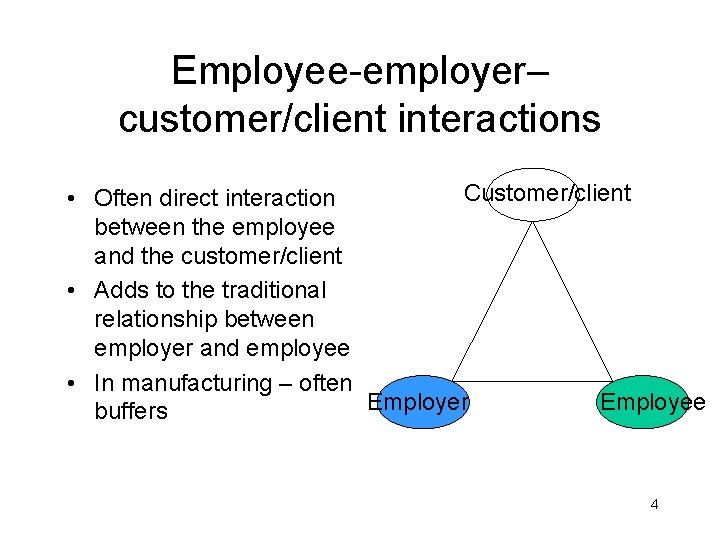
Employee-employer– customer/client interactions Customer/client • Often direct interaction between the employee and the customer/client • Adds to the traditional relationship between employer and employee • In manufacturing – often Employer Employee buffers 4
Classic definition of service work • • Intangibility Perishability Variability Simultaneous production and consumption • Inseparability - co-production between employee and customer (Korczynski (2002: 5 -7)) 5
Limitations of this definition • Not all service work has all five characteristics – Back office jobs – no customer contact and nonperishable products – Administrator in a hospital – separate from patients – Sales work – presence of a physical product • Manufacturing work often involves working on services and customers • Differences between manufacturing and services are eroding – extent to which they are based on knowledge 6
Previous research in the field • New service management school – the customer-serviceprofit chain (Schlesinger and Heskett (1992) Schneider and Bowen (1995)) – Links between management of employees and customers’ perception of service – Advocate the deindustrialisation of service work and the empowerment approach • Critical perspectives – ‘Mac. Donalization of society’ (Ritzer (1999)) – Customer service work as fake, invasive, emotionally draining, demeaning, routinised and alienating • Much of this is based on traditional views of service work (retail, hospitality, health care etc) • Alternative approach – what are the basic means of production – the key assets upon which the firm depends? 7
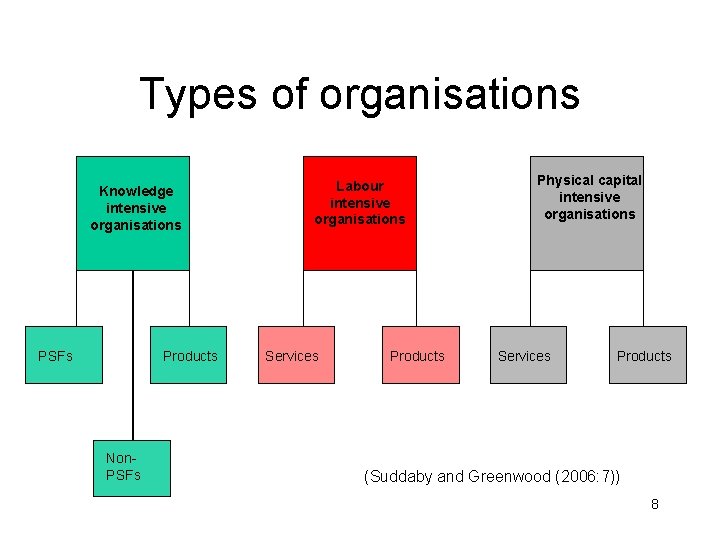
Types of organisations Knowledge intensive organisations PSFs Products Non. PSFs Labour intensive organisations Services Products Physical capital intensive organisations Services Products (Suddaby and Greenwood (2006: 7)) 8
Knowledge-based view of the firm • Firms compete principally on the basis of their knowledge – both individual and collective • Valuable, rare, inimitable and nonsubstitutable • Ability to grow this knowledge and to grow it quickly can be a key source of competitive advantage in fast moving environments 9
Types of knowledge and implications for knowledge management and HRM • Explicit knowledge – ‘know what’ – can be codified and written down – tends to be associated with knowledge management systems – often IT based – collecting information together and exploiting it • Tacit knowledge – ‘know how’ – difficult to codify and write down – in people’s heads/ socially constructed – ‘personalised’ and culture based knowledge management systems • If knowledge takes these forms – highlights the key role played by managing knowledge and managing knowledge workers 10
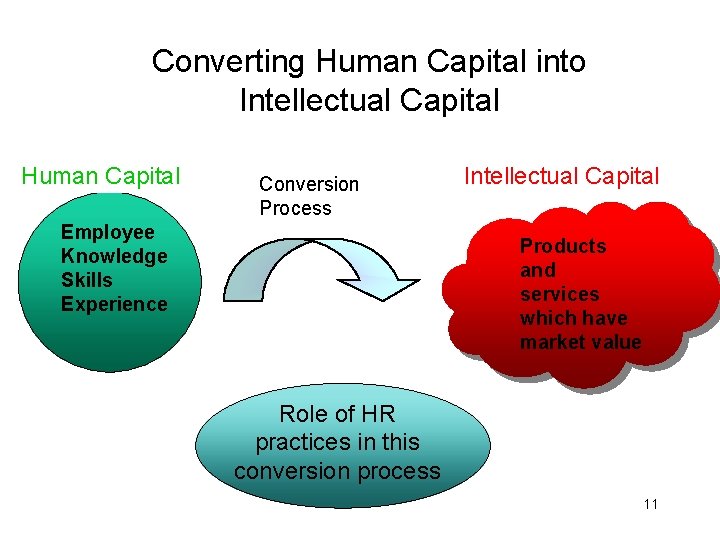
Converting Human Capital into Intellectual Capital Human. Capital Conversion Process Employee Knowledge Skills Experience Intellectual Capital Products and services which have market value Role of HR practices in this conversion process 11
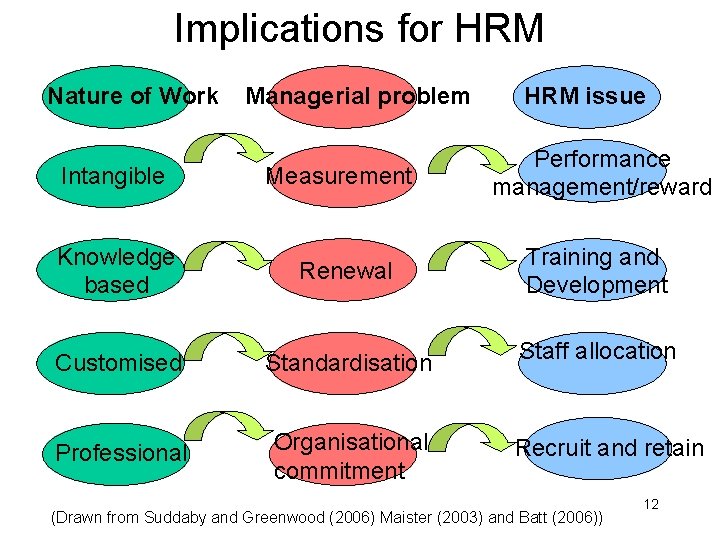
Implications for HRM Nature of Work Intangible Managerial problem Measurement HRM issue Performance management/reward Knowledge based Renewal Training and Development Customised Standardisation Staff allocation Professional Organisational commitment Recruit and retain (Drawn from Suddaby and Greenwood (2006) Maister (2003) and Batt (2006)) 12
Preparation for next week • Drawing on a knowledge intensive service firm with which you are familiar consider: – What are the key resources upon which the success of the firm is based? (consider those in addition to the knowledge and skills of employees) – How does this firm use HR practices to try to manage these resources? 13