
Human Resource Management in Construction Learning Outcome 3









- Slides: 25
Human Resource Management in Construction Learning Outcome 3 Describe the nature and methods of training and development of personnel in the construction industry
Knowledge and/or Skills • Contemporary apprenticeship and skills certification scheme • Technical professional and management staff development options • Appraisal and review systems in construction organisations • Induction, grievance and disciplinary
Key Facts for the Assessment • Which types of training are available for which groups of employees? • What do they involve? • What are the benefits of this approach for the employer and the employee? • How does the approach link to long term career progression?
Apprenticeships (Slide 1 of 2) • Combines learning at college/with a training provider with on-site experience • Gives a mix of technical and practical skills • Can last up to four years with mandatory attendance at College or Training Centre • CITB – largest provider of apprenticeships in construction in Scotland • Apprentices must be registered with either The Scottish Building Apprenticeship and Training Council (SBATC) or The Scottish Painting and Decorating Apprenticeship Council (SPADAC).
Apprenticeships (Slide 2 of 2) Apprenticeship Grant in Scotland • Organisations can claim for employed apprentices on approved construction related programmes of two years or more • Maximum of £ 6000 for a two year course and £ 10, 250 for three or four years For more information on grants available refer to http: //www. citb. co. uk/levy-grant/grants-available/apprenticeshipgrant-scotland/ Source: http: //www. citb. co. uk/levy-grant/claiming-grants-available/apprenticeship-grant-scotland/
CITB – Apprenticeship Types • Traditional apprenticeship – combines college study with work experience, SVQ or NVQ • Higher Apprenticeship – broad based training and structured career path for technical, supervision and management roles • Specialist Apprenticeship – on the job for those who cannot access apprenticeships through education providers • Shared Apprenticeship Scheme (England Wales only) – on site experience working on high profile projects for more than one employer
Scottish Apprenticeship Week 29 February - 4 March 2016 – Promotion of modern apprenticeship opportunities • Organisations can take on an apprentice on a trial basis for two weeks • Gives them the opportunity to familiarise themselves with a live construction environment • Allows the organisation to ensure they are a good fit for the organisation
Modern Apprenticeships sips Modern Apprenticeships • Can be a new team member or existing employee (16 – 24, small number 25+) • Employed from the start of training and apprentice receives a wage from their employer • Training costs are paid by Skills Development Scotland • http: //www. skillsdevelopmentscotland. co. uk/ourservices/modern-apprenticeship -frameworks/construction/
Foundation Apprenticeships • A blended learning approach combining a work-based qualification with academic learning and industry involvement. • Starts in S 4 or S 5 and takes two years to complete • Based on existing modern apprenticeship frameworks • Developed in partnership with local authorities, schools, learning providers and industry to create better links between education and local employers. • Benefits the apprentice as they develop employability skills, and gain valuable work experience and industry recognised qualifications • Makes the transition from school to work easier
Foundation Apprenticeships • New foundation apprenticeship in construction launched at the new Forth crossing • From August 2015 up to 50 S 5 pupils in Lothian and Highlands will enrol on foundation apprenticeship modelled on MA in Civil Engineering • First of its kind in construction • Aim is to break down the real and perceived barriers to a career in construction Source: http: //www. citb. co. uk/news-events/scotland/school-pupils-tobuild-career-with-new-foundation-apprenticeship/
Benefits of Taking on an Apprentice • Keen, motivated individual who wants to learn • Training developed in consultation with industry – apprentices learn the right skills for the job • Availability of funding • Can support succession planning – consider ageing workforce, succession planning and skills shortages as discussed in Learning Outcome 1
Skills Certification Scheme • CSCS is the leading skills certification scheme within the UK construction industry. • CSCS cards provide proof that individuals working on construction sites have the required training and qualifications for the type of work they carry out. • The Scheme keeps a database of people working in construction who have achieved, or are committed to achieving a recognised construction related qualification. • Most principal contractors and major house builders require construction workers on their sites to hold a valid CSCS card. • CSCS is a not-for-profit limited company. Its directors are from employer organisations and unions representing the breadth of the industry.
Applying for CSCS cards • To apply for a CSCS card you need to prove you have the training and qualifications required to carry out your job. • The type of work you do and your qualifications or membership of professional bodies will determine which type of CSCS card you should apply for. • This will also tell you which type of CITB Health, Safety and Environment test you need to take.
CSCS News April 2016 - recommended to check electronic checking of cards before workers are allowed on site – due to card fraud March 2016 – Smart recording of exposure to vibration
Paired Activity In your group discuss and list the benefits of the CSCS card for a construction organisation, an individual and the construction industry.
Technical, Professional and Management Staff Development Options • SVQ - evidence based on the job • Degree Study – opens up different opportunities http: //www. prospects. ac. uk/options_building _construction_management. htm • Professional Qualifications
Development Options • • E learning Distance learning Web class Masterclasses College attendance Degree Study Professional qualifications CPD – Professional Groups, Membership
Surveyor – progression routes • • • Foundation degree Batchelors degree BSc (Hons) Building Surveying BSc (Hons) Construction Management BSc (Hons) Quantity Surveying http: //www. cem. ac. uk/our-programmes/undergraduate-study/certificatediploma-foundation-degree-surveying-practice. aspx
Site Management Qualifications – Chartered Institute of Building • Level 4 Site Management Qualifications for access to the CSCS management card • Vocational qualifications based on the national occupational standards (NOS) for site managers • The CIOB L 3 Diploma in Site Supervisory Studies (QCF) and the CIOB L 4 Certificate and Diploma in Site Management (QCF). Both are intended to provide a qualification for those in an operative or trade role who want to move into a supervisory position. Gaining these qualifications can provide a route to CIOB membership at Associate or Incorporate grade - See more at: http: //www. ciob. org/Your-Career/vocational-qualifications-andapprenticeships#sthash. VWh. Kkpc. F. dpuf
Provision of training within construction • Pubic sector – heavy investment in training • Small firms – offer less training due to cost implications and fear of losing the employees once skills have been developed. Training is delivered to ensure compliance • Trend – increase in training for professional qualifications • Main reason cited for training is to overcome skills gaps driven by new legislation, technology and new working practices Source: CITB – Skills and training in the construction industry 2014
Training trends • Increase in the provision of on the job training • Most likely to receive on the job training were roofers, bricklayers, plasterers and plant and machine operatives • Within professional services, the occupations most likely to receive on the job training were architects and civil engineers.
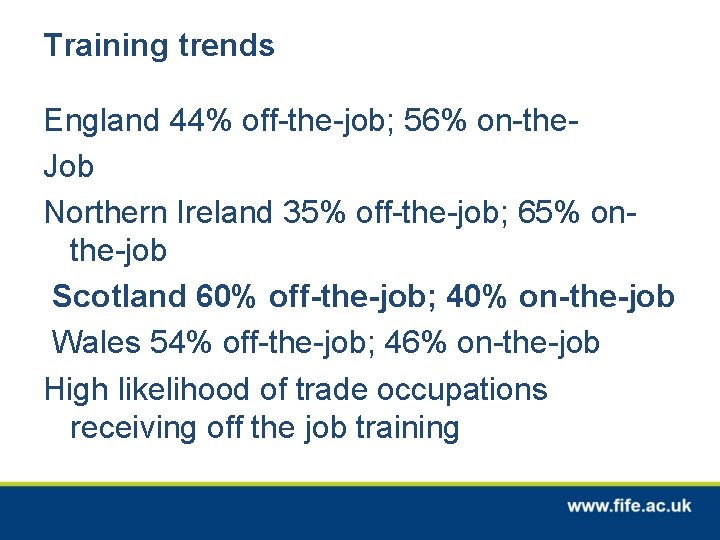
Training trends England 44% off-the-job; 56% on-the. Job Northern Ireland 35% off-the-job; 65% onthe-job Scotland 60% off-the-job; 40% on-the-job Wales 54% off-the-job; 46% on-the-job High likelihood of trade occupations receiving off the job training
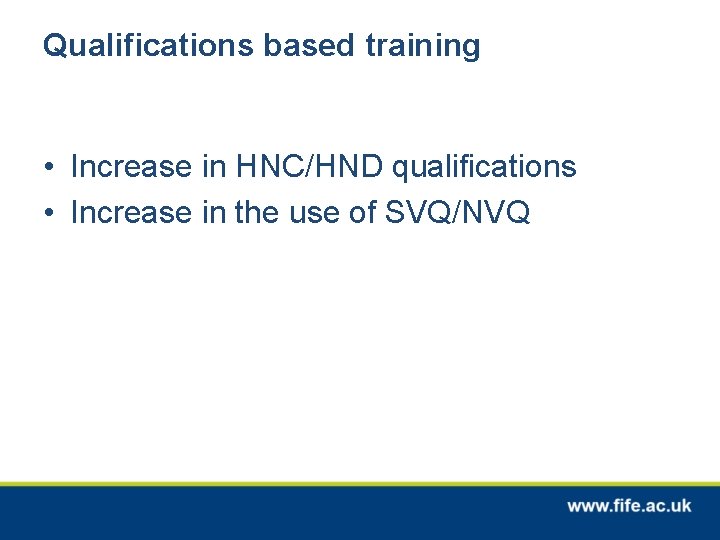
Qualifications based training • Increase in HNC/HND qualifications • Increase in the use of SVQ/NVQ
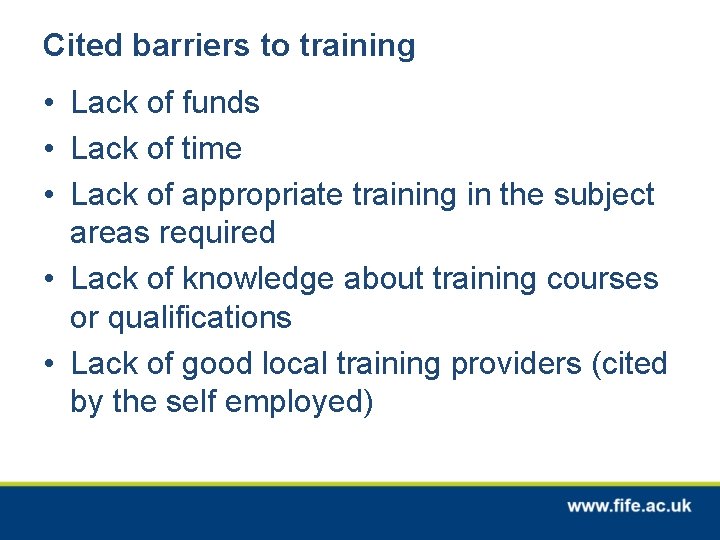
Cited barriers to training • Lack of funds • Lack of time • Lack of appropriate training in the subject areas required • Lack of knowledge about training courses or qualifications • Lack of good local training providers (cited by the self employed)
Individual v Organisational Training Needs What is the difference between individual and organisational training needs? How are the normally identified?