
Human Resource Management in Construction Learning Outcome 2
- Slides: 24
Human Resource Management in Construction – Learning Outcome 2 Week 3 – The Recruitment Process
Learning Outcome 2 Describe the nature and stages of a recruitment process within the construction environment. Knowledge and/or skills • Elements of recruitment agencies, job centres and newspapers or specialist magazines for attracting potential recruits • Job description preparation • People specification preparation • Job advertisement preparation • Selection interviewing from application form to CV
Recruitment • • Systematic recruitment cycle / process Different recruitment channels/methods Managing the process Relevant documentation
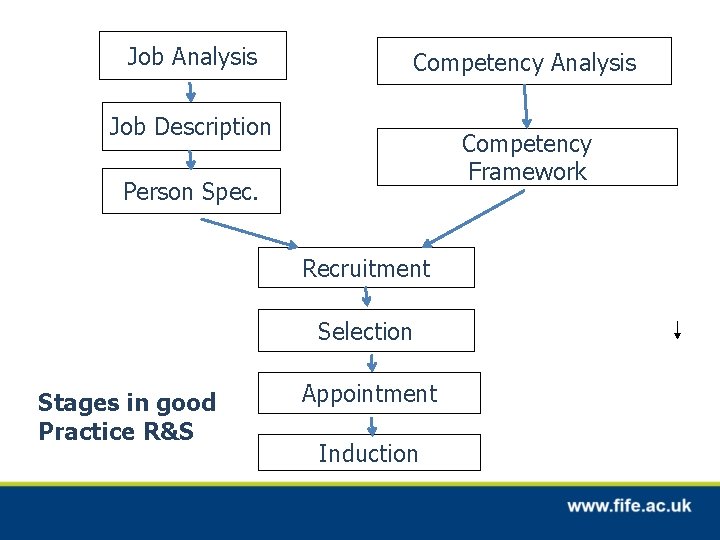
Job Analysis Competency Analysis Job Description Competency Framework Person Spec. Recruitment Selection Stages in good Practice R&S Appointment Induction
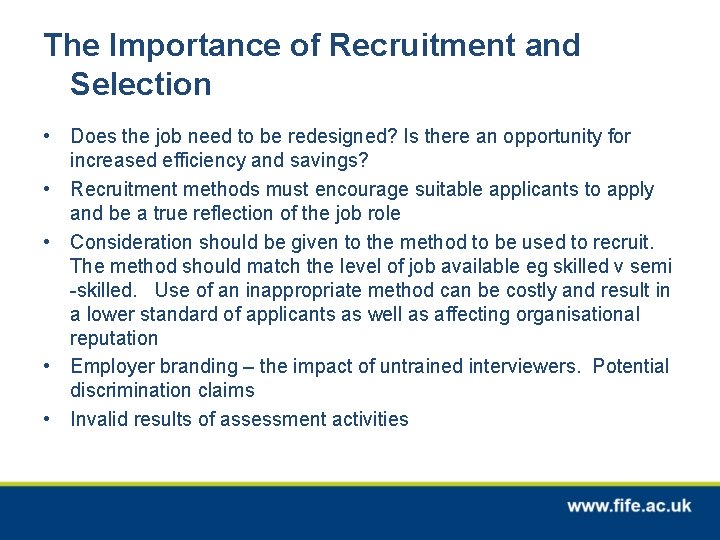
The Importance of Recruitment and Selection • Does the job need to be redesigned? Is there an opportunity for increased efficiency and savings? • Recruitment methods must encourage suitable applicants to apply and be a true reflection of the job role • Consideration should be given to the method to be used to recruit. The method should match the level of job available eg skilled v semi -skilled. Use of an inappropriate method can be costly and result in a lower standard of applicants as well as affecting organisational reputation • Employer branding – the impact of untrained interviewers. Potential discrimination claims • Invalid results of assessment activities
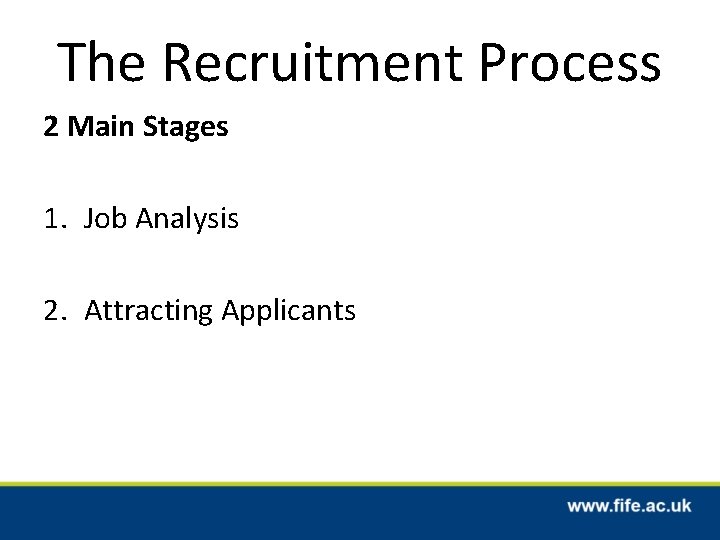
The Recruitment Process 2 Main Stages 1. Job Analysis 2. Attracting Applicants
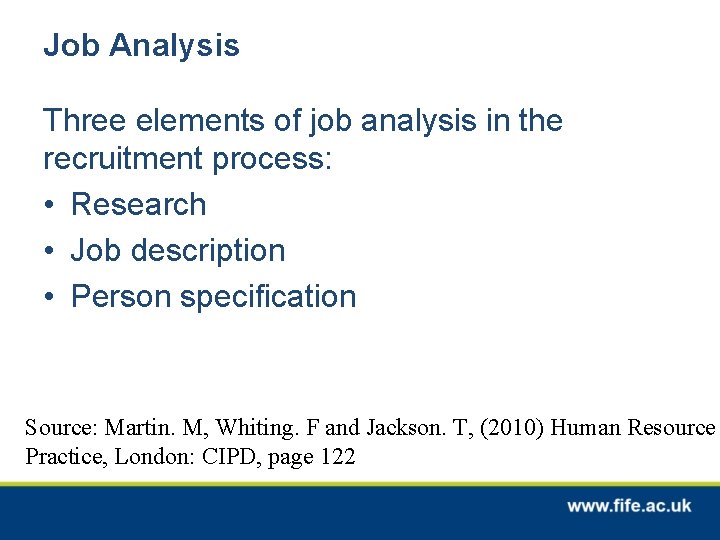
Job Analysis Three elements of job analysis in the recruitment process: • Research • Job description • Person specification Source: Martin. M, Whiting. F and Jackson. T, (2010) Human Resource Practice, London: CIPD, page 122
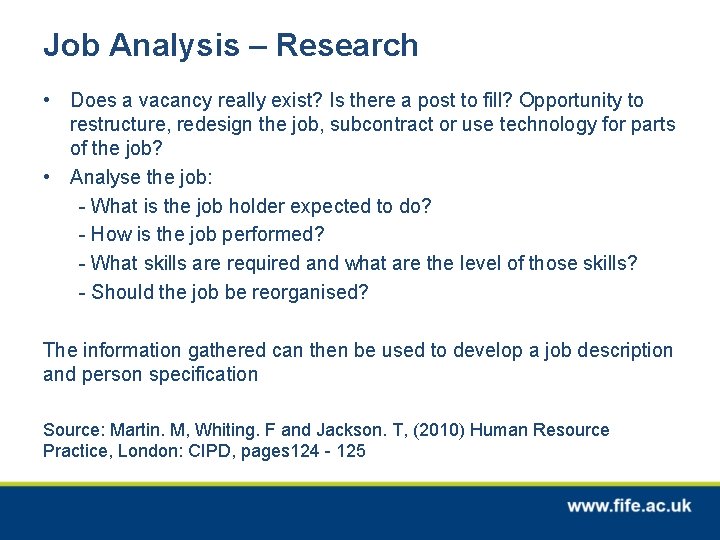
Job Analysis – Research • Does a vacancy really exist? Is there a post to fill? Opportunity to restructure, redesign the job, subcontract or use technology for parts of the job? • Analyse the job: - What is the job holder expected to do? - How is the job performed? - What skills are required and what are the level of those skills? - Should the job be reorganised? The information gathered can then be used to develop a job description and person specification Source: Martin. M, Whiting. F and Jackson. T, (2010) Human Resource Practice, London: CIPD, pages 124 - 125
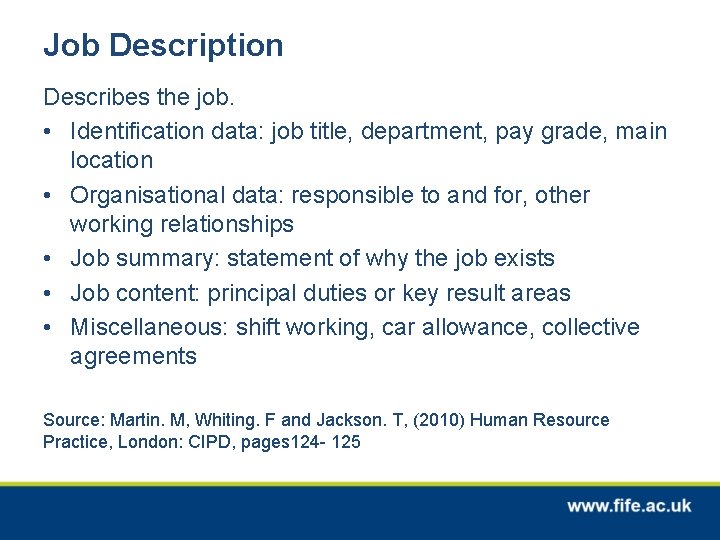
Job Description Describes the job. • Identification data: job title, department, pay grade, main location • Organisational data: responsible to and for, other working relationships • Job summary: statement of why the job exists • Job content: principal duties or key result areas • Miscellaneous: shift working, car allowance, collective agreements Source: Martin. M, Whiting. F and Jackson. T, (2010) Human Resource Practice, London: CIPD, pages 124 - 125
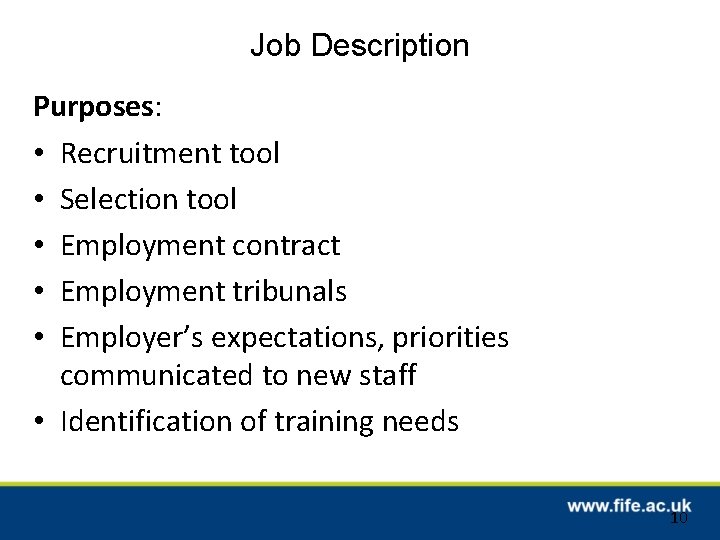
Job Description Purposes: • Recruitment tool • Selection tool • Employment contract • Employment tribunals • Employer’s expectations, priorities communicated to new staff • Identification of training needs 10
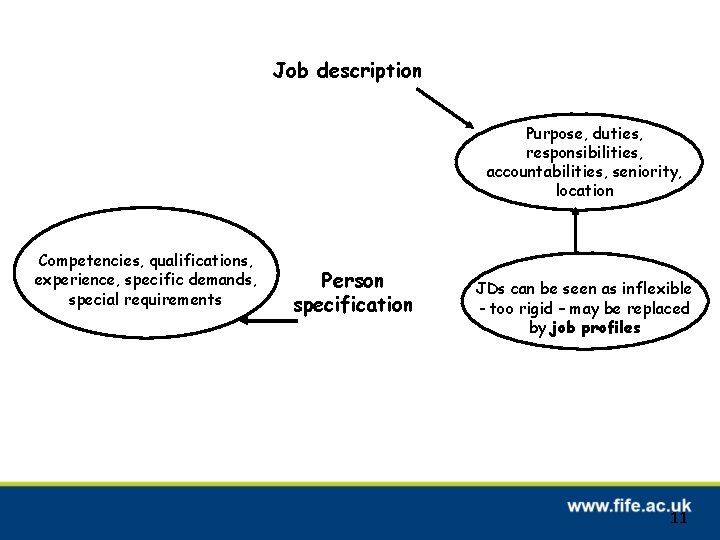
Job description Purpose, duties, responsibilities, accountabilities, seniority, location Competencies, qualifications, experience, specific demands, special requirements Person specification JDs can be seen as inflexible - too rigid – may be replaced by job profiles 11
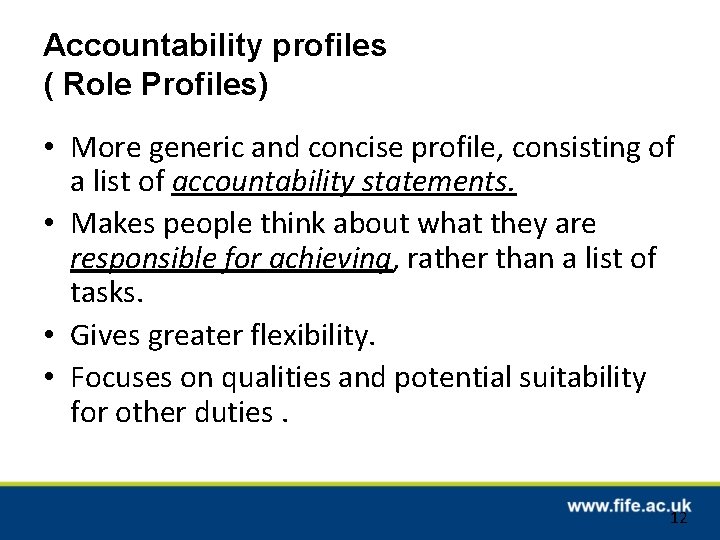
Accountability profiles ( Role Profiles) • More generic and concise profile, consisting of a list of accountability statements. • Makes people think about what they are responsible for achieving, rather than a list of tasks. • Gives greater flexibility. • Focuses on qualities and potential suitability for other duties. 12
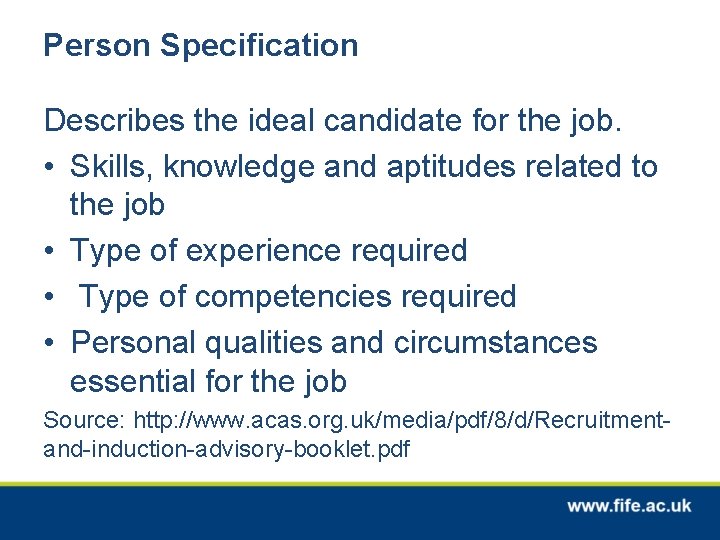
Person Specification Describes the ideal candidate for the job. • Skills, knowledge and aptitudes related to the job • Type of experience required • Type of competencies required • Personal qualities and circumstances essential for the job Source: http: //www. acas. org. uk/media/pdf/8/d/Recruitmentand-induction-advisory-booklet. pdf
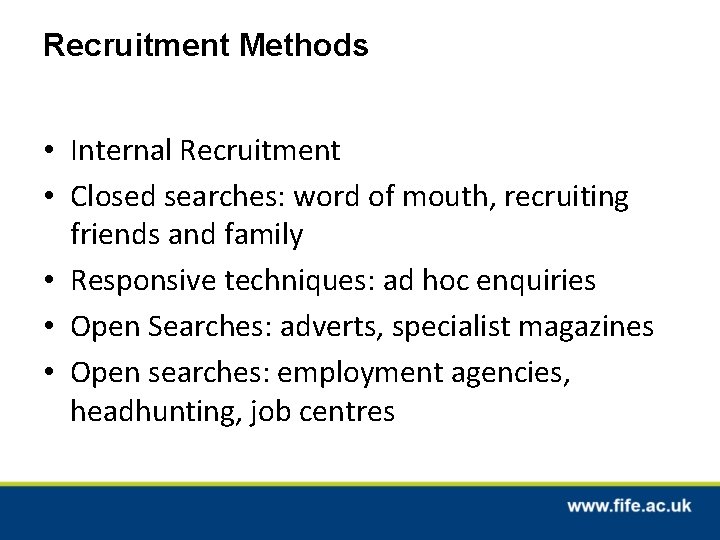
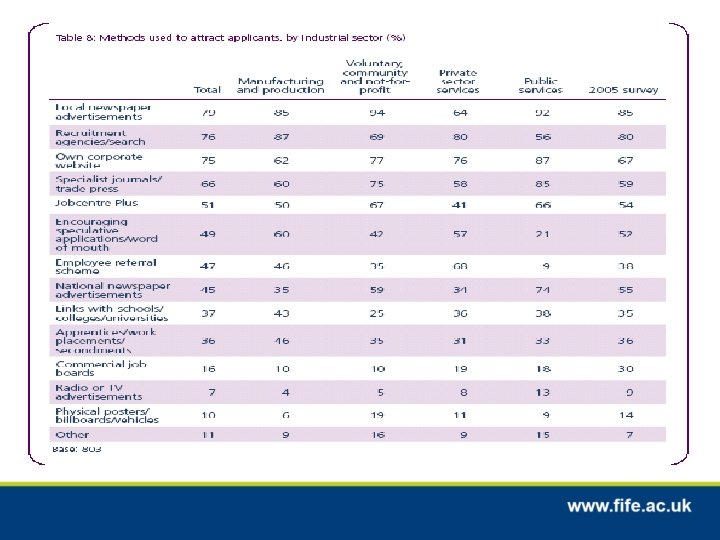
Recruitment Methods • Internal Recruitment • Closed searches: word of mouth, recruiting friends and family • Responsive techniques: ad hoc enquiries • Open Searches: adverts, specialist magazines • Open searches: employment agencies, headhunting, job centres
Recruitment Methods Identify the recruitment method used to recruit: • Craft • Supervisory • Management and Professional
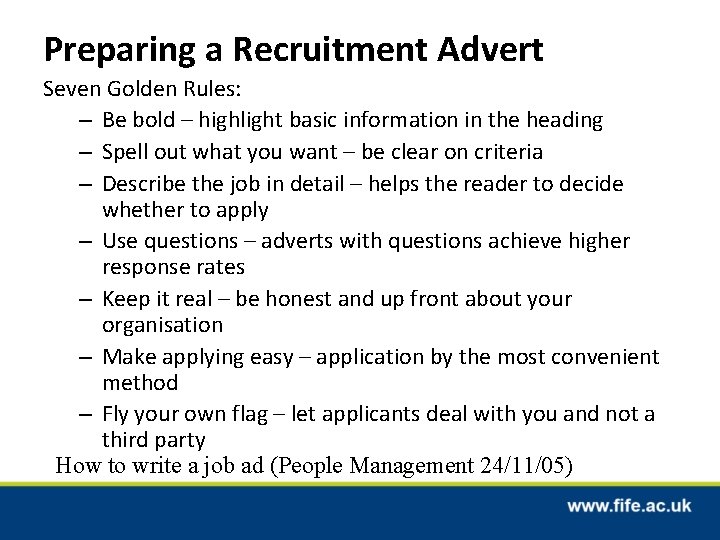
Preparing a Recruitment Advert Seven Golden Rules: – Be bold – highlight basic information in the heading – Spell out what you want – be clear on criteria – Describe the job in detail – helps the reader to decide whether to apply – Use questions – adverts with questions achieve higher response rates – Keep it real – be honest and up front about your organisation – Make applying easy – application by the most convenient method – Fly your own flag – let applicants deal with you and not a third party How to write a job ad (People Management 24/11/05)
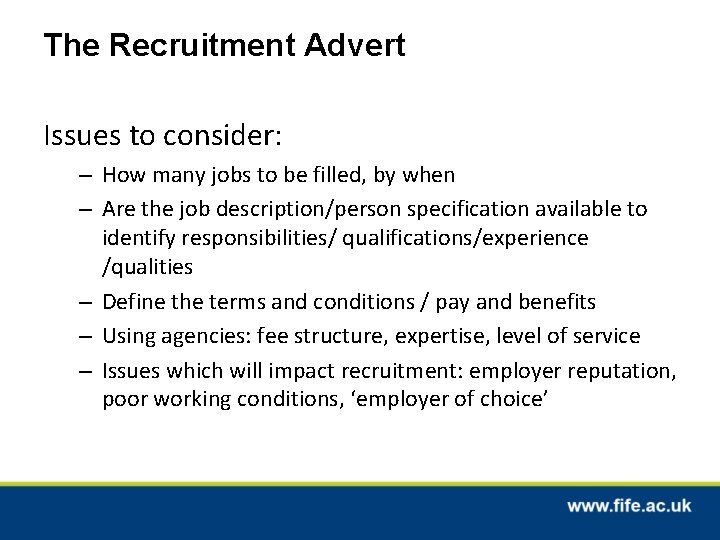
The Recruitment Advert Issues to consider: – How many jobs to be filled, by when – Are the job description/person specification available to identify responsibilities/ qualifications/experience /qualities – Define the terms and conditions / pay and benefits – Using agencies: fee structure, expertise, level of service – Issues which will impact recruitment: employer reputation, poor working conditions, ‘employer of choice’
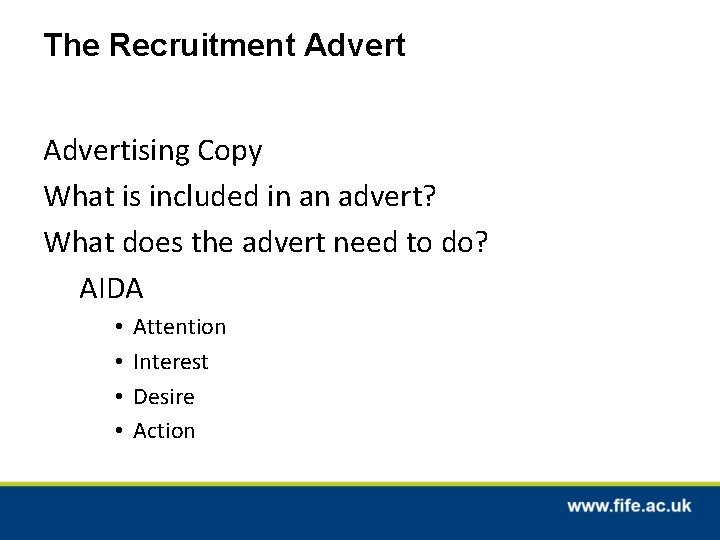
The Recruitment Advertising Copy What is included in an advert? What does the advert need to do? AIDA • • Attention Interest Desire Action
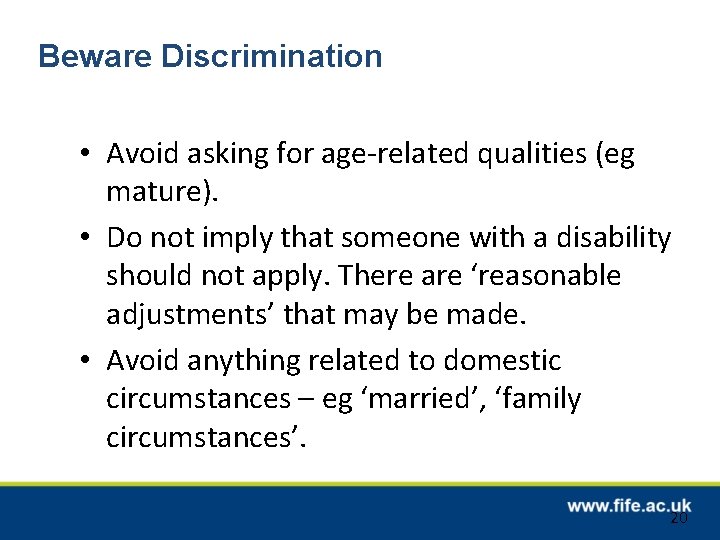
Beware Discrimination • Avoid asking for age-related qualities (eg mature). • Do not imply that someone with a disability should not apply. There are ‘reasonable adjustments’ that may be made. • Avoid anything related to domestic circumstances – eg ‘married’, ‘family circumstances’. 20
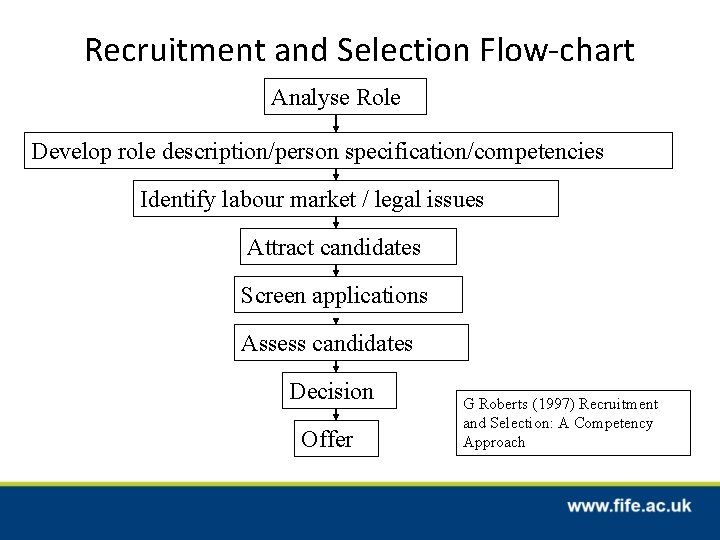
Recruitment and Selection Flow-chart Analyse Role Develop role description/person specification/competencies Identify labour market / legal issues Attract candidates Screen applications Assess candidates Decision Offer G Roberts (1997) Recruitment and Selection: A Competency Approach
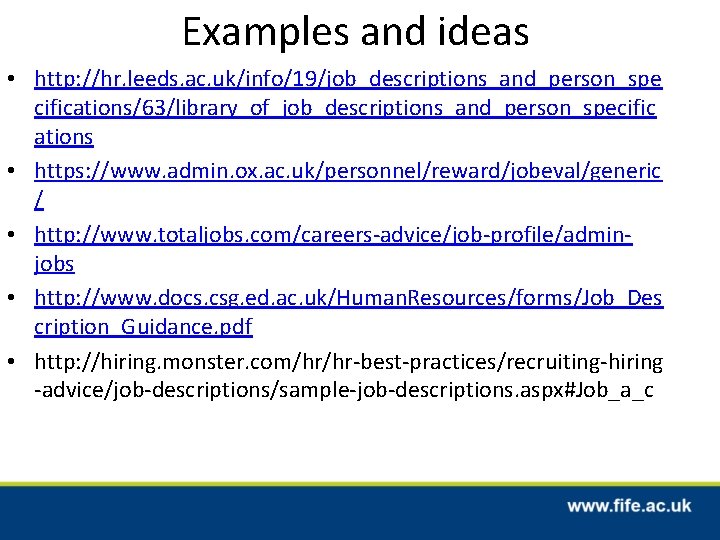
Examples and ideas • http: //hr. leeds. ac. uk/info/19/job_descriptions_and_person_spe cifications/63/library_of_job_descriptions_and_person_specific ations • https: //www. admin. ox. ac. uk/personnel/reward/jobeval/generic / • http: //www. totaljobs. com/careers-advice/job-profile/adminjobs • http: //www. docs. csg. ed. ac. uk/Human. Resources/forms/Job_Des cription_Guidance. pdf • http: //hiring. monster. com/hr/hr-best-practices/recruiting-hiring -advice/job-descriptions/sample-job-descriptions. aspx#Job_a_c
• http: //hiring. monster. co. uk/hr/hr-bestpractices/recruiting-hiring-advice/screeningjob-candidates/how-do-i-put-together-aperson-specification. aspx • http: //www. publicjobs. ie/publicjobs/client/to olkit/s 8_1. htm