
HUMAN RESOURCE MANAGEMENT HRM WHAT IS HRM FUNCTIONS

- Slides: 11
HUMAN RESOURCE MANAGEMENT (HRM)
WHAT IS HRM
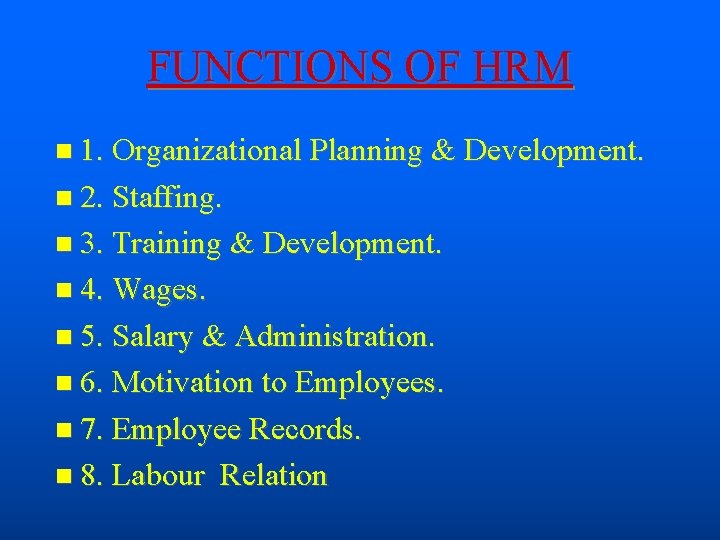
FUNCTIONS OF HRM 1. Organizational Planning & Development. 2. Staffing. 3. Training & Development. 4. Wages. 5. Salary & Administration. 6. Motivation to Employees. 7. Employee Records. 8. Labour Relation
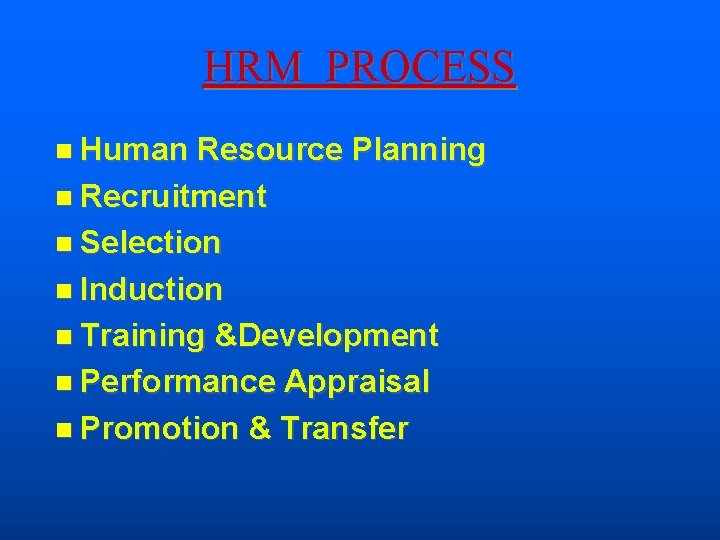
HRM PROCESS Human Resource Planning Recruitment Selection Induction Training &Development Performance Appraisal Promotion & Transfer
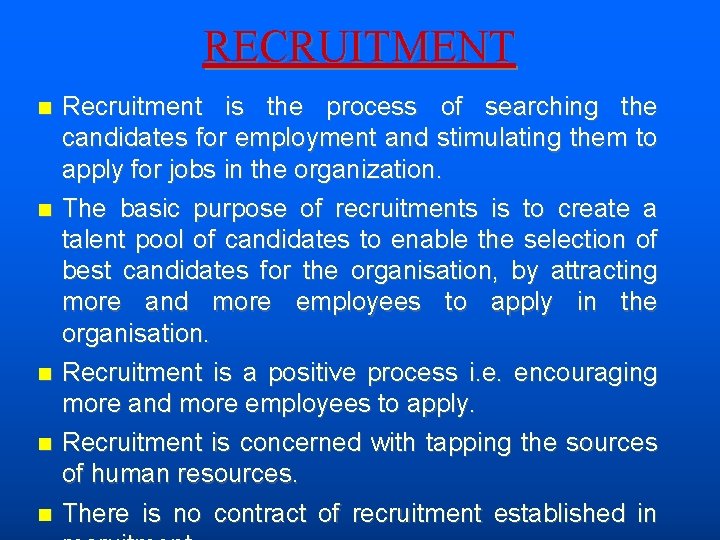
RECRUITMENT Recruitment is the process of searching the candidates for employment and stimulating them to apply for jobs in the organization. The basic purpose of recruitments is to create a talent pool of candidates to enable the selection of best candidates for the organisation, by attracting more and more employees to apply in the organisation. Recruitment is a positive process i. e. encouraging more and more employees to apply. Recruitment is concerned with tapping the sources of human resources. There is no contract of recruitment established in
SELECTION Selection involves the series of steps by which the candidates are screened for choosing the most suitable persons for vacant posts. The basic purpose of selection process is to choose the right candidate to fill the various positions in the organisation. Selection is a negative process as it involves rejection of the unsuitable candidates. Selection is concerned with selecting the most suitable candidate through various interviews and tests. Selection results in a contract of service between the employer and the selected employee.
METHODS OF SELECTION 1. Inviting Application Forms. 2. Initial Screening. 3. Testing 4. Reference Check. 5. In depth Selection Interview. 6. Physical Test. 7. Job Offer.
PERFORMANCE APPRISAL Performance appraisal is the process of obtaining, analyzing and recording information about the relative worth of an employee. The focus of the performance appraisal is measuring and improving the actual performance of the employee and also the future potential of the employee. Its aim is to measure what an employee does. According to Flippo, a prominent personality in the field of Human resources, “performance appraisal is the systematic, periodic and an impartial rating of an employee’s excellence in the matters pertaining to his present job and his potential for a better job. " Performance appraisal is a systematic way of reviewing and assessing the performance of an employee during a given period of
METHODS OF PA 1. CONFIDENTIAL 2. RATING REPORT. SCALE. 3. RANKING SYSTEM. 4. FORCED CHOICE METHOD. 5. COST ACCOUNTING METHOD.
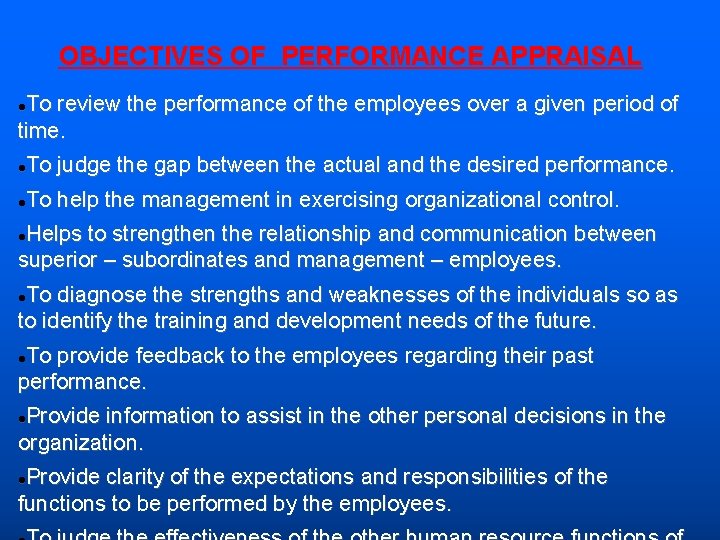
OBJECTIVES OF PERFORMANCE APPRAISAL To review the performance of the employees over a given period of time. To judge the gap between the actual and the desired performance. To help the management in exercising organizational control. Helps to strengthen the relationship and communication between superior – subordinates and management – employees. To diagnose the strengths and weaknesses of the individuals so as to identify the training and development needs of the future. To provide feedback to the employees regarding their past performance. Provide information to assist in the other personal decisions in the organization. Provide clarity of the expectations and responsibilities of the functions to be performed by the employees.
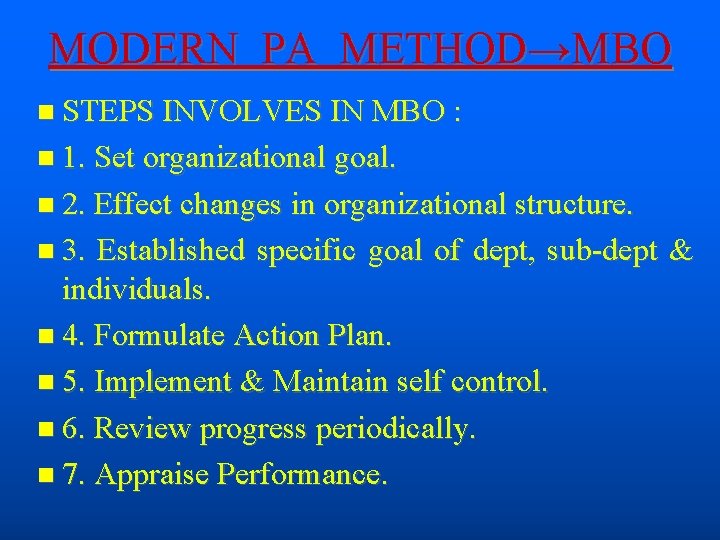
MODERN PA METHOD→MBO STEPS INVOLVES IN MBO : 1. Set organizational goal. 2. Effect changes in organizational structure. 3. Established specific goal of dept, sub-dept & individuals. 4. Formulate Action Plan. 5. Implement & Maintain self control. 6. Review progress periodically. 7. Appraise Performance.