
Human Resource Management Gaining a Competitive Advantage Chapter
- Slides: 13
Human Resource Management Gaining a Competitive Advantage Chapter 12 Recognizing Employee Contributions with Pay Mc. Graw-Hill/Irwin Copyright © 2008 by The Mc. Graw-Hill Companies, All Rights Reserved. 1 -1
How Does Pay Influence Individual Employees? • Reinforcement Theory - A response followed by a reward is more likely to recur in the future. • Expectancy Theory - Motivation is a function of valence, instrumentality, and expectancy. • Agency Theory -The interests of the principals (owners) and their agents (managers) may no longer converge. – Types of agency costs include: • perquisites • attitudes towards risk • decision-making horizons 12 -2
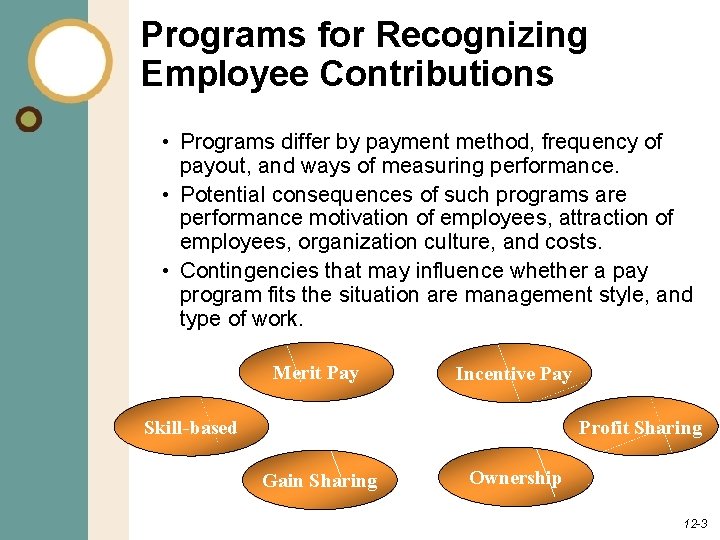
Programs for Recognizing Employee Contributions • Programs differ by payment method, frequency of payout, and ways of measuring performance. • Potential consequences of such programs are performance motivation of employees, attraction of employees, organization culture, and costs. • Contingencies that may influence whether a pay program fits the situation are management style, and type of work. Merit Pay Incentive Pay Profit Sharing Skill-based Gain Sharing Ownership 12 -3
Merit Pay • Merit pay programs link performanceappraisal ratings to annual pay increases. • A merit increase grid combines an employee’s performance rating with the employee’s position in a pay range to determine the size and frequency of his or her pay increases. • Some organizations provide guidelines regarding the percentage of employees who should fall into each performance category. 12 -4
Merit Pay • Edward W. Deming, who is a critic of merit pay, argues that it is unfair to rate individual performance because "apparent differences between people arise almost entirely from the system that they work in, not the people themselves. ” • Criticisms of merit pay include: – The focus on merit pay discourages teamwork. – The measurement of performance is done unfairly and inaccurately. – Merit pay may not really exist. 12 -5
Individual Incentives • Individual incentives reward individual performance, but payments are not rolled into base pay, and performance is usually measured as physical output rather than by subjective ratings. • They are relatively rare because: – Most jobs have no physical output measure. – There are many potential administrative problems. – Employees may do what they get paid for and nothing else. – They typically do not fit in with the team approach. – They may be inconsistent with organizational goals. – Some incentive plans reward output at the expense of quality or customer service. 12 -6
Where’s the Merit Payoff? • Jeffrey Pfeffer (Stanford) argues that idea that individual pay for performance will enhance org performance rests on set of assumptions that do not hold in vast majority of orgs – “Merit pay is not based on merit” • Perf appraisals biased • Pay increases not enough to motivate ees, but are enough to irritate them • In effect, for vast majority of ees, merit increases are unevenly distributed cost-of-living and market-adjustment increases couched in language of performance rewards • But, high levels of differentiation destroy engagement, breed distrust, and undermine teamwork – Higher turnover, lower quality, serious ethical breaches – “Effective management is a system, not a pay plan. The mistake is that companies try to solve all their problems with pay. ” – Evidence suggests group bonuses, profit sharing, and gain sharing are more effective forms of performance-based pay than merit pay or individual incentives » Source: Workforce Management, 11/3/08 12 -7
Profit Sharing • Under profit sharing, payments are based on a measure of organization performance (profits), and payments do not become a part of base pay. – The advantage is that profit sharing may encourage employees to think more like owners. – The drawback is that workers may perceive their performance has little to do with profit but is more related to top management decisions over which they have little control. 12 -8
Ownership • Ownership encourages employees to focus on the success of the organization as a whole, but, like profit sharing, ownership may be less motivational the larger the organization. • One method to achieve employee ownership is through stock options, which give employees the opportunity to buy company stock at a previously fixed price. • Employee stock ownership plans (ESOPs) are employee ownership plans that give employers certain tax and financial advantages when stock is granted to employees. – ESOPs can carry significant risk for employees. 12 -9
Gainsharing • Gainsharing programs offer a means of sharing productivity gains with employees, and are based on group or plant performance that does not become part of the employee’s base salary. • Conditions that should be in place for gainsharing to be effective include: – management commitment – a need to change or a strong commitment to continuous improvement – management's acceptance and encouragement of employee input 12 -10
Balanced Scorecard • Some companies find it useful to design a mix of pay programs. • The four categories of a balanced scorecard include: – financial – customer – internal – learning and growth 12 -11
“Bottom-Up Pay” • Some companies (~20%) tie executive compensation to Ee satisfaction data – Similar to faculty merit pay? ? ? • Gordon Bethune, CEO, Continental Airlines: – “Being an effective leader and having a company where people enjoy coming to work is not a popularity contest. When you run popularity contests, you tend to do things that may get you more points. That may not be good for shareholders and may not be good for the company. ” » Source: Wall Street Journal, 4/6/00 12 -12
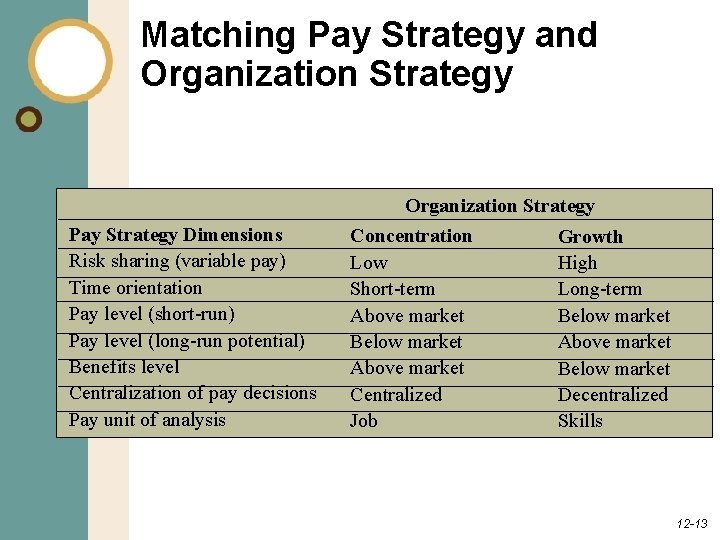
Matching Pay Strategy and Organization Strategy Pay Strategy Dimensions Risk sharing (variable pay) Time orientation Pay level (short-run) Pay level (long-run potential) Benefits level Centralization of pay decisions Pay unit of analysis Concentration Low Short-term Above market Below market Above market Centralized Job Growth High Long-term Below market Above market Below market Decentralized Skills 12 -13