
Human Resource Management Fifteenth Edition Chapter 2 Equal



- Slides: 54
Human Resource Management Fifteenth Edition Chapter 2 Equal Opportunity and the Law Copyright © 2017, 2015, 2013 Pearson Education, Inc. All Rights Reserved
Learning Objectives (1 of 2) 2 -1. Explain the importance of and list the basic features of Title VII of the 1964 Civil Rights Act and at least five other equal employment laws. 2 -2. Describe post-1990 employment laws including the Americans with Disabilities Act and how to avoid accusations of sexual harassment at work. Copyright © 2017, 2015, 2013 Pearson Education, Inc. All Rights Reserved
Learning Objectives (2 of 2) 2 -3. Illustrate two defenses you can use in the event of discriminatory practice allegations, and cite specific discriminatory personnel management practices in recruitment, selection, promotion, transfer, layoffs, and benefits. 2 -4. List the steps in the EEOC enforcement process. 2 -5. Discuss why diversity management is important and how to install a diversity management program. Copyright © 2017, 2015, 2013 Pearson Education, Inc. All Rights Reserved
I. Explain the importance of and list the basic features of Title VII of the 1964 Civil Rights Act and at least five other equal employment laws. Copyright © 2017, 2015, 2013 Pearson Education, Inc. All Rights Reserved
Equal Opportunity Laws Enacted From 1964 to 1991 Copyright © 2017, 2015, 2013 Pearson Education, Inc. All Rights Reserved
Title VII of the 1964 Civil Rights Act • Title VII of the 1964 Civil Rights Act – Who Does Title VII Cover? – The EEOC Copyright © 2017, 2015, 2013 Pearson Education, Inc. All Rights Reserved
Executive Orders • Signed into law by various presidents • Affirmative Action • Office of Federal Contract Compliance Programs (OFCCP) Copyright © 2017, 2015, 2013 Pearson Education, Inc. All Rights Reserved
Equal Pay Act of 1963 • Unlawful to discriminate on basis of sex • Jobs involve: – Equal work – Equivalent skills – Similar conditions Copyright © 2017, 2015, 2013 Pearson Education, Inc. All Rights Reserved
Age Discrimination in Employment Act of 1967 • Under ADEA, no discrimination for those between 40 – 65 • No slack for employer if fired employee replaced by one much younger Copyright © 2017, 2015, 2013 Pearson Education, Inc. All Rights Reserved
Vocational Rehabilitation Act of 1973 • Federal contracts > $2, 500 • Affirmative Action • Reasonable accommodations Copyright © 2017, 2015, 2013 Pearson Education, Inc. All Rights Reserved
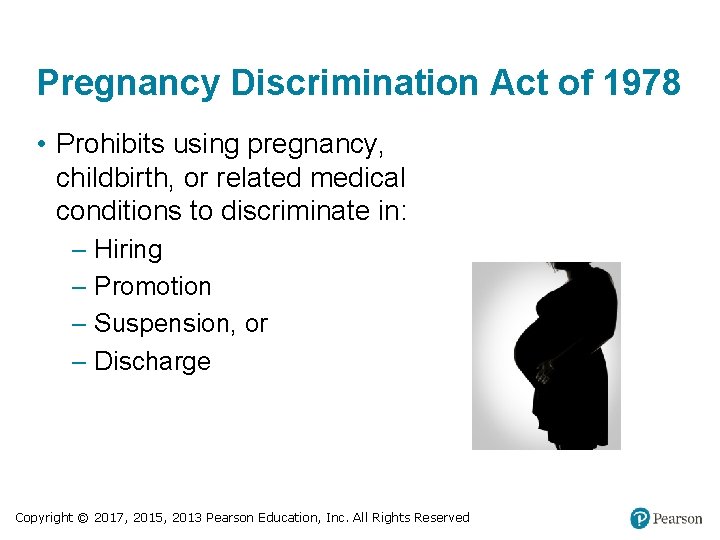
Pregnancy Discrimination Act of 1978 • Prohibits using pregnancy, childbirth, or related medical conditions to discriminate in: – Hiring – Promotion – Suspension, or – Discharge Copyright © 2017, 2015, 2013 Pearson Education, Inc. All Rights Reserved
Federal Agency Guidelines • EEOC • Civil Service Commission • Department of Labor (DOL) • Department of Justice (DOJ) Copyright © 2017, 2015, 2013 Pearson Education, Inc. All Rights Reserved
Early Court Decisions, Equal Employment Opportunity • Griggs v. Duke power company • Albemarle paper company v. Moody Copyright © 2017, 2015, 2013 Pearson Education, Inc. All Rights Reserved
II. Describe post-1990 employment laws including the Americans with Disabilities Act and how to avoid accusations of sexual harassment at work. Copyright © 2017, 2015, 2013 Pearson Education, Inc. All Rights Reserved
The Laws Enacted from 1991 to the Present Copyright © 2017, 2015, 2013 Pearson Education, Inc. All Rights Reserved
The Civil Rights Act of 1991 • Burden of proof • Money damages • Mixed motives Copyright © 2017, 2015, 2013 Pearson Education, Inc. All Rights Reserved
The Americans with Disabilities Act • Mental impairments and the ADA • Qualified individual • Reasonable accommodation • The ADA Amendments Act of 2008 (ADAAA) Copyright © 2017, 2015, 2013 Pearson Education, Inc. All Rights Reserved
ADA Guidelines for Managers and Employers • Do not deny a job to a disabled individual if the person is qualified and able to perform the essential job functions. • Make a reasonable accommodation unless doing so would result in undue hardship. • Know what you can ask applicants. In general, you may not make preemployment inquiries about a person’s disability before making an offer. However, you may ask questions about the person’s ability to perform essential job functions. • Itemize essential job functions on the job descriptions. In virtually any ADA legal action, a central question will be, what are the essential functions of the job? • Do not allow misconduct or erratic performance (including absences and tardiness), even if that behavior is linked to the disability. Copyright © 2017, 2015, 2013 Pearson Education, Inc. All Rights Reserved
Uniformed Services Employment and Reemployment Rights Act Copyright © 2017, 2015, 2013 Pearson Education, Inc. All Rights Reserved
Genetic Information Non-discrimination Act of 2008 (GINA) Copyright © 2017, 2015, 2013 Pearson Education, Inc. All Rights Reserved
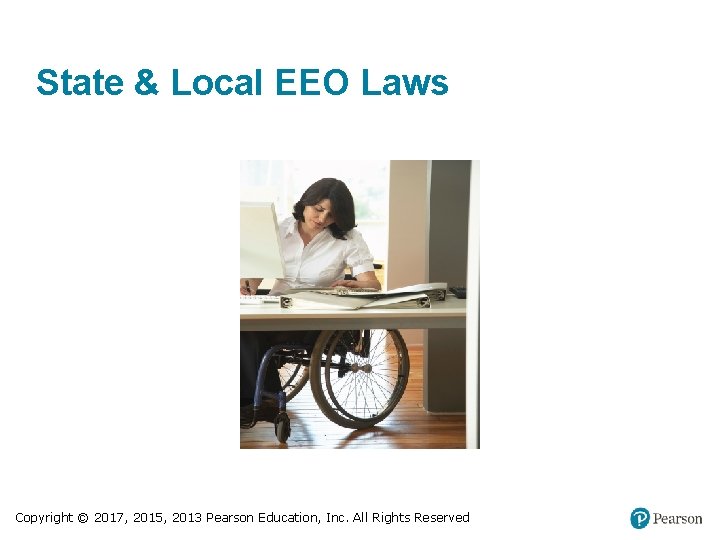
State & Local EEO Laws Copyright © 2017, 2015, 2013 Pearson Education, Inc. All Rights Reserved
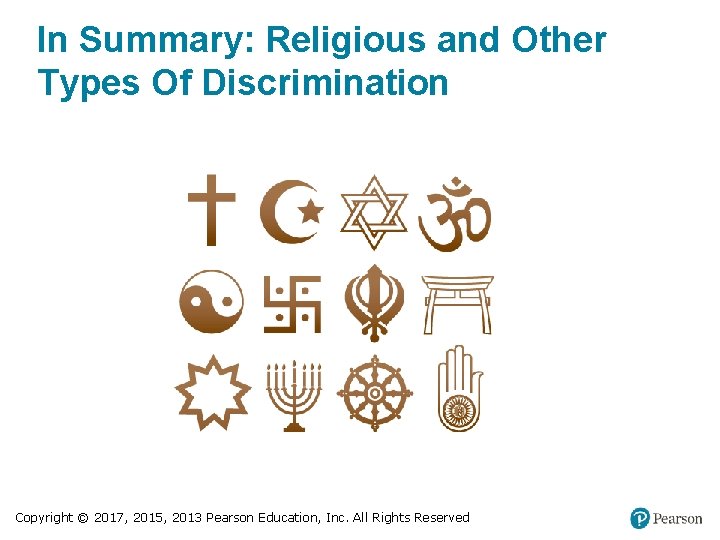
In Summary: Religious and Other Types Of Discrimination Copyright © 2017, 2015, 2013 Pearson Education, Inc. All Rights Reserved
Recent Trends in Discrimination Law Copyright © 2017, 2015, 2013 Pearson Education, Inc. All Rights Reserved
Sexual Harassment (1 of 3) • The Federal Violence Against Women Act of 1994 • What is Sexual Harassment • Proving Sexual Harassment – Quid Pro Quo – Hostile Environment Created by Supervisors – Hostile Environment Created by Coworkers or Non Employees Copyright © 2017, 2015, 2013 Pearson Education, Inc. All Rights Reserved
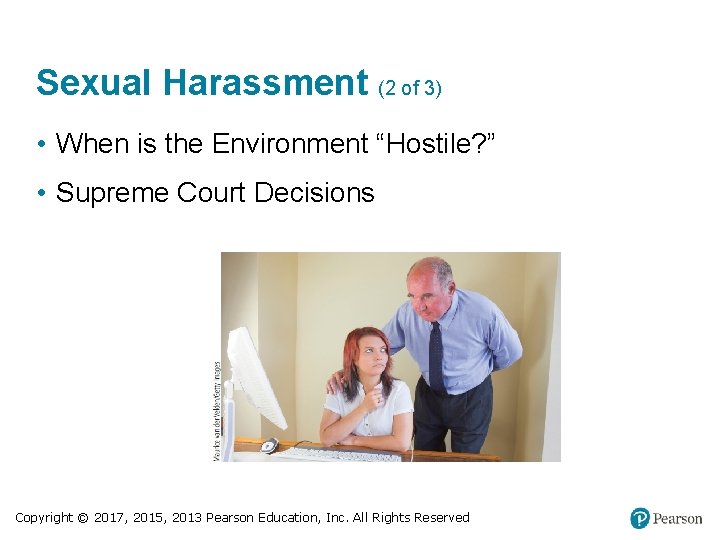
Sexual Harassment (2 of 3) • When is the Environment “Hostile? ” • Supreme Court Decisions Copyright © 2017, 2015, 2013 Pearson Education, Inc. All Rights Reserved
Sexual Harassment (3 of 3) • Implications for Employers & Managers • When the Law Isn’t Enough • What the Employee Can Do Copyright © 2017, 2015, 2013 Pearson Education, Inc. All Rights Reserved
Trends Shaping HR: Digital and Social Media Copyright © 2017, 2015, 2013 Pearson Education, Inc. All Rights Reserved
III. Illustrate two defenses you can use in the event of discriminatory practice allegations, and cite specific discriminatory personnel management practices in recruitment, selection, promotion, transfer, layoffs, and benefits. Copyright © 2017, 2015, 2013 Pearson Education, Inc. All Rights Reserved
Defenses Against Discrimination Allegations Copyright © 2017, 2015, 2013 Pearson Education, Inc. All Rights Reserved
The Central Role of Adverse Impact • Showing adverse impact – Disparate rejection rates – The Standard Deviation Rule – Restricted policy – Population comparisons – Mc. Donnell-Douglas Test Copyright © 2017, 2015, 2013 Pearson Education, Inc. All Rights Reserved
Bona Fide Occupational Qualification (BFOQ) • Age • Religion • Gender • National origin Copyright © 2017, 2015, 2013 Pearson Education, Inc. All Rights Reserved
Business Necessity “Business necessity” is a defense created by the courts. It requires showing that there is an overriding business purpose for the discriminatory practice and that the practice is therefore acceptable. Copyright © 2017, 2015, 2013 Pearson Education, Inc. All Rights Reserved
Know Your Employment Law Copyright © 2017, 2015, 2013 Pearson Education, Inc. All Rights Reserved
Let’s Talk About it… Copyright © 2017, 2015, 2013 Pearson Education, Inc. All Rights Reserved
IV. List the steps in the EEOC enforcement process. Copyright © 2017, 2015, 2013 Pearson Education, Inc. All Rights Reserved
The EEOC Enforcement Process Copyright © 2017, 2015, 2013 Pearson Education, Inc. All Rights Reserved
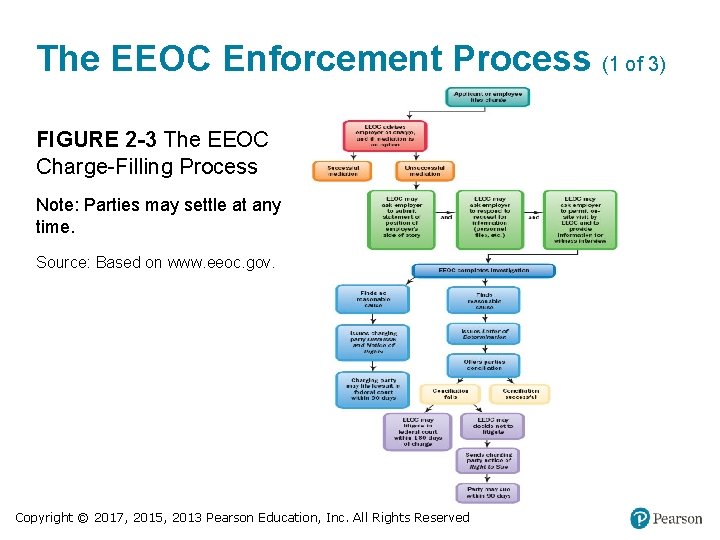
The EEOC Enforcement Process (1 of 3) FIGURE 2 -3 The EEOC Charge-Filling Process Note: Parties may settle at any time. Source: Based on www. eeoc. gov. Copyright © 2017, 2015, 2013 Pearson Education, Inc. All Rights Reserved
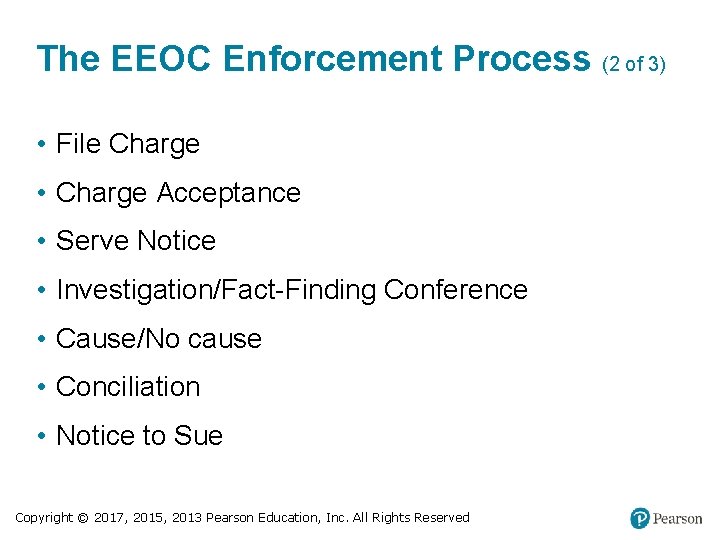
The EEOC Enforcement Process (2 of 3) • File Charge • Charge Acceptance • Serve Notice • Investigation/Fact-Finding Conference • Cause/No cause • Conciliation • Notice to Sue Copyright © 2017, 2015, 2013 Pearson Education, Inc. All Rights Reserved
The EEOC Enforcement Process (3 of 3) • Voluntary mediation • Mandatory arbitration of discrimination claims Copyright © 2017, 2015, 2013 Pearson Education, Inc. All Rights Reserved
Voluntary Mediation – “an informal process in which a neutral third party assists the opposing parties to reach a voluntary, negotiated resolution of a charge of discrimination. Copyright © 2017, 2015, 2013 Pearson Education, Inc. All Rights Reserved
Mandatory Arbitration of Discrimination Claims Copyright © 2017, 2015, 2013 Pearson Education, Inc. All Rights Reserved
Improving Performance: HR Tools for Line Managers and Small Businesses EEOC – Investigations Let’s take a look at what is look at and what to do… Copyright © 2017, 2015, 2013 Pearson Education, Inc. All Rights Reserved
V. Discuss why diversity management is important and how to install a diversity management program. Copyright © 2017, 2015, 2013 Pearson Education, Inc. All Rights Reserved
Diversity Management Copyright © 2017, 2015, 2013 Pearson Education, Inc. All Rights Reserved
Potential Threats to Diversity • Stereotyping • Discrimination • Tokenism • Ethnocentrism Copyright © 2017, 2015, 2013 Pearson Education, Inc. All Rights Reserved
Improving Performance: HR as a Profit Center (1 of 2) Diversity can drive Higher profits Let’s talk about it… Copyright © 2017, 2015, 2013 Pearson Education, Inc. All Rights Reserved
Managing Diversity Copyright © 2017, 2015, 2013 Pearson Education, Inc. All Rights Reserved
Improving Performance: HR as a Profit Center (2 of 2) Workforce Diversity Let’s talk about it… Copyright © 2017, 2015, 2013 Pearson Education, Inc. All Rights Reserved
Implementing the Affirmative Action Program Copyright © 2017, 2015, 2013 Pearson Education, Inc. All Rights Reserved
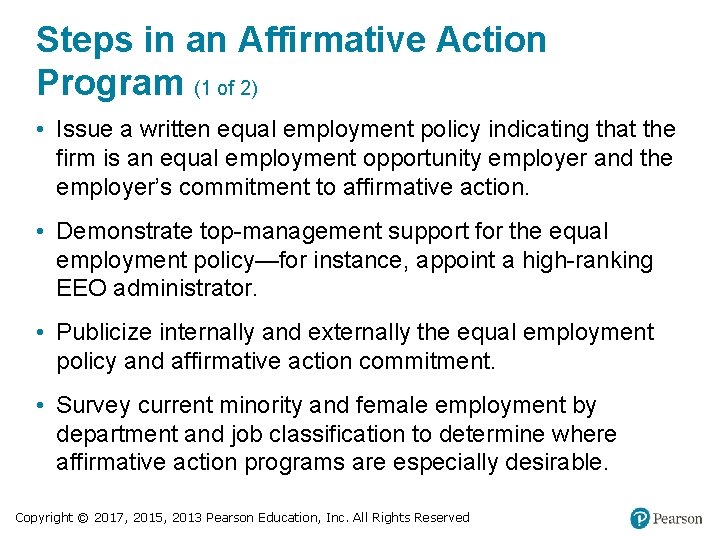
Steps in an Affirmative Action Program (1 of 2) • Issue a written equal employment policy indicating that the firm is an equal employment opportunity employer and the employer’s commitment to affirmative action. • Demonstrate top-management support for the equal employment policy—for instance, appoint a high-ranking EEO administrator. • Publicize internally and externally the equal employment policy and affirmative action commitment. • Survey current minority and female employment by department and job classification to determine where affirmative action programs are especially desirable. Copyright © 2017, 2015, 2013 Pearson Education, Inc. All Rights Reserved
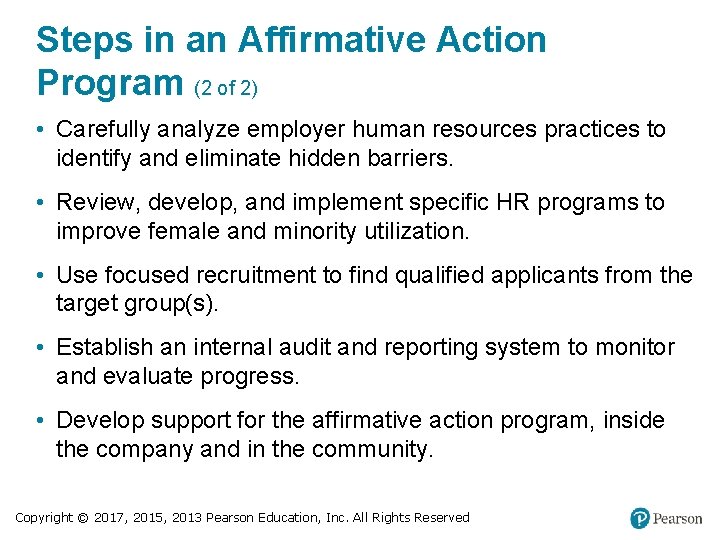
Steps in an Affirmative Action Program (2 of 2) • Carefully analyze employer human resources practices to identify and eliminate hidden barriers. • Review, develop, and implement specific HR programs to improve female and minority utilization. • Use focused recruitment to find qualified applicants from the target group(s). • Establish an internal audit and reporting system to monitor and evaluate progress. • Develop support for the affirmative action program, inside the company and in the community. Copyright © 2017, 2015, 2013 Pearson Education, Inc. All Rights Reserved
Reverse Discrimination Copyright © 2017, 2015, 2013 Pearson Education, Inc. All Rights Reserved
Chapter 2 Review What you should now know…. Copyright © 2017, 2015, 2013 Pearson Education, Inc. All Rights Reserved
Copyright © 2017, 2015, 2013 Pearson Education, Inc. All Rights Reserved