
Human Resource Management Employee Rights and Responsibilities CHAPTER
Human Resource Management Employee Rights and Responsibilities CHAPTER 15 Robert L. Mathis | John H. Jackson | Sean R. Valentine 14 e © 2014 Cengage Learning. All rights reserved. May not be scanned, copied or duplicated, or posted to a publicly accessible Web site, in whole or in part.
Learning Objectives Define employment-at-will and discuss how wrongful discharge, just cause, and due process are interrelated Identify employee rights associated with free speech and access to employee records Discuss issues associated with workplace monitoring, employer investigations, and drug testing © 2014 Cengage Learning. All rights reserved. May not be scanned, copied or duplicated, or posted to a publicly accessible Web site, in whole or in part.
Learning Objectives List elements to consider when developing an employee handbook Understand the use of employee discipline in companies and differentiate between the positive and progressive approaches to discipline Outline the issues and procedures related to employee discharge and termination © 2014 Cengage Learning. All rights reserved. May not be scanned, copied or duplicated, or posted to a publicly accessible Web site, in whole or in part.

Employee Rights and Responsibilities Rights: Power, privileges or interests derived from law, nature, or tradition Statutory rights: Based on specific laws or statutes passed by federal, state, or local governments Equal employment opportunity Collective bargaining Workplace safety Responsibilities: Obligations to perform certain tasks and duties © 2014 Cengage Learning. All rights reserved. May not be scanned, copied or duplicated, or posted to a publicly accessible Web site, in whole or in part.
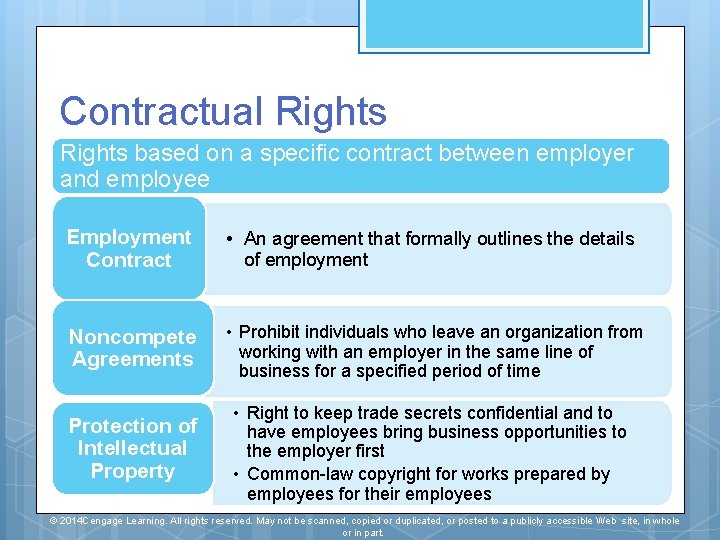
Contractual Rights based on a specific contract between employer and employee Employment Contract • An agreement that formally outlines the details of employment Noncompete Agreements • Prohibit individuals who leave an organization from working with an employer in the same line of business for a specified period of time Protection of Intellectual Property • Right to keep trade secrets confidential and to have employees bring business opportunities to the employer first • Common-law copyright for works prepared by employees for their employees © 2014 Cengage Learning. All rights reserved. May not be scanned, copied or duplicated, or posted to a publicly accessible Web site, in whole or in part.
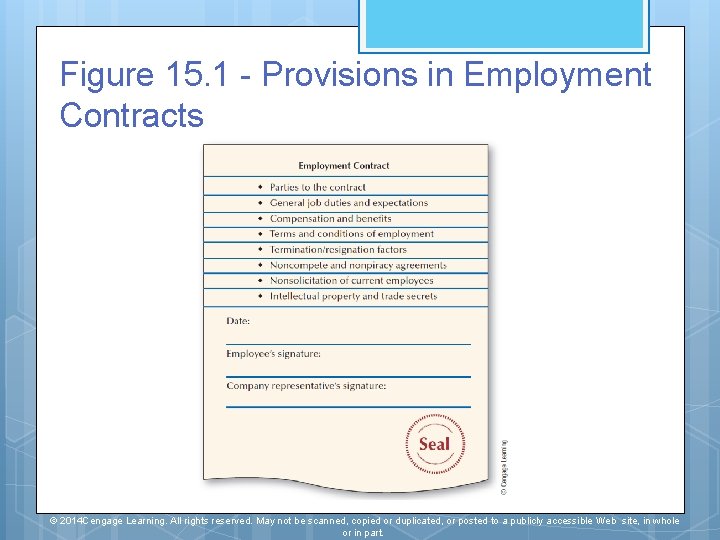
Figure 15. 1 - Provisions in Employment Contracts © 2014 Cengage Learning. All rights reserved. May not be scanned, copied or duplicated, or posted to a publicly accessible Web site, in whole or in part.

Noncompete Agreements Employment Contract Clauses Nonpiracy agreements Nonsolicitation of current employees Intellectual property and trade secrets © 2014 Cengage Learning. All rights reserved. May not be scanned, copied or duplicated, or posted to a publicly accessible Web site, in whole or in part.
Implied Contracts Unwritten contract between individuals and their employers Affects employment relationship Rights and responsibilities of the employee may exist only as unwritten employer expectations about what is acceptable behavior or performance © 2014 Cengage Learning. All rights reserved. May not be scanned, copied or duplicated, or posted to a publicly accessible Web site, in whole or in part.
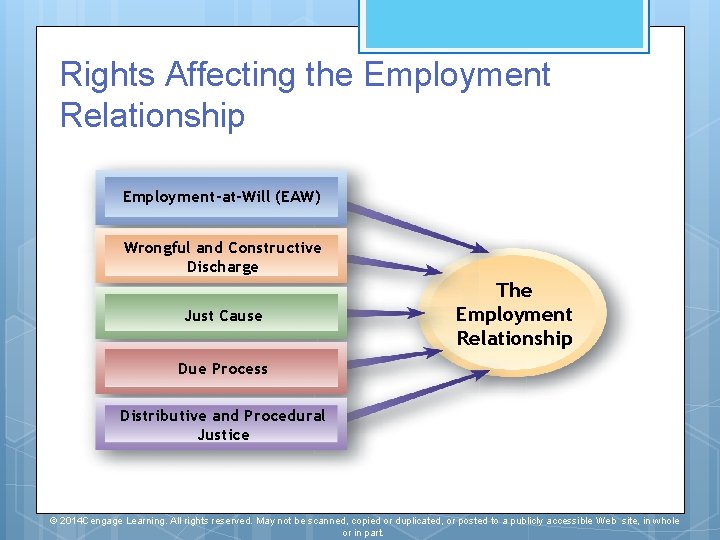
Rights Affecting the Employment Relationship Employment-at-Will (EAW) Wrongful and Constructive Discharge Just Cause The Employment Relationship Due Process Distributive and Procedural Justice © 2014 Cengage Learning. All rights reserved. May not be scanned, copied or duplicated, or posted to a publicly accessible Web site, in whole or in part.
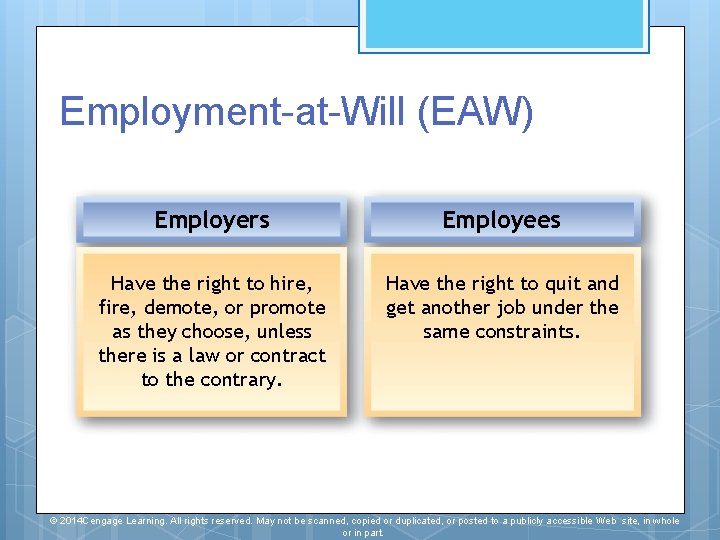
Employment-at-Will (EAW) Employers Employees Have the right to hire, fire, demote, or promote as they choose, unless there is a law or contract to the contrary. Have the right to quit and get another job under the same constraints. © 2014 Cengage Learning. All rights reserved. May not be scanned, copied or duplicated, or posted to a publicly accessible Web site, in whole or in part.
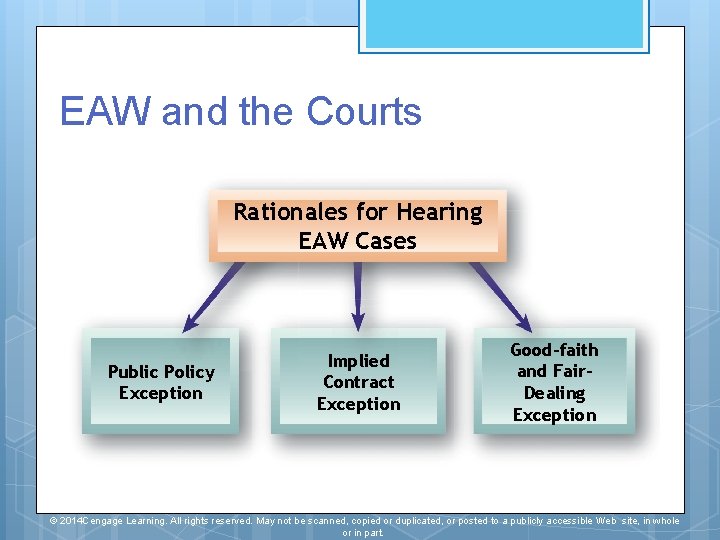
EAW and the Courts Rationales for Hearing EAW Cases Public Policy Exception Implied Contract Exception Good-faith and Fair. Dealing Exception © 2014 Cengage Learning. All rights reserved. May not be scanned, copied or duplicated, or posted to a publicly accessible Web site, in whole or in part.

Employment-at-Will Restrictions Wrongful Discharge • Termination of an individual’s employment for reasons that are improper or illegal Constructive Discharge • An employer deliberately makes working conditions intolerable for an employee in an attempt to get (to force) that employee to resign or quit © 2014 Cengage Learning. All rights reserved. May not be scanned, copied or duplicated, or posted to a publicly accessible Web site, in whole or in part.
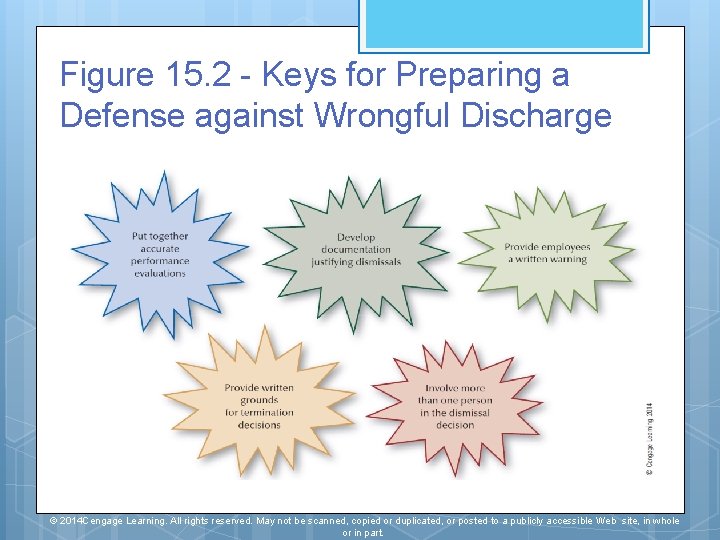
Figure 15. 2 - Keys for Preparing a Defense against Wrongful Discharge © 2014 Cengage Learning. All rights reserved. May not be scanned, copied or duplicated, or posted to a publicly accessible Web site, in whole or in part.

Employment-at-Will: Fairness Just cause: Reasonable justification for taking an employment-related action Due process: Requirement that the employer use a fair process to determine employee wrongdoing Allows employees to explain and defend their actions against charges or discipline © 2014 Cengage Learning. All rights reserved. May not be scanned, copied or duplicated, or posted to a publicly accessible Web site, in whole or in part.
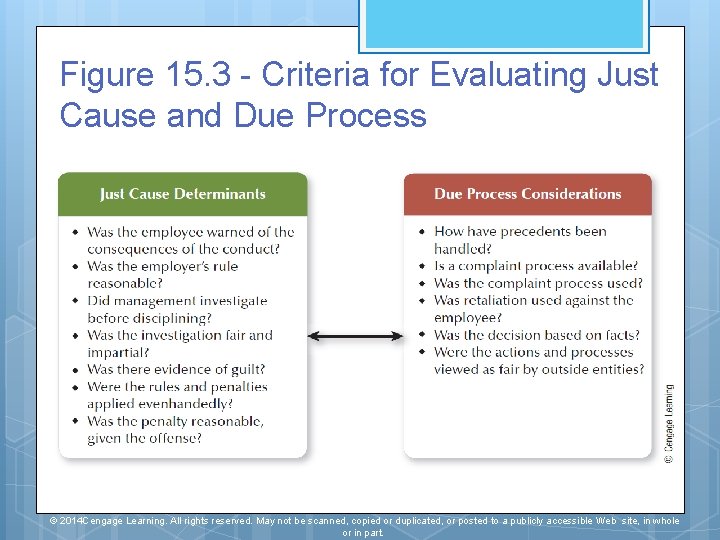
Figure 15. 3 - Criteria for Evaluating Just Cause and Due Process © 2014 Cengage Learning. All rights reserved. May not be scanned, copied or duplicated, or posted to a publicly accessible Web site, in whole or in part.
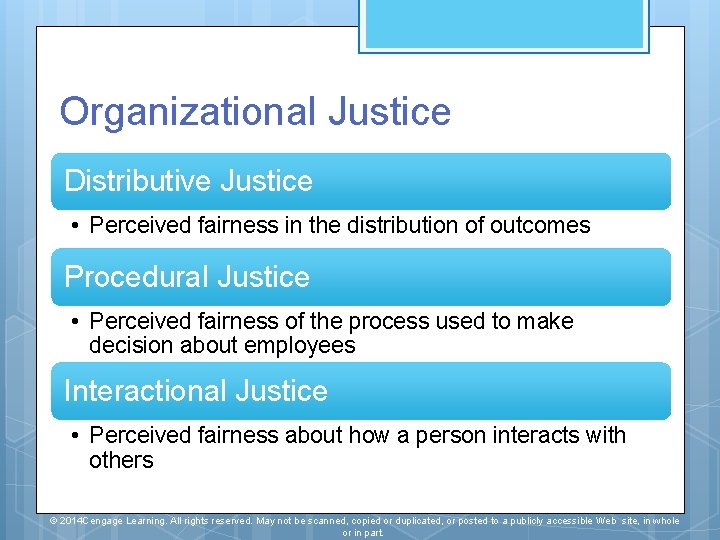
Organizational Justice Distributive Justice • Perceived fairness in the distribution of outcomes Procedural Justice • Perceived fairness of the process used to make decision about employees Interactional Justice • Perceived fairness about how a person interacts with others © 2014 Cengage Learning. All rights reserved. May not be scanned, copied or duplicated, or posted to a publicly accessible Web site, in whole or in part.
Open Door Policy Anyone with a complaint can talk with a manager, an HR representative, or an executive Probability of being mishandled Nonunion firms benefit from having formal complaint procedures that are well-defined © 2014 Cengage Learning. All rights reserved. May not be scanned, copied or duplicated, or posted to a publicly accessible Web site, in whole or in part.
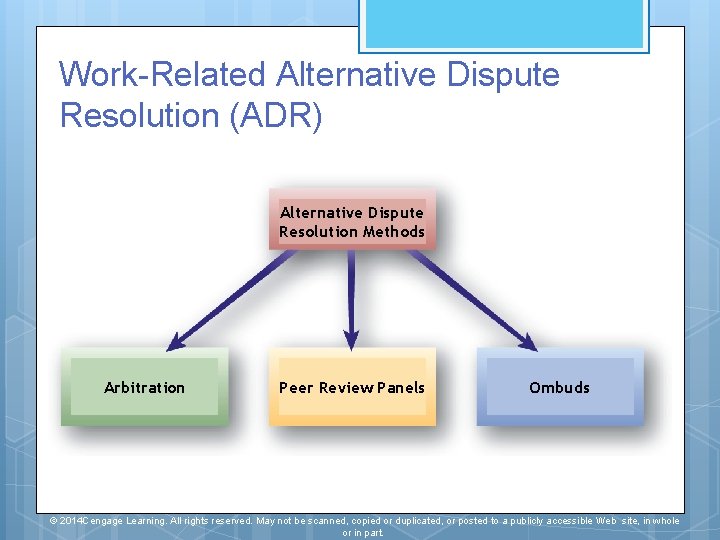
Work-Related Alternative Dispute Resolution (ADR) Alternative Dispute Resolution Methods Arbitration Peer Review Panels Ombuds © 2014 Cengage Learning. All rights reserved. May not be scanned, copied or duplicated, or posted to a publicly accessible Web site, in whole or in part.
Work-Related Alternative Dispute Resolution Arbitration: Using a neutral third party to make a decision • Compulsory arbitration • All disputes will be submitted to arbitration • Employees waive their rights to pursue legal action until the completion of the arbitration process Peer review panels - Advantages • • Reduces lawsuits Provision of due process Lower costs Management and employee development © 2014 Cengage Learning. All rights reserved. May not be scanned, copied or duplicated, or posted to a publicly accessible Web site, in whole or in part.
Work-Related Alternative Dispute Resolution Ombuds • Individuals outside the normal chain of command, acting as problem solvers for both management and employees Mediation • Tool for developing appropriate and fair outcomes for all parties involved • Helps settle disputes and figures out how employees can more effectively interact with each other on the job © 2014 Cengage Learning. All rights reserved. May not be scanned, copied or duplicated, or posted to a publicly accessible Web site, in whole or in part.
Right to Privacy An individual’s freedom from unauthorized and unreasonable intrusion into personal affairs Change in nature of privacy issues at work place due to: Internet communications Specialized computers Telecommunications systems © 2014 Cengage Learning. All rights reserved. May not be scanned, copied or duplicated, or posted to a publicly accessible Web site, in whole or in part.
Privacy Rights and Employee Records Employee Medical Records • Recordkeeping and retention practices are affected by provisions of Americans with Disabilities Act (ADA) Security of Employee Records • Protect the privacy of employees • Protect employers from potential liability for improper disclosure of personal information Electronic Records © 2014 Cengage Learning. All rights reserved. May not be scanned, copied or duplicated, or posted to a publicly accessible Web site, in whole or in part.
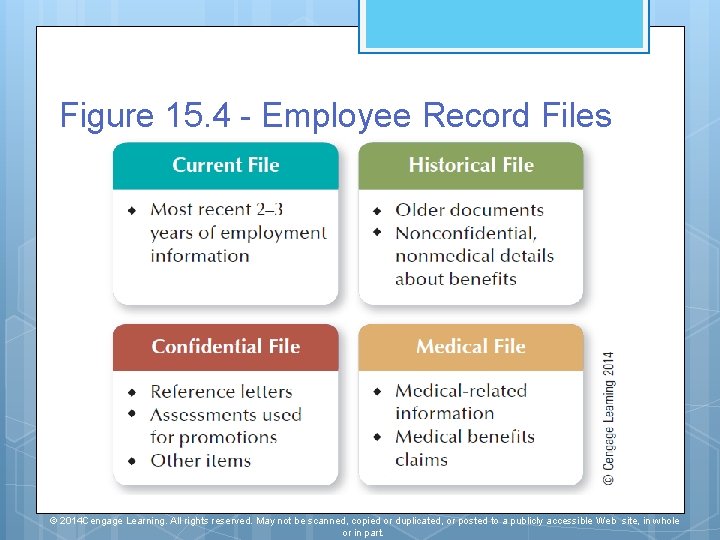
Figure 15. 4 - Employee Record Files © 2014 Cengage Learning. All rights reserved. May not be scanned, copied or duplicated, or posted to a publicly accessible Web site, in whole or in part.
Employees’ Free Speech Rights Employee Advocacy of Controversial Views • Handling concerns • Attempt informal resolution first • Outline the boundaries and standards for appropriate behavior in a formalized policy that addresses work expectations • Signed nondisclosure privacy agreement Whistle-Blowing and Employee Protection • Whistle-blowers: Individuals who report real or perceived wrongs committed by their employers © 2014 Cengage Learning. All rights reserved. May not be scanned, copied or duplicated, or posted to a publicly accessible Web site, in whole or in part.
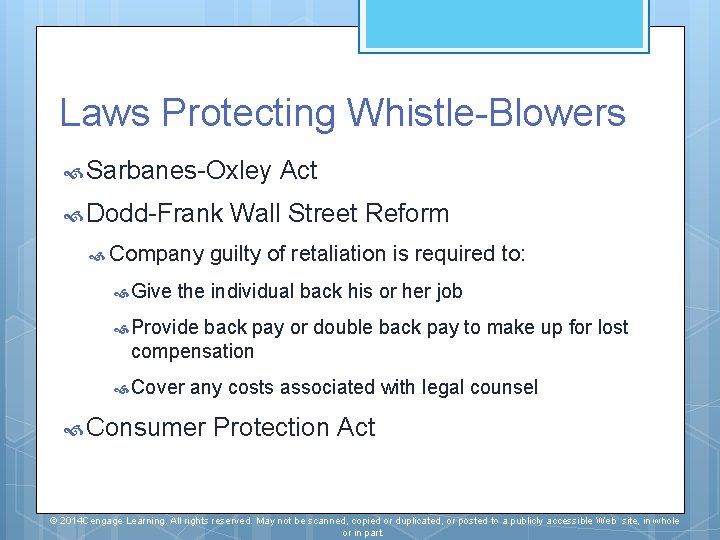
Laws Protecting Whistle-Blowers Sarbanes-Oxley Dodd-Frank Company Give Act Wall Street Reform guilty of retaliation is required to: the individual back his or her job Provide back pay or double back pay to make up for lost compensation Cover any costs associated with legal counsel Consumer Protection Act © 2014 Cengage Learning. All rights reserved. May not be scanned, copied or duplicated, or posted to a publicly accessible Web site, in whole or in part.
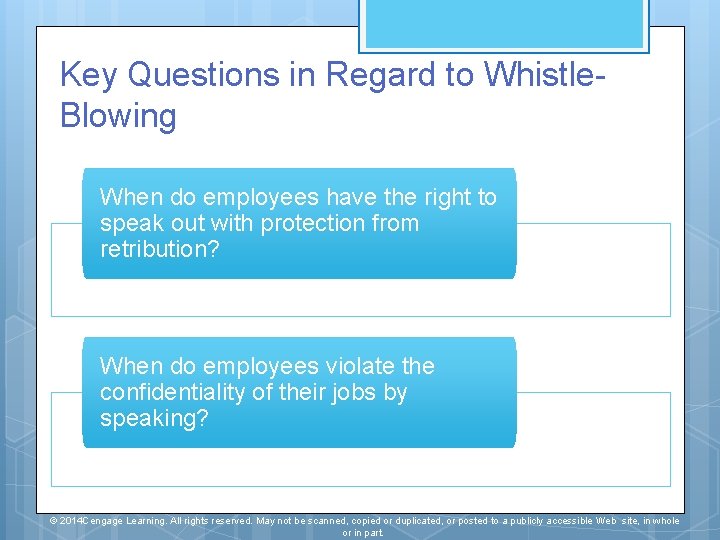
Key Questions in Regard to Whistle. Blowing When do employees have the right to speak out with protection from retribution? When do employees violate the confidentiality of their jobs by speaking? © 2014 Cengage Learning. All rights reserved. May not be scanned, copied or duplicated, or posted to a publicly accessible Web site, in whole or in part.
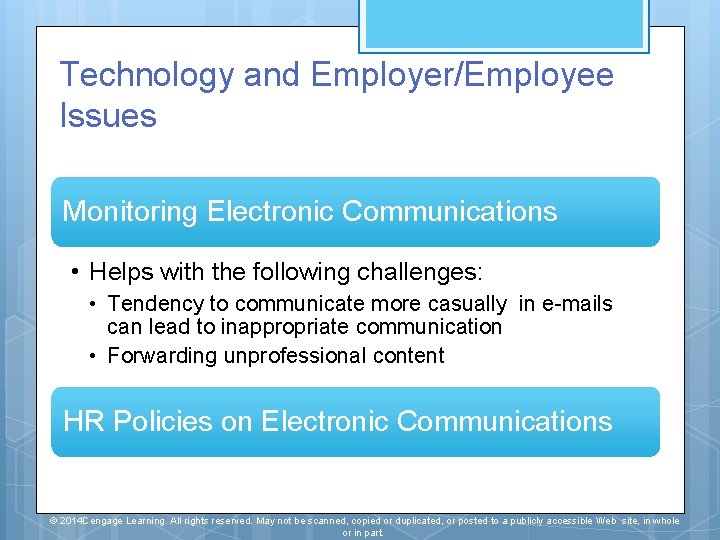
Technology and Employer/Employee Issues Monitoring Electronic Communications • Helps with the following challenges: • Tendency to communicate more casually in e-mails can lead to inappropriate communication • Forwarding unprofessional content HR Policies on Electronic Communications © 2014 Cengage Learning. All rights reserved. May not be scanned, copied or duplicated, or posted to a publicly accessible Web site, in whole or in part.
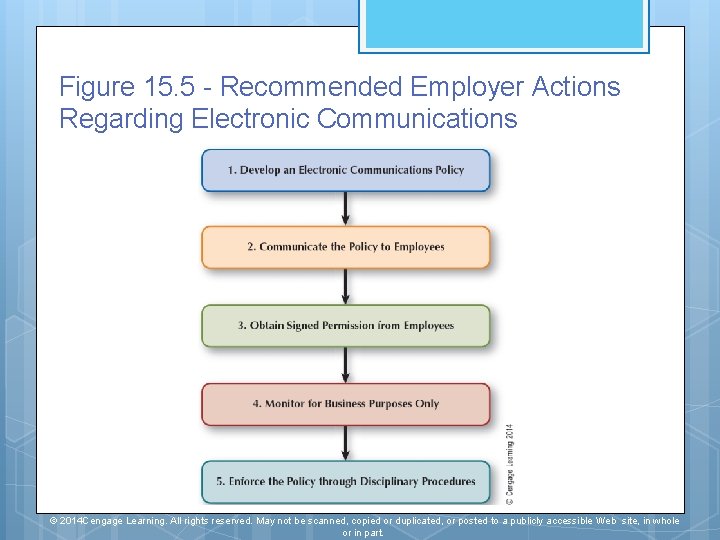
Figure 15. 5 - Recommended Employer Actions Regarding Electronic Communications © 2014 Cengage Learning. All rights reserved. May not be scanned, copied or duplicated, or posted to a publicly accessible Web site, in whole or in part.
Employee Rights and Personal Behavior Reviewing Unusual Behavior Dress and Body Appearance Limitations • Placing legitimate job-related limits on an employee’s personal at-work appearance Off-Duty Behavior • Discipline an employee if his/her off-the-job behavior puts the company in legal or financial jeopardy © 2014 Cengage Learning. All rights reserved. May not be scanned, copied or duplicated, or posted to a publicly accessible Web site, in whole or in part.
Workplace Monitoring Conducting Video Surveillance at Work • Ensures employee security • Requires employers to be careful so that employer rights and employee privacy do not collide Monitoring Employee Performance • Signed employee consent form stating that performance will be monitored regularly © 2014 Cengage Learning. All rights reserved. May not be scanned, copied or duplicated, or posted to a publicly accessible Web site, in whole or in part.
Conducting Work-Related Investigations - Best Practices Develop a good working plan to respond in times of crises • Give high priority to confidentiality throughout investigations • All important incidents should be properly documented Specify whether HR or another party will conduct the actual investigation Investigate problems quickly before evidence can be tampered with Credibility of individuals providing information in an investigation must be assessed Use the stories and information collected to identify a conclusion to the investigation © 2014 Cengage Learning. All rights reserved. May not be scanned, copied or duplicated, or posted to a publicly accessible Web site, in whole or in part.

Honesty and Polygraph Tests Employee Polygraph Protection Act Prohibits the use of polygraphs for most preemployment screening Requires that employees must: Be advised of their rights to refuse to take a polygraph exam Be allowed to stop the exam at any time; and Not be terminated because they refuse to take a polygraph test or solely because of the exam results © 2014 Cengage Learning. All rights reserved. May not be scanned, copied or duplicated, or posted to a publicly accessible Web site, in whole or in part.
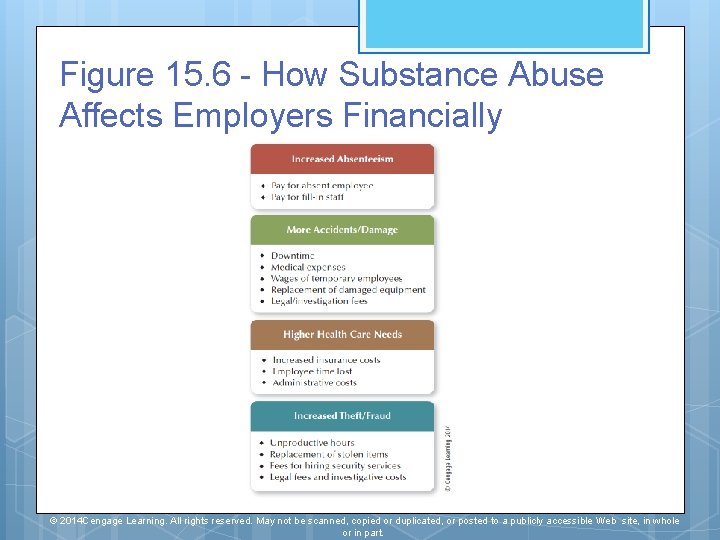
Figure 15. 6 - How Substance Abuse Affects Employers Financially © 2014 Cengage Learning. All rights reserved. May not be scanned, copied or duplicated, or posted to a publicly accessible Web site, in whole or in part.
Substance Abuse and Drug Testing American with Disabilities Act • Alcoholism is a disability, but that dependency on illegal drugs is not Family and Medical Leave Act • Covers substance abuse Drug-Free Workplace Act of 1988 • Requires government contractors to take steps to eliminate employee drug use © 2014 Cengage Learning. All rights reserved. May not be scanned, copied or duplicated, or posted to a publicly accessible Web site, in whole or in part.
Drug Testing and Employee Rights Policies for Conducting Drug Tests • Random testing of all employees at periodic intervals • Testing only in cases of probable cause • Testing after accidents Test Conditions • • • Job-related consequences outweigh privacy concerns Accurate test procedures are available Written consent of the employee is obtained Results are treated confidentially Employer has drug program, including an EAP © 2014 Cengage Learning. All rights reserved. May not be scanned, copied or duplicated, or posted to a publicly accessible Web site, in whole or in part.

HR Policies, Procedures, and Rules Policies Procedures Rules General guidelines that focus organizational actions. Customary methods of handling activities Specific guidelines that regulate and restrict the behavior of individuals. “How we do it” “Why we do it” “The limits on what we do” Employee Rights © 2014 Cengage Learning. All rights reserved. May not be scanned, copied or duplicated, or posted to a publicly accessible Web site, in whole or in part.
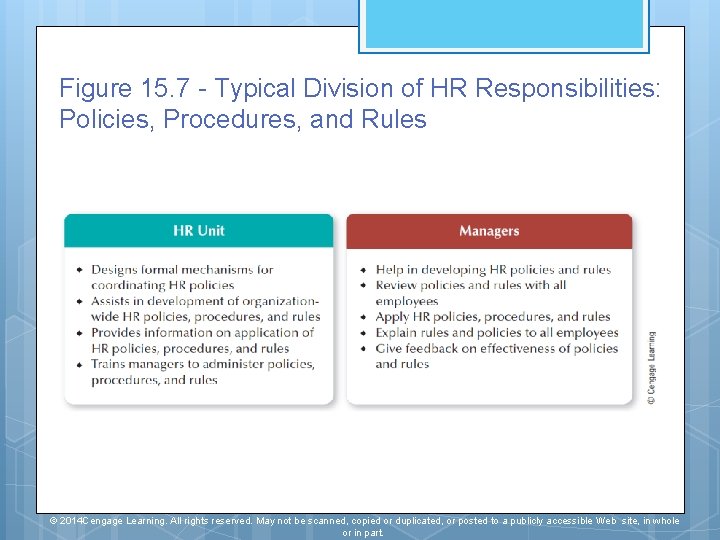
Figure 15. 7 - Typical Division of HR Responsibilities: Policies, Procedures, and Rules © 2014 Cengage Learning. All rights reserved. May not be scanned, copied or duplicated, or posted to a publicly accessible Web site, in whole or in part.
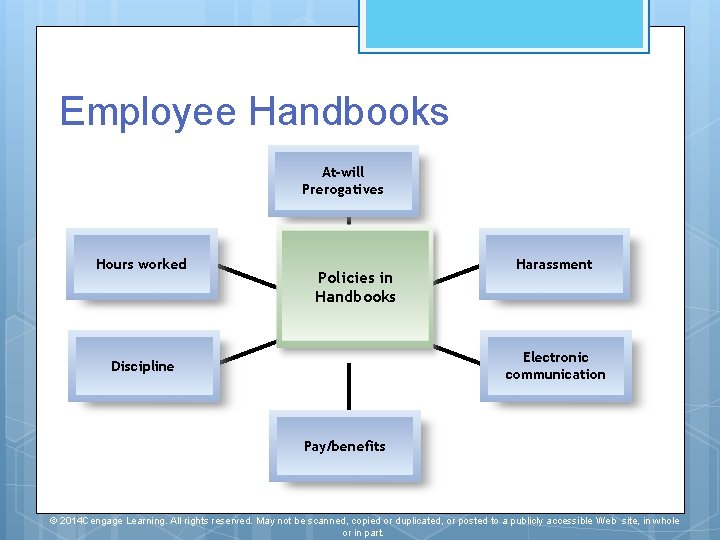
Employee Handbooks At-will Prerogatives Hours worked Policies in Handbooks Harassment Electronic communication Discipline Pay/benefits © 2014 Cengage Learning. All rights reserved. May not be scanned, copied or duplicated, or posted to a publicly accessible Web site, in whole or in part.
Employee Handbooks Legal Review of Language • Eliminate controversial phrases in wording • Use disclaimers disavowing handbook as a contract • Keep handbook content current Readability • Adjust reading level of handbook for intended audience of employees Use • Communicate and discuss handbook • Notify all employees of changes in the handbook © 2014 Cengage Learning. All rights reserved. May not be scanned, copied or duplicated, or posted to a publicly accessible Web site, in whole or in part.
Communicating HR Information Downward communication Flows from top management to the rest of the organization Informs employees about expectations and goals of top management Upward communication Enables managers to learn about the ideas, concerns, and information needs of employees © 2014 Cengage Learning. All rights reserved. May not be scanned, copied or duplicated, or posted to a publicly accessible Web site, in whole or in part.
Employee Discipline: A form of training that enforces organizational rules Effective discipline Focuses on problem behaviors, not at the employees personally Supports distributive and procedural justice in the organizations Relies on supervisors and manager who are properly trained on when and how to use discipline © 2014 Cengage Learning. All rights reserved. May not be scanned, copied or duplicated, or posted to a publicly accessible Web site, in whole or in part.
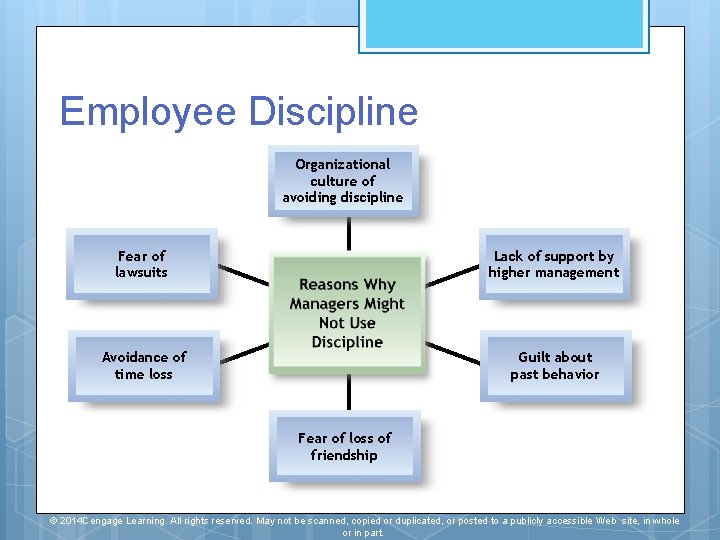
Employee Discipline Organizational culture of avoiding discipline Fear of lawsuits Lack of support by higher management Avoidance of time loss Guilt about past behavior Fear of loss of friendship © 2014 Cengage Learning. All rights reserved. May not be scanned, copied or duplicated, or posted to a publicly accessible Web site, in whole or in part.
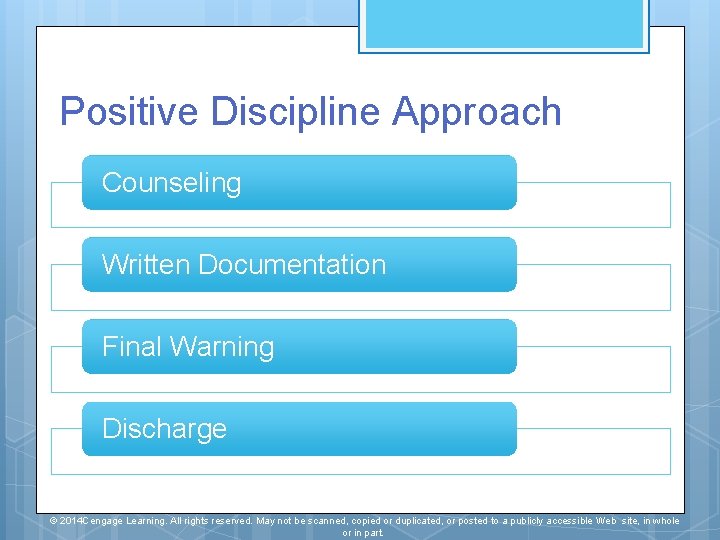
Positive Discipline Approach Counseling Written Documentation Final Warning Discharge © 2014 Cengage Learning. All rights reserved. May not be scanned, copied or duplicated, or posted to a publicly accessible Web site, in whole or in part.

Figure 15. 8 - Progressive Discipline Process © 2014 Cengage Learning. All rights reserved. May not be scanned, copied or duplicated, or posted to a publicly accessible Web site, in whole or in part.
Discharge and Termination Discharge: When an employee is removed from a job at an employer © 2014 Cengage Learning. All rights reserved. May not be scanned, copied or duplicated, or posted to a publicly accessible Web site, in whole or in part.
- Slides: 45