
HUMAN RESOURCE MANAGEMENT CHAPTER ONE WHY IS HUMAN


- Slides: 32
HUMAN RESOURCE MANAGEMENT CHAPTER ONE
WHY IS HUMAN RESOURCE IMPORTANT? • Affects the quality of goods and service produced • Is the driving force in organizational life cycle • is responsible for managing other resources of an organization • Prerequisite for organizational learning • Employees are scarce resources that should be acquired effectively, utilized, developed and retained. • Provides an organization with competitive advantage
DEFINITION OF HUMAN RESOURCE MANAGEMENT • Human resource management refers to the management of an organization’s most valued assets – the people working there who individually and collectively contribute to the achievement of its objectives. • Human Resource Management is the process of achieving organizational goal by attracting, developing, and retaining and properly using talented human resource. • Human resource management can be defined as a strategic, integrated and coherent approach to the employment, development and well-being of the people working in organizations. • Is about having the best human resources who are best utilized to produce cheaper and better quality goods and services • The process of managing human talent to achieve an organization’s objectives
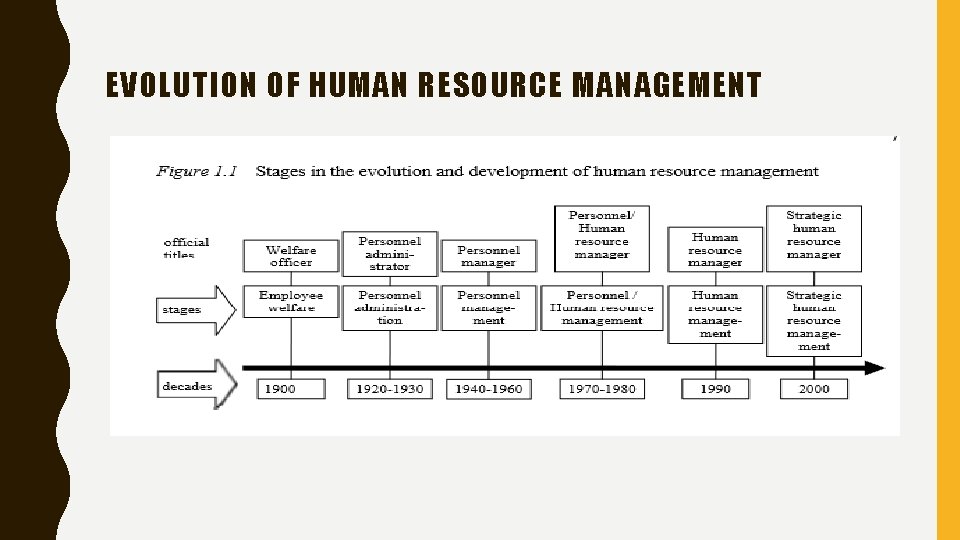
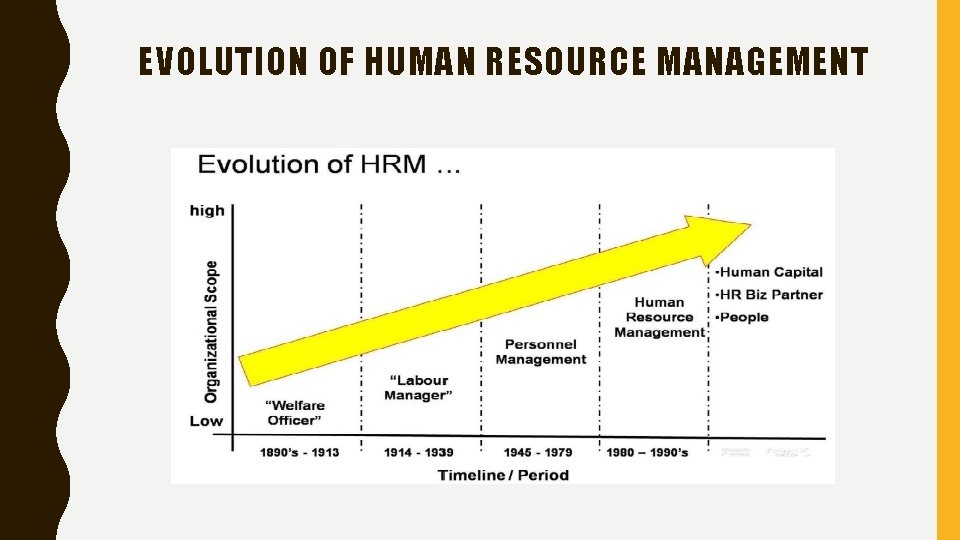
EVOLUTION OF HUMAN RESOURCE MANAGEMENT
EVOLUTION OF HUMAN RESOURCE MANAGEMENT
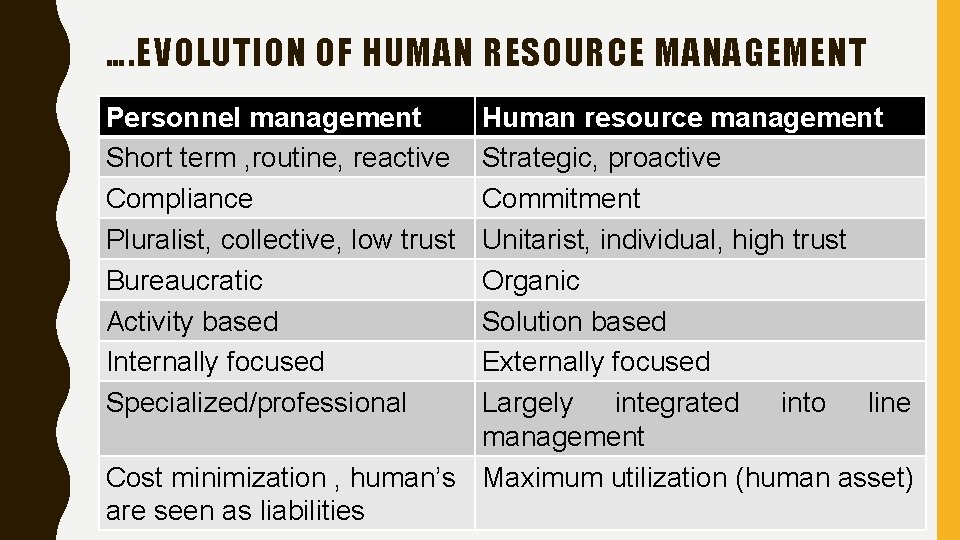
…. EVOLUTION OF HUMAN RESOURCE MANAGEMENT Personnel management Short term , routine, reactive Compliance Pluralist, collective, low trust Bureaucratic Activity based Internally focused Specialized/professional Human resource management Strategic, proactive Commitment Unitarist, individual, high trust Organic Solution based Externally focused Largely integrated into line management Cost minimization , human’s Maximum utilization (human asset) are seen as liabilities
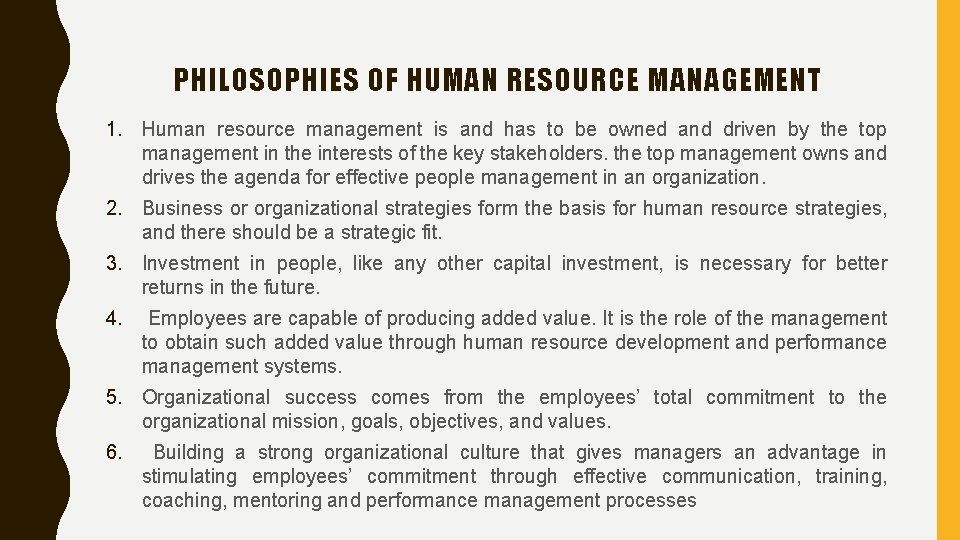
PHILOSOPHIES OF HUMAN RESOURCE MANAGEMENT 1. Human resource management is and has to be owned and driven by the top management in the interests of the key stakeholders. the top management owns and drives the agenda for effective people management in an organization. 2. Business or organizational strategies form the basis for human resource strategies, and there should be a strategic fit. 3. Investment in people, like any other capital investment, is necessary for better returns in the future. 4. Employees are capable of producing added value. It is the role of the management to obtain such added value through human resource development and performance management systems. 5. Organizational success comes from the employees’ total commitment to the organizational mission, goals, objectives, and values. 6. Building a strong organizational culture that gives managers an advantage in stimulating employees’ commitment through effective communication, training, coaching, mentoring and performance management processes
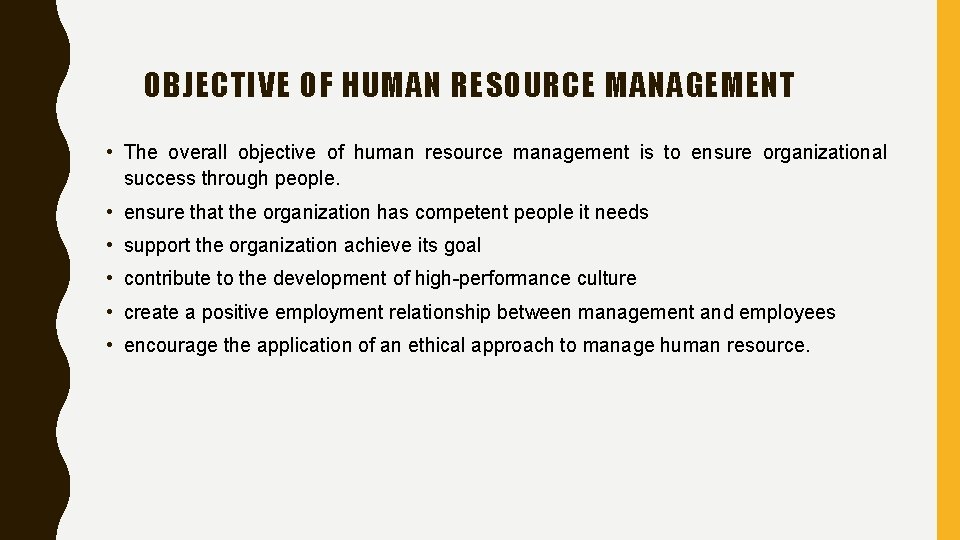
OBJECTIVE OF HUMAN RESOURCE MANAGEMENT • The overall objective of human resource management is to ensure organizational success through people. • ensure that the organization has competent people it needs • support the organization achieve its goal • contribute to the development of high-performance culture • create a positive employment relationship between management and employees • encourage the application of an ethical approach to manage human resource.
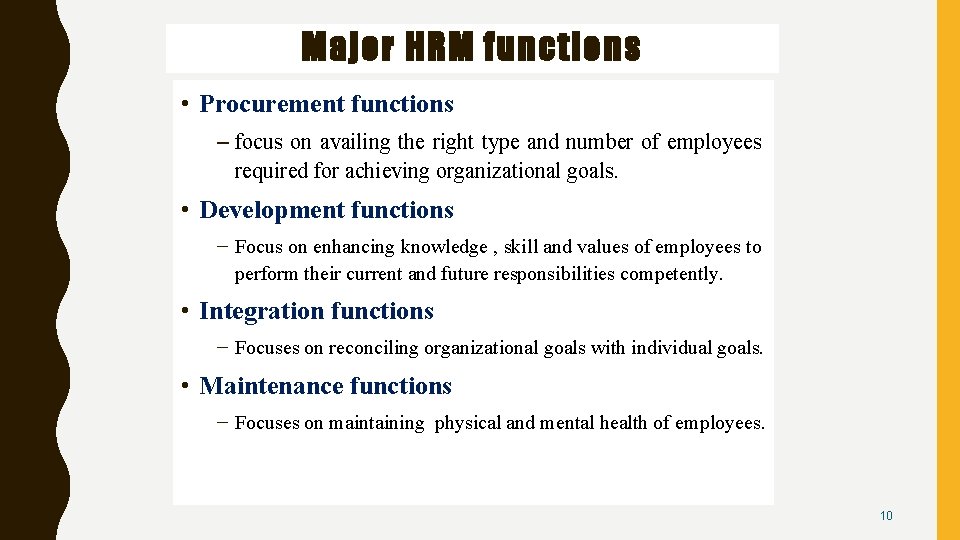
Major HRM functions • Procurement functions – focus on availing the right type and number of employees required for achieving organizational goals. • Development functions – Focus on enhancing knowledge , skill and values of employees to perform their current and future responsibilities competently. • Integration functions – Focuses on reconciling organizational goals with individual goals. • Maintenance functions – Focuses on maintaining physical and mental health of employees. 10
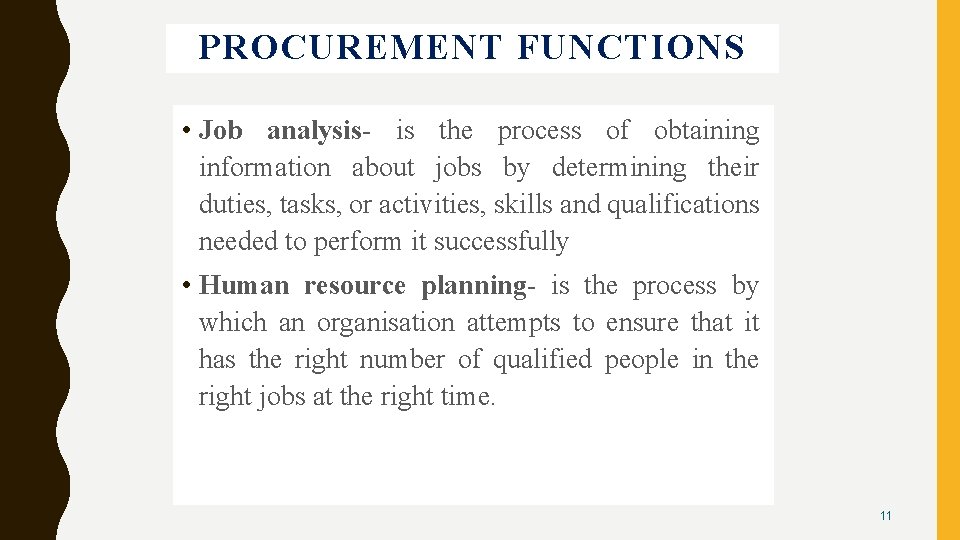
PROCUREMENT FUNCTIONS • Job analysis- is the process of obtaining information about jobs by determining their duties, tasks, or activities, skills and qualifications needed to perform it successfully • Human resource planning- is the process by which an organisation attempts to ensure that it has the right number of qualified people in the right jobs at the right time. 11
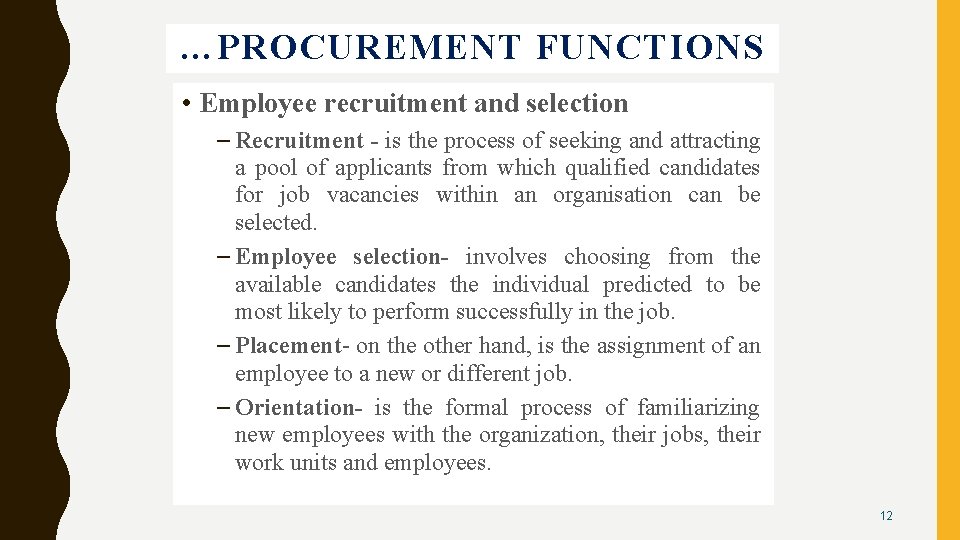
…PROCUREMENT FUNCTIONS • Employee recruitment and selection – Recruitment - is the process of seeking and attracting a pool of applicants from which qualified candidates for job vacancies within an organisation can be selected. – Employee selection- involves choosing from the available candidates the individual predicted to be most likely to perform successfully in the job. – Placement- on the other hand, is the assignment of an employee to a new or different job. – Orientation- is the formal process of familiarizing new employees with the organization, their jobs, their work units and employees. 12
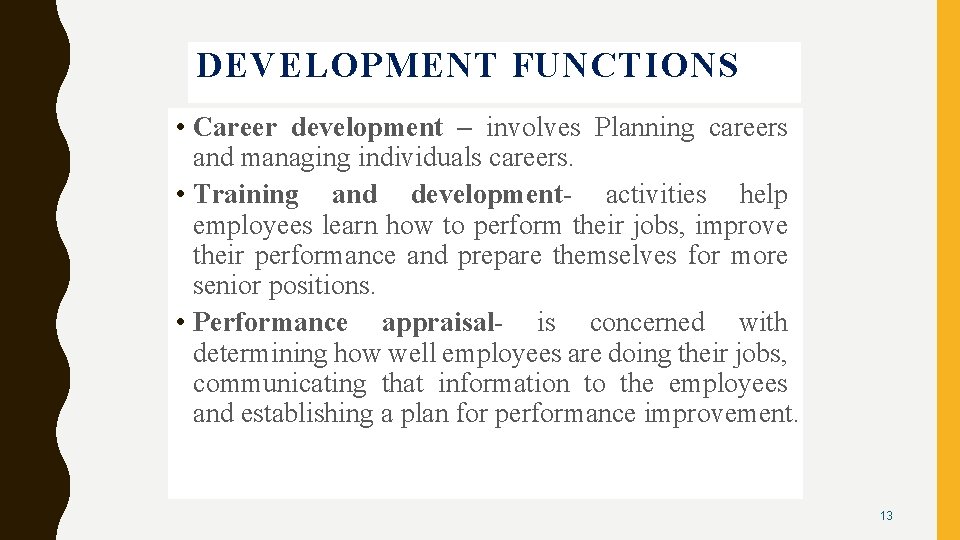
DEVELOPMENT FUNCTIONS • Career development – involves Planning careers and managing individuals careers. • Training and development- activities help employees learn how to perform their jobs, improve their performance and prepare themselves for more senior positions. • Performance appraisal- is concerned with determining how well employees are doing their jobs, communicating that information to the employees and establishing a plan for performance improvement. 13
INTEGRATION FUNCTIONS • Employee disciplining • Compensation refers to all types of rewards that employees receive in return for their services. 14
MAINTENANCE FUNCTIONS �Safety- involves protecting employees from injuries caused by work-related accidents. �Health- devising schemes that enhance employees' physical and mental well being. �Creating conducive working environment �Promoting smooth working relationship between management and employees 15
STRATEGIC IMPORTANCE OF HUMAN RESOURCE MANAGEMENT • If managed strategically HRM can bring organizational excellence through: – Becoming partner with top and line managers of an organization in strategy execution – Organizing work efficiently compromising quality to ensure costs are reduced without – Becoming representative of employees by representing employees concern to top management and by working on ways to increase employee commitment. – Become an agent of continuous change by shaping process and organizational culture.
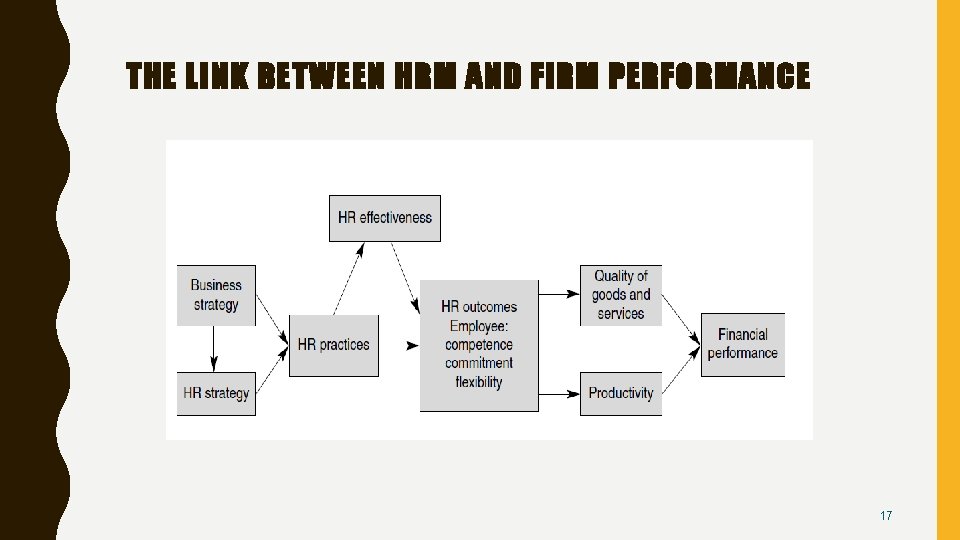
THE LINK BETWEEN HRM AND FIRM PERFORMANCE 17
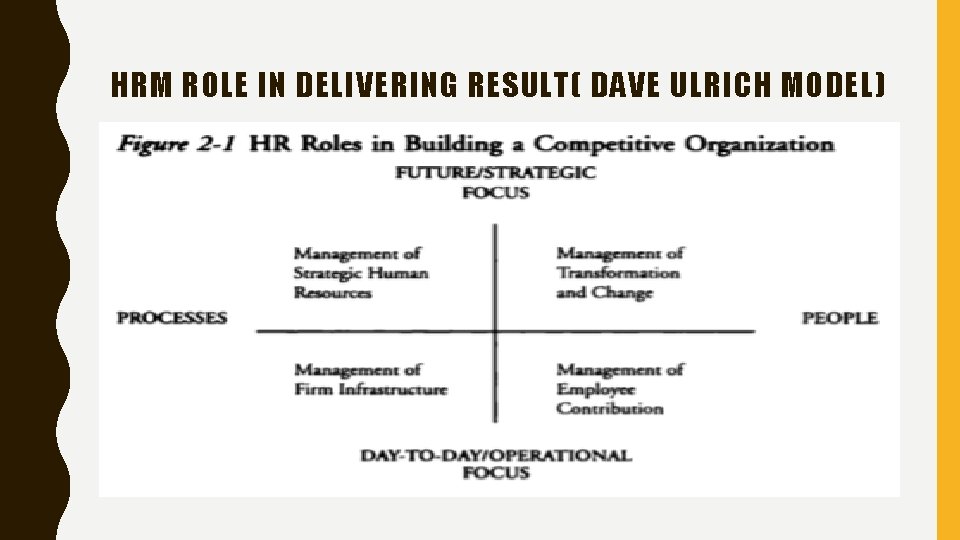
HRM ROLE IN DELIVERING RESULT( DAVE ULRICH MODEL)
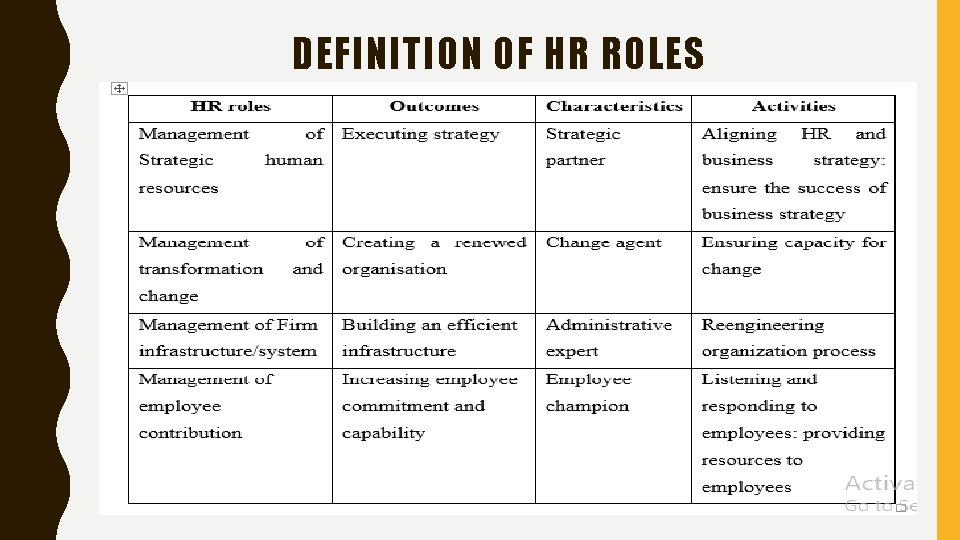
DEFINITION OF HR ROLES
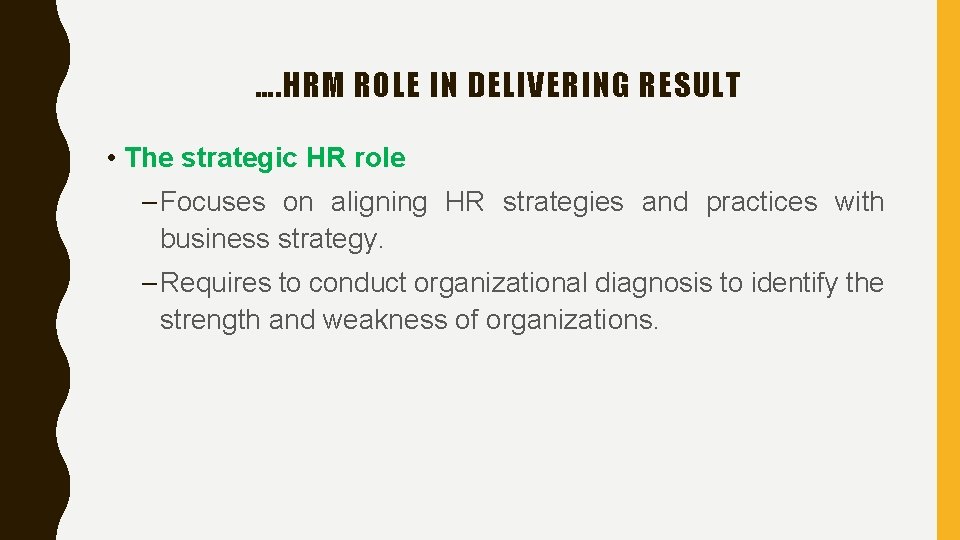
…. HRM ROLE IN DELIVERING RESULT • The strategic HR role – Focuses on aligning HR strategies and practices with business strategy. – Requires to conduct organizational diagnosis to identify the strength and weakness of organizations.
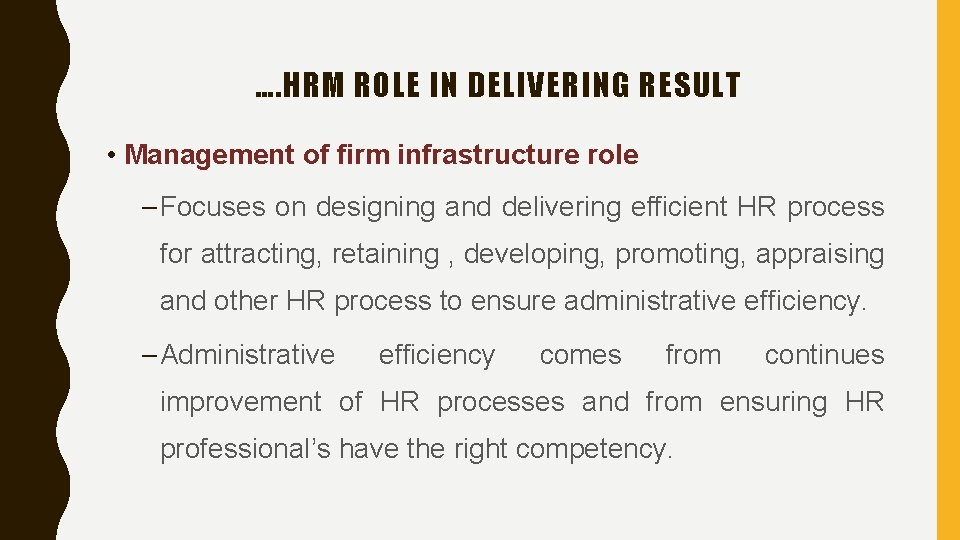
…. HRM ROLE IN DELIVERING RESULT • Management of firm infrastructure role – Focuses on designing and delivering efficient HR process for attracting, retaining , developing, promoting, appraising and other HR process to ensure administrative efficiency. – Administrative efficiency comes from continues improvement of HR processes and from ensuring HR professional’s have the right competency.
…. HRM ROLE IN DELIVERING RESULT • Management of employee contribution role – Encompasses involvement in the day to day problems, concerns and needs of employees. – Required understanding employees needs and working to met those needs in order to increase employees contributions. – Focuses on developing employees competences to deliver results.
…. HRM ROLE IN DELIVERING RESULT • Management of transformation and change role – HR professionals are expected to play cultural guardian's and cultural catalyst role. – Help employees let go of the past way of doing things and adapt to the new way of doing things. – Ensure the change occurs as intended by defining value and behavioral requirements of the change.
READING ASSIGNMENT • Read models of human resource management (Armstrong management practice page 4 -8) human resource
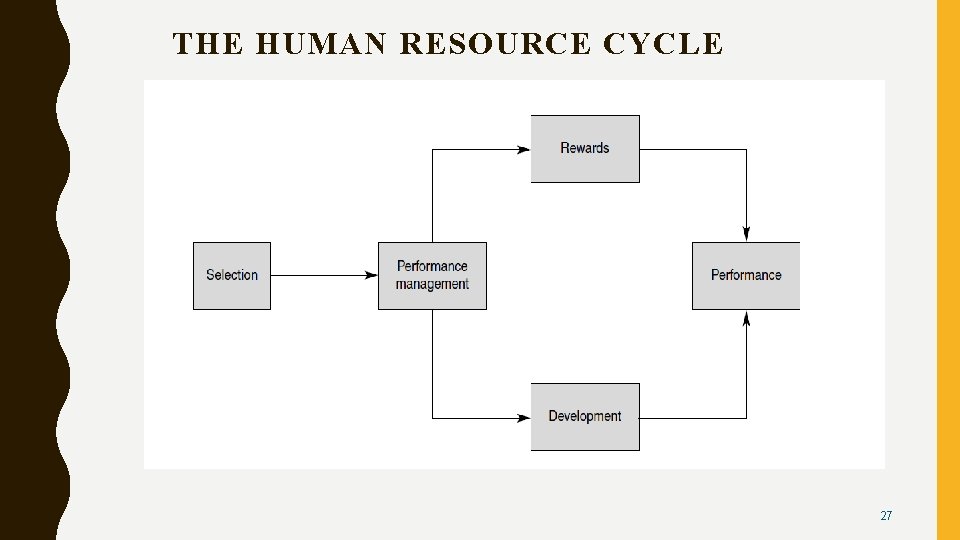
THE MICHIGAN/MATCHING MODEL o Emphasizes more on “tight fit” between the HR strategy and the business strategy. o Business strategy is the main focus o Human resources are taken like any other resource which must be fully utilized together with the other resources to achieve organizational objectives. o This model emphasizes more on the hard side of HRM • HR systems and the organization structure should be managed in a way that is congruent with organizational strategy 25
THE MICHIGAN/MATCHING MODEL
THE HUMAN RESOURCE CYCLE 27
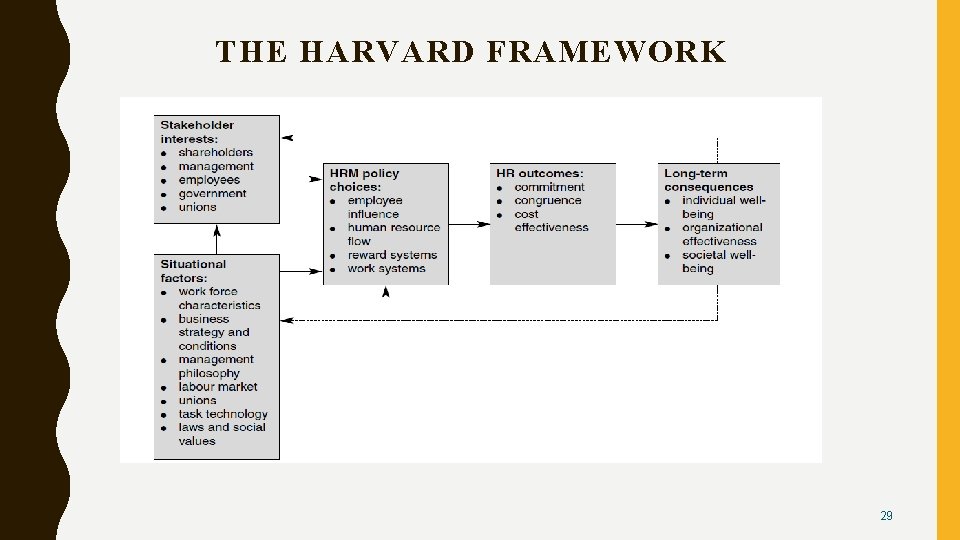
HARVARD MODEL OF HRM o The Harvard model acknowledges the existence of multiple stakeholders within the organization. • • • shareholders management employees, government and the community at large o interest of the various groups must be fused and factored in the creation of HRM strategies and ultimately the creation of business strategies. o This model emphasizes more on the human/soft side of HRM o Emphasizes the importance of employees like any other stakeholder in influencing organizational outcomes. 28
THE HARVARD FRAMEWORK 29
CHARACTERISTICS OF HRM IN HARVARD FRAMEWORK • Line managers accept more responsibility for ensuring the alignment of competitive strategy and HRM policy • HRM has the mission of setting policies that govern how HR activities are developed and implemented in ways that make them more mutually reinforcing • HRM is the concern of management in general rather than the HRM function in particular. 30
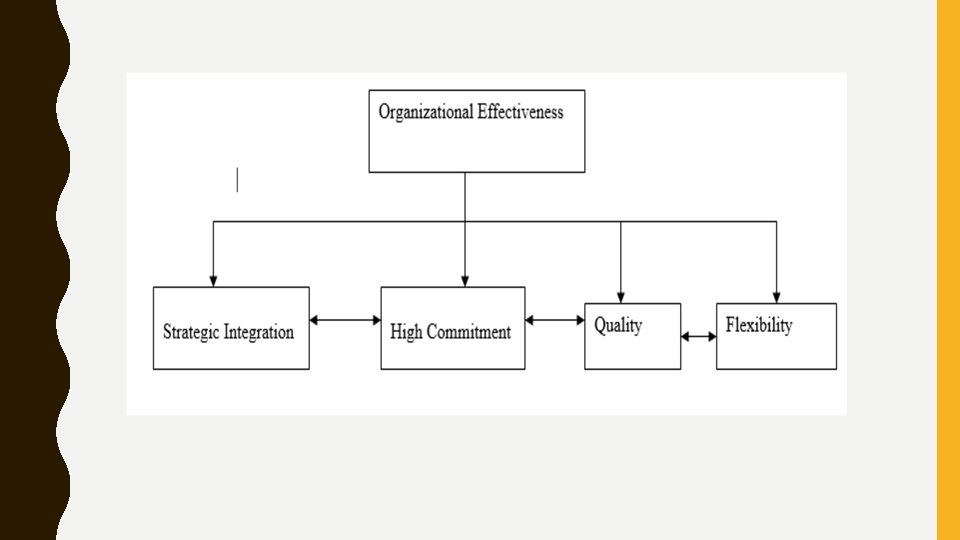
GUEST MODEL OF HRM o This model is a fusion of hard and a soft approach of HRM. o Guest proposes 4 crucial components that underpin organizational effectiveness. 1. Strategic Integration This is the ability of organizations to maintain a fit between the HRM strategy and the business strategy. In other words, there must be congruence between business strategy and the HR strategy for the organization to achieve its goals. 31
GUEST MODEL OF HRM 2. Flexibility the ability of the organization and its people to adapt to the changing business and work environment. 3. High Commitment attitudinal commitment- which is reflected through a strong identification with the organization. behavioral commitment- the ability to go an extra mile, and 4. Quality is based on the assumption that provision of high quality goods and services results from a quality way of managing people. 32