
Human Resource Management 1 ELEVENTH EDITION GARY DESSLER

- Slides: 54
Human Resource Management 1 ELEVENTH EDITION GARY DESSLER Part 5 | Employee Relations Chapter 16 Employee Safety and Health © 2008 Prentice Hall, Inc. All rights reserved. Power. Point Presentation by Charlie Cook The University of West Alabama
J. J. Keller On. Line J. J. Keller Online © 2008 Prentice Hall, Inc. All rights reserved. 16– 2
Occupational Safety Law • Occupational Safety and Health Act Ø The law passed by Congress in 1970 “to assure so far as possible every working man and woman in the nation safe and healthful working conditions and to preserve our human resources. ” • Occupational Safety and Health Administration (OSHA) Ø The agency created within the Department of Labor to set safety and health standards for almost all workers in the United States. © 2008 Prentice Hall, Inc. All rights reserved. 16– 3
OSHA Standards and Record Keeping • OSHA Standards Ø General industry standards, maritime standards, construction standards, other regulations and procedures, and a field operations manual. • Record Keeping Ø Employers with 11 or more employees must maintain records of, and report, occupational injuries and occupational illnesses. Ø Occupational illness v Any abnormal condition or disorder caused by exposure to environmental factors associated with employment. © 2008 Prentice Hall, Inc. All rights reserved. 16– 4
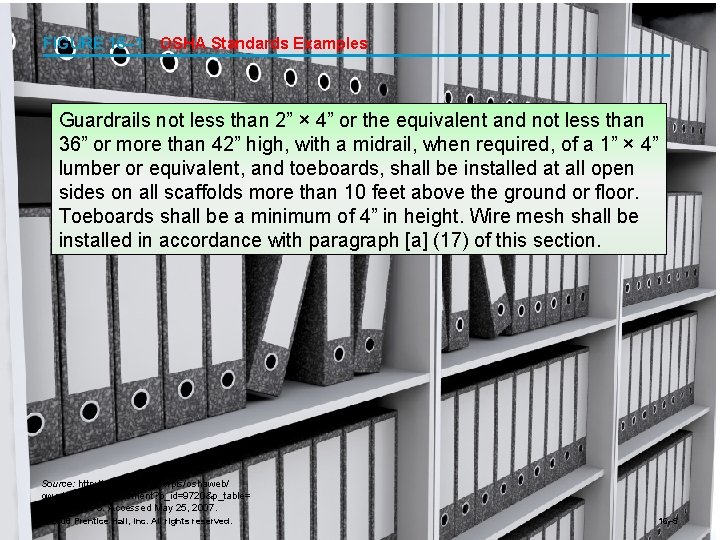
FIGURE 16– 1 OSHA Standards Examples Guardrails not less than 2” × 4” or the equivalent and not less than 36” or more than 42” high, with a midrail, when required, of a 1” × 4” lumber or equivalent, and toeboards, shall be installed at all open sides on all scaffolds more than 10 feet above the ground or floor. Toeboards shall be a minimum of 4” in height. Wire mesh shall be installed in accordance with paragraph [a] (17) of this section. Source: http: //www. osha. gov/pls/oshaweb/ owadisp. show_document? p_id=9720&p_table= STANDARDS. Accessed May 25, 2007. © 2008 Prentice Hall, Inc. All rights reserved. 16– 5
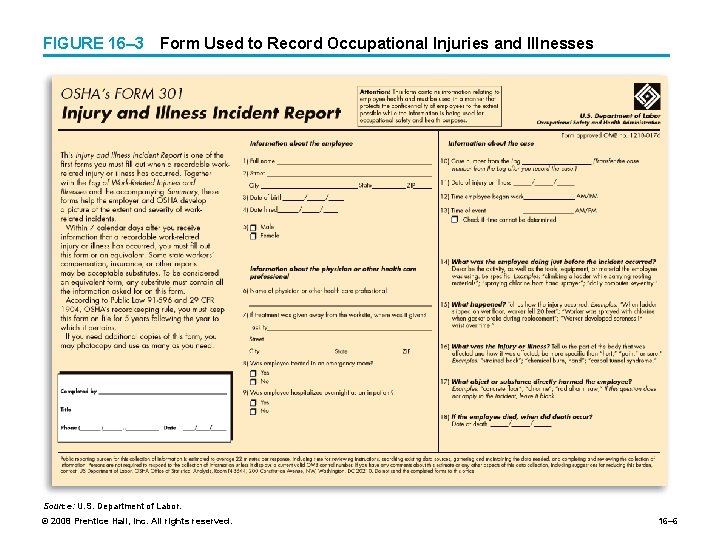
FIGURE 16– 3 Form Used to Record Occupational Injuries and Illnesses Source: U. S. Department of Labor. © 2008 Prentice Hall, Inc. All rights reserved. 16– 6
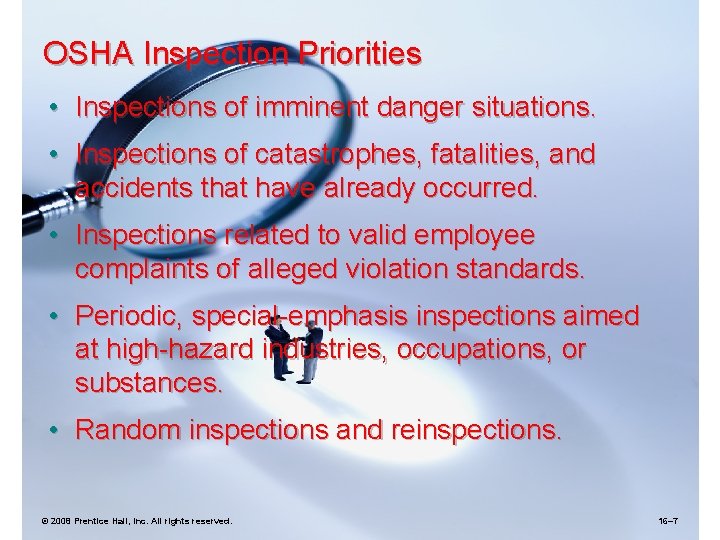
OSHA Inspection Priorities • Inspections of imminent danger situations. • Inspections of catastrophes, fatalities, and accidents that have already occurred. • Inspections related to valid employee complaints of alleged violation standards. • Periodic, special-emphasis inspections aimed at high-hazard industries, occupations, or substances. • Random inspections and reinspections. © 2008 Prentice Hall, Inc. All rights reserved. 16– 7
Citations and Penalties • Citation Ø A summons informing employers and employees of the regulations and standards that have been violated in the workplace. • Penalties Ø Are calculated based on the gravity of the violation and usually take into consideration factors like the size of the business, the firm’s compliance history, and the employer’s good faith. © 2008 Prentice Hall, Inc. All rights reserved. 16– 8
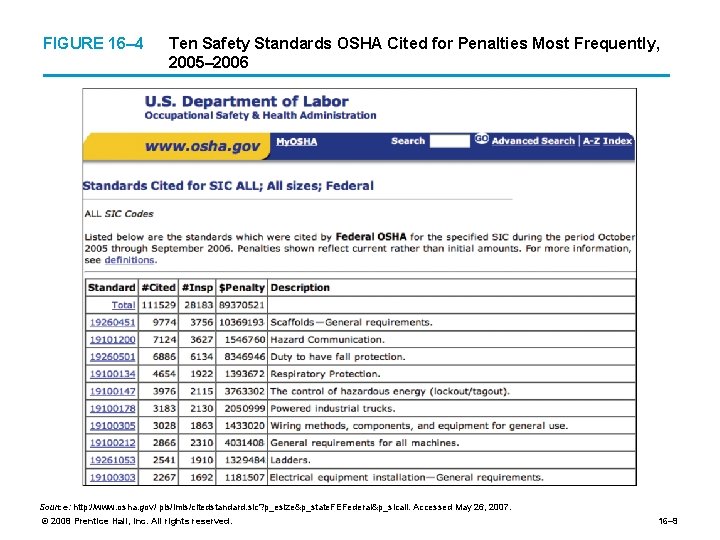
FIGURE 16– 4 Ten Safety Standards OSHA Cited for Penalties Most Frequently, 2005– 2006 Source: http: //www. osha. gov/ pls/imis/citedstandard. sic? p_esize&p_state. FEFederal&p_sicall. Accessed May 26, 2007. © 2008 Prentice Hall, Inc. All rights reserved. 16– 9
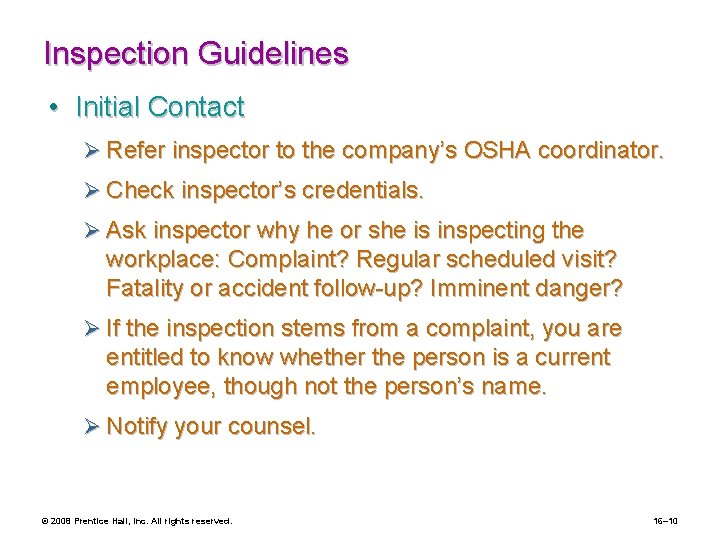
Inspection Guidelines • Initial Contact Ø Refer inspector to the company’s OSHA coordinator. Ø Check inspector’s credentials. Ø Ask inspector why he or she is inspecting the workplace: Complaint? Regular scheduled visit? Fatality or accident follow-up? Imminent danger? Ø If the inspection stems from a complaint, you are entitled to know whether the person is a current employee, though not the person’s name. Ø Notify your counsel. © 2008 Prentice Hall, Inc. All rights reserved. 16– 10
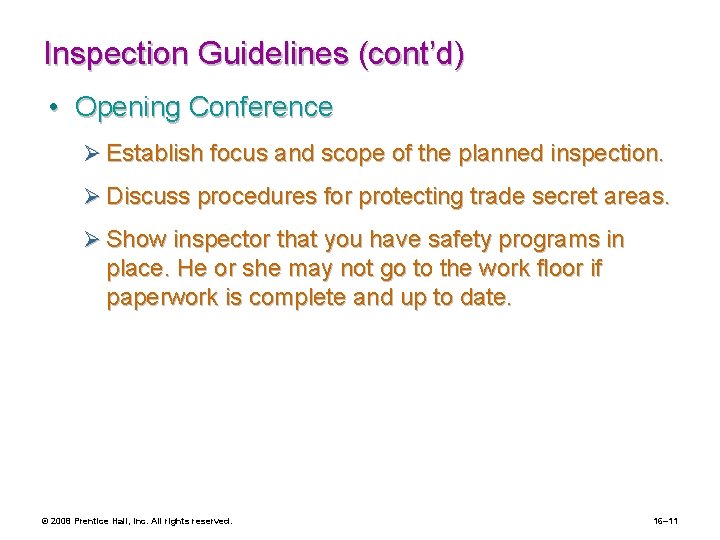
Inspection Guidelines (cont’d) • Opening Conference Ø Establish focus and scope of the planned inspection. Ø Discuss procedures for protecting trade secret areas. Ø Show inspector that you have safety programs in place. He or she may not go to the work floor if paperwork is complete and up to date. © 2008 Prentice Hall, Inc. All rights reserved. 16– 11
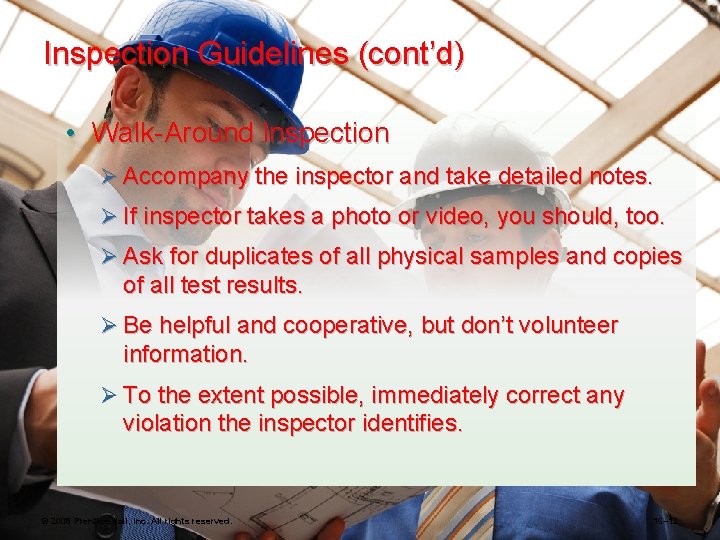
Inspection Guidelines (cont’d) • Walk-Around Inspection Ø Accompany the inspector and take detailed notes. Ø If inspector takes a photo or video, you should, too. Ø Ask for duplicates of all physical samples and copies of all test results. Ø Be helpful and cooperative, but don’t volunteer information. Ø To the extent possible, immediately correct any violation the inspector identifies. © 2008 Prentice Hall, Inc. All rights reserved. 16– 12
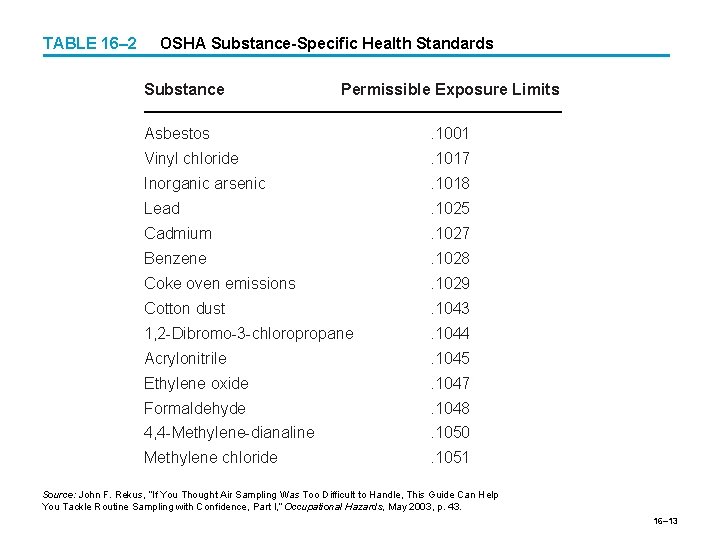
TABLE 16– 2 OSHA Substance-Specific Health Standards Substance Permissible Exposure Limits Asbestos . 1001 Vinyl chloride . 1017 Inorganic arsenic . 1018 Lead . 1025 Cadmium . 1027 Benzene . 1028 Coke oven emissions . 1029 Cotton dust . 1043 1, 2 -Dibromo-3 -chloropropane . 1044 Acrylonitrile . 1045 Ethylene oxide . 1047 Formaldehyde . 1048 4, 4 -Methylene-dianaline . 1050 Methylene chloride . 1051 Source: John F. Rekus, “If You Thought Air Sampling Was Too Difficult to Handle, This Guide Can Help You Tackle Routine Sampling with Confidence, Part I, ” Occupational Hazards, May 2003, p. 43. 16– 13
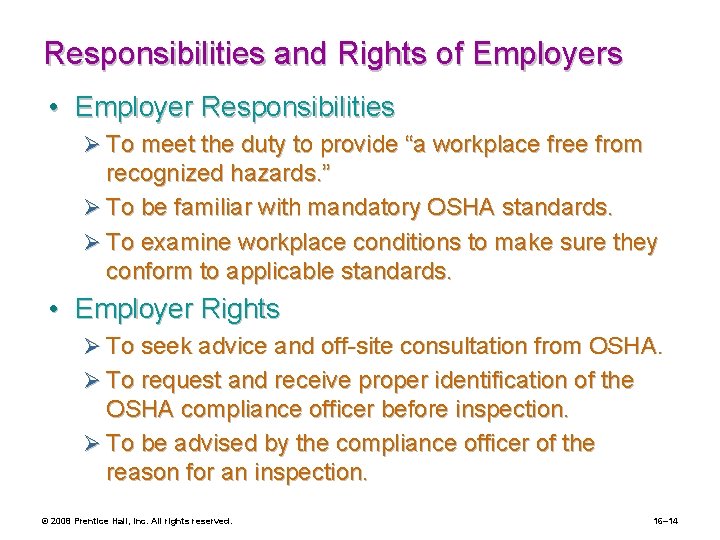
Responsibilities and Rights of Employers • Employer Responsibilities Ø To meet the duty to provide “a workplace free from recognized hazards. ” Ø To be familiar with mandatory OSHA standards. Ø To examine workplace conditions to make sure they conform to applicable standards. • Employer Rights Ø To seek advice and off-site consultation from OSHA. Ø To request and receive proper identification of the OSHA compliance officer before inspection. Ø To be advised by the compliance officer of the reason for an inspection. © 2008 Prentice Hall, Inc. All rights reserved. 16– 14
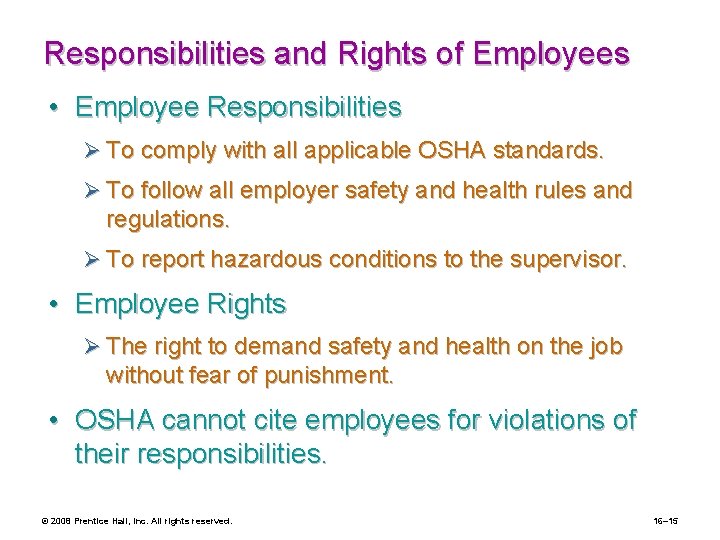
Responsibilities and Rights of Employees • Employee Responsibilities Ø To comply with all applicable OSHA standards. Ø To follow all employer safety and health rules and regulations. Ø To report hazardous conditions to the supervisor. • Employee Rights Ø The right to demand safety and health on the job without fear of punishment. • OSHA cannot cite employees for violations of their responsibilities. © 2008 Prentice Hall, Inc. All rights reserved. 16– 15
© 2008 Prentice Hall, Inc. All rights reserved. 16– 16
© 2008 Prentice Hall, Inc. All rights reserved. 16– 17
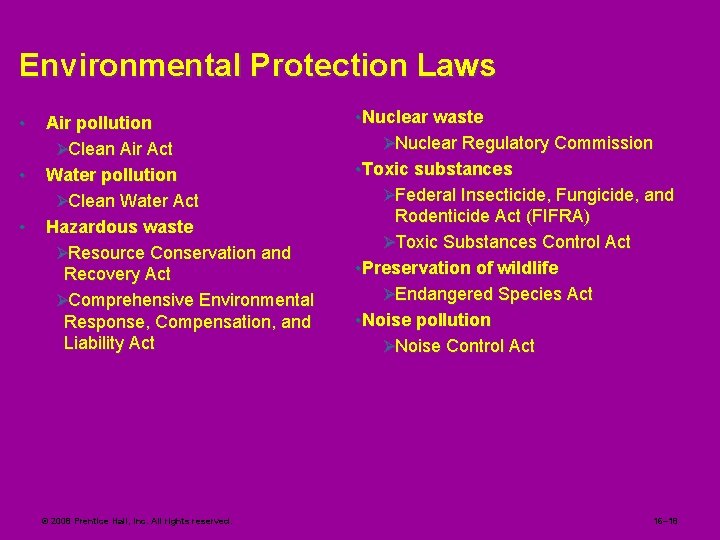
Environmental Protection Laws • • • Air pollution ØClean Air Act Water pollution ØClean Water Act Hazardous waste ØResource Conservation and Recovery Act ØComprehensive Environmental Response, Compensation, and Liability Act © 2008 Prentice Hall, Inc. All rights reserved. • Nuclear waste ØNuclear Regulatory Commission • Toxic substances ØFederal Insecticide, Fungicide, and Rodenticide Act (FIFRA) ØToxic Substances Control Act • Preservation of wildlife ØEndangered Species Act • Noise pollution ØNoise Control Act 16– 18
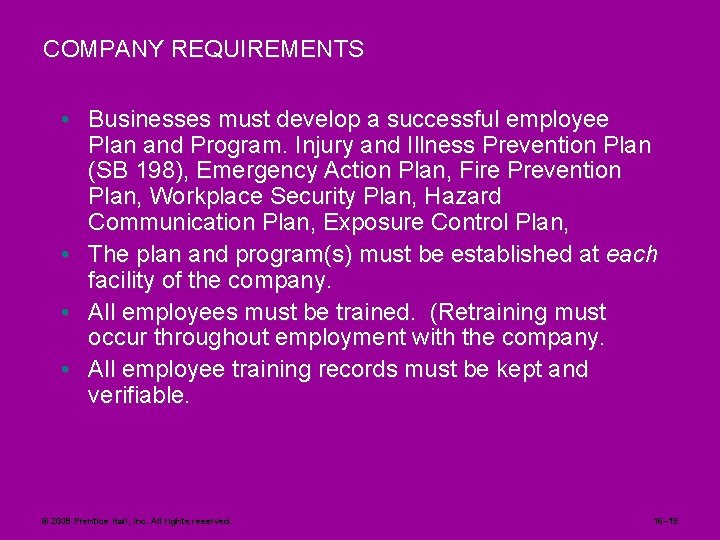
COMPANY REQUIREMENTS • Businesses must develop a successful employee Plan and Program. Injury and Illness Prevention Plan (SB 198), Emergency Action Plan, Fire Prevention Plan, Workplace Security Plan, Hazard Communication Plan, Exposure Control Plan, • The plan and program(s) must be established at each facility of the company. • All employees must be trained. (Retraining must occur throughout employment with the company. • All employee training records must be kept and verifiable. © 2008 Prentice Hall, Inc. All rights reserved. 16– 19
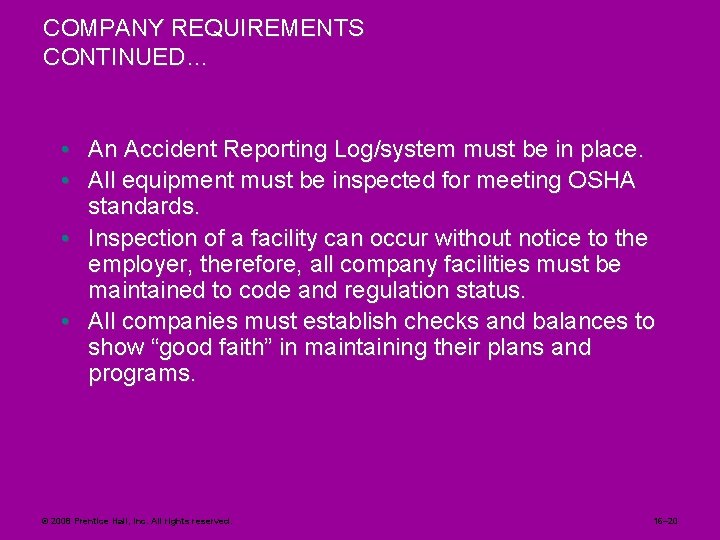
COMPANY REQUIREMENTS CONTINUED… • An Accident Reporting Log/system must be in place. • All equipment must be inspected for meeting OSHA standards. • Inspection of a facility can occur without notice to the employer, therefore, all company facilities must be maintained to code and regulation status. • All companies must establish checks and balances to show “good faith” in maintaining their plans and programs. © 2008 Prentice Hall, Inc. All rights reserved. 16– 20
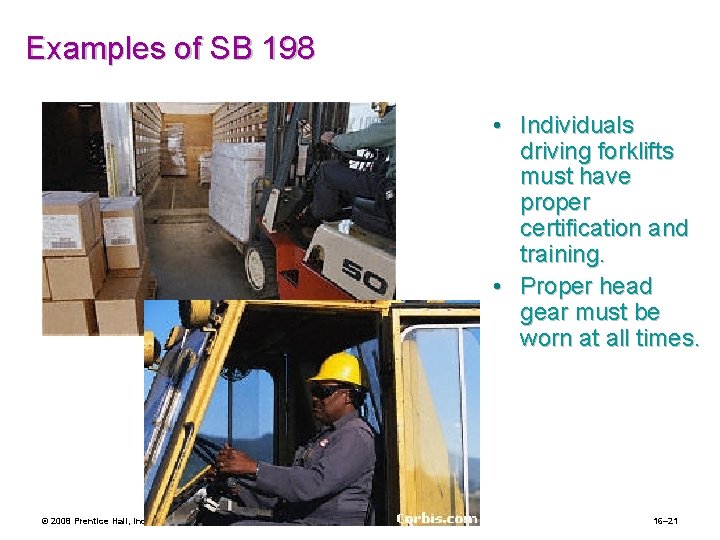
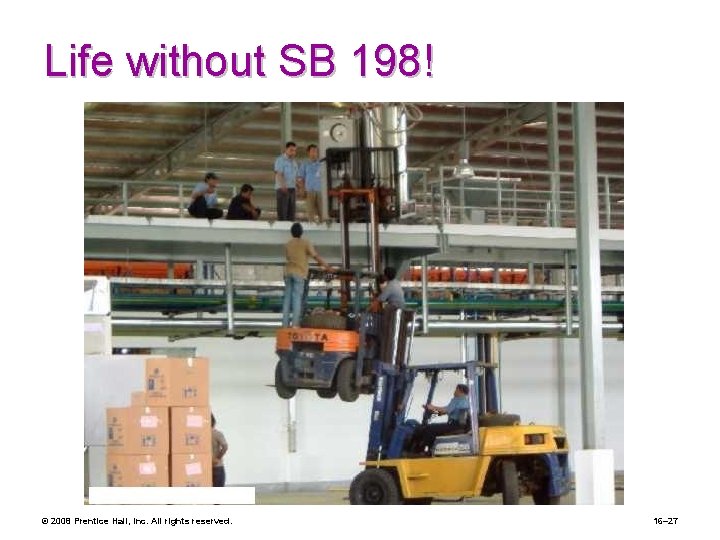
Examples of SB 198 © 2008 Prentice Hall, Inc. All rights reserved. • Individuals driving forklifts must have proper certification and training. • Proper head gear must be worn at all times. 16– 21
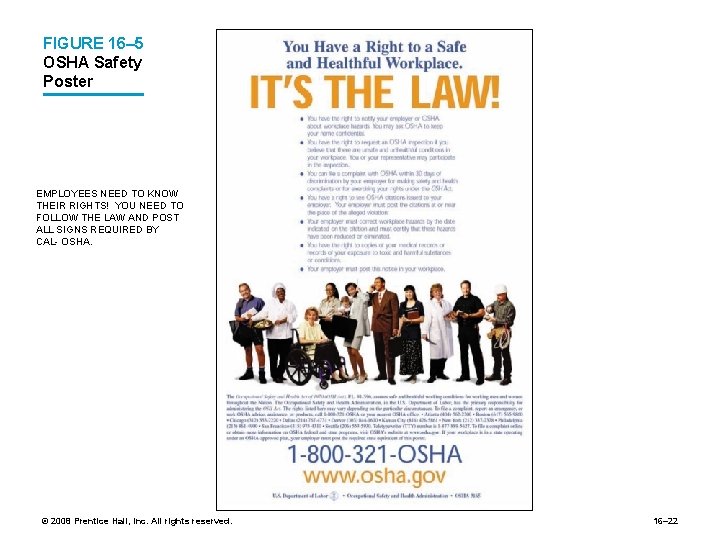
FIGURE 16– 5 OSHA Safety Poster EMPLOYEES NEED TO KNOW THEIR RIGHTS! YOU NEED TO FOLLOW THE LAW AND POST ALL SIGNS REQUIRED BY CAL- OSHA. © 2008 Prentice Hall, Inc. All rights reserved. 16– 22
Life without SB 198, DOT & OSHA
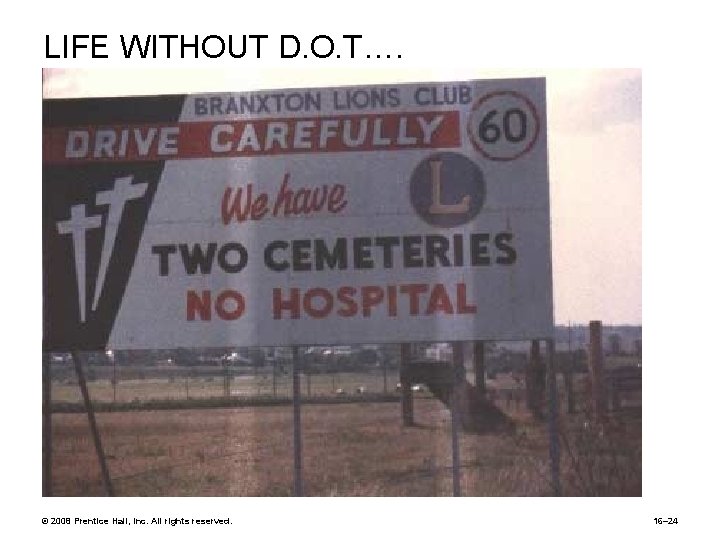
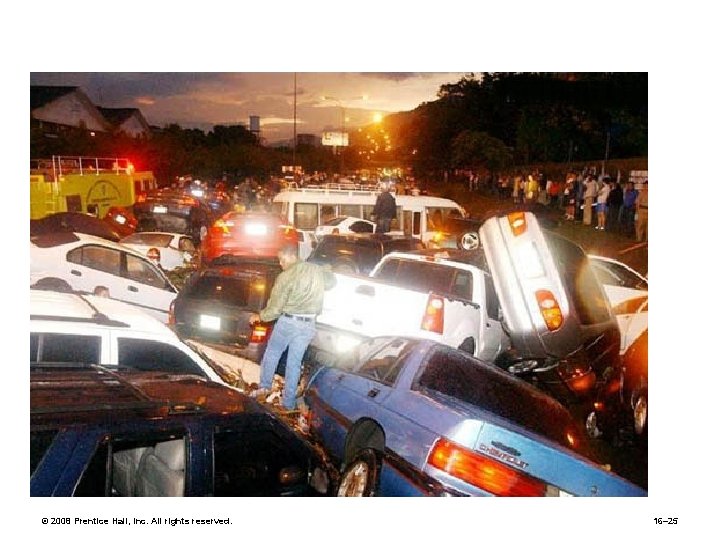
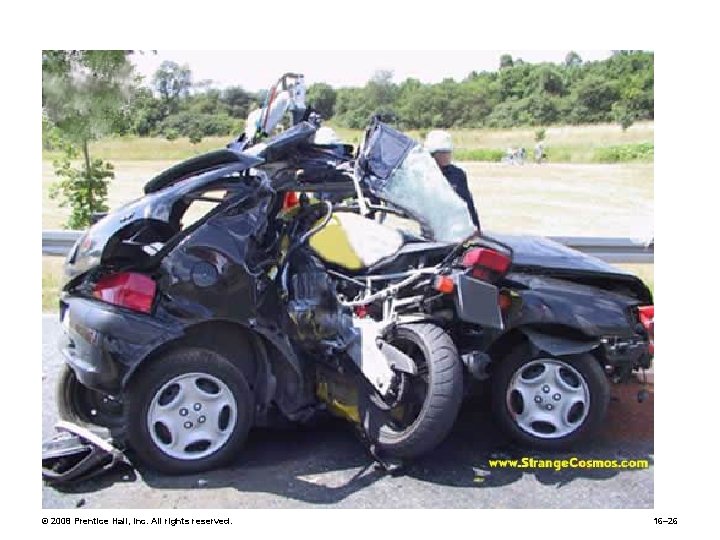
LIFE WITHOUT D. O. T…. © 2008 Prentice Hall, Inc. All rights reserved. 16– 24
© 2008 Prentice Hall, Inc. All rights reserved. 16– 25
© 2008 Prentice Hall, Inc. All rights reserved. 16– 26
Life without SB 198! © 2008 Prentice Hall, Inc. All rights reserved. 16– 27
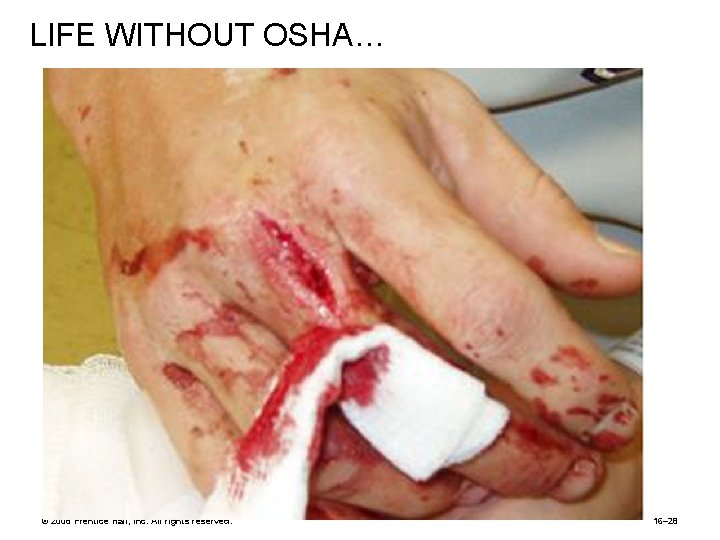
LIFE WITHOUT OSHA… © 2008 Prentice Hall, Inc. All rights reserved. 16– 28
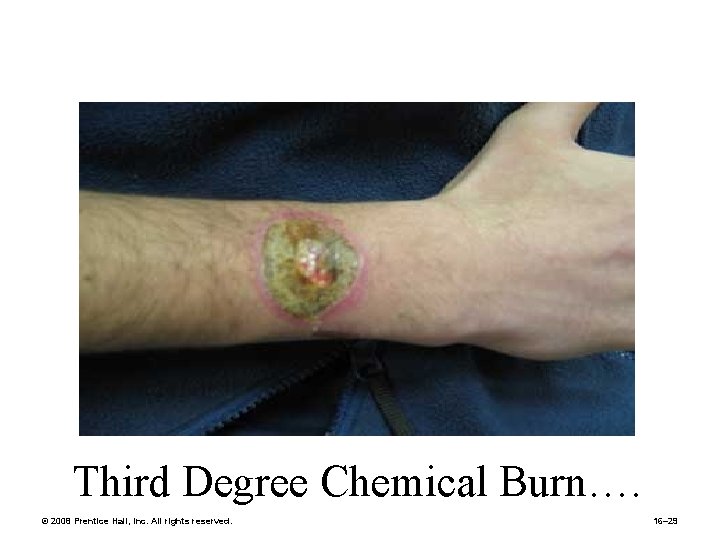
Third Degree Chemical Burn…. © 2008 Prentice Hall, Inc. All rights reserved. 16– 29
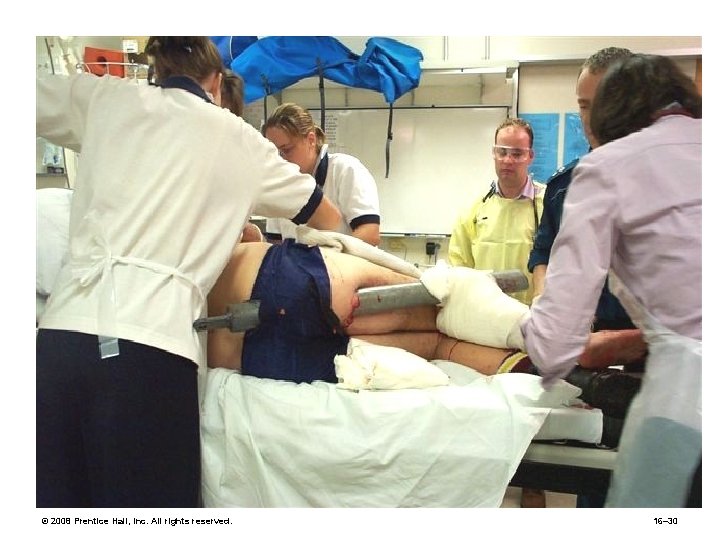
© 2008 Prentice Hall, Inc. All rights reserved. 16– 30
Accident Reporting © 2008 Prentice Hall, Inc. All rights reserved. • Accident reporting is part of SB 198. Emergency response teams are ready within the company to respond in conjunction with outside response from the Fire Department, Police or other medical response teams. 16– 31
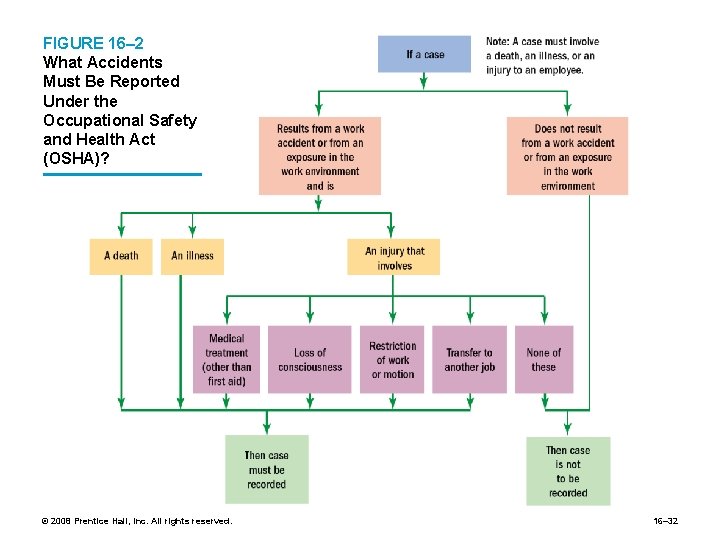
FIGURE 16– 2 What Accidents Must Be Reported Under the Occupational Safety and Health Act (OSHA)? © 2008 Prentice Hall, Inc. All rights reserved. 16– 32
10 Ways To Get into Trouble with OSHA 1. 2. Ignore or retaliate against employees who raise safety issues. 3. 4. Keep inaccurate OSHA logs and have disorganized safety files. 5. Fail to control the flow of information during and after an inspection. 6. Do not conduct a safety audit, or identify a serious hazard and do nothing about it. 7. 8. Do not use appropriate engineering controls. Antagonize or lie to OSHA during an inspection. Do not correct hazards OSHA has cited you for and ignore commonly cited hazards. Do not take a systemic approach toward safety. 9. Do not enforce safety rules. 10. Ignore industrial hygiene issues. © 2008 Prentice Hall, Inc. All rights reserved. 16– 33
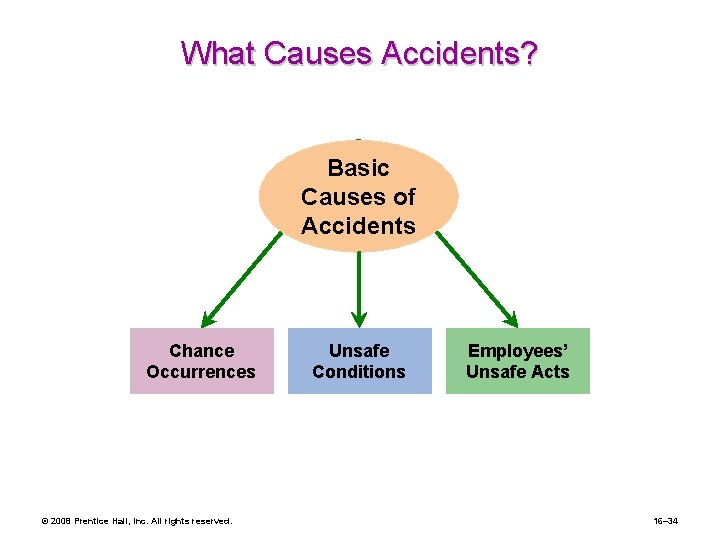
What Causes Accidents? Basic Causes of Accidents Chance Occurrences © 2008 Prentice Hall, Inc. All rights reserved. Unsafe Conditions Employees’ Unsafe Acts 16– 34
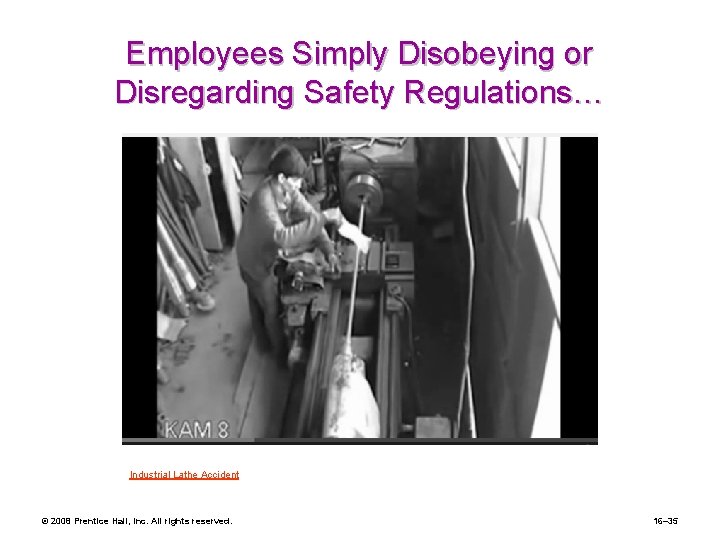
Employees Simply Disobeying or Disregarding Safety Regulations… Industrial Lathe Accident © 2008 Prentice Hall, Inc. All rights reserved. 16– 35
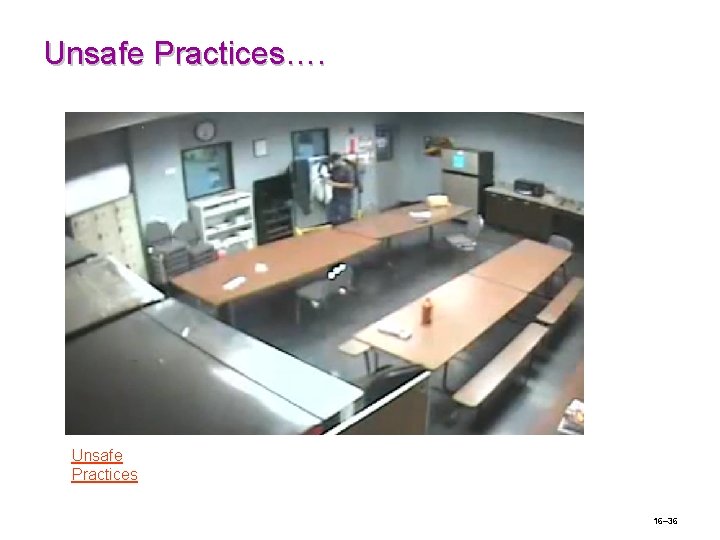
Unsafe Practices…. Unsafe Practices 16– 36
Dealing with Employee Resistance • The employer is liable for any penalties that result from employees’ noncompliance with OSHA standards. Ø Ways to gain compliance v Bargain with the union for the right to discharge or discipline an employee who disobeys an OSHA standard. v Establish a formal employer-employee arbitration process for resolving OSHA-related disputes. v Use positive reinforcement and training for gaining employee compliance. v Discipline Process and Termination for repeated non-compliance © 2008 Prentice Hall, Inc. All rights reserved.
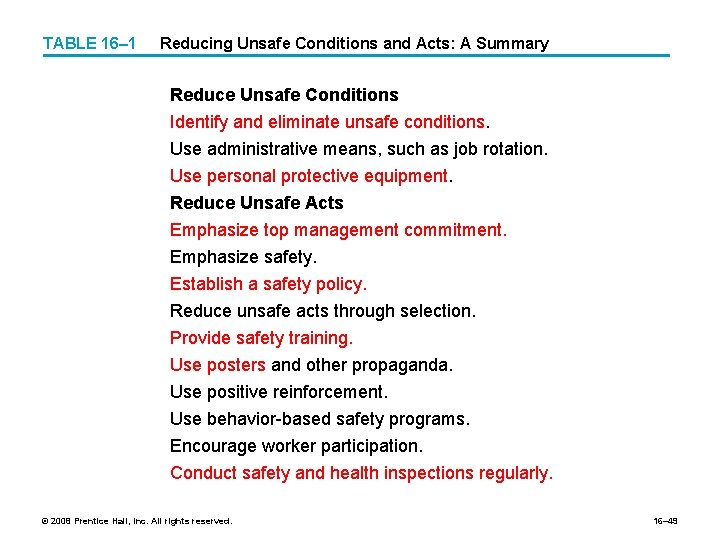
How to Prevent Accidents • Reduce unsafe conditions and encourage use of personal protective equipment • Emphasize safety • Select safety-minded employees • Provide safety training • Use posters, incentive programs, and positive reinforcement to motivate employees • Use behavior-based safety • Use employee participation • Conduct safety and health audits and inspections © 2008 Prentice Hall, Inc. All rights reserved. 16– 38
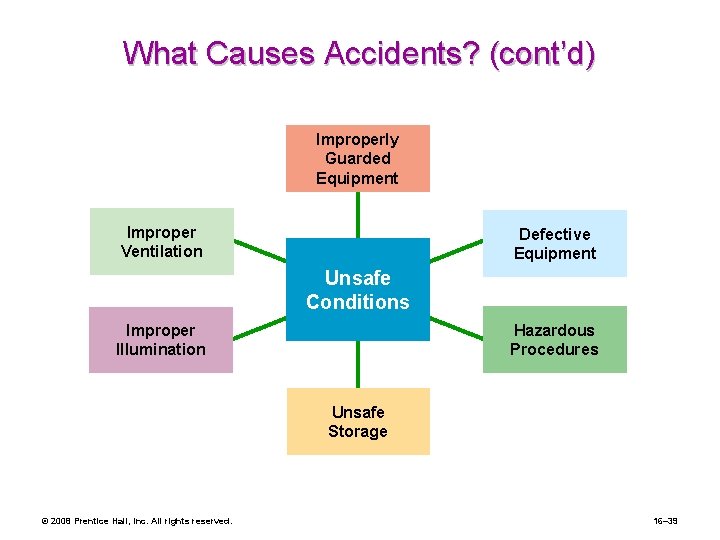
What Causes Accidents? (cont’d) Improperly Guarded Equipment Improper Ventilation Defective Equipment Unsafe Conditions Hazardous Procedures Improper Illumination Unsafe Storage © 2008 Prentice Hall, Inc. All rights reserved. 16– 39
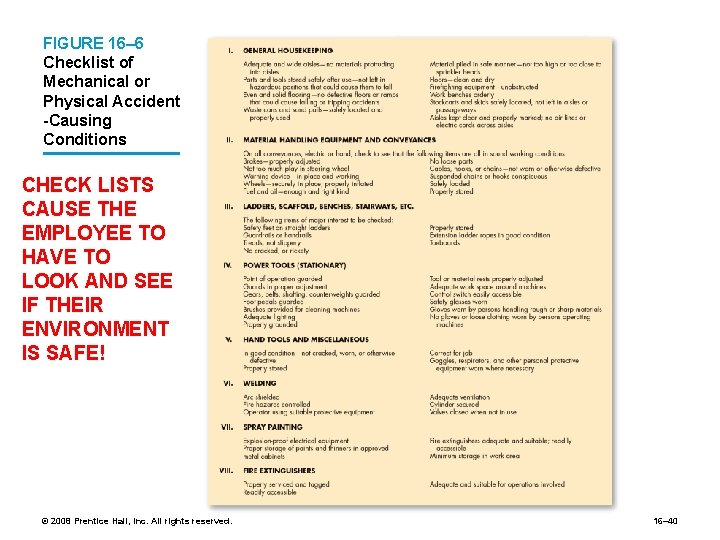
FIGURE 16– 6 Checklist of Mechanical or Physical Accident -Causing Conditions CHECK LISTS CAUSE THE EMPLOYEE TO HAVE TO LOOK AND SEE IF THEIR ENVIRONMENT IS SAFE! © 2008 Prentice Hall, Inc. All rights reserved. 16– 40
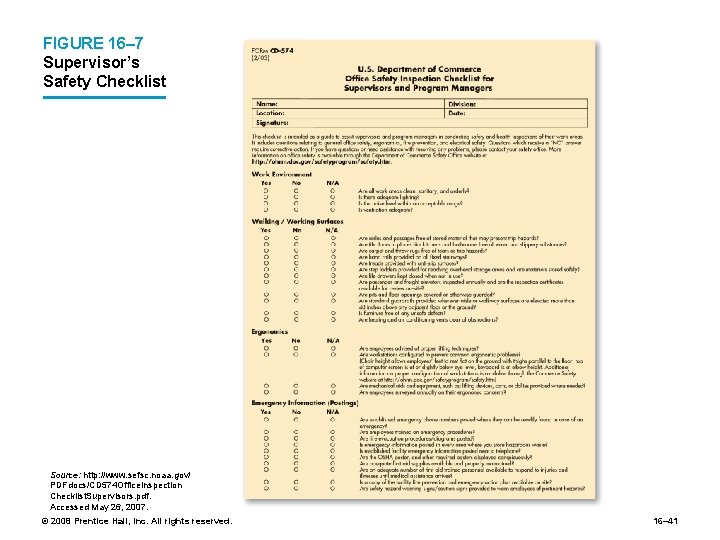
FIGURE 16– 7 Supervisor’s Safety Checklist Source: http: //www. sefsc. noaa. gov/ PDFdocs/CD 574 Office. Inspection Checklist. Supervisors. pdf. Accessed May 26, 2007. © 2008 Prentice Hall, Inc. All rights reserved. 16– 41
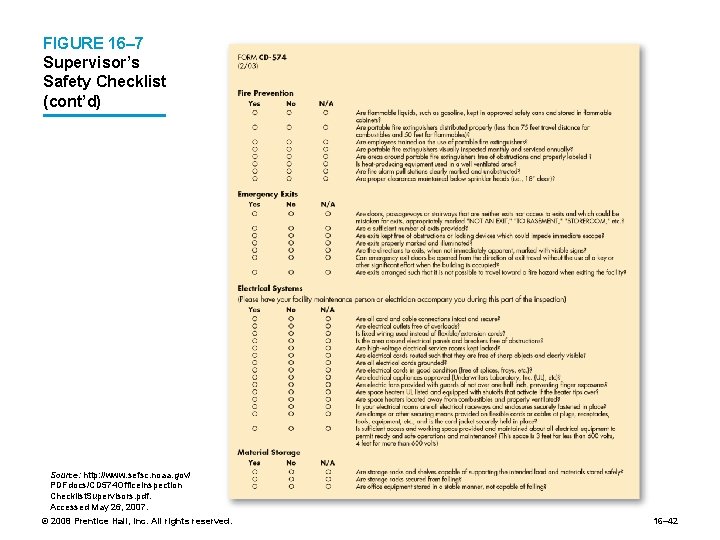
FIGURE 16– 7 Supervisor’s Safety Checklist (cont’d) Source: http: //www. sefsc. noaa. gov/ PDFdocs/CD 574 Office. Inspection Checklist. Supervisors. pdf. Accessed May 26, 2007. © 2008 Prentice Hall, Inc. All rights reserved. 16– 42
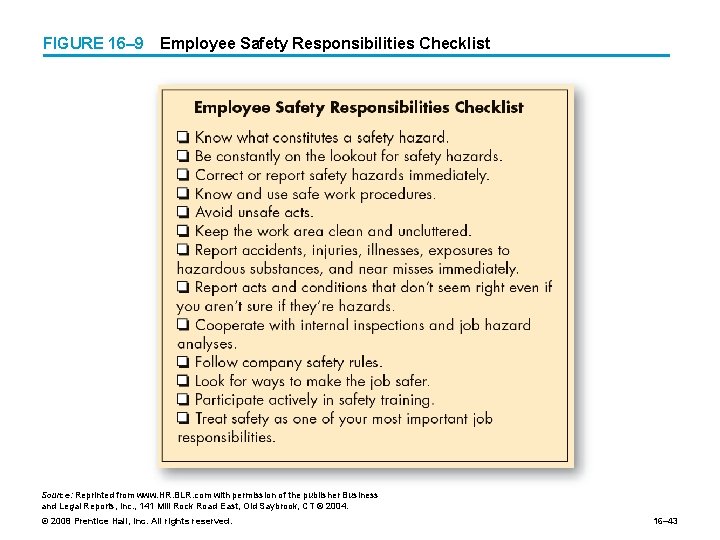
FIGURE 16– 9 Employee Safety Responsibilities Checklist Source: Reprinted from www. HR. BLR. com with permission of the publisher Business and Legal Reports, Inc. , 141 Mill Rock Road East, Old Saybrook, CT © 2004. © 2008 Prentice Hall, Inc. All rights reserved. 16– 43
Controlling Workers’ Compensation Costs • Before an Accident Ø Communicate written safety and substance abuse policies to workers and then strictly enforce policies. • Should an Accident Occur: Ø Be proactive in providing first aid, and make sure the worker gets quick medical attention. Ø Make it clear that you are interested in the injured worker and his or her fears and questions. Ø Document the accident; file required reports. Ø A doctor’s release will be required prior to the employee returning to work. 16– 44
BASIC TRAINING © 2008 Prentice Hall, Inc. All rights reserved. 16– 45
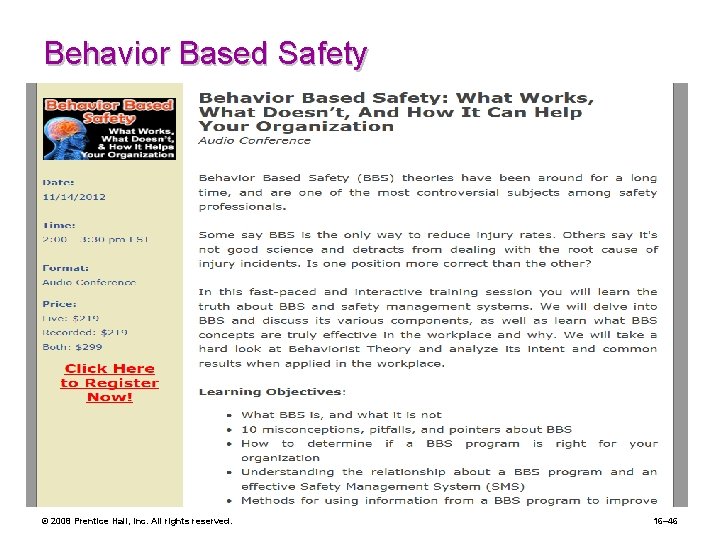
Behavior Based Safety © 2008 Prentice Hall, Inc. All rights reserved. 16– 46
Training Videos: © 2008 Prentice Hall, Inc. All rights reserved. 16– 47
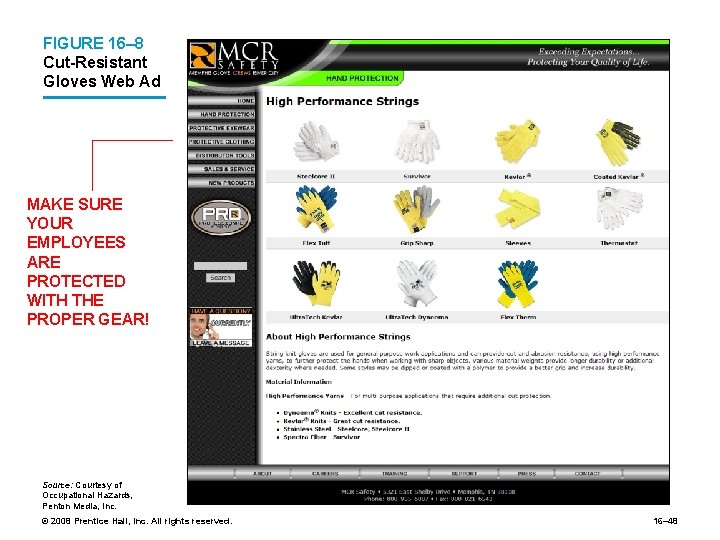
FIGURE 16– 8 Cut-Resistant Gloves Web Ad MAKE SURE YOUR EMPLOYEES ARE PROTECTED WITH THE PROPER GEAR! Source: Courtesy of Occupational Hazards, Penton Media, Inc. © 2008 Prentice Hall, Inc. All rights reserved. 16– 48
TABLE 16– 1 Reducing Unsafe Conditions and Acts: A Summary Reduce Unsafe Conditions Identify and eliminate unsafe conditions. Use administrative means, such as job rotation. Use personal protective equipment. Reduce Unsafe Acts Emphasize top management commitment. Emphasize safety. Establish a safety policy. Reduce unsafe acts through selection. Provide safety training. Use posters and other propaganda. Use positive reinforcement. Use behavior-based safety programs. Encourage worker participation. Conduct safety and health inspections regularly. © 2008 Prentice Hall, Inc. All rights reserved. 16– 49
DEALING WITH SUBSTANCE ABUSE © 2008 Prentice Hall, Inc. All rights reserved. 16– 50
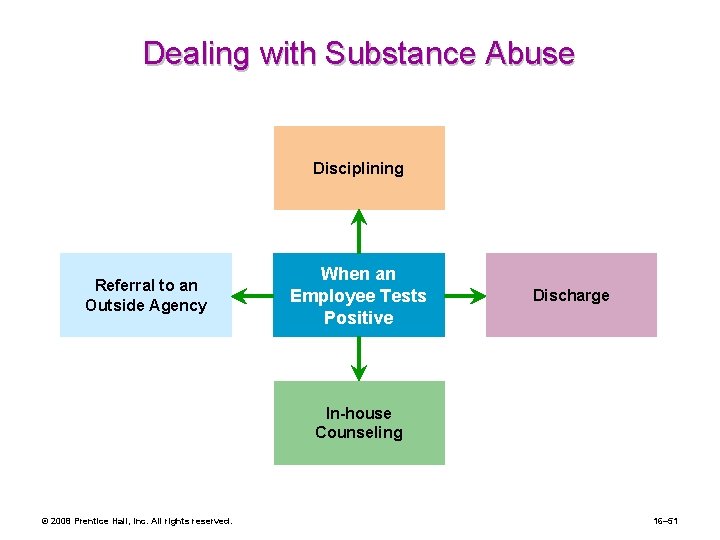
Dealing with Substance Abuse Disciplining Referral to an Outside Agency When an Employee Tests Positive Discharge In-house Counseling © 2008 Prentice Hall, Inc. All rights reserved. 16– 51
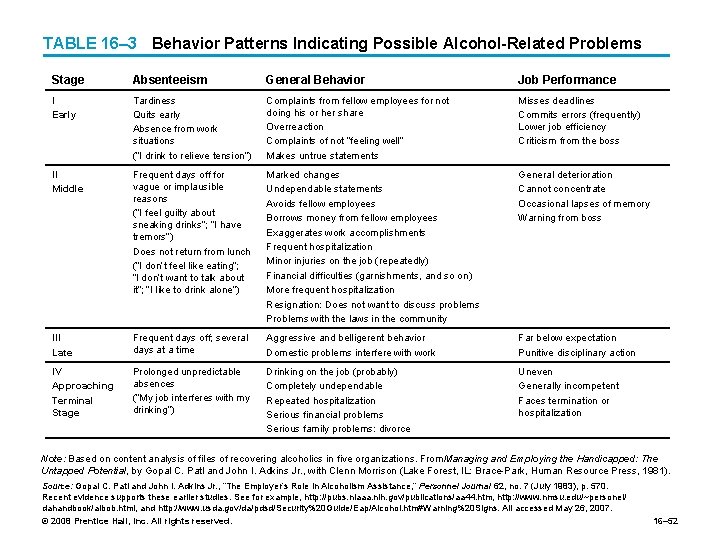
TABLE 16– 3 Behavior Patterns Indicating Possible Alcohol-Related Problems Stage Absenteeism General Behavior Job Performance I Early Tardiness Quits early Absence from work situations (“I drink to relieve tension”) Complaints from fellow employees for not doing his or her share Overreaction Complaints of not “feeling well” Makes untrue statements Misses deadlines Commits errors (frequently) Lower job efficiency Criticism from the boss II Middle Frequent days off for vague or implausible reasons (“I feel guilty about sneaking drinks”; “I have tremors”) Does not return from lunch (“I don’t feel like eating”; “I don’t want to talk about it”; “I like to drink alone”) Marked changes Undependable statements Avoids fellow employees Borrows money from fellow employees Exaggerates work accomplishments Frequent hospitalization Minor injuries on the job (repeatedly) Financial difficulties (garnishments, and so on) More frequent hospitalization Resignation: Does not want to discuss problems Problems with the laws in the community General deterioration Cannot concentrate Occasional lapses of memory Warning from boss III Late Frequent days off; several days at a time Aggressive and belligerent behavior Domestic problems interfere with work Far below expectation Punitive disciplinary action IV Approaching Terminal Stage Prolonged unpredictable absences (“My job interferes with my drinking”) Drinking on the job (probably) Completely undependable Repeated hospitalization Serious financial problems Serious family problems: divorce Uneven Generally incompetent Faces termination or hospitalization Note: Based on content analysis of files of recovering alcoholics in five organizations. From Managing and Employing the Handicapped: The Untapped Potential, by Gopal C. Patl and John I. Adkins Jr. , with Clenn Morrison (Lake Forest, IL: Brace-Park, Human Resource Press, 1981). Source: Gopal C. Patl and John I. Adkins Jr. , “The Employer’s Role in Alcoholism Assistance, ” Personnel Journal 62, no. 7 (July 1983), p. 570. Recent evidence supports these earlier studies. See for example, http: //pubs. niaaa. nih. gov/publications/aa 44. htm, http: //www. nmsu. edu/~personel/ dahandbook/albob. html, and http: //www. usda. gov/da/pdsd/Security%20 Guide/Eap/Alcohol. htm#Warning%20 Signs. All accessed May 26, 2007. © 2008 Prentice Hall, Inc. All rights reserved. 16– 52
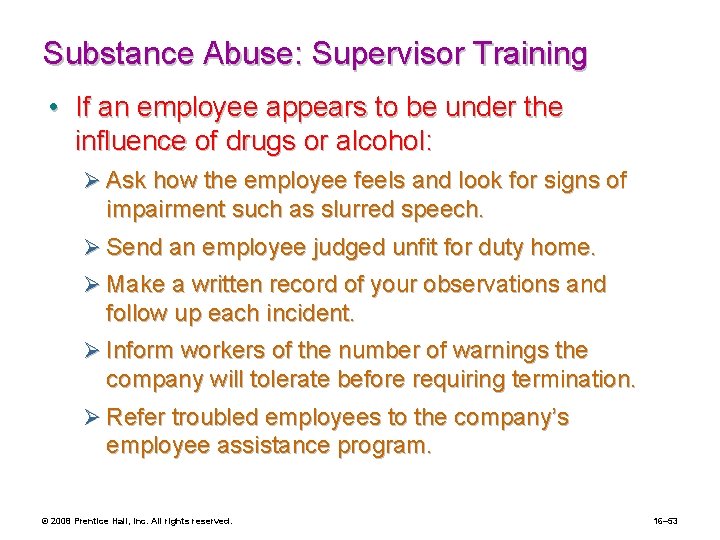
Substance Abuse: Supervisor Training • If an employee appears to be under the influence of drugs or alcohol: Ø Ask how the employee feels and look for signs of impairment such as slurred speech. Ø Send an employee judged unfit for duty home. Ø Make a written record of your observations and follow up each incident. Ø Inform workers of the number of warnings the company will tolerate before requiring termination. Ø Refer troubled employees to the company’s employee assistance program. © 2008 Prentice Hall, Inc. All rights reserved. 16– 53
Dealing with Substance Abuse (cont’d) • Establishing and Communicating a Substance Abuse Policy Ø State management’s position on alcohol and drug abuse and on the use and possession of illegal drugs on company premises. Ø List the methods used to determine the causes of poor performance. Ø State the company’s views on rehabilitation, including workplace counseling, and specify penalties for policy violations. Ø Specify penalties for policy violations. © 2008 Prentice Hall, Inc. All rights reserved. 16– 54