
Human Resource Development Review Manuscript Review FormTheory and
- Slides: 9
Human Resource Development Review Manuscript Review Form-Theory and Conceptual Articles “Effects of Learning Interventions on Organizational Human Capital and Performance” Shannon Deer Laura Cajiao Maxine Wu Sheri Olivier Jessica Saenz
Significance of the research problem and/or theoretical ideas supported with literature Rate: 3 • • Introduction presented like a theoretical framework, linked with lots of citations that didn’t allow the readers to see the author’s personal overview of the study. Only at the end of the introduction, the purpose of the research was presented (Page 5). Significance of the research was not clearly stated on the paper. The researcher should write about the effect of the study, and how it will change or impact the HRD field. Lack of explanation in the statement that “Zula and Chermack (2007) went further to state that ‘HRD academicians have virtually ignored human capital theory’” (Page 4). How to ignore? No publications at all?
Review of the literature in support of the research problem grounded in previous research and justifies the need for the study Rate: 3 • • Due to the interest of the author to examine the relationship between organizational investments (ED and CD) with two organizational long-term performance indicators (process competency and customer competency), theoretical framework should also provide deep clarifications or broader theories about the two performance indicators. References too old for topics such as learning interventions, organizational performance (OD), CD, ED, and human capital that could offer and/or are discussed by recent theorists and practitioners within the fiel. d. Ex: Schultz, 1961(Page 7); Denison, 1962 (Page 7); Harbison, 1973 (Page 7). Framework of the study should also presented a discussion about the organizational culture as the research is oriented to a sample within a Korean corporate context that differs from the west. There was not any learning theories identified in the literature review. Is this only formal learning? Is this only cognitive learning? Does it consider intervention that foster experiential learning (and other constructivist theories)?
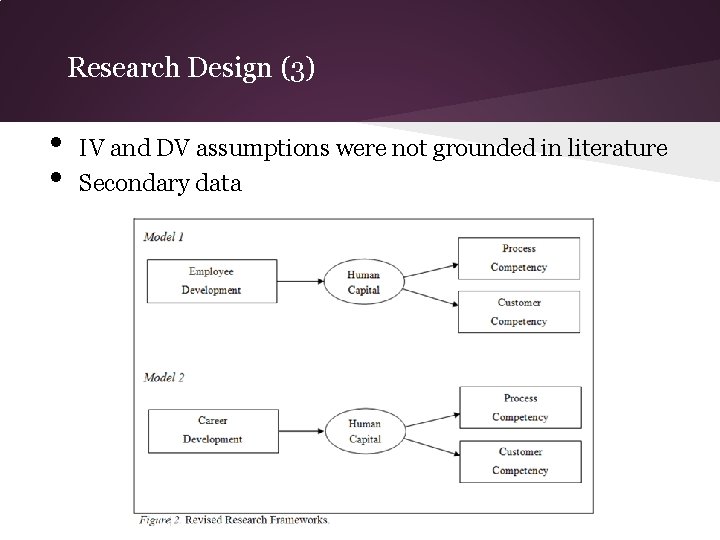
Research questions/hypotheses presented clearly Rate: 5 • • The research questions are presented clearly. Research framework was not presented or described in theoretical portion of the study. The author proposed the research framework? The author mentioned that this framework refers to Buller and Mc. Evoy (2012)’s research model. Inappropriate citation in Fig 1 (Page 11).
Research Design (3) • • IV and DV assumptions were not grounded in literature Secondary data
Data Collection and Analysis (4) • • • 2009 secondary data Unclear sampling - “The survey population is corporations employing more than 100 employees. . . in the six industries. . . in which accumulation of human capital is judged to be relatively more important than in the other industries (according to Korean standard industrial classification)” (p. 13). “The data set for this research is the survey data from 473 corporations among the survey population of 4, 109” (p. 13).
Implications for Practice ● This paper serves more as a foundation for a future study (pg. 25) ○ Very low contribution to the field ○ Human Capital Corporate Panel ○ Findings have already been supported by other research ● “It is not unusual in practice that an introduction or retention of a certain program is a challenge in terms of its direct business impact or measurable monetary value”. This statement has already been supported by the empirical findings researched by Nafukho, Hairston, and Brooks in 2004. (pg. 25) ○ How are these findings different? What’s new? ● How are they applicable for practitioners in the field? (pg. 28) ○ May consider re-framing this section
Implications for Practice ● Consider tying in other areas that could fit better in this section such as: (pg. 29) ○ Planning and implementing Talent Management/ Evaluation PRocess ○ How does this research tie into the Korean context? ○ Include the influence of culture ● Implications or Suggestions? ○ EX: “One of the good ways for the translation and conversion is to demonstrate business impacts of an intervention in a quantifiable and measurable fashion. ” (pg. 29)
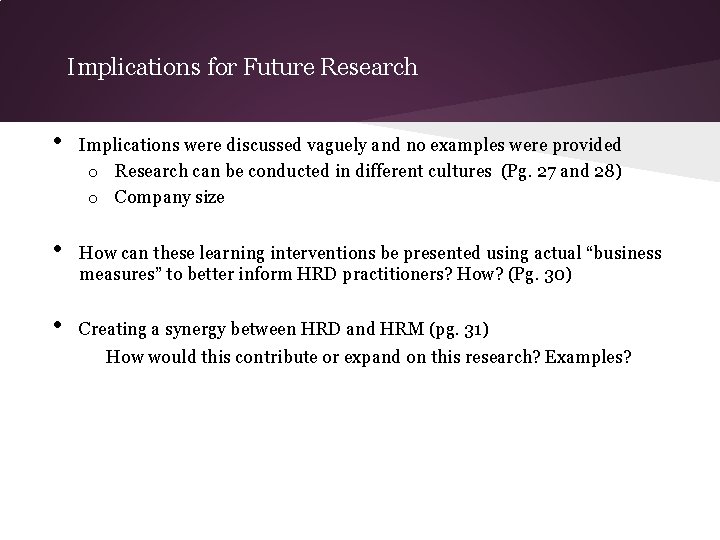
Implications for Future Research • • • Implications were discussed vaguely and no examples were provided o Research can be conducted in different cultures (Pg. 27 and 28) o Company size How can these learning interventions be presented using actual “business measures” to better inform HRD practitioners? How? (Pg. 30) Creating a synergy between HRD and HRM (pg. 31) How would this contribute or expand on this research? Examples?