
HUMAN RESOURCE CAPACITY GAP ASSESSMENT STUDY RCNKNUST Department



- Slides: 20
HUMAN RESOURCE CAPACITY GAP ASSESSMENT STUDY RCN/KNUST Department of Civil Engineering 25/11/2020 1
Presentation outline q. Study background and objectives q. Workshop objectives q. Water and Sanitation Coverage q. Institutional structure and HR in the WASH sector q. Assessment Methodology q. Capacity building framework 25/11/2020 2
Background q. The constraints in getting the required number of staff and competence to meet the MDGs and to sustain services are not certain, q. The IWA in collaboration with Cap-Net is supporting WASH Sector Human Resource Capacity Gap Assessment, 25/11/2020 3
WASH HR Workshop Objectives q. To present the purpose of the study to stakeholders and seek their inputs and guidance, q. To discuss the study methodology and key partners to review work and make inputs, q. To plan follow up meeting for verification of findings and presentation of final report q. To plan for Human Resources Development (HRD) Plan or capacity building in WASH Sector. 25/11/2020 4
Study Objectives The objective of the study is: q. To assess the demand for WASH HRs in Ghana to meet MDGs. q. To assess supply of HRs and the competences (skills and knowledge) being made available to the sector q. To propose capacity development recommendations to meet demand for qualified personnel in the short and medium term, 25/11/2020 5
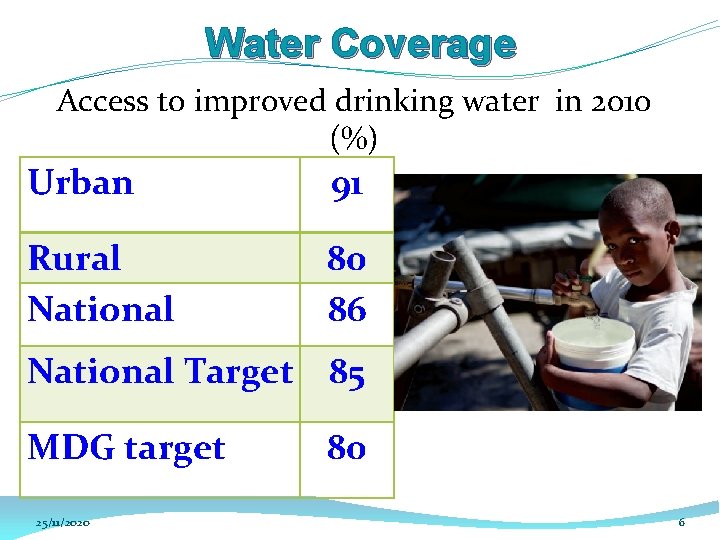
Water Coverage Access to improved drinking water in 2010 (%) Urban 91 Rural National 80 86 National Target 85 MDG target 25/11/2020 80 6
Sanitation Coverage Access to improved sanitation in 2010 (%) Urban 19 Rural National 8 14 National Target 54 MDG target 25/11/2020 52 7
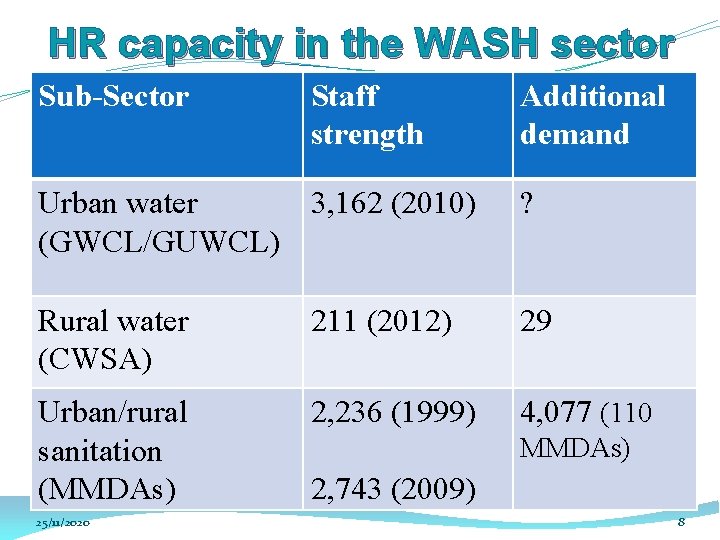
HR capacity in the WASH sector Sub-Sector Staff strength Additional demand Urban water 3, 162 (2010) (GWCL/GUWCL) ? Rural water (CWSA) 211 (2012) 29 Urban/rural sanitation (MMDAs) 2, 236 (1999) 4, 077 (110 25/11/2020 MMDAs) 2, 743 (2009) 8
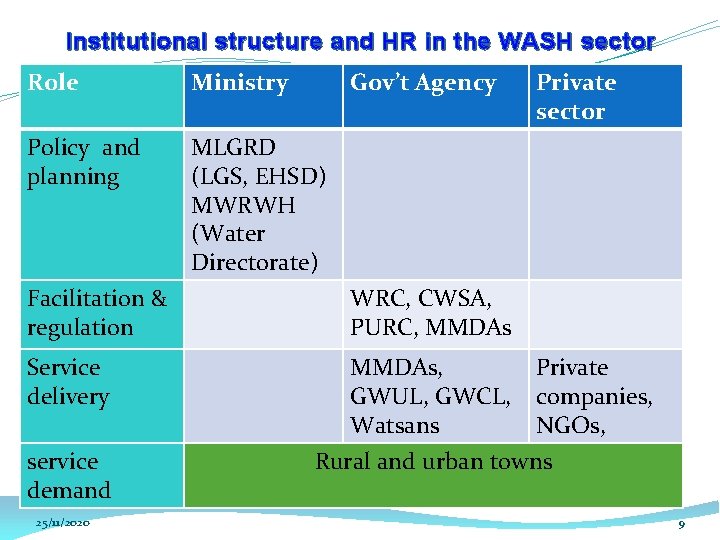
Institutional structure and HR in the WASH sector Role Ministry Policy and planning MLGRD (LGS, EHSD) MWRWH (Water Directorate) Facilitation & regulation Service delivery service demand 25/11/2020 Gov’t Agency Private sector WRC, CWSA, PURC, MMDAs, Private GWUL, GWCL, companies, Watsans NGOs, Rural and urban towns 9
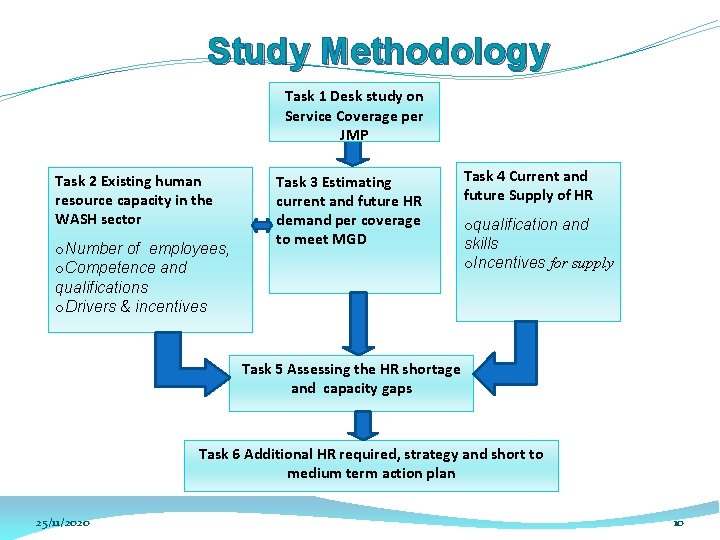
Study Methodology Task 1 Desk study on Service Coverage per JMP Task 2 Existing human resource capacity in the WASH sector o. Number of employees, o. Competence and qualifications o. Drivers & incentives Task 3 Estimating current and future HR demand per coverage to meet MGD Task 4 Current and future Supply of HR oqualification and skills o. Incentives for supply Task 5 Assessing the HR shortage and capacity gaps Task 6 Additional HR required, strategy and short to medium term action plan 25/11/2020 10
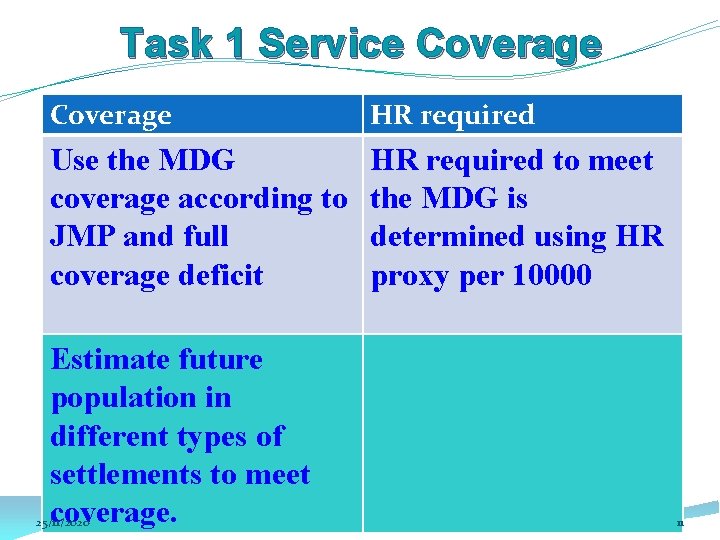
Task 1 Service Coverage HR required Use the MDG coverage according to JMP and full coverage deficit HR required to meet the MDG is determined using HR proxy per 10000 Estimate future population in different types of settlements to meet coverage. 25/11/2020 11
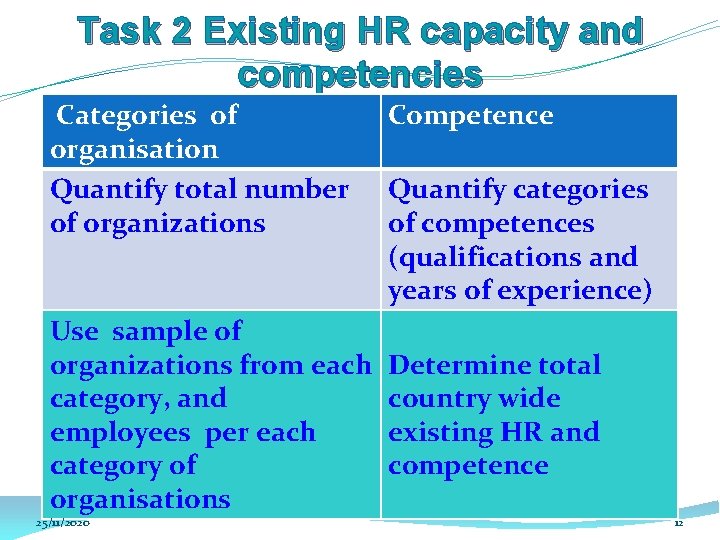
Task 2 Existing HR capacity and competencies Categories of organisation Quantify total number of organizations Use sample of organizations from each category, and employees per each category of organisations 25/11/2020 Competence Quantify categories of competences (qualifications and years of experience) Determine total country wide existing HR and competence 12
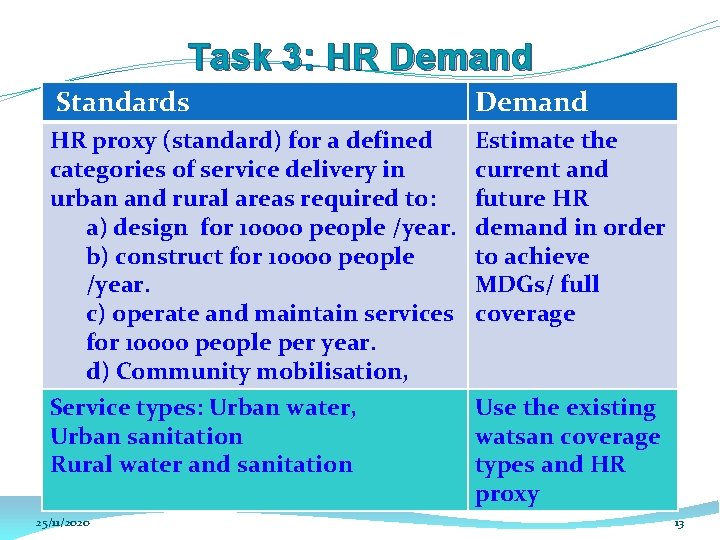
Task 3: HR Demand Standards Demand HR proxy (standard) for a defined categories of service delivery in urban and rural areas required to: a) design for 10000 people /year. b) construct for 10000 people /year. c) operate and maintain services for 10000 people per year. d) Community mobilisation, Service types: Urban water, Urban sanitation Rural water and sanitation Estimate the current and future HR demand in order to achieve MDGs/ full coverage 25/11/2020 Use the existing watsan coverage types and HR proxy 13
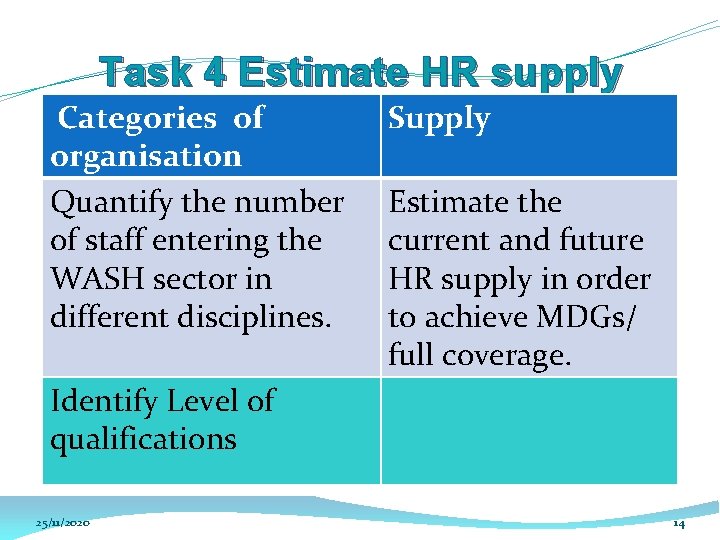
Task 4 Estimate HR supply Categories of organisation Quantify the number of staff entering the WASH sector in different disciplines. Supply Estimate the current and future HR supply in order to achieve MDGs/ full coverage. Identify Level of qualifications 25/11/2020 14
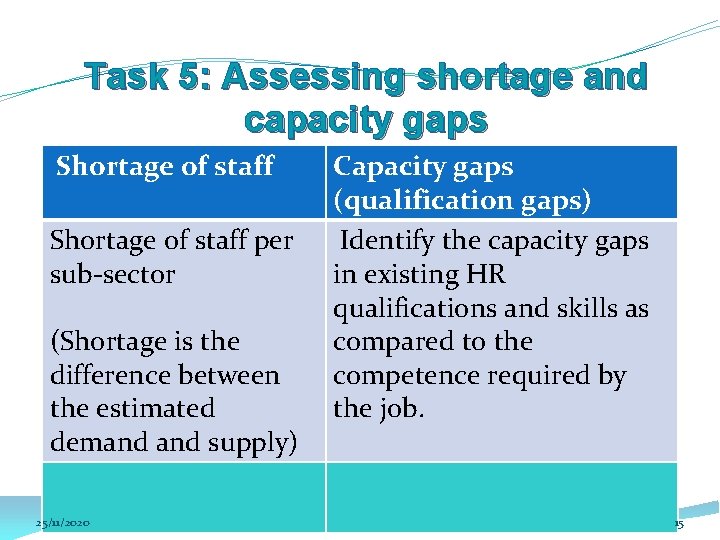
Task 5: Assessing shortage and capacity gaps Shortage of staff per sub-sector (Shortage is the difference between the estimated demand supply) 25/11/2020 Capacity gaps (qualification gaps) Identify the capacity gaps in existing HR qualifications and skills as compared to the competence required by the job. 15
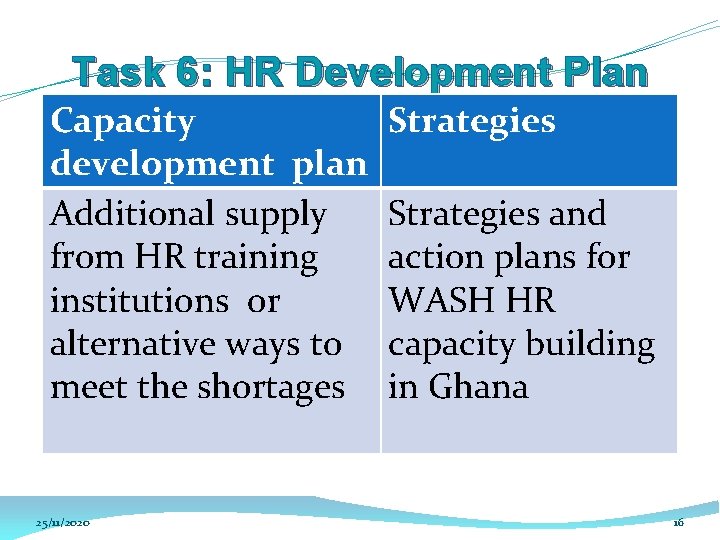
Task 6: HR Development Plan Capacity development plan Additional supply from HR training institutions or alternative ways to meet the shortages 25/11/2020 Strategies and action plans for WASH HR capacity building in Ghana 16
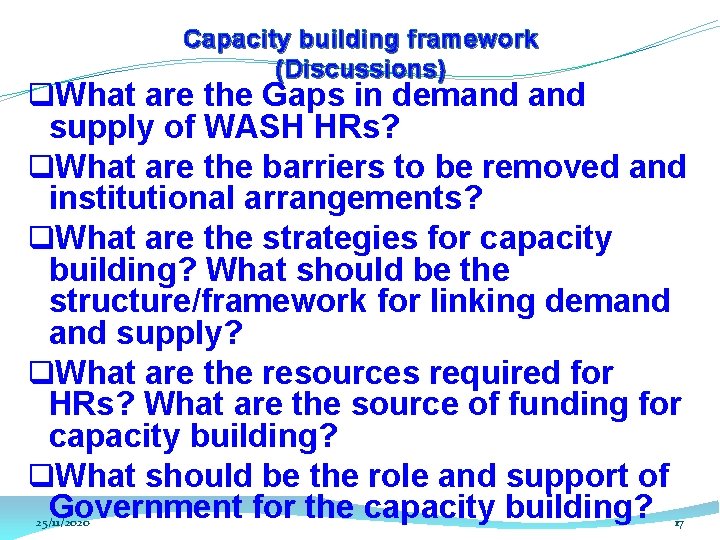
Capacity building framework (Discussions) q. What are the Gaps in demand supply of WASH HRs? q. What are the barriers to be removed and institutional arrangements? q. What are the strategies for capacity building? What should be the structure/framework for linking demand supply? q. What are the resources required for HRs? What are the source of funding for capacity building? q. What should be the role and support of Government for the capacity building? 25/11/2020 17
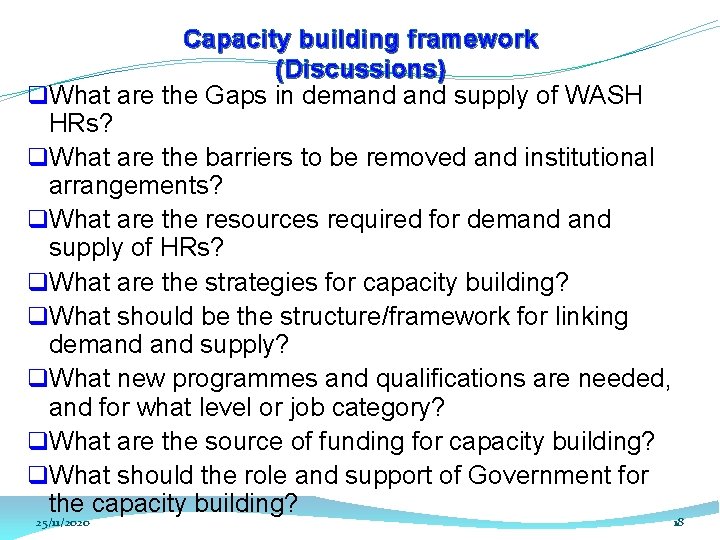
Capacity building framework (Discussions) q. What are the Gaps in demand supply of WASH HRs? q. What are the barriers to be removed and institutional arrangements? q. What are the resources required for demand supply of HRs? q. What are the strategies for capacity building? q. What should be the structure/framework for linking demand supply? q. What new programmes and qualifications are needed, and for what level or job category? q. What are the source of funding for capacity building? q. What should the role and support of Government for the capacity building? 25/11/2020 18
Thank You 25/11/2020 19
Discussions and Questions 25/11/2020 20