
HUMAN RESEARCH ETHICS AT UVIC We acknowledge with




- Slides: 29
HUMAN RESEARCH ETHICS AT UVIC
We acknowledge with respect the Lekwungen peoples on whose traditional territory the university stands and the Songhees, Esquimalt and WSÁNEĆ peoples whose historical relationships with the land continue to this day.
Dr. Julie Bull is an Inuk (Nunatu. Kavut) researcher and educator from Happy Valley – Goose Bay, Labrador with nearly 15 years of experience in community-based participatory action research, specifically in research involving Indigenous Peoples. As an award-winning researcher, Julie is committed to bridging the gaps between western and Indigenous ways of understanding the world through the lens of research with a focus on social justice. As a forward thinker and seasoned leader, Julie’s vision is to see Indigenous and non-Indigenous people in Canada and around the world work together to achieve common goals. Julie’s main area of research is the governance of research and research ethics involving Indigenous Peoples. www. juliebull. net #justsuckless
Outline • Historical contexts • What is Research Ethics? • Research Ethics at UVic • What activities require research ethics approval? • Research ethics review processes and timelines (online system: UVic-RAIS) • Principles and practices to consider when developing your research study
Historical context • Many atrocities have been done in the name of “science” • From the Nuremberg trials the Nuremberg Code was created – a set of research ethics principles designed to prevent unethical experimentation and exploitation –Principles include informed consent; properly formulated scientific experimentation; and beneficence towards experiment participants.
HUMAN RESEARCH ETHICS A set of guidelines and principles which direct: • the conduct of research involving human participants • human biological specimens • the access, use and protection of human data (e. g. clinical and client records) • and human information from non-research to research domains
CANADIAN RESEARCH ETHICS POLICY WITH ONLINE TUTORIAL! The Tri-Council Policy Statement on the Ethical Conduct for Research Involving Humans Also known as the TCPS 2 (2018) http: //www. pre. ethics. gc. ca/eng/policy-politique_tcps 2 eptc 2_2018. html • All Graduate Students are now required to complete the CORE tutorial, prior to submitting their research ethics application!
WHO IS INVOLVED? Human Research Ethics Board (HREB): • • • 22 members, including faculty, graduate students, and community members HREB Chair: Dr. Sandra Gibbons, School of Exercise Science, Physical and Health Ed HREB Vice-Chair: Dr. Matt Murphy, Business Research Ethics Office Staff: Eugenie Lam, Research Ethics Coordinator Phone: 250 -472 -5202, hrethics@uvic. ca Kenna Miskelly, Research Ethics Facilitator Phone: 250 -472 -5555, hre@uvic. ca Jeta Rugova-Plakolli, Research Ethics Liaison Phone: 250 -472 -4321, ethics@uvic. ca Joanne Mclean, Research Ethics Assistant Phone: 250 -472 -4545, ethicsassist@uvic. ca
UVIC HUMAN RESEARCH ETHICS FORMS AND GUIDELINES Everything is on our websites: • http: //www. uvic. ca/research/conduct/home/ regapproval/humanethics/ • https: //www. uvic. ca/userais/ Search “Human Research Ethics” on the UVic homepage; get to the “useraise” website from the Research Ethics webpage; log into RAIS via the “useraise” page Forms, Annotated Guidelines, Information, FAQ’s, Resources!
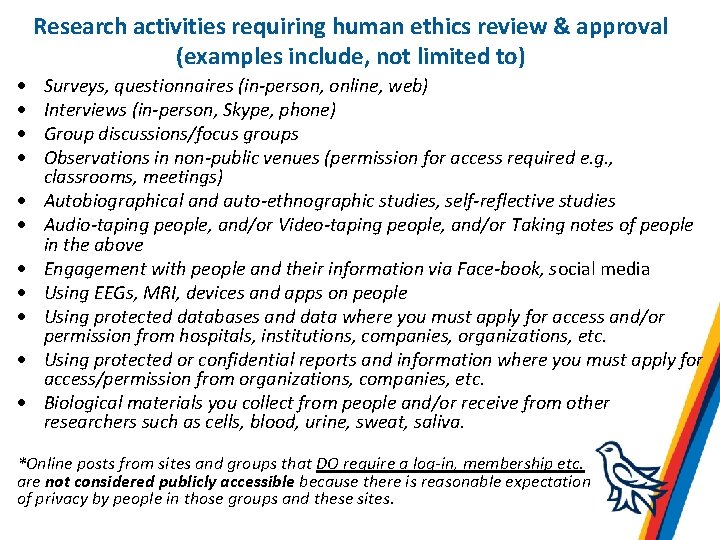
Research activities requiring human ethics review & approval (examples include, not limited to) Surveys, questionnaires (in-person, online, web) Interviews (in-person, Skype, phone) Group discussions/focus groups Observations in non-public venues (permission for access required e. g. , classrooms, meetings) Autobiographical and auto-ethnographic studies, self-reflective studies Audio-taping people, and/or Video-taping people, and/or Taking notes of people in the above Engagement with people and their information via Face-book, social media Using EEGs, MRI, devices and apps on people Using protected databases and data where you must apply for access and/or permission from hospitals, institutions, companies, organizations, etc. Using protected or confidential reports and information where you must apply for access/permission from organizations, companies, etc. Biological materials you collect from people and/or receive from other researchers such as cells, blood, urine, sweat, saliva. *Online posts from sites and groups that DO require a log-in, membership etc. are not considered publicly accessible because there is reasonable expectation of privacy by people in those groups and these sites.
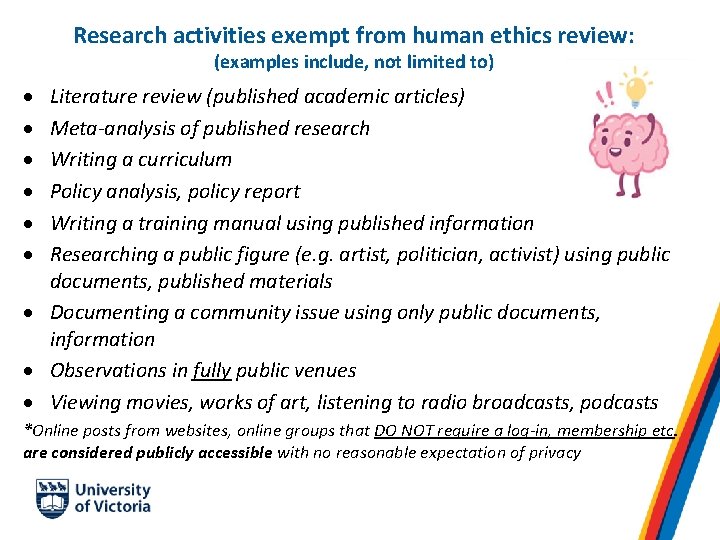
Research activities exempt from human ethics review: (examples include, not limited to) Literature review (published academic articles) Meta-analysis of published research Writing a curriculum Policy analysis, policy report Writing a training manual using published information Researching a public figure (e. g. artist, politician, activist) using public documents, published materials Documenting a community issue using only public documents, information Observations in fully public venues Viewing movies, works of art, listening to radio broadcasts, podcasts *Online posts from websites, online groups that DO NOT require a log-in, membership etc. are considered publicly accessible with no reasonable expectation of privacy
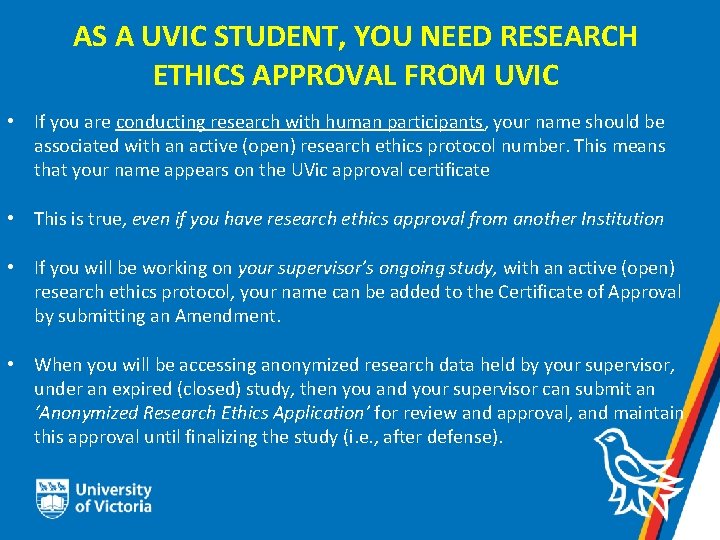
AS A UVIC STUDENT, YOU NEED RESEARCH ETHICS APPROVAL FROM UVIC • If you are conducting research with human participants, your name should be associated with an active (open) research ethics protocol number. This means that your name appears on the UVic approval certificate • This is true, even if you have research ethics approval from another Institution • If you will be working on your supervisor’s ongoing study, with an active (open) research ethics protocol, your name can be added to the Certificate of Approval by submitting an Amendment. • When you will be accessing anonymized research data held by your supervisor, under an expired (closed) study, then you and your supervisor can submit an ‘Anonymized Research Ethics Application’ for review and approval, and maintain this approval until finalizing the study (i. e. , after defense).
If you have any questions about whether you need research ethics approval and/or how to obtain research ethics approval, contact us: ethics@uvic. ca Be wary of advice that does not come from the Human Research Ethics Board Office!
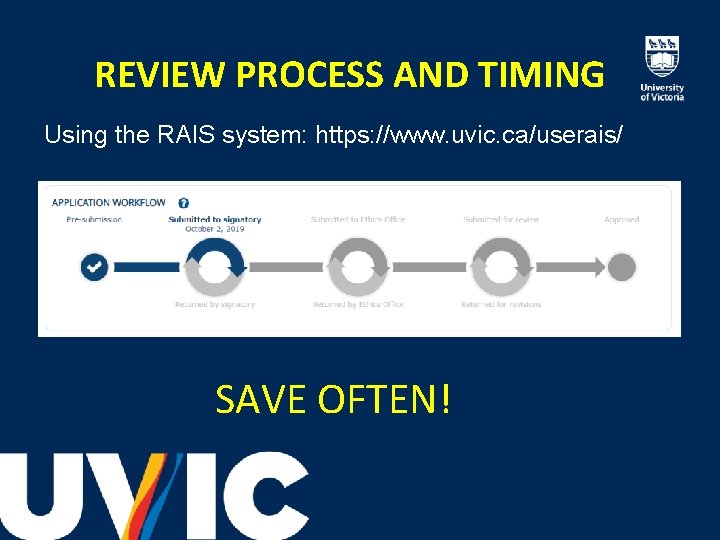
REVIEW PROCESS AND TIMING Using the RAIS system: https: //www. uvic. ca/userais/ SAVE OFTEN!
• Your supervisor (the PI) must initiate the research ethics application and grant you access • The a student researcher, or postdoctoral fellow, is the Principal Applicant (PA) • Log into RAIS using your netlink ID • Once the PI has started the application and added you as the PA, you will have access to the application to complete it
REVIEW PROCESS AND TIMING continued (SAVE OFTEN): • The PI (supervisor) submits the application for departmental sign-off (to Chair/Director/Dean) and this signatory submits the application to the research ethics office • The HREB reviews: we send you a “Notice of Ethical Review” through the system (email notification) • Response time by ethics = 4 -6 weeks from date of submission to the research ethics office • You submit revisions through the system: follow instructions formatting revisions • We notify you of approval via email (usually within 5 business days)
PRINCIPLES AND PRACTICES • Research participation is voluntary: the freedom to accept or decline participation without penalty • Consent must be informed: Complete information to make a choice to about participation • If there any risks, the risks must not outweigh benefits • Vulnerable contexts for participants • Anonymity and Confidentiality
ADDITIONAL CONSIDERATIONS • Indigenous studies and respect for communities - consultation can begin prior to ethics submission or approval! - the HREB does not want to impose processes that may be culturally inappropriate or awkward for participants (see TCPS 2 Chapter 9) • Nature of the relationship between researcher and participant(s): power-over, influential relationships, dual roles - Guidelines for Ethics in Dual-Role Research for Teachers and other Practitioners: see the Research Ethics website!
The Three C’s: • Clarity • Consistency • Completeness
COVID-19 Considerations • There has been a moratorium on in-person research activities at UVic since March 20, 2020. UVic is currently implementing procedures to allow for the safe and gradual resumption of research activities both oncampus and in the community. • Unrestricted return to in-person research activities is unlikely to be allowed for some time. • For guidance and requirements that researchers must follow as restrictions ease, to minimize the spread of COVID-19 during the global pandemic, see Human Research Ethics (HRE) Bulletin #3 (July 16, 2020): https: //www. uvic. ca/research/assets/docs/Ethics/covid 19_human_research_ethics_bulletin_3 -jul_16. pdf • During the continued COVID-19 restrictions, use of remote methods for research involving human participants are the safest. Researchers are advised to use remote methods (via telephone, Zoom, email, etc. ) in lieu of in-person activities, whenever possible. • The most up-to-date information can be found on the Research Ethics website: https: //www. uvic. ca/research/conduct/home/regapproval/humanethics/index. php
Questions and Discussion
OLD PAPER-BASED SYSTEM If your supervisor has a an applicable research ethics application that was approved using the old, paper-based system, approvals will remain in the old paper-based system. You will need to submit a paper-based Modification Request to make changes to this study, etc. if needed.
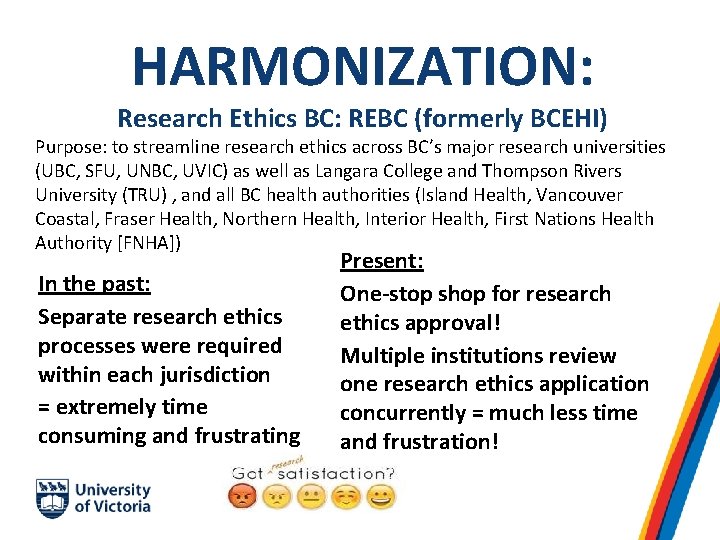
HARMONIZATION: Research Ethics BC: REBC (formerly BCEHI) Purpose: to streamline research ethics across BC’s major research universities (UBC, SFU, UNBC, UVIC) as well as Langara College and Thompson Rivers University (TRU) , and all BC health authorities (Island Health, Vancouver Coastal, Fraser Health, Northern Health, Interior Health, First Nations Health Authority [FNHA]) In the past: Separate research ethics processes were required within each jurisdiction = extremely time consuming and frustrating Present: One-stop shop for research ethics approval! Multiple institutions review one research ethics application concurrently = much less time and frustration!
HARMONIZATION: Research Ethics BC: REBC (formerly BCEHI) • Consider: Health Authority patients, clinicians, staff, co-Investigators, clinics/programs/employees under the jurisdiction of the HA’s, hospital-based data, etc. • Ethical reviews are concurrent – each involved institution participates • Operational approvals • Visit the REBC website: https: //researchethicsbc. ca/ • See the UVic research ethics website: http: //www. uvic. ca/research/conduct/home/regapproval/humanethics/index. php • Contact us! ethics@uvic. ca
USE OF ANONYMIZED DATA (OR ANONYMIZED BIOLOGICAL MATERIALS) Ask: 1. Will the data be received as “anonymous”? 2. Is this the full scope of your data collection? If yes to both: Complete the “Anonymized Data or Biological Materials Application” • See the UVic research ethics websites: http: //www. uvic. ca/research/conduct/home/regapproval/humanethics/index. php https: //www. uvic. ca/userais/ • Contact us! ethics@uvic. ca
RESEARCH VERSUS QUALITY IMPROVEMENT, QUALITY ASSURANCE, AND PROGRAM EVALUATION If the study is being conducted for academic purposes, it falls under the University of Victoria’s definition of research. As such, UVic policies and procedures for Research Involving Humans apply, including application of the TCPS 2, and applicable privacy legislation. This is different from cases in which an organization conducts an investigation for internal purposes (e. g. internal quality improvement project, program evaluation, etc. ).
Stay tuned contact elaine at elaberge@uvic. ca with ideas for human research ethics webinars