
Human Readiness Levels Where Are We Now Department
- Slides: 12
Human Readiness Levels: Where Are We Now? Department of Defense Human Factors Engineering Technical Advisory Board Meeting November 18 -19, 2020 Key Contributors: Judi E. See, Richard Craft, Stephen Kropp Sandia National Laboratories PRESENTED BY Judi E. See, Ph. D. , CPE Sandia National Laboratories/New Mexico Systems Analysis & Decision Support (2831) jesee@sandia. gov, 505 -844 -4567 SAND 2020 -10899 C 1 Holly A. H. Handley Old Dominion University Michael O’Neil Naval Postgraduate School Sandia National Laboratories is a multimission laboratory managed and operated by National Technology & Engineering Solutions of Sandia, LLC, a wholly owned subsidiary of Honeywell International Inc. , for the U. S. Department of Energy’s National Nuclear Security Administration under contract DE-NA 0003525.
2 Human Readiness Level (HRL) Scale • HRL scale is a simple nine-level scale to evaluate, track, and communicate readiness of a system for human use Complements and supplements existing TRL scale during technology development o Provides a familiar systematic and consistent approach o Focuses on readiness of a technology for human use o Fully incorporates human element throughout lifecycle o • TRLs are routinely used throughout DOD, DOE, industry, and academia • Value of TRLs is widely recognized Provide Assurance That: TRL Technology will function as intended HRL Human is able to use the technology as intended DOD = Department of Defense; DOE = Department of Energy; TRL = Technology Readiness Level HRLs do for humans what TRLs do for technology
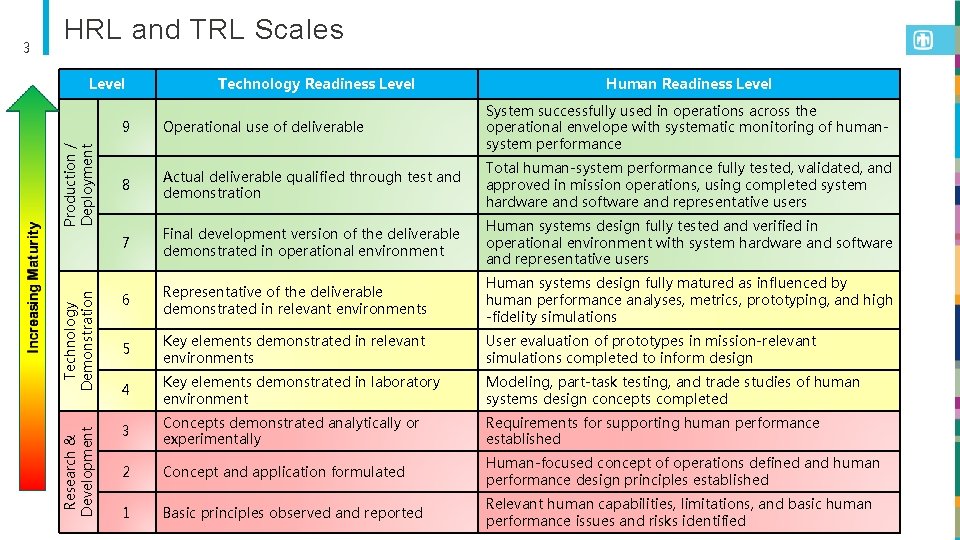
Technology Readiness Level Human Readiness Level Operational use of deliverable 8 Actual deliverable qualified through test and demonstration Total human-system performance fully tested, validated, and approved in mission operations, using completed system hardware and software and representative users 7 Final development version of the deliverable demonstrated in operational environment Human systems design fully tested and verified in operational environment with system hardware and software and representative users 6 Representative of the deliverable demonstrated in relevant environments Human systems design fully matured as influenced by human performance analyses, metrics, prototyping, and high -fidelity simulations 5 Key elements demonstrated in relevant environments User evaluation of prototypes in mission-relevant simulations completed to inform design 4 Key elements demonstrated in laboratory environment Modeling, part-task testing, and trade studies of human systems design concepts completed 3 Concepts demonstrated analytically or experimentally Requirements for supporting human performance established 2 Concept and application formulated Human-focused concept of operations defined and human performance design principles established 1 Basic principles observed and reported Relevant human capabilities, limitations, and basic human performance issues and risks identified Production / Deployment 9 System successfully used in operations across the operational envelope with systematic monitoring of humansystem performance Technology Demonstration Level Research & Development 3 HRL and TRL Scales
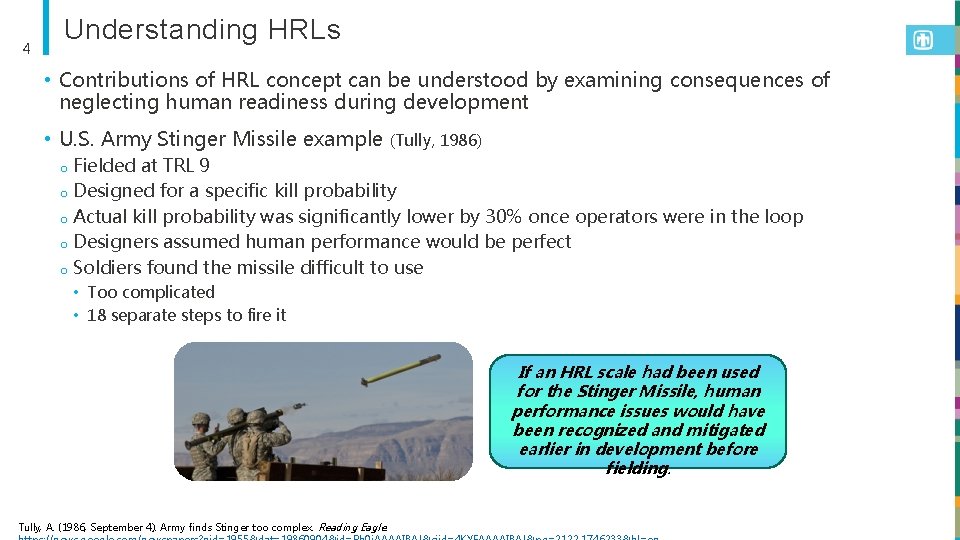
4 Understanding HRLs • Contributions of HRL concept can be understood by examining consequences of neglecting human readiness during development • U. S. Army Stinger Missile example o o o (Tully, 1986) Fielded at TRL 9 Designed for a specific kill probability Actual kill probability was significantly lower by 30% once operators were in the loop Designers assumed human performance would be perfect Soldiers found the missile difficult to use • Too complicated • 18 separate steps to fire it If an HRL scale had been used for the Stinger Missile, human performance issues would have been recognized and mitigated earlier in development before fielding. Tully, A. (1986, September 4). Army finds Stinger too complex. Reading Eagle.
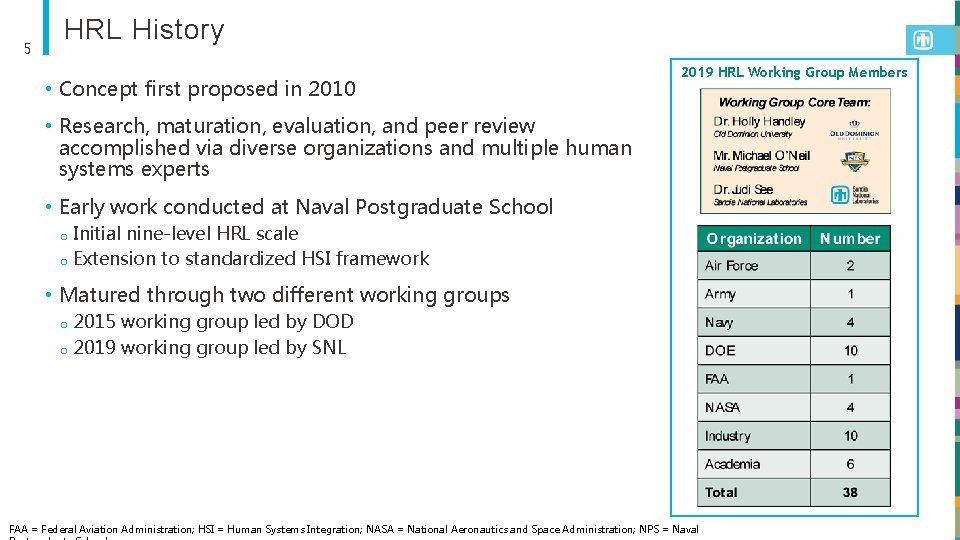
5 HRL History • Concept first proposed in 2010 2019 HRL Working Group Members • Research, maturation, evaluation, and peer review accomplished via diverse organizations and multiple human systems experts • Early work conducted at Naval Postgraduate School Initial nine-level HRL scale o Extension to standardized HSI framework o • Matured through two different working groups 2015 working group led by DOD o 2019 working group led by SNL o FAA = Federal Aviation Administration; HSI = Human Systems Integration; NASA = National Aeronautics and Space Administration; NPS = Naval
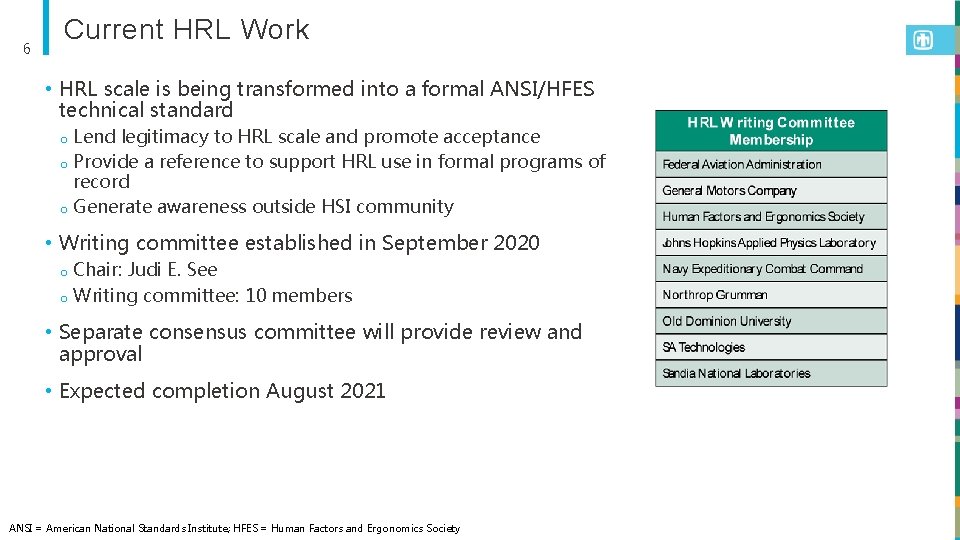
6 Current HRL Work • HRL scale is being transformed into a formal ANSI/HFES technical standard Lend legitimacy to HRL scale and promote acceptance o Provide a reference to support HRL use in formal programs of record o Generate awareness outside HSI community o • Writing committee established in September 2020 Chair: Judi E. See o Writing committee: 10 members o • Separate consensus committee will provide review and approval • Expected completion August 2021 ANSI = American National Standards Institute; HFES = Human Factors and Ergonomics Society
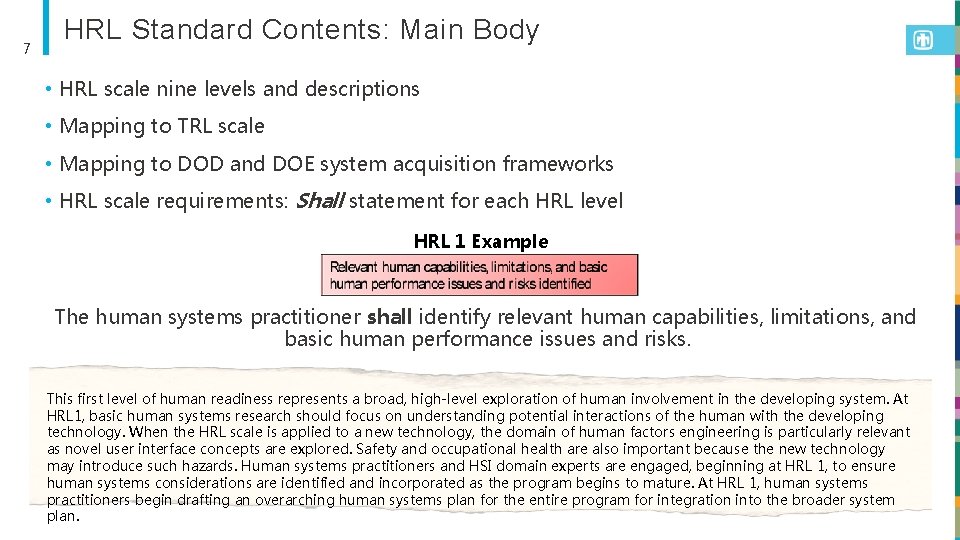
7 HRL Standard Contents: Main Body • HRL scale nine levels and descriptions • Mapping to TRL scale • Mapping to DOD and DOE system acquisition frameworks • HRL scale requirements: Shall statement for each HRL level HRL 1 Example The human systems practitioner shall identify relevant human capabilities, limitations, and basic human performance issues and risks. This first level of human readiness represents a broad, high-level exploration of human involvement in the developing system. At HRL 1, basic human systems research should focus on understanding potential interactions of the human with the developing technology. When the HRL scale is applied to a new technology, the domain of human factors engineering is particularly relevant as novel user interface concepts are explored. Safety and occupational health are also important because the new technology may introduce such hazards. Human systems practitioners and HSI domain experts are engaged, beginning at HRL 1, to ensure human systems considerations are identified and incorporated as the program begins to mature. At HRL 1, human systems practitioners begin drafting an overarching human systems plan for the entire program for integration into the broader system plan.
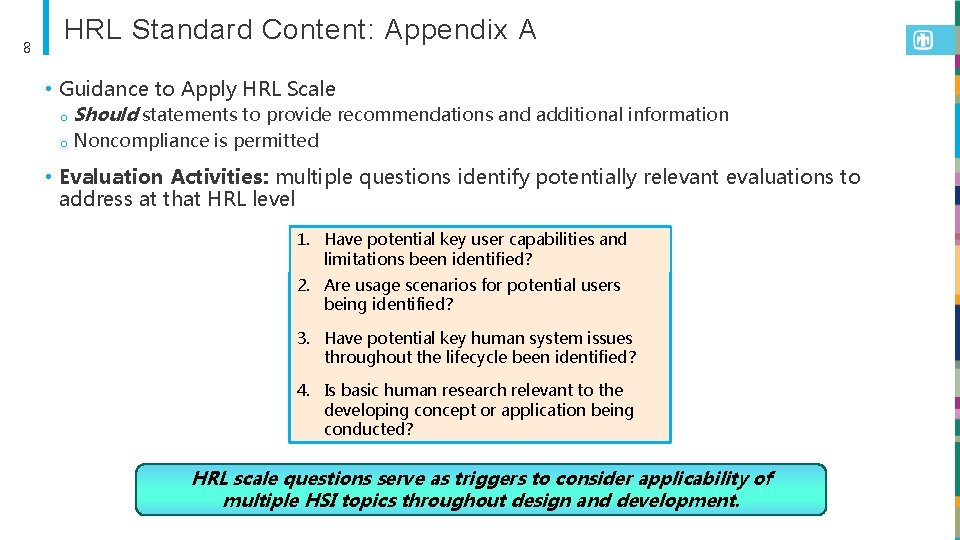
8 HRL Standard Content: Appendix A • Guidance to Apply HRL Scale o Should statements to provide recommendations and additional information o Noncompliance is permitted • Evaluation Activities: multiple questions identify potentially relevant evaluations to address at that HRL level 1. Have potential key user capabilities and limitations been identified? 2. Are usage scenarios for potential users being identified? 3. Have potential key human system issues throughout the lifecycle been identified? 4. Is basic human research relevant to the developing concept or application being conducted? HRL scale questions serve as triggers to consider applicability of multiple HSI topics throughout design and development.
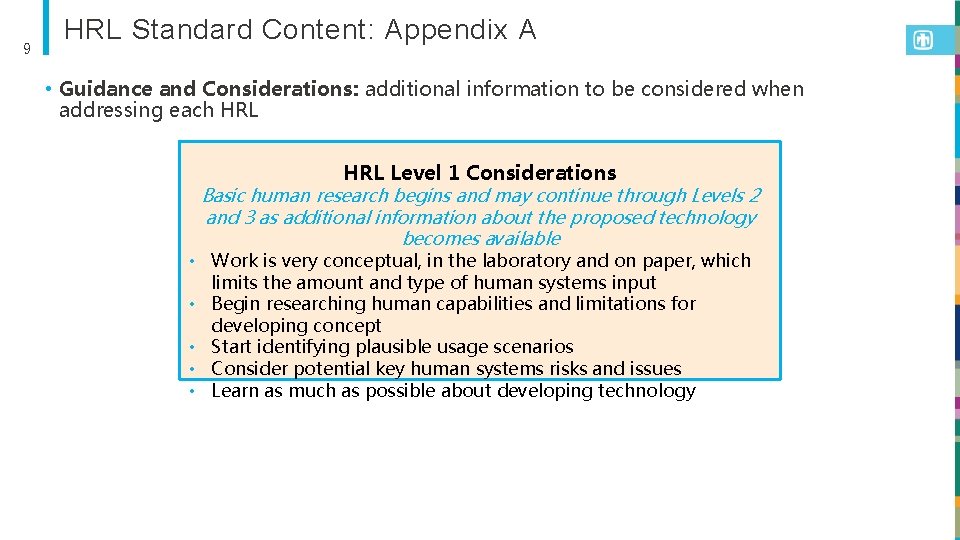
9 HRL Standard Content: Appendix A • Guidance and Considerations: additional information to be considered when addressing each HRL Level 1 Considerations Basic human research begins and may continue through Levels 2 and 3 as additional information about the proposed technology becomes available • Work is very conceptual, in the laboratory and on paper, which limits the amount and type of human systems input • Begin researching human capabilities and limitations for developing concept • Start identifying plausible usage scenarios • Consider potential key human systems risks and issues • Learn as much as possible about developing technology
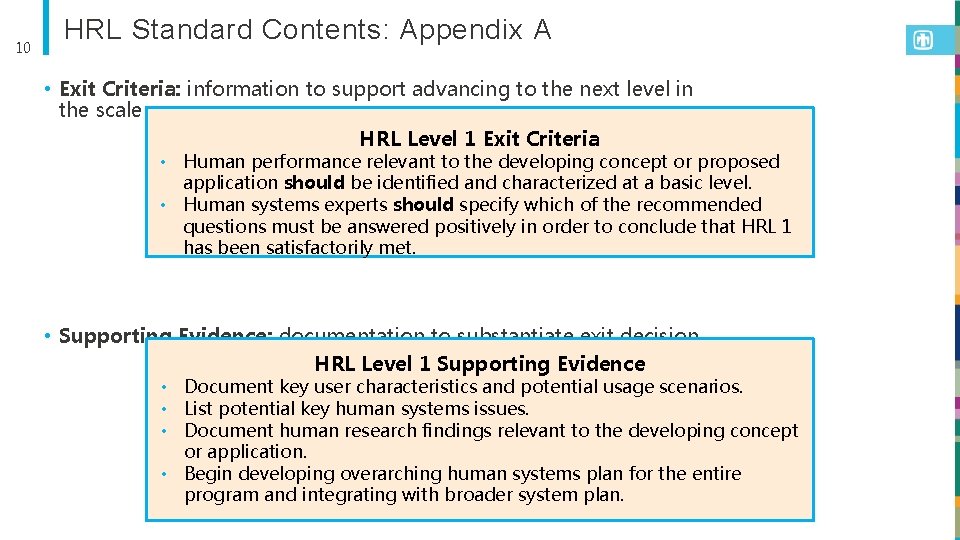
10 HRL Standard Contents: Appendix A • Exit Criteria: information to support advancing to the next level in the scale HRL Level 1 Exit Criteria • Human performance relevant to the developing concept or proposed application should be identified and characterized at a basic level. • Human systems experts should specify which of the recommended questions must be answered positively in order to conclude that HRL 1 has been satisfactorily met. • Supporting Evidence: documentation to substantiate exit decision HRL Level 1 Supporting Evidence • Document key user characteristics and potential usage scenarios. • List potential key human systems issues. • Document human research findings relevant to the developing concept or application. • Begin developing overarching human systems plan for the entire program and integrating with broader system plan.
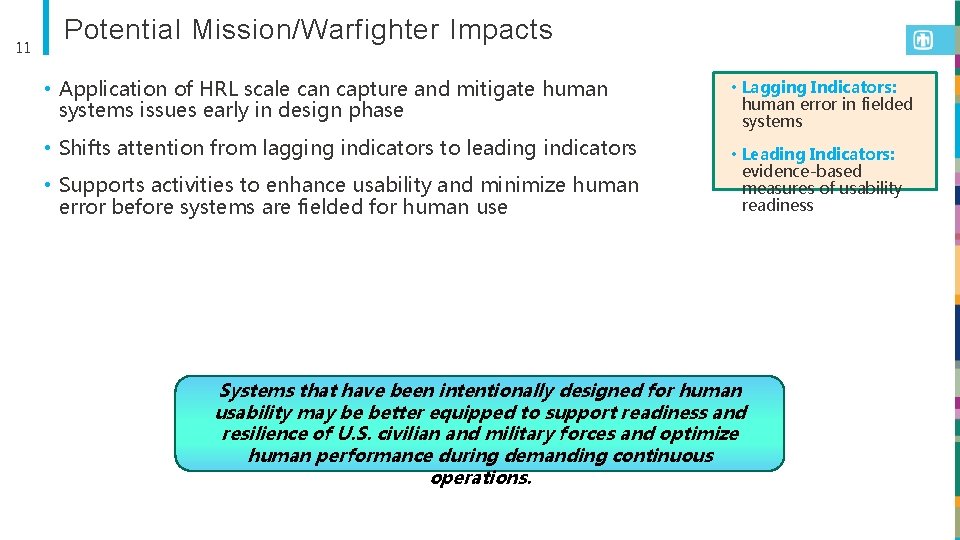
11 Potential Mission/Warfighter Impacts • Application of HRL scale can capture and mitigate human systems issues early in design phase • Shifts attention from lagging indicators to leading indicators • Supports activities to enhance usability and minimize human error before systems are fielded for human use • Lagging Indicators: human error in fielded systems • Leading Indicators: evidence-based measures of usability readiness Systems that have been intentionally designed for human usability may be better equipped to support readiness and resilience of U. S. civilian and military forces and optimize human performance during demanding continuous operations.
12 Thank You! For additional information or questions, contact Judi See at jesee@sandia. gov or 505 -844 -4567.