
HUMAN PROCESS LABORATORY A Human Behavioural Process Laboratory
HUMAN PROCESS LABORATORY
�A Human Behavioural Process Laboratory (HBPL) is an experimental set-up for a particular period of time � to provide opportunities for the participants to look at their own behaviour processes and � its impact on others, and �learn from this experience as well as others in the group.
�HPL is basically experiential learning and therefore greatly depends on what one experience and experiments in the group. Contrary to class room learning there are no topics to discuss, debate and lecture about. The matter for learning is yourself and the group and therefore experiencing yourself and others in interaction how we come across to others as we interact here and generate data for learning.
�Phase 1 – One to one Interaction with the facilitator �Phase 2 – Process Lab �Phase 3 – Enneagram Intervention with plan of action
�The involvement in the lab is voluntary. However, the group dynamism invariably will bring everybody to participate in the process. �The experience/ learning of the individuals in the Lab could vary. �Some may feel totally drained, some may feel rejuvenated, some may feel rejected, some may feel they have discovered their hidden self etc. �The process could be extremely painful in the beginning of the `Journey to discover the self’ and enriching at the end. �The facilitator is expected to observe what’ is happening `here and now’.
The basic assumptions of a HBPL �The search for the true self is an eternal journey. �The search is complex, and painful in the first leg of the journey and enriching and compassionae at the end. �The search is internal rather than external to the self. �Experiential learning is the best way of adult learning. �It helps individual to be better, responsible human beings in different context.
�It believes that every individual who is participating in the journey wishes to stop, look, and proceed on his/her own self. �It believes that all participants do have a willingness to learn. �Nobody is `the knowledgeable’. Everybody is in the process of learning. �Voluntary participation �The focus on the individual rather than others.
Values: �Confrontation on issues �Openness �Objectivity in Feed-back �Collaboration �Trust
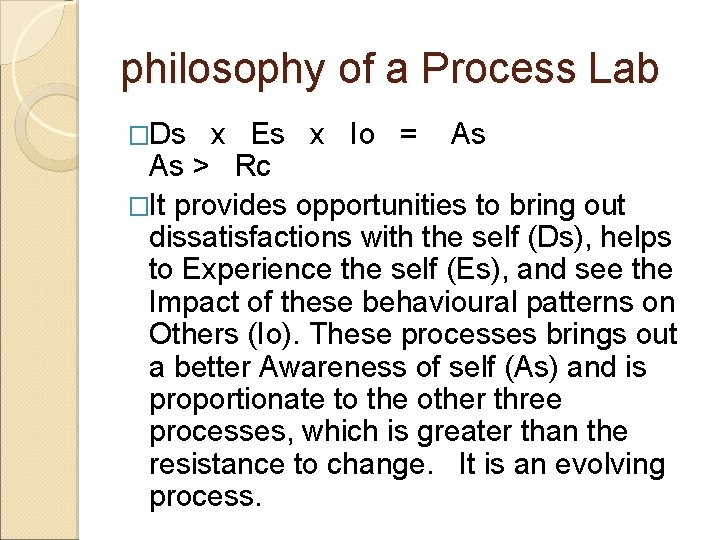
philosophy of a Process Lab �Ds x Es x Io = As As > Rc �It provides opportunities to bring out dissatisfactions with the self (Ds), helps to Experience the self (Es), and see the Impact of these behavioural patterns on Others (Io). These processes brings out a better Awareness of self (As) and is proportionate to the other three processes, which is greater than the resistance to change. It is an evolving process.
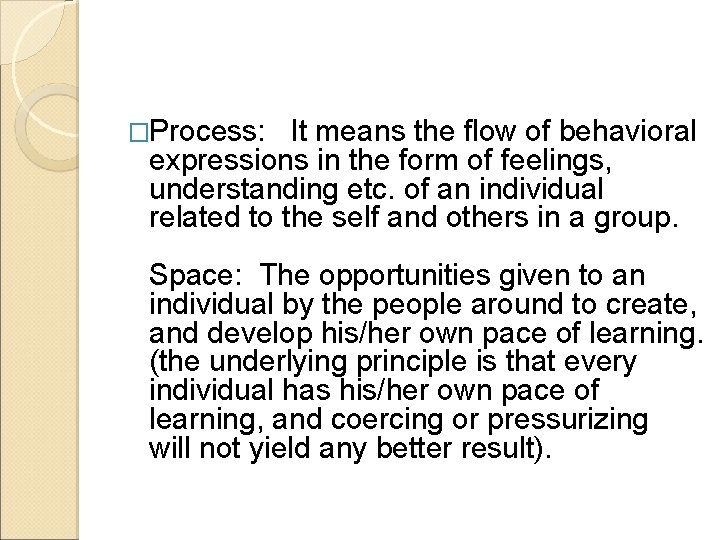
�Process: It means the flow of behavioral expressions in the form of feelings, understanding etc. of an individual related to the self and others in a group. Space: The opportunities given to an individual by the people around to create, and develop his/her own pace of learning. (the underlying principle is that every individual has his/her own pace of learning, and coercing or pressurizing will not yield any better result).
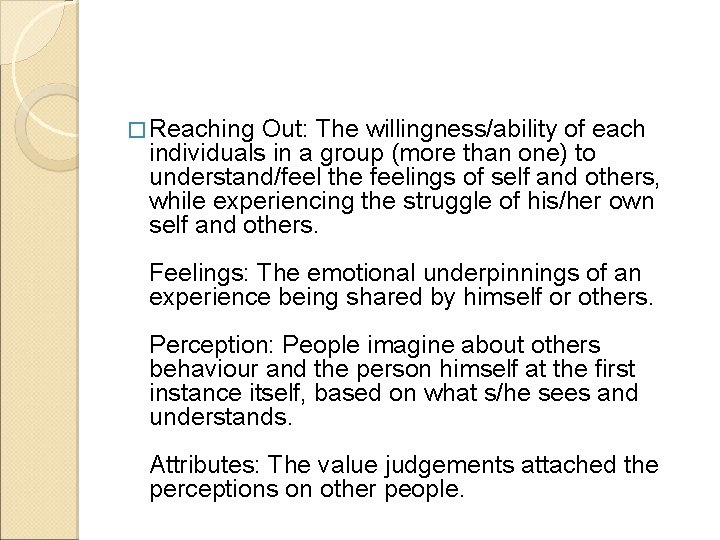
� Reaching Out: The willingness/ability of each individuals in a group (more than one) to understand/feel the feelings of self and others, while experiencing the struggle of his/her own self and others. Feelings: The emotional underpinnings of an experience being shared by himself or others. Perception: People imagine about others behaviour and the person himself at the first instance itself, based on what s/he sees and understands. Attributes: The value judgements attached the perceptions on other people.
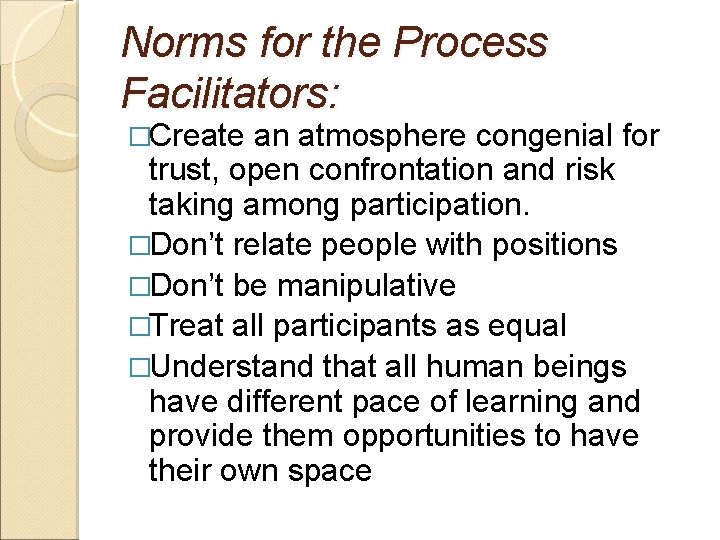
Norms for the Process Facilitators: �Create an atmosphere congenial for trust, open confrontation and risk taking among participation. �Don’t relate people with positions �Don’t be manipulative �Treat all participants as equal �Understand that all human beings have different pace of learning and provide them opportunities to have their own space
�Be objective : No grouping based on Nepotism/ caste /regionalism. However, this does not make the facilitator above the group processes. �Be genuine in the expression of feelings �Do accept/believe `what is happening’. �Don’t attribute values to an action /behaviour of an individual. �Trust the participants.
METHODOLOGY �A Human Process Lab is conducted with 10 -12 participants. It’s not a classroom-with-chairs-and-a-projector kind of setting. Instead, mattresses and pillows are laid out on the floor. �Participants are seated on these mattresses as they engage with each other as well as the coach over 40 hours of the lab duration.
�The first 16 hours of the lab involves free -wheeling discussion between participants on what concerns them in their professional and personal life. �The discussion at times gets intense, as debates occur and participants try to push their own agenda, dominate, digress or simply avoid talking. �This develops some sort of dynamics among team members. Feelings and emotions germinate among the participants towards each other.
� This inventory of incidents, statements, feelings, emotions, feedbacks and judgements form the data which is critical for the balance 24 hours of the workshop. �It’s then that the coach takes complete charge and the workshop gets intense. �The coach helps participants to express what they are feeling and makes them to get aware where that feeling is coming from. �The coach then enables participants to give feedback to (and not pass judgement on) those who made them feel what they felt.
�By the 32 nd hour, the group really opens up. Participants start sharing on their own, as they see in the group a medium to shed their masks which they had been wearing for years. �Their pent up emotions, deepest prejudices, fears etc. start flowing seamlessly in the room. �‘The coach as well as the group help the participants in the process.
�Participants who see the lab as a unique opportunity to offload their years of emotional burden share openly. �They feel relieved after shedding the burden and learn from the experience. �The coach as well as the group help such participants to deal with the emotional catharsis. �This experiment acts as a precursor to using the learning at home or in office. Using the learning directly in the outside world is not advised. Hence the word – lab.
- Slides: 19