
Human Population National Geographic 7 billion Popu Lations
Human Population National Geographic : 7 billion


Popu. Lations
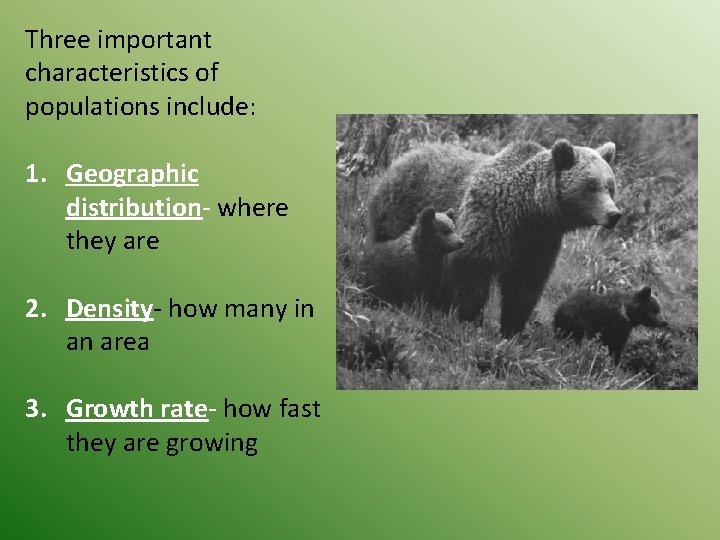
Three important characteristics of populations include: 1. Geographic distribution- where they are 2. Density- how many in an area 3. Growth rate- how fast they are growing

Population Growth is affected by three factors: the number of births, the numbers of deaths, and the number of individuals entering or leaving.

Immigration- movement of individuals into an area. Emigration- movement of individuals out of an area.

Types of population growth: 1. Exponential- “J” curve; ideal conditions with unlimited resources. 2. Logistic- “S” curve; limits to resources *carrying capacity (K) is this “cap” for pop. growth*
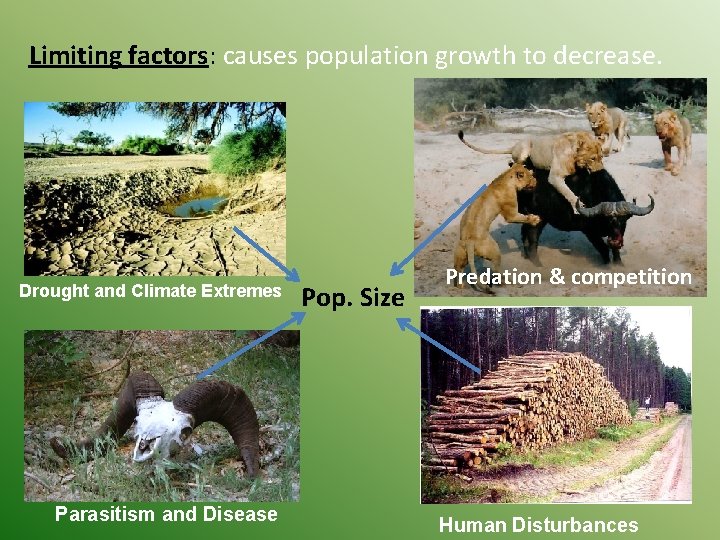
Limiting factors: causes population growth to decrease. Drought and Climate Extremes Parasitism and Disease Pop. Size Predation & competition Human Disturbances
Limiting factors can be density-dependent or density independent. Density-dependent depends on the population itself. ex. Competition, predation, disease, etc. Density-independent have nothing to do with the population are caused by outside influences. ex. Natural disasters, seasonal cycles, human activities.
Exit Slip 1. If wolves and lynx both eat the same small animals, will they be under pressure to change in ways that increase or decrease their competition? Explain your answer. 2. What limiting factors affect human populations?
- Slides: 10