
Human Population Growth History 1800 1 billion 1930

Human Population Growth
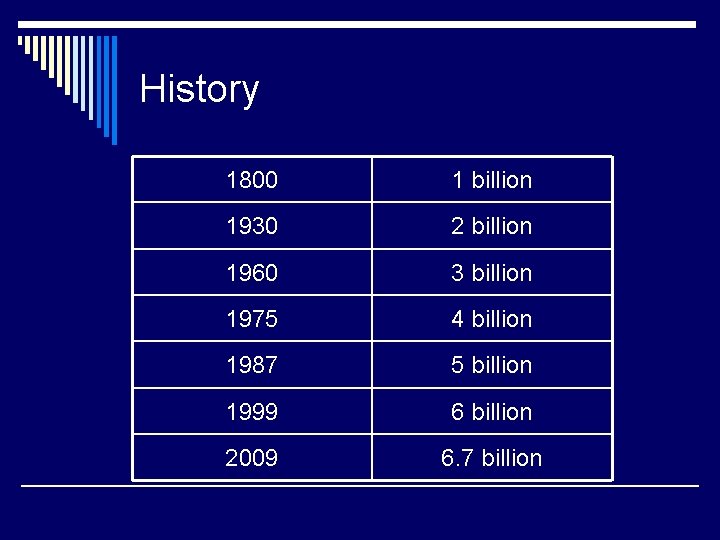
History 1800 1 billion 1930 2 billion 1960 3 billion 1975 4 billion 1987 5 billion 1999 6 billion 2009 6. 7 billion
History (cont) o Draw graph from Miller & Levine p. 143 o Most of human history, pop. grew slowly n Life was harsh – food was scarce, predators & diseases were common (limiting factors) o Industrial Revolution exponential growth n Better nutrition, sanitation, medicine, & healthcare lower death rates
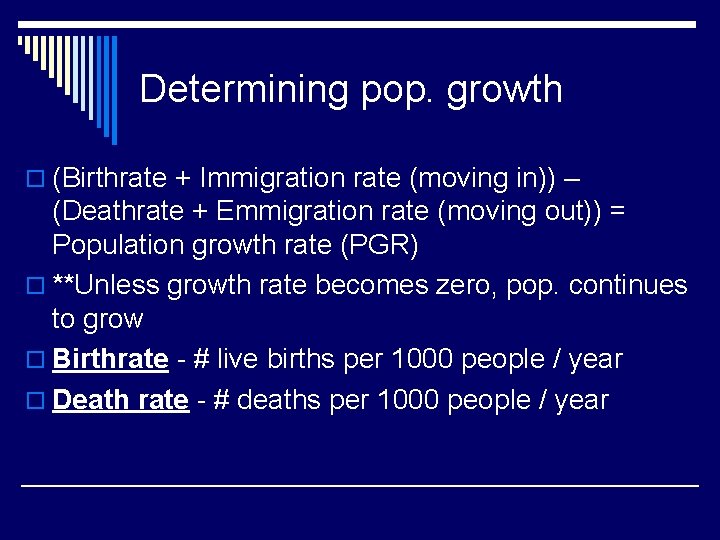
Determining pop. growth o (Birthrate + Immigration rate (moving in)) – (Deathrate + Emmigration rate (moving out)) = Population growth rate (PGR) o **Unless growth rate becomes zero, pop. continues to grow o Birthrate - # live births per 1000 people / year o Death rate - # deaths per 1000 people / year
Age Structure o Proportions of pop. in different age levels n Rapid growth – wide base (many children and teenagers) n Stable growth – almost equal in each category o M & L p. 144 fig 5 -13 o US: slow, steady growth rate o Guatemala: rapid growth (double in 30 years)
o What can you tell about this country based on its age structure graph? o Wide base = rapid growth o Skinny top = poor health care
o What can you tell about this country based on its age structure graph? o Base not much wider than middle = slow growth o Balanced fairly evenly throughout ages = good health care o # of females at top = females have longer life expectancy
o What can you tell about this country based on its age structure graph? o Base smaller than middle = population decline o Balanced fairly evenly throughout age groups = good health care o # females at top = live longer
Biodiversity o Variety of species in a certain area o Is there more biodiversity in … n n n A corn field or a tropical rain forest? A grassland or a coral reef? High Rock Lake or a lake in Brazil? o **Biodiversity is highest closer to the equator
Importance o Interdependence of food webs n What would happen without insects or decomposers? o Brings stability n Monocultures vs. scattered population in a forest o Provides oxygen, carbon dioxide removal, food, genetic material for new crops (drought or pest-resistant), raw materials, medicines
Loss o Extinction – species dies, genetics are gone forever n Passenger pigeon, Carolina parakeet, dusky seaside sparrow o Endangered – species numbers so low, extinction is possible o Threatened – likely to become endangered
Threats o **Habitat loss** o Habitat fragmentation o Edge effects o Habitat degradation (pollution) o Exotic/invasive species
What can we do? – sustainable practices o Recycling o Conserve nonrenewable resources n Fossil fuels: oil, coal, natural gas, aluminum o Use renewable resources sustainably n Solar power, wind, water, forests, crops n Sustainable agriculture p Use fewer pesticides, avoid monocultures, drip irrigation, no-till drilling o Be a wise consumer! Vote with your money. n Avoid products with excessive plastic packaging, buy in bulk, watch for recycled products, reuse items until they wear out
- Slides: 13