
Human Population APES Review 2009 2010 Carrying capacity

- Slides: 30
Human Population APES Review 2009 -2010
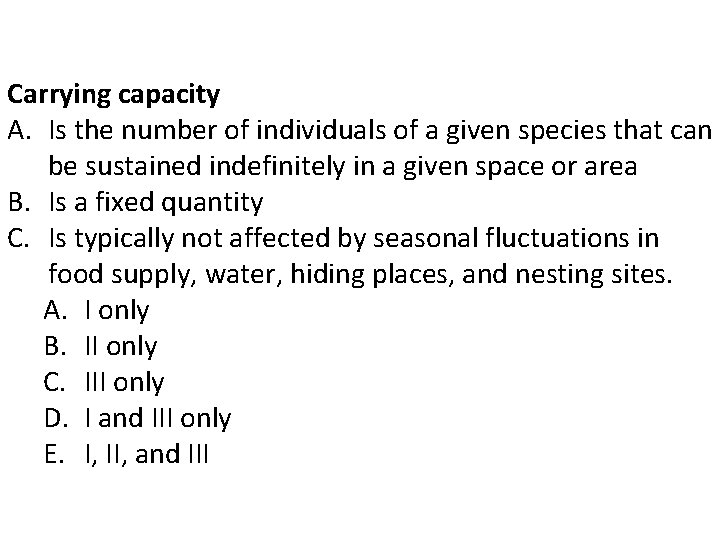
Carrying capacity A. Is the number of individuals of a given species that can be sustained indefinitely in a given space or area B. Is a fixed quantity C. Is typically not affected by seasonal fluctuations in food supply, water, hiding places, and nesting sites. A. I only B. II only C. III only D. I and III only E. I, II, and III
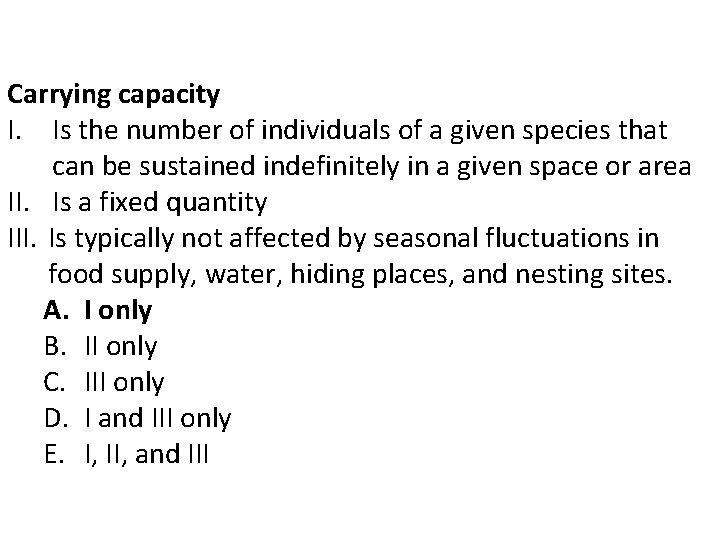
Carrying capacity I. Is the number of individuals of a given species that can be sustained indefinitely in a given space or area II. Is a fixed quantity III. Is typically not affected by seasonal fluctuations in food supply, water, hiding places, and nesting sites. A. I only B. II only C. III only D. I and III only E. I, II, and III
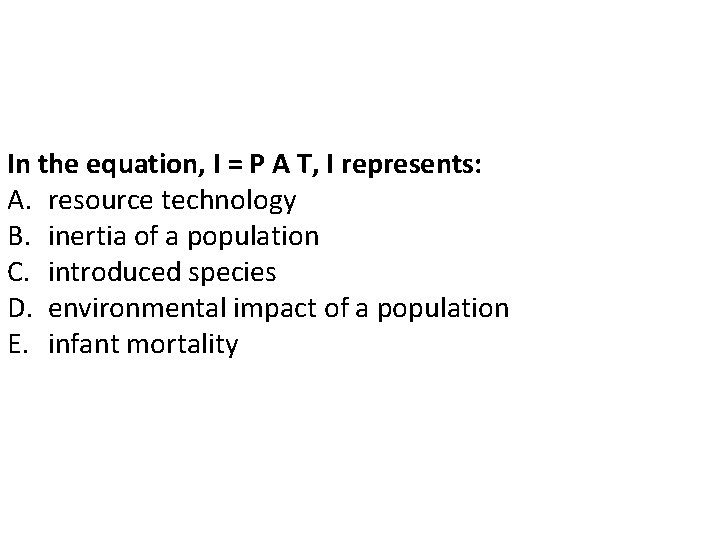
In the equation, I = P A T, I represents: A. resource technology B. inertia of a population C. introduced species D. environmental impact of a population E. infant mortality
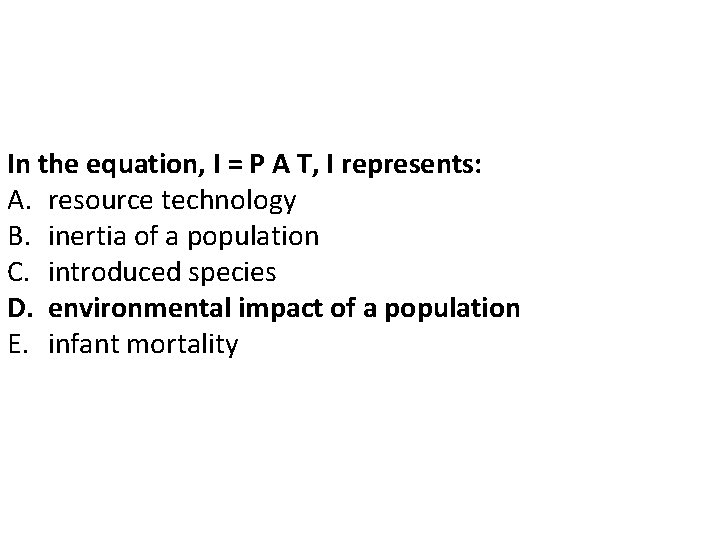
In the equation, I = P A T, I represents: A. resource technology B. inertia of a population C. introduced species D. environmental impact of a population E. infant mortality
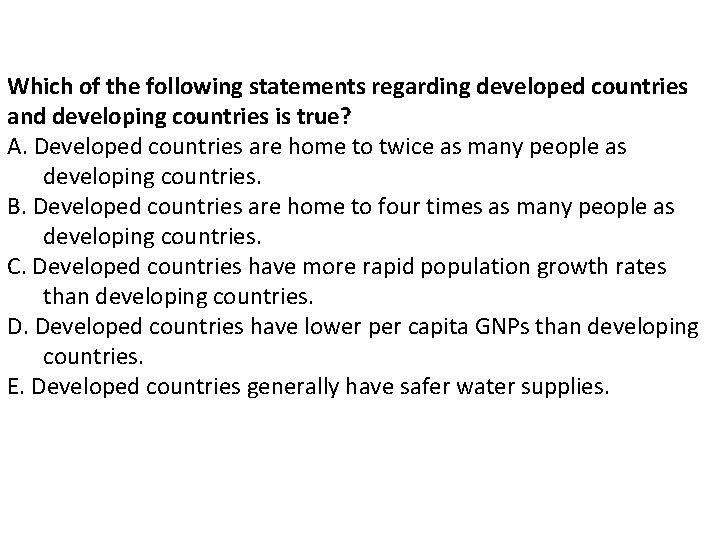
Which of the following statements regarding developed countries and developing countries is true? A. Developed countries are home to twice as many people as developing countries. B. Developed countries are home to four times as many people as developing countries. C. Developed countries have more rapid population growth rates than developing countries. D. Developed countries have lower per capita GNPs than developing countries. E. Developed countries generally have safer water supplies.
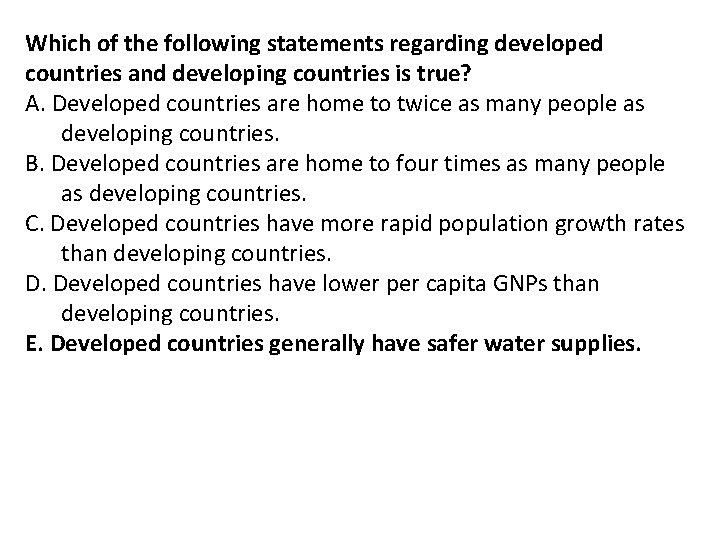
Which of the following statements regarding developed countries and developing countries is true? A. Developed countries are home to twice as many people as developing countries. B. Developed countries are home to four times as many people as developing countries. C. Developed countries have more rapid population growth rates than developing countries. D. Developed countries have lower per capita GNPs than developing countries. E. Developed countries generally have safer water supplies.
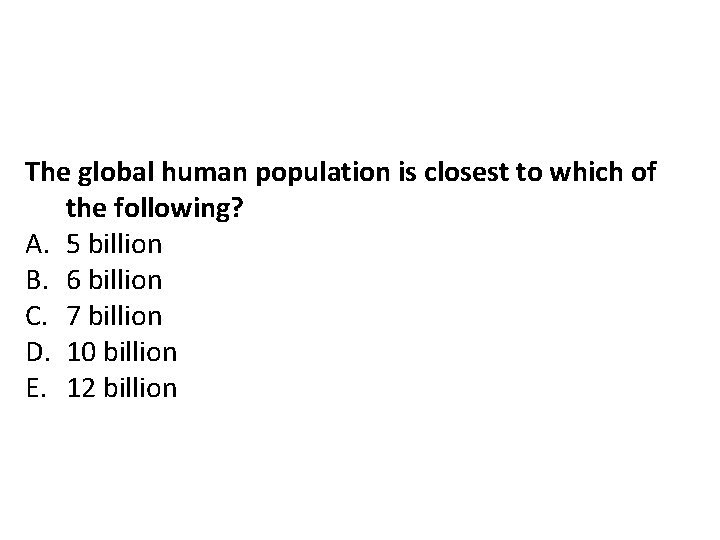
The global human population is closest to which of the following? A. 5 billion B. 6 billion C. 7 billion D. 10 billion E. 12 billion
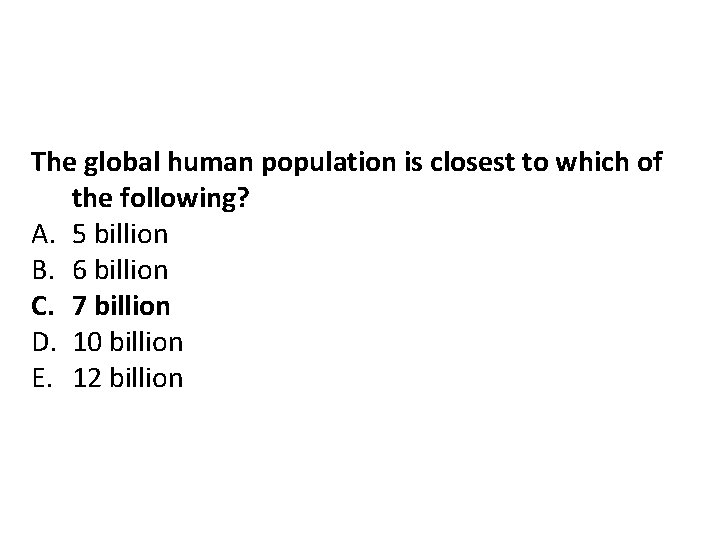
The global human population is closest to which of the following? A. 5 billion B. 6 billion C. 7 billion D. 10 billion E. 12 billion
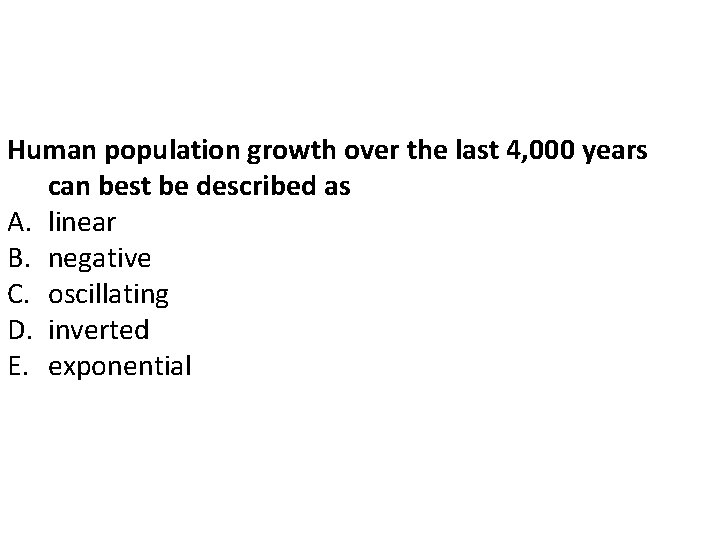
Human population growth over the last 4, 000 years can best be described as A. linear B. negative C. oscillating D. inverted E. exponential
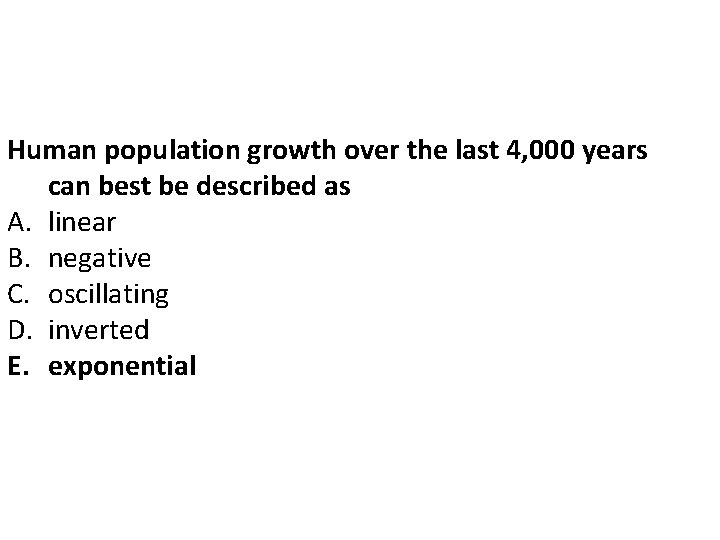
Human population growth over the last 4, 000 years can best be described as A. linear B. negative C. oscillating D. inverted E. exponential
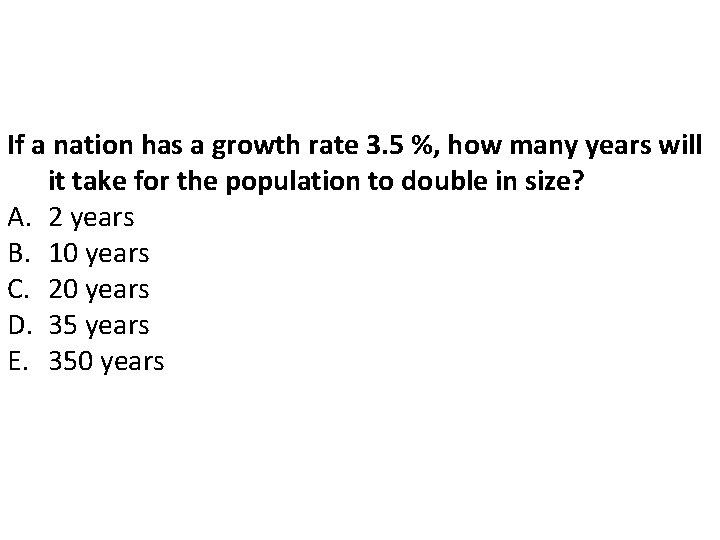
If a nation has a growth rate 3. 5 %, how many years will it take for the population to double in size? A. 2 years B. 10 years C. 20 years D. 35 years E. 350 years
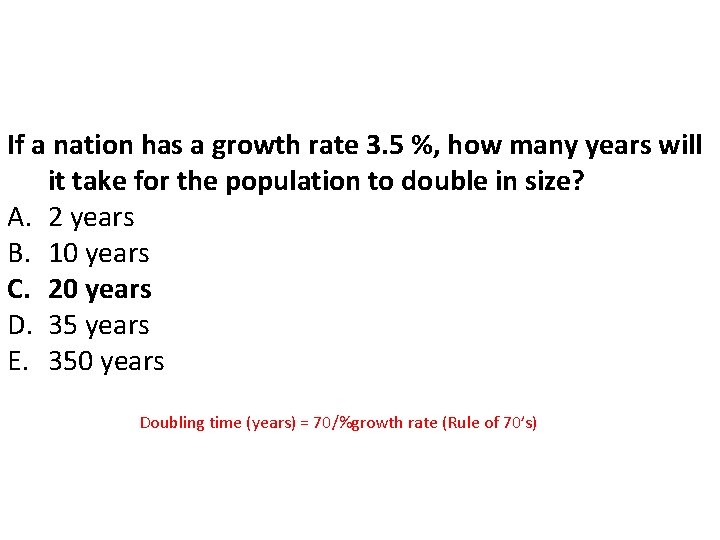
If a nation has a growth rate 3. 5 %, how many years will it take for the population to double in size? A. 2 years B. 10 years C. 20 years D. 35 years E. 350 years Doubling time (years) = 70/%growth rate (Rule of 70’s)
A country currently has a population of 200 million and an annual growth rate of 3. 0%. If the growth rate remains constant, after 70 years, the population will be approximately: A. 260 million B. 500 million C. 600 million D. 800 million E. 1600 million
A country currently has a population of 200 million and an annual growth rate of 3. 0%. If the growth rate remains constant, after 70 years, the population will be approximately: A. 260 million B. 500 million C. 600 million D. 800 million E. 1600 million Use Rule of 70’s. If 70/3% = 23 yrs (23 years to double), then in 70 yrs the population will be around 1600 million.
In 1999, Australia had a crude birth rate of 14 and a crude death rate of 7. Based on these figures, the annual rate of increase or decrease, expressed as a percent, equals: A. 0. 007% B. 0. 07% C. 0. 7% D. 7. 0% E. 70. 0%
In 1999, Australia had a crude birth rate of 14 and a crude death rate of 7. Based on these figures, the annual rate of increase or decrease, expressed as a percent, equals: A. 0. 007% B. 0. 07% C. 0. 7% D. 7. 0% E. 70. 0% Rate of increase (r)=(CBR-CRD)/10
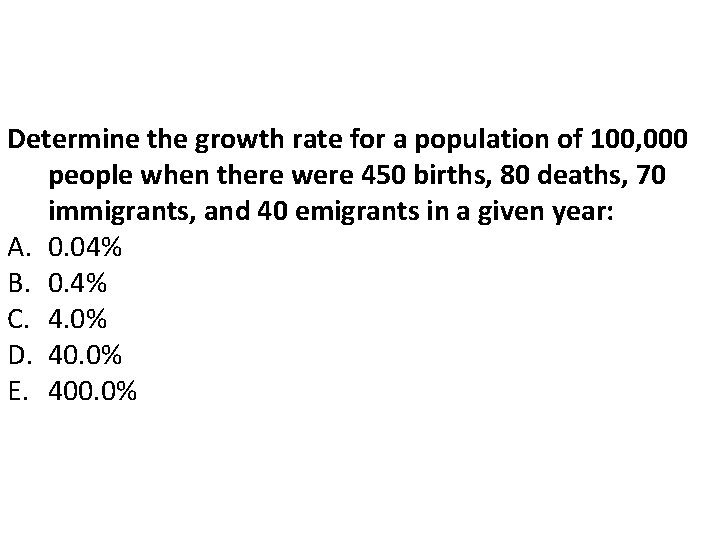
Determine the growth rate for a population of 100, 000 people when there were 450 births, 80 deaths, 70 immigrants, and 40 emigrants in a given year: A. 0. 04% B. 0. 4% C. 4. 0% D. 40. 0% E. 400. 0%
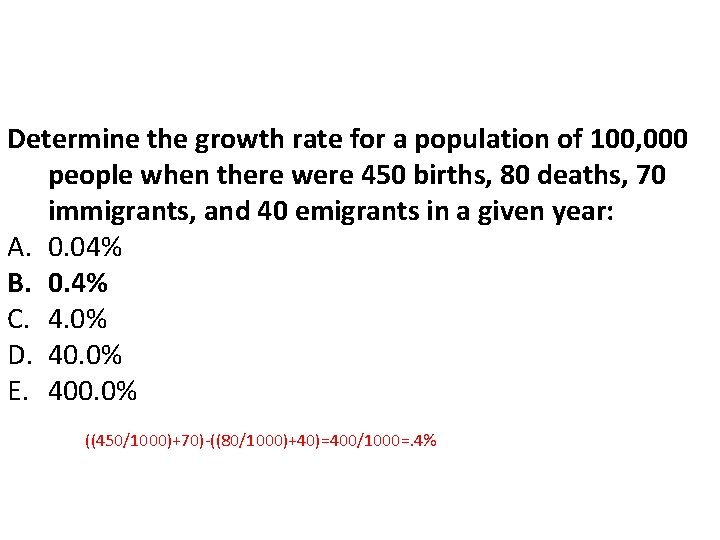
Determine the growth rate for a population of 100, 000 people when there were 450 births, 80 deaths, 70 immigrants, and 40 emigrants in a given year: A. 0. 04% B. 0. 4% C. 4. 0% D. 40. 0% E. 400. 0% ((450/1000)+70)-((80/1000)+40)=400/1000=. 4%
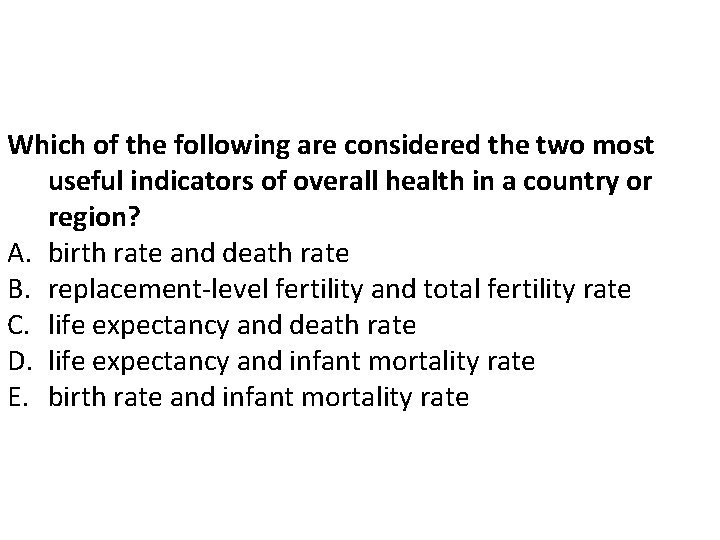
Which of the following are considered the two most useful indicators of overall health in a country or region? A. birth rate and death rate B. replacement-level fertility and total fertility rate C. life expectancy and death rate D. life expectancy and infant mortality rate E. birth rate and infant mortality rate
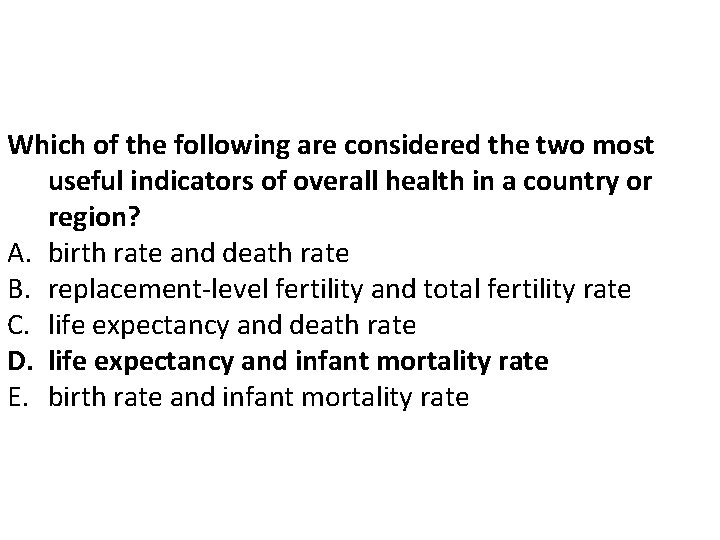
Which of the following are considered the two most useful indicators of overall health in a country or region? A. birth rate and death rate B. replacement-level fertility and total fertility rate C. life expectancy and death rate D. life expectancy and infant mortality rate E. birth rate and infant mortality rate
In the absence of high mortality, the major determining factor for population growth is____. A. crude birth rate B. crude death rate C. total fertility rate D. replacement-level fertility E. infant mortality
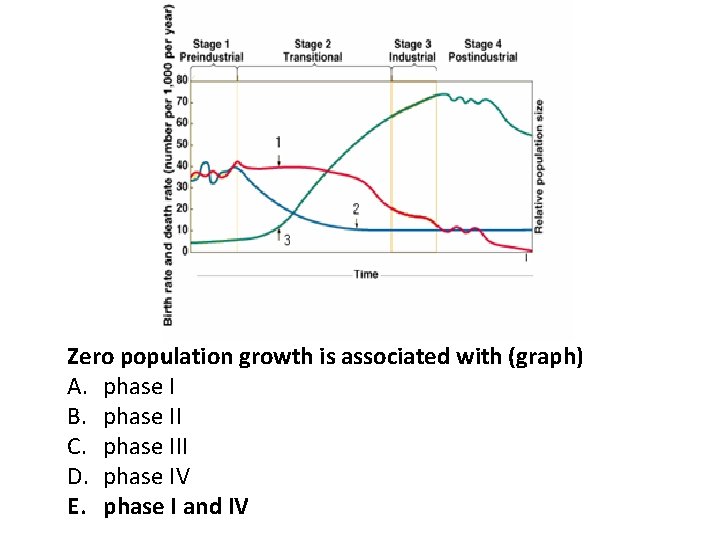
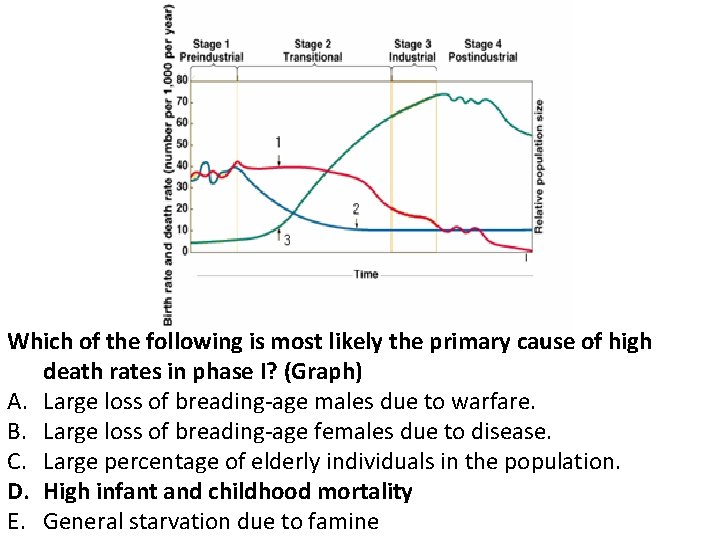
Demographic Transition refers to: A. a requirement for a population to reach a specific size before it becomes stable B. The slowing down in the growth of a population as it approaches the carrying capacity. C. The changes in the growth, birth rate, and death rate which a nation experiences as it goes through industrialization. D. The decline in death rates that occurred when the germ theory of disease was discovered. E. Migration from overpopulated nation’s different countries, mainly MDC’s.
Demographic Transition refers to: A. a requirement for a population to reach a specific size before it becomes stable B. The slowing down in the growth of a population as it approaches the carrying capacity. C. The changes in the growth, birth rate, and death rate which a nation experiences as it goes through industrialization. D. The decline in death rates that occurred when the germ theory of disease was discovered. E. Migration from overpopulated nation’s different countries, mainly MDC’s.
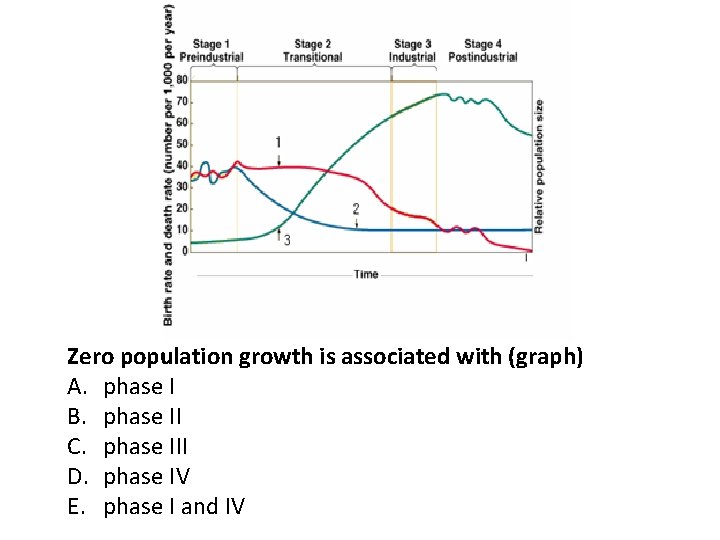
Zero population growth is associated with (graph) A. phase I B. phase II C. phase III D. phase IV E. phase I and IV
Zero population growth is associated with (graph) A. phase I B. phase II C. phase III D. phase IV E. phase I and IV
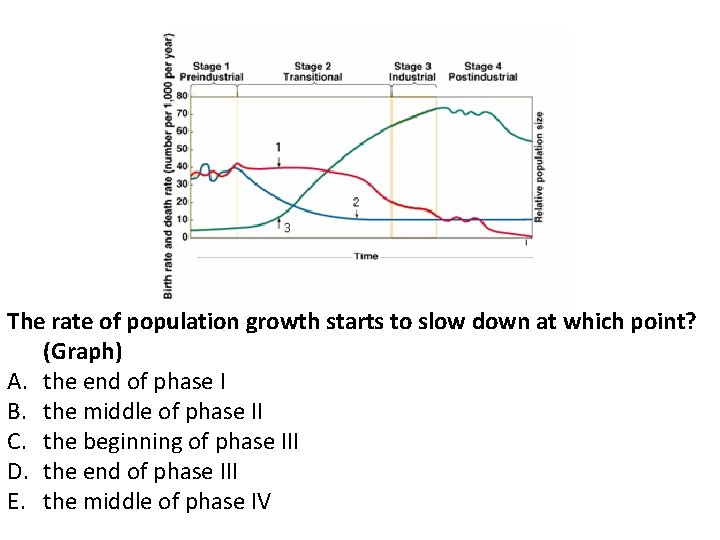
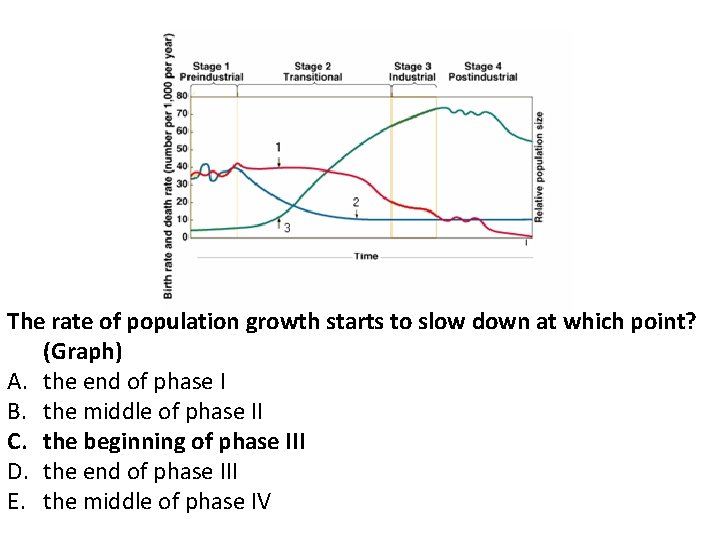
The rate of population growth starts to slow down at which point? (Graph) A. the end of phase I B. the middle of phase II C. the beginning of phase III D. the end of phase III E. the middle of phase IV
The rate of population growth starts to slow down at which point? (Graph) A. the end of phase I B. the middle of phase II C. the beginning of phase III D. the end of phase III E. the middle of phase IV
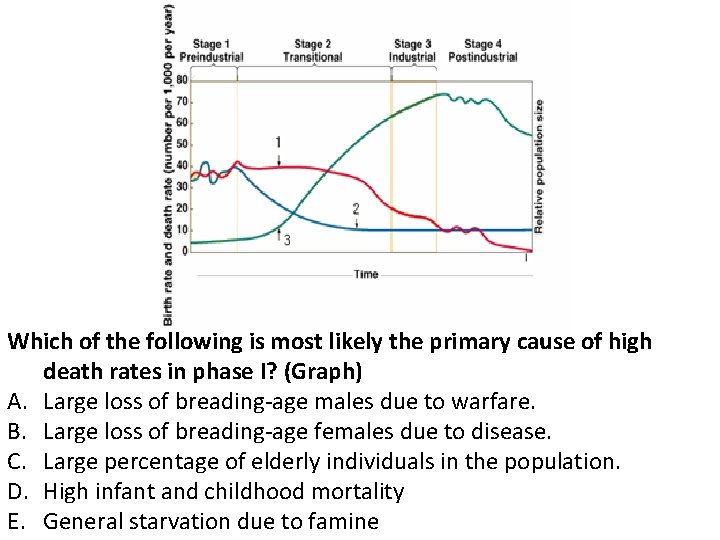
Which of the following is most likely the primary cause of high death rates in phase I? (Graph) A. Large loss of breading-age males due to warfare. B. Large loss of breading-age females due to disease. C. Large percentage of elderly individuals in the population. D. High infant and childhood mortality E. General starvation due to famine
Which of the following is most likely the primary cause of high death rates in phase I? (Graph) A. Large loss of breading-age males due to warfare. B. Large loss of breading-age females due to disease. C. Large percentage of elderly individuals in the population. D. High infant and childhood mortality E. General starvation due to famine