
Human Performance Engineering Dotan Shvorin Kevin Taaffe Identification
- Slides: 1
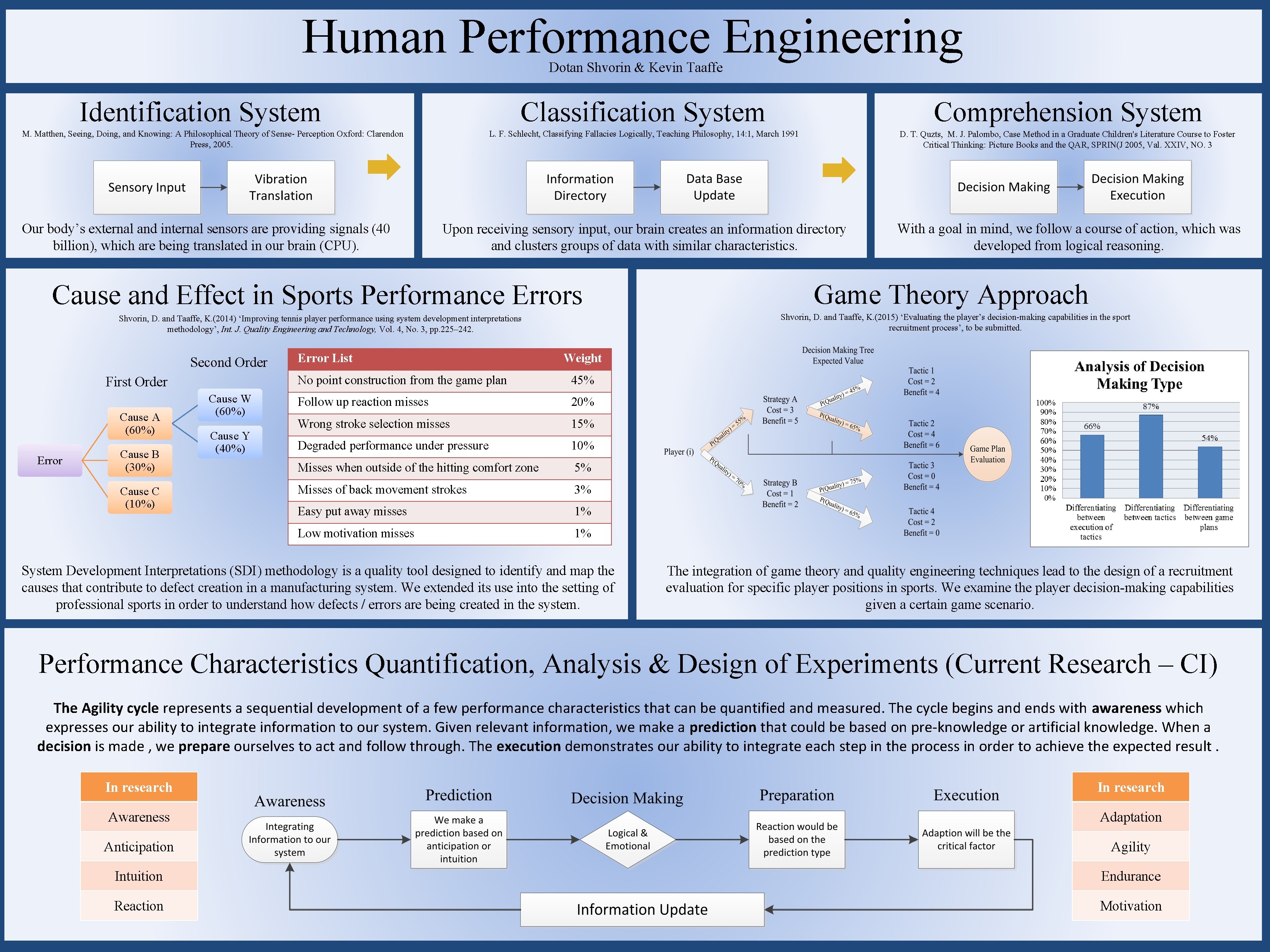
Human Performance Engineering Dotan Shvorin & Kevin Taaffe Identification System Classification System Comprehension System L. F. Schlecht, Classifying Fallacies Logically, Teaching Philosophy, 14: 1, March 1991 D. T. Quzts, M. J. Palombo, Case Method in a Graduate Children's Literature Course to Foster Critical Thinking: Picture Books and the QAR, SPRIN(J 2005, Val. XXIV, NO. 3 Upon receiving sensory input, our brain creates an information directory and clusters groups of data with similar characteristics. With a goal in mind, we follow a course of action, which was developed from logical reasoning. M. Matthen, Seeing, Doing, and Knowing: A Philosophical Theory of Sense Perception Oxford: Clarendon Press, 2005. Our body’s external and internal sensors are providing signals (40 billion), which are being translated in our brain (CPU). Cause and Effect in Sports Performance Errors Shvorin, D. and Taaffe, K. (2015) ‘Evaluating the player’s decision making capabilities in the sport recruitment process’, to be submitted. Shvorin, D. and Taaffe, K. (2014) ‘Improving tennis player performance using system development interpretations methodology’, Int. J. Quality Engineering and Technology, Vol. 4, No. 3, pp. 225– 242. Second Order Error Cause B (30%) Cause C (10%) Weight No point construction from the game plan 45% Cause W (60%) Follow up reaction misses 20% Cause Y (40%) Wrong stroke selection misses 15% Degraded performance under pressure 10% Misses when outside of the hitting comfort zone 5% Misses of back movement strokes 3% Easy put away misses 1% Low motivation misses 1% First Order Cause A (60%) Error List Game Theory Approach System Development Interpretations (SDI) methodology is a quality tool designed to identify and map the causes that contribute to defect creation in a manufacturing system. We extended its use into the setting of professional sports in order to understand how defects / errors are being created in the system. The integration of game theory and quality engineering techniques lead to the design of a recruitment evaluation for specific player positions in sports. We examine the player decision making capabilities given a certain game scenario. Performance Characteristics Quantification, Analysis & Design of Experiments (Current Research – CI) The Agility cycle represents a sequential development of a few performance characteristics that can be quantified and measured. The cycle begins and ends with awareness which expresses our ability to integrate information to our system. Given relevant information, we make a prediction that could be based on pre-knowledge or artificial knowledge. When a decision is made , we prepare ourselves to act and follow through. The execution demonstrates our ability to integrate each step in the process in order to achieve the expected result. In research Awareness Adaptation Anticipation Agility Intuition Endurance Reaction Motivation