
Human Papillomavirus HPV Vaccination Help beat cervical cancer

Human Papillomavirus (HPV) Vaccination Help beat cervical cancer Vaccine Preventable Disease Programme September 2014
What is HPV? • Human Papillomavirus (HPV) is a very common virus that infects the deeper layers of the skin • There are over 100 types of HPV, 40 of which affect the genital area • You can catch it by having intimate sexual contact with someone who has the virus. • There are low risk and high risk types of HPV • HPV causes 99% of cancers of the cervix Vaccine Preventable Disease Programme September 2014
What is cervical cancer? • Cervical cancer is cancer of the cervix • HPV infections can’t be treated but if precancerous changes caused by HPV are detected by screening (smear test) the damaged tissue can be removed. • Smear testing has saved many lives but in the UK more than 2 women die every day from cervical cancer Vaccine Preventable Disease Programme September 2014
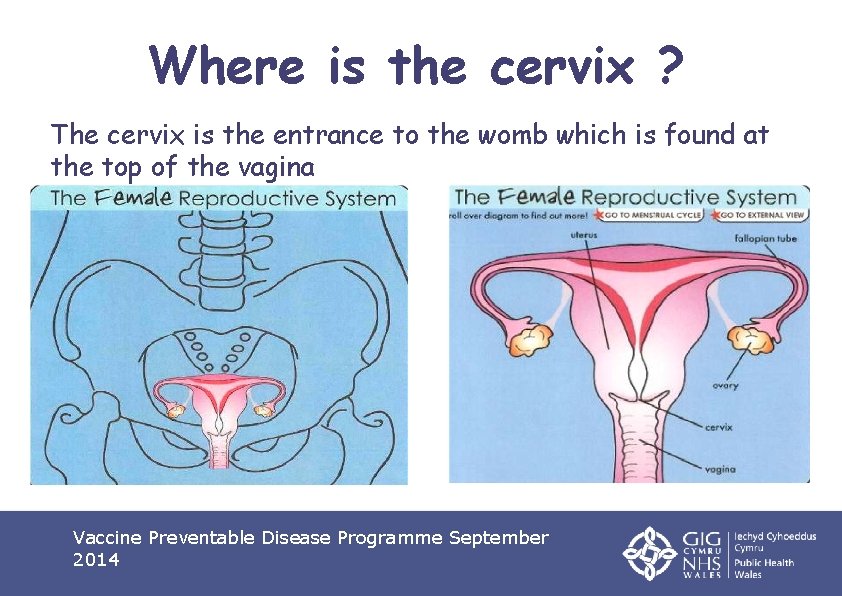
Where is the cervix ? The cervix is the entrance to the womb which is found at the top of the vagina Vaccine Preventable Disease Programme September 2014
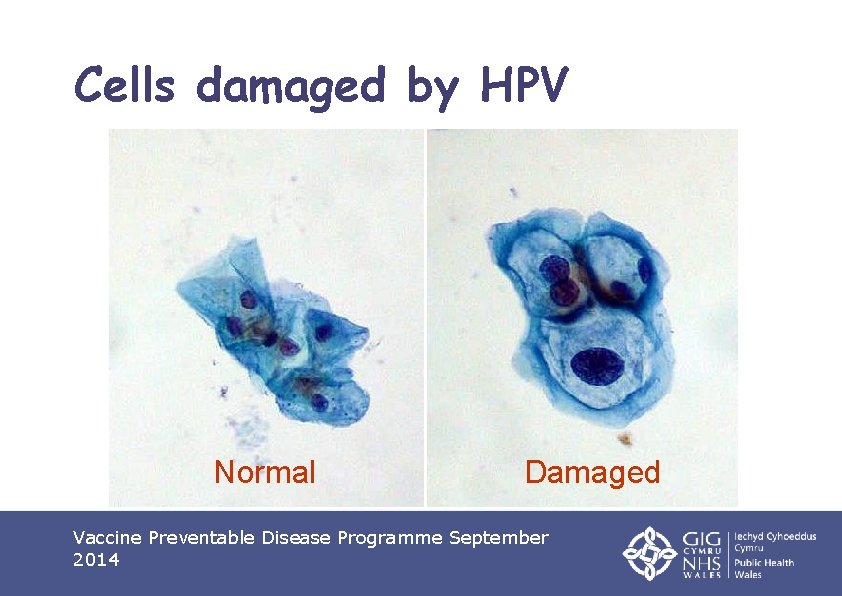
Cells damaged by HPV Normal Damaged Vaccine Preventable Disease Programme September 2014
Is there a lot of HPV about? YES – HPV is very common • Many people will be infected with HPV at some time in their lives • HPV has been found in up to 4 out of 10 women aged 20 -24 years old • Half of women have evidence of infection at some time in their lives • Most people infected with HPV have no symptoms and don’t know they are infected Vaccine Preventable Disease Programme September 2014
About the vaccine • The HPV vaccine is routinely offered to girls aged 12 -13 years old (School Year 8) • All girls up to 18 years of age are still able to have the HPV vaccination course • HPV vaccine is not offered to boys or girls after their 18 th birthday • In September 2012 there was a change to the vaccine offered from Cervarix to Gardasil • Gardasil offers protection against 4 HPV types Vaccine Preventable Disease Programme September 2014
What does Gardasil protect against? • Cervical Cancer • Genital Warts • HPV types 16 and 18 • Causes over 70% of cervical cancer • Does not protect against all cervical cancer so screening is still necessary • HPV types 6 and 11 • Causes over 90% of genital warts • It does not protect you against any other sexually transmitted diseases or pregnancy Vaccine Preventable Disease Programme September 2014

Why is the HPV vaccine being given to 12 -13 year old girls? • Girls should be vaccinated before they are likely to come in contact with the HPV virus. • From the age of 14 the number of girls infected begins to increase and therefore giving the vaccine in school year 8 offers the best protection. • Girls who have already had sex should still have the vaccine because it isn’t possible to say if she has been infected with HPV or not. Vaccine Preventable Disease Programme September 2014
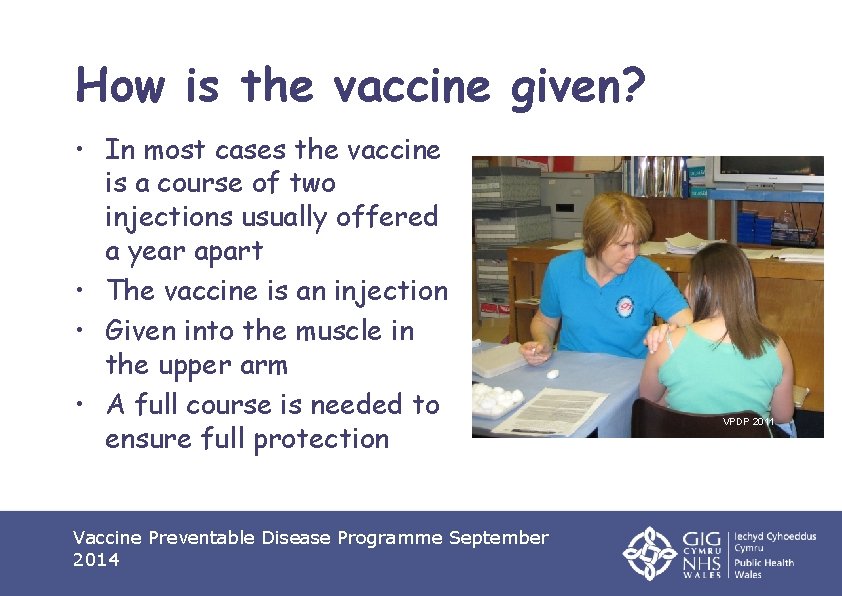
How is the vaccine given? • In most cases the vaccine is a course of two injections usually offered a year apart • The vaccine is an injection • Given into the muscle in the upper arm • A full course is needed to ensure full protection Vaccine Preventable Disease Programme September 2014 VPDP 2011
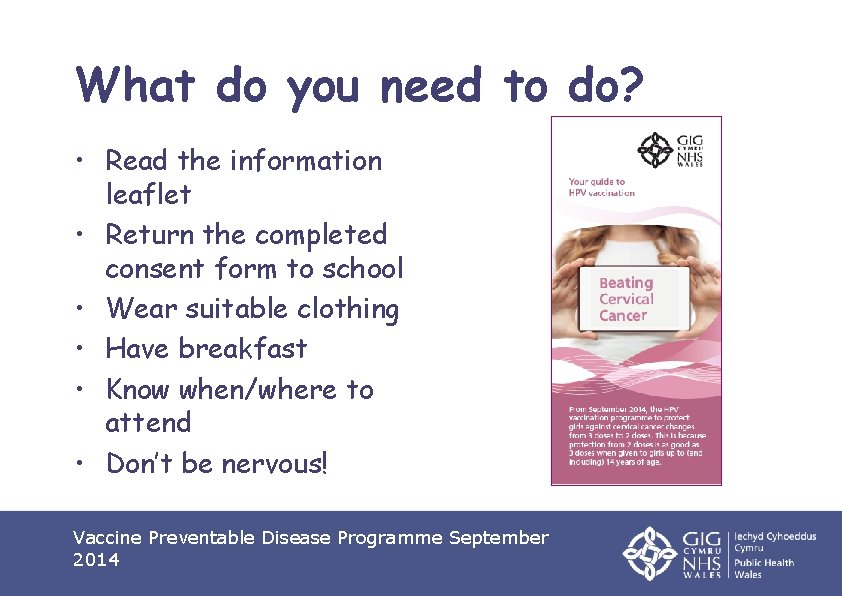
What do you need to do? • Read the information leaflet • Return the completed consent form to school • Wear suitable clothing • Have breakfast • Know when/where to attend • Don’t be nervous! Vaccine Preventable Disease Programme September 2014
Are there any side effects? • • • May sting a little during and immediately after injection Arm may be a bit red and sore afterwards Mild temperature Headache Aching muscles If you or your parents are worried-speak to your school nurse. Vaccine Preventable Disease Programme September 2014
Will this save lives? • Yes it will. • In Wales in 2012 there were 170 new cases of cervical cancer and over 40 deaths from the disease • Girls who have the vaccination will reduce their risk of getting cervical cancer by over 70%. Vaccine Preventable Disease Programme September 2014
Will I still need a smear test when I am older? Yes The vaccine does not protect against all types of HPV which cause cervical cancer so regular smear tests will still be very important. Vaccine Preventable Disease Programme September 2014
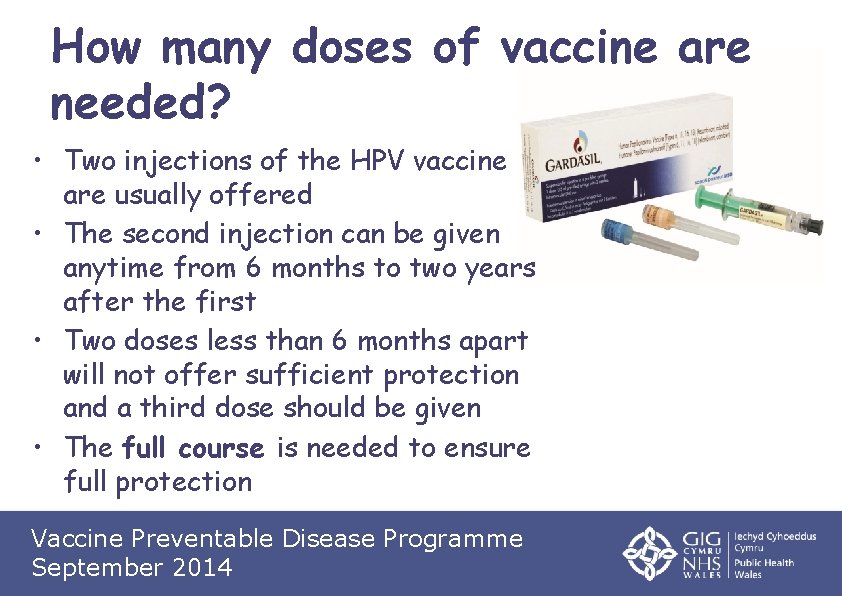
How many doses of vaccine are needed? • Two injections of the HPV vaccine are usually offered • The second injection can be given anytime from 6 months to two years after the first • Two doses less than 6 months apart will not offer sufficient protection and a third dose should be given • The full course is needed to ensure full protection Vaccine Preventable Disease Programme September 2014

Why are some girls offered more than 2 doses? • A HPV vaccination course of 3 doses is offered to girls: – Who have a weakened immune system – Who received the first dose after their 15 th birthday – Who have already started a 3 dose course of HPV vaccine • The three dose schedule is offered at 0, 1 and 4 to 6 months Vaccine Preventable Disease Programme September 2014
My sister in year 9 has had the first two doses of the three-dose schedule last year – does she still need the third one now? • Yes, girls who have started a three-dose schedule should complete it as originally planned. • Ideally 3 rd dose should be given within a year • Speak to the School Nurse Vaccine Preventable Disease Programme September 2014
Look out for information • Information on HPV for reading and download are available fromwww. nhsdirect. wales. nhs. uk • Request HPV leaflets hplibrary@wales. nhs. uk • Speak to your School Nurse Vaccine Preventable Disease Programme September 2014
Acknowledgements • Amended slide set from – Ashton Leigh Wigan PCT – Aneurin Bevan Health Board • Leah Millinship Images (unless otherwise stated) Vaccine Preventable Disease Programme September 2014
- Slides: 19