
Human Nervous System Central Nervous System Brain Spinal
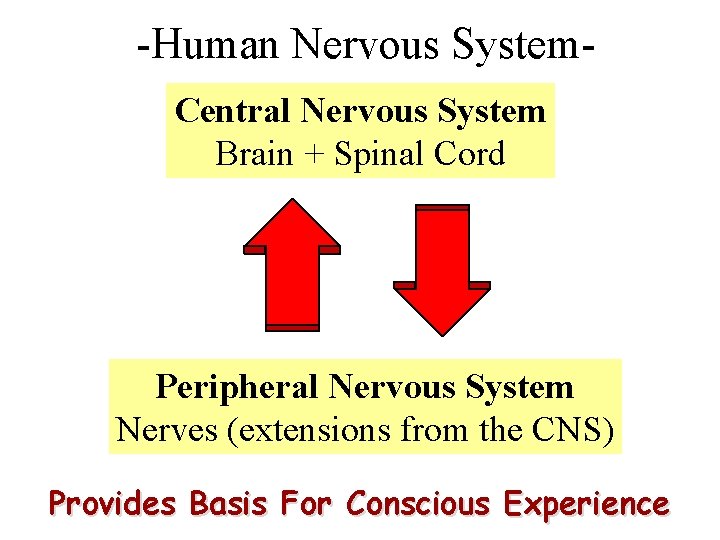
-Human Nervous System. Central Nervous System Brain + Spinal Cord Peripheral Nervous System Nerves (extensions from the CNS) Provides Basis For Conscious Experience
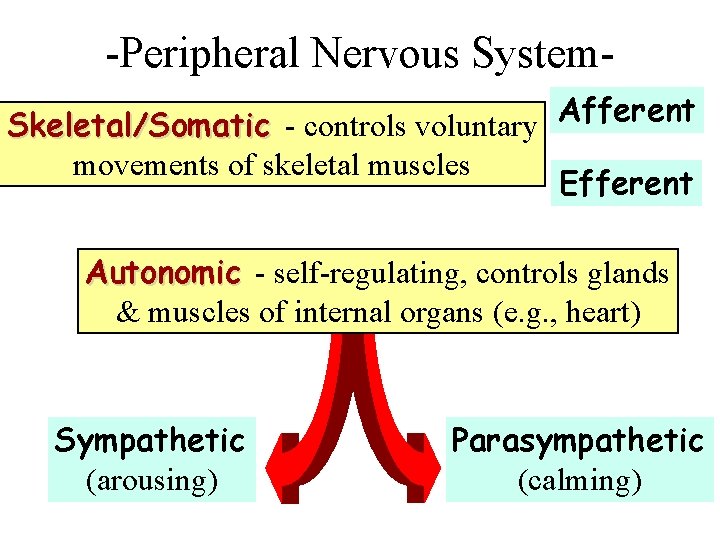
-Peripheral Nervous System. Skeletal/Somatic - controls voluntary Afferent movements of skeletal muscles Efferent Autonomic - self-regulating, controls glands & muscles of internal organs (e. g. , heart) Sympathetic (arousing) Parasympathetic (calming)
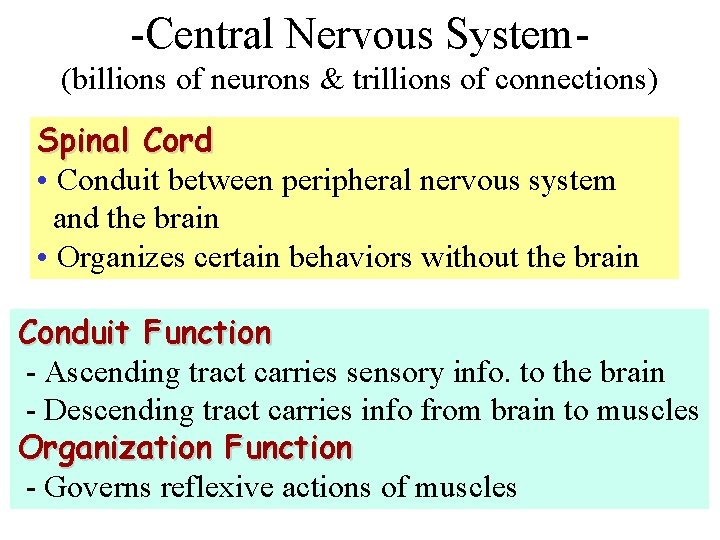
-Central Nervous System(billions of neurons & trillions of connections) Spinal Cord • Conduit between peripheral nervous system and the brain • Organizes certain behaviors without the brain Conduit Function - Ascending tract carries sensory info. to the brain - Descending tract carries info from brain to muscles Organization Function - Governs reflexive actions of muscles
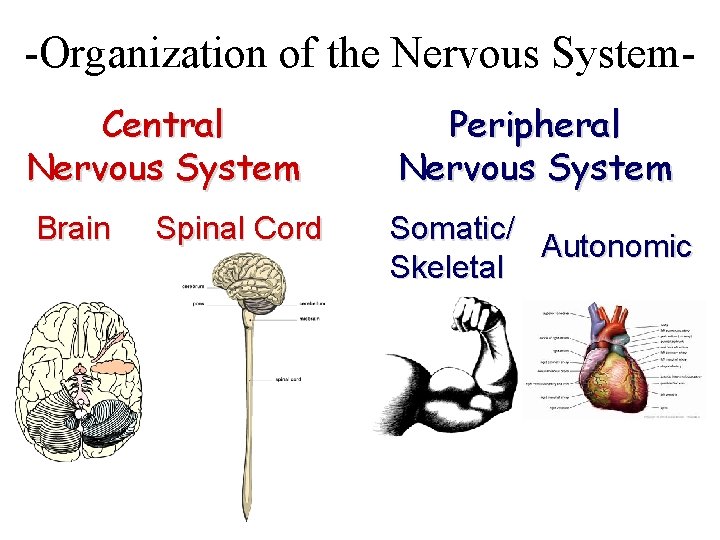
-Organization of the Nervous System. Central Nervous System Brain Spinal Cord Peripheral Nervous System Somatic/ Autonomic Skeletal
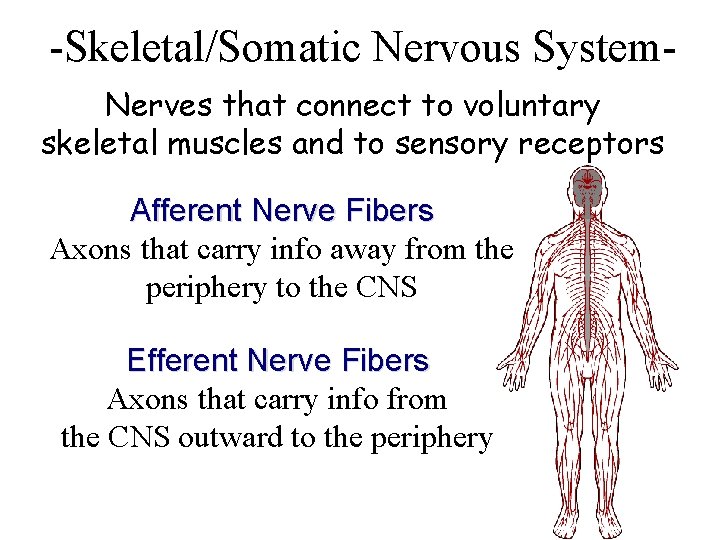
-Skeletal/Somatic Nervous System. Nerves that connect to voluntary skeletal muscles and to sensory receptors Afferent Nerve Fibers Axons that carry info away from the periphery to the CNS Efferent Nerve Fibers Axons that carry info from the CNS outward to the periphery
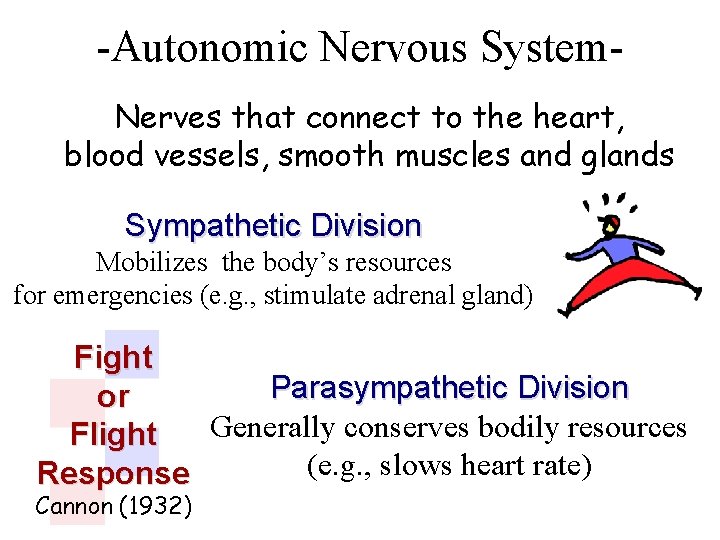
-Autonomic Nervous System. Nerves that connect to the heart, blood vessels, smooth muscles and glands Sympathetic Division Mobilizes the body’s resources for emergencies (e. g. , stimulate adrenal gland) Fight Parasympathetic Division or Generally conserves bodily resources Flight (e. g. , slows heart rate) Response Cannon (1932)
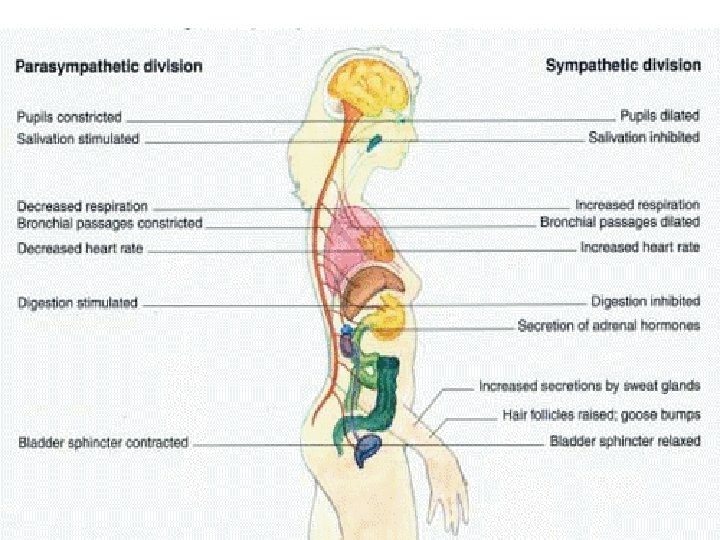
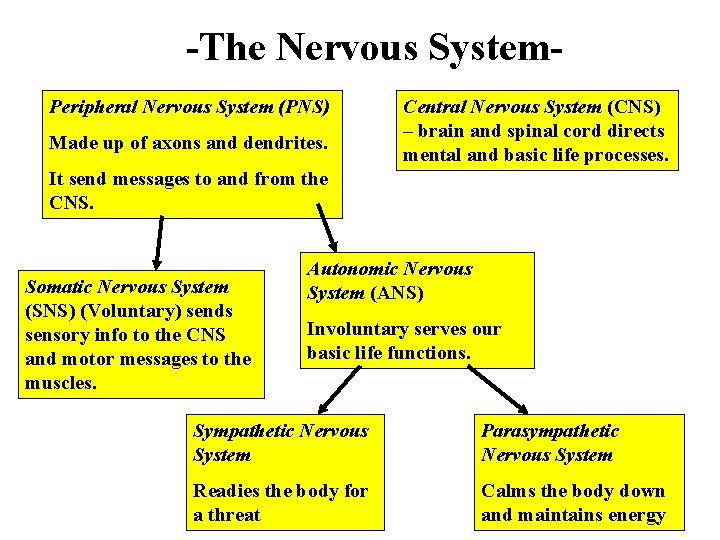
-The Nervous System. Peripheral Nervous System (PNS) Made up of axons and dendrites. Central Nervous System (CNS) – brain and spinal cord directs mental and basic life processes. It send messages to and from the CNS. Somatic Nervous System (SNS) (Voluntary) sends sensory info to the CNS and motor messages to the muscles. Autonomic Nervous System (ANS) Involuntary serves our basic life functions. Sympathetic Nervous System Parasympathetic Nervous System Readies the body for a threat Calms the body down and maintains energy
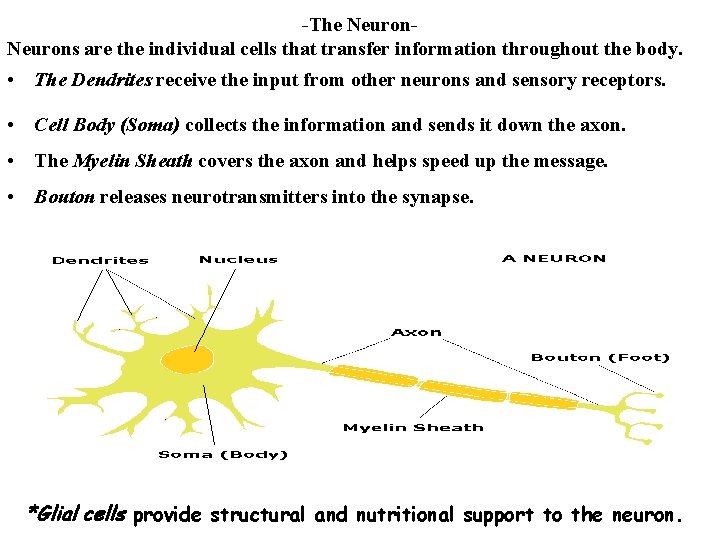
-The Neurons are the individual cells that transfer information throughout the body. • The Dendrites receive the input from other neurons and sensory receptors. • Cell Body (Soma) collects the information and sends it down the axon. • The Myelin Sheath covers the axon and helps speed up the message. • Bouton releases neurotransmitters into the synapse. *Glial cells provide structural and nutritional support to the neuron.
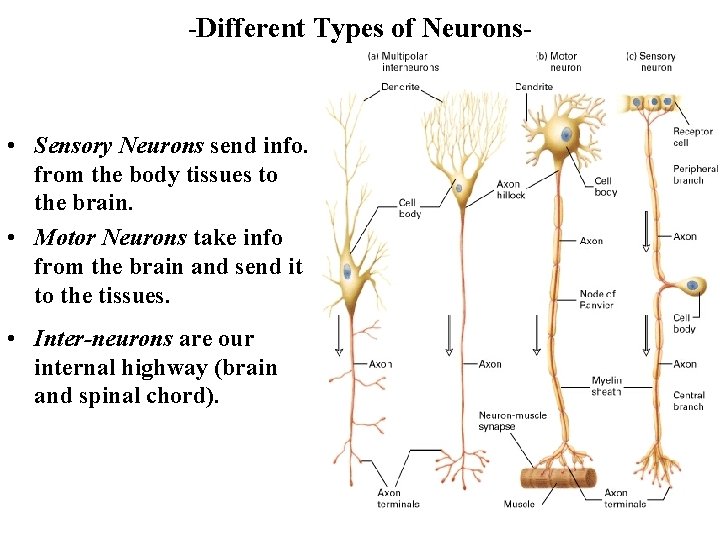
-Different Types of Neurons- • Sensory Neurons send info. from the body tissues to the brain. • Motor Neurons take info from the brain and send it to the tissues. • Inter-neurons are our internal highway (brain and spinal chord).
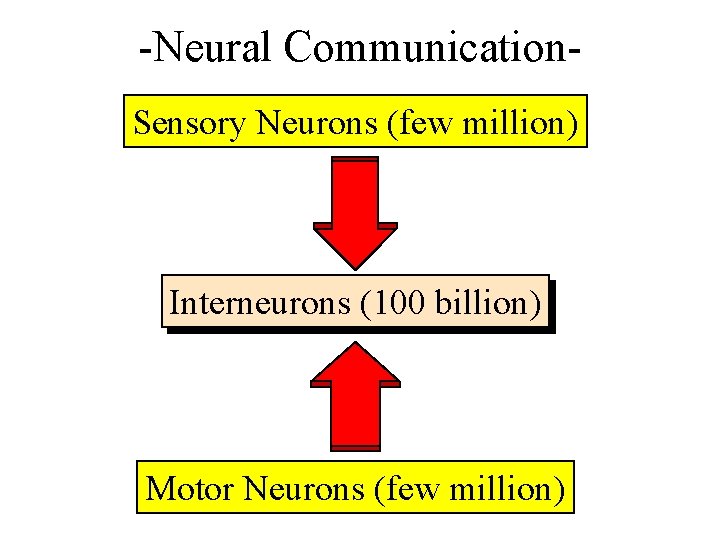
-Neural Communication. Sensory Neurons (few million) Interneurons (100 billion) Motor Neurons (few million)
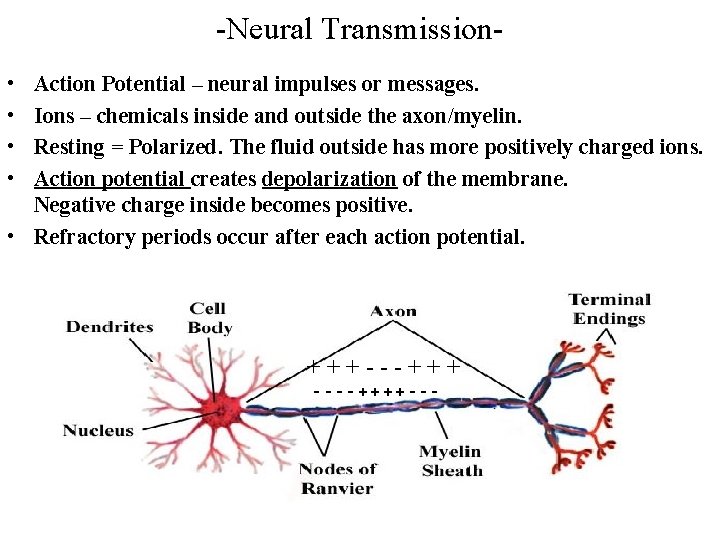
-Neural Transmission • • Action Potential – neural impulses or messages. Ions – chemicals inside and outside the axon/myelin. Resting = Polarized. The fluid outside has more positively charged ions. Action potential creates depolarization of the membrane. Negative charge inside becomes positive. • Refractory periods occur after each action potential. +++---+++ ----++++---
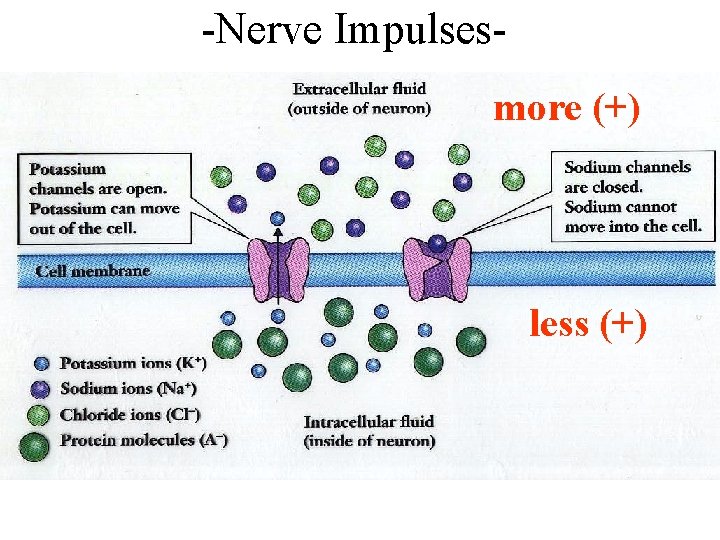
-Nerve Impulsesmore (+) less (+)
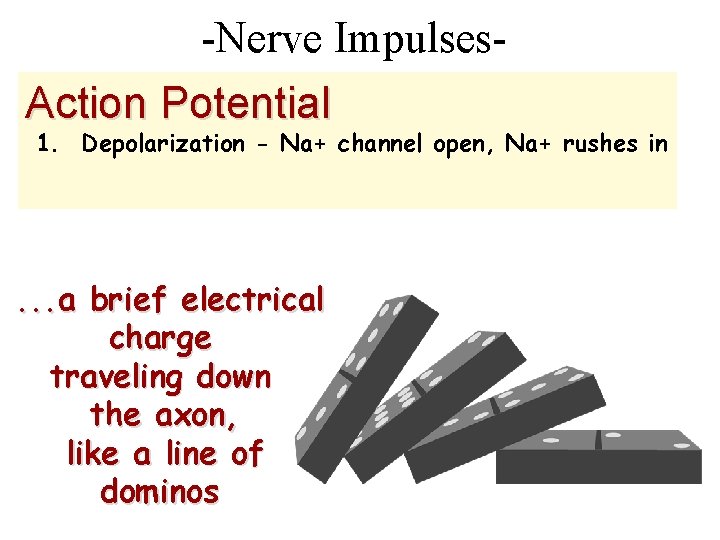
-Nerve Impulses. Action Potential 1. Depolarization - Na+ channel open, Na+ rushes in . . . a brief electrical charge traveling down the axon, like a line of dominos
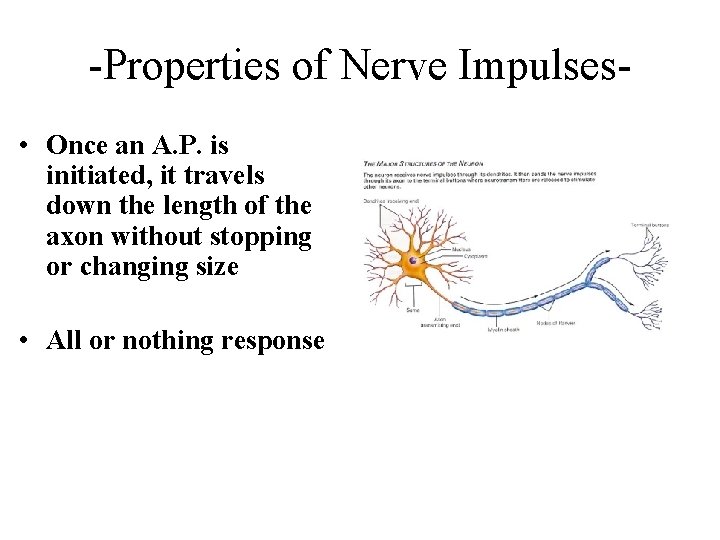
-Properties of Nerve Impulses • Once an A. P. is initiated, it travels down the length of the axon without stopping or changing size • All or nothing response
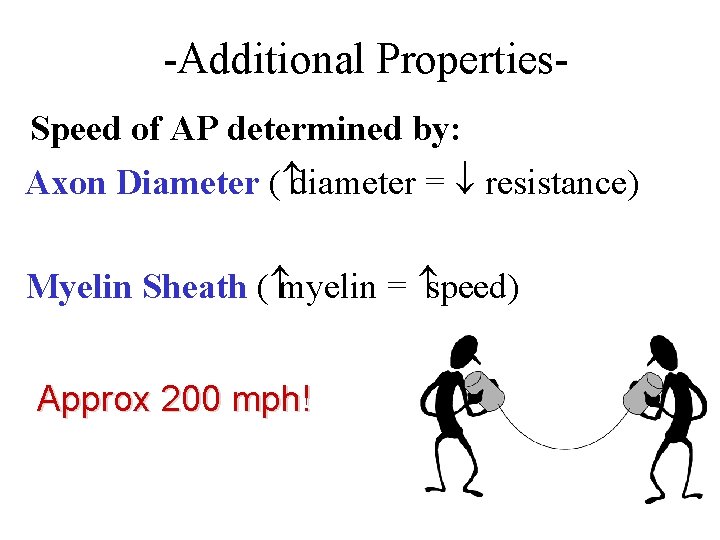
-Additional Properties. Speed of AP determined by: Axon Diameter ( diameter = ¯ resistance) Myelin Sheath ( myelin = speed) Approx 200 mph!
-The Synapse • Synapse is the space between the terminal ending (bouton/foot) of the sending neuron and the dendrites of the receiving neuron. Santiago Ramón y Cajal • A chemical process bridges the gap between neurons.
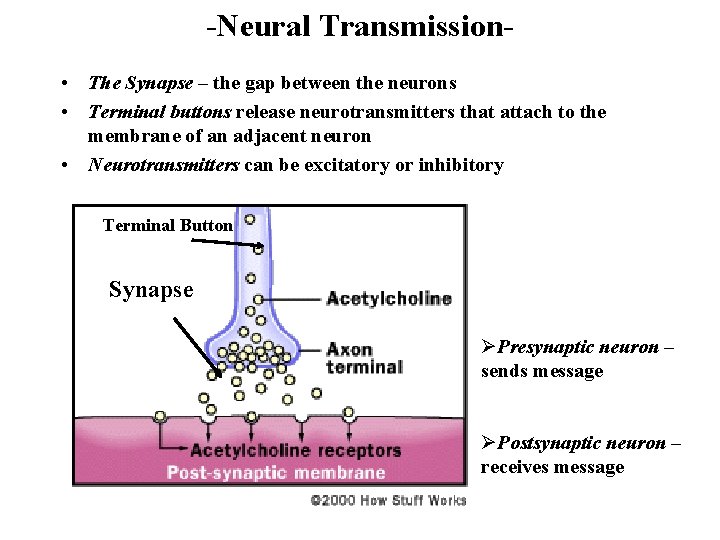
-Neural Transmission • The Synapse – the gap between the neurons • Terminal buttons release neurotransmitters that attach to the membrane of an adjacent neuron • Neurotransmitters can be excitatory or inhibitory Terminal Button Synapse ØPresynaptic neuron – sends message ØPostsynaptic neuron – receives message
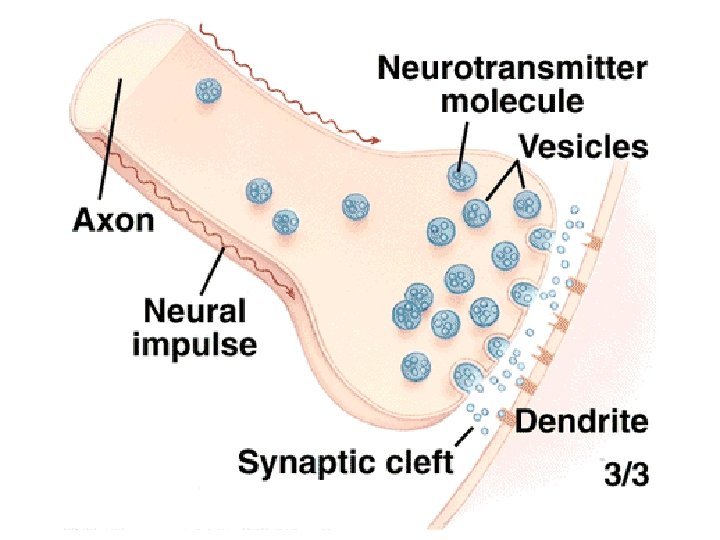
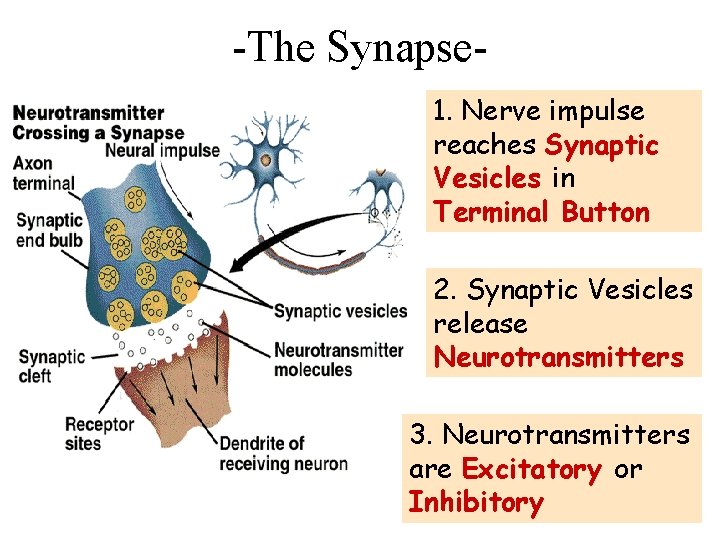
-The Synapse 1. Nerve impulse reaches Synaptic Vesicles in Terminal Button 2. Synaptic Vesicles release Neurotransmitters 3. Neurotransmitters are Excitatory or Inhibitory
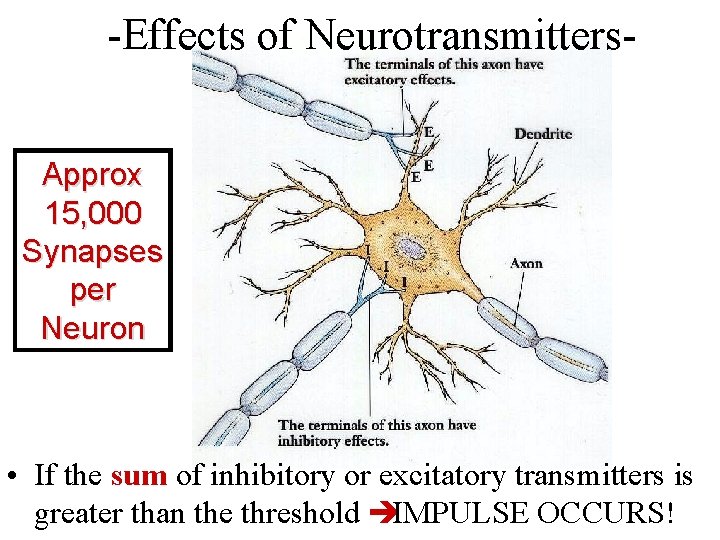
-Effects of Neurotransmitters. Approx 15, 000 Synapses per Neuron • If the sum of inhibitory or excitatory transmitters is greater than the threshold èIMPULSE OCCURS!
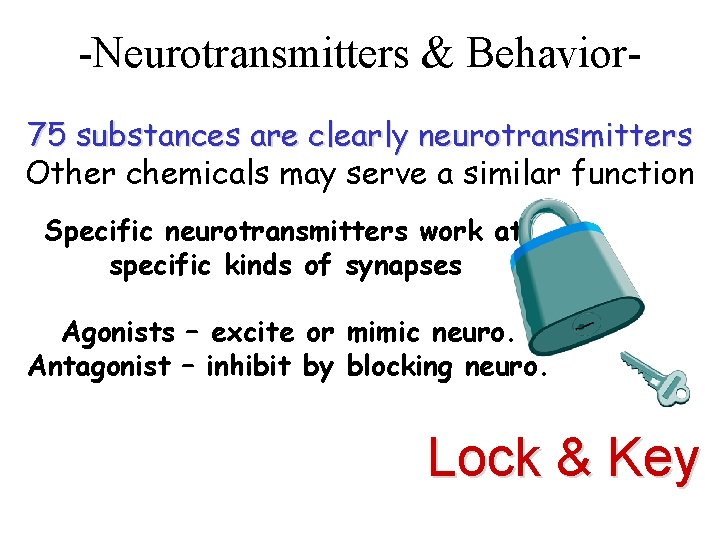
-Neurotransmitters & Behavior 75 substances are clearly neurotransmitters Other chemicals may serve a similar function Specific neurotransmitters work at specific kinds of synapses Agonists – excite or mimic neuro. Antagonist – inhibit by blocking neuro. Lock & Key
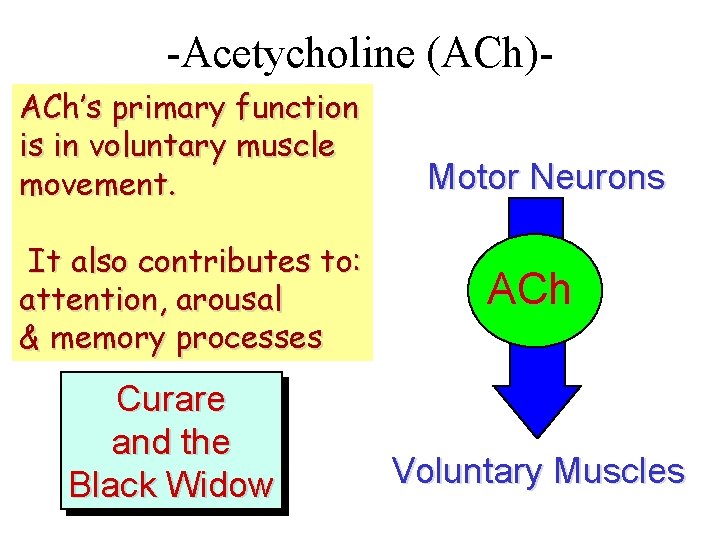
-Acetycholine (ACh)ACh’s primary function is in voluntary muscle movement. It also contributes to: attention, arousal & memory processes Curare and the Black Widow Motor Neurons ACh Voluntary Muscles
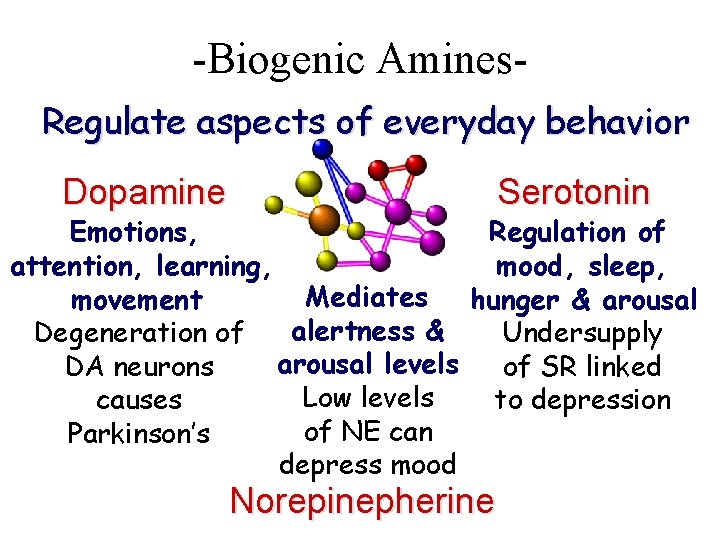
-Biogenic Amines. Regulate aspects of everyday behavior Dopamine Serotonin Emotions, Regulation of attention, learning, mood, sleep, Mediates movement hunger & arousal alertness & Degeneration of Undersupply arousal levels DA neurons of SR linked Low levels causes to depression of NE can Parkinson’s depress mood Norepinepherine
-Endorphins(a. k. a. Endogenous Morphines) Endorphins Entire family of internally produced chemicals that resemble opiates in structure and effects Cross Blood-Brain Barrier and bind to specialized receptors in the brain Neuromodulators Chemicals that modulate activity of specific N. Ts (e. g. , Decrease N. T. that delivers pain signals)
-Endocrine System • Endocrine (ducts) – release of hormones in the blood • Hormones move more slowly than neurotransmitters, but last longer • Effect growth, reproduction, metabolism, mood Adrenal Gland Release hormone (adrenaline) Increase heart rate, blood pressure Increased energy
-Endocrine System • Hypothalamus – control center • Anterior pituitary – growth hormone • Posterior pituitary – raises blood pressure • Thyroid (thyroxin) – increases metabolic rate, growth • Parathyroid – increases blood calcium, decreases potassium • Pancreas (insulin, glucagons) – regulates level of sugar • Ovary (estrogen) – promotes ovulation and sex characteristics • Testes (androgen)– promote sperm production and male sex characteristics
- Slides: 27