
Human motivation Contents What is motivation Its importance

- Slides: 27
Human motivation
Contents Ø What is motivation? Ø Its importance , need , types, techniques Ø What do the content theories suggest about individual needs and motivation? Ø What do the process theories suggest about individual motivation? Ø What are reinforcement theories and how are they linked to motivation?
What is Motivation…. w Motivation is derived from the word ‘Motive’ w A motive is an inner state that energizes, activates or moves and directs behavior towards goals. w A need or desire that causes a person to act; to have initiative, spirit or be enterprising is known as motivation. ‘Motivation’ can be expressed as internal process that activate, guide and maintain our behavior in the given time. w Employer’s Point of View: – Productivity – Paycheck – Job Satisfaction
INTRODUCTION TO MOTIVATION w Motivation is the answer to the question “Why we do what we do? ” w Motivation is a process of stimulating people to action to accomplish desired results. Generally speaking, motivation results from a felt need. It is goal-directed. It persists until the satisfaction or reduction of a particular need. Moreover, it is a personal and internal feeling v Multiple causes: different people may have different visions for behaving in the same manner v Multiple behaviour: Another important characteristic of motivation is that the same motive or drive may lead to different behaviour v Complex and difficult to explain: Motivation is a complex subject as it is not easy to explain and predict the behaviour of employees.
Basic concepts w Motivation is the consequence of an interaction between the individual and the situation. People who are “motivated” exert a greater effort to perform than those who are ‘not motivated’. w Motivation is the willingness to do something. It is conditioned by this action’s ability to satisfy some need for the individual
What is motivation? Ø Motivation refers to forces within an individual that account for the level, direction, and persistence of effort expended at work. – Direction — an individual’s choice when presented with a number of possible alternatives. – Level — the amount of effort a person puts forth. – Persistence — the length of time a person stays with a given action. – According to Freud Luthans, Motivation is a process that starts with a physiological or psychological deficiency or need that activates behaviour or a drive that is aimed at a goal or incentive
Nature of motivation w Motivation is an inner feeling, which energizes a person to work more w Motivation is a complex phenomenon – Motives can’t be observed, only inferred from behavior of others – Some motives remain active even when original goal is attained w Motivation is the set of forces that cause people to choose certain behaviours from among the many alternatives open to them.
Types of motivation w There are two types of motivation, Intrinsic and Extrinsic motivation. w Intrinsic motivation means that the individual's motivational stimuli are coming from within. The individual has the desire to perform a specific task, because its results are in accordance with his belief system or fulfils a desire and therefore importance is attached to it. w Our deep-rooted desires have the highest motivational power. Below are some examples: w Acceptance: We all need to feel that we, as well as our decisions, are accepted by our co-workers. w Curiosity: We all have the desire to be in the know. w Honor: We all need to respect the rules and to be ethical. w Independence: We all need to feel we are unique. w Power: We all have the desire to be able to have influence. w Social contact: We all need to have some social interactions. w Social Status: We all have the desire to feel important.
Extrinsic Motivation w Extrinsic motivation means that the individual's motivational stimuli are coming from outside. In other words, our desires to perform a task are controlled by an outside source. Note that even though the stimuli are coming from outside, the result of performing the task will still be rewarding for the individual performing the task. w Extrinsic motivation is external in nature. The most wellknown and the most debated motivation is money. Below are some other examples: w Employee of the month award w Benefit package w Bonuses w Organized activities
Techniques of motivation 1. Financial incentives: First techniques of motivation are financial incentives as money is indicator of success. Therefore it fulfils psychological safety and status need as people satisfy their needs by money. Wages, salary motivates employees to perform better. 2. Job enlargement: Under this technique, task assigned to do job are increased by adding task. So the scope of job enlargement is high for the motivation of subordinates. It is also known as horizontally leading of job. 3. Job enrichment: Under this technique jobs are made challenging and meaningful by increasing responsibility and growth opportunities. In such technique of motivation, planning and control responsibility are added to the job usually with less supervision and more self evaluation. It is also called vertical leading.
4. Job rotation: it refers to shifting an employee from one job to another. Such job rotation doesn’t mean hanging of their job but only the employees are rotated. By this it helps to develop the competency in several job which helps in development of employees. 5. Participation : Participation refers to involvement of employee in planning and decision making. it helps the employees feel that they are an asset of the organization which helps in developing ideas to solve the problems. 6. Quality of work life: It is the relationship between employees’ and the total working environment of organization. It integrates employee needs and well being with improves productivity, higher job satisfaction and great employee involvement. It ensures higher level of satisfaction.
Types of Motives A reason for doing something is known as motives. w. Primary Motives w. General Motives w. Secondary Motives
Primary Motives w Hunger w Thirst w Clothing w Sleep w Maternal concern General Motives which can not be termed primary or secondary w Primary needs try to reduce the tension or stimulation whereas the general need induces the individual to enhance the amount of stimulation. Secondary Motives w Also called stimulus motives – Love, concern and affection. w Learned drives become secondary motives w Includes Ø Curiosity Ø Manipulation
Factors Affecting Motivation Factors that affect “Motivation” are 1. Instincts : - We are born with certain inbuilt pattern of behavior depending on our innate urges and tendencies 2. Driving forces: - Some bodily demands from within of ourselves- what can be better labeled as ‘biological needs’ which push you forcibly to behave to fulfill there urges E. g. Food, air, water, sleeps Etc. 3. Arousal: - Process through which we increase our existing drives. We the humans need optimal level of arousal 4. Expected outcomes: - when we start an action with a belief that we will be benefited by it , these expected positive out comes (i. e. incentives) become the factors motivating us. These incentives make us work hard at our jobs. Eg of incentives may be monitory/capital gain of self esteem, status Etc.
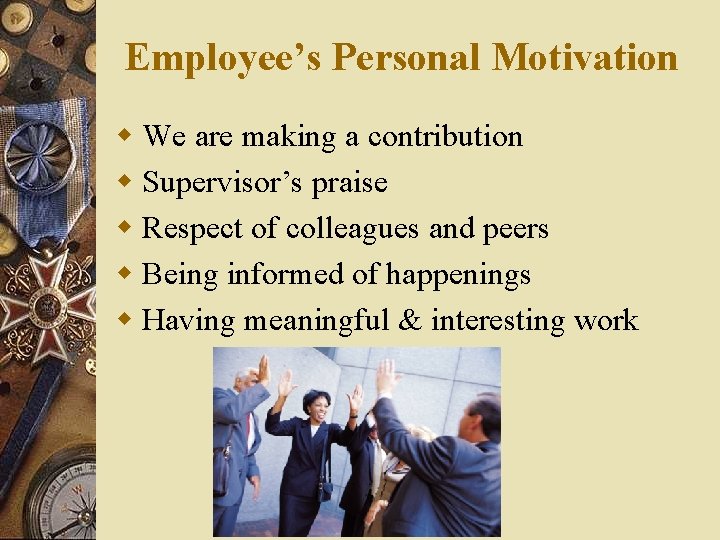
Employee’s Personal Motivation w We are making a contribution w Supervisor’s praise w Respect of colleagues and peers w Being informed of happenings w Having meaningful & interesting work
Importance of Motivation w Motivation is a critical aspect of business, where the input of human resources is maximized through achieving a high level of output. w Motivation is generally what energizes, maintains, and controls behaviour; it acts as a stimulus for desirable actions 1. Motivation helps to Increase the productivity 2. Job satisfaction 3. self-esteem levels will improve 4. Increased commitment 5. Enthusiasm to work 6. Rapport with colleagues will increase 7. Individual goals will match with organisational goals 8. will be more of a team member rather than being alone
w The purpose of motivation is to create condition in which people are willing to work with zeal, initiative. Interest, and enthusiasm, with a high personal and group moral satisfaction with a sense of responsibility. w To increase loyalty against company. w For improving discipline with pride and confidence in cohesive manner so that the goal of an organization are achieved effectively. w Motivation techniques utilized to stimulate employee growth. w For the motivation you can buy man’s time. Physical presence at a given place. w Performance results from the interaction of physical, financial and human resource.
Specific characteristics of a high achiever w Takes reasonable risks. w Prefers immediate feedback w Derives satisfaction on the successful accomplishment of a task w Has total concentration or preoccupation with the assigned task 19
Theories of Motivation Some important theories: Ø Maslow’s Hierarchy of Needs Theory Ø Mcclelland’s Achievement Motivation Theory Ø Herzberg’s Motivation-Hygiene theory Ø Expectancy Theory
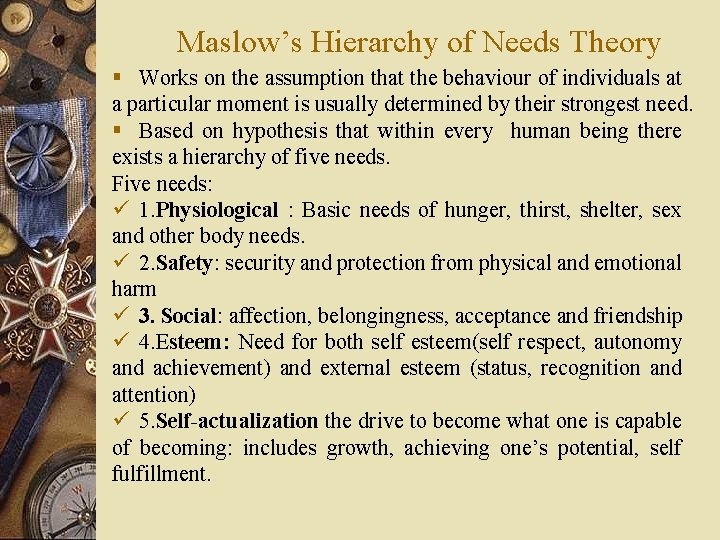
Maslow’s Hierarchy of Needs Theory § Works on the assumption that the behaviour of individuals at a particular moment is usually determined by their strongest need. § Based on hypothesis that within every human being there exists a hierarchy of five needs. Five needs: ü 1. Physiological : Basic needs of hunger, thirst, shelter, sex and other body needs. ü 2. Safety: security and protection from physical and emotional harm ü 3. Social: affection, belongingness, acceptance and friendship ü 4. Esteem: Need for both self esteem(self respect, autonomy and achievement) and external esteem (status, recognition and attention) ü 5. Self-actualization the drive to become what one is capable of becoming: includes growth, achieving one’s potential, self fulfillment.
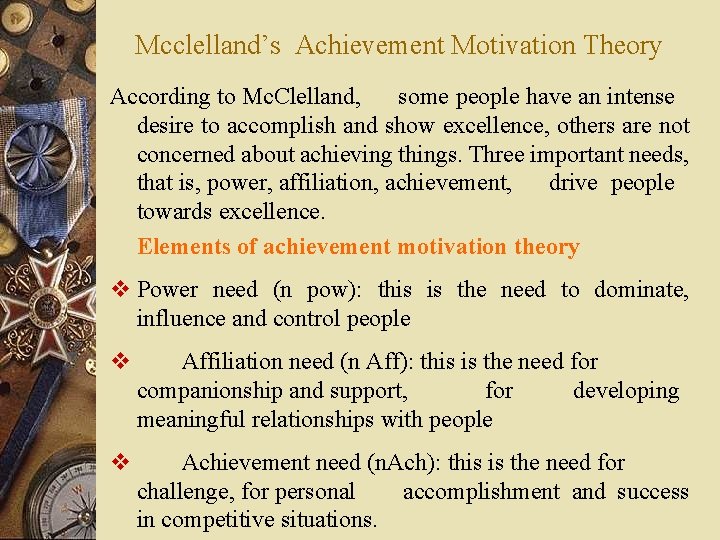
Mcclelland’s Achievement Motivation Theory According to Mc. Clelland, some people have an intense desire to accomplish and show excellence, others are not concerned about achieving things. Three important needs, that is, power, affiliation, achievement, drive people towards excellence. Elements of achievement motivation theory v Power need (n pow): this is the need to dominate, influence and control people v Affiliation need (n Aff): this is the need for companionship and support, for developing meaningful relationships with people v Achievement need (n. Ach): this is the need for challenge, for personal accomplishment and success in competitive situations.
Herzberg’s Motivation-Hygiene theory According to Herzberg, if managers wish to increase motivation and performance above the average level, they must enrich the job by concentrating on motivators (such as achievement, recognition, responsibility, interesting advancement, work, growth etc) and not the hygiene factors (mostly environment related factors) Based on the conclusion that people have two different categories of needs: w Hygiene factors w Motivating factors
13 -13 Variables affecting motivation in an organizational setting Evaluation v The critical incident method applied on a small sample is being questioned v The assumption that the two sets of factors work in only one direction is also attacked severely v Critics questioned the procedural deficiencies also; such as the subjective interpretation of the responses.
Expectancy Theory This theory argues that the strength of a tendency to act in a certain way depends on the strength of an expectation that the act will be followed by a given outcome and on the attractiveness of the outcome to the individual. It includes three variables: w Attractiveness: the importance that the individual places on the potential outcome or reward that can be achieved on the job. This considers the unsatisfied needs of the individual. w 2. Performance-reward linkage: the degree to which the individual believes that performing at a particular level will lead to the attainment of each job outcome w Effort –performance linkage: the perceived probability by the individual that exerting a given amount of effort will lead to performance. Rti, Jammu
Expectancy Theory w 3. Effort –performance linkage: the perceived probability by the individual that exerting a given amount of effort will lead to performance. Rti, Jammu 26
MBO approach to Motivation w System of management that emphasizes on a particular set of goals that are tangible, verifiable and measurable. w It is the method by which managers and employees jointly set goals for work performance and personal development, periodically evaluate the employee’s progress towards achieving these goals and integrating of individual, team, departmental and organizational goals. w 27
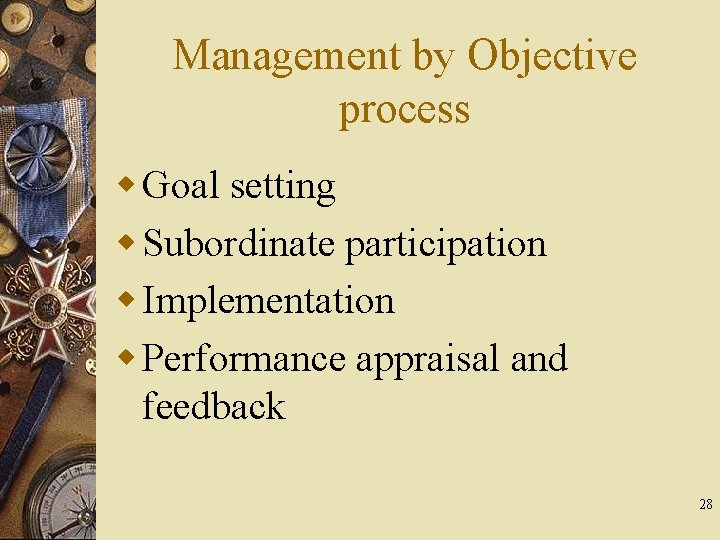
Management by Objective process w Goal setting w Subordinate participation w Implementation w Performance appraisal and feedback 28