
Human Memory II Acquisition and Retrieval Presumably we
Human Memory II
Acquisition and Retrieval Presumably, we put information into LTM with the idea that we might want to access it at a later time. If, however, we are unable to retrieve it, having it in LTM would be of little value. There are, of course, several ways of retrieving that information. commonly “recall” or “recognition. ” We. Most might ask, then, by how are acquisition and retrieval related?

Context-Dependent Learning There is a great deal of evidence to support the notion that the presence of connections formed during learning is important for retrieval. There a variety of such “context-dependent” learning situations: • Physical • Emotional • Mood congruence • State-dependent
Context-Dependent Learning (con’t) The conclusion is clear: recall is best when the external (or internal) contexts of study and recall match. You need not be physically in the same “place” when you are learning and recalling. So long as the connections are reinstated, successful retrieval is likely to occur.

Encoding Specificity When The to-be-remembered a hint suggests a information different context, is notrecall the only suffers. thing This that is is connected because weorlearn “encoded” the word during and context learning. as The a whole, specific notthoughts as you have orparts. individual perspective you take regarding the material during learning are also encoded and, therefore, may serve as retrieval paths. However, the “extra” thoughts and perceptions can also alter the meaning of what is remembered and, therefore, may affect whether you can recall the information at a later time. For example, “The man lifted the piano” or “The man tuned the piano”
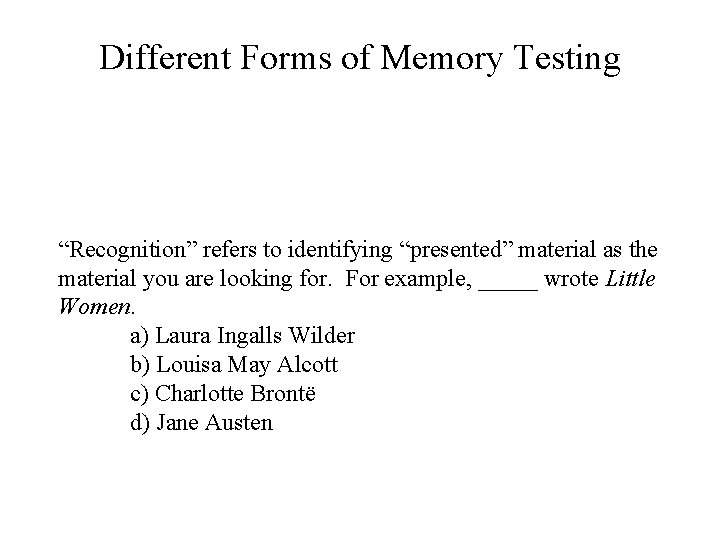
Different Forms of Memory Testing “Recognition” We “Recall” have refers just noted refers to retrieving the to importance identifying the material of “presented” having fromstudy memory material and by testing as the contexts you searching material match. until areyou’ve looking Does our found for. initial what Forlearning example, you’re make looking _____ a difference for wrote on Little yourif the retrieval own Women. (e. g. , Who is one wrote of recall Davidor Copperfield? ). recognition? a) Laura Ingalls Wilder b) Louisa May Alcott c) Charlotte Brontë d) Jane Austen
Memory Testing (con’t) Thus, In With That both is, “recognition, ” our cases, you ability lack weto source may recognize however, bememory aware information wethat sometimes forwe the“know” information. sometimes seem thetocorrect get occurs a response. feeling because that of “source the material memory” is “familiar, ” and sometimes but we because don’t quite of know why (e. g. , that person looks familiar, but I can’t put my finger “familiarity. ” on where I know her).
Implicit Memory Implicit While Explicit wememories have conscious are those access of which to many youofare ouraware unaware memories, andorcan there are those recall cannot orrecall, recognize. memories but can forinfluence which we your do not, behavior or only in some with great manner difficulty (e. g. , improved (e. g. , position performance of keys on on a task) typewriter, – whathow sometorefer shifttogears as in a car, how “memory without to tieawareness. ” a shoestring, etc. ).
Implicit Memory (con’t) That There In these phenomena areinstances, a variety issubjects of notways limited were we to can influenced lists demonstrate of words, by previous the but existence is easily of implicit memories: exposure demonstrated to theinmaterial, many real-world yet werecircumstances: not able to directly recall the material. • False Lexical-decision fame task • Illusion Word-stem of Truth completion • Savings
Implicit Memory (con’t) In What theseis real terms, instances, different seeing, insubjects the hearing, False were or Fame reading influenced and false Illusion byinformation previous of Truth examplesfamiliarity exposure provides to is the thatmaterial, subjects and, at but had some in a “feeling thelater absence time, of familiarity” of that being familiarity able or to “that may rings identify be misinterpreted a bell” the “source” feeling as and “I’ve of the were heard familiarity, required that before… to their interpret behavior I guess theirwas isfeelings. must be determined by how they interpreted their feelings of familiarity. true. ”
What Is Implicit Memory? Processing The Consider idea that thefluency following we canmay have possibility: be“memory thought of Implicit without as an enhanced memory awareness” isability the seems to quite clear. manifestation more quickly. Itor of is efficiently important, increased “processing process then, to abestimulus. able fluency” to explain resulting “implicit from memory. ” (i. e. , previous exposure or mental effort) “practice”
What Is Implicit Memory? (con’t) 1. People sensitive to degrees of processing fluency and easily A few more are (reasonable? ) assumptions are needed to explain processed material results in a sense of “distinctiveness” or being other results (e. g. , “familiarity”): “special. ” 2. An attribution process is triggered when material results in a sense of distinctiveness and people are motivated to interpret the feeling as familiarity and attribute it (correctly or incorrectly) to a source. 3. Decreases in processing fluency can result in material feeling distinctive as well (e. g. , when a friend shaves off their beard… you know something is different, but can’t put your finger on it) which will also trigger an attribution process.
Hippocampal Formation and Amnesia The hippocampus is a structure embedded within the temporal lobes and is considered critical for the formation of new memories. Damage (e. g. , head injury, surgery, infection -- encephalitis, Korsakoff’s syndrome resulting from chronic alcoholism) to the hippocampus and surrounding structures can produce retrograde (loss of memories before the damage) or anterograde (inability to form new permanent memories) amnesia. As such, amnesia patients offer a unique opportunity for the study of memory.
Amnesia (con’t) “Working memory” seems to function normally, allowing for interactions in the here-and-now. In cases where the damage is not permanent (e. g. , a blow to the head) anterograde and retrograde amnesia show a “contracting” pattern of recovery. Slowly, the patient shows the ability to learn new things and recall of past events returns. Older memories are usually preserved, but memories temporally close to the injury are permanently lost. Patients are able to remember things for short periods of time (e. g. , 10 seconds), but then forget them.
What Is The Problem? Similar patterns of memory disruption are also seen in cases where the damage is permanent. It has longed be argued that anterograde amnesia was the result of an inability for working memory to transfer information into LTM. However, there are many studies that question that argument: • Acquisition of trivia • Preference to previously heard songs • Improvement in “mirror-drawing” It seems that anterograde amnesic patients are able to acquire new “implicit” memories but not new “explicit” memories, while other cases show just the opposite. Such evidence supports the idea that implicit and explicit memory are independent of each other.
Practical Advice For Optimal Learning What practical lessons can we draw from all of this? Since you will not always know under what conditions you will be asked to recall or in what way you will be asked to recall (i. e. , • recall recognition), it is best to learn from as Use or elaborative rehearsal many different perspectives as you can so you can establish • Paraphrase the information numerous connections betweenexamples memories: • Develop multiple • Explain it to someone else • Get someone to quiz you • Etc.
- Slides: 16