
Human Life Tables and Survivorship Curves PURPOSE Test
Human Life Tables and Survivorship Curves
PURPOSE: Test hypotheses about human survivorship using: 1. Life tables 2. life expectancy 3. Survivorship curves
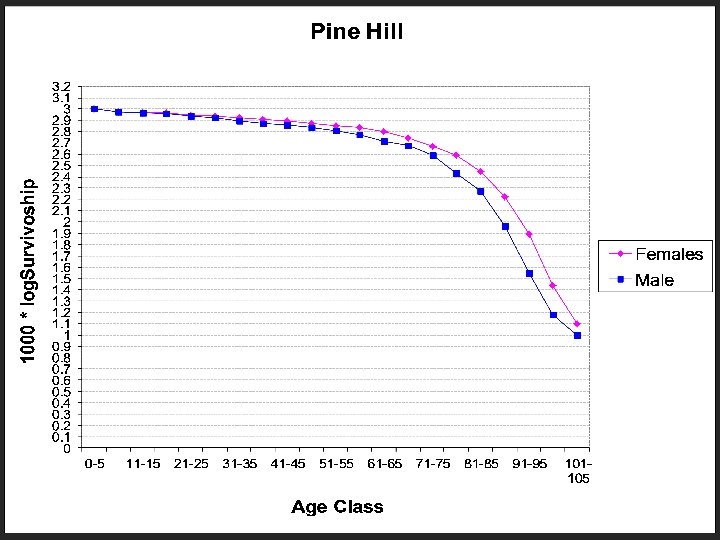
Hypotheses about Males and Females H 1 Females have a greater life expectancy than males because of risky male behaviors and the toxic effects of testosterone. prediction: the survivorship curve and the calculated life expectancy for females is higher than that for males. H 2 Females are more likely to die during the reproductive years because of the risks associated with pregnancy. prediction: the calculated life expectancy for males during the reproductive years is higher than that for females and the dx value is greater for females during the reproductive years.
Hypotheses about Public Health H 3 Human life expectancy has increased with time due to advances in medicine, nutrition, and sanitation. prediction: survivorship curves and calculated life expectancies are higher for newer graveyards. BRB R. I. P.

What are life tables? • A life table contains age-specific survival and mortality rates in a population. It also contains fecundity and age distribution information. • Life tables come in 2 varieties: – Cohort life table: Follows a group of individuals born at the same time. – Static life table: Constructed by recording the age at death of a large number of individuals. This is what we’ll be making.

Example Life Table l x Dx Nx x ax qx 1000 lx log 1000 lx 0 -5 1 4. 00 250. 00 1. 00 0. 98 0. 02 1000. 00 3. 00 6 -10 2 0. 00 246. 00 0. 98 1. 00 0. 00 984. 00 2. 99 11 -15 3 1. 00 246. 00 0. 98 1. 00 0. 00 984. 00 2. 99 16 -20 4 3. 00 245. 00 0. 98 0. 99 0. 01 980. 00 2. 99 21 -25 5 3. 00 242. 00 0. 97 0. 99 0. 01 968. 00 2. 99 26 -30 6 0. 00 239. 00 0. 96 1. 00 0. 00 956. 00 2. 98 31 -35 7 3. 00 239. 00 0. 96 0. 99 0. 01 956. 00 2. 98 36 -40 8 2. 00 236. 00 0. 94 0. 99 0. 01 944. 00 2. 97 41 -45 9 1. 00 234. 00 0. 94 1. 00 0. 00 936. 00 2. 97 46 -50 10 12. 00 233. 00 0. 93 0. 95 0. 05 932. 00 2. 97
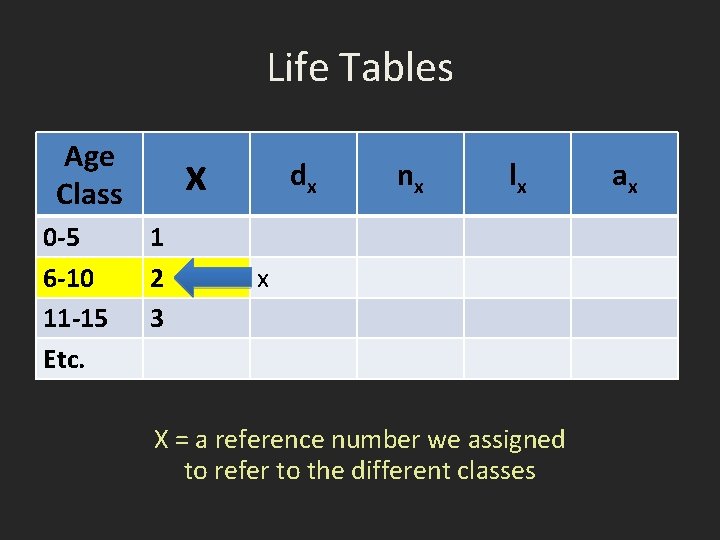
Life Tables Age Class 0 -5 6 -10 11 -15 Etc. x 1 2 3 dx nx lx x X = a reference number we assigned to refer to the different classes ax

Life Tables Age Class 0 -5 6 -10 11 -15 Etc. x 1 2 3 dx nx lx x-1 x X = a reference number we assigned to refer to the different classes ax
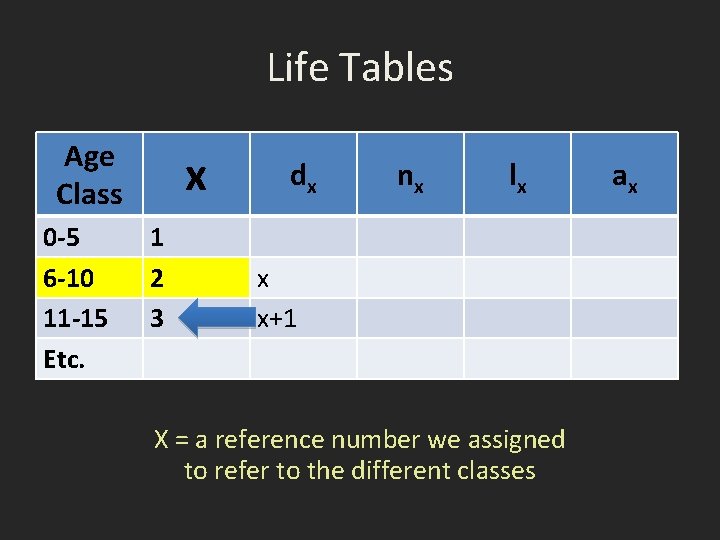
Life Tables Age Class 0 -5 6 -10 11 -15 Etc. x 1 2 3 dx nx lx x x+1 X = a reference number we assigned to refer to the different classes ax
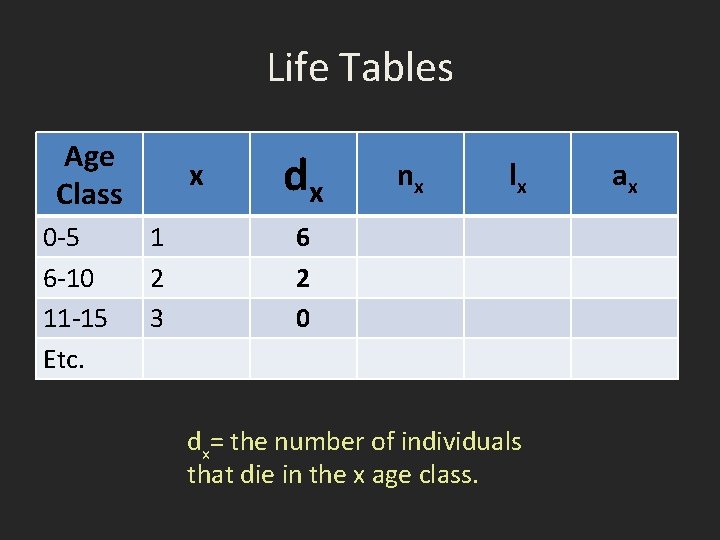
Life Tables Age Class 0 -5 6 -10 11 -15 Etc. x 1 2 3 dx nx lx 6 2 0 dx= the number of individuals that die in the x age class. ax
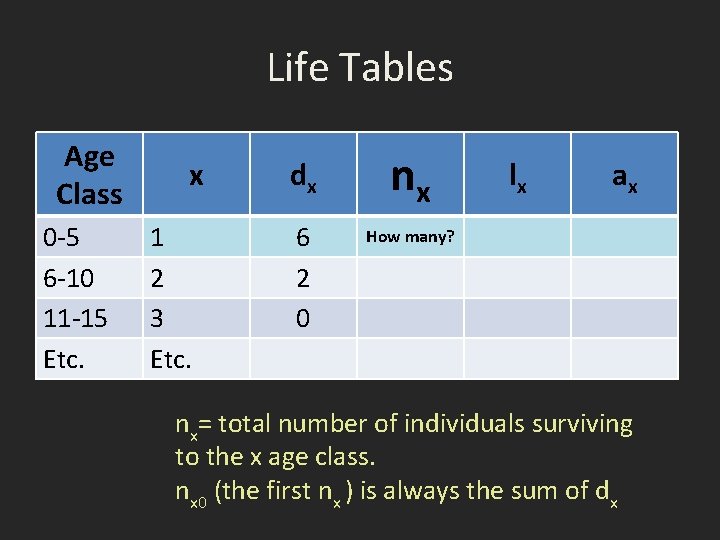
Life Tables Age Class 0 -5 6 -10 11 -15 Etc. x 1 2 3 Etc. dx 6 2 0 nx lx ax How many? nx= total number of individuals surviving to the x age class. nx 0 (the first nx ) is always the sum of dx
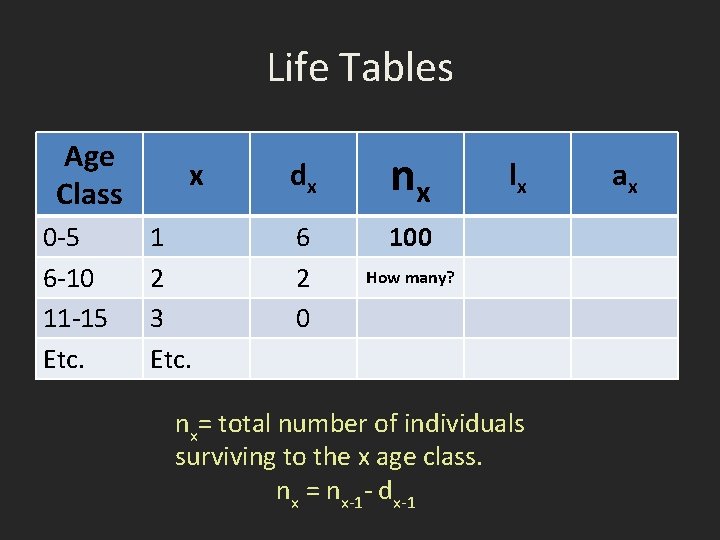
Life Tables Age Class 0 -5 6 -10 11 -15 Etc. x 1 2 3 Etc. dx nx 6 2 0 100 lx How many? nx= total number of individuals surviving to the x age class. nx = nx-1 - dx-1 ax
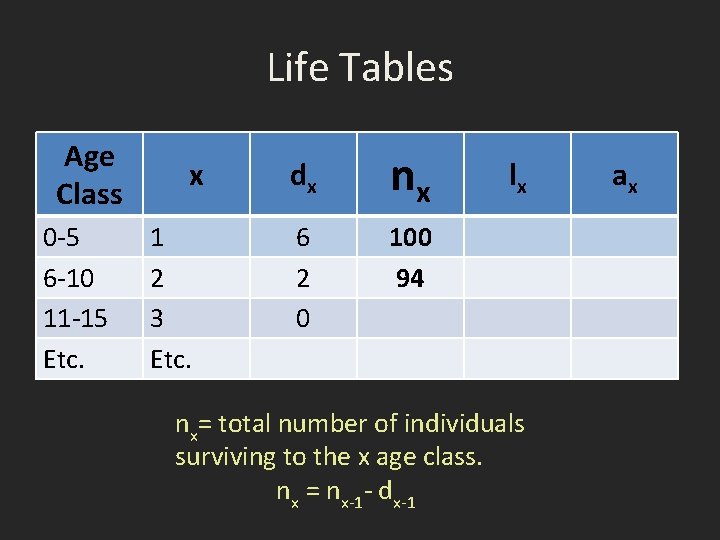
Life Tables Age Class 0 -5 6 -10 11 -15 Etc. x 1 2 3 Etc. dx nx 6 2 0 100 94 lx nx= total number of individuals surviving to the x age class. nx = nx-1 - dx-1 ax
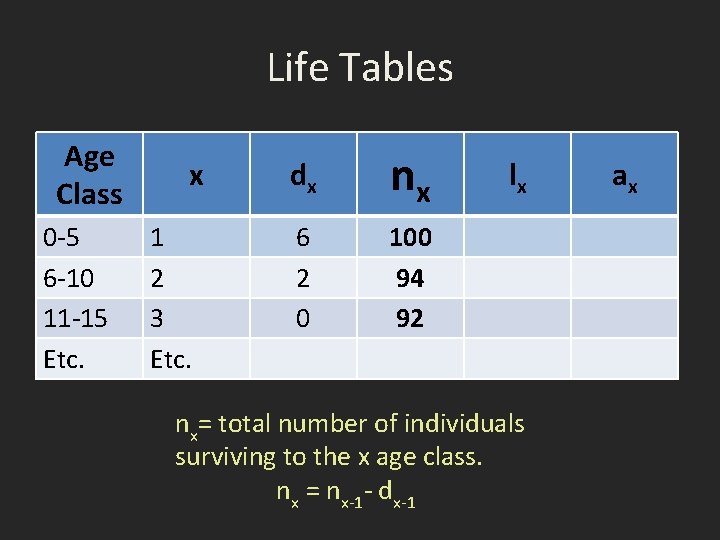
Life Tables Age Class 0 -5 6 -10 11 -15 Etc. x 1 2 3 Etc. dx nx 6 2 0 100 94 92 lx nx= total number of individuals surviving to the x age class. nx = nx-1 - dx-1 ax
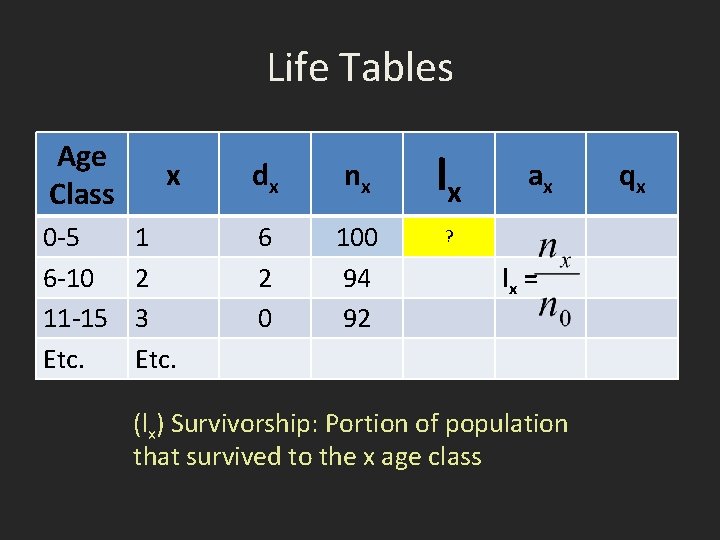
Life Tables Age Class x dx nx 0 -5 6 -10 11 -15 Etc. 1 2 3 Etc. 6 2 0 100 94 92 lx ax ? lx = (lx) Survivorship: Portion of population that survived to the x age class qx
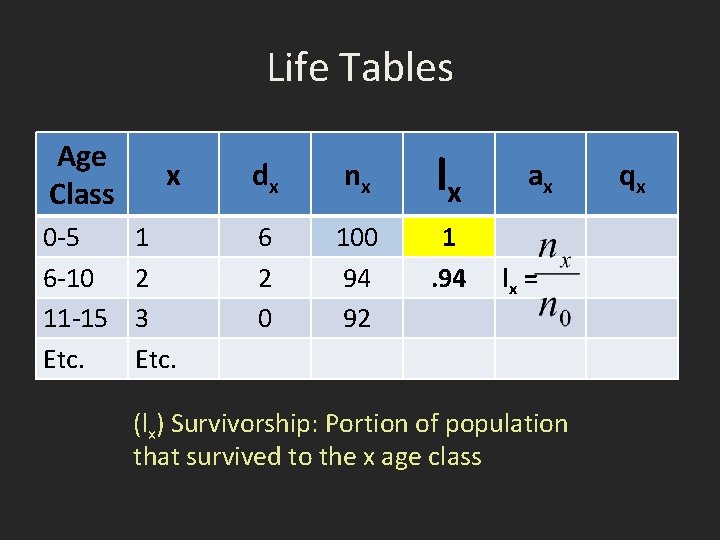
Life Tables Age Class x dx nx lx 0 -5 6 -10 11 -15 Etc. 1 2 3 Etc. 6 2 0 100 94 92 1. 94 ax lx = (lx) Survivorship: Portion of population that survived to the x age class qx
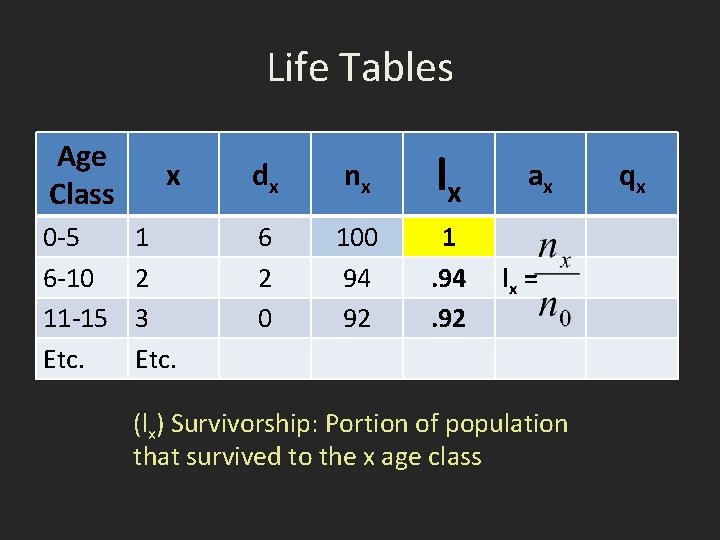
Life Tables Age Class x dx nx lx 0 -5 6 -10 11 -15 Etc. 1 2 3 Etc. 6 2 0 100 94 92 1. 94. 92 ax lx = (lx) Survivorship: Portion of population that survived to the x age class qx
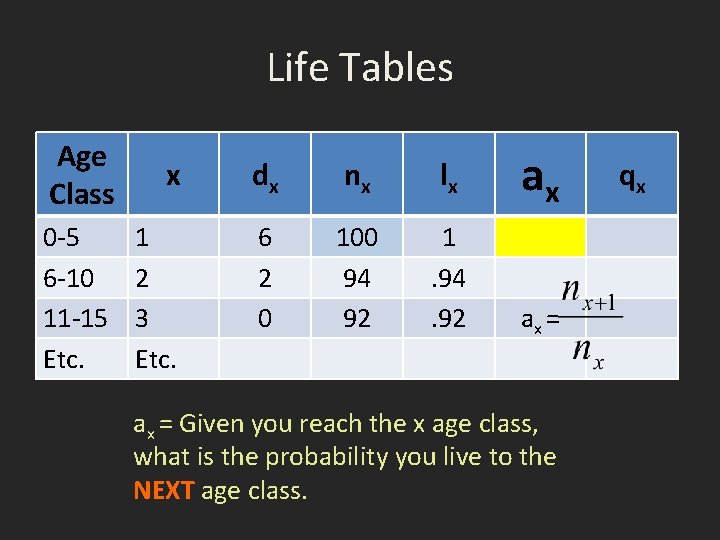
Life Tables Age Class x dx nx lx ax 0 -5 6 -10 11 -15 Etc. 1 2 3 Etc. 6 2 0 100 94 92 1. 94. 92 ax = Given you reach the x age class, what is the probability you live to the NEXT age class. qx
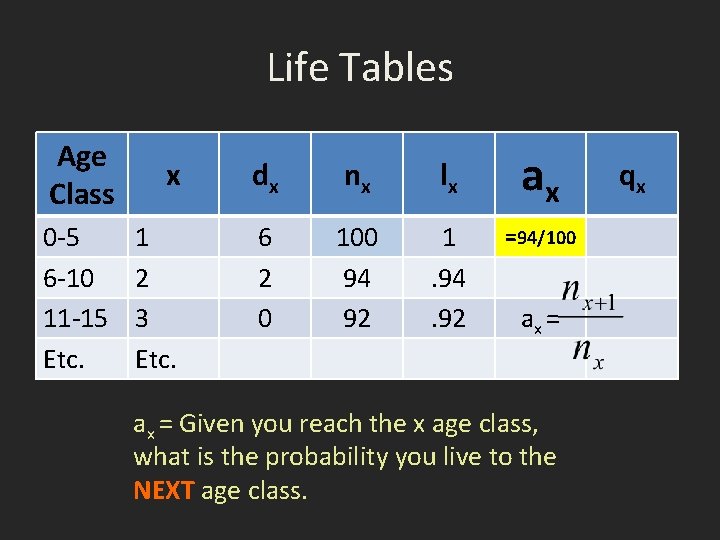
Life Tables Age Class x dx nx lx ax 0 -5 6 -10 11 -15 Etc. 1 2 3 Etc. 6 2 0 100 94 92 1. 94. 92 =94/100 ax = Given you reach the x age class, what is the probability you live to the NEXT age class. qx
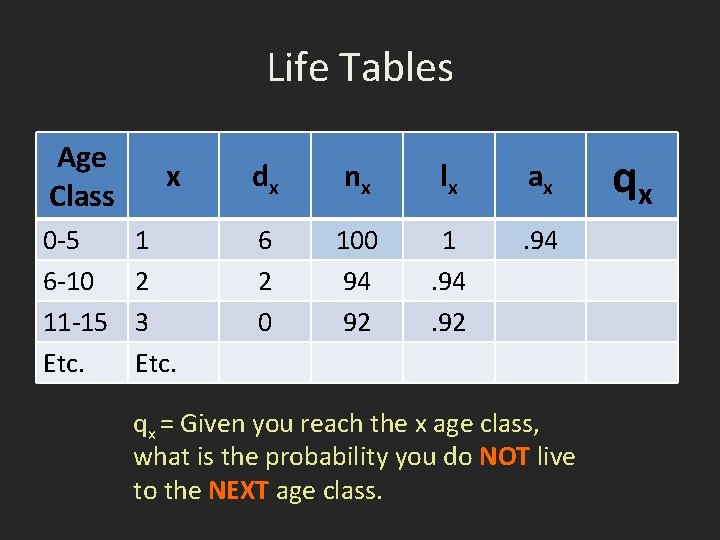
Life Tables Age Class x dx nx lx ax 0 -5 6 -10 11 -15 Etc. 1 2 3 Etc. 6 2 0 100 94 92 1. 94. 92 . 94 qx = Given you reach the x age class, what is the probability you do NOT live to the NEXT age class. qx
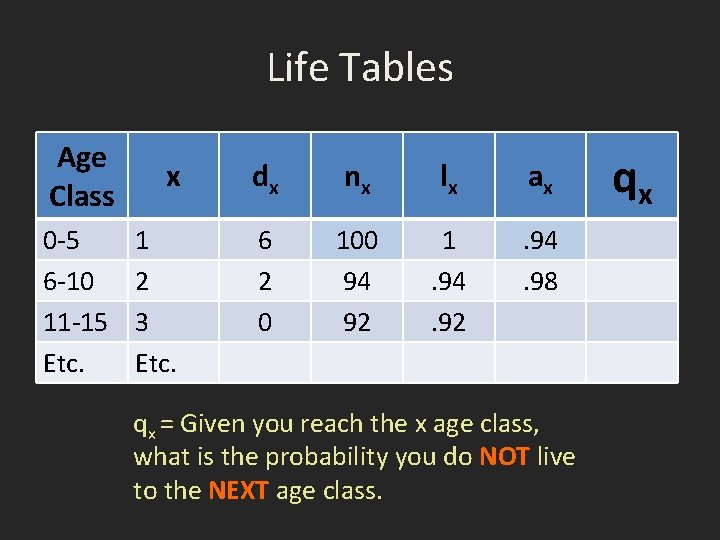
Life Tables Age Class x dx nx lx ax 0 -5 6 -10 11 -15 Etc. 1 2 3 Etc. 6 2 0 100 94 92 1. 94. 92 . 94. 98 qx = Given you reach the x age class, what is the probability you do NOT live to the NEXT age class. qx

Life Tables Age Class x dx nx lx 0 -5 6 -10 11 -15 Etc. 1 2 3 Etc. 6 2 0 100 94 92 1. 94. 92 ax. 94. 98 qx = Given you reach the x age class, what is the probability you do NOT live to the NEXT age class. qx
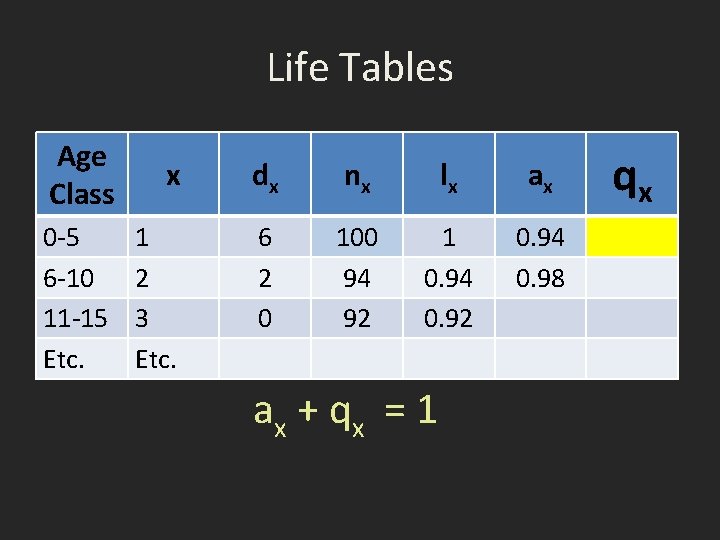
Life Tables Age Class x dx nx lx ax 0 -5 6 -10 11 -15 Etc. 1 2 3 Etc. 6 2 0 100 94 92 1 0. 94 0. 92 0. 94 0. 98 ax + q x = 1 qx
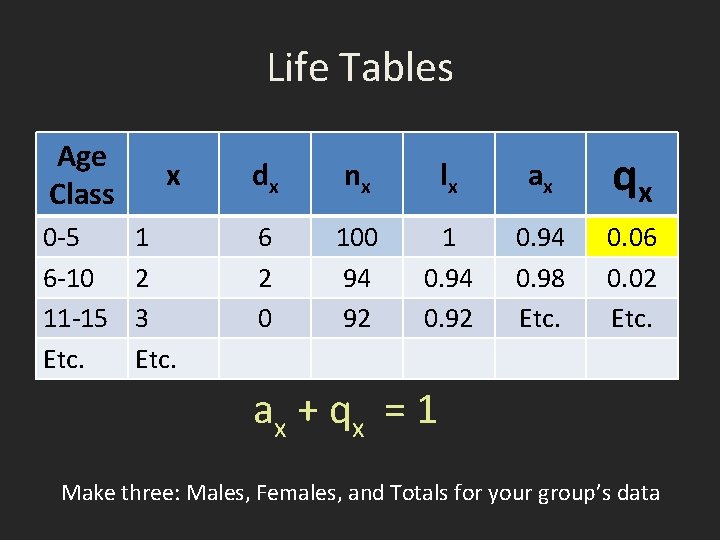
Life Tables Age Class x dx nx lx ax qx 0 -5 6 -10 11 -15 Etc. 1 2 3 Etc. 6 2 0 100 94 92 1 0. 94 0. 92 0. 94 0. 98 Etc. 0. 06 0. 02 Etc. ax + q x = 1 Make three: Males, Females, and Totals for your group’s data
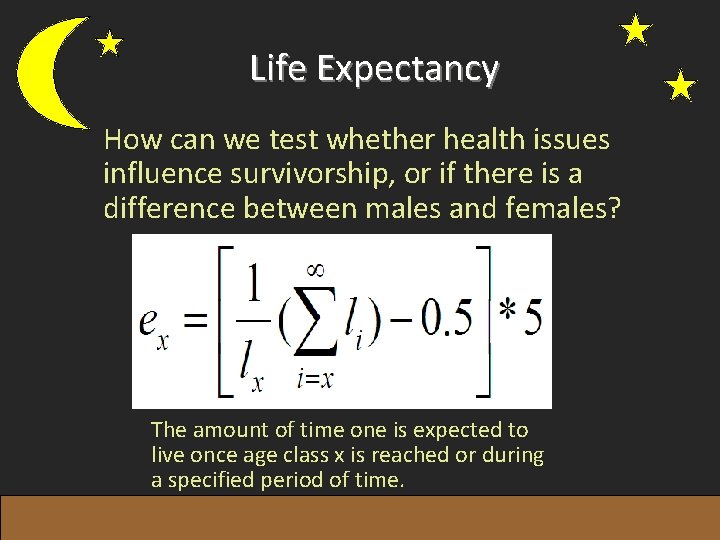
Life Expectancy How can we test whether health issues influence survivorship, or if there is a difference between males and females? The amount of time one is expected to live once age class x is reached or during a specified period of time.
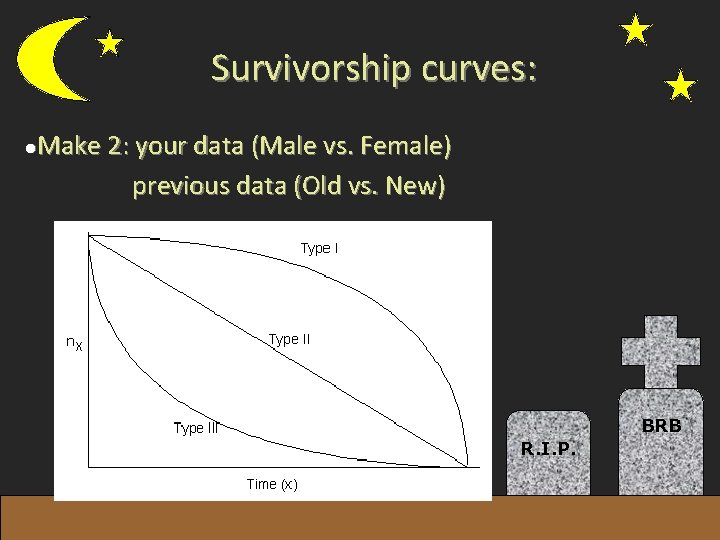
Survivorship curves: ●Make 2: your data (Male vs. Female) previous data (Old vs. New) BRB R. I. P.
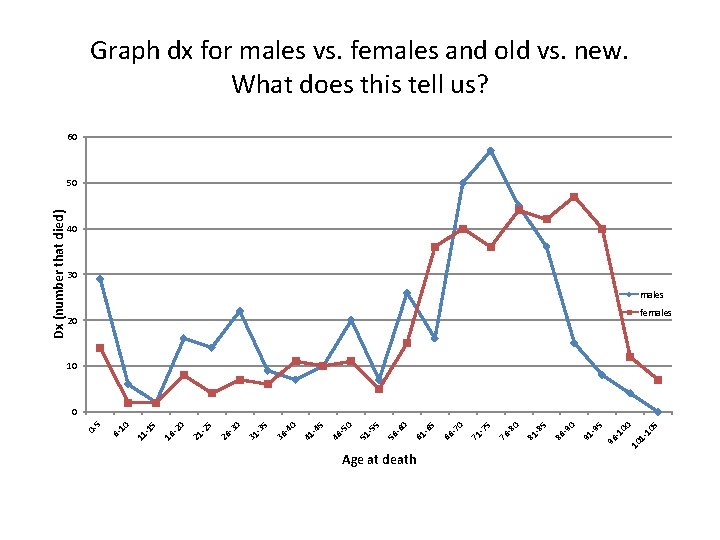
0 5 46 -5 0 51 -5 5 56 -6 0 61 -6 5 66 -7 0 71 -7 5 76 -8 0 81 -8 5 86 -9 0 91 -9 5 96 -1 00 10 110 5 41 -4 36 -4 5 31 -3 0 26 -3 5 21 -2 0 16 -2 5 11 -1 610 5 0 - Dx (number that died) Graph dx for males vs. females and old vs. new. What does this tell us? 60 50 40 30 males 20 females 10 0 Age at death
Binomial tests Male vs. female childbearing
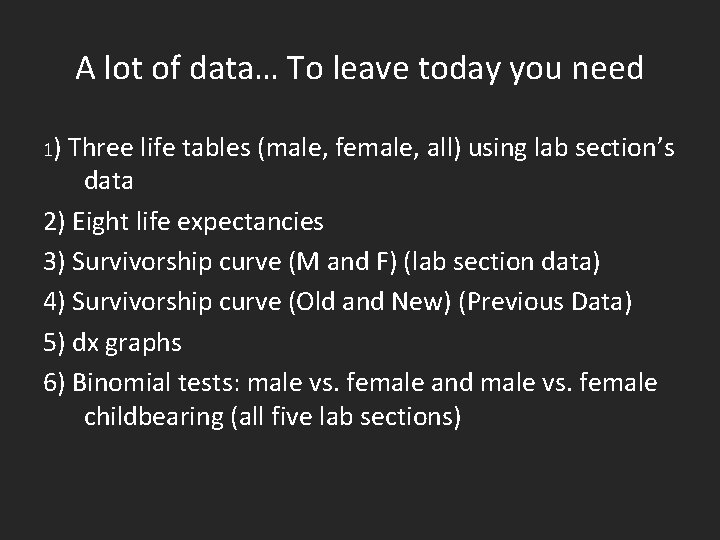
A lot of data… To leave today you need 1) Three life tables (male, female, all) using lab section’s data 2) Eight life expectancies 3) Survivorship curve (M and F) (lab section data) 4) Survivorship curve (Old and New) (Previous Data) 5) dx graphs 6) Binomial tests: male vs. female and male vs. female childbearing (all five lab sections)
- Slides: 30