
Human life safety Extreme situations on radiation dangerous










- Slides: 29
Human life safety Extreme situations on radiation dangerous objects. Lecture № 6
Study Questions. 1. Radiation accidents, their types, main dangers and sources of radiation hazard. Radiation sickness. 2. Tasks, stages and the methods of assessing the radiation situation. Zoning of the areas after radiation contaminations. 3. The notion of radiation forecast. Abstract: This section deals with emergencies in radiation dangerous objects. Keywords: radiation dangerous objects, radiation accident, radiation situation.
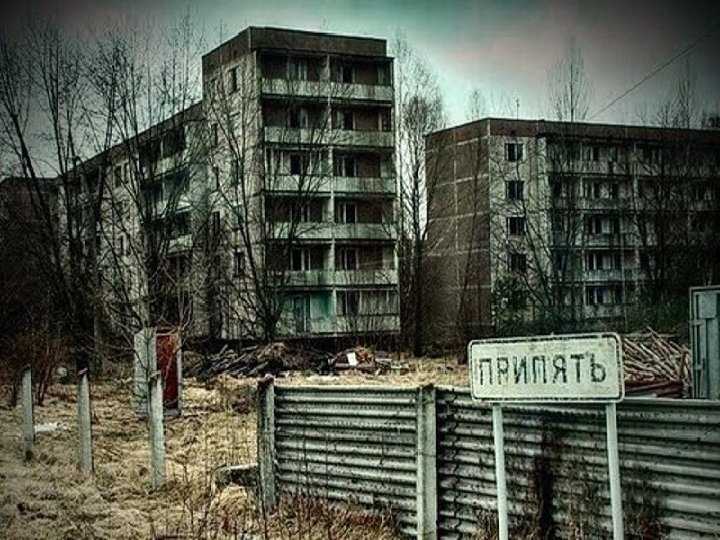
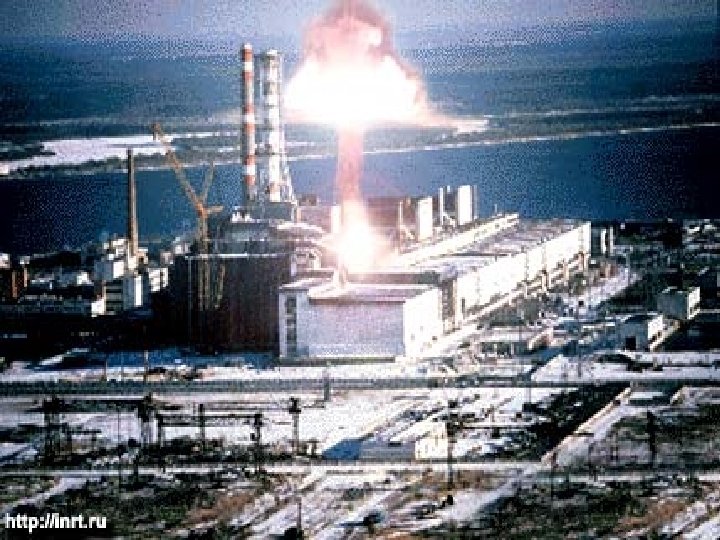
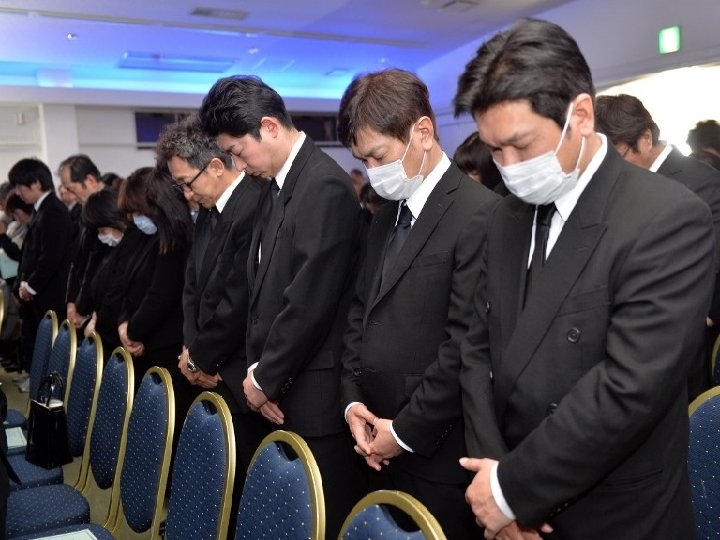
Major accidents in the NP stations � 1. England (Uindekeyl, 1957). The accident resulted in Uindekeyle died 13 people and was contaminated with radioactive substances, area of 500 km 2. � 2. United States (Three Mile Island, 1979). Direct damage of the accident was more than 1 bln. Dollars. � 3. USSR (Chernobyl, 26. 04. 1986 city). The Chernobyl accident was the most serious. During Chernobyl accident 30 people died, more than 500 were hospitalized and 115 thousand of people was evacuated. � 4. Japan ("Fukushima-1" NPP, 11. 03. 2011). More then 1500 people died after this accident.
1945
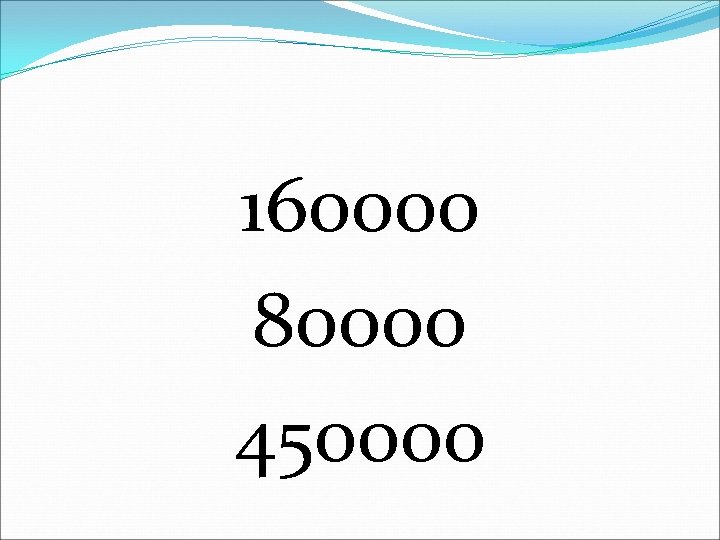
160000 80000 450000
The radiation-dangerous object (RDO) - any production object, which is stored, processed, used or transported radioactive substances (RS), accident in such object can occur irradiation, humans radioactive contamination, contamination of animals and plants, and environmental pollution.
NUCLEAR POWER ENGINEERING OF THE WORLD
RUSSIAN NUCLEAR POWER ENGINEERING
Radiation accident - the accident at the RDO, in which there was a release of radioactive products or ionizing radiation causing the of the population irradiation and pollution of the environment. Depending on the nature and extent of damage and destruction of the accident at radiation dangerous objects are divided into some groups: 1. The project accidents; 2. The project accidents with the largest effects (maximum project); 3. Extra project (hypothetical) accidents.
� Their are four phases of radiation accident development � The initial phase of the accident - is the time period preceding the beginning of the release (reset) of radioactivity into the environment or period of radiation detection outside the sanitary protection zone. In some cases, this phase can not exist because of its short duration. � The early crash phase (the phase of acute irradiation) is the period of the actual release of radioactive substances into the environment, or the period of the formation of the radiation situation influenced by the release of radioactive substances in the places of population location. This period may be lasted from several minutes to several hours in the case of a single release of radioactive substances, and up to several days in the case of extended release. � Intermediate accident phase include the period during which there is no additional income from a source of radioactivity released into the environment and in which the decisions are made on the introduction of new protection measures. The intermediate phase begins with the first few hours after the release and lasts up to several days, weeks or longer. For single emissions of the intermediate phase length equal to predict 7 -10 days. � The late phase (recovery phase) can last from some weeks to several years. In this period the normal conditions of life became.
The main radiation accident affecting factors: - External radiation (gamma, beta and X-rays, neutron radiation); - Internal irradiation of the human body caught radionuclide's (alpha and beta radiation); - Mechanical injuries; - Thermal injuries; -Chemical burns.
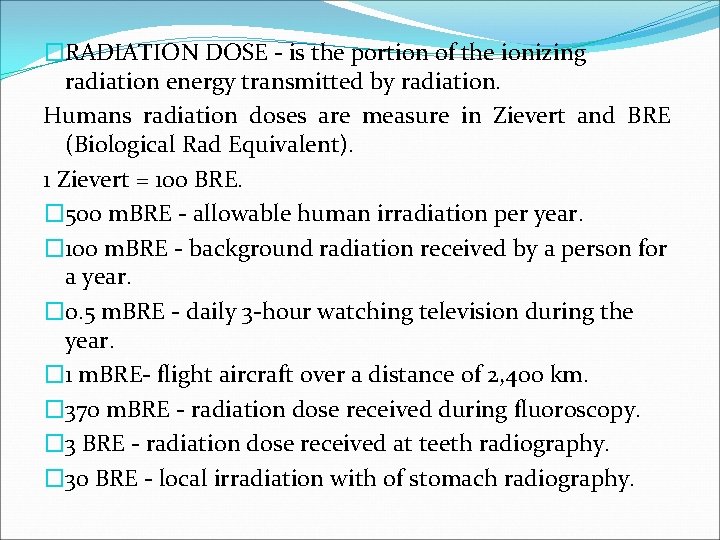
�RADIATION DOSE - is the portion of the ionizing radiation energy transmitted by radiation. Humans radiation doses are measure in Zievert and BRE (Biological Rad Equivalent). 1 Zievert = 100 BRE. � 500 m. BRE - allowable human irradiation per year. � 100 m. BRE - background radiation received by a person for a year. � 0. 5 m. BRE - daily 3 -hour watching television during the year. � 1 m. BRE- flight aircraft over a distance of 2, 400 km. � 370 m. BRE - radiation dose received during fluoroscopy. � 3 BRE - radiation dose received at teeth radiography. � 30 BRE - local irradiation with of stomach radiography.
Internal organs (tissue), which are most exposed to the action of radioactive substances, called critical organs. Critical organs are divided into three groups according to the degree of decrease in radio sensitivity: Group 1 - red bone brain, gonads, the lymph nodes; Group 2 - the lens of the eye, thyroid gland, muscle and adipose tissue, gastrointestinal tract, lungs, kidneys, liver; Group 3 - skin, bone, hands, legs, feet.
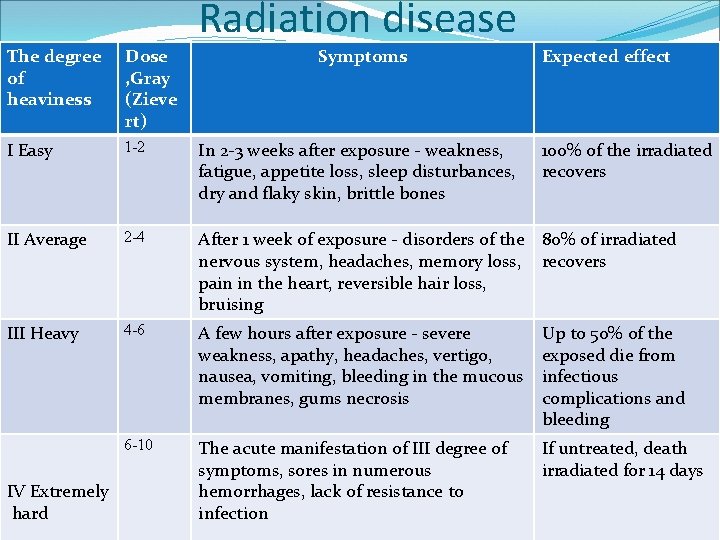
Radiation disease The degree of heaviness Dose , Gray (Zieve rt) I Easy 1 -2 In 2 -3 weeks after exposure - weakness, fatigue, appetite loss, sleep disturbances, dry and flaky skin, brittle bones II Average 2 -4 After 1 week of exposure - disorders of the 80% of irradiated nervous system, headaches, memory loss, recovers pain in the heart, reversible hair loss, bruising III Heavy 4 -6 A few hours after exposure - severe weakness, apathy, headaches, vertigo, nausea, vomiting, bleeding in the mucous membranes, gums necrosis Up to 50% of the exposed die from infectious complications and bleeding 6 -10 The acute manifestation of III degree of symptoms, sores in numerous hemorrhages, lack of resistance to infection If untreated, death irradiated for 14 days IV Extremely hard Symptoms Expected effect 100% of the irradiated recovers
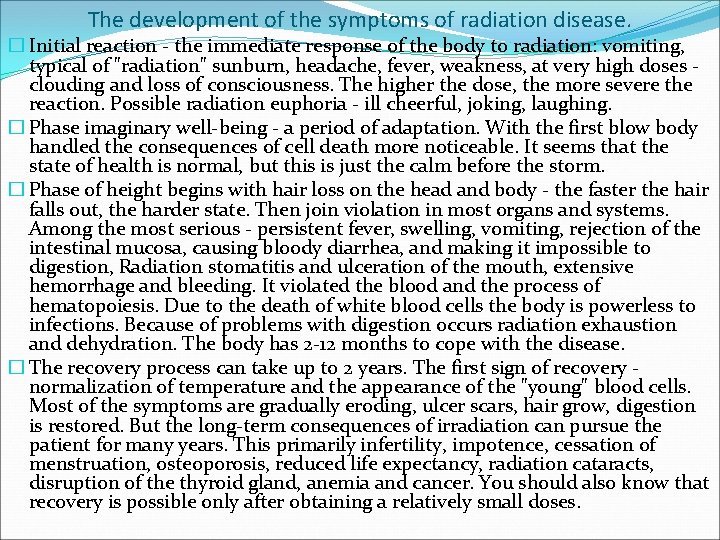
The development of the symptoms of radiation disease. � Initial reaction - the immediate response of the body to radiation: vomiting, typical of "radiation" sunburn, headache, fever, weakness, at very high doses clouding and loss of consciousness. The higher the dose, the more severe the reaction. Possible radiation euphoria - ill cheerful, joking, laughing. � Phase imaginary well-being - a period of adaptation. With the first blow body handled the consequences of cell death more noticeable. It seems that the state of health is normal, but this is just the calm before the storm. � Phase of height begins with hair loss on the head and body - the faster the hair falls out, the harder state. Then join violation in most organs and systems. Among the most serious - persistent fever, swelling, vomiting, rejection of the intestinal mucosa, causing bloody diarrhea, and making it impossible to digestion, Radiation stomatitis and ulceration of the mouth, extensive hemorrhage and bleeding. It violated the blood and the process of hematopoiesis. Due to the death of white blood cells the body is powerless to infections. Because of problems with digestion occurs radiation exhaustion and dehydration. The body has 2 -12 months to cope with the disease. � The recovery process can take up to 2 years. The first sign of recovery normalization of temperature and the appearance of the "young" blood cells. Most of the symptoms are gradually eroding, ulcer scars, hair grow, digestion is restored. But the long-term consequences of irradiation can pursue the patient for many years. This primarily infertility, impotence, cessation of menstruation, osteoporosis, reduced life expectancy, radiation cataracts, disruption of the thyroid gland, anemia and cancer. You should also know that recovery is possible only after obtaining a relatively small doses.
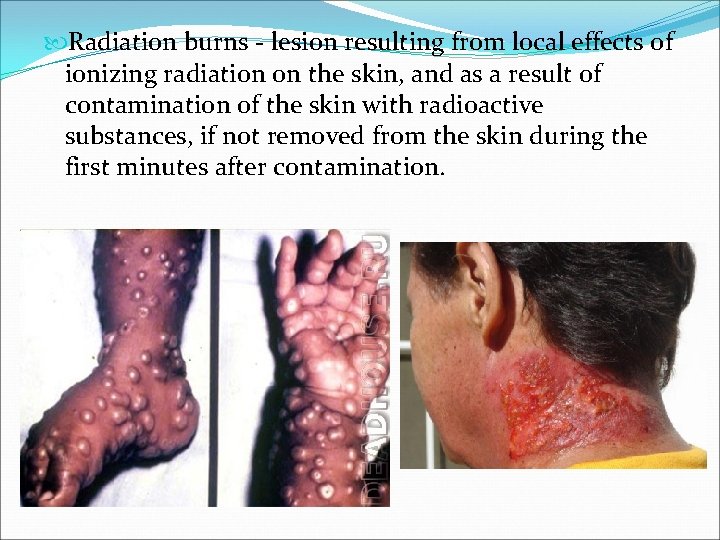
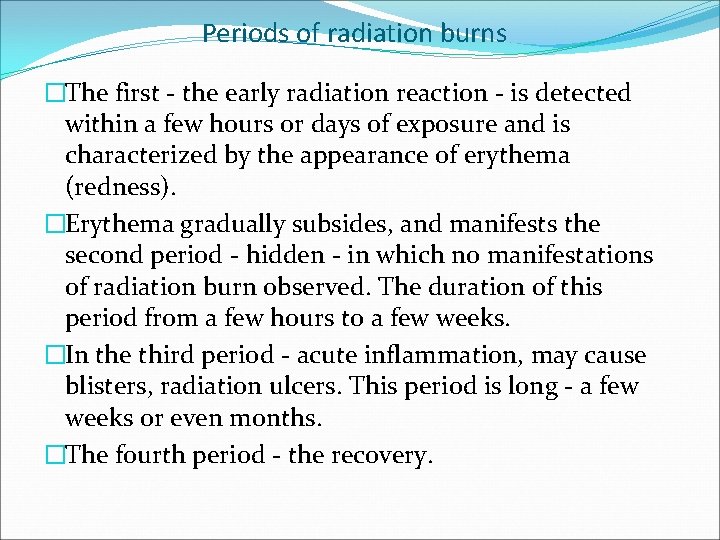
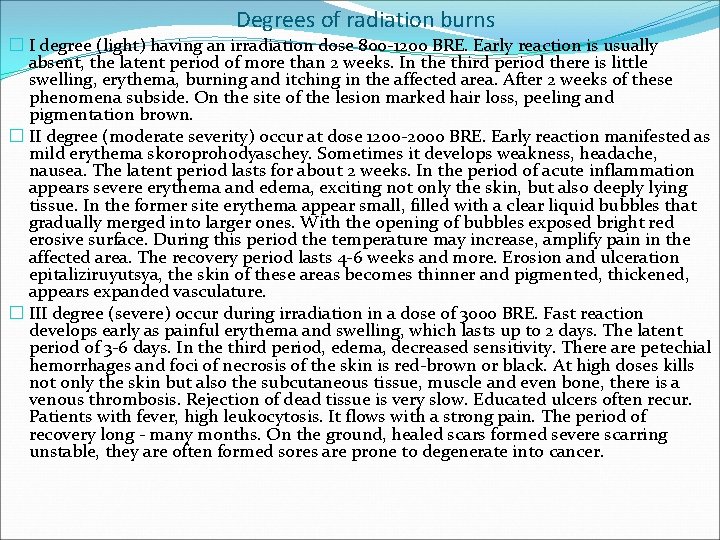
Radiation burns - lesion resulting from local effects of ionizing radiation on the skin, and as a result of contamination of the skin with radioactive substances, if not removed from the skin during the first minutes after contamination.
Periods of radiation burns �The first - the early radiation reaction - is detected within a few hours or days of exposure and is characterized by the appearance of erythema (redness). �Erythema gradually subsides, and manifests the second period - hidden - in which no manifestations of radiation burn observed. The duration of this period from a few hours to a few weeks. �In the third period - acute inflammation, may cause blisters, radiation ulcers. This period is long - a few weeks or even months. �The fourth period - the recovery.
Degrees of radiation burns � I degree (light) having an irradiation dose 800 -1200 BRE. Early reaction is usually absent, the latent period of more than 2 weeks. In the third period there is little swelling, erythema, burning and itching in the affected area. After 2 weeks of these phenomena subside. On the site of the lesion marked hair loss, peeling and pigmentation brown. � II degree (moderate severity) occur at dose 1200 -2000 BRE. Early reaction manifested as mild erythema skoroprohodyaschey. Sometimes it develops weakness, headache, nausea. The latent period lasts for about 2 weeks. In the period of acute inflammation appears severe erythema and edema, exciting not only the skin, but also deeply lying tissue. In the former site erythema appear small, filled with a clear liquid bubbles that gradually merged into larger ones. With the opening of bubbles exposed bright red erosive surface. During this period the temperature may increase, amplify pain in the affected area. The recovery period lasts 4 -6 weeks and more. Erosion and ulceration epitaliziruyutsya, the skin of these areas becomes thinner and pigmented, thickened, appears expanded vasculature. � III degree (severe) occur during irradiation in a dose of 3000 BRE. Fast reaction develops early as painful erythema and swelling, which lasts up to 2 days. The latent period of 3 -6 days. In the third period, edema, decreased sensitivity. There are petechial hemorrhages and foci of necrosis of the skin is red-brown or black. At high doses kills not only the skin but also the subcutaneous tissue, muscle and even bone, there is a venous thrombosis. Rejection of dead tissue is very slow. Educated ulcers often recur. Patients with fever, high leukocytosis. It flows with a strong pain. The period of recovery long - many months. On the ground, healed scars formed severe scarring unstable, they are often formed sores are prone to degenerate into cancer.
Radioactive contamination - contamination of the surface of the earth, air, water and various objects with radioactive substances, dropped out from the cloud of a nuclear explosion.
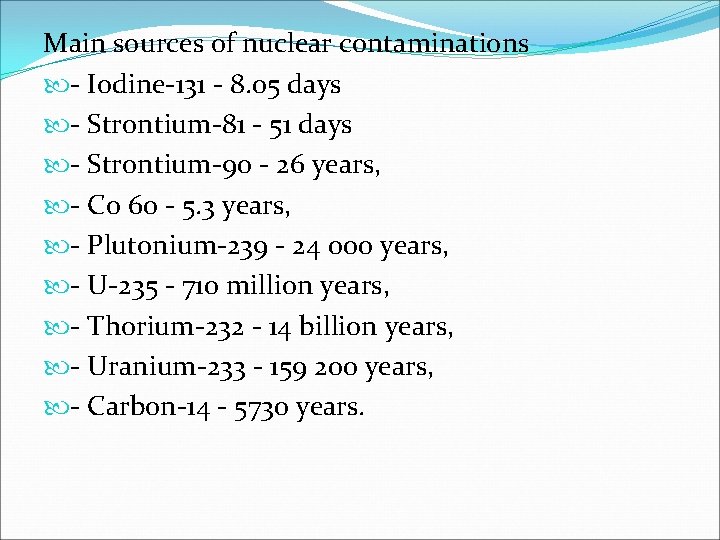
Main sources of nuclear contaminations - Iodine-131 - 8. 05 days - Strontium-81 - 51 days - Strontium-90 - 26 years, - Co 60 - 5. 3 years, - Plutonium-239 - 24 000 years, - U-235 - 710 million years, - Thorium-232 - 14 billion years, - Uranium-233 - 159 200 years, - Carbon-14 - 5730 years.
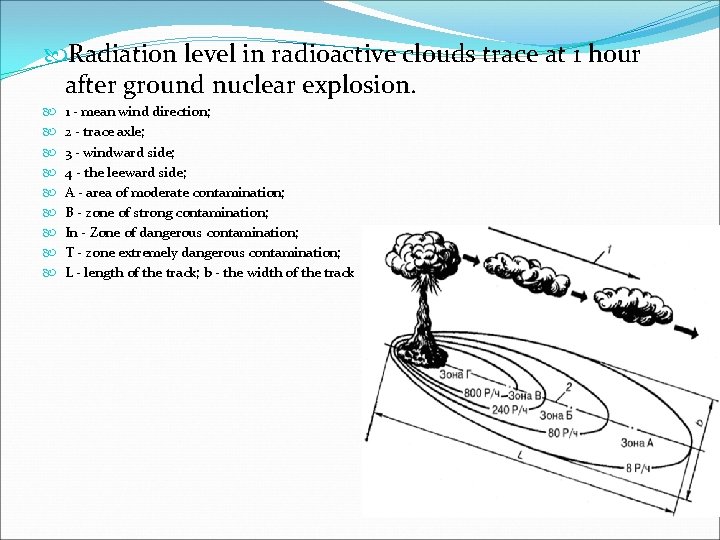
Radiation level in radioactive clouds trace at 1 hour after ground nuclear explosion. 1 - mean wind direction; 2 - trace axle; 3 - windward side; 4 - the leeward side; A - area of moderate contamination; B - zone of strong contamination; In - Zone of dangerous contamination; T - zone extremely dangerous contamination; L - length of the track; b - the width of the track
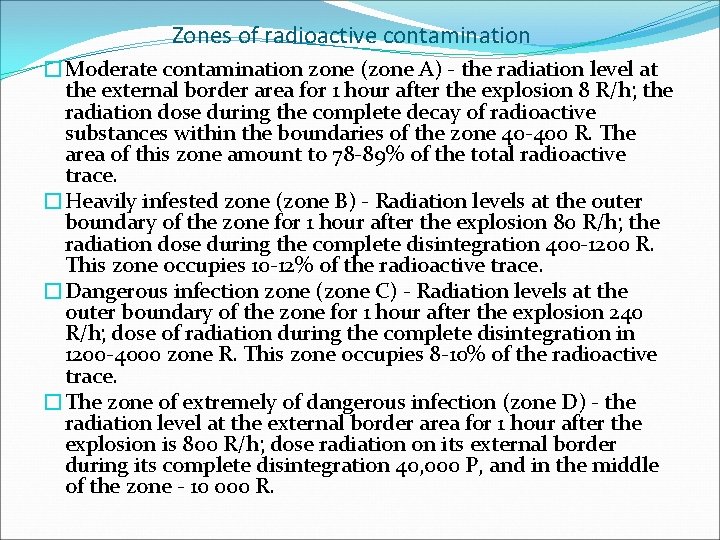
Zones of radioactive contamination �Moderate contamination zone (zone A) - the radiation level at the external border area for 1 hour after the explosion 8 R/h; the radiation dose during the complete decay of radioactive substances within the boundaries of the zone 40 -400 R. The area of this zone amount to 78 -89% of the total radioactive trace. �Heavily infested zone (zone B) - Radiation levels at the outer boundary of the zone for 1 hour after the explosion 80 R/h; the radiation dose during the complete disintegration 400 -1200 R. This zone occupies 10 -12% of the radioactive trace. �Dangerous infection zone (zone C) - Radiation levels at the outer boundary of the zone for 1 hour after the explosion 240 R/h; dose of radiation during the complete disintegration in 1200 -4000 zone R. This zone occupies 8 -10% of the radioactive trace. �The zone of extremely of dangerous infection (zone D) - the radiation level at the external border area for 1 hour after the explosion is 800 R/h; dose radiation on its external border during its complete disintegration 40, 000 P, and in the middle of the zone - 10 000 R.