
Human Language Technology HLT and Knowledge Acquisition for

- Slides: 143
Human Language Technology (HLT) and Knowledge Acquisition for the Semantic Web: a Tutorial Diana Maynard (University of Sheffield) Julien Nioche (University of Sheffield) Marta Sabou (Vrije Universiteit Amsterdam) Johanna Völker (AIFB) Atanas Kiryakov (Ontotext Lab, Sirma AI) EKAW 2006 [This work has been supported by SEKT (http: //sekt. semanticweb. org/) and Knowledge. Web (http: //knowledgeweb. semanticweb. org/ ]
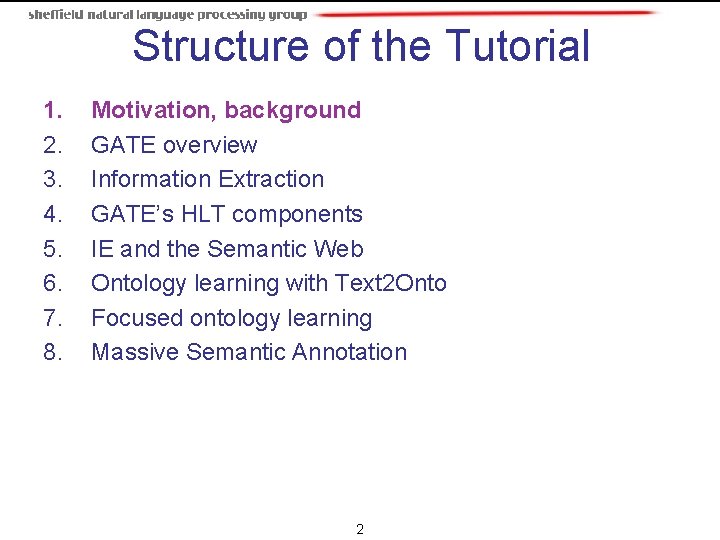
Structure of the Tutorial 1. 2. 3. 4. 5. 6. 7. 8. Motivation, background GATE overview Information Extraction GATE’s HLT components IE and the Semantic Web Ontology learning with Text 2 Onto Focused ontology learning Massive Semantic Annotation 2
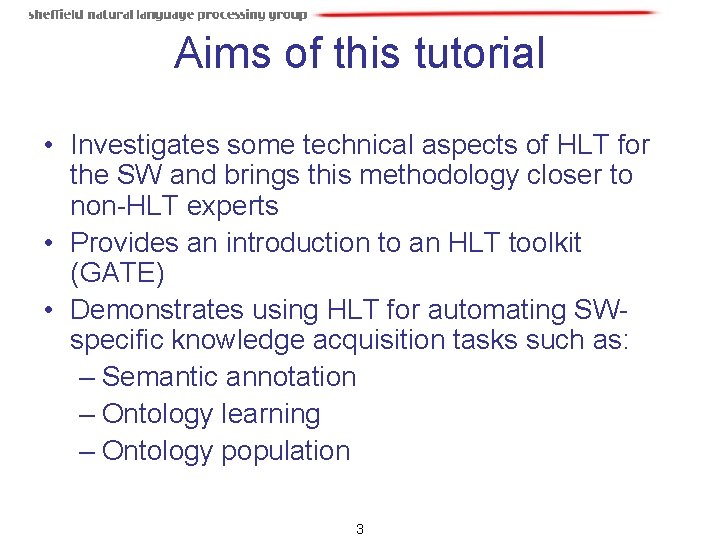
Aims of this tutorial • Investigates some technical aspects of HLT for the SW and brings this methodology closer to non-HLT experts • Provides an introduction to an HLT toolkit (GATE) • Demonstrates using HLT for automating SWspecific knowledge acquisition tasks such as: – Semantic annotation – Ontology learning – Ontology population 3
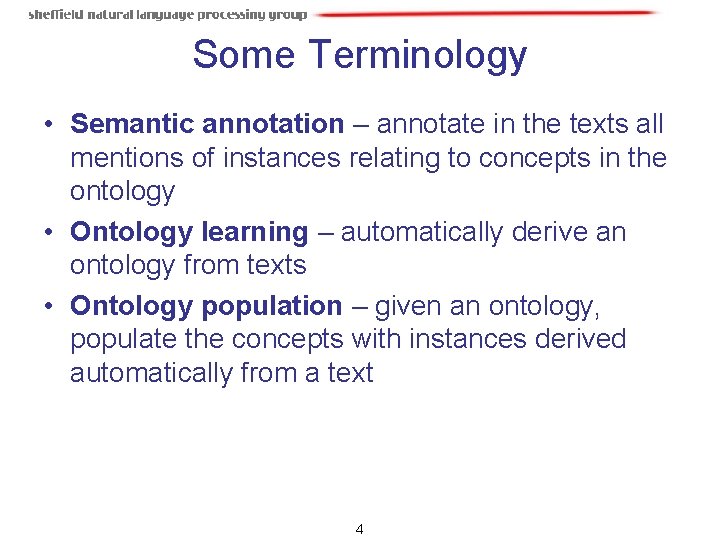
Some Terminology • Semantic annotation – annotate in the texts all mentions of instances relating to concepts in the ontology • Ontology learning – automatically derive an ontology from texts • Ontology population – given an ontology, populate the concepts with instances derived automatically from a text 4
Semantic Annotation: Motivation • Semantic metadata extraction and annotation is the glue that ties ontologies into document spaces • Metadata is the link between knowledge and its management • Manual metadata production cost is too high • State-of-the-art in automatic annotation needs extending to target ontologies and scale to industrial document stores and the web 5
Challenge of the Semantic Web • The Semantic Web requires machine processable, repurposable data to complement hypertext • Once metadata is attached to documents, they become much more useful and more easily processable, e. g. for categorising, finding relevant information, and monitoring • Such metadata can be divided into two types of information: explicit and implicit. 6
Metadata extraction • Explicit metadata extraction involves information describing the document, such as that contained in the header information of HTML documents (titles, abstracts, authors, creation date, etc. ) • Implicit metadata extraction involves semantic information deduced from the text, i. e. endogenous information such as names of entities and relations contained in the text. This essentially involves Information Extraction techniques, often with the help of an ontology. 7
Ontology Learning and Population: Motivation • Creating and populating ontologies manually is a very time-consuming and labour-intensive task • It requires both domain and ontology experts • Manually created ontologies are generally not compatible with other ontologies, so reduce interoperability and reuse • Manual methods are impossible with very large amounts of data 8
Semantic Annotation vs Ontology Population • Semantic Annotation – Mentions of instances in the text are annotated wrt concepts (classes) in the ontology. – Requires that instances are disambiguated. – It is the text which is modified. • Ontology Population – Generates new instances in an ontology from a text. – Links unique mentions of instances in the text to instances of concepts in the ontology. – Instances must be not only disambiguated but also co -reference between them must be established. – It is the ontology which is modified. 9
Structure of the Tutorial 1. 2. 3. 4. 5. 6. 7. 8. Motivation, background GATE overview Information Extraction GATE’s HLT components IE and the Semantic Web Ontology learning with Text 2 Onto Focused ontology learning Massive Semantic Annotation 10
GATE : an open source framework for HLT • GATE (General Architecture for Text Engineering) is a framework for language processing (http: //gate. ac. uk) • Open Source (LGPL licence) • Hosted on Source. Forge http: //sourceforge. net/projects/gate • Ten years old (!), with 1000 s of users at 100 s of sites • Current version 3. 1 11
4 sides to the story • An architecture: A macro-level organisational picture for HLT software systems. • A framework: For programmers, GATE is an object-oriented class library that implements the architecture. • A development environment: For language engineers, computational linguists et al, a graphical development environment. • A community of users and contributors 12
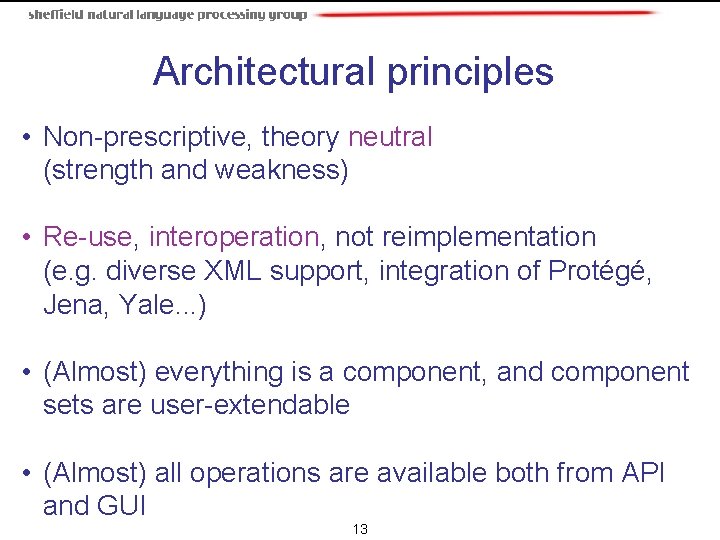
Architectural principles • Non-prescriptive, theory neutral (strength and weakness) • Re-use, interoperation, not reimplementation (e. g. diverse XML support, integration of Protégé, Jena, Yale. . . ) • (Almost) everything is a component, and component sets are user-extendable • (Almost) all operations are available both from API and GUI 13
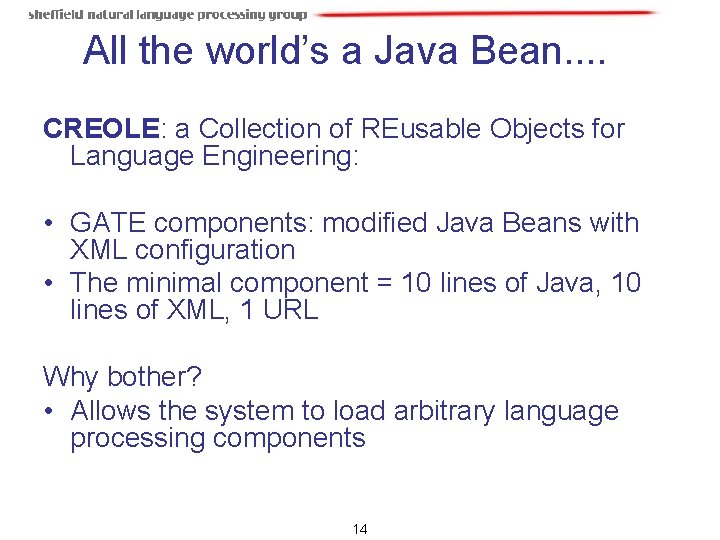
All the world’s a Java Bean. . CREOLE: a Collection of REusable Objects for Language Engineering: • GATE components: modified Java Beans with XML configuration • The minimal component = 10 lines of Java, 10 lines of XML, 1 URL Why bother? • Allows the system to load arbitrary language processing components 14
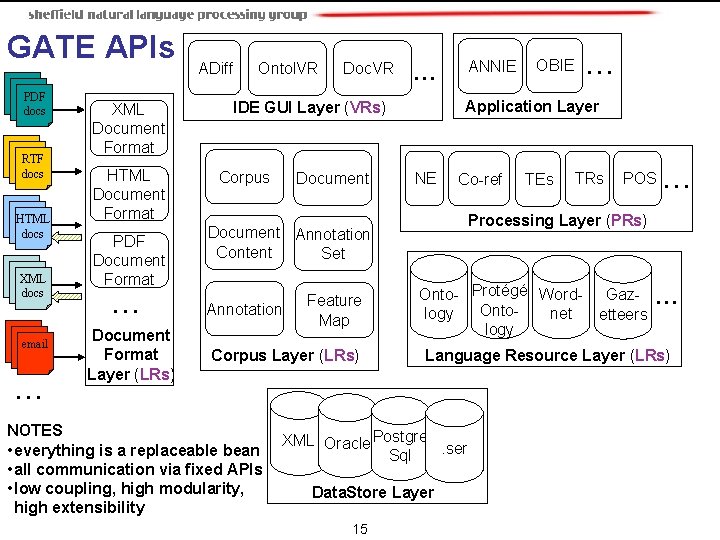
GATE APIs PDF docs RTF docs HTML docs XML docs email … XML Document Format HTML Document Format PDF Document Format … Document Format Layer (LRs) ADiff Ontol. VR Doc. VR . . . Document NE Co-ref Annotation Corpus Layer (LRs) NOTES • everything is a replaceable bean • all communication via fixed APIs • low coupling, high modularity, high extensibility TEs TRs POS Onto- Protégé Word- Gaz. Ontology net etteers logy … . . . Language Resource Layer (LRs) XML Oracle Postgre. ser Sql Data. Store Layer 15 … Processing Layer (PRs) Document Annotation Content Set Feature Map OBIE Application Layer IDE GUI Layer (VRs) Corpus ANNIE
GATE Users • American National Corpus project • Perseus Digital Library project, Tufts University, US • Longman Pearson publishing, UK • Merck Kg. Aa, Germany • Canon Europe, UK • Knight Ridder, US • BBN (leading HLT research lab), US • SMEs: Melandra, SG-Media. Style, . . . • a large number of other UK, US and EU Universities • UK and EU projects inc. SEKT, Presto. Space, Knowledge. Web, My. Grid, CLEF, Dot. Kom, AMITIES, Cub. Reporter, … 17
Past Projects using GATE • MUMIS: conceptual indexing: automatic semantic indices for sports video • MUSE: multi-genre multilingual IE • HSL: IE in domain of health and safety • Old Bailey: IE on 17 th century court reports • Multiflora: plant taxonomy text analysis for biodiversity research in e-science • EMILLE: creation of S. Asian language corpus • ACE / TIDES: IE competitions and collaborations in English, Chinese, Arabic, Hindi • h-Tech. Sight: ontology-based IE and text mining 18
Current projects using GATE • • • ETCSL: Language tools for Sumerian digital library SEKT: Semantic Knowledge Technologies Presto. Space: Preservation of audiovisual data Knowledge. Web: Semantic Web network of excellence MEDIACAMPAIGN: Discovering, inter-relating and navigating cross-media campaign knowledge • TAO : Transitioning Applications to Ontologies • MUSING : SW-based business intelligence tools • NEON : Networked Ontologies 19
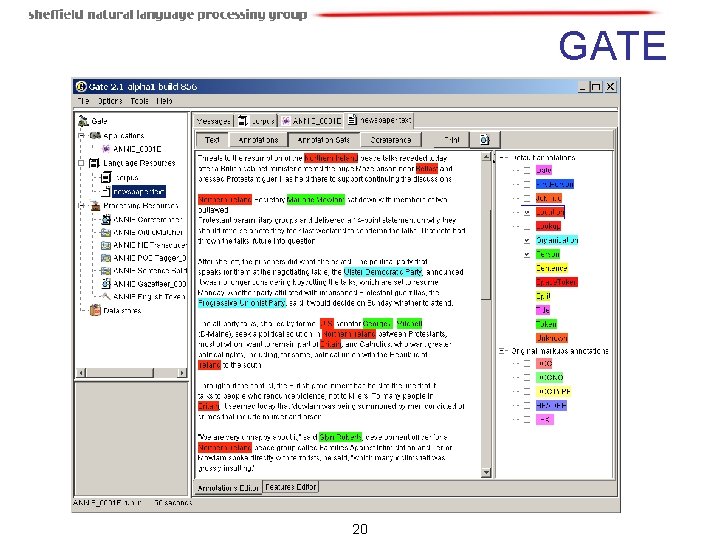
GATE 20
Structure of the Tutorial 1. 2. 3. 4. 5. 6. 7. 8. Motivation, background GATE overview Information Extraction GATE’s HLT components IE and the Semantic Web Ontology learning with Text 2 Onto Focused ontology learning Massive Semantic Annotation 21
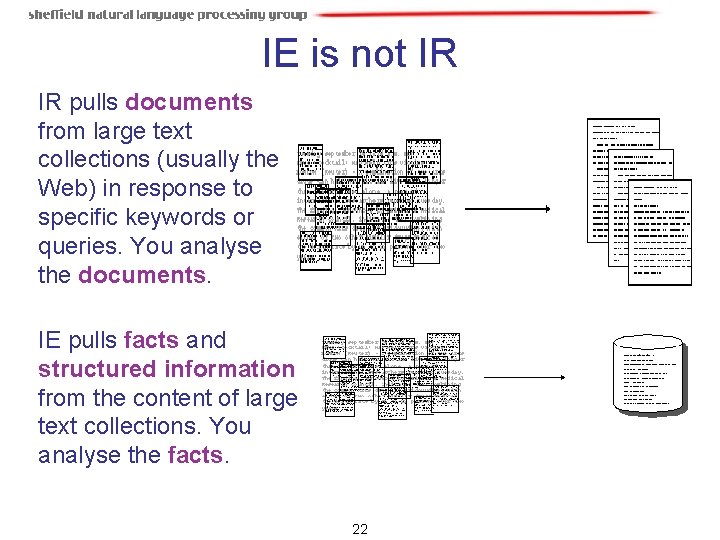
IE is not IR IR pulls documents from large text collections (usually the Web) in response to specific keywords or queries. You analyse the documents. IE pulls facts and structured information from the content of large text collections. You analyse the facts. 22
IE for Document Access • With traditional query engines, getting the facts can be hard and slow • Where has the Queen visited in the last year? • Which places on the East Coast of the US have had cases of West Nile Virus? • Which search terms would you use to get this kind of information? • How can you specify you want someone’s home page? • IE returns information in a structured way • IR returns documents containing the relevant information somewhere (if you’re lucky) 23
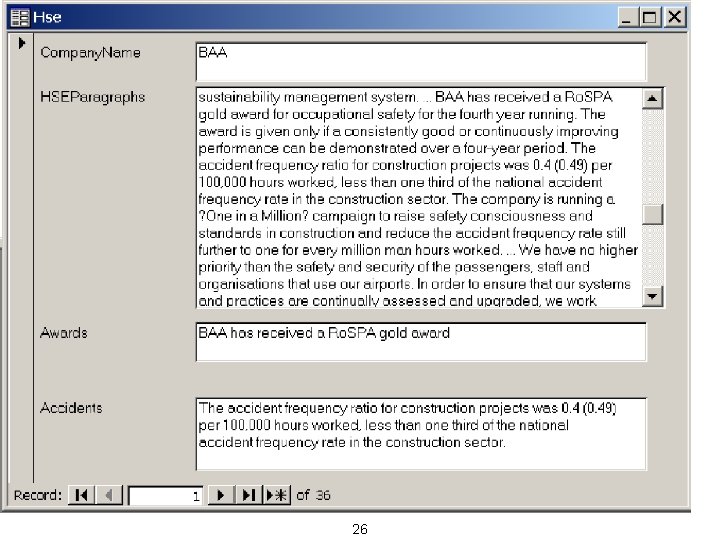
Ha. SIE: an example application • Application developed by University of Sheffield, which aims to find out how companies report about health and safety information • Answers questions such as: “How many members of staff died or had accidents in the last year? ” “Is there anyone responsible for health and safety? ” “What measures have been put in place to improve health and safety in the workplace? ” 24
Ha. SIE • Identification of such information is too timeconsuming and arduous to be done manually. • Each company report may be hundreds of pages long. • IR systems can’t help because they return whole documents • System identifies relevant sections of each document, pulls out sentences about health and safety issues, and populates a database with relevant information • This can then be analysed by an expert 25
HASIE 26
Named Entity Recognition: the cornerstone of IE • Identification of proper names in texts, and their classification into a set of predefined categories of interest • Persons • Organisations (companies, government organisations, committees, etc) • Locations (cities, countries, rivers, etc) • Date and time expressions • Various other types as appropriate 27
Why is NE important? • NE provides a foundation from which to build more complex IE systems • Relations between NEs can provide tracking, ontological information and scenario building • Tracking (co-reference) “Dr Smith”, “John”, he” • Ontologies “Athens, Georgia” vs “Athens, Greece” 28
Two kinds of approaches Knowledge Engineering Learning Systems • rule based • use statistics or other machine learning • developed by experienced language engineers • developers do not need LE expertise • make use of human intuition • require large amounts of annotated training data • require only small amount of training data • some changes may require re-annotation of • development can be very the entire training corpus time consuming • some changes may be hard to accommodate 29
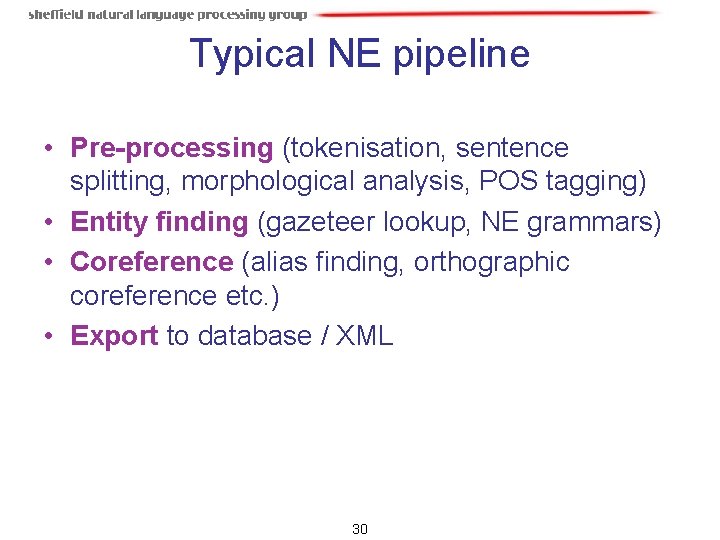
Typical NE pipeline • Pre-processing (tokenisation, sentence splitting, morphological analysis, POS tagging) • Entity finding (gazeteer lookup, NE grammars) • Coreference (alias finding, orthographic coreference etc. ) • Export to database / XML 30
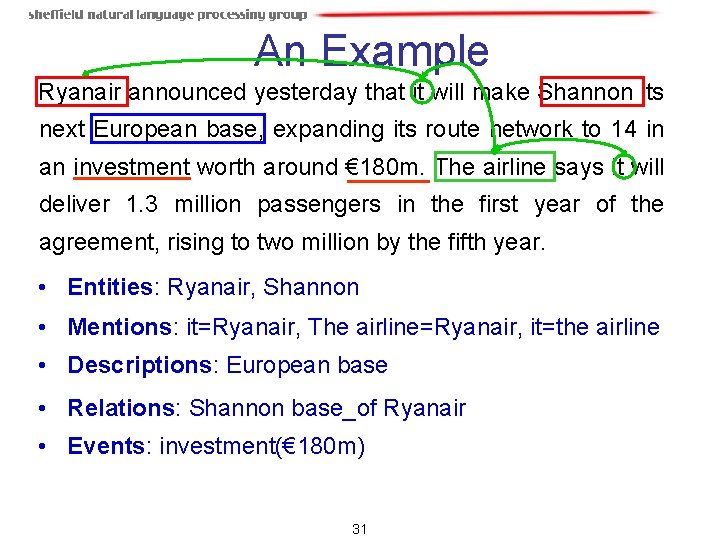
An Example Ryanair announced yesterday that it will make Shannon its next European base, expanding its route network to 14 in an investment worth around € 180 m. The airline says it will deliver 1. 3 million passengers in the first year of the agreement, rising to two million by the fifth year. • Entities: Ryanair, Shannon • Mentions: it=Ryanair, The airline=Ryanair, it=the airline • Descriptions: European base • Relations: Shannon base_of Ryanair • Events: investment(€ 180 m) 31
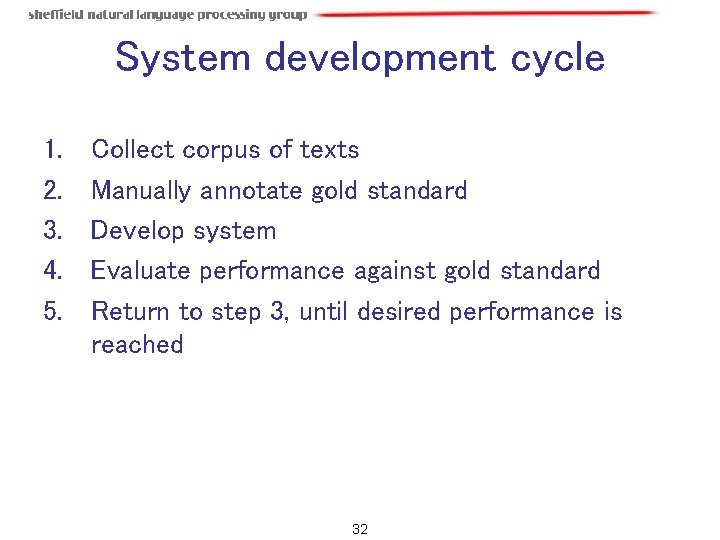
System development cycle 1. 2. 3. 4. 5. Collect corpus of texts Manually annotate gold standard Develop system Evaluate performance against gold standard Return to step 3, until desired performance is reached 32
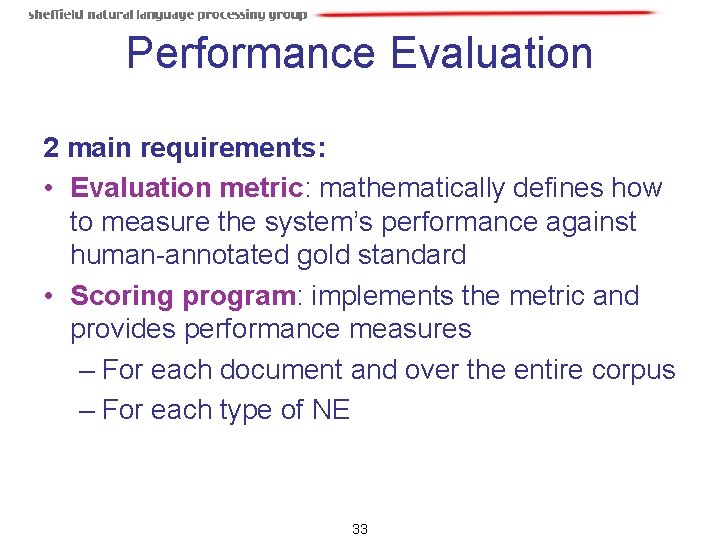
Performance Evaluation 2 main requirements: • Evaluation metric: mathematically defines how to measure the system’s performance against human-annotated gold standard • Scoring program: implements the metric and provides performance measures – For each document and over the entire corpus – For each type of NE 33
Evaluation Metrics • Most common are Precision and Recall • Precision = correct answers/answers produced • Recall = correct answers/total possible correct answers • Trade-off between precision and recall • F 1 (balanced) Measure = 2 PR / 2(R + P) • Some tasks sometimes use other metrics, e. g. costbased (good for application-specific adjustment) • Ontology-based IE requires measures sensitive to the ontology 34
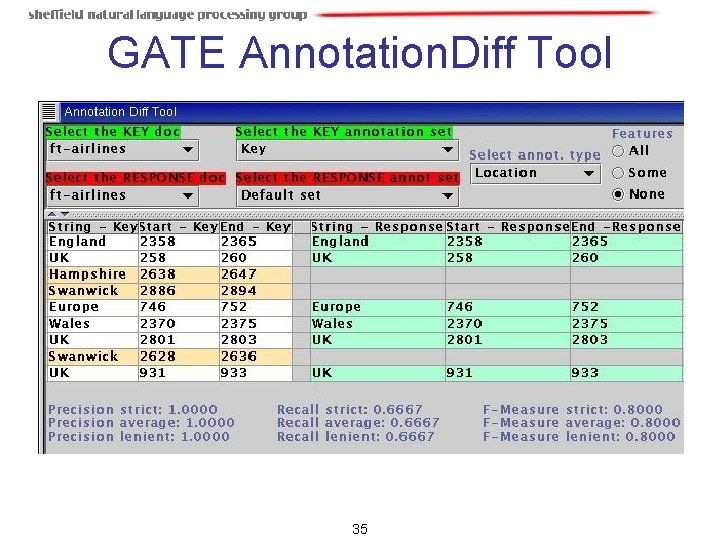
GATE Annotation. Diff Tool 35
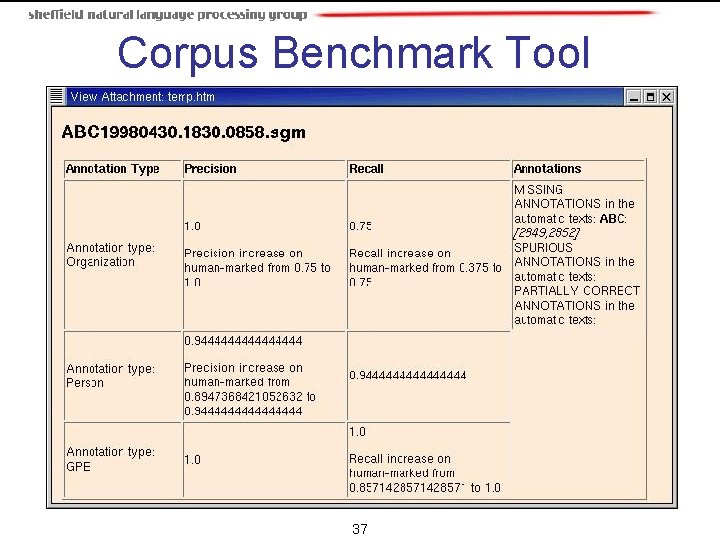
Corpus-level Regression Testing • Need to track system’s performance over time • When a change is made we want to know implications over whole corpus • Why: because an improvement in one case can lead to problems in others • GATE offers corpus benchmark tool, which can compare different versions of the same system against a gold standard • This operates on a whole corpus rather than a single document 36
Corpus Benchmark Tool 37
Structure of the Tutorial 1. 2. 3. 4. 5. 6. 7. 8. Motivation, background GATE overview Information Extraction GATE’s HLT components IE and the Semantic Web Ontology learning with Text 2 Onto Focused ontology learning Massive Semantic Annotation 38
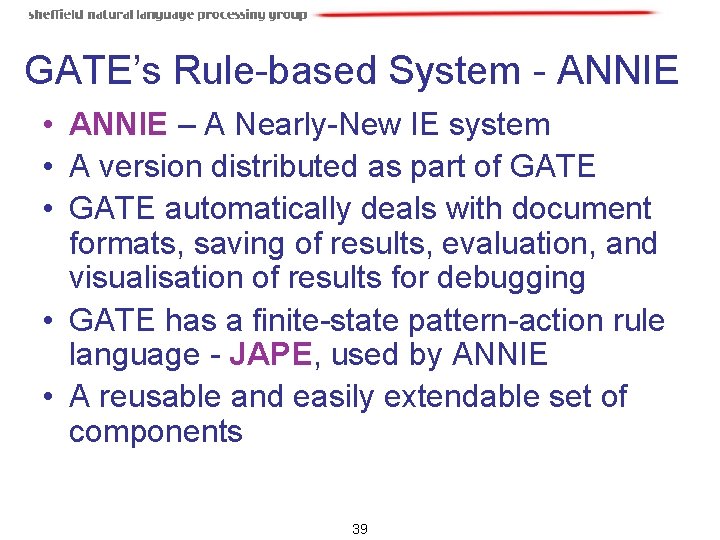
GATE’s Rule-based System - ANNIE • ANNIE – A Nearly-New IE system • A version distributed as part of GATE • GATE automatically deals with document formats, saving of results, evaluation, and visualisation of results for debugging • GATE has a finite-state pattern-action rule language - JAPE, used by ANNIE • A reusable and easily extendable set of components 39
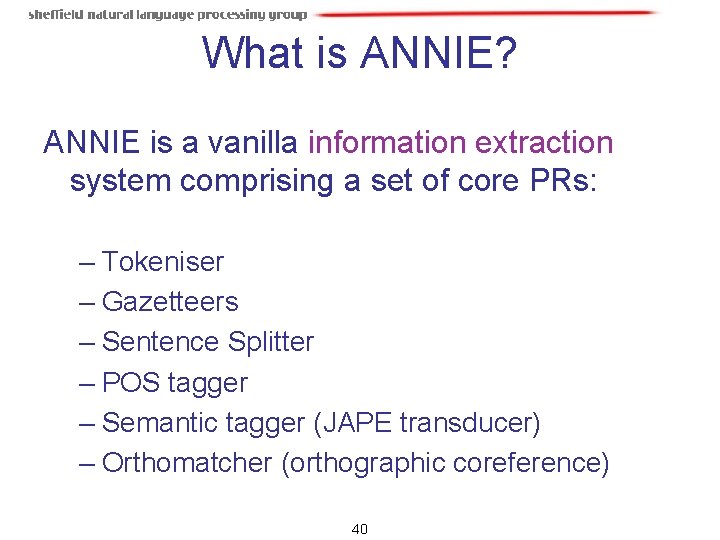
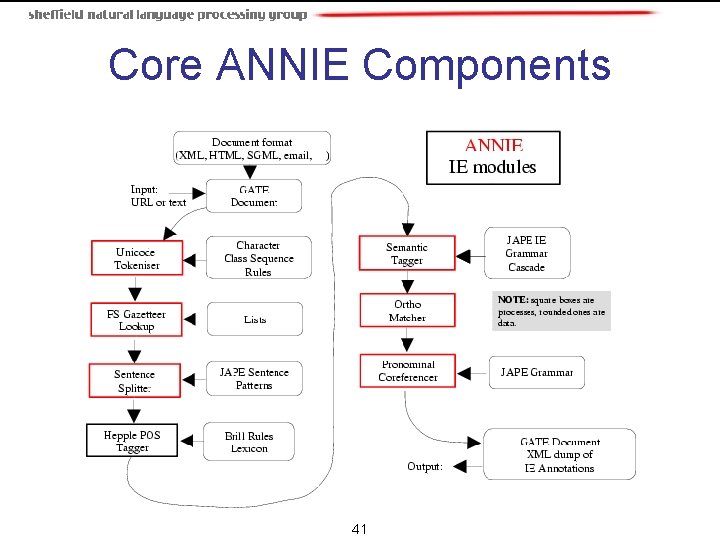
What is ANNIE? ANNIE is a vanilla information extraction system comprising a set of core PRs: – Tokeniser – Gazetteers – Sentence Splitter – POS tagger – Semantic tagger (JAPE transducer) – Orthomatcher (orthographic coreference) 40
Core ANNIE Components 41
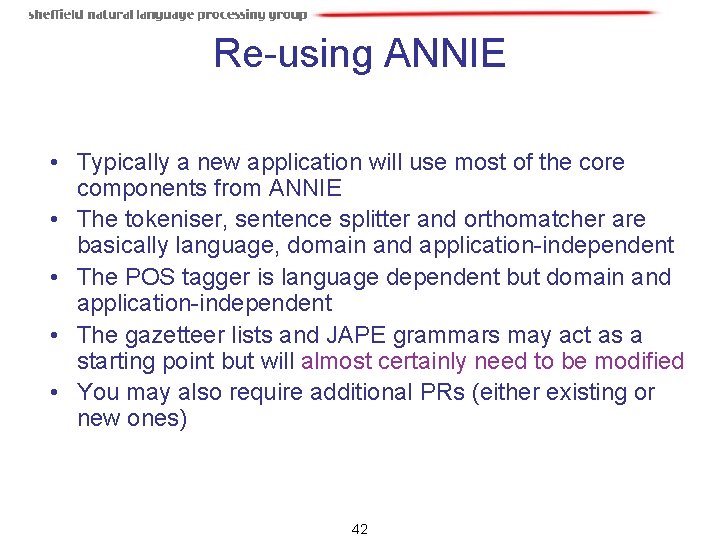
Re-using ANNIE • Typically a new application will use most of the core components from ANNIE • The tokeniser, sentence splitter and orthomatcher are basically language, domain and application-independent • The POS tagger is language dependent but domain and application-independent • The gazetteer lists and JAPE grammars may act as a starting point but will almost certainly need to be modified • You may also require additional PRs (either existing or new ones) 42
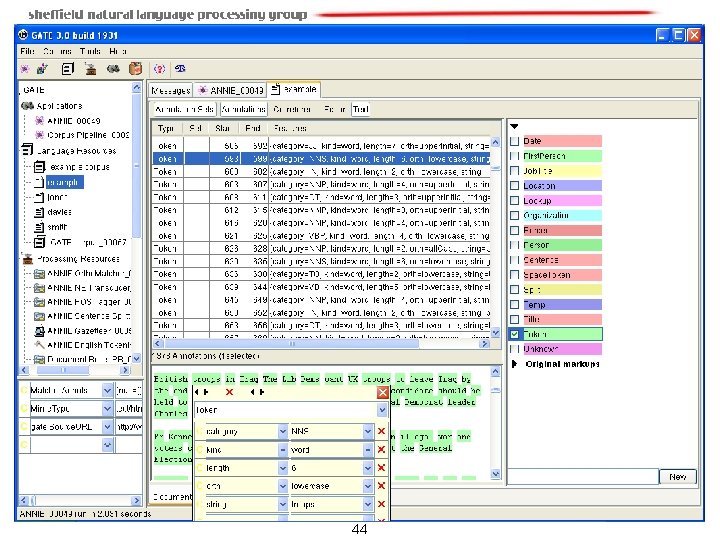
DEMO of ANNIE and GATE GUI • • • Loading ANNIE Creating a corpus Loading documents Running ANNIE on corpus Demo 43
44
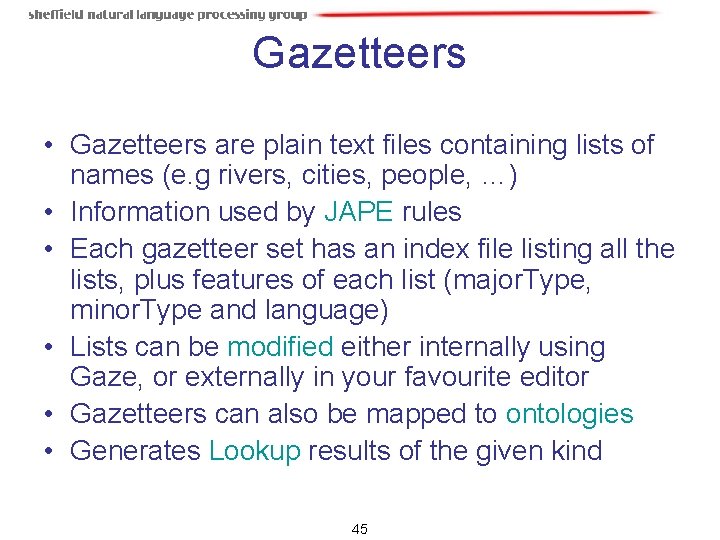
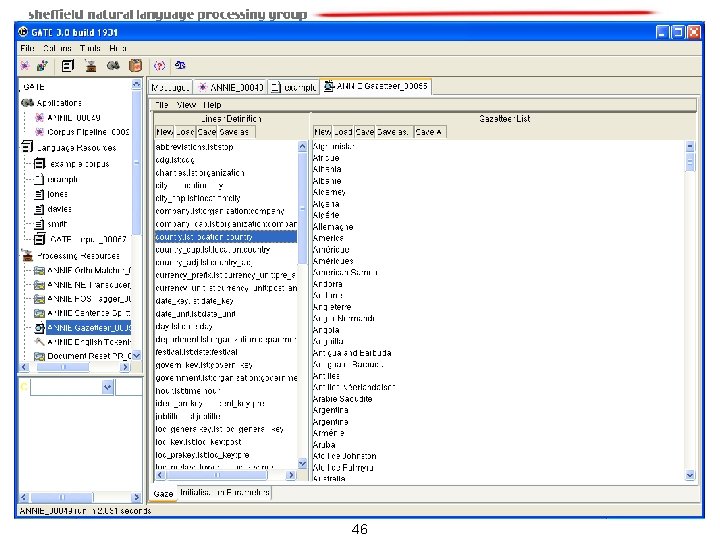
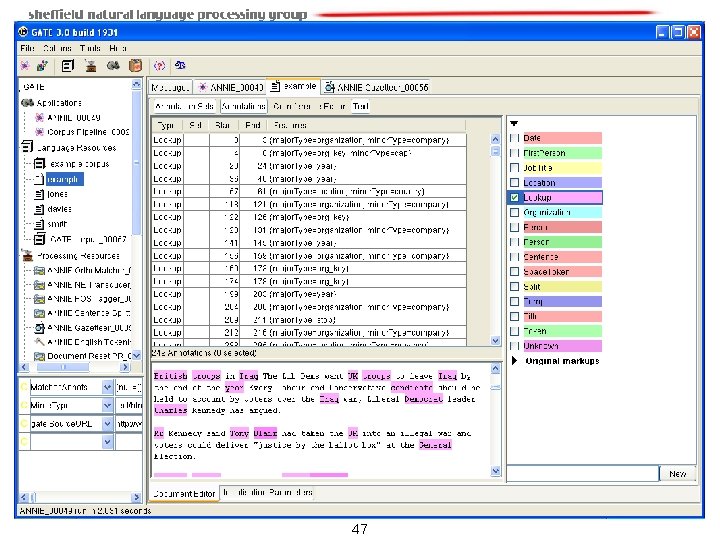
Gazetteers • Gazetteers are plain text files containing lists of names (e. g rivers, cities, people, …) • Information used by JAPE rules • Each gazetteer set has an index file listing all the lists, plus features of each list (major. Type, minor. Type and language) • Lists can be modified either internally using Gaze, or externally in your favourite editor • Gazetteers can also be mapped to ontologies • Generates Lookup results of the given kind 45
46
47
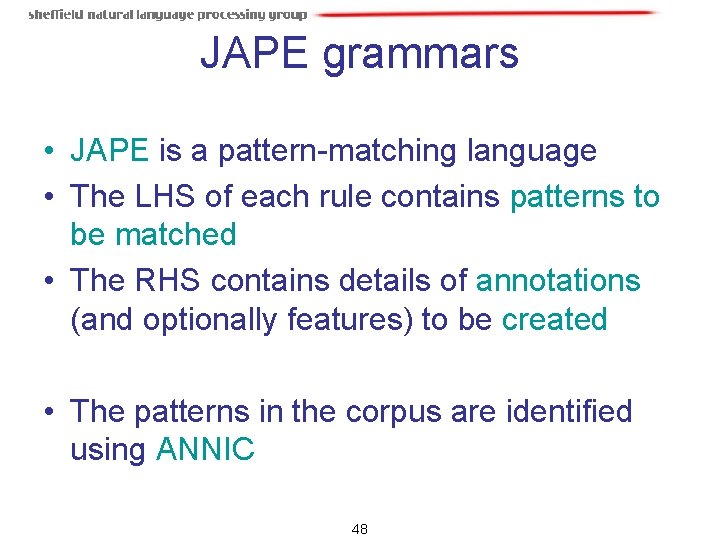
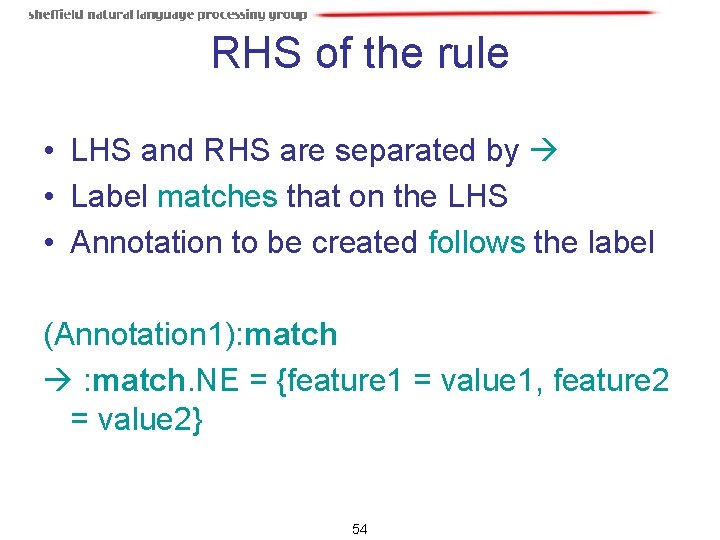
JAPE grammars • JAPE is a pattern-matching language • The LHS of each rule contains patterns to be matched • The RHS contains details of annotations (and optionally features) to be created • The patterns in the corpus are identified using ANNIC 48
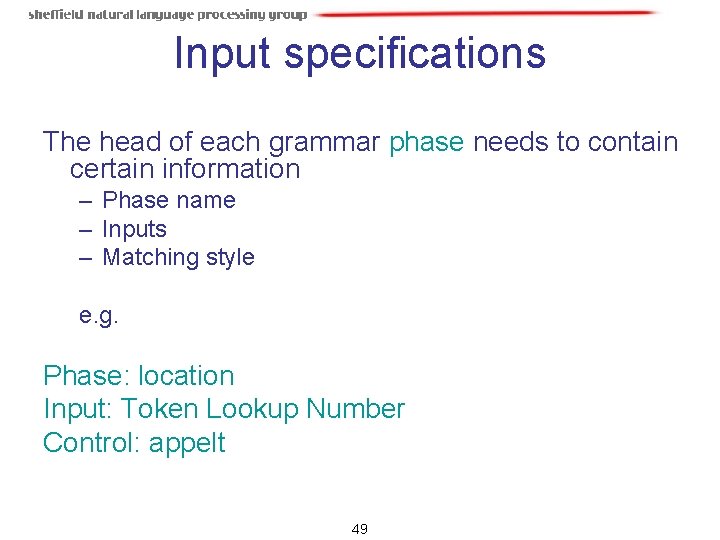
Input specifications The head of each grammar phase needs to contain certain information – Phase name – Inputs – Matching style e. g. Phase: location Input: Token Lookup Number Control: appelt 49
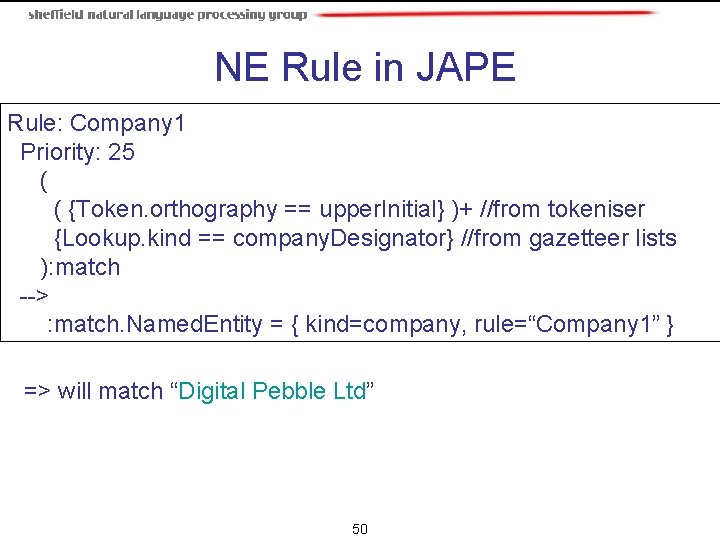
NE Rule in JAPE Rule: Company 1 Priority: 25 ( ( {Token. orthography == upper. Initial} )+ //from tokeniser {Lookup. kind == company. Designator} //from gazetteer lists ): match --> : match. Named. Entity = { kind=company, rule=“Company 1” } => will match “Digital Pebble Ltd” 50
LHS of the rule • LHS is expressed in terms of existing annotations, and optionally features and their values • Any annotation to be used must be included in the input header • Any annotation not included in the input header will be ignored (e. g. whitespace) • Each annotation is enclosed in curly braces • Each pattern to be matched is enclosed in round brackets and has a label attached 51
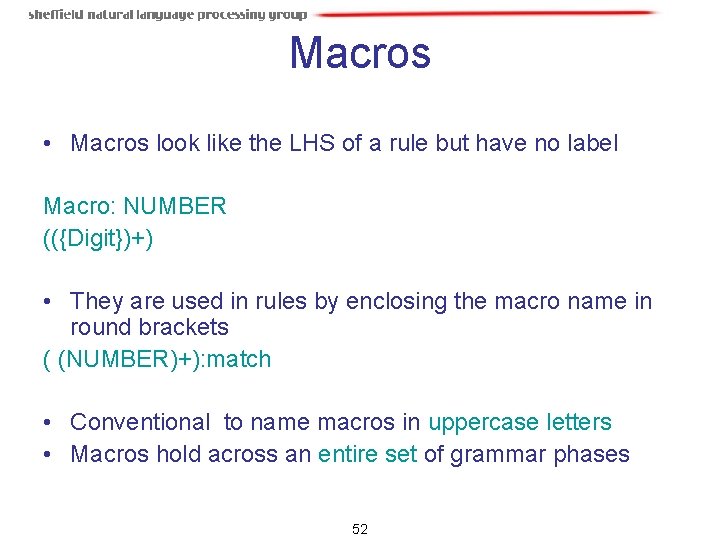
Macros • Macros look like the LHS of a rule but have no label Macro: NUMBER (({Digit})+) • They are used in rules by enclosing the macro name in round brackets ( (NUMBER)+): match • Conventional to name macros in uppercase letters • Macros hold across an entire set of grammar phases 52
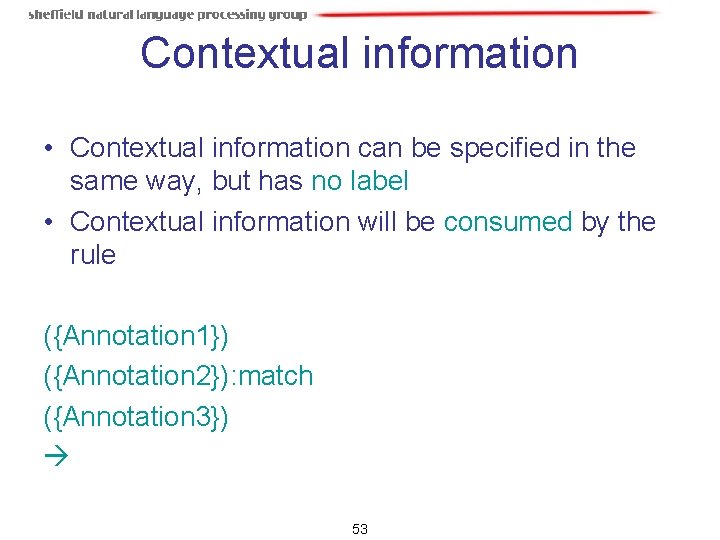
Contextual information • Contextual information can be specified in the same way, but has no label • Contextual information will be consumed by the rule ({Annotation 1}) ({Annotation 2}): match ({Annotation 3}) 53
RHS of the rule • LHS and RHS are separated by • Label matches that on the LHS • Annotation to be created follows the label (Annotation 1): match : match. NE = {feature 1 = value 1, feature 2 = value 2} 54
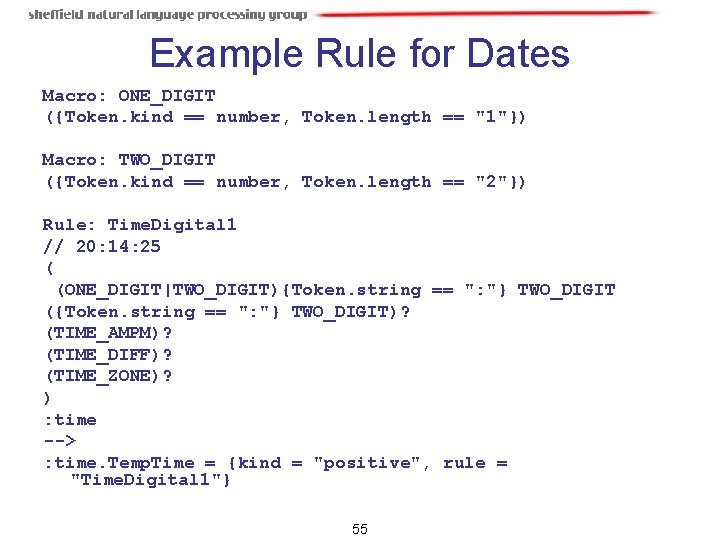
Example Rule for Dates Macro: ONE_DIGIT ({Token. kind == number, Token. length == "1"}) Macro: TWO_DIGIT ({Token. kind == number, Token. length == "2"}) Rule: Time. Digital 1 // 20: 14: 25 ( (ONE_DIGIT|TWO_DIGIT){Token. string == ": "} TWO_DIGIT ({Token. string == ": "} TWO_DIGIT)? (TIME_AMPM)? (TIME_DIFF)? (TIME_ZONE)? ) : time --> : time. Temp. Time = {kind = "positive", rule = "Time. Digital 1"} 55
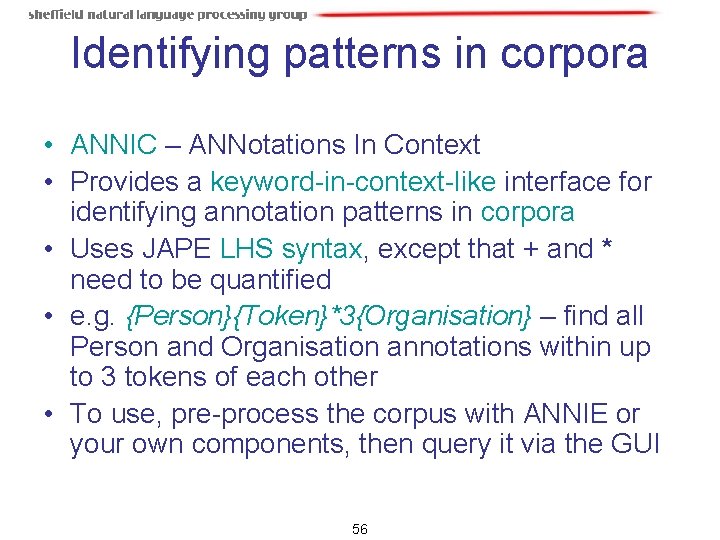
Identifying patterns in corpora • ANNIC – ANNotations In Context • Provides a keyword-in-context-like interface for identifying annotation patterns in corpora • Uses JAPE LHS syntax, except that + and * need to be quantified • e. g. {Person}{Token}*3{Organisation} – find all Person and Organisation annotations within up to 3 tokens of each other • To use, pre-process the corpus with ANNIE or your own components, then query it via the GUI 56
ANNIC Demo • • • Formulating queries Finding matches in the corpus Analysing the contexts Refining the queries Demo 57
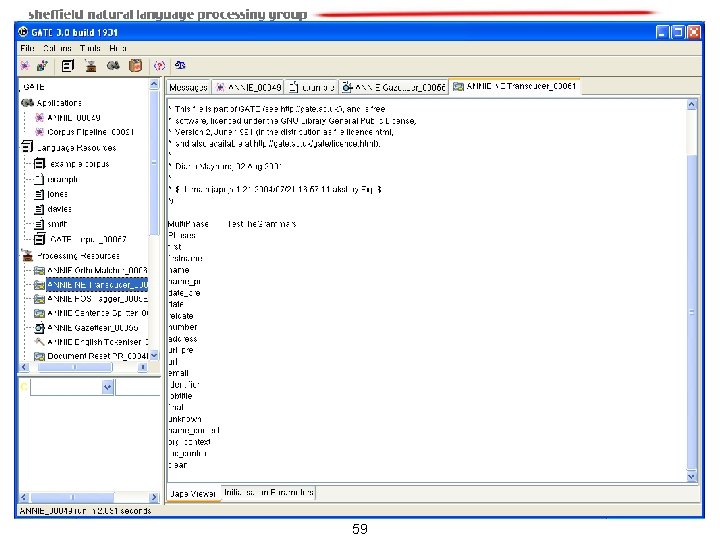
Using phases • Grammars usually consist of several phases, run sequentially • A definition phase (conventionally called main. jape) lists the phases to be used, in order • Only the definition phase needs to be loaded • Temporary annotations may be created in early phases and used as input for later phases • Annotations from earlier phases may need to be combined or modified 58
59
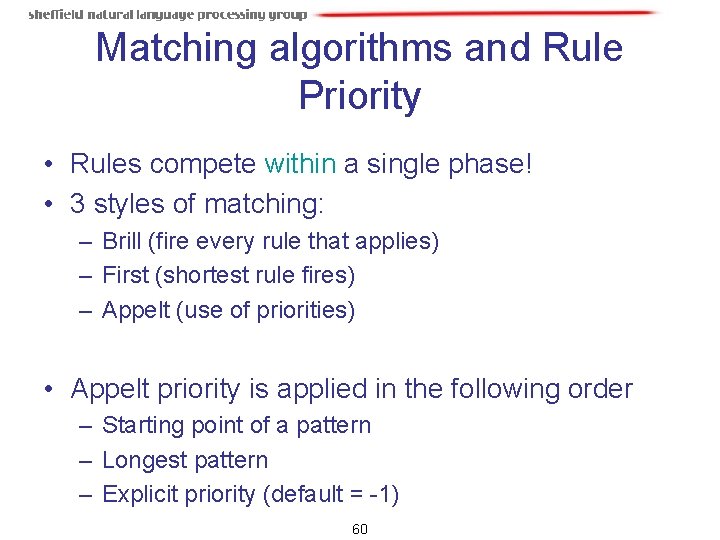
Matching algorithms and Rule Priority • Rules compete within a single phase! • 3 styles of matching: – Brill (fire every rule that applies) – First (shortest rule fires) – Appelt (use of priorities) • Appelt priority is applied in the following order – Starting point of a pattern – Longest pattern – Explicit priority (default = -1) 60
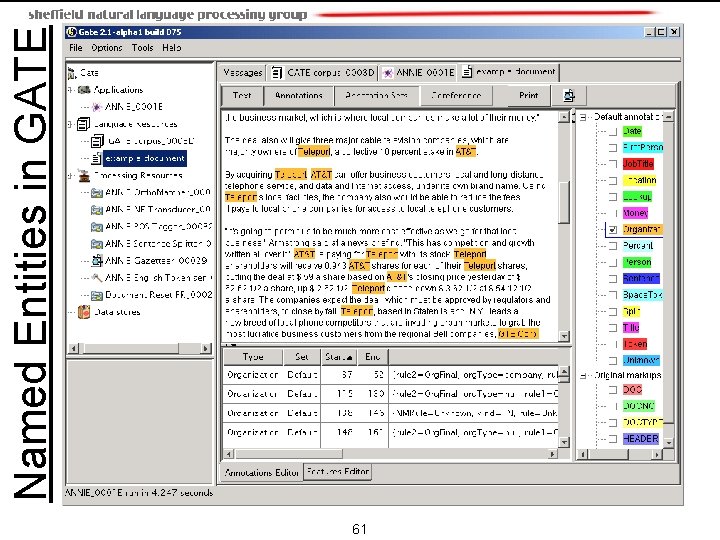
61 Named Entities in GATE
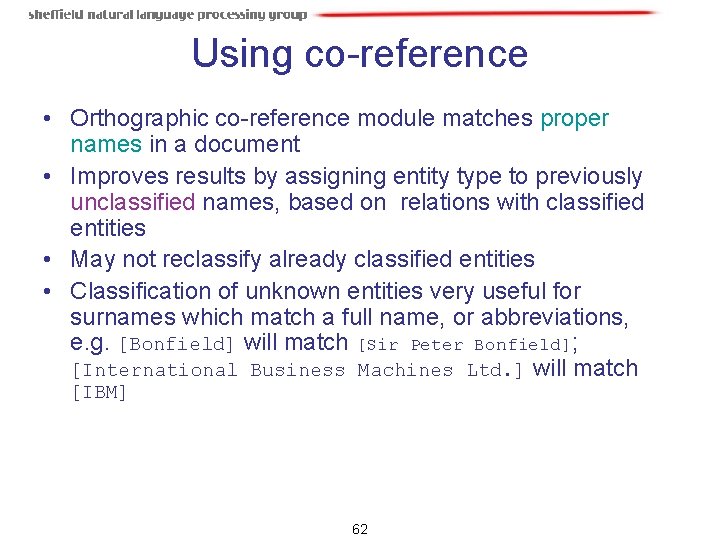
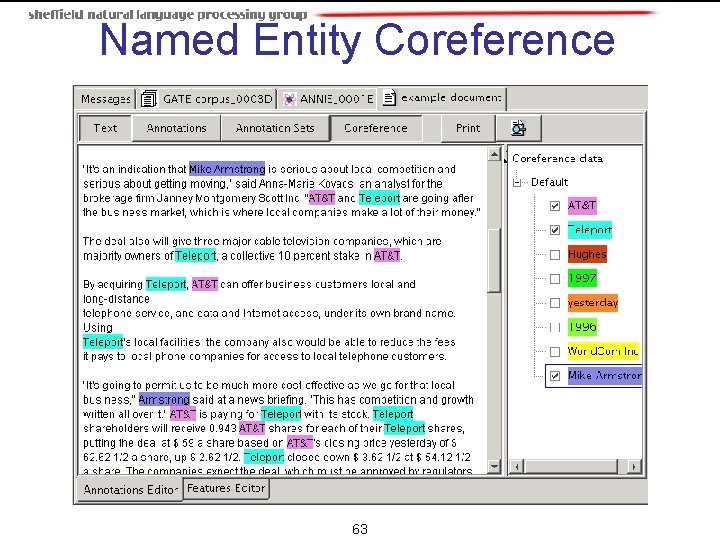
Using co-reference • Orthographic co-reference module matches proper names in a document • Improves results by assigning entity type to previously unclassified names, based on relations with classified entities • May not reclassify already classified entities • Classification of unknown entities very useful for surnames which match a full name, or abbreviations, e. g. [Bonfield] will match [Sir Peter Bonfield]; [International Business Machines Ltd. ] will match [IBM] 62
Named Entity Coreference 63
GATE 4. 0 • • • Before end 06 Faster and leaner! Nicer GUI ANNIC included Improved Machine Learning API (based on YALE) • and more… 64
Structure of the Tutorial 1. 2. 3. 4. 5. 6. 7. 8. Motivation, background GATE overview Information Extraction GATE’s HLT components IE and the Semantic Web Ontology learning with Text 2 Onto Focused ontology learning Massive Semantic Annotation 65
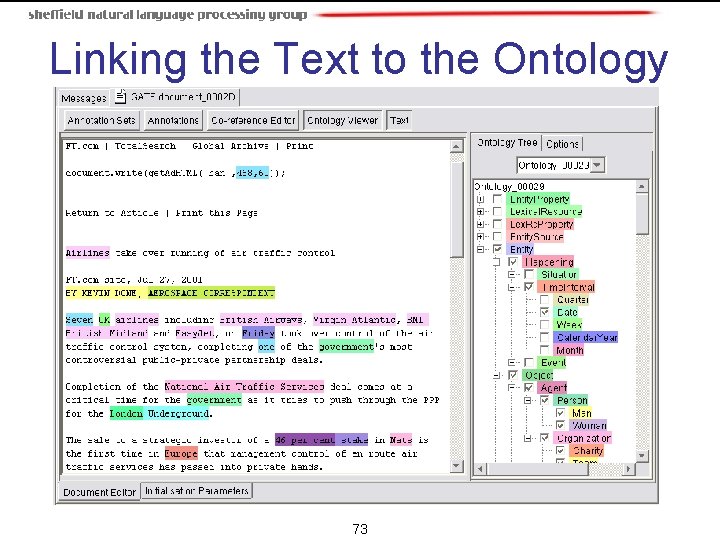
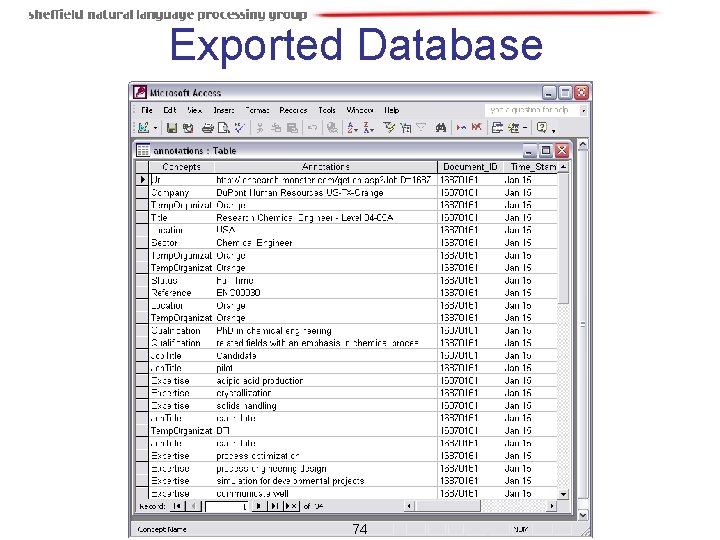
Information Extraction for the Semantic Web • Traditional IE is based on a flat structure, e. g. recognising Person, Location, Organisation, Date, Time etc. • For the Semantic Web, we need information in a hierarchical structure • Idea is that we attach semantic metadata to the documents, pointing to concepts in an ontology • Information can be exported as an ontology annotated with instances, or as text annotated with links to the ontology 66
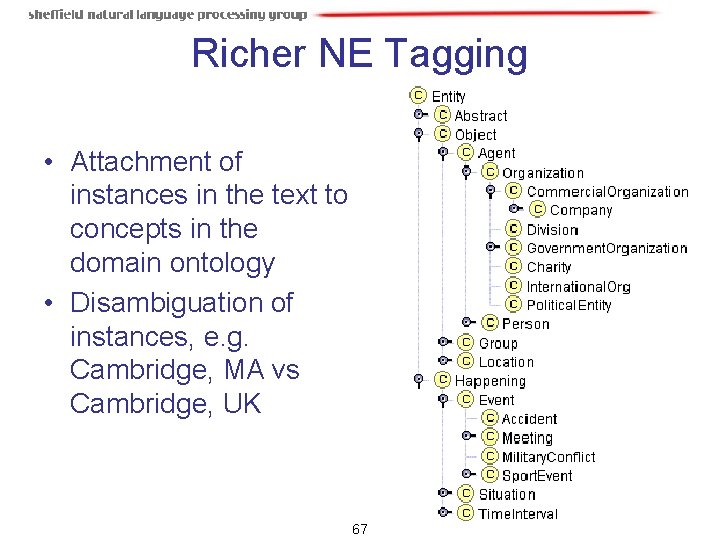
Richer NE Tagging • Attachment of instances in the text to concepts in the domain ontology • Disambiguation of instances, e. g. Cambridge, MA vs Cambridge, UK 67
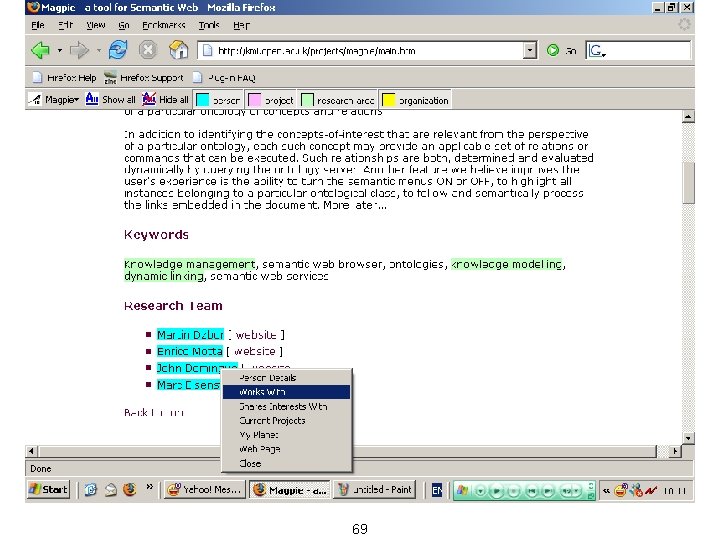
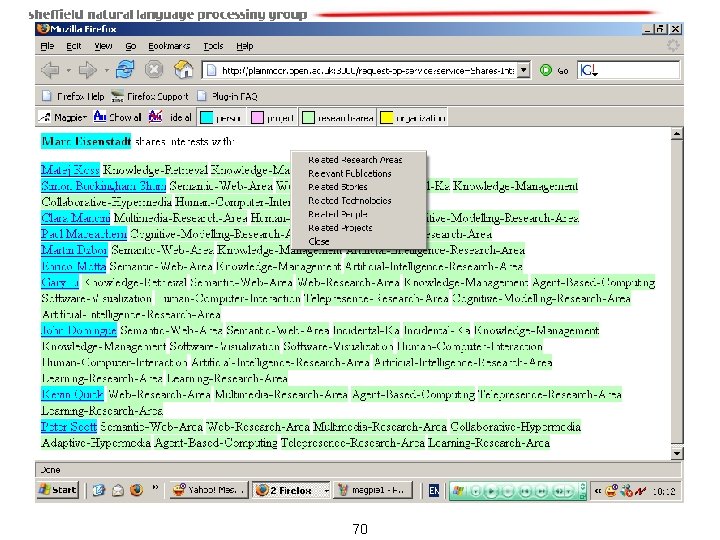
Magpie: an example • Developed by the Open University • Plugin for standard web browser • Automatically associates an ontology-based semantic layer to web resources, allowing relevant services to be linked • Provides means for a structured and informed exploration of the web resources • e. g. looking at a list of publications, we can find information about an author such as projects they work on, other people they work with, etc. 68
MAGPIE in action 69
MAGPIE in action 70
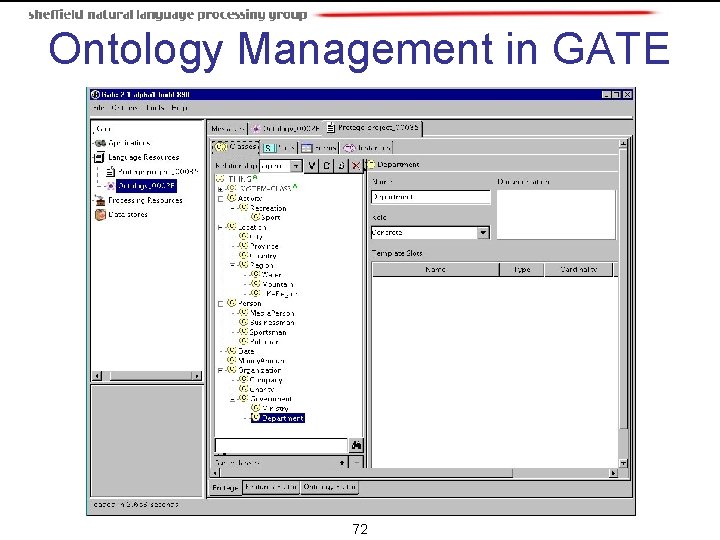
GATE and the Semantic Web • Supports ontologies as part of IE applications Ontology-Based IE (OBIE) • Supports semantic annotation and ontology population • Can combine learning and rule-based methods • Allows combination of IE and IR • Enables use of large-scale linguistic resources for IE, such as Word. Net 71
Ontology Management in GATE 72
Linking the Text to the Ontology 73
Exported Database 74
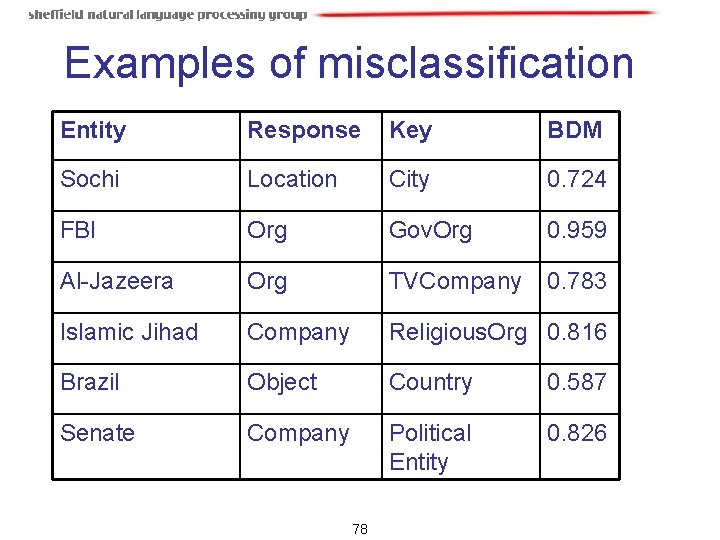
Evaluation for OBIE • Traditional IE is evaluated in terms of Precision, Recall and F-measure. • But these are not sufficient for ontology-based IE, because the distinction between right and wrong is less obvious • Recognising a Person as a Location is clearly wrong, but recognising a Research Assistant as a Lecturer is not so wrong • Similarity metrics need to be integrated so that items closer together in the hierarchy are given a higher score, if wrong 75
Augmented Precision and Recall • Development of a new BDM (Balanced Distance Metric) which compares key and response concepts wrt a given ontology • In the case of ontological mismatch, provides an indication of how serious the error is, and weights it accordingly • BDM provides a score between 0 and 1 for each key/response match instead of a binary measure 76
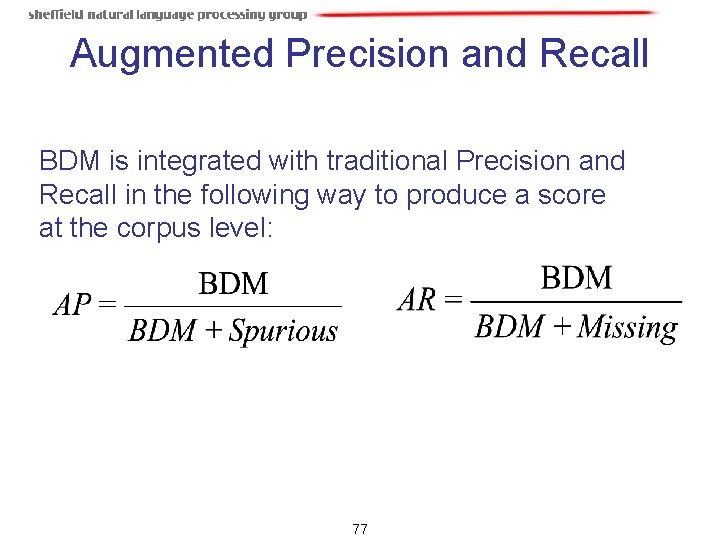
Augmented Precision and Recall BDM is integrated with traditional Precision and Recall in the following way to produce a score at the corpus level: 77
Examples of misclassification Entity Response Key BDM Sochi Location City 0. 724 FBI Org Gov. Org 0. 959 Al-Jazeera Org TVCompany 0. 783 Islamic Jihad Company Religious. Org 0. 816 Brazil Object Country 0. 587 Senate Company Political Entity 0. 826 78
Structure of the Tutorial 1. 2. 3. 4. 5. 6. 7. 8. Motivation, background GATE overview Information Extraction GATE’s HLT components IE and the Semantic Web Ontology learning with Text 2 Onto Focused ontology learning Massive Semantic Annotation 79
Ontology Learning with Text 2 Onto http: //ontoware. org/projects/text 2 onto/ Johanna Völker voelker@aifb. uni-karlsruhe. de Institute AIFB University of Karlsruhe
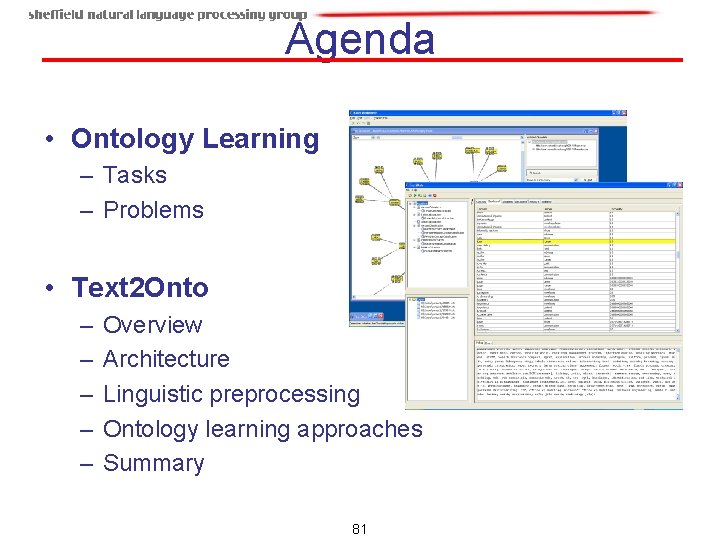
Agenda • Ontology Learning – Tasks – Problems • Text 2 Onto – – – Overview Architecture Linguistic preprocessing Ontology learning approaches Summary 81
Ontology Learning • Extraction of (domain) ontologies from natural language text – Machine learning – Natural language processing • Tools: Onto. Learn, Onto. LT, ASIUM, Mo’K Workbench, JATKE, Text. To. Onto, … 82
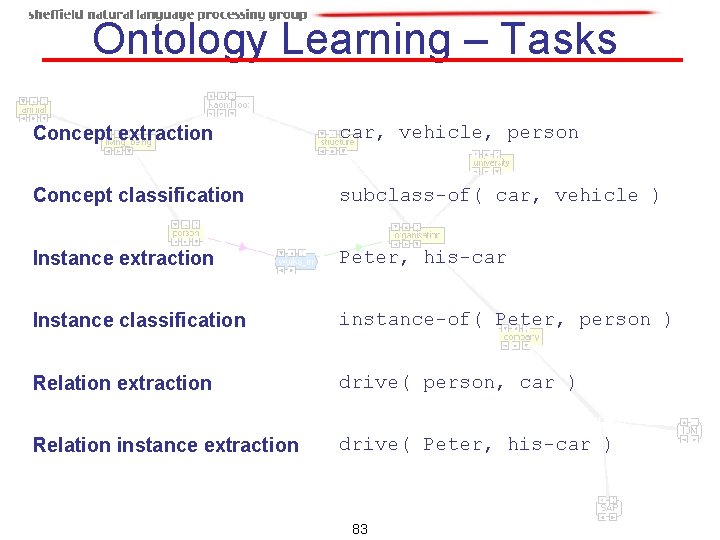
Ontology Learning – Tasks Concept extraction car, vehicle, person Concept classification subclass-of( car, vehicle ) Instance extraction Peter, his-car Instance classification instance-of( Peter, person ) Relation extraction drive( person, car ) Relation instance extraction drive( Peter, his-car ) 83
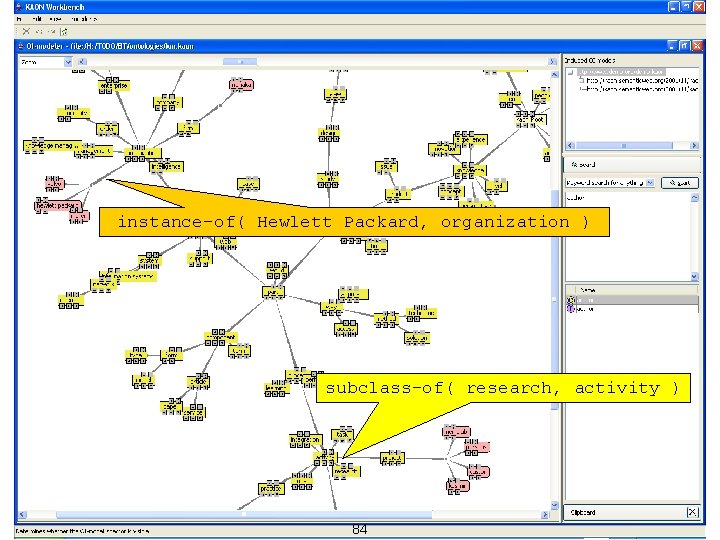
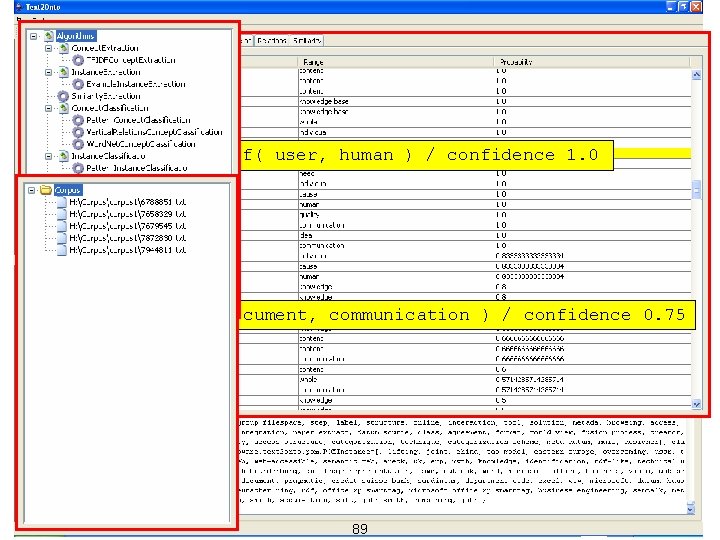
instance-of( Hewlett Packard, organization ) subclass-of( research, activity ) 84
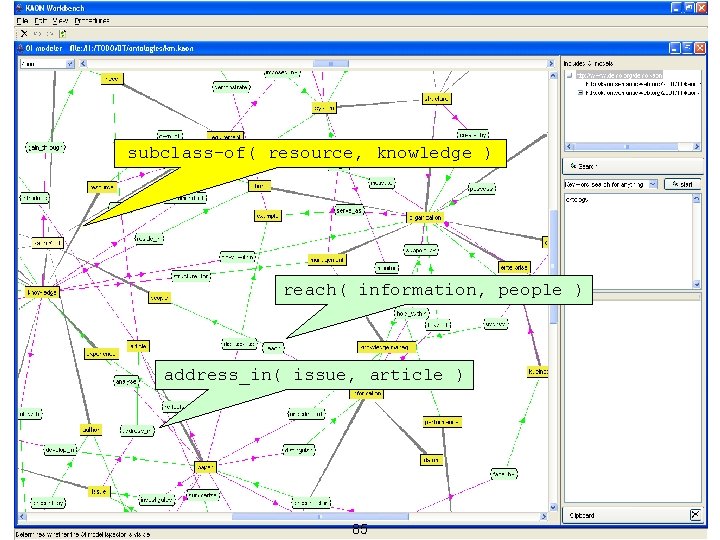
subclass-of( resource, knowledge ) reach( information, people ) address_in( issue, article ) 85
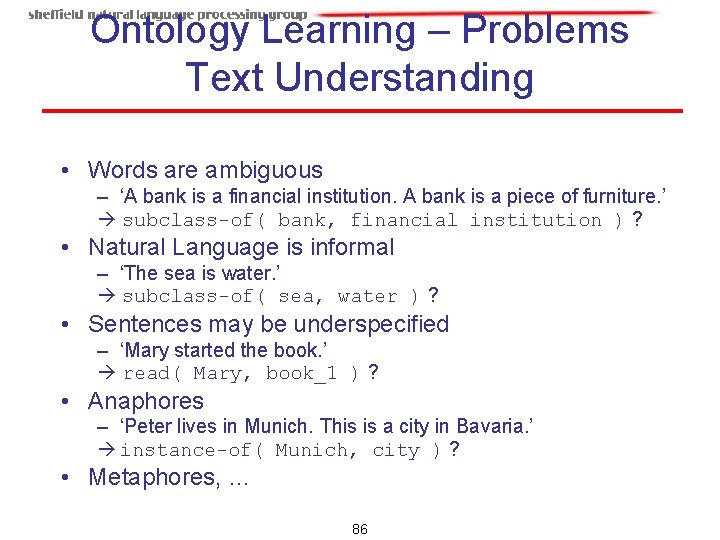
Ontology Learning – Problems Text Understanding • Words are ambiguous – ‘A bank is a financial institution. A bank is a piece of furniture. ’ subclass-of( bank, financial institution ) ? • Natural Language is informal – ‘The sea is water. ’ subclass-of( sea, water ) ? • Sentences may be underspecified – ‘Mary started the book. ’ read( Mary, book_1 ) ? • Anaphores – ‘Peter lives in Munich. This is a city in Bavaria. ’ instance-of( Munich, city ) ? • Metaphores, … 86
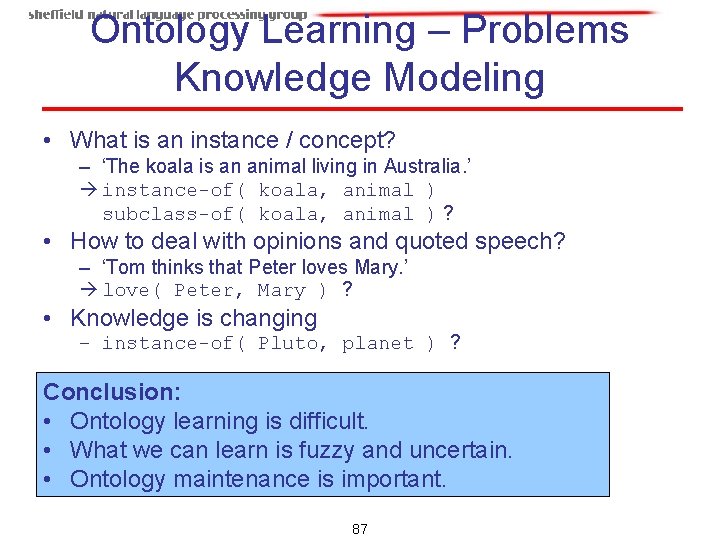
Ontology Learning – Problems Knowledge Modeling • What is an instance / concept? – ‘The koala is an animal living in Australia. ’ instance-of( koala, animal ) subclass-of( koala, animal ) ? • How to deal with opinions and quoted speech? – ‘Tom thinks that Peter loves Mary. ’ love( Peter, Mary ) ? • Knowledge is changing – instance-of( Pluto, planet ) ? Conclusion: • Ontology learning is difficult. • What we can learn is fuzzy and uncertain. • Ontology maintenance is important. 87
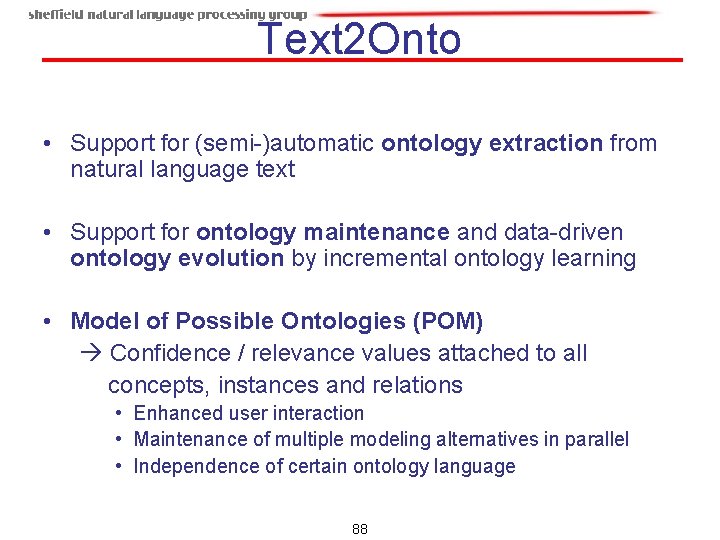
Text 2 Onto • Support for (semi-)automatic ontology extraction from natural language text • Support for ontology maintenance and data-driven ontology evolution by incremental ontology learning • Model of Possible Ontologies (POM) Confidence / relevance values attached to all concepts, instances and relations • Enhanced user interaction • Maintenance of multiple modeling alternatives in parallel • Independence of certain ontology language 88
subclass-of( user, human ) / confidence 1. 0 subclass-of( document, communication ) / confidence 0. 75 89
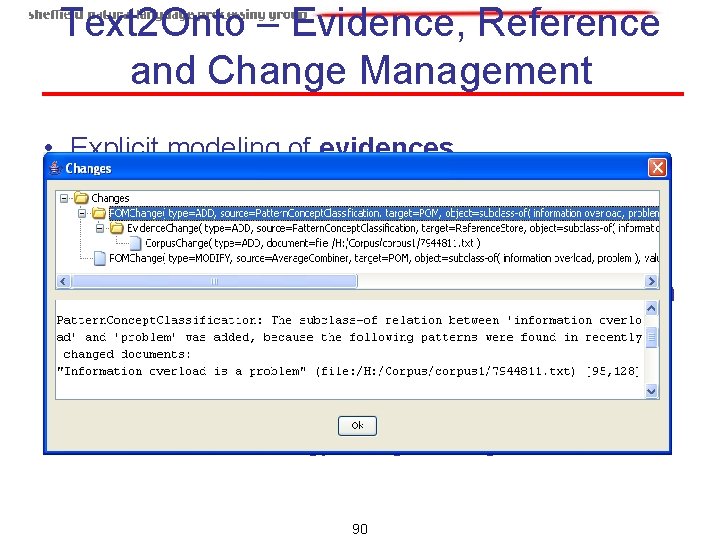
Text 2 Onto – Evidence, Reference and Change Management • Explicit modeling of evidences – Algorithms provide different types of evidences – Explanation component • References for annotation and change detection • Explicit modeling of changes – Corpus, evidence, reference and ontology changes – Future work: ontology change strategies 90
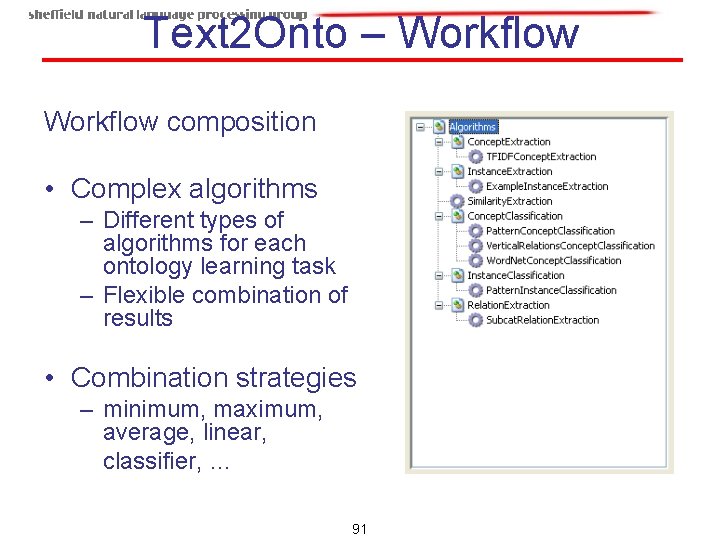
Text 2 Onto – Workflow composition • Complex algorithms – Different types of algorithms for each ontology learning task – Flexible combination of results • Combination strategies – minimum, maximum, average, linear, classifier, … 91
POM Visualization Workflow Manager API Corpus Evidence Store Reference Store POM Ontology GATE Algorithm Controller OWL Writer Text 2 Onto 92 RDFS Writer F-Logic Writer
Linguistic Preprocessing GATE • Standard ANNIE components for – – Tokenization Sentence splitting POS tagging Stemming / lemmatizing • Self-defined JAPE patterns and processing resources for – Stop word detection – Shallow parsing • GATE applications for English, German and Spanish 93
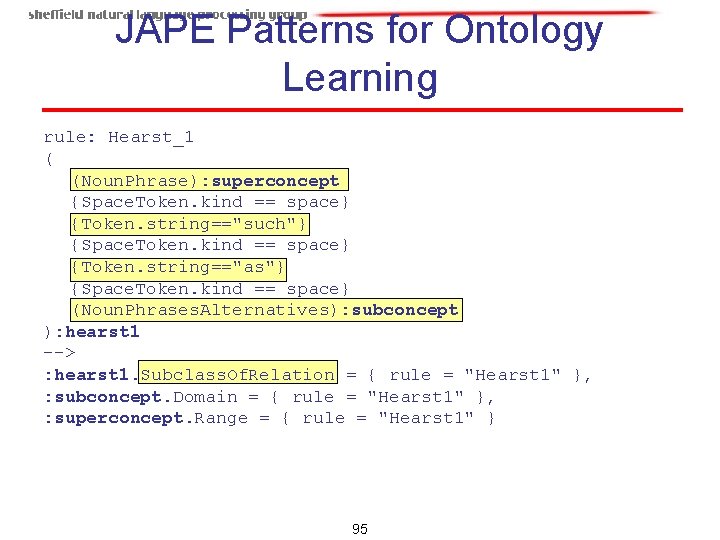
Ontology Learning Approaches Concept Classification • Heuristics – ‘image processing software’ subclass-of( image processing software, software ) • Patterns – ‘animals such as dogs’ – ‘dogs and other animals’ – ‘a dog is an animal’ subclass-of( dog, animal ) 94
JAPE Patterns for Ontology Learning rule: Hearst_1 ( (Noun. Phrase): superconcept {Space. Token. kind == space} {Token. string=="such"} {Space. Token. kind == space} {Token. string=="as"} {Space. Token. kind == space} (Noun. Phrases. Alternatives): subconcept ): hearst 1 --> : hearst 1. Subclass. Of. Relation = { rule = "Hearst 1" }, : subconcept. Domain = { rule = "Hearst 1" }, : superconcept. Range = { rule = "Hearst 1" } 95
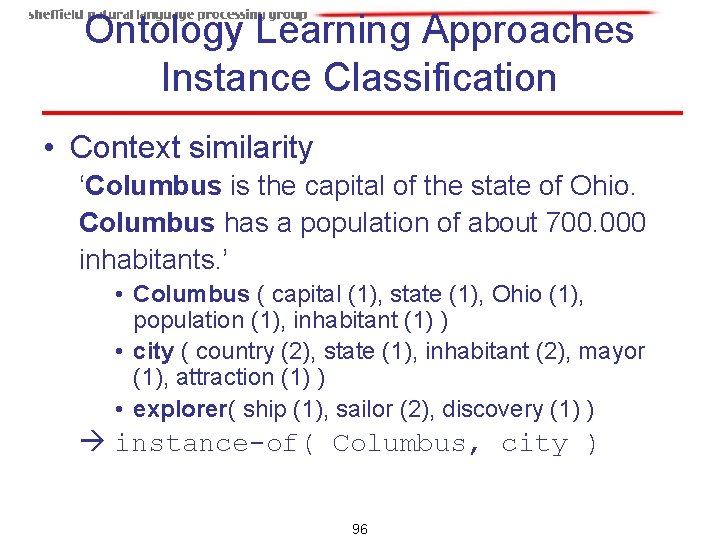
Ontology Learning Approaches Instance Classification • Context similarity ‘Columbus is the capital of the state of Ohio. Columbus has a population of about 700. 000 inhabitants. ’ • Columbus ( capital (1), state (1), Ohio (1), population (1), inhabitant (1) ) • city ( country (2), state (1), inhabitant (2), mayor (1), attraction (1) ) • explorer( ship (1), sailor (2), discovery (1) ) instance-of( Columbus, city ) 96
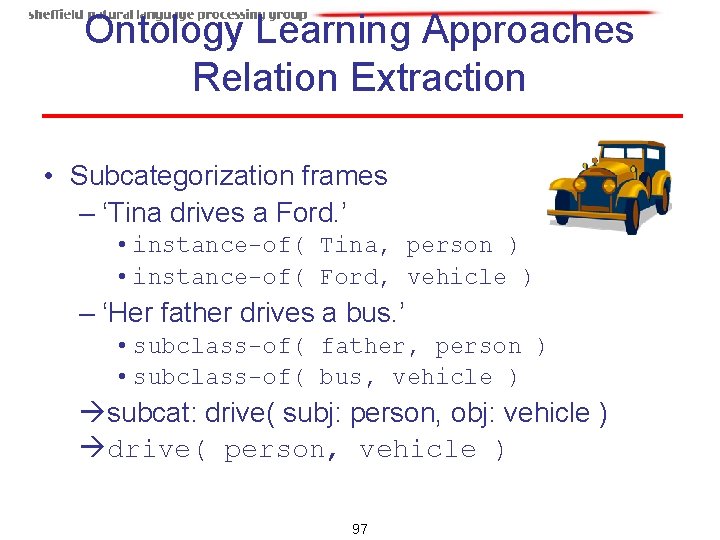
Ontology Learning Approaches Relation Extraction • Subcategorization frames – ‘Tina drives a Ford. ’ • instance-of( Tina, person ) • instance-of( Ford, vehicle ) – ‘Her father drives a bus. ’ • subclass-of( father, person ) • subclass-of( bus, vehicle ) subcat: drive( subj: person, obj: vehicle ) drive( person, vehicle ) 97
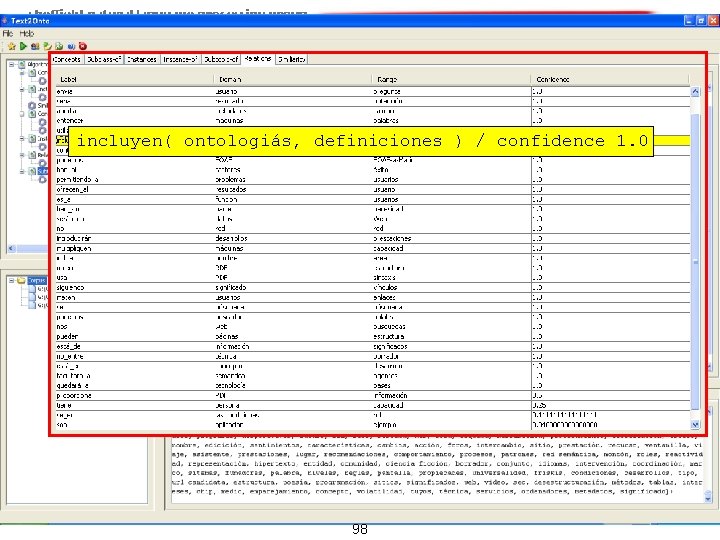
incluyen( ontologiás, definiciones ) / confidence 1. 0 98
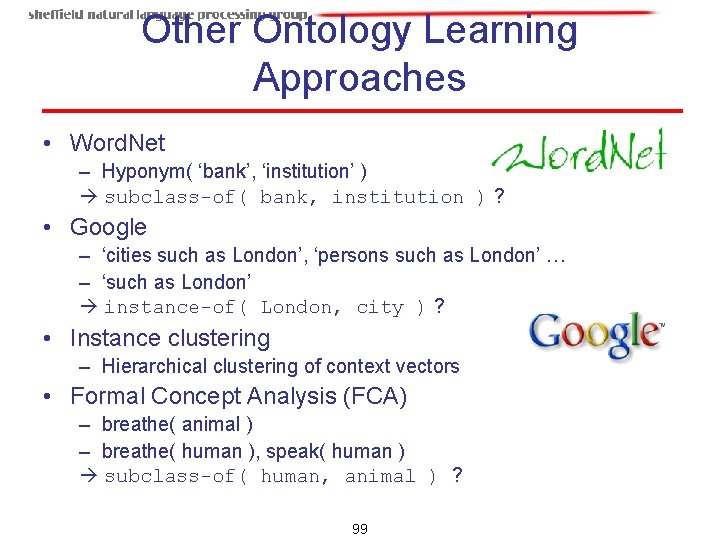
Other Ontology Learning Approaches • Word. Net – Hyponym( ‘bank’, ‘institution’ ) subclass-of( bank, institution ) ? • Google – ‘cities such as London’, ‘persons such as London’ … – ‘such as London’ instance-of( London, city ) ? • Instance clustering – Hierarchical clustering of context vectors • Formal Concept Analysis (FCA) – breathe( animal ) – breathe( human ), speak( human ) subclass-of( human, animal ) ? 99
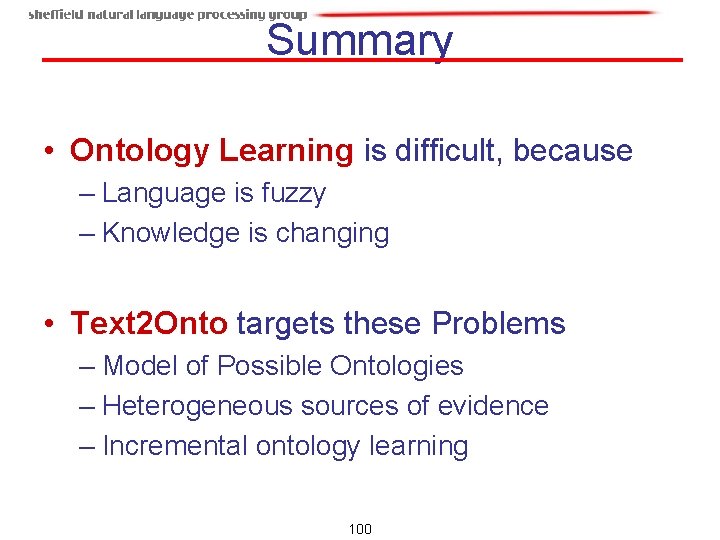
Summary • Ontology Learning is difficult, because – Language is fuzzy – Knowledge is changing • Text 2 Onto targets these Problems – Model of Possible Ontologies – Heterogeneous sources of evidence – Incremental ontology learning 100
Thanks! http: //www. aifb. de/WBS/jvo/ontology-learning http: //www. ontoware. org/projects/text 2 onto
Structure of the Tutorial 1. 2. 3. 4. 5. 6. 7. 8. Motivation, background GATE overview Information Extraction GATE’s HLT components IE and the Semantic Web Ontology learning with Text 2 Onto Focused ontology learning Massive Semantic Annotation 102
Focused Ontology Learning with GATE A Practical Report on Learning Web Service Ontologies Marta Sabou
Goal of the Talk The goal of this talk is: • To describe a Semantic Web relevant task: Focused Ontology Learning. • To exemplify this task in the context of Web Services. • To show focused ontology learning can be implemented in GATE. The focus of the talk is NOT ontology learning but the elements of GATE that helped to perform this task.
Outline 1) Generic Problem: * Focused Ontology Learning (definition and characteristics) 2) Specific Problem: * Learning Web Service Ontologies (Context, Problem Scenario) 3) GATE support for: * writing extraction patterns * evaluating term extraction performance
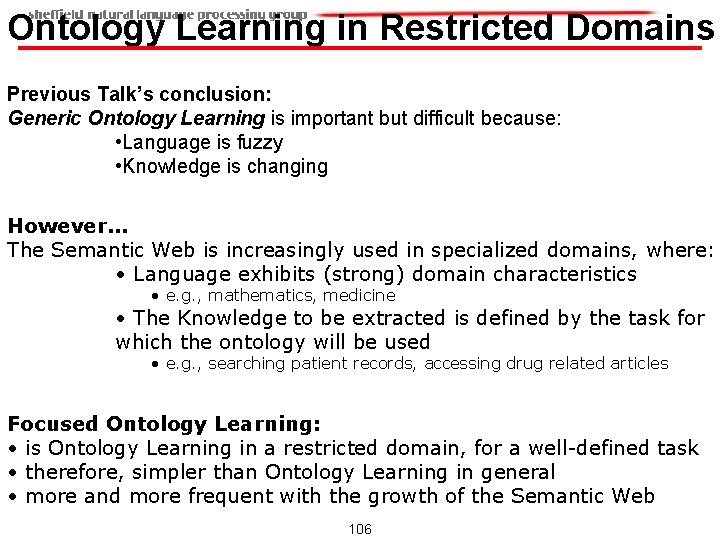
Ontology Learning in Restricted Domains Previous Talk’s conclusion: Generic Ontology Learning is important but difficult because: • Language is fuzzy • Knowledge is changing However. . . The Semantic Web is increasingly used in specialized domains, where: • Language exhibits (strong) domain characteristics • e. g. , mathematics, medicine • The Knowledge to be extracted is defined by the task for which the ontology will be used • e. g. , searching patient records, accessing drug related articles Focused Ontology Learning: • is Ontology Learning in a restricted domain, for a well-defined task • therefore, simpler than Ontology Learning in general • more and more frequent with the growth of the Semantic Web 106
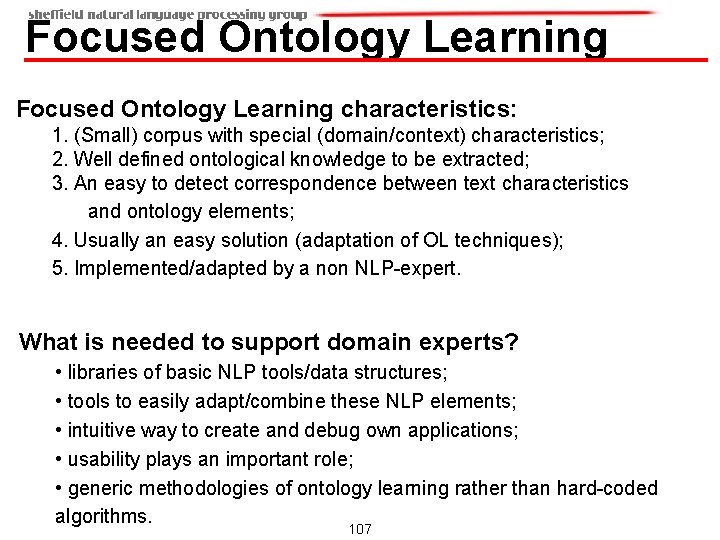
Focused Ontology Learning characteristics: 1. (Small) corpus with special (domain/context) characteristics; 2. Well defined ontological knowledge to be extracted; 3. An easy to detect correspondence between text characteristics and ontology elements; 4. Usually an easy solution (adaptation of OL techniques); 5. Implemented/adapted by a non NLP-expert. What is needed to support domain experts? • libraries of basic NLP tools/data structures; • tools to easily adapt/combine these NLP elements; • intuitive way to create and debug own applications; • usability plays an important role; • generic methodologies of ontology learning rather than hard-coded algorithms. 107
Outline 1) Generic Problem: * Focused Ontology Learning (definition and characteristics) 2) Specific Problem: * Learning Web Service Ontologies (Context, Problem Scenario) 3) GATE support for: * writing extraction patterns (given) * evaluating term extraction performance (given)
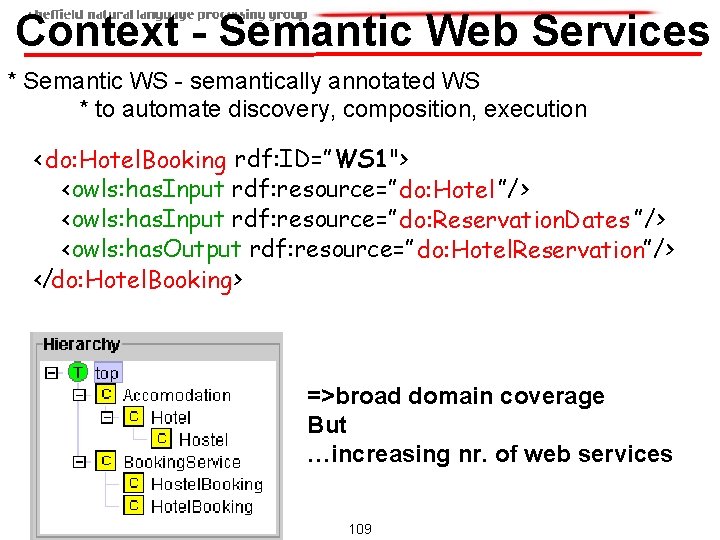
Context - Semantic Web Services * Semantic WS - semantically annotated WS * to automate discovery, composition, execution < do: Hotel. Booking rdf: ID=”WS 1"> <owls: has. Input rdf: resource=” do: Hotel ”/> <owls: has. Input rdf: resource=” do: Reservation. Dates ”/> <owls: has. Output rdf: resource=” do: Hotel. Reservation”/> </do: Hotel. Booking > =>broad domain coverage But …increasing nr. of web services 109
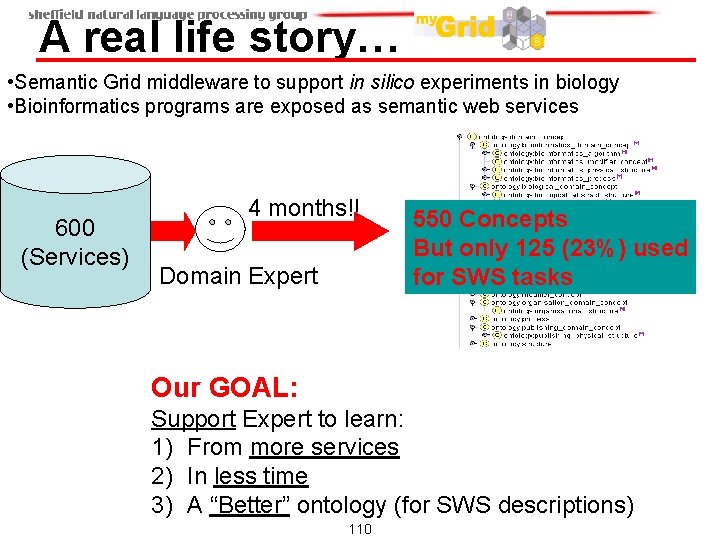
A real life story… • Semantic Grid middleware to support in silico experiments in biology • Bioinformatics programs are exposed as semantic web services 600 150 (Services) 4 months!! Domain Expert 550 Concepts But only 125 (23%) used for SWS tasks Our GOAL: Support Expert to learn: 1) From more services 2) In less time 3) A “Better” ontology (for SWS descriptions) 110
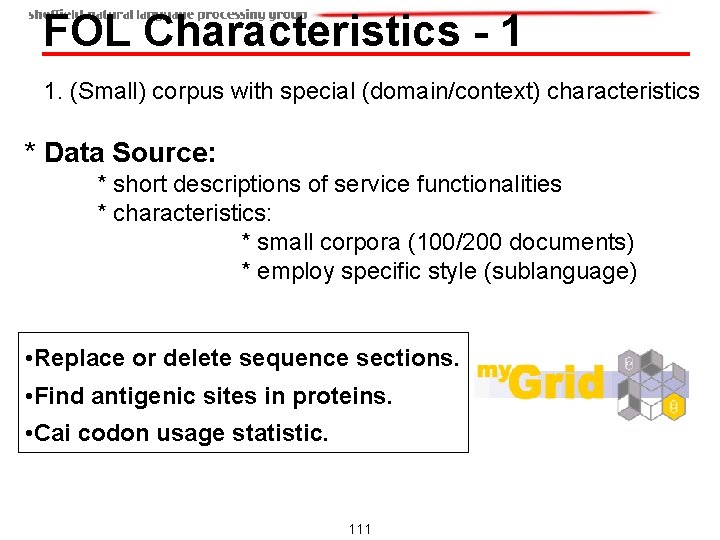
FOL Characteristics - 1 1. (Small) corpus with special (domain/context) characteristics * Data Source: * short descriptions of service functionalities * characteristics: * small corpora (100/200 documents) * employ specific style (sublanguage) • Replace or delete sequence sections. • Find antigenic sites in proteins. • Cai codon usage statistic. 111
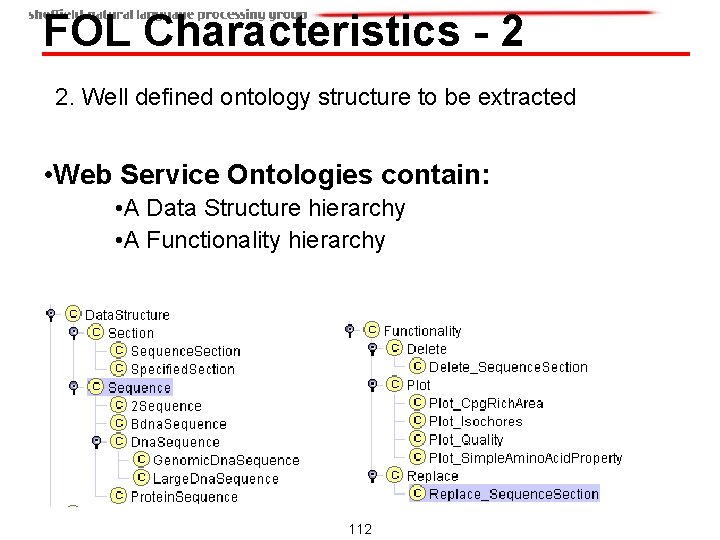
FOL Characteristics - 2 2. Well defined ontology structure to be extracted • Web Service Ontologies contain: • A Data Structure hierarchy • A Functionality hierarchy 112
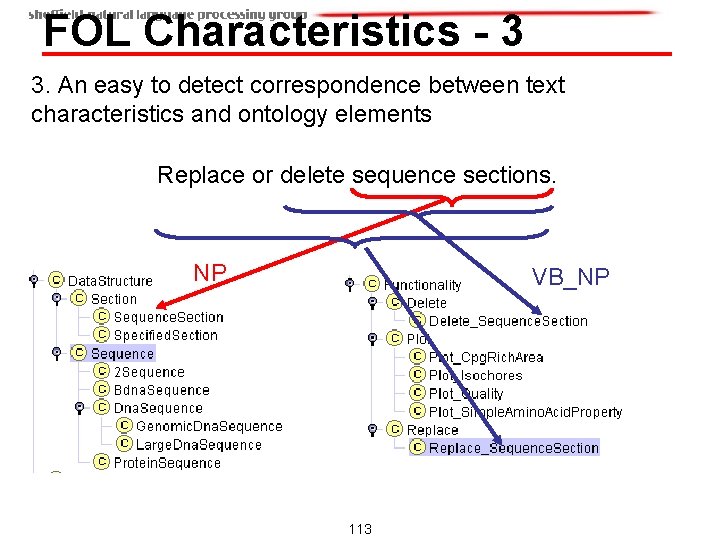
FOL Characteristics - 3 3. An easy to detect correspondence between text characteristics and ontology elements Replace or delete sequence sections. NP VB_NP 113
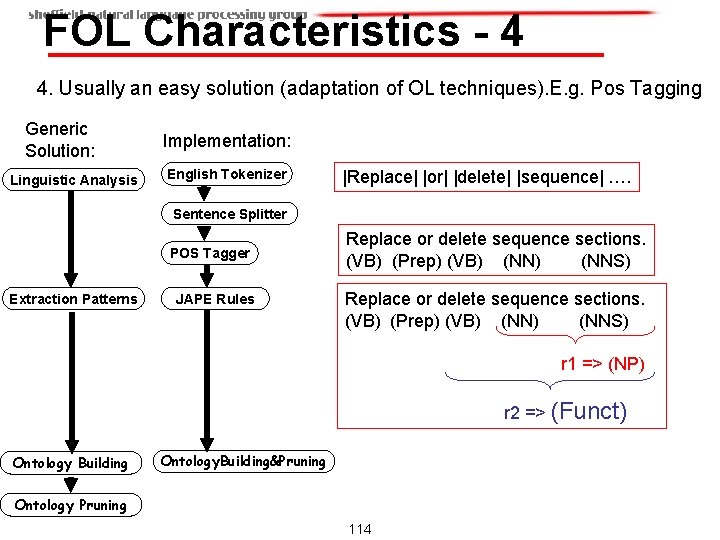
FOL Characteristics - 4 4. Usually an easy solution (adaptation of OL techniques). E. g. Pos Tagging Generic Solution: Linguistic Analysis Implementation: English Tokenizer |Replace| |or| |delete| |sequence| …. Sentence Splitter POS Tagger Extraction Patterns JAPE Rules Replace or delete sequence sections. (VB) (Prep) (VB) (NN) (NNS) r 1 => (NP) r 2 => (Funct) Ontology Building Ontology. Building&Pruning Ontology Pruning 114
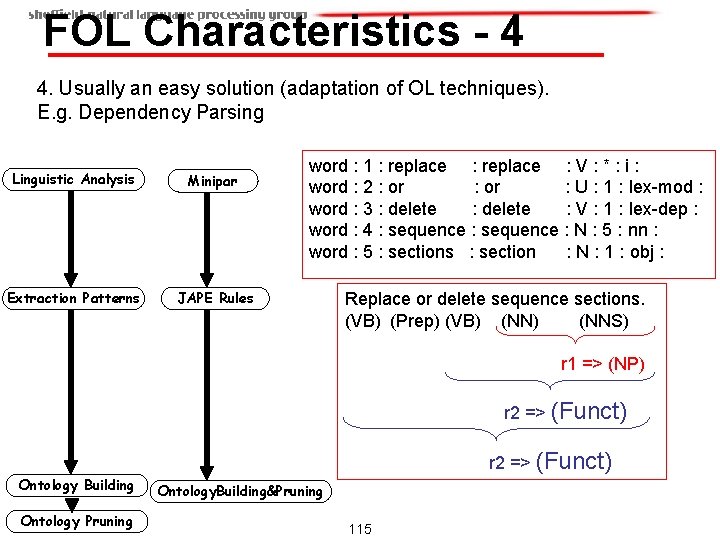
FOL Characteristics - 4 4. Usually an easy solution (adaptation of OL techniques). E. g. Dependency Parsing Linguistic Analysis Minipar Extraction Patterns JAPE Rules word : 1 : replace : V : * : i : word : 2 : or : U : 1 : lex-mod : word : 3 : delete : V : 1 : lex-dep : word : 4 : sequence : N : 5 : nn : word : 5 : sections : section : N : 1 : obj : Replace or delete sequence sections. (VB) (Prep) (VB) (NNS) r 1 => (NP) r 2 => (Funct) Ontology Building Ontology Pruning Ontology. Building&Pruning 115
Outline 1) Generic Problem: * Focused Ontology Learning (definition and characteristics) 2) Specific Problem: * Learning Web Service Ontologies (Context, Problem Scenario) 3) GATE support for: * writing extraction patterns * evaluating term extraction performance
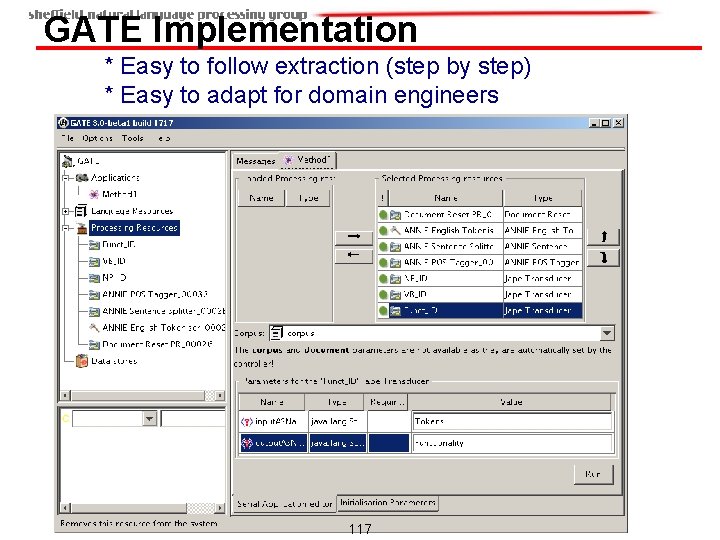
GATE Implementation * Easy to follow extraction (step by step) * Easy to adapt for domain engineers 117
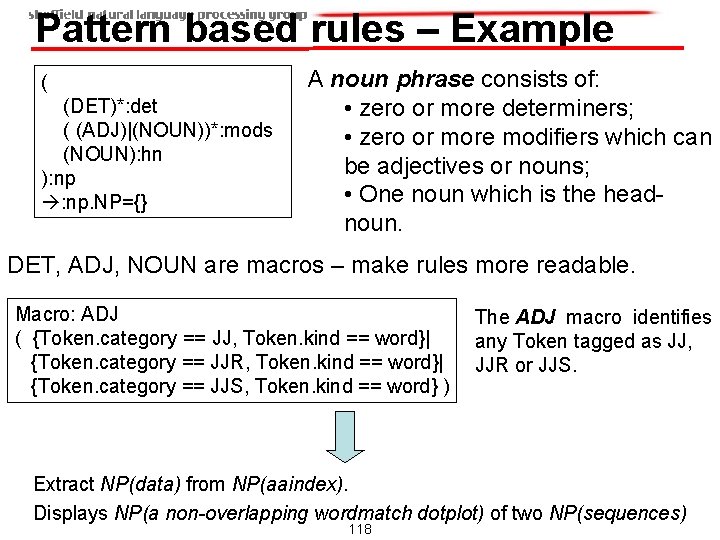
Pattern based rules – Example ( (DET)*: det ( (ADJ)|(NOUN))*: mods (NOUN): hn ): np. NP={} A noun phrase consists of: • zero or more determiners; • zero or more modifiers which can be adjectives or nouns; • One noun which is the headnoun. DET, ADJ, NOUN are macros – make rules more readable. Macro: ADJ ( {Token. category == JJ, Token. kind == word}| {Token. category == JJR, Token. kind == word}| {Token. category == JJS, Token. kind == word} ) The ADJ macro identifies any Token tagged as JJ, JJR or JJS. Extract NP(data) from NP(aaindex). Displays NP(a non-overlapping wordmatch dotplot) of two NP(sequences) 118
Outline 1) Generic Problem: * Focused Ontology Learning (definition and characteristics) 2) Specific Problem: * Learning Web Service Ontologies (Context, Problem Scenario) 3) GATE support for: * writing extraction patterns (given) * evaluating term extraction performance (given)
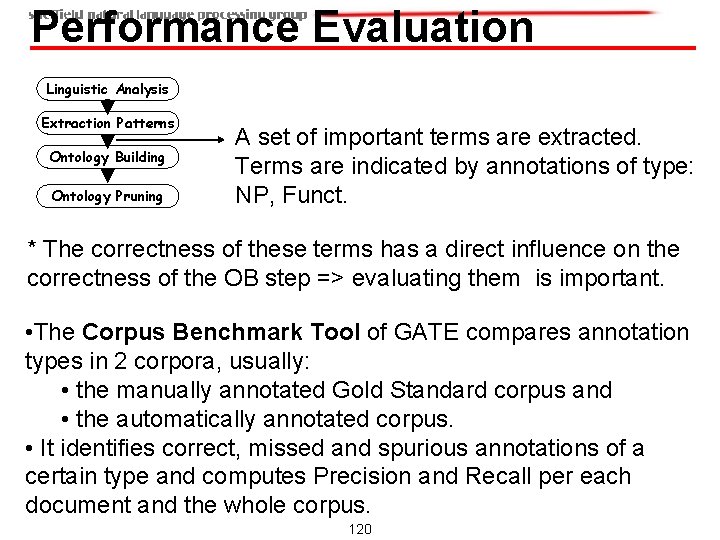
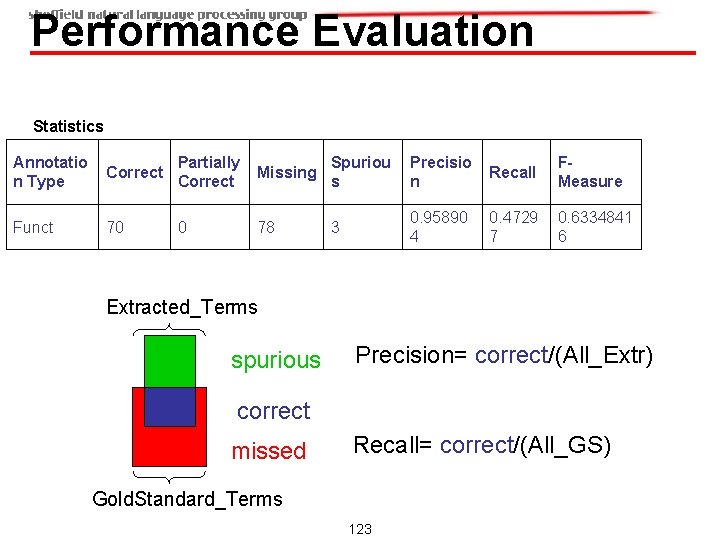
Performance Evaluation Linguistic Analysis Extraction Patterns Ontology Building Ontology Pruning A set of important terms are extracted. Terms are indicated by annotations of type: NP, Funct. * The correctness of these terms has a direct influence on the correctness of the OB step => evaluating them is important. • The Corpus Benchmark Tool of GATE compares annotation types in 2 corpora, usually: • the manually annotated Gold Standard corpus and • the automatically annotated corpus. • It identifies correct, missed and spurious annotations of a certain type and computes Precision and Recall per each document and the whole corpus. 120
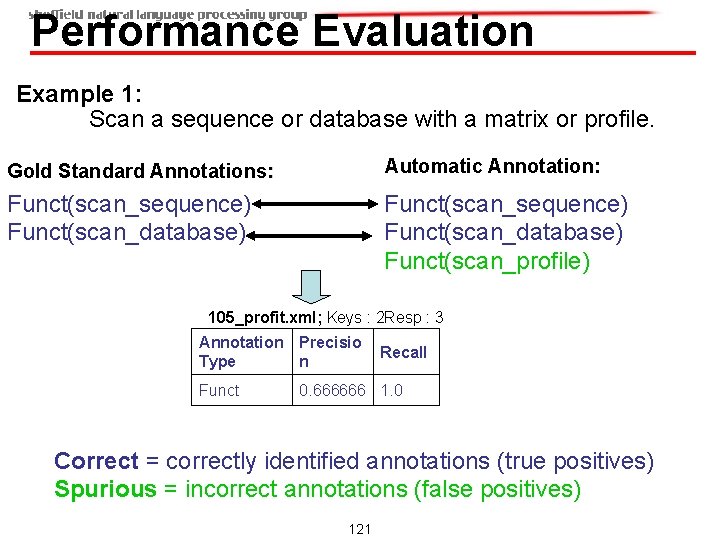
Performance Evaluation Example 1: Scan a sequence or database with a matrix or profile. Gold Standard Annotations: Automatic Annotation: Funct(scan_sequence) Funct(scan_database) Funct(scan_profile) 105_profit. xml; Keys : 2 Resp : 3 Annotation Type Precisio n Funct 0. 666666 1. 0 Recall Correct = correctly identified annotations (true positives) Spurious = incorrect annotations (false positives) 121
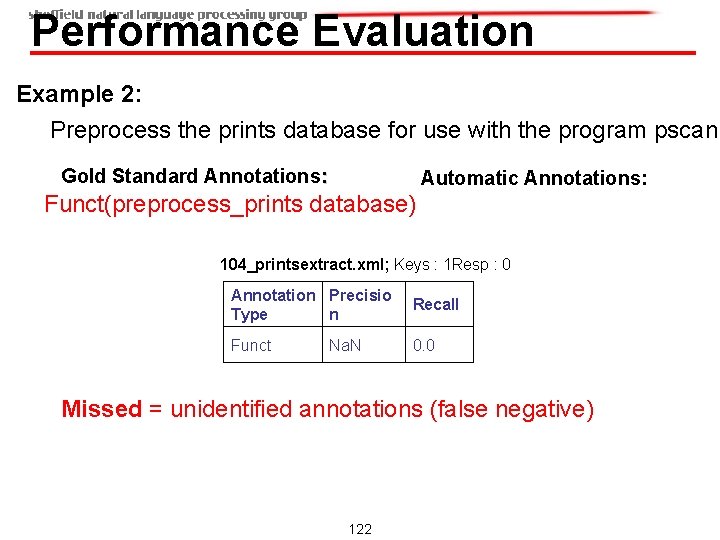
Performance Evaluation Example 2: Preprocess the prints database for use with the program pscan. Gold Standard Annotations: Automatic Annotations: Funct(preprocess_prints database) 104_printsextract. xml; Keys : 1 Resp : 0 Annotation Precisio Type n Recall Funct 0. 0 Na. N Missed = unidentified annotations (false negative) 122
Performance Evaluation Statistics Annotatio n Type Correct Partially Correct Missing Spuriou s Precisio n Recall FMeasure Funct 70 0 78 3 0. 95890 4 0. 4729 7 0. 6334841 6 Extracted_Terms spurious Precision= correct/(All_Extr) correct missed Recall= correct/(All_GS) Gold. Standard_Terms 123
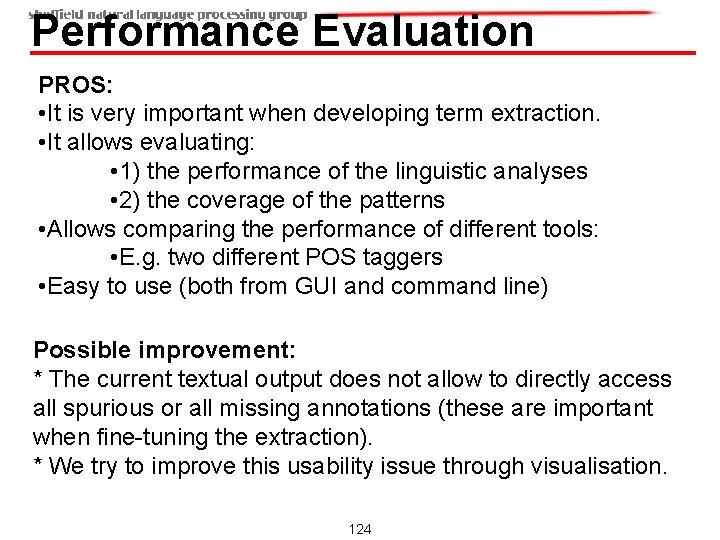
Performance Evaluation PROS: • It is very important when developing term extraction. • It allows evaluating: • 1) the performance of the linguistic analyses • 2) the coverage of the patterns • Allows comparing the performance of different tools: • E. g. two different POS taggers • Easy to use (both from GUI and command line) Possible improvement: * The current textual output does not allow to directly access all spurious or all missing annotations (these are important when fine-tuning the extraction). * We try to improve this usability issue through visualisation. 124
Summary • Focused Ontology Learning = OL in a restricted domain. • Example FOL = OL for Web Services. • GATE supports the development of FOL in many ways: • allows easy reuse and combination of basic NLP modules; • offers software libraries for fundamental NLP data structures (Documents, Corpora, Annotations); • incorporates evaluation mechanisms; • easy to debug and use for non-NLP experts. 125
Structure of the Tutorial 1. 2. 3. 4. 5. 6. 7. 8. Motivation, background GATE overview Information Extraction GATE’s HLT components IE and the Semantic Web Ontology learning with Text 2 Onto Focused ontology learning Massive Semantic Annotation 126
KIM Platform An Overview Atanas Kiryakov Ontotext Lab, Sirma AI naso@sirma. bg http: //www. ontotext. com/kim/ 127
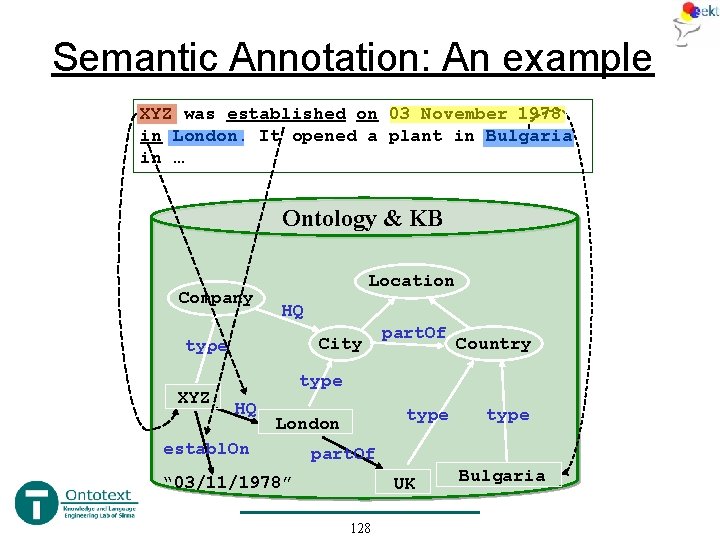
Semantic Annotation: An example XYZ was established on 03 November 1978 in London. It opened a plant in Bulgaria in … Ontology & KB Company Location HQ City type XYZ part. Of Country type HQ type London establ. On type part. Of “ 03/11/1978” UK 128 Bulgaria
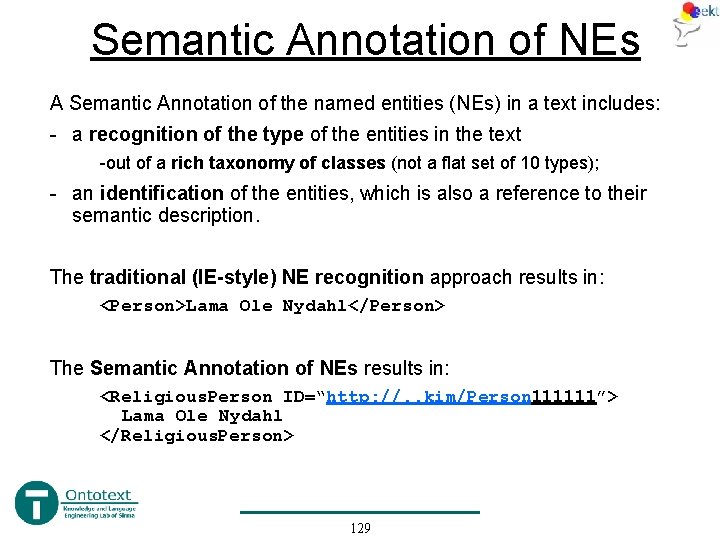
Semantic Annotation of NEs A Semantic Annotation of the named entities (NEs) in a text includes: - a recognition of the type of the entities in the text -out of a rich taxonomy of classes (not a flat set of 10 types); - an identification of the entities, which is also a reference to their semantic description. The traditional (IE-style) NE recognition approach results in: <Person>Lama Ole Nydahl</Person> The Semantic Annotation of NEs results in: <Religious. Person ID=“http: //. . kim/Person 111111”> Lama Ole Nydahl </Religious. Person> 129
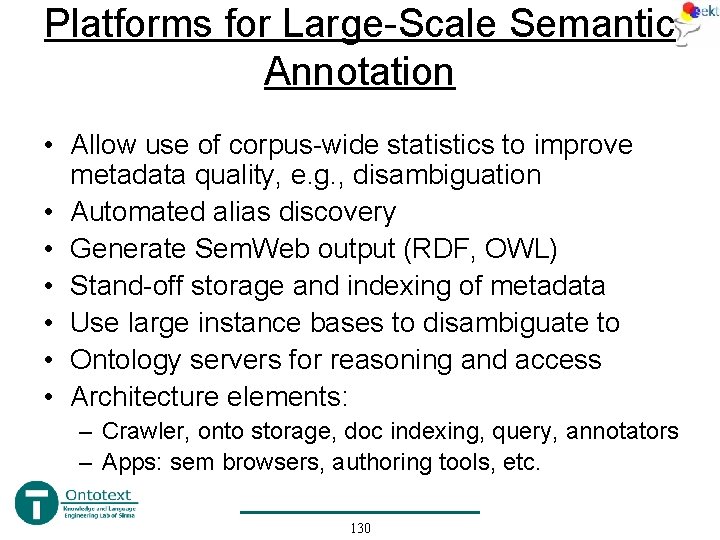
Platforms for Large-Scale Semantic Annotation • Allow use of corpus-wide statistics to improve metadata quality, e. g. , disambiguation • Automated alias discovery • Generate Sem. Web output (RDF, OWL) • Stand-off storage and indexing of metadata • Use large instance bases to disambiguate to • Ontology servers for reasoning and access • Architecture elements: – Crawler, onto storage, doc indexing, query, annotators – Apps: sem browsers, authoring tools, etc. 130
The KIM Platform • A platform offering services and infrastructure for: – (semi-) automatic semantic annotation and – ontology population – semantic indexing and retrieval of content – query and navigation over the formal knowledge • Based on an Information Extraction technology • Aim: to arm Semantic Web applications - by providing a metadata generation technology - in a standard, consistent, and scalable framework 131
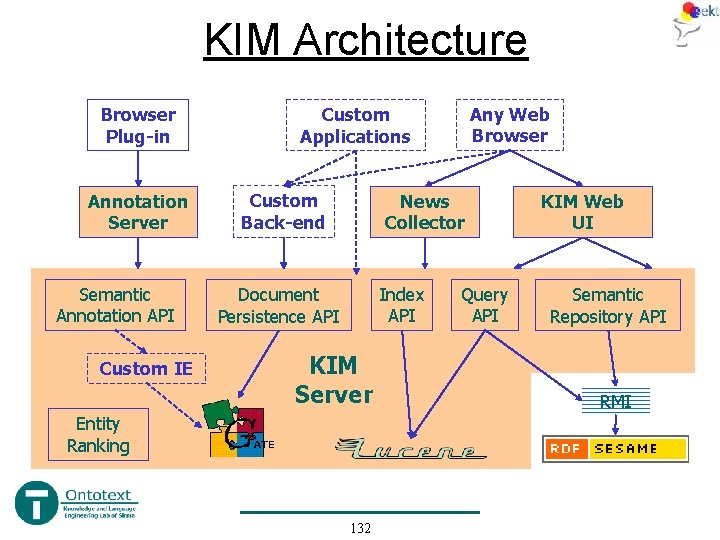
KIM Architecture Browser Plug-in Annotation Server Semantic Annotation API Custom IE Any Web Browser Custom Applications Custom Back-end News Collector Index API Document Persistence API KIM Server Entity Ranking 132 Query API KIM Web UI Semantic Repository API RMI
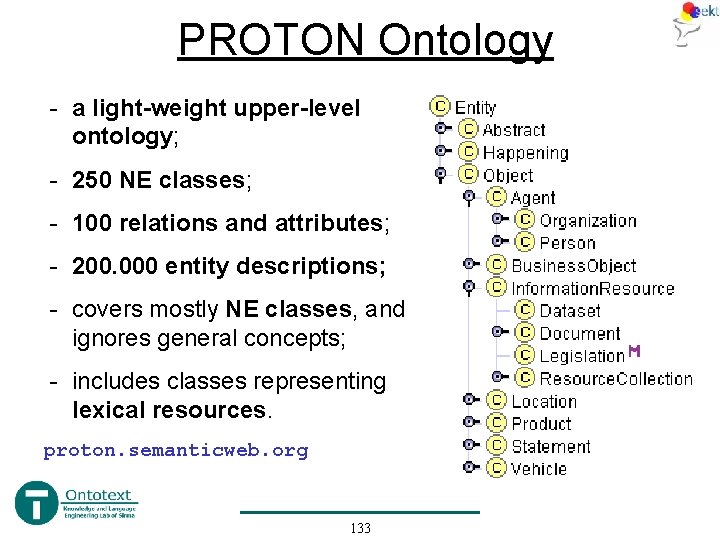
PROTON Ontology - a light-weight upper-level ontology; - 250 NE classes; - 100 relations and attributes; - 200. 000 entity descriptions; - covers mostly NE classes, and ignores general concepts; - includes classes representing lexical resources. proton. semanticweb. org 133
KIM Scaling on Data • The Semantic Repository is based on Sesame. • Our practical tests demonstrate a good performance on top of: – 1. 2 M entity descriptions: – about 15 M explicit statements; – above 30 M statements after forward chaining. • Document and annotation storage and indexing with Lucene: –. 5 M docs, processed on a $1000 -worth machine; – retrieval in milliseconds. 134
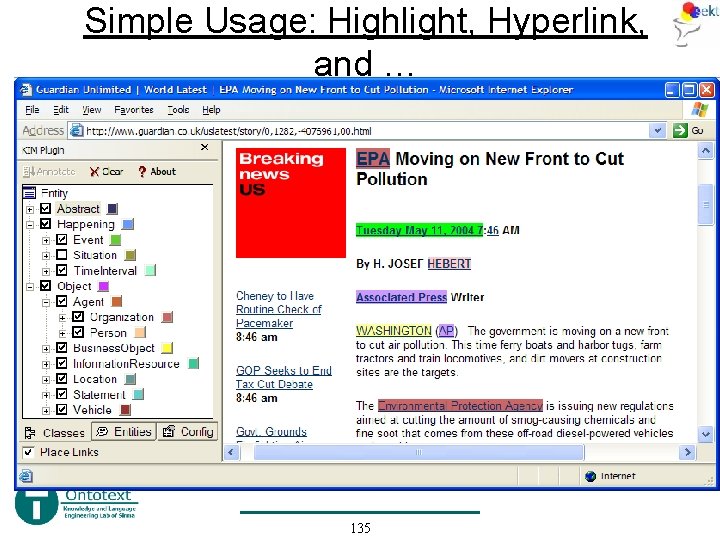
Simple Usage: Highlight, Hyperlink, and … 135
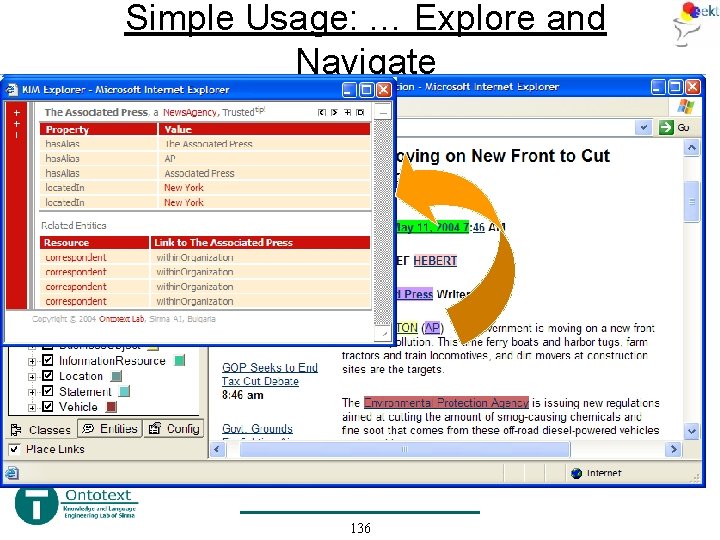
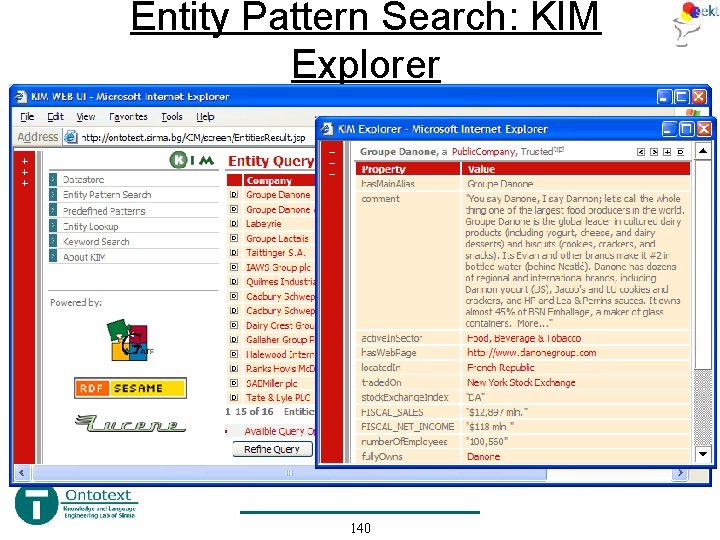
Simple Usage: … Explore and Navigate 136
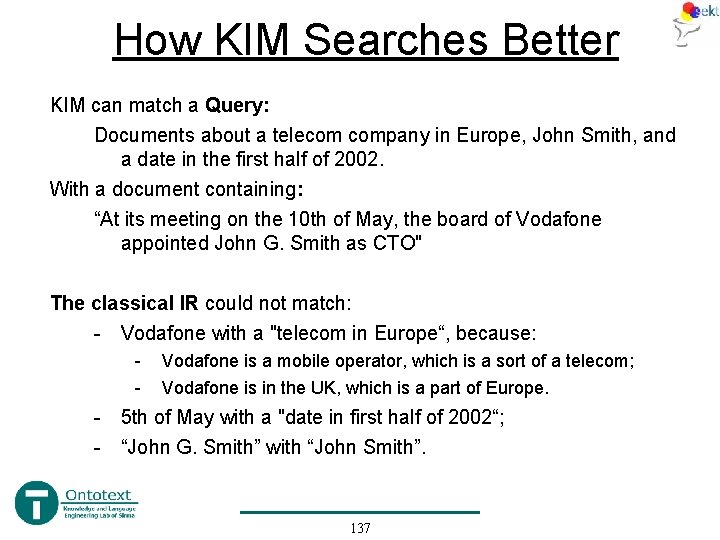
How KIM Searches Better KIM can match a Query: Documents about a telecom company in Europe, John Smith, and a date in the first half of 2002. With a document containing: “At its meeting on the 10 th of May, the board of Vodafone appointed John G. Smith as CTO" The classical IR could not match: - Vodafone with a "telecom in Europe“, because: - Vodafone is a mobile operator, which is a sort of a telecom; Vodafone is in the UK, which is a part of Europe. - 5 th of May with a "date in first half of 2002“; - “John G. Smith” with “John Smith”. 137
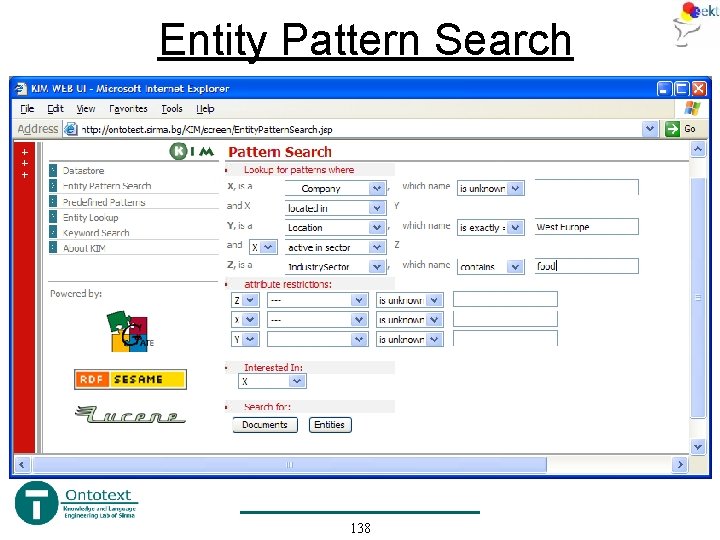
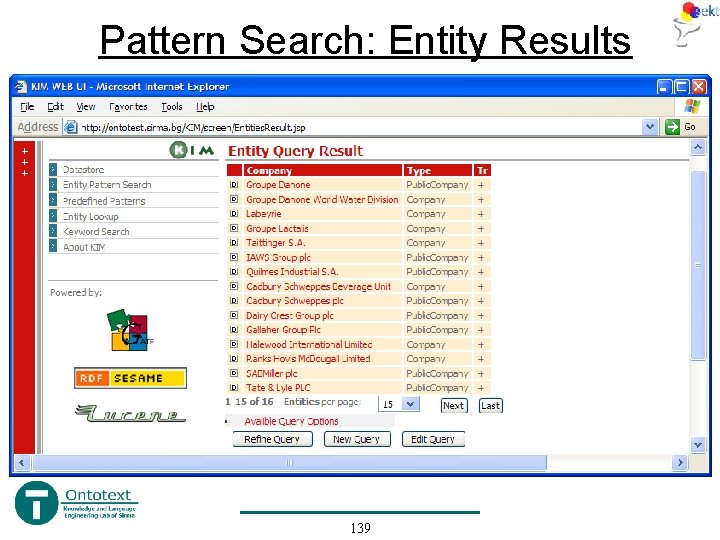
Entity Pattern Search 138
Pattern Search: Entity Results 139
Entity Pattern Search: KIM Explorer 140
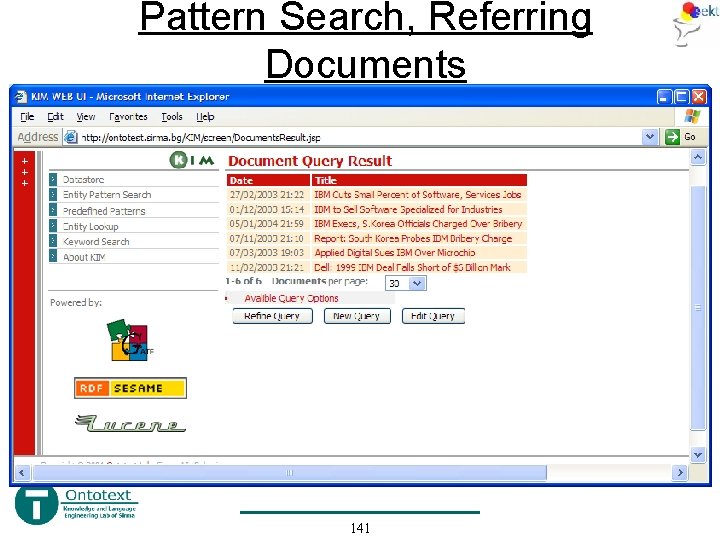
Pattern Search, Referring Documents 141
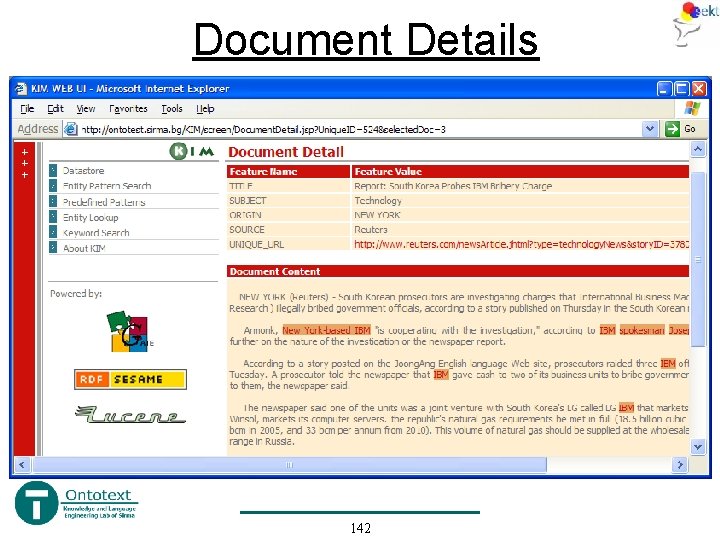
Document Details 142
Summary KIM is a platform for: - semantic annotation and ontology population, - semantic indexing and retrieval, - providing an API for remote access and integration, - based on Information Extraction (IE) using GATE. KIM is: - Robust - Scalable - General-purpose, off the shelf platform! 143
THANK YOU! (for not snoring) The slides: http: //www. gate. ac. uk/sale/talks/ekaw 2006 tutorial. ppt [This work has been supported by SEKT (http: //sekt. semanticweb. org/) and Knowledge. Web (http: //knowledgeweb. semanticweb. org/ )] 144