
Human Interactions in Complex Earth Systems Lessons from


- Slides: 21
Human Interactions in Complex Earth Systems Lessons from the Tragedy of the Sahel Doug Cullen, July 2010
� “It is difficult to get a man to understand something when his salary depends upon his not understanding it. ’ - Upton Sinclair "Ethics is knowing the difference between what you have a right to do and what is the right thing to do. "-Justice Potter Stewart, US Supreme Court
Human Interactions in Complex Earth Systems �We use a modeling program called Stella to introduce our students to systems components, systems notation and as an entry to complex Earth systems. �Students construct a “stock and flow” model in Stella from the article “Understanding the Tragedy of the Sahel”, Corey L. Lufdahl, 1992
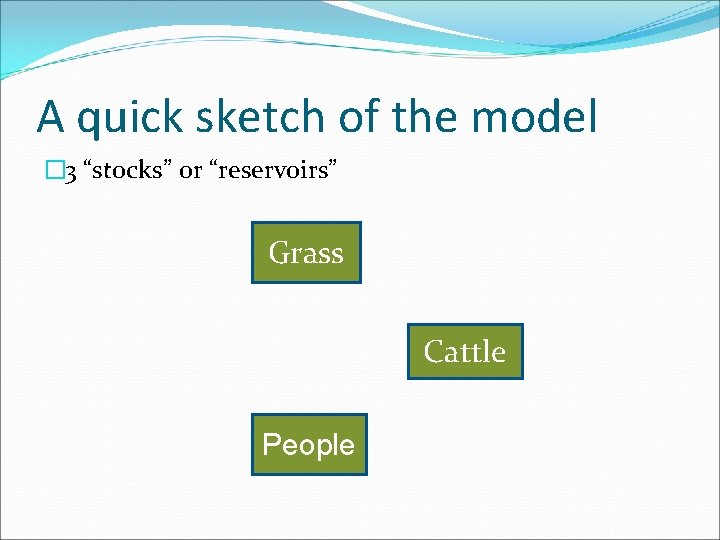
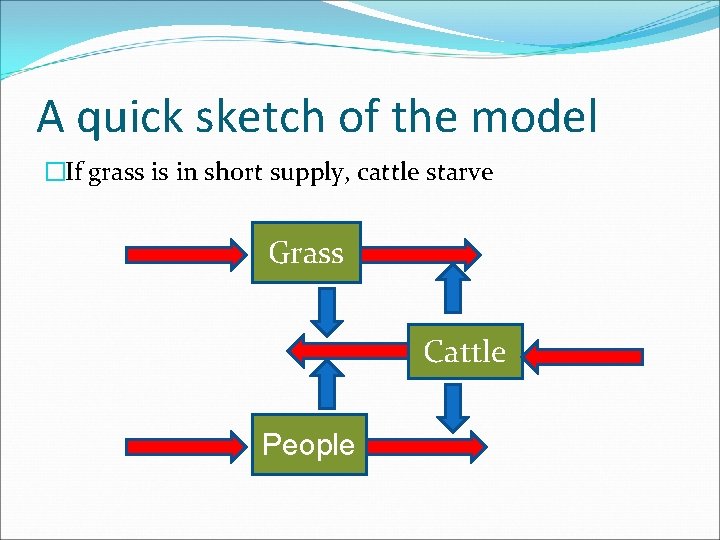
A quick sketch of the model � 3 “stocks” or “reservoirs” Grass Cattle People
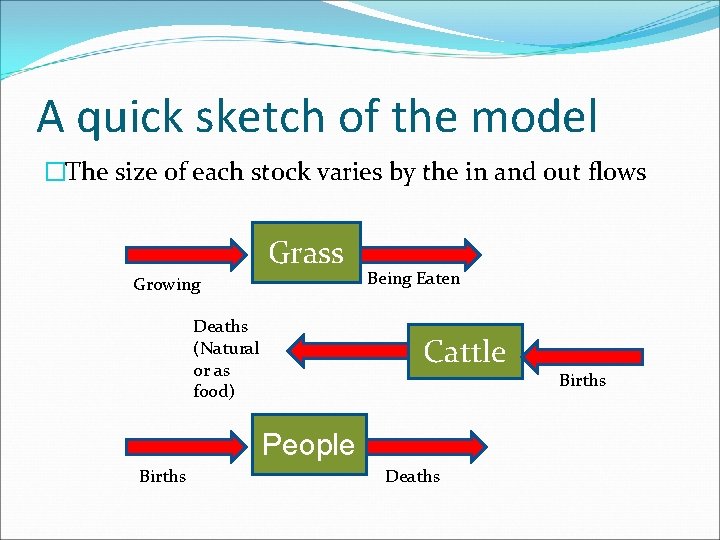
A quick sketch of the model �The size of each stock varies by the in and out flows Grass Growing Deaths (Natural or as food) Being Eaten Cattle People Births Deaths Births
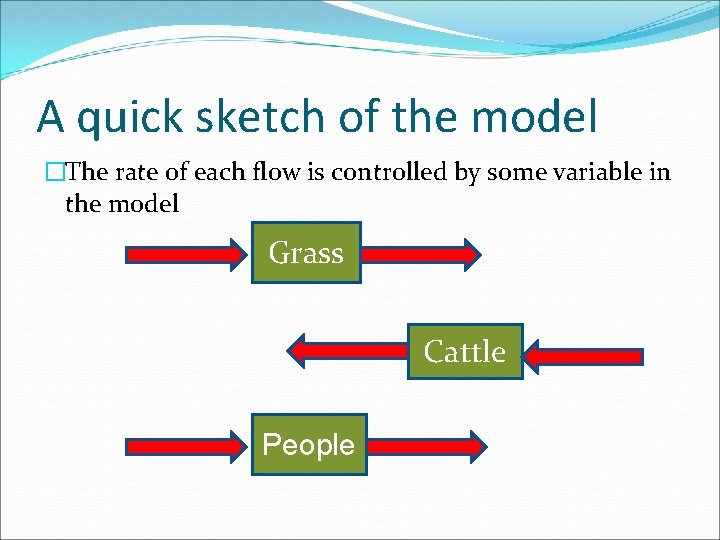
A quick sketch of the model �The rate of each flow is controlled by some variable in the model Grass Cattle People
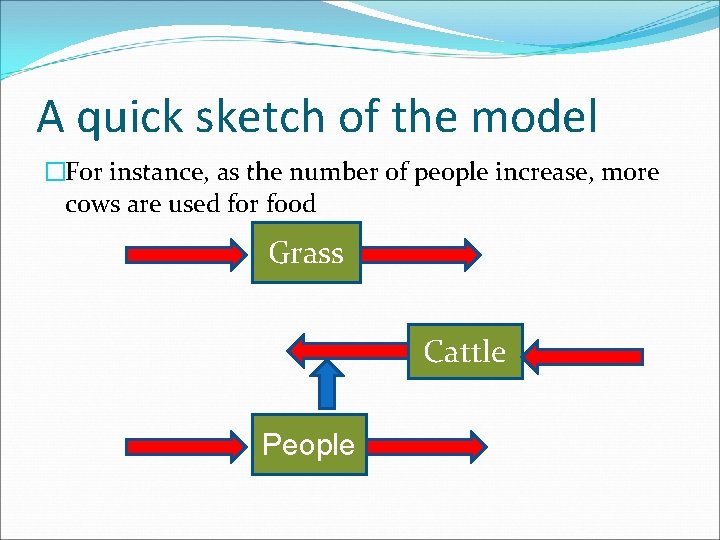
A quick sketch of the model �For instance, as the number of people increase, more cows are used for food Grass Cattle People
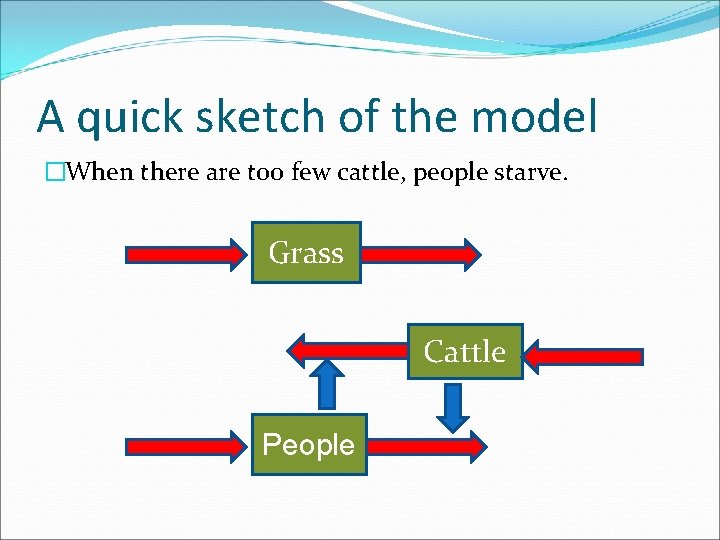
A quick sketch of the model �When there are too few cattle, people starve. Grass Cattle People
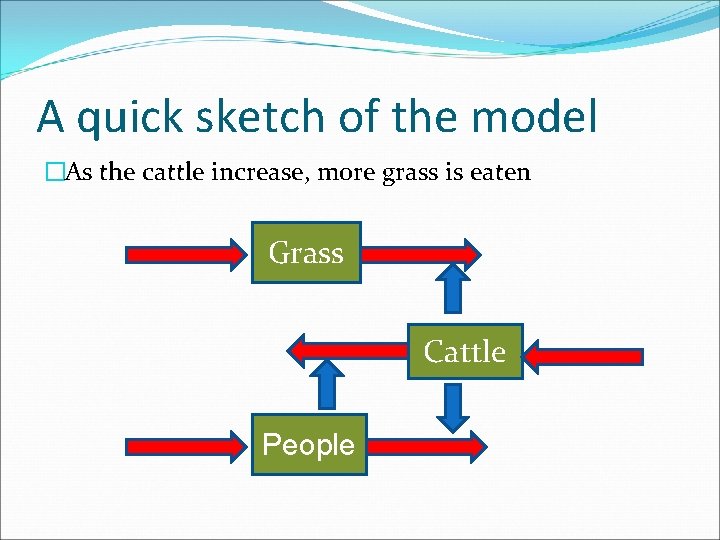
A quick sketch of the model �As the cattle increase, more grass is eaten Grass Cattle People
A quick sketch of the model �If grass is in short supply, cattle starve Grass Cattle People
A quick sketch of the model �From these relationships, students create model of the behavior of these 3 stocks over time. �The grassland is shared by numerous farmers �Each farmer begins with n number of cattle.
A quick sketch of the model �Farmers may choose to by more cattle, increasing their income from selling milk and beef. �More cattle places stress on the grasslands �Too many cattle will overgraze the grasslands and reduce milk production and eventually lead to starvation of the cattle.
A quick sketch of the model �A single farmer may be able to increase the size of his herd and profit be grazing on the common land. �But, more total cattle, will reduce the amount of milk produced by each cow. �If you add enough additional you can still get a net gain
A quick sketch of the model � BUT …
A quick sketch of the model �Every other farmer who keeps the same number of cattle now has less milk. �So now there is pressure to increase herd sizes �At some point, the grass will not be able to re-grow due to overgrazing
A quick sketch of the model �And all of the cattle die and everyone starves. �So the tragedy is that the action of 1 farmer to improve his lot leads to the loss of the entire community.
Lesson in the Classroom �After running several variations of the model, students almost always reach the same conclusion: All must share equally. �I find this to be a wonderful, altruistic and completely naïve view of the world. �The weakness of the model is that the students are participating as outside observers.
A new plan �After the students construct and run the “stock and flow” model, they will participate in the Hubnet activity “Tragedy of the Commons” �The Hubnet activity connects many computers together in an interative Netlogo simulation.
A new plan �Students will play the role of farmers, each starting with n cows and the ability to choose to buy more cows (or not) �Each student will be able to track their “wealth” in the form of milk production, cattle and money.
A new plan �I think that students may not be as ready to adopt the “share and share alike” plan in this context. �This creates an opportunity to talk about the difficulties in reach agreements between communities, states and nations about issues such as pollution and greenhouse gases.
Further refinement �I just discover that Netlogo include a “Systems Dynamics Modeler” that creates model in a similar fashion to Stella. �Since Netlogo is freely available, I’ve decided to rework the Stella model into Netlogo so that it can be more widely used.