
Human Information Processing Perception Memory Cognition Response Types
- Slides: 84
Human Information Processing Perception, Memory, Cognition, Response
Types of Information • • • Quantitative (e. g. , 100% charged, 63% charged) Qualitative (e. g. , fully charged, partially charged) Status (normal, abnormal) Warning (abnormal -- potentially dangerous) Representational (e. g. , pictures, diagrams) Identification (e. g. , labels) 2
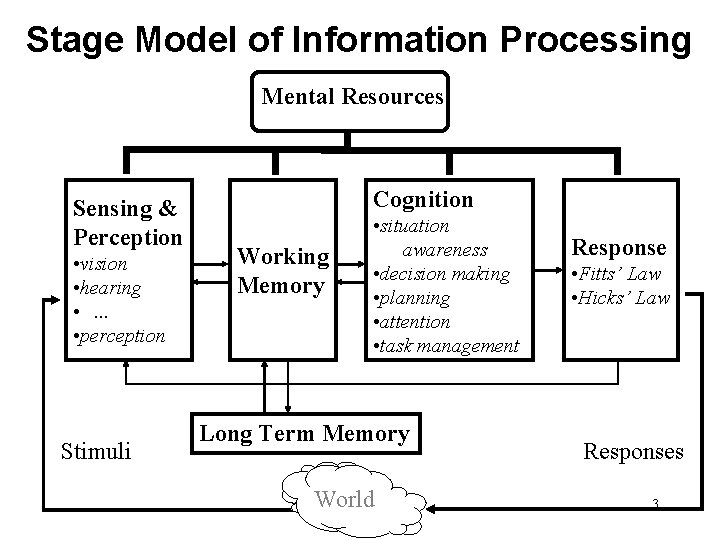
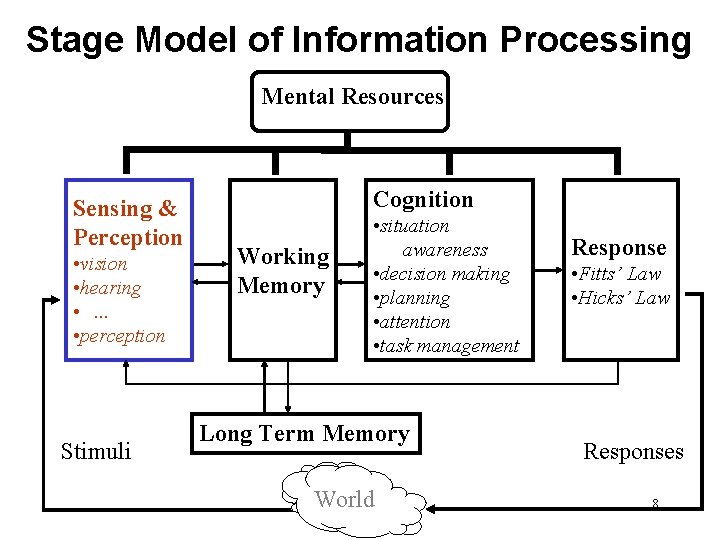
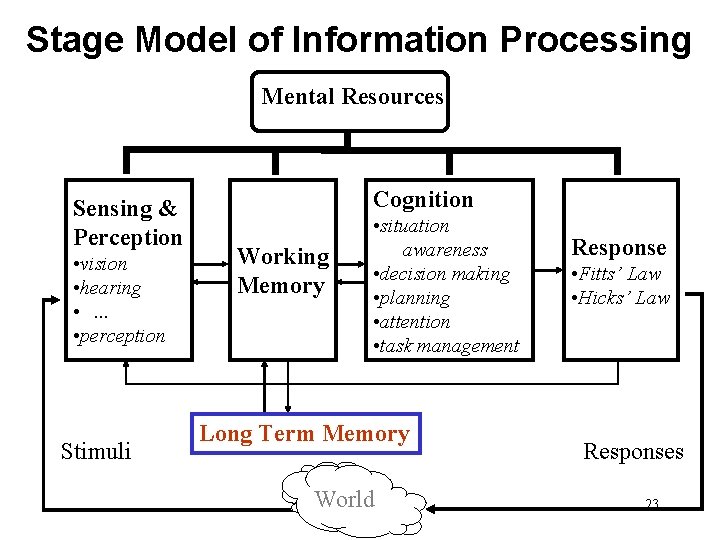
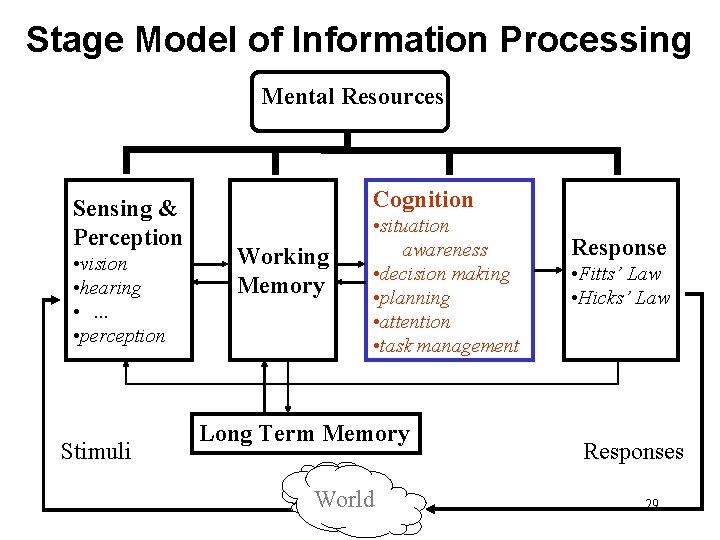
Stage Model of Information Processing Mental Resources Sensing & Perception • vision • hearing • . . . • perception Stimuli Cognition Working Memory • situation awareness • decision making • planning • attention • task management Long Term Memory World Response • Fitts’ Law • Hicks’ Law Responses 3
Stimuli • Sensible energy • Examples • • • visual auditory chemical tactile acceleration etc. 4
Information Coding • use of stimulus attributes to convey meaning 5
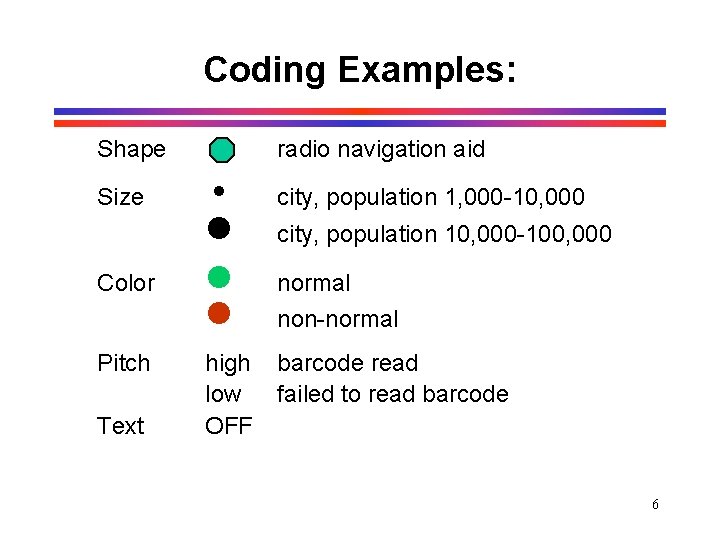
Coding Examples: Shape Size Color Pitch Text radio navigation aid i n city, population 1, 000 -10, 000 n n normal high low OFF barcode read failed to read barcode city, population 10, 000 -100, 000 non-normal 6
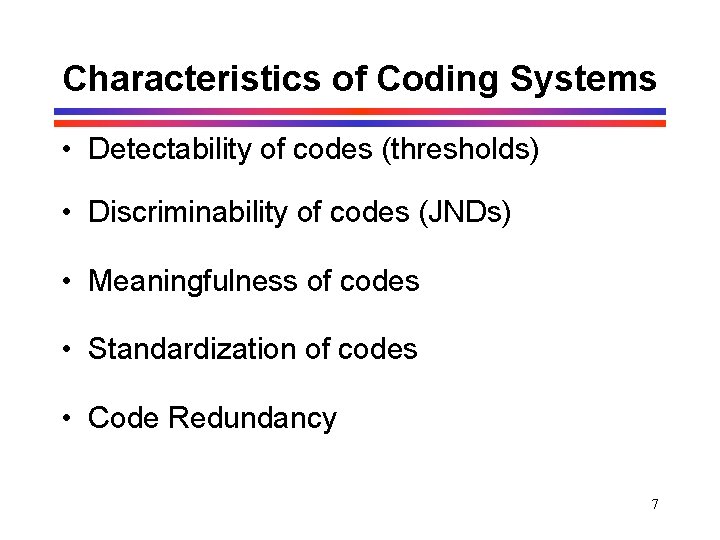
Characteristics of Coding Systems • Detectability of codes (thresholds) • Discriminability of codes (JNDs) • Meaningfulness of codes • Standardization of codes • Code Redundancy 7
Stage Model of Information Processing Mental Resources Sensing & Perception • vision • hearing • . . . • perception Stimuli Cognition Working Memory • situation awareness • decision making • planning • attention • task management Long Term Memory World Response • Fitts’ Law • Hicks’ Law Responses 8
Sensing • • • Vision Hearing Smell Touch Temperature Pain Kinesthetic Equilibrium Vibration 9
Sensing (continued) • Sensory Memory • Iconic (visual) • Echoic (auditory) • Limits • Detection thresholds • Discrimination thresholds • Pain 10
Perception • Definition • interpretation of sensory stimuli • pattern recognition • preparation for further processing • Processes • feature analysis (e. g. , text, object perception) • top-down processing (use of context, expectancy) • Examples • Recognizing face of friend • Detecting defect in piece of plywood 11
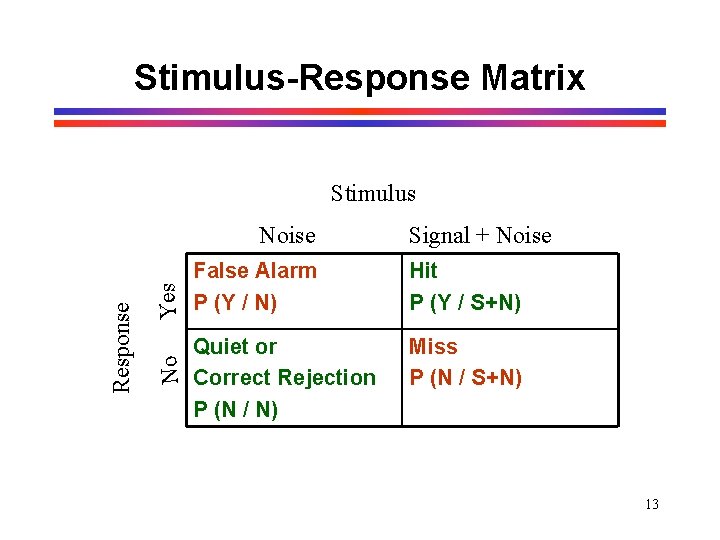
Perception - Signal Detection • • Stimulus: sensory input(s) Signal: stimulus having a special pattern Noise: Obscuring stimuli Task: Report “yes” when signal present, otherwise “no” • Example: steam power plant • task: detect boiler leak • stimulus: sound pressure level (SPL) • signal: higher than normal SPL 12
Stimulus-Response Matrix Stimulus Yes No Response Noise Signal + Noise False Alarm P (Y / N) Hit P (Y / S+N) Quiet or Correct Rejection P (N / N) Miss P (N / S+N) 13
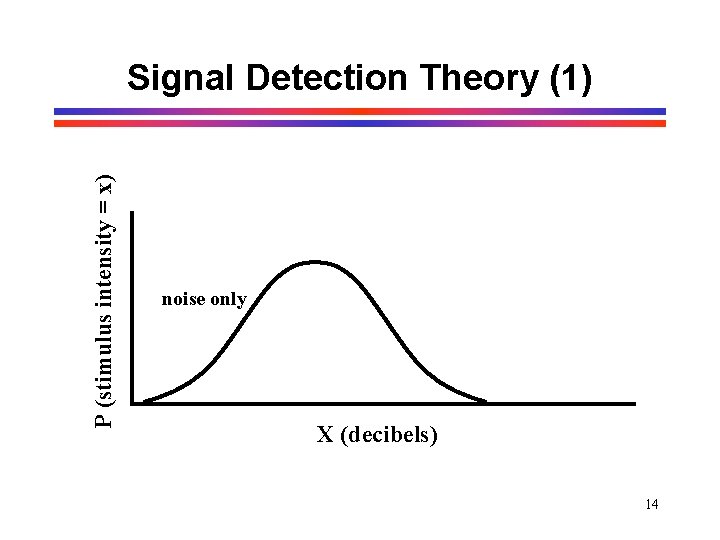
P (stimulus intensity = x) Signal Detection Theory (1) noise only X (decibels) 14
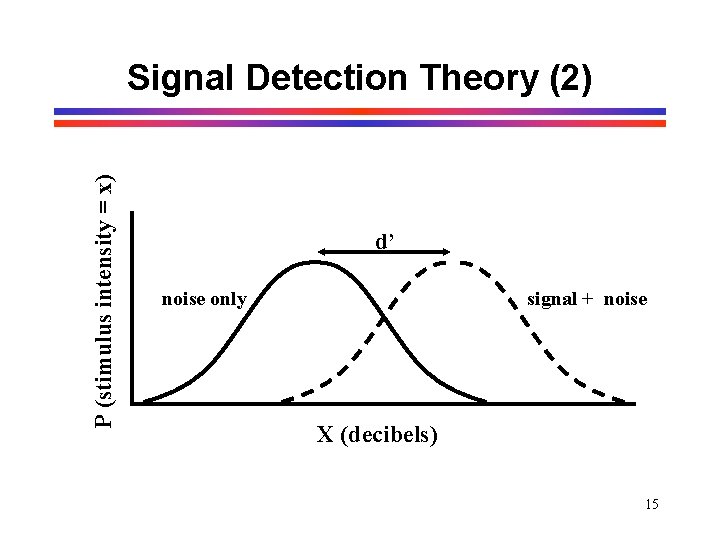
P (stimulus intensity = x) Signal Detection Theory (2) d’ noise only signal + noise X (decibels) 15
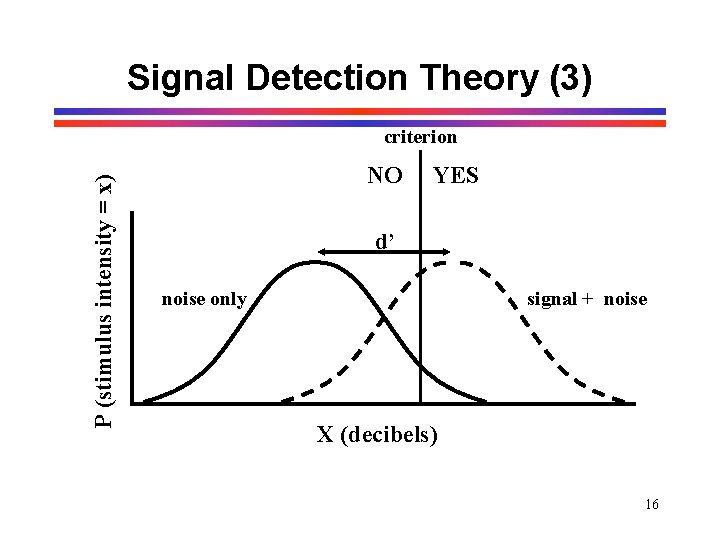
Signal Detection Theory (3) P (stimulus intensity = x) criterion NO YES d’ noise only signal + noise X (decibels) 16
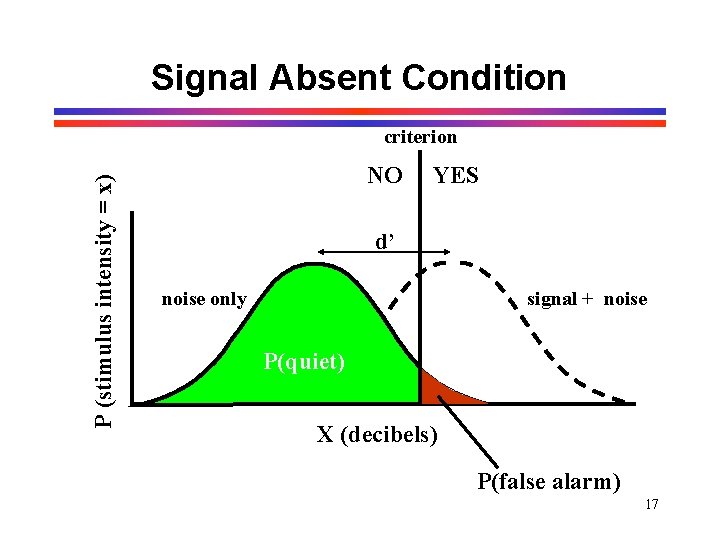
Signal Absent Condition P (stimulus intensity = x) criterion NO YES d’ noise only signal + noise P(quiet) X (decibels) P(false alarm) 17
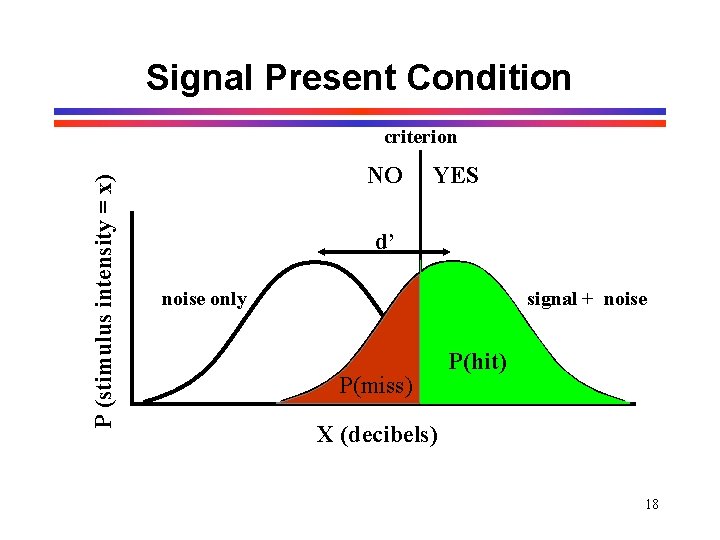
Signal Present Condition P (stimulus intensity = x) criterion NO YES d’ noise only signal + noise P(miss) P(hit) X (decibels) 18
Signal Detection: Low d’ • Phenomenon • low d’ leads to poor SD performance • Example • failure to detect defects in lumber • Explanation • lack of memory to memorize signal • Countermeasure • memory aid 19
Signal Detection: Vigilance Decrement • Phenomenon • prolonged monitoring (signal detection) • P(hit) decreases, P(miss) increases after about 30 min • Example • manufacturing process goes out of tolerance • Explanation • sensitivity loss/fatigue/memory loss • Countermeasures • • training signal transformations feedback extraneous stimuli 20
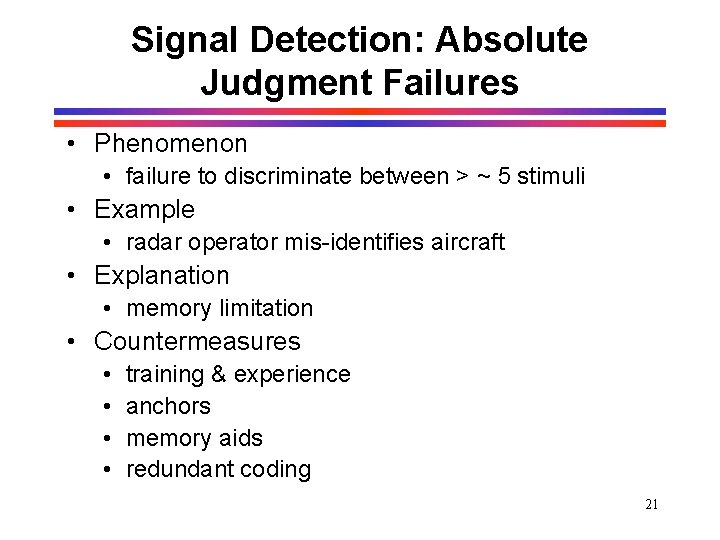
Signal Detection: Absolute Judgment Failures • Phenomenon • failure to discriminate between > ~ 5 stimuli • Example • radar operator mis-identifies aircraft • Explanation • memory limitation • Countermeasures • • training & experience anchors memory aids redundant coding 21
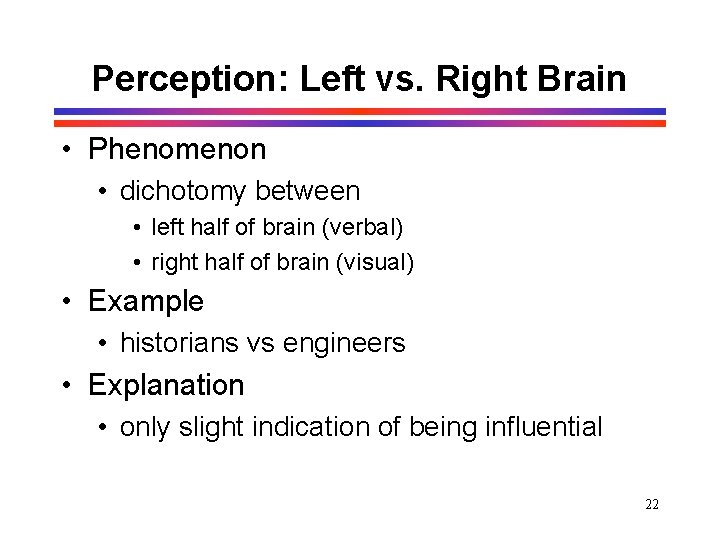
Perception: Left vs. Right Brain • Phenomenon • dichotomy between • left half of brain (verbal) • right half of brain (visual) • Example • historians vs engineers • Explanation • only slight indication of being influential 22
Stage Model of Information Processing Mental Resources Sensing & Perception • vision • hearing • . . . • perception Stimuli Cognition Working Memory • situation awareness • decision making • planning • attention • task management Long Term Memory World Response • Fitts’ Law • Hicks’ Law Responses 23
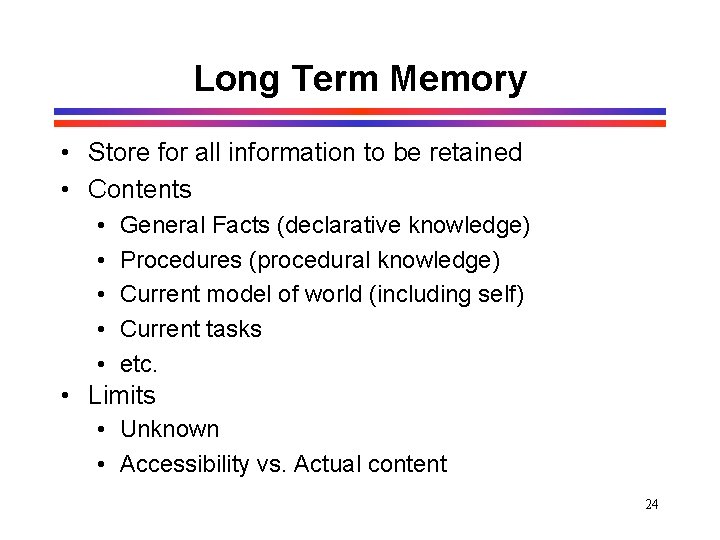
Long Term Memory • Store for all information to be retained • Contents • • • General Facts (declarative knowledge) Procedures (procedural knowledge) Current model of world (including self) Current tasks etc. • Limits • Unknown • Accessibility vs. Actual content 24
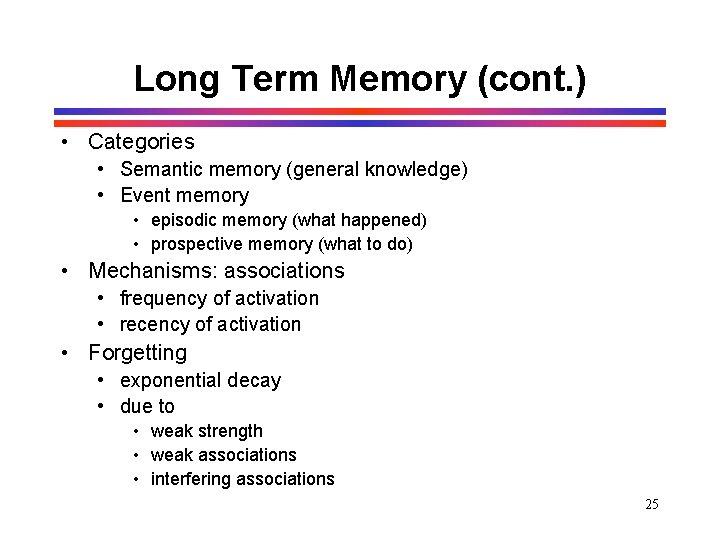
Long Term Memory (cont. ) • Categories • Semantic memory (general knowledge) • Event memory • episodic memory (what happened) • prospective memory (what to do) • Mechanisms: associations • frequency of activation • recency of activation • Forgetting • exponential decay • due to • weak strength • weak associations • interfering associations 25
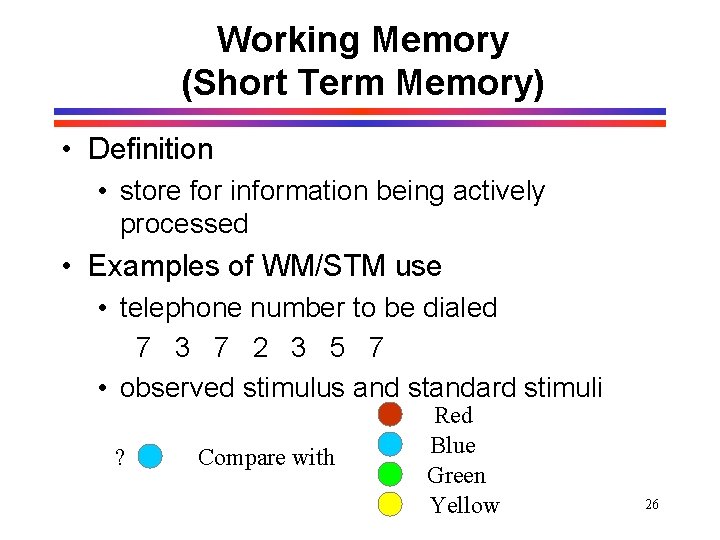
Working Memory (Short Term Memory) • Definition • store for information being actively processed • Examples of WM/STM use • telephone number to be dialed 7 3 7 2 3 5 7 • observed stimulus and standard stimuli ? Compare with Red Blue Green Yellow 26
Working Memory Capacity • 7 + 2 “chunks”, e. g. , • • • digits (0, 1, 2, . . . ) digit sequences (737 -, 752 -, 745 -, 754 -, . . . ) names (“Bill”, “Sue”, “Nan”, etc. ) persons (Bill, Sue, Nan, etc. ) etc. • Miller’s magic number (Miller, 1956). • Very significant human limitation. • Enhanced by “chunking”. 27
Working Memory Duration • • • max 10 - 15 s without attention/rehearsal. Decay rate influenced by number of items. Greatest limitation of WM. Very significant human limitation. Has implications for design. 28
Stage Model of Information Processing Mental Resources Sensing & Perception • vision • hearing • . . . • perception Stimuli Cognition Working Memory • situation awareness • decision making • planning • attention • task management Long Term Memory World Response • Fitts’ Law • Hicks’ Law Responses 29
Decision Making and Problem Solving
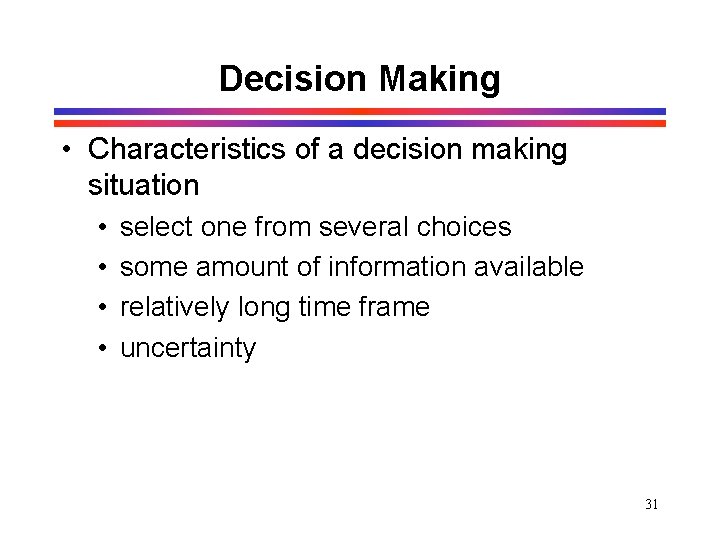
Decision Making • Characteristics of a decision making situation • • select one from several choices some amount of information available relatively long time frame uncertainty 31
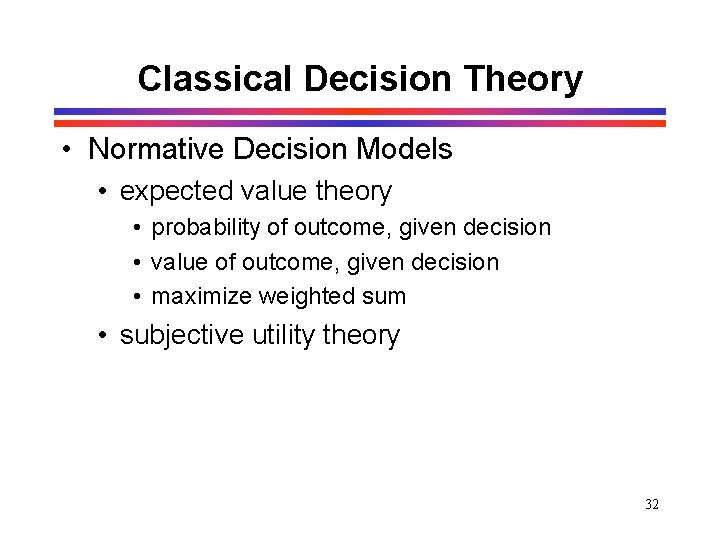
Classical Decision Theory • Normative Decision Models • expected value theory • probability of outcome, given decision • value of outcome, given decision • maximize weighted sum • subjective utility theory 32
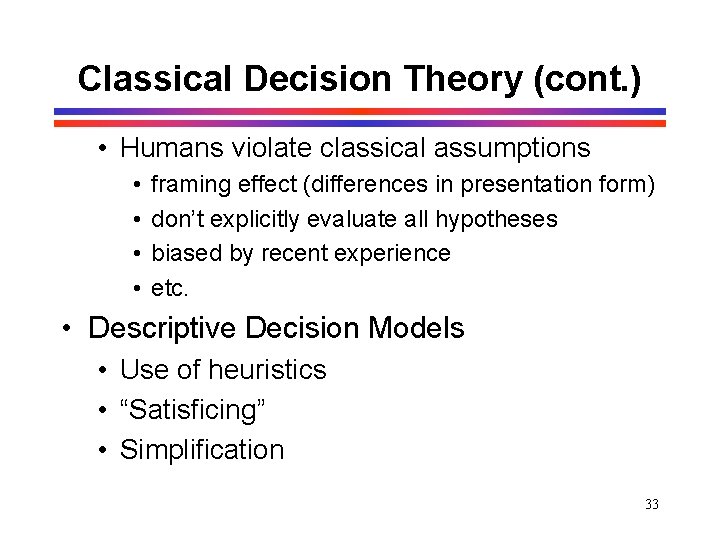
Classical Decision Theory (cont. ) • Humans violate classical assumptions • • framing effect (differences in presentation form) don’t explicitly evaluate all hypotheses biased by recent experience etc. • Descriptive Decision Models • Use of heuristics • “Satisficing” • Simplification 33
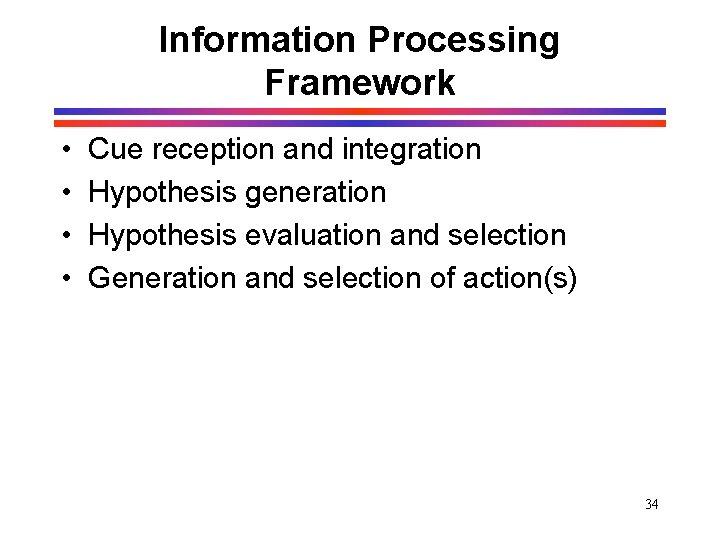
Information Processing Framework • • Cue reception and integration Hypothesis generation Hypothesis evaluation and selection Generation and selection of action(s) 34
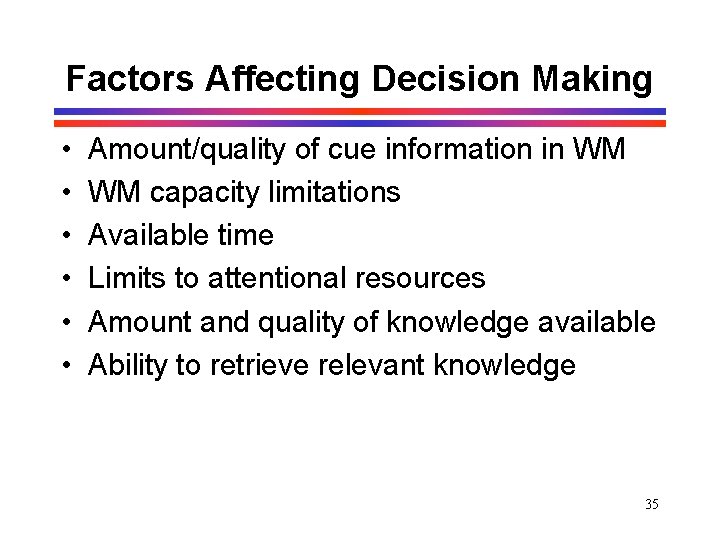
Factors Affecting Decision Making • • • Amount/quality of cue information in WM WM capacity limitations Available time Limits to attentional resources Amount and quality of knowledge available Ability to retrieve relevant knowledge 35
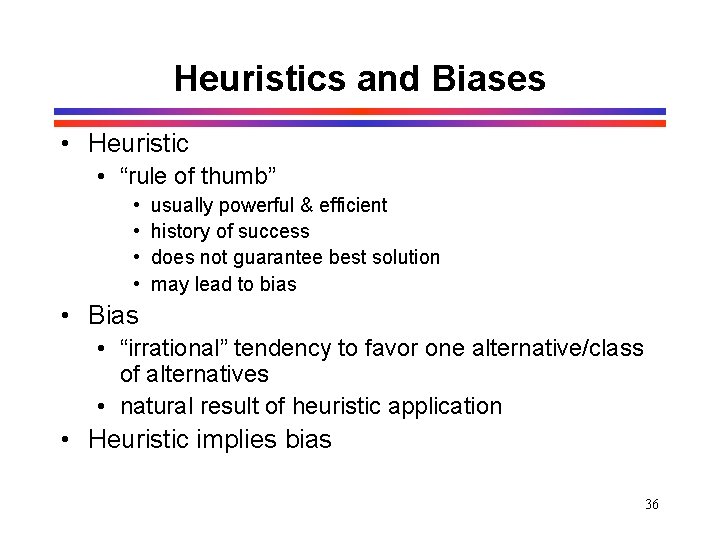
Heuristics and Biases • Heuristic • “rule of thumb” • • usually powerful & efficient history of success does not guarantee best solution may lead to bias • Bias • “irrational” tendency to favor one alternative/class of alternatives • natural result of heuristic application • Heuristic implies bias 36
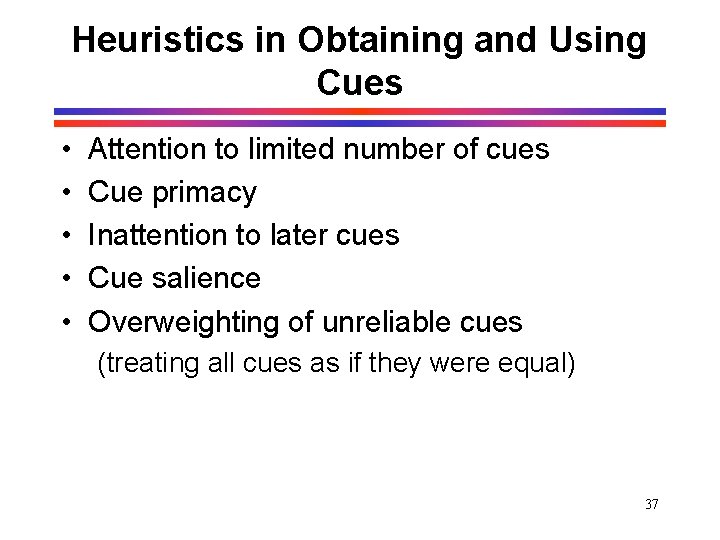
Heuristics in Obtaining and Using Cues • • • Attention to limited number of cues Cue primacy Inattention to later cues Cue salience Overweighting of unreliable cues (treating all cues as if they were equal) 37
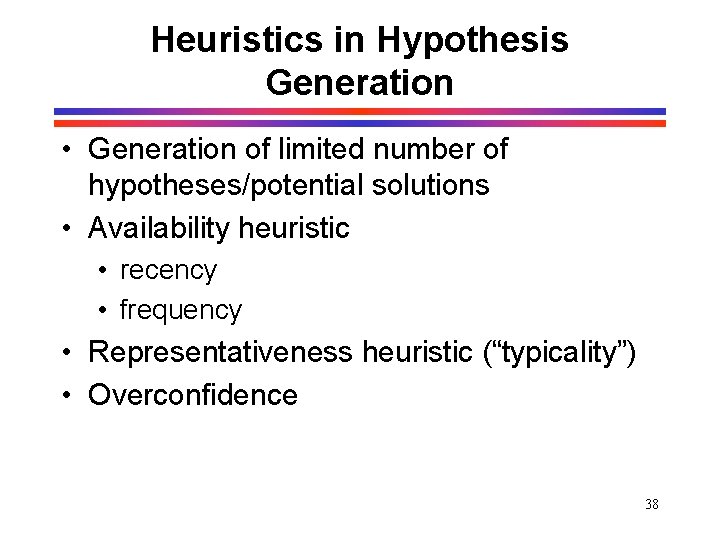
Heuristics in Hypothesis Generation • Generation of limited number of hypotheses/potential solutions • Availability heuristic • recency • frequency • Representativeness heuristic (“typicality”) • Overconfidence 38
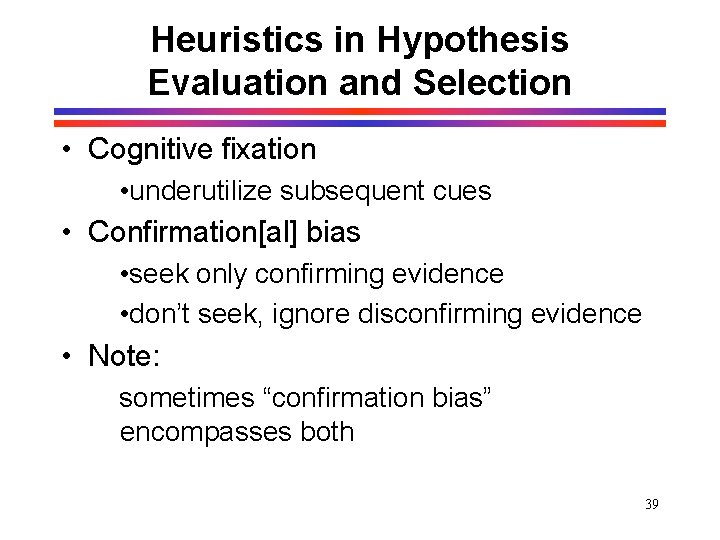
Heuristics in Hypothesis Evaluation and Selection • Cognitive fixation • underutilize subsequent cues • Confirmation[al] bias • seek only confirming evidence • don’t seek, ignore disconfirming evidence • Note: sometimes “confirmation bias” encompasses both 39
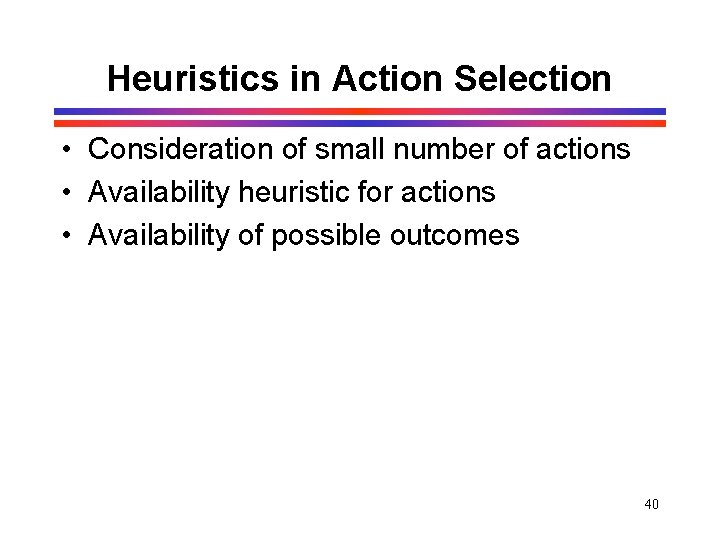
Heuristics in Action Selection • Consideration of small number of actions • Availability heuristic for actions • Availability of possible outcomes 40
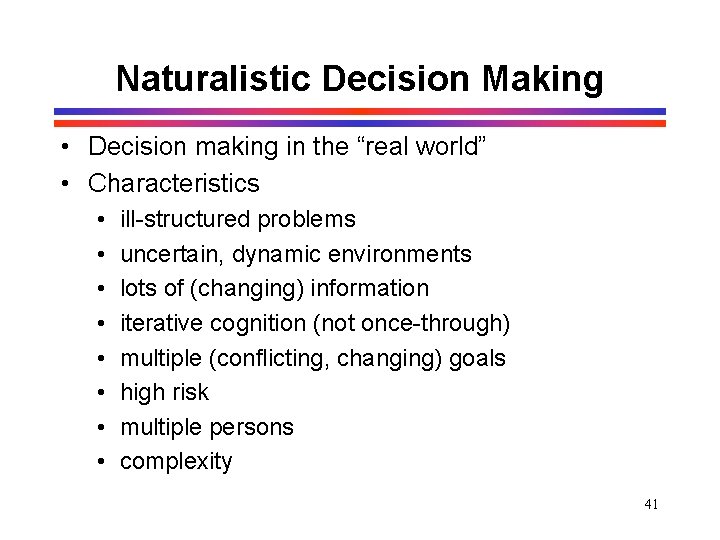
Naturalistic Decision Making • Decision making in the “real world” • Characteristics • • ill-structured problems uncertain, dynamic environments lots of (changing) information iterative cognition (not once-through) multiple (conflicting, changing) goals high risk multiple persons complexity 41
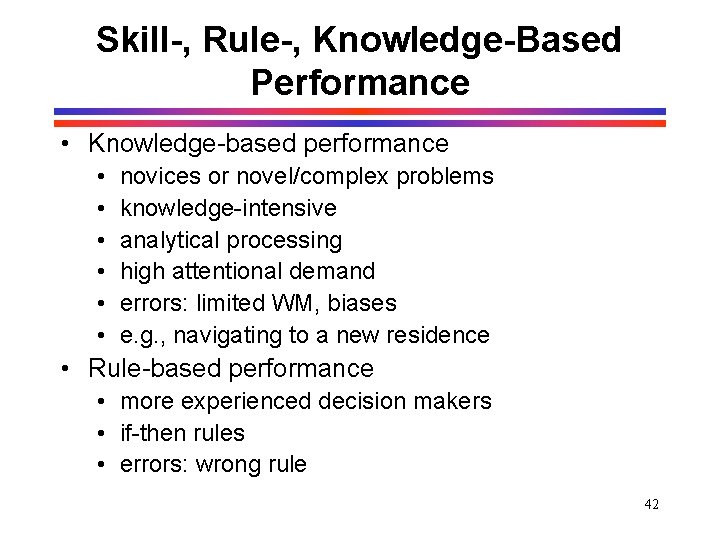
Skill-, Rule-, Knowledge-Based Performance • Knowledge-based performance • • • novices or novel/complex problems knowledge-intensive analytical processing high attentional demand errors: limited WM, biases e. g. , navigating to a new residence • Rule-based performance • more experienced decision makers • if-then rules • errors: wrong rule 42
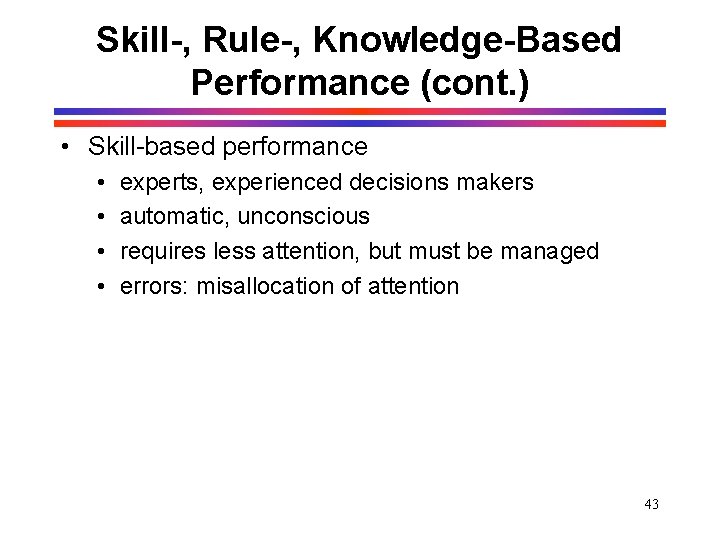
Skill-, Rule-, Knowledge-Based Performance (cont. ) • Skill-based performance • • experts, experienced decisions makers automatic, unconscious requires less attention, but must be managed errors: misallocation of attention 43
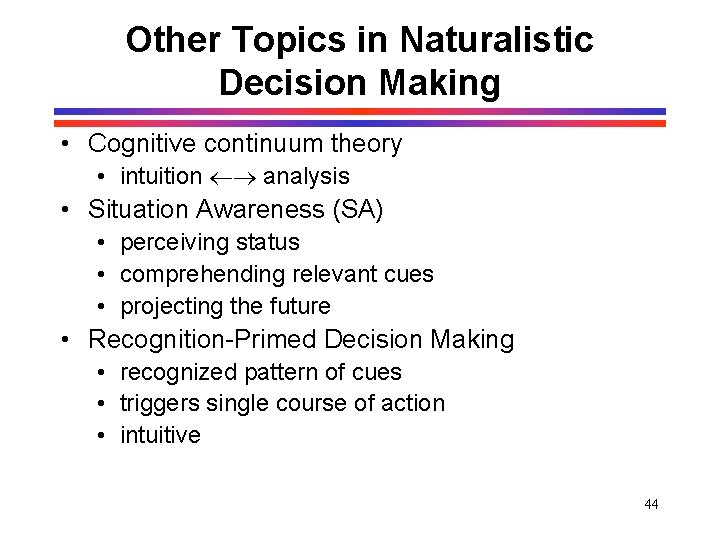
Other Topics in Naturalistic Decision Making • Cognitive continuum theory • intuition analysis • Situation Awareness (SA) • perceiving status • comprehending relevant cues • projecting the future • Recognition-Primed Decision Making • recognized pattern of cues • triggers single course of action • intuitive 44
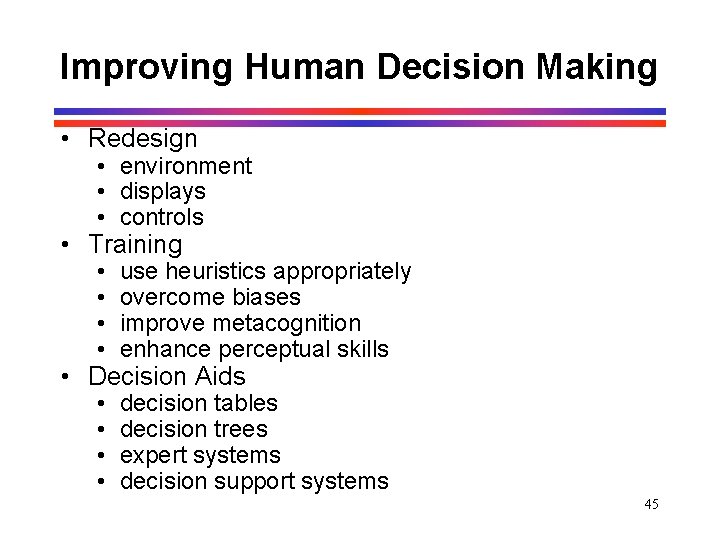
Improving Human Decision Making • Redesign • environment • displays • controls • Training • • use heuristics appropriately overcome biases improve metacognition enhance perceptual skills • • decision tables decision trees expert systems decision support systems • Decision Aids 45
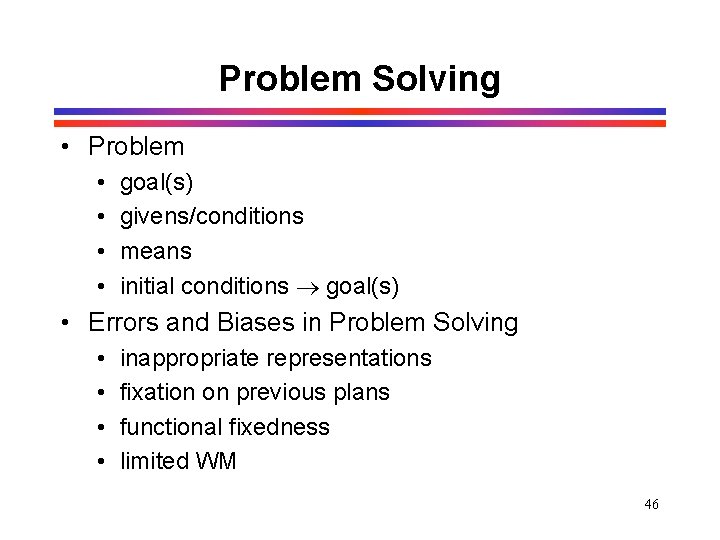
Problem Solving • Problem • • goal(s) givens/conditions means initial conditions goal(s) • Errors and Biases in Problem Solving • • inappropriate representations fixation on previous plans functional fixedness limited WM 46
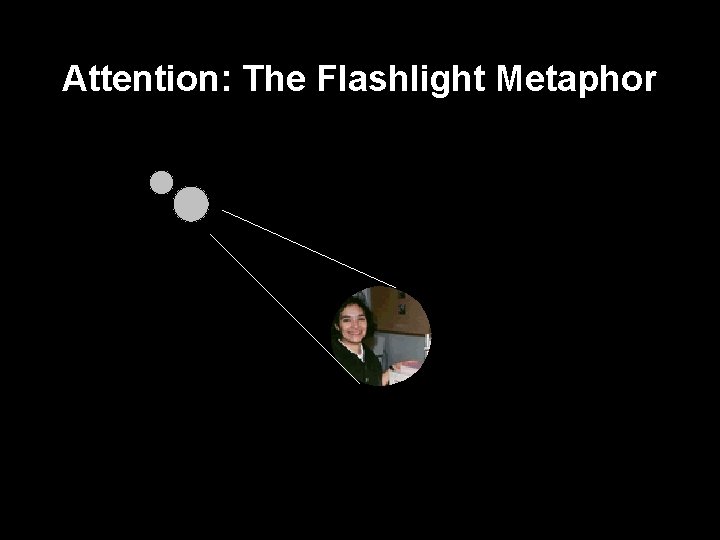
Attention: The Flashlight Metaphor 47
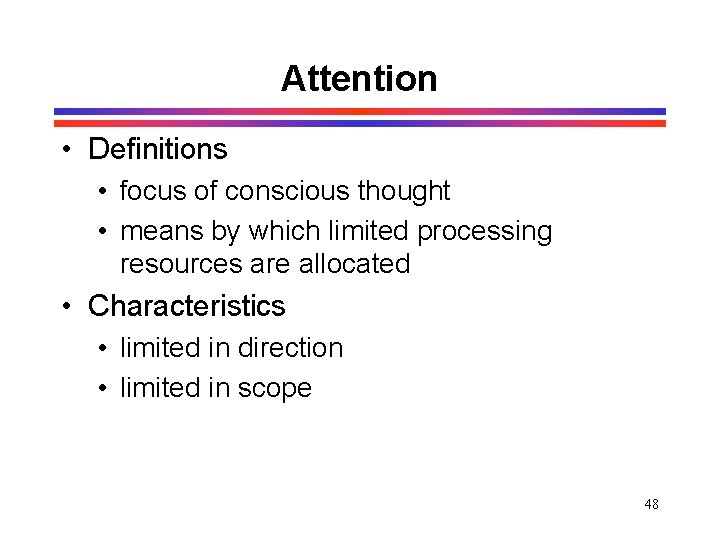
Attention • Definitions • focus of conscious thought • means by which limited processing resources are allocated • Characteristics • limited in direction • limited in scope 48
Attention: Selection • Phenomenon • inappropriate selection (i. e. , inappropriate attention to something) • Example • using cell phone while driving • Explanation • salient cues • Countermeasures • control salience of cues 49
Attention: Distraction • Phenomenon • tendency to be distracted • Example • pilot distracted by flight attendant call • Explanation • high salience of less important cues • low salience of important cues • Countermeasures • remove distractions • control salience 50
Attention: Divided Attention • Phenomenon • inability to divide attention among several cues/tasks • Example • using cell phone while driving • Explanation • limited cognitive resources • Countermeasures • integrate controls & displays 51
Attention: Sampling • Phenomenon • stress-induced narrowing of attention • Example • Everglades L 1011 accident • Explanation • anecdotal • Countermeasures • sampling reminders 52
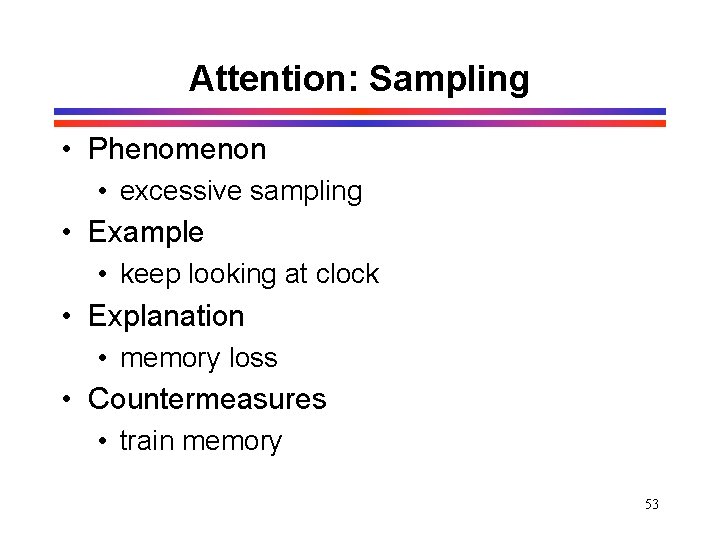
Attention: Sampling • Phenomenon • excessive sampling • Example • keep looking at clock • Explanation • memory loss • Countermeasures • train memory 53
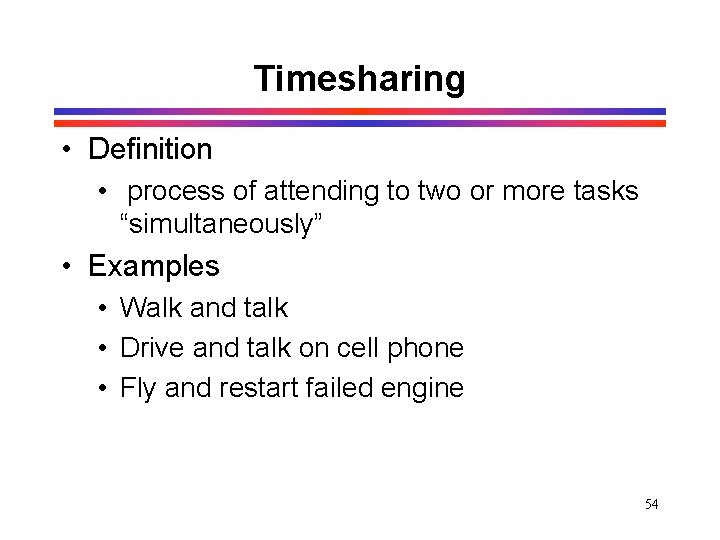
Timesharing • Definition • process of attending to two or more tasks “simultaneously” • Examples • Walk and talk • Drive and talk on cell phone • Fly and restart failed engine 54
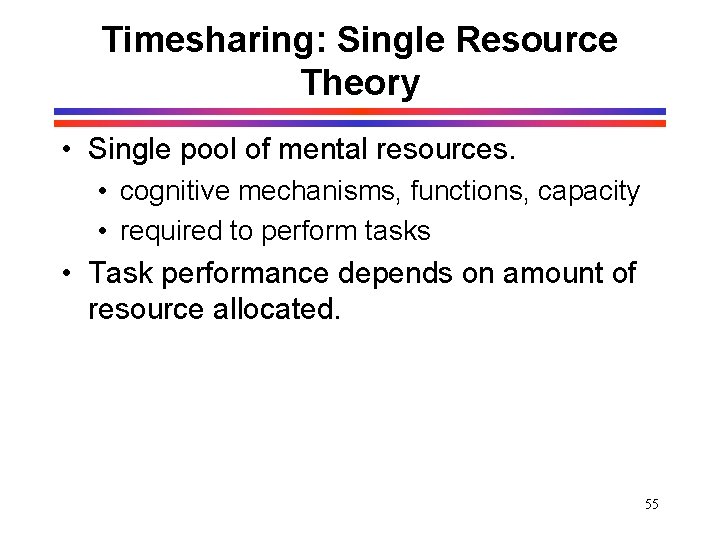
Timesharing: Single Resource Theory • Single pool of mental resources. • cognitive mechanisms, functions, capacity • required to perform tasks • Task performance depends on amount of resource allocated. 55
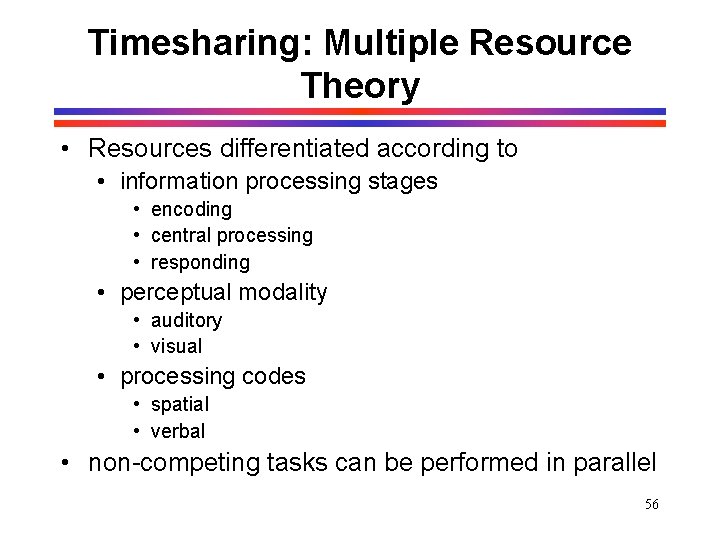
Timesharing: Multiple Resource Theory • Resources differentiated according to • information processing stages • encoding • central processing • responding • perceptual modality • auditory • visual • processing codes • spatial • verbal • non-competing tasks can be performed in parallel 56
Timesharing: Task Performance • Phenomenon • performance limitations not due to data limitations • Example • reading two adjacent lines of text at once • Explanation • limited resources • Countermeasures • decompose tasks • eliminate resource contentions 57
Mental Workload • Definition • “amount” of mental resources required by a set of concurrent tasks and the mental resources actually available • Examples • Low: driving on a straight rural road • High: driving in heavy traffic • • • on wet, slippery road surface reading map dialing cell phone talking with passenger worrying about fuel quantity • Significance • high workload poor task performance 58
Workload Measures • Analytic • e. g. , timeline analysis • Primary task performance • e. g. , driving task • Secondary task performance • e. g. , driving task plus mental arithmetic • Physiological • e. g. , heart rate variability • Subjective • e. g. , NASA TLX 59
NASA TLX Workload Measurement • Rate the following: • mental demand (low - high) • required mental activity • physical demand (low - high) • required physical activity • temporal demand (low - high) • time pressure • performance (failure - perfect) • success in accomplishing goals • effort (low - high) • mental and physical • frustration level (low - high) 60
Other Cognitive Functions • • • Deduction Induction Situation Awareness Planning Problem Solving 61
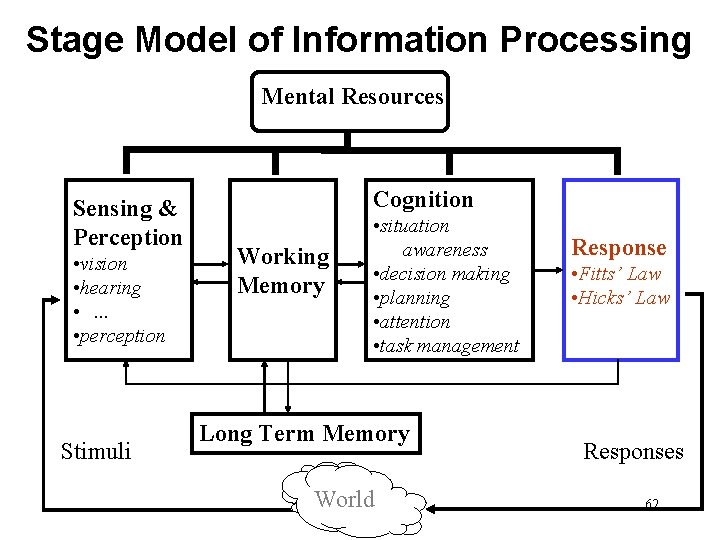
Stage Model of Information Processing Mental Resources Sensing & Perception • vision • hearing • . . . • perception Stimuli Cognition Working Memory • situation awareness • decision making • planning • attention • task management Long Term Memory World Response • Fitts’ Law • Hicks’ Law Responses 62
Response Selection: Reaction Time Definition: • time it takes for a human to respond to a stimulus 63
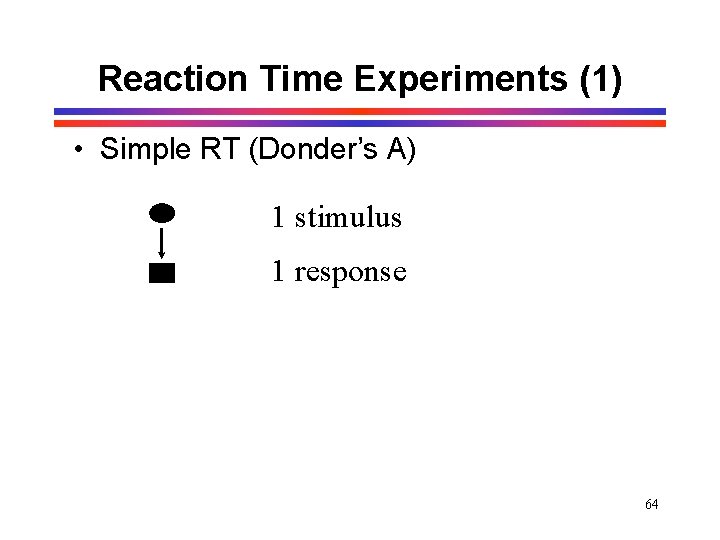
Reaction Time Experiments (1) • Simple RT (Donder’s A) 1 stimulus 1 response 64
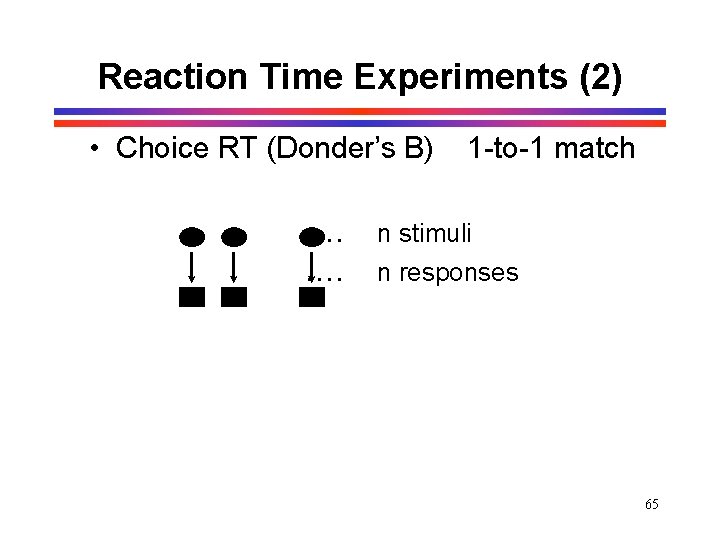
Reaction Time Experiments (2) • Choice RT (Donder’s B) …. …. 1 -to-1 match n stimuli n responses 65
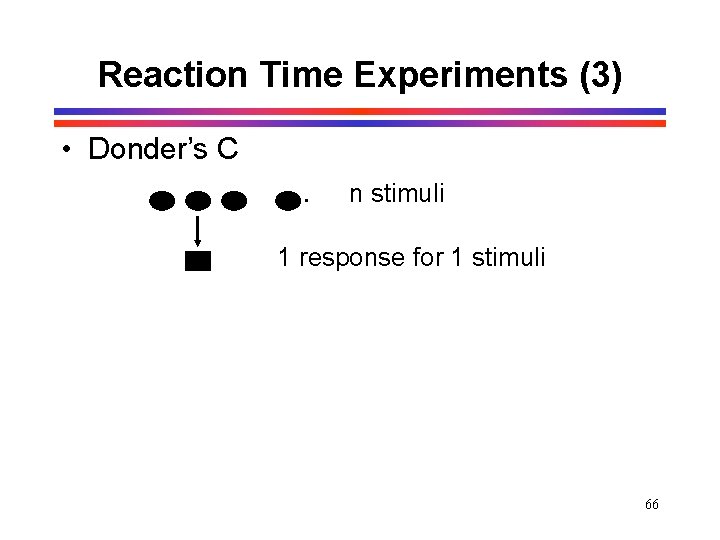
Reaction Time Experiments (3) • Donder’s C. . . n stimuli 1 response for 1 stimuli 66
Response: Selection • Phenomenon • response time proportional to stimulus uncertainty • Example • radar operator detecting and identifying radar contacts • Explanation • Hick Hyman Law 67
Hick Hyman Law Response time is proportional to stimulus uncertainty. OR, equivalently Response time is proportional to stimulus information content. 68
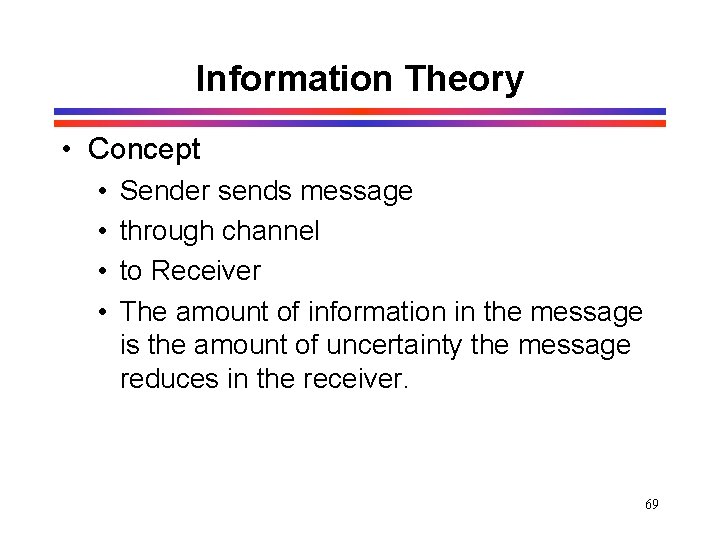
Information Theory • Concept • • Sender sends message through channel to Receiver The amount of information in the message is the amount of uncertainty the message reduces in the receiver. 69
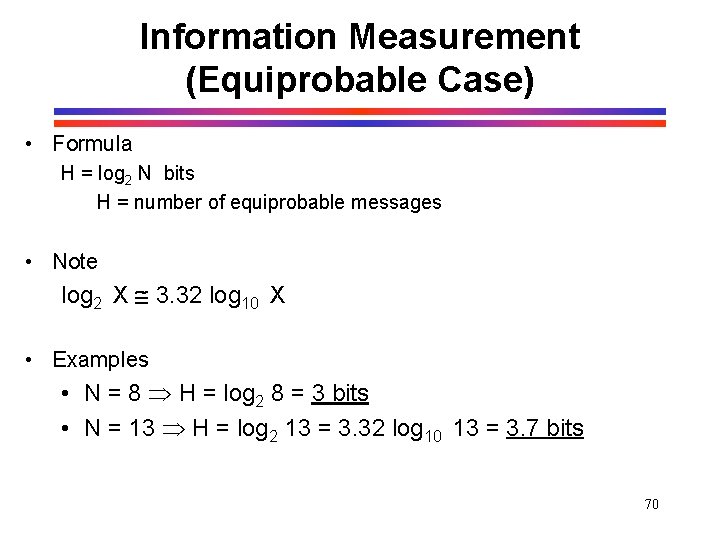
Information Measurement (Equiprobable Case) • Formula H = log 2 N bits H = number of equiprobable messages • Note log 2 X @ 3. 32 log 10 X • Examples • N = 8 H = log 2 8 = 3 bits • N = 13 H = log 2 13 = 3. 32 log 10 13 = 3. 7 bits 70
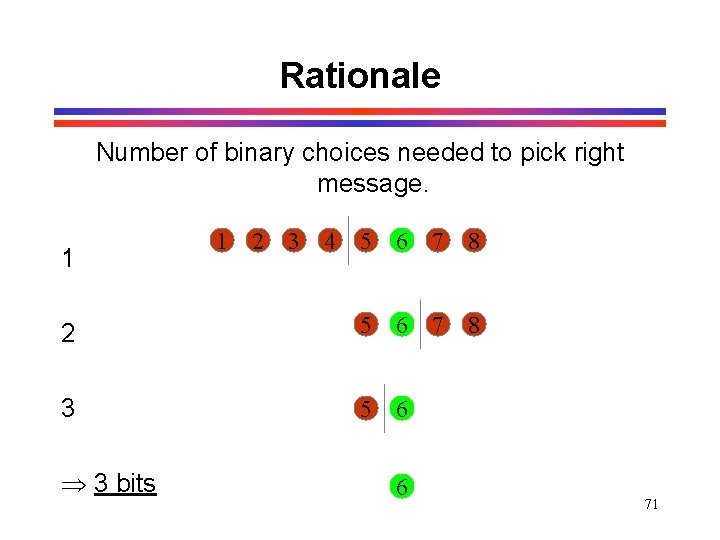
Rationale Number of binary choices needed to pick right message. 5 6 7 8 2 5 6 7 8 3 5 6 1 3 bits 1 2 3 4 6 71
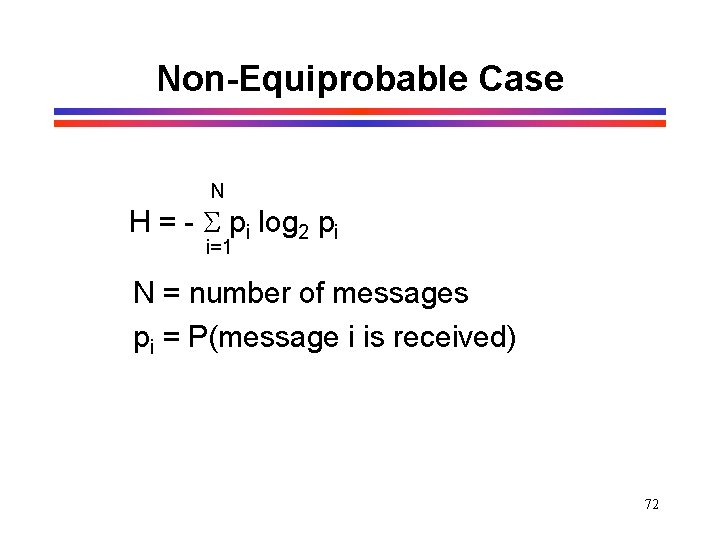
Non-Equiprobable Case N H = - S pi log 2 pi i=1 N = number of messages pi = P(message i is received) 72
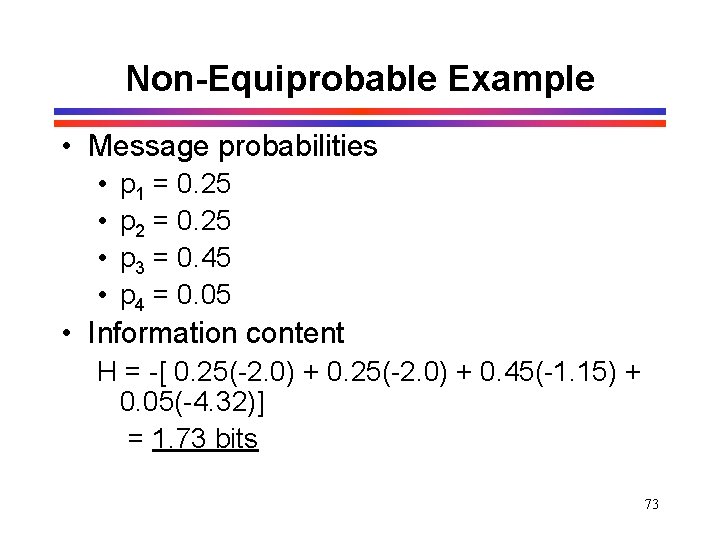
Non-Equiprobable Example • Message probabilities • • p 1 = 0. 25 p 2 = 0. 25 p 3 = 0. 45 p 4 = 0. 05 • Information content H = -[ 0. 25(-2. 0) + 0. 45(-1. 15) + 0. 05(-4. 32)] = 1. 73 bits 73
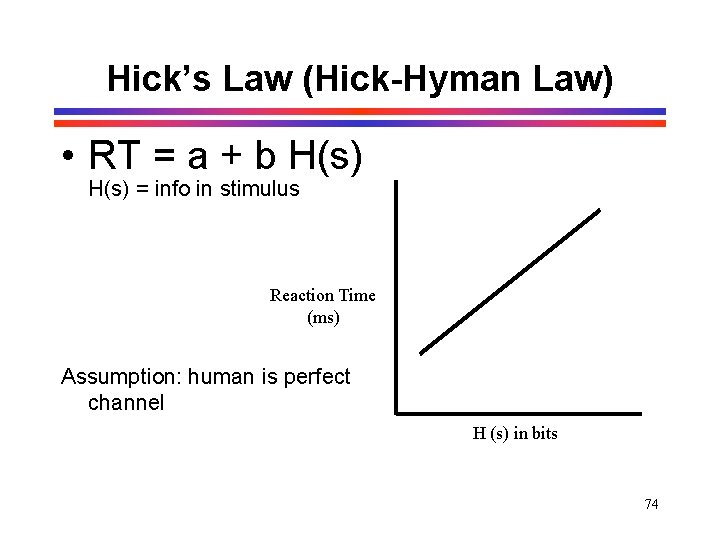
Hick’s Law (Hick-Hyman Law) • RT = a + b H(s) = info in stimulus Reaction Time (ms) Assumption: human is perfect channel H (s) in bits 74
Response: Selection • Phenomenon • simple RT to visual stimuli faster than to auditory • Example • visual vs. auditory low oil pressure annunciator • Explanation • visual dominance • Countermeasures • use visual stimuli when appropriate 75
Response: Selection • Phenomenon • simple RT inversely proportional to stimulus intensity • Example • cockpit master warning • Explanation • salience • Countermeasures • control stimulus intensity 76
Response: Selection • Phenomenon • response time affected by temporal uncertainty • Example • ATC controller usually (but not always) accepts handoffs for other controller • Explanation • possible preprocessing (? ) • Countermeasures • provide pre-stimulus warning, if possible 77
Response: Selection • Phenomenon • response time inversely proportional to subset familiarity • Example • trained radar operator vs untrained radar operator • Explanation • response automaticity • Countermeasures • training 78
Response: Selection • Phenomenon • response time inversely proportional to stimulus discriminability • Example • sonar operator distinguishing between two submarine signatures • Explanation • ambiguous stimuli may require more processing • Countermeasures • increase discriminability • remove shared, redundant features 79
Response: Selection • Phenomenon • response time affected by repeated stimuli • usually faster for several identical stimuli in sequence • increases after “too many” of same stimulus • Example • computer user confirming multiple file deletions • Explanation • conspicuity, salience • Countermeasures • ? 80
Response: Selection • Phenomenon • response time inversely proportional to stimulusresponse compatibility • Example • power plant operator acknowledging fault annunciation • Explanation • automatic responses require little processing • Countermeasures • enhance stimulus-response compatibility 81
Response: Selection • Phenomenon • response time inversely proportional to practice • Example • trained radar operator faster at detecting and identifying targets • Explanation • automaticity of responses • Countermeasures • provide training 82
Response: Selection • Phenomenon • response time inversely proportional to required accuracy • Example • radar operator detecting and identifying targets • Explanation • speed-accuracy tradeoff • Countermeasures • reduce accuracy requirements • enhance operator accuracy through training & other means 83
Other Factors Affecting RT • • Stimulus complexity Workload Stimulus location Task interference/workload Motivation Fatigue Environmental variables etc. 84