
Human Impacts on the Lithosphere Needs and consequences


- Slides: 57
Human Impacts on the Lithosphere
Needs and consequences for land use
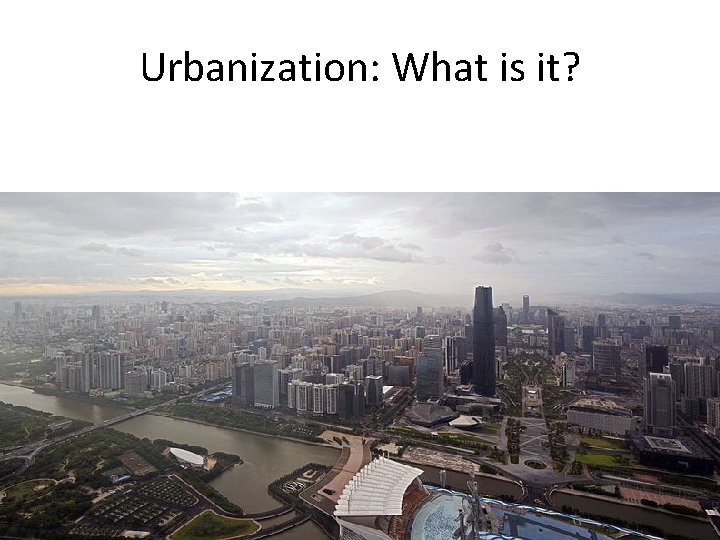
Urbanization: What is it?
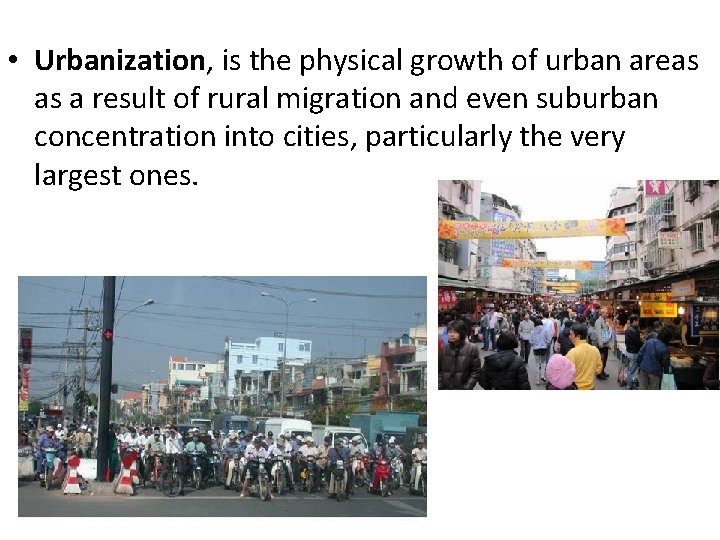
• Urbanization, is the physical growth of urban areas as a result of rural migration and even suburban concentration into cities, particularly the very largest ones.
• Urbanization is the increasing number of people that migrate from rural to urban areas • Urbanization results from both industrialization (increasing efficiency among farmers) and population growth. – As more and more people leave villages and farms to live in cities, urban growth results. More people = more consumption and need of different products Requires water and creates more pollutants In developing countries where the urbanization is occurring (most rapidly) the technology is not high enough to take responsibility of water treatment and clean production
US and World Population Clock • http: //www. census. gov/main/www/popclock. html • Why is it needed? – People need places to live. Many move to big cities. • The United Nations projected that half of the world's population would live in urban areas at the end of 2008. – As the human population increases, the need for urbanization also increases.
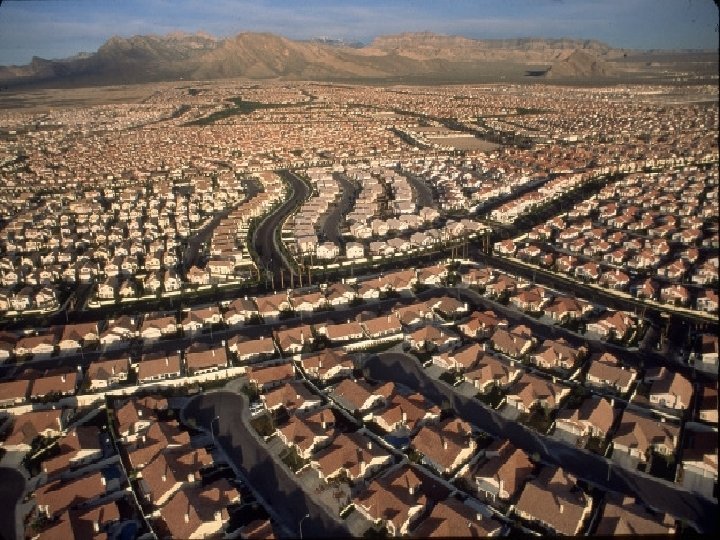
Consequences of Urbanization • Urban sprawl is a multifaceted concept centered around the expansion of low-density development. – In the last 50 years, the greatest percentage of population growth in the US has occurred in two classes: suburban and exurban • With more people moving to the suburbs…you need to remove trees and build houses! • Overpopulation, less land available, etc
Population growth • Population Growth leads to four effects on the land: – – 1) Pollution 2) Industrialization 3) Acid Rain 4) Acidification of Lakes
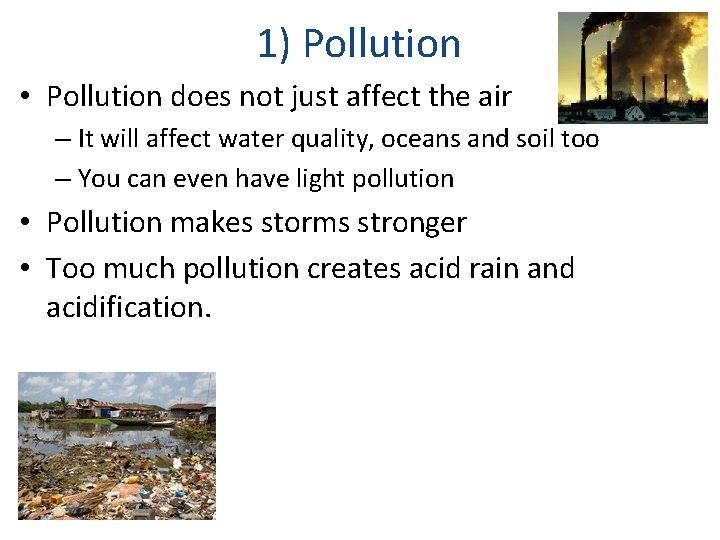
1) Pollution • Pollution does not just affect the air – It will affect water quality, oceans and soil too – You can even have light pollution • Pollution makes storms stronger • Too much pollution creates acid rain and acidification.
• http: //science. howstuffworks. com/environmen tal/30218 -really-big-things-americas-landfillsvideo. htm
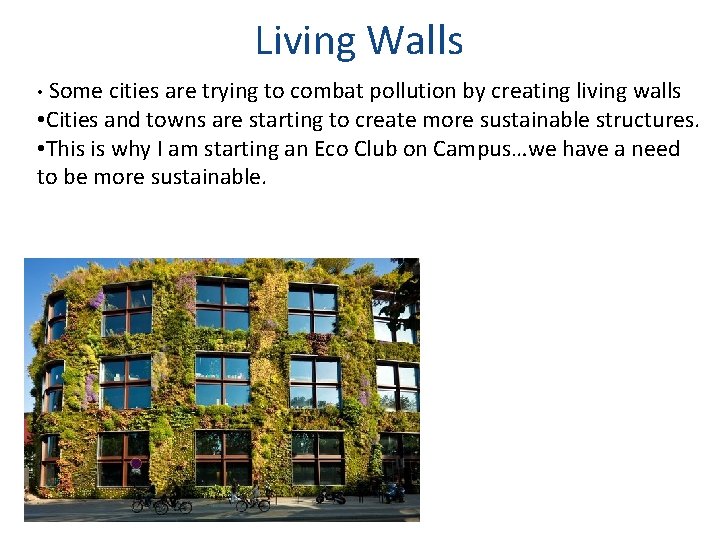
Living Walls • Some cities are trying to combat pollution by creating living walls • Cities and towns are starting to create more sustainable structures. • This is why I am starting an Eco Club on Campus…we have a need to be more sustainable.
• http: //science. howstuffworks. com/environme ntal/28794 -how-do-they-do-it-recyclingmachine-video. htm
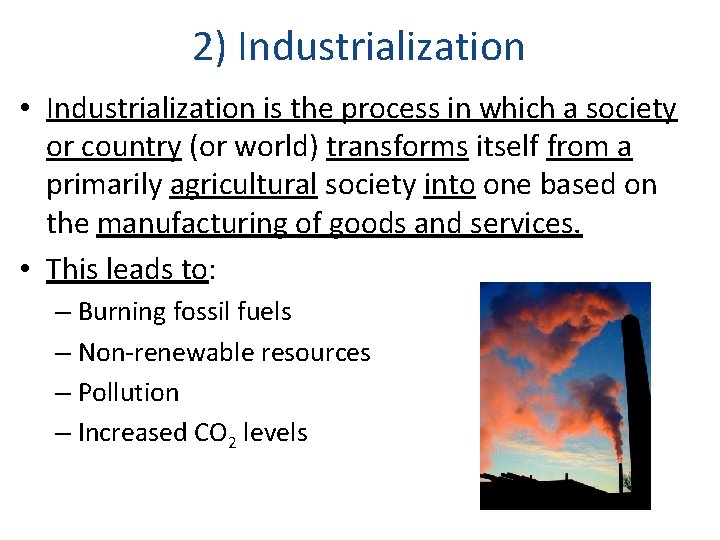
2) Industrialization • Industrialization is the process in which a society or country (or world) transforms itself from a primarily agricultural society into one based on the manufacturing of goods and services. • This leads to: – Burning fossil fuels – Non-renewable resources – Pollution – Increased CO 2 levels
3) Acid Rain • Acid Rain is precipitation (rain, snow or sleet) that contains high concentrations of acid- forming chemicals – These chemicals come from • coal smoke • Chemical manufacturing • smelting • The chemicals are then released into the atmosphere where they combine with water vapor and become harmful to the environment.
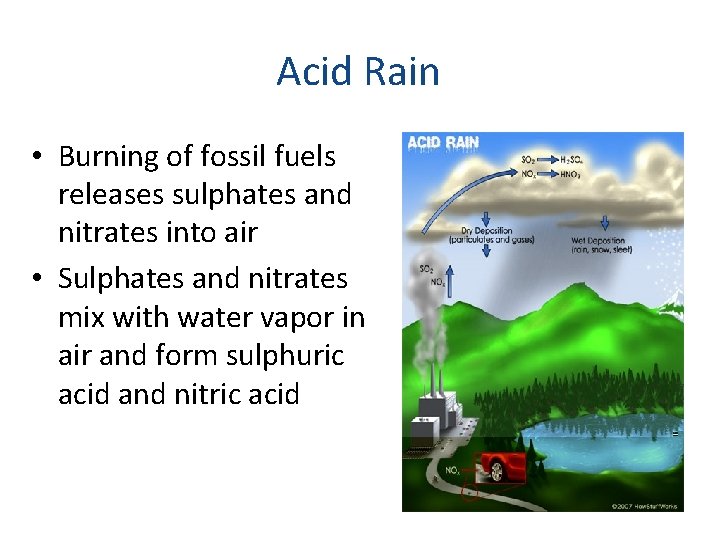
Acid Rain • Burning of fossil fuels releases sulphates and nitrates into air • Sulphates and nitrates mix with water vapor in air and form sulphuric acid and nitric acid
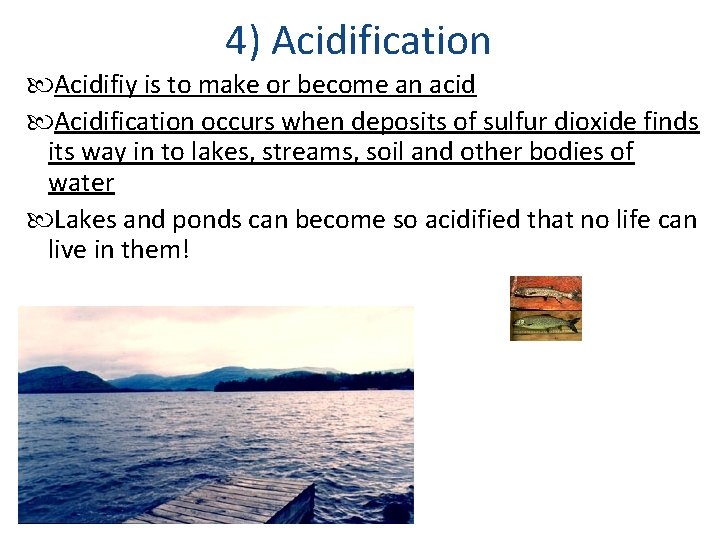
4) Acidification Acidifiy is to make or become an acid Acidification occurs when deposits of sulfur dioxide finds its way in to lakes, streams, soil and other bodies of water Lakes and ponds can become so acidified that no life can live in them!
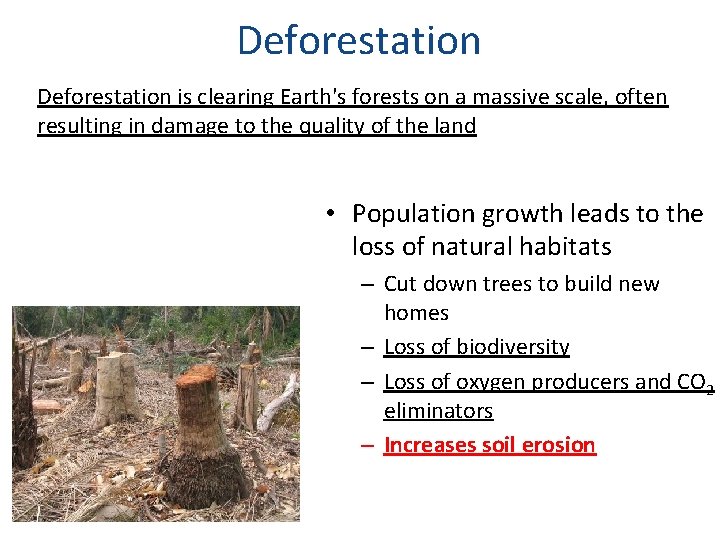
Deforestation is clearing Earth's forests on a massive scale, often resulting in damage to the quality of the land • Population growth leads to the loss of natural habitats – Cut down trees to build new homes – Loss of biodiversity – Loss of oxygen producers and CO 2 eliminators – Increases soil erosion
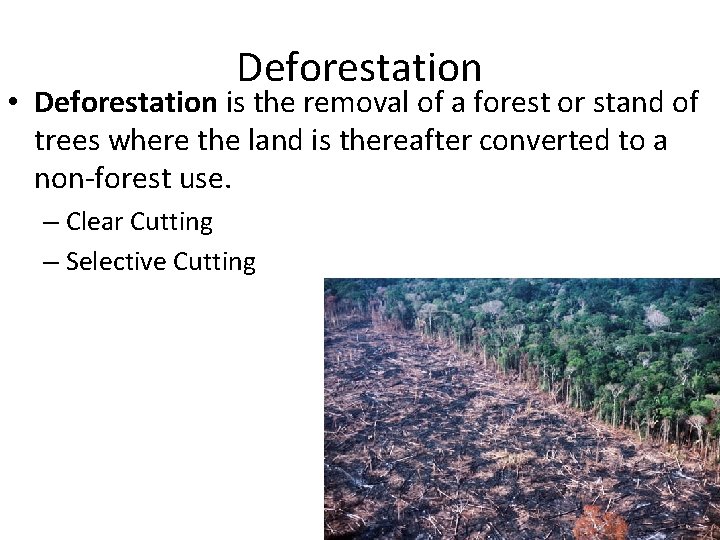
Deforestation • Deforestation is the removal of a forest or stand of trees where the land is thereafter converted to a non-forest use. – Clear Cutting – Selective Cutting
Why is deforestation needed? • Forests provide paper and wood that we use for many common things • We need more land for other uses – Conversion of forestland to farms, ranches, or urban use.
Deforestation Facts Forests cover 30% of the land worldwide ◦ However, swaths (sections) the size of Panama are cut down every year. The world’s rain forests could completely vanish in a hundred years at the current deforestation rate Deforestation drives climate change ◦ Forests tend to be moist, but when trees are cut they block the sun from the soil and dry it out. This slows down the water cycle…because trees contribute to the water cycle. Without trees flourishing forests become barren lands and turn into deserts Without trees acting as a canopy in a forest, the forest floor cannot cool at night…this disrupts animal and plants that need cooler evenings.
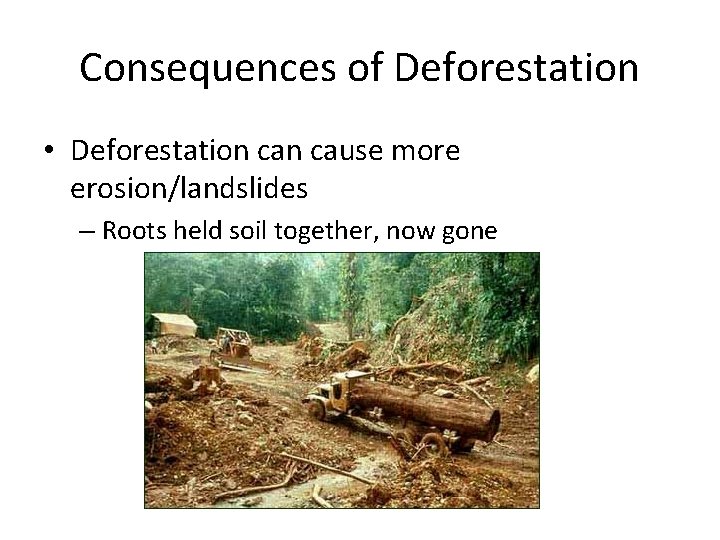
Consequences of Deforestation • Deforestation cause more erosion/landslides – Roots held soil together, now gone
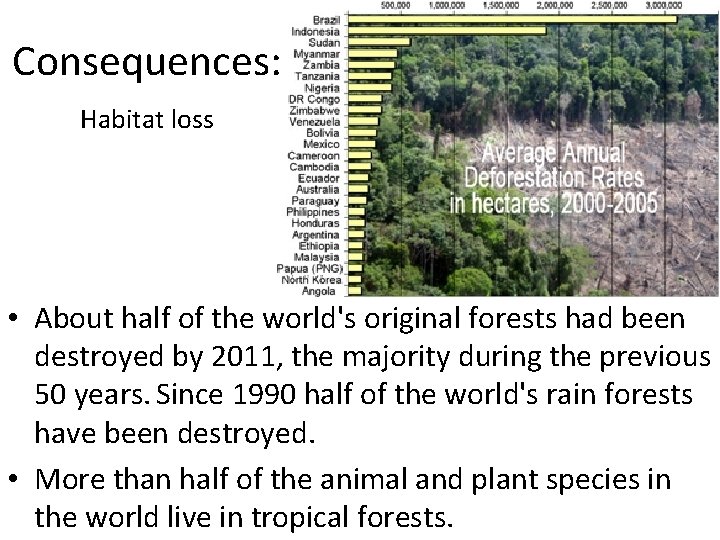
Consequences: Habitat loss • About half of the world's original forests had been destroyed by 2011, the majority during the previous 50 years. Since 1990 half of the world's rain forests have been destroyed. • More than half of the animal and plant species in the world live in tropical forests.
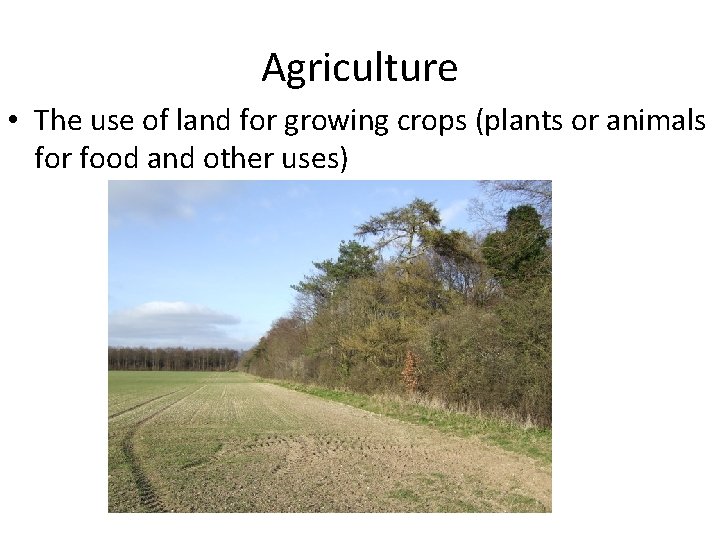
Agriculture • The use of land for growing crops (plants or animals for food and other uses)
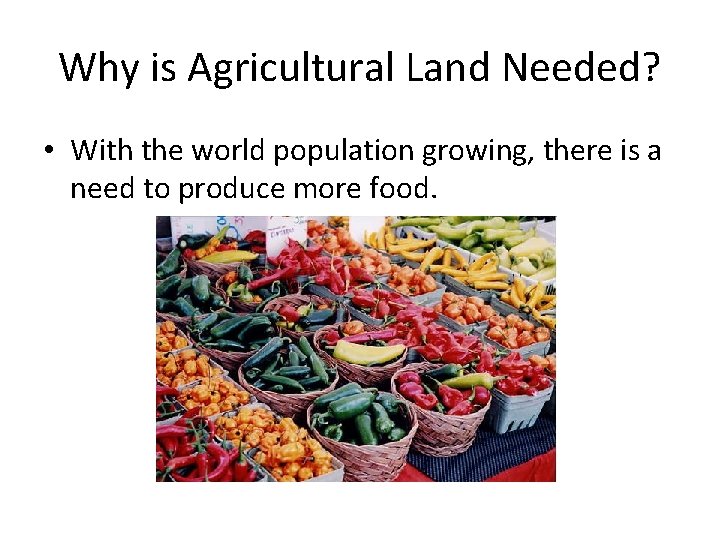
Why is Agricultural Land Needed? • With the world population growing, there is a need to produce more food.
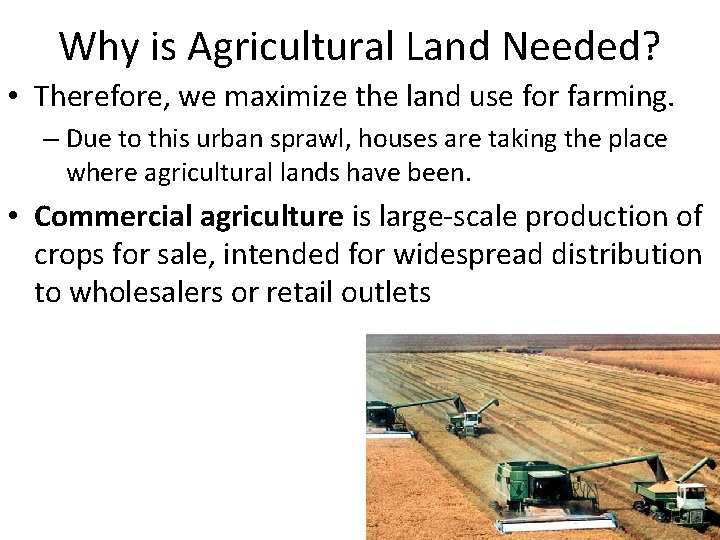
Why is Agricultural Land Needed? • Therefore, we maximize the land use for farming. – Due to this urban sprawl, houses are taking the place where agricultural lands have been. • Commercial agriculture is large-scale production of crops for sale, intended for widespread distribution to wholesalers or retail outlets
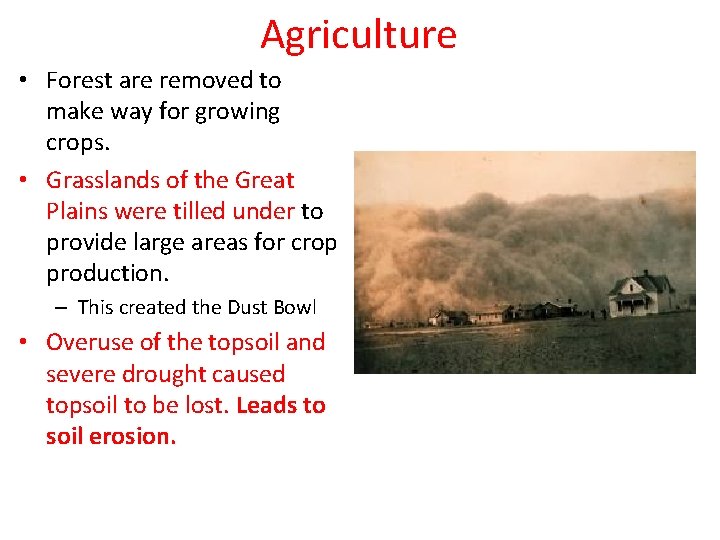
Agriculture • Forest are removed to make way for growing crops. • Grasslands of the Great Plains were tilled under to provide large areas for crop production. – This created the Dust Bowl • Overuse of the topsoil and severe drought caused topsoil to be lost. Leads to soil erosion.
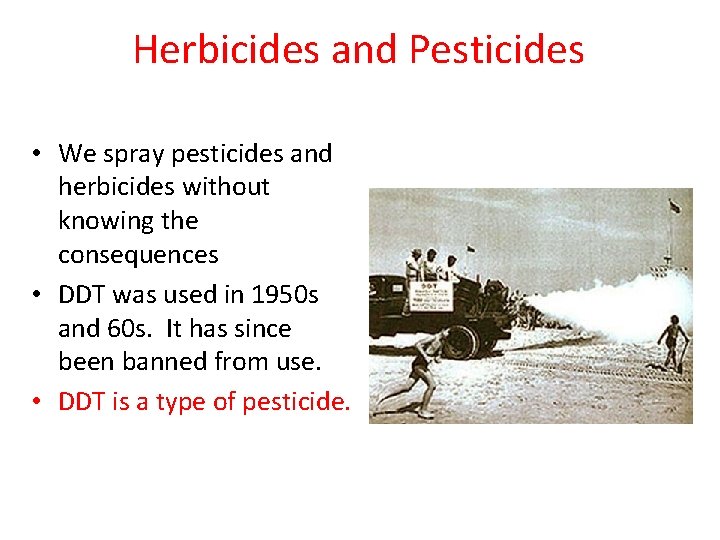
Herbicides and Pesticides • We spray pesticides and herbicides without knowing the consequences • DDT was used in 1950 s and 60 s. It has since been banned from use. • DDT is a type of pesticide.
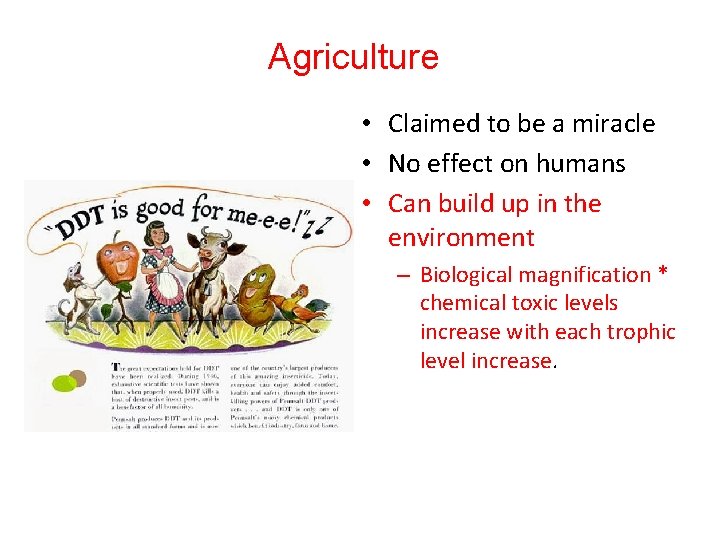
Agriculture • Claimed to be a miracle • No effect on humans • Can build up in the environment – Biological magnification * chemical toxic levels increase with each trophic level increase.
Consequences of Agriculture • Traditional (small-scale) agricultural practices are being replaced by massive farming operations using chemical fertilizers, pesticides, etc. • Again, there is a need for the removal of forest land to produce agriculture land. • However, this might take away from the land needed for housing… • What do you do?
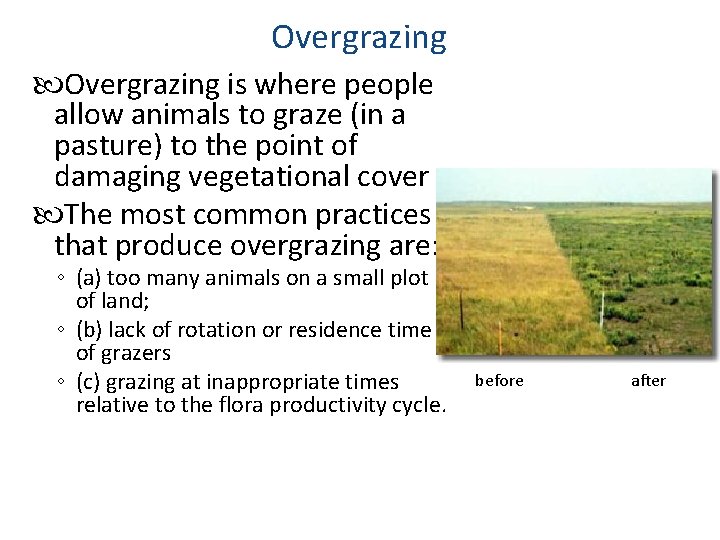
Overgrazing is where people allow animals to graze (in a pasture) to the point of damaging vegetational cover The most common practices that produce overgrazing are: ◦ (a) too many animals on a small plot of land; ◦ (b) lack of rotation or residence time of grazers ◦ (c) grazing at inappropriate times relative to the flora productivity cycle. before after
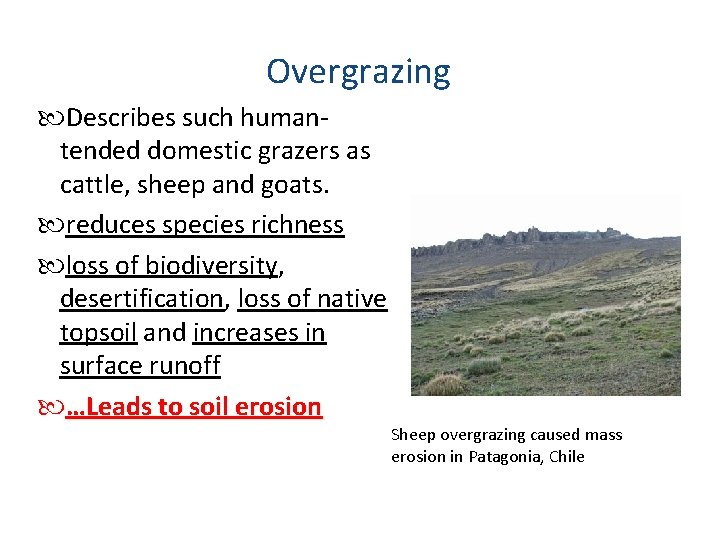
Overgrazing Describes such humantended domestic grazers as cattle, sheep and goats. reduces species richness loss of biodiversity, desertification, loss of native topsoil and increases in surface runoff …Leads to soil erosion Sheep overgrazing caused mass erosion in Patagonia, Chile
Desertification • It is the process by which land becomes a desert. • Desertification costs the world more that $40 billion a year in lost productivity. • It is occurring in 70% of all dry lands, or ¼ of the total land area of the Earth. • Each year the planet loses 24 billion tons of topsoil.
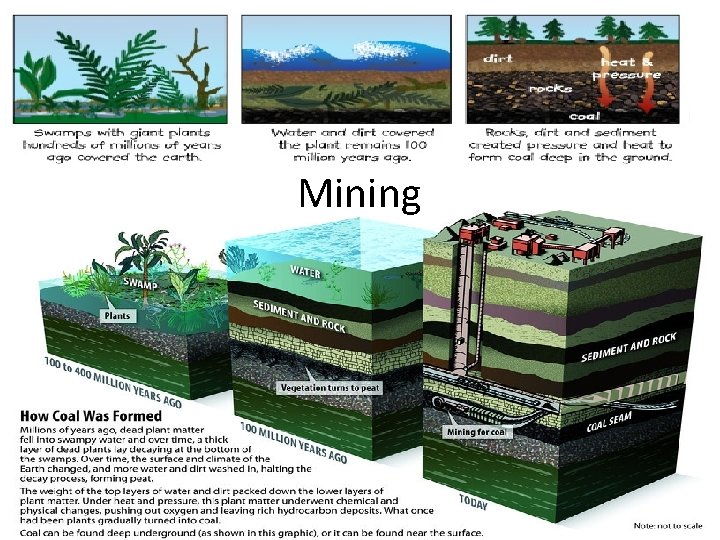
Mining
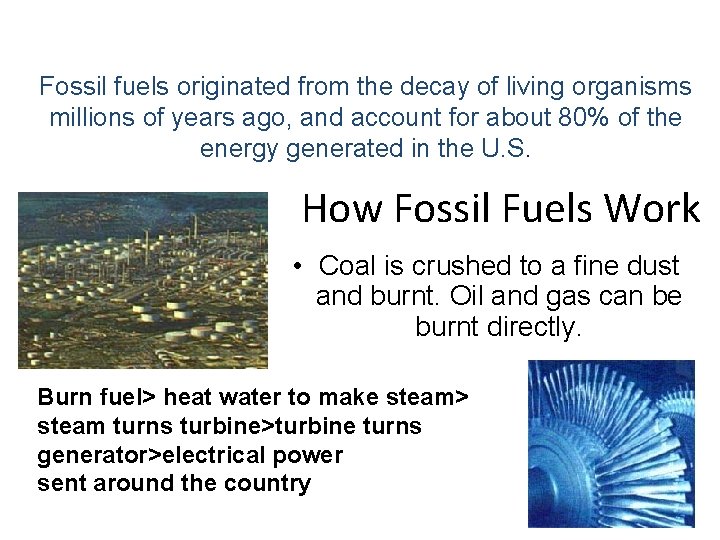
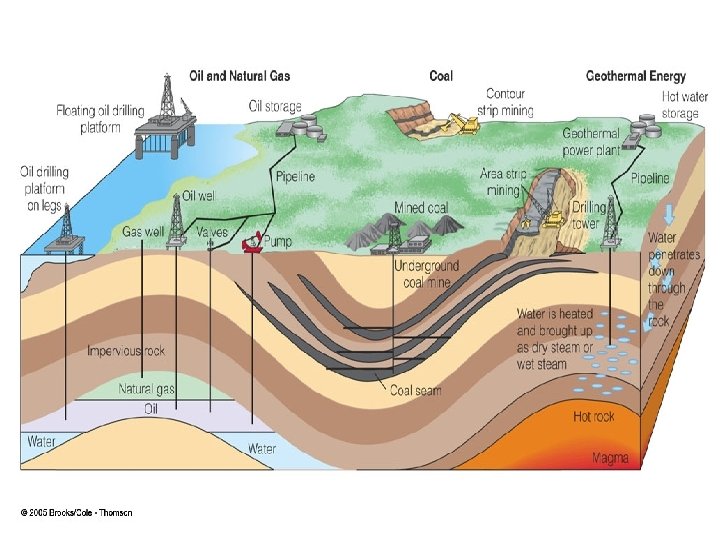
Fossil fuels originated from the decay of living organisms millions of years ago, and account for about 80% of the energy generated in the U. S. How Fossil Fuels Work • Coal is crushed to a fine dust and burnt. Oil and gas can be burnt directly. Burn fuel> heat water to make steam> steam turns turbine>turbine turns generator>electrical power sent around the country
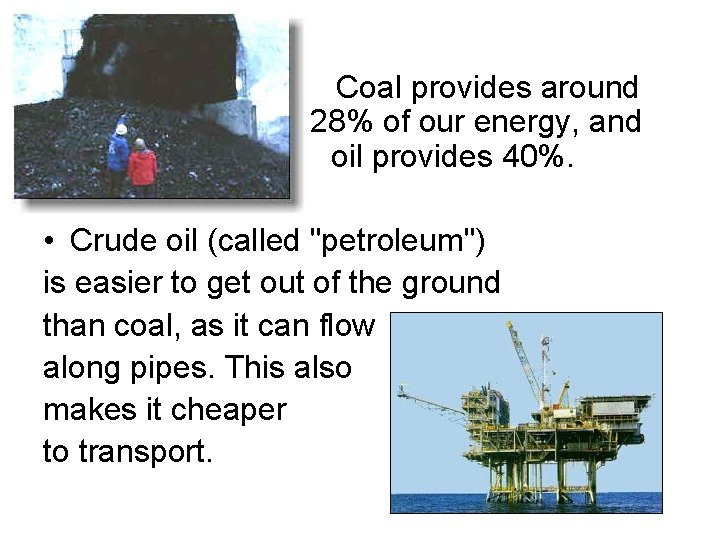
• Coal provides around 28% of our energy, and oil provides 40%. • Crude oil (called "petroleum") is easier to get out of the ground than coal, as it can flow along pipes. This also makes it cheaper to transport.
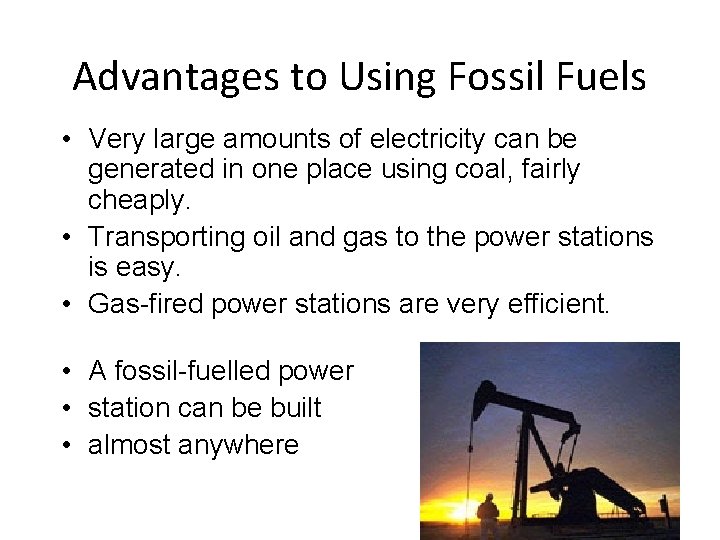
Advantages to Using Fossil Fuels • Very large amounts of electricity can be generated in one place using coal, fairly cheaply. • Transporting oil and gas to the power stations is easy. • Gas-fired power stations are very efficient. • A fossil-fuelled power • station can be built • almost anywhere
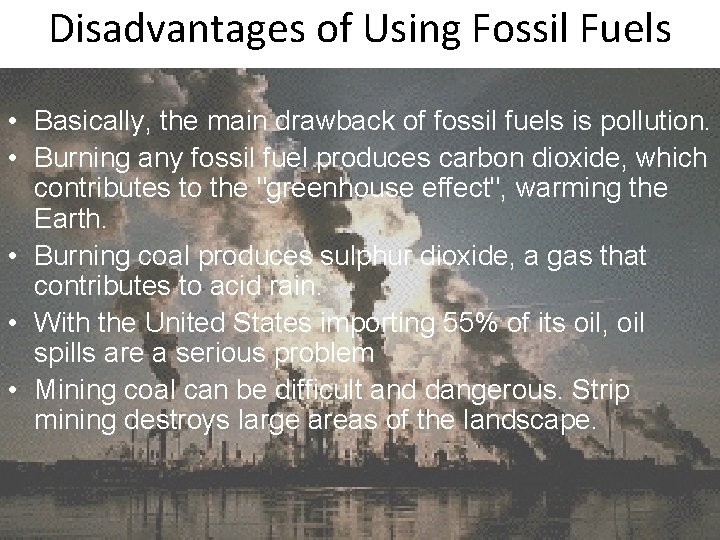
Disadvantages of Using Fossil Fuels • Basically, the main drawback of fossil fuels is pollution. • Burning any fossil fuel produces carbon dioxide, which contributes to the "greenhouse effect", warming the Earth. • Burning coal produces sulphur dioxide, a gas that contributes to acid rain. • With the United States importing 55% of its oil, oil spills are a serious problem • Mining coal can be difficult and dangerous. Strip mining destroys large areas of the landscape.
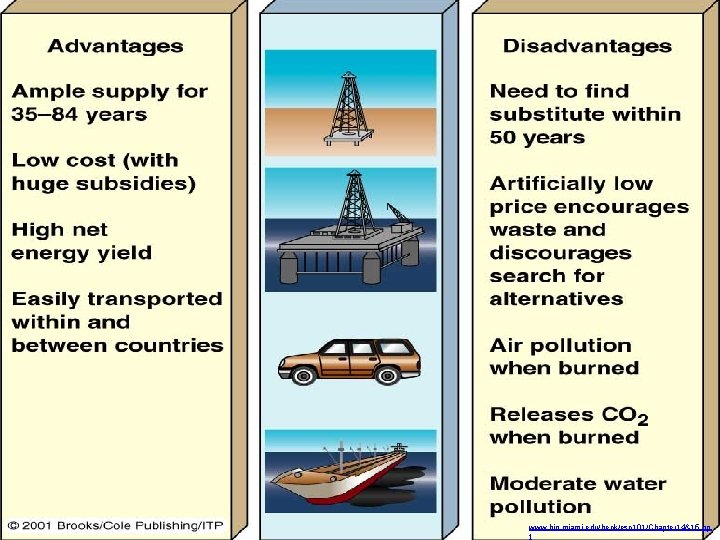
Problems with Fossil Fuels • Fossil fuels are nonrenewable resources – At projected consumption rates, natural gas and petroleum will be depleted before the end of the 21 st century • Impurities in fossil fuels are a major source of pollution • Burning fossil fuels produce large amounts of CO 2, which contributes to global warming www. lander. edu/rlayland/Chem%20103/chap_12. ppt
Coal Three types of coal lignite, bituminous, and anthracite. The concentrations of carbon and density increase with each type. Forms from generations of dying swamp plants. Over time the concentration of oxygen and hydrogen are lost and the concentration of carbon increase. Shaft and drift mining is used to extract the coal. Produces 48% of the United States’ total energy consumed.
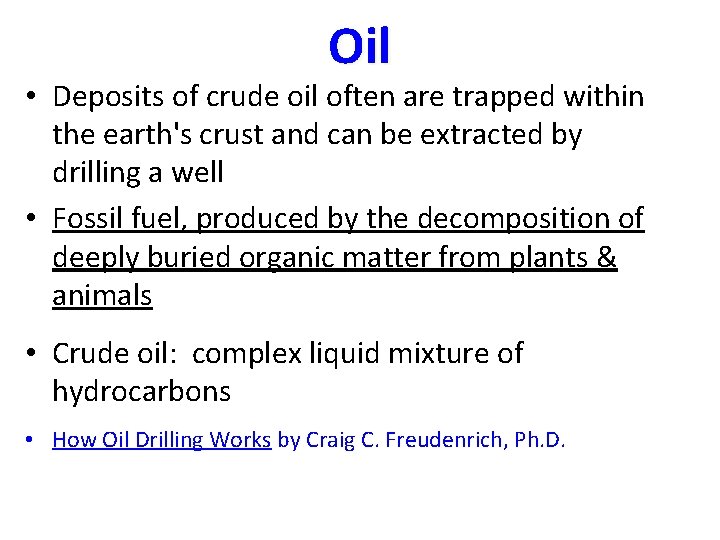
Oil • Deposits of crude oil often are trapped within the earth's crust and can be extracted by drilling a well • Fossil fuel, produced by the decomposition of deeply buried organic matter from plants & animals • Crude oil: complex liquid mixture of hydrocarbons • How Oil Drilling Works by Craig C. Freudenrich, Ph. D.
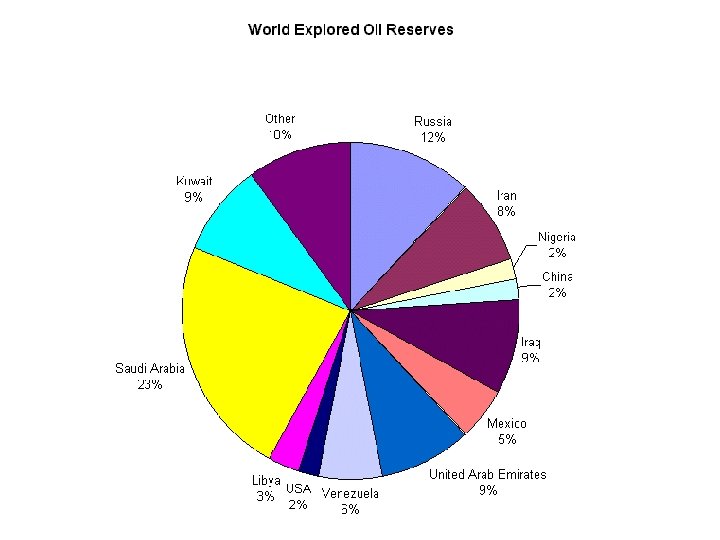
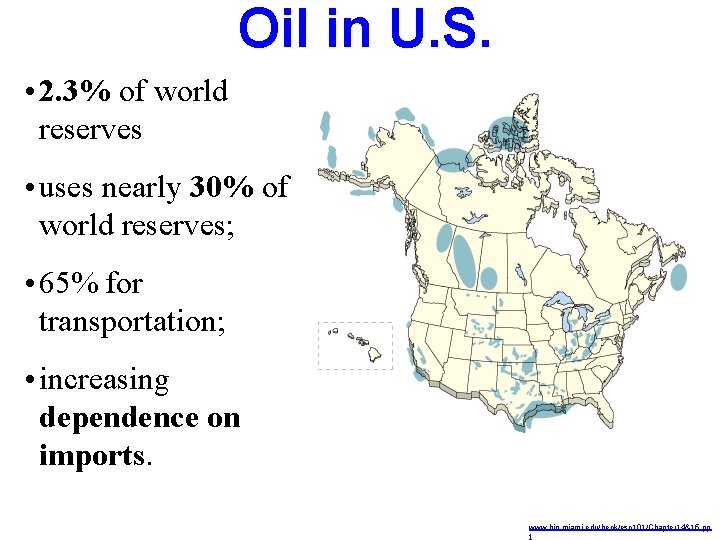
Oil in U. S. • 2. 3% of world reserves • uses nearly 30% of world reserves; • 65% for transportation; • increasing dependence on imports. www. bio. miami. edu/beck/esc 101/Chapter 14&15. pp t
www. bio. miami. edu/beck/esc 101/Chapter 14&15. pp t
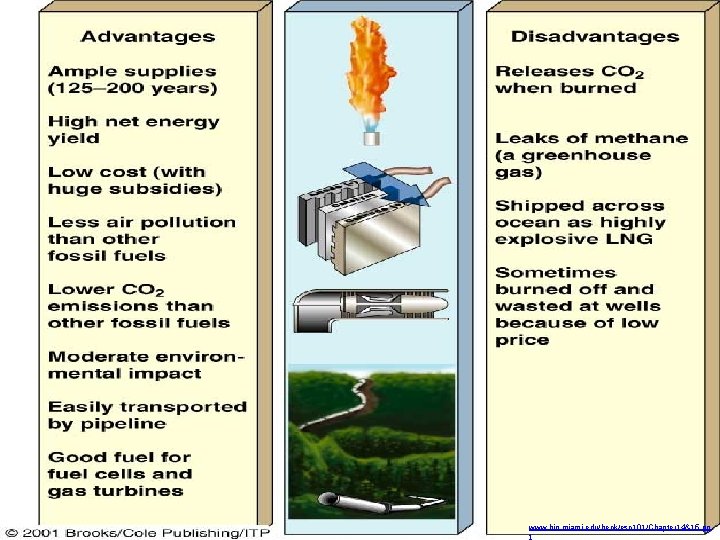
Natural Gas • Natural gas is considered a fossil fuel because natural gas was formed from the remains of tiny sea animals and plants that died 300 to 400 million years ago. • The main ingredient is methane, a natural compound that is formed whenever plant and animal matter decays. Resource: Need. org
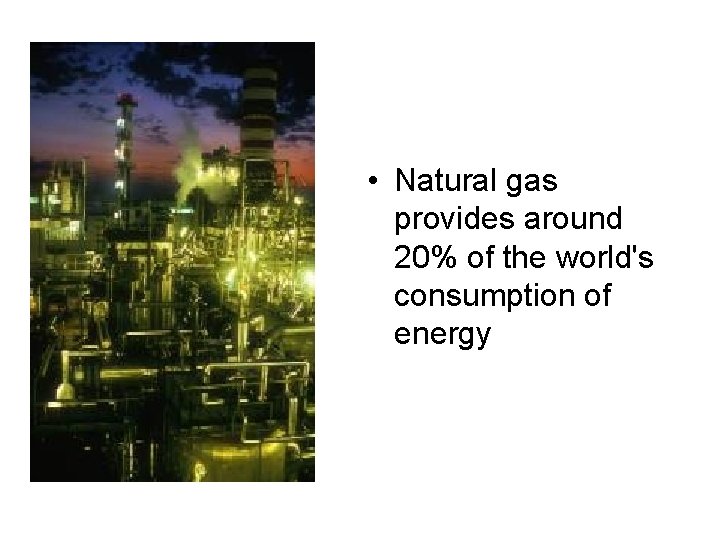
• Natural gas provides around 20% of the world's consumption of energy
• How does natural gas get to you? Usually by pipeline. – Over two million miles of underground pipelines link natural gas wells to cleaning plants to major cities across the United States • Shale gas is natural gas that is trapped in shale formations. – Shale is essentially a common form of sedimentary rock.
SHALE GAS PRODUCTION • Horizontal Drilling: A vertical well is drilled to the formation that has been identified as a natural gas reservoir • Hydraulic Fracturing: Hydraulic fracturing, or “fracking, ” uses water, silica (sand), and chemical compounds piped several thousand feet below the Earth’s surface, creating cracks or fissures in shale formations – This allows natural gas to be released and flow into the well
www. bio. miami. edu/beck/esc 101/Chapter 14&15. pp t
https: //www. youtube. com/watch? v=Uti 2 ni. W 2 BRA
Mining • There are 3 ways that Mining affects the land. – Deforestation – Loss of Biodiversity – Pollution
Mining Effects On The Land 1) Deforestation: • Mining requires large areas of land to be cleared so that the earth could be dug into by the miners. • Vegetation in the adjoining areas also needs to be cut in order to construct roads and residential facilities for the mine workers. • Leads to soil erosion
Mining Effects On The Land 2) Loss of Biodiversity: The forests that are cleared for mining purposes are home to a large number of organisms. ◦ Indiscriminate clearing of the forests leads to loss of habitat of a large number of animals. This puts the survival of a large number of animal species at stake. ◦ The cutting down of trees in itself is a big threat to a number of plants, trees, birds and animals growing in the forests.
Mining Effects On The Land 3) Pollution: • Despite measures being taken to release the chemical waste into the nearby rivers through pipes, a large amount of chemicals such as mercury, cyanide, sulfuric acid, arsenic and methyl mercury still leak out onto the land into nearby rivers. – This changes the chemical composition of the land poison the waters.
3) Pollution – Continued • The chemicals make the soil unsuitable for plants to grow. Also, the organisms that live in the soil find the polluted environment hostile for their survival. – The toxic waters kill marine organisms and make the water unsafe for human consumption.
Overall: • There is a global need to use land for human use. • More people need more homes and like the suburban feel. • As a result, there is an increase in deforestation and more of a need for agriculture land.