
HUMAN IMPACTS AND GLOBAL CLIMATE CHANGE DEFINITION FORAIR
HUMAN IMPACTS AND GLOBAL CLIMATE CHANGE
DEFINITION FORAIR POLLUTION It is defined as any atmospheric condition in which certain substances are present in such concentrations that they produce undesirable effects on humans and environment.

COMMON AIR POLLUTANTS Six major types of pollutants 1. Carbon monoxide 2. Hydrocarbons 3. Nitrogen oxides 4. Particulates 5. Sulfur dioxide 6. Photochemical oxidants.
SOURCES OF AIR POLLUTION Four major human sources 1. Power and heat generation 2. Burning of solid wastes 3. Industrial processes 4. Transportation
SOURCES OF POLLUTION Four major natural sources Volcanic eruptions( ash and dust ) Dust from loose and dry soils Pollen Spores
CATEGORIES OF POLLUTANTS Secondary Form when a primary pollutant comes in contact with other primary pollutants or naturally occurring substances like water vapor and a chemical reaction occurs. Example Ozone – Forms when oxygen in the air reacts with volatile organic compounds (VOCs) and other air pollution from trucks, cars, and natural sources in the presence of the sun’s ultraviolet rays.
SULFUR DIOXIDE (SO 2) Description Produced cy chemical reactions between sulfur and oxygen Primary Sources Comes largely from burning fossil fuels. Released from petroleum refineries, smelters, paper mills, chemical plants, and coal-burning power plants Effects Contributes to acid rain, which damages lakes, forests, metals, and stone.
NITROGEN OXIDES (NOX) Primary Sources Comes from burning fuels in vehicles, power plants and industrial boilers. Effects Can make the body vulnerable to respiratory infections, lung disease, and possibly cancer. Contributes to the brown haze often seen over congested areas Contributes to acid rain Causes metal corrosion and the fading and deterioration of fabrics
CAUSES OF AIR POLLUTION One of the main causes of air pollution is the release of carbon dioxide into the atmosphere, this happens because of deforestation and fossil fuel burning Sulfur dioxide is another air polluter and is released into the atmosphere by the burning of sulfur containing compounds of fossil fuels. Sulfur oxides are very dangerous to humans at a high concentration. Sulfur in the atmosphere is responsible for acid rain
FOCUS QUESTION HOW DO HUMANS AFFECT AIR QUALITY? Pollutants from human activities can easy combine with the atmosphere gasses. Pollutants become mobile and can negatively impact areas other than where they originate. Areas exposed to even low concentrations of pollutants can be impacted.
AIR POLLUTION ON THE BIOSPHERE Acid Shock - p. H change of the environment Cause aluminum to leech out of the soil surrounding a lake. Aluminum accumulates in the gills of fish, stimulating the mucus production. Fish slowly suffocate from the build of this mucus on their gills Cause fish and amphibians to produce few eggs that usually do not hatch Weakens the hardness of bird egg shells causing a loss of production regeneration Trees foliage is burned, and increases in soil ph cause trees to die
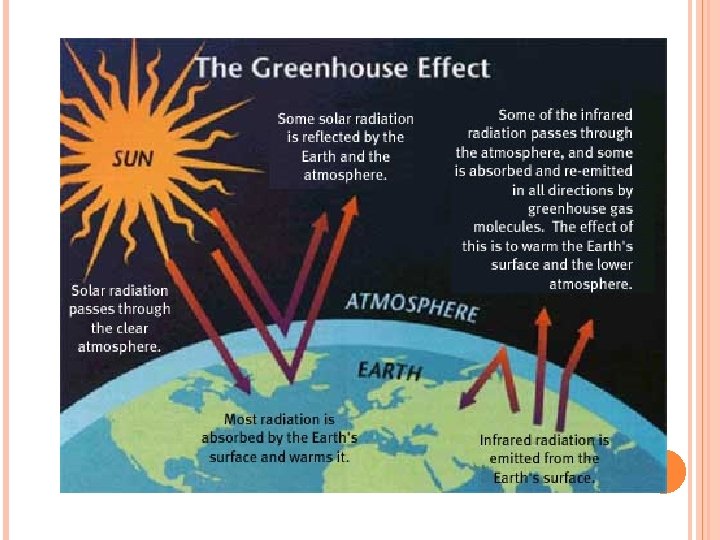
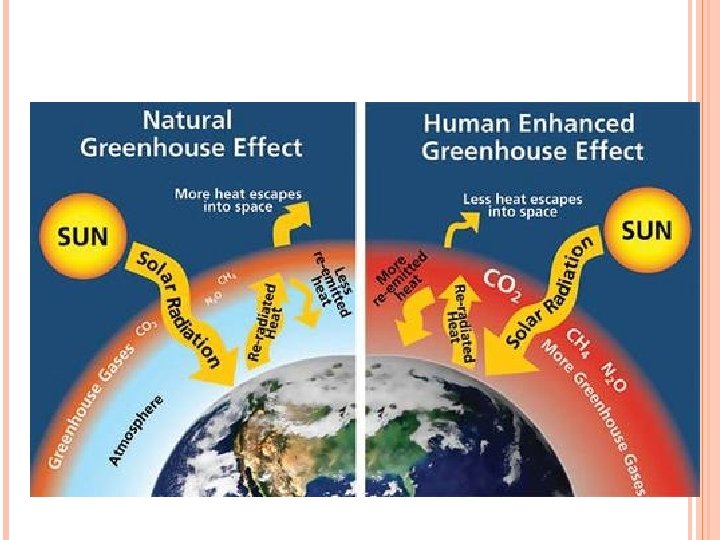
CONSEQUENCES OF AIR POLLUTION CO 2 is a good transmitter of sunlight, but it also partially restricts infrared radiation going back from the earth into space, which produces the so-called greenhouse effect that prevents a drastic cooling of the Earth during the night Increasing the amount of CO 2 in the atmosphere reinforces this effect and is expected to result in a warming of the Earth's surface CO 2 in atmosphere GLOBAL WARMING
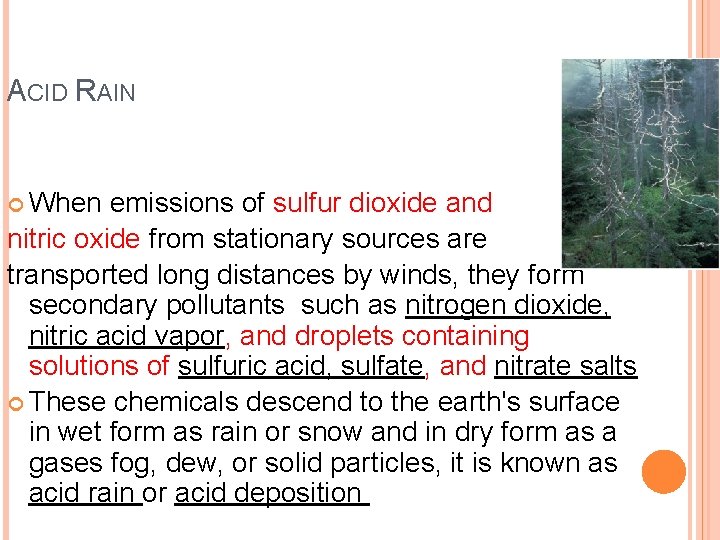
ACID RAIN When emissions of sulfur dioxide and nitric oxide from stationary sources are transported long distances by winds, they form secondary pollutants such as nitrogen dioxide, nitric acid vapor, and droplets containing solutions of sulfuric acid, sulfate, and nitrate salts These chemicals descend to the earth's surface in wet form as rain or snow and in dry form as a gases fog, dew, or solid particles, it is known as acid rain or acid deposition
CONSEQUENCES CONTINUED Sulfur dioxide, nitrogen oxides, ozone and, cause direct damage to leaves of crop plants and trees when they enter leaf pores. Chronic exposure of leaves and needles to air pollutants can also break down the waxy coating that helps prevent excessive water loss and damage from diseases, pests, drought and frost
CHANGES IN SOCIETY AND THE ECONOMY Population growth Industrialization Growth and distribution of wealth Changing social attitudes Environmental activism
REDUCTION OF AIR POLLUTION Pollutant levels are monitored. If levels are found to be greater than permissible, local authorities are contacted and a plan to bring levels down is implemented. Power plants and motor vehicle use pollution control devices to reduce or eliminate by products of fossil fuel burning. Increase use of clean alternate energy sources, such as solar, wind and hydroelectric power Design of electric and hybrid cars Energy efficiency improvements Cleaner fuels
HOW DOES THE BURNING OF FOSSIL FUELS AFFECT THE CLIMATE? When fossil fuels burned energy and gases CO 2 are released. Even though only a tiny amount of the gases in Earth’s atmosphere are greenhouse gases, they have a huge effect on climate.
There are several different types of greenhouse gases. The major ones are carbon dioxide, water vapor, methane, and nitrous oxide.
HOW DOES THE BURNING OF FOSSIL FUELS AFFECT THE CLIMATE? All of these have molecules with three or more atoms. The atoms are held together loosely enough that they vibrate when they absorb heat. Eventually, the vibrating molecule will release the radiation. The radiation will likely be absorbed by another greenhouse gas molecule. This process, which keeps heat near the Earth’s surface, is called the greenhouse effect.
IMPACT OF BURNING FOSSIL FUELS Adds CO 2 to the atmosphere Increasing amounts of CO 2 , increases the atmosphere’s capacity to absorb more heat radiated from the Earth surfaces. The atmosphere temperature increases, causing an increase in the rate of surface water evaporation The higher atmosphere temperature causes surface temperatures to increase.
Nitrogen oxides are produced by the burning of fossil fuels, the use of organic and chemical fertilizers and industrial processes. Methane gas is another greenhouse gas that has increased in the atmosphere due to cattle ranching, waste disposal in landfills and the production and distribution of natural gas.
AFFECT OF METHANE Accounts for 20% of the enhanced greenhouse effect. Lower concentrations than carbon dioxide, it produces 21 times as much warming as CO 2. Two thirds of global methane comes from man-made sources, such as the burning of fossil fuel, the accidental release during drilling for natural gas or from cattle ranching.
HYDROCARBONS An organic compound consisting of hydrogen and carbon Mineral resources from plants and marine animals Primary energy source for current civilizations Methane, coal, crude oil, natural gas Extracted from sedimentary basins, tar sands and oil shale Energy is produced when burnt
HOW DOES DEFORESTATION AFFECT THE CLIMATE? source of carbon emissions forest soak up carbon dioxide Rainforest trees draw up huge amounts of water from the soil and release most of it into the atmosphere. providing more water to the clouds to be rained back on the forest. Evaporation also helps keep the forested landscape cool. Large-scale forest loss could dry out the local climate so much that it would be difficult or impossible for the forests to grow back.
HOW DO CHANGES IN THE OZONE LAYER AFFECT CLIMATE Changes in the ozone layer have been linked to observed shifts in seasonal surface winds over the Southern Hemisphere, contributing to the Antarctic Peninsula warming and the high plateau cooling. Climate change alters the atmosphere's temperature and circulation patterns, which in turn affect the processes that deplete the ozone layer.
CLIMATE CHANGES I. Volcanic Eruptions • The presence of volcanic aerosols (ash, dust, and sulfur-based aerosols) in the air increases the amount of solar radiation that is reflected back into space. This causes Earth’s lower atmosphere to cool. II. Ocean Circulation • Changes in ocean circulation also can result in short-term climate fluctuations.
CLIMATE CHANGES III. Solar Activity • When the sun is most active, it contains dark blemishes called sunspots. The formation of sunspots appears to correspond with warm periods in Europe and North America. IV. Earth Motions • Geographic changes in Earth’s land water bodies cause changes in climate. • Changes in the shape of Earth’s orbit and the tilt of Earth on its axis are other Earth motions that affect global climates.
CLIMATE CHANGES V. The Greenhouse Effect • The greenhouse effect is a natural warming of both Earth’s lower atmosphere and Earth’s surface from solar radiation being absorbed and emitted by the atmosphere. VI. Global Warming • As a result of increased levels of carbon dioxide and other greenhouse gases, global temperatures have increased. This increase is called global warming.
Focus Question: How do human activities influences global climate change
HUMAN ACTIVITIES CAUSE CLIMATE CHANGE Cause changes in Earth’s atmosphere in the amounts of greenhouse gases, aerosols (small particles), and cloudiness. The largest known contribution comes from the burning of fossil fuels, which releases carbon dioxide gas to the atmosphere. Greenhouse gases and aerosols affect climate by altering incoming solar radiation and out-going infrared (thermal) radiation that are part of Earth’s energy balance. Changing the atmospheric abundance or properties of these gases and particles can lead to a warming or cooling of the climate system. Since the start of the industrial era (about 1750), the overall effect of human activities on climate has been a warming influence. The human impact on climate during this era greatly exceeds that due to known changes in natural processes, such as solar changes and volcanic eruptions.
Greenhouse Effect The greenhouse effect is appropriately named due to the fact that it functions in much the same way as a greenhouse. The sun emits short wavelengths that can pass through the atmosphere for the most part.
GREENHOUSE EFFECT Without the greenhouse effect, much of Earth’s heat energy would be lost to outer space. Earth’s average temperature would be about 33°C cooler than it is now – freezing! The greenhouse effect has helped Earth thrive as a planet. However, recently we have seen a significant increase in levels of carbon dioxide in the atmosphere. We are watching to see if the global heat budget is getting out of balance.
WHAT IS GLOBAL WARMING?
WHAT IS GLOBAL WARMING? Lesson Objectives: • To understand what is meant by ‘global warming’ • To know what we think causes global warming. • To begin to understand how our activities can cause climate change.
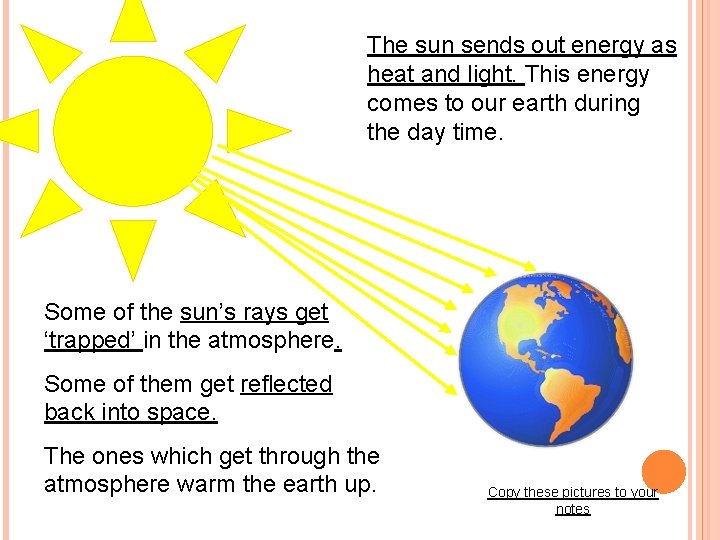
The sun sends out energy as heat and light. This energy comes to our earth during the day time. Some of the sun’s rays get ‘trapped’ in the atmosphere. Some of them get reflected back into space. The ones which get through the atmosphere warm the earth up. Copy these pictures to your notes
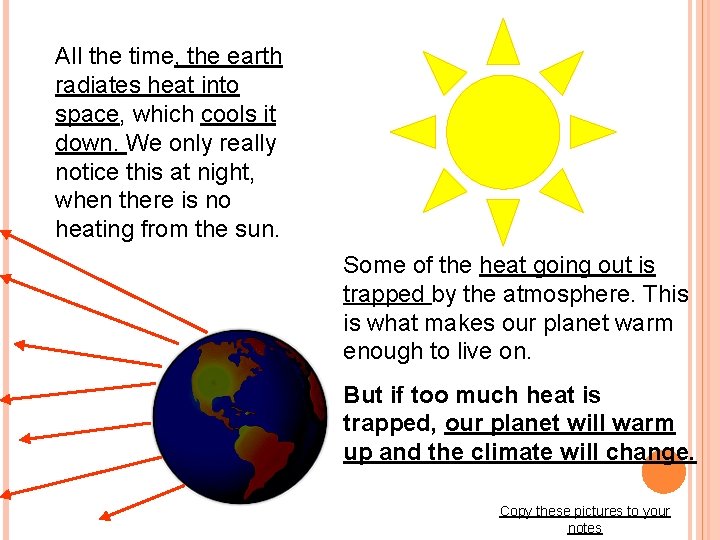
All the time, the earth radiates heat into space, which cools it down. We only really notice this at night, when there is no heating from the sun. Some of the heat going out is trapped by the atmosphere. This is what makes our planet warm enough to live on. But if too much heat is trapped, our planet will warm up and the climate will change. Copy these pictures to your notes
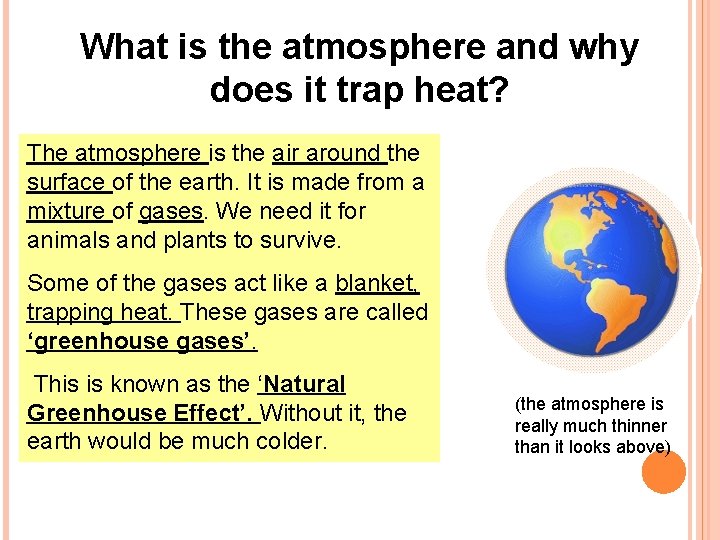
What is the atmosphere and why does it trap heat? The atmosphere is the air around the surface of the earth. It is made from a mixture of gases. We need it for animals and plants to survive. Some of the gases act like a blanket, trapping heat. These gases are called ‘greenhouse gases’. This is known as the ‘Natural Greenhouse Effect’. Without it, the earth would be much colder. (the atmosphere is really much thinner than it looks above)
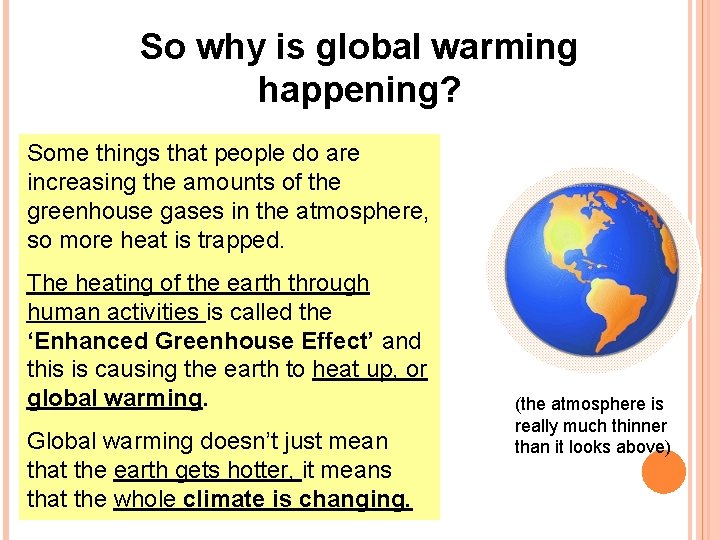
So why is global warming happening? Some things that people do are increasing the amounts of the greenhouse gases in the atmosphere, so more heat is trapped. The heating of the earth through human activities is called the ‘Enhanced Greenhouse Effect’ and this is causing the earth to heat up, or global warming. Global warming doesn’t just mean that the earth gets hotter, it means that the whole climate is changing. (the atmosphere is really much thinner than it looks above)
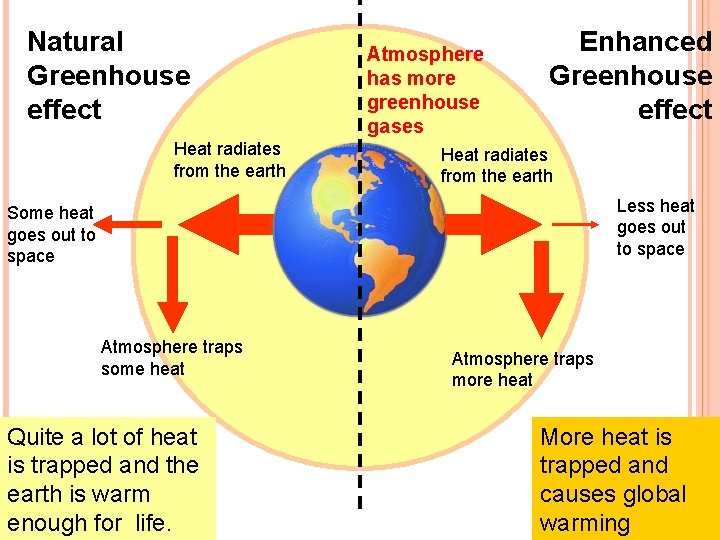
Natural Greenhouse effect Heat radiates from the earth Atmosphere has more greenhouse gases Enhanced Greenhouse effect Heat radiates from the earth Less heat goes out to space Some heat goes out to space Atmosphere traps some heat Quite a lot of heat is trapped and the earth is warm enough for life. Atmosphere traps more heat More heat is trapped and causes global warming
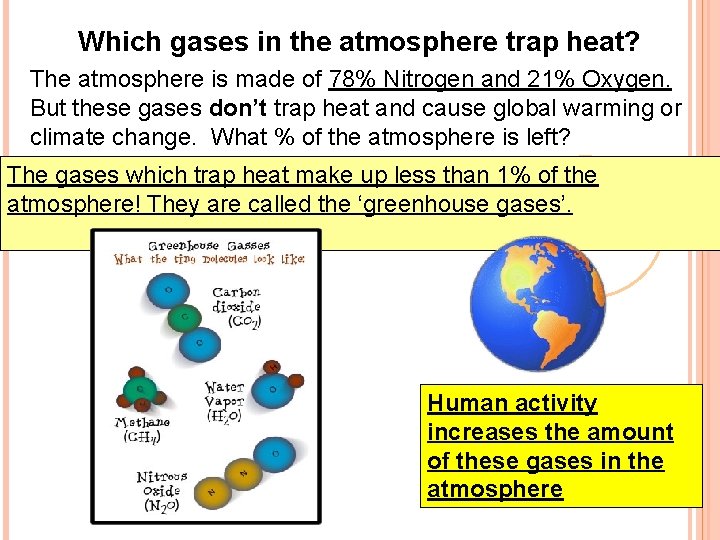
Which gases in the atmosphere trap heat? The atmosphere is made of 78% Nitrogen and 21% Oxygen. But these gases don’t trap heat and cause global warming or climate change. What % of the atmosphere is left? The gases which trap heat make up less than 1% of the atmosphere! They are called the ‘greenhouse gases’. Human activity increases the amount of these gases in the atmosphere
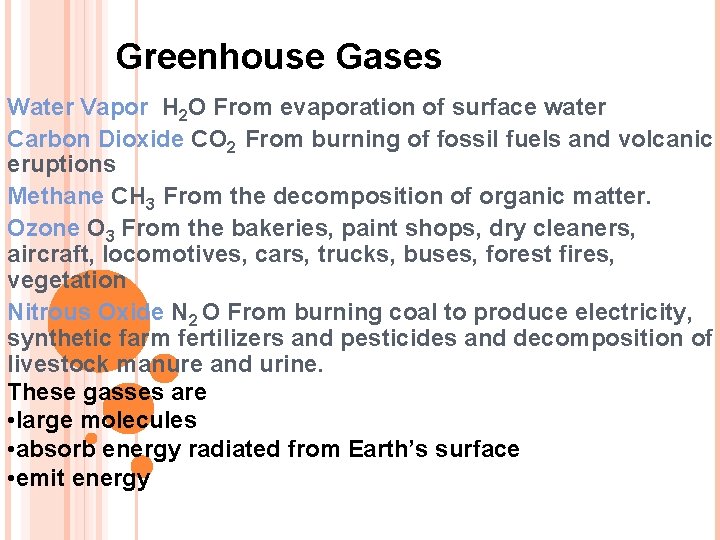
Greenhouse Gases Water Vapor H 2 O From evaporation of surface water Carbon Dioxide CO 2 From burning of fossil fuels and volcanic eruptions Methane CH 3 From the decomposition of organic matter. Ozone O 3 From the bakeries, paint shops, dry cleaners, aircraft, locomotives, cars, trucks, buses, forest fires, vegetation Nitrous Oxide N 2 O From burning coal to produce electricity, synthetic farm fertilizers and pesticides and decomposition of livestock manure and urine. These gasses are • large molecules • absorb energy radiated from Earth’s surface • emit energy
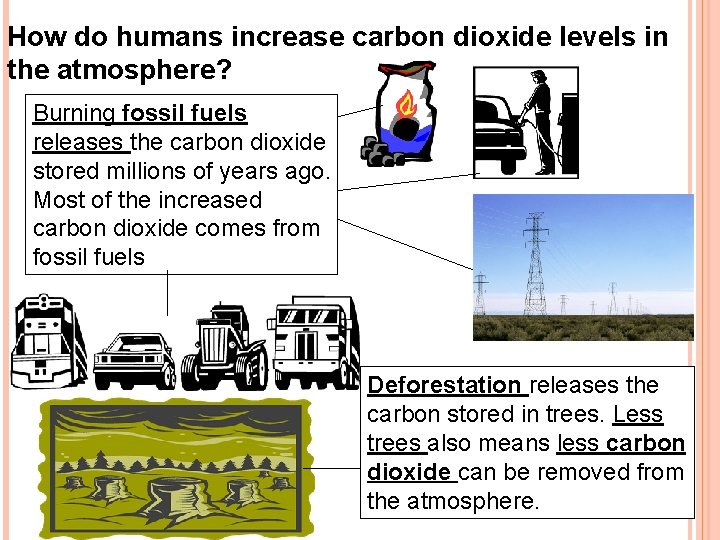
How do humans increase carbon dioxide levels in the atmosphere? Burning fossil fuels releases the carbon dioxide stored millions of years ago. Most of the increased carbon dioxide comes from fossil fuels Deforestation releases the carbon stored in trees. Less trees also means less carbon dioxide can be removed from the atmosphere.
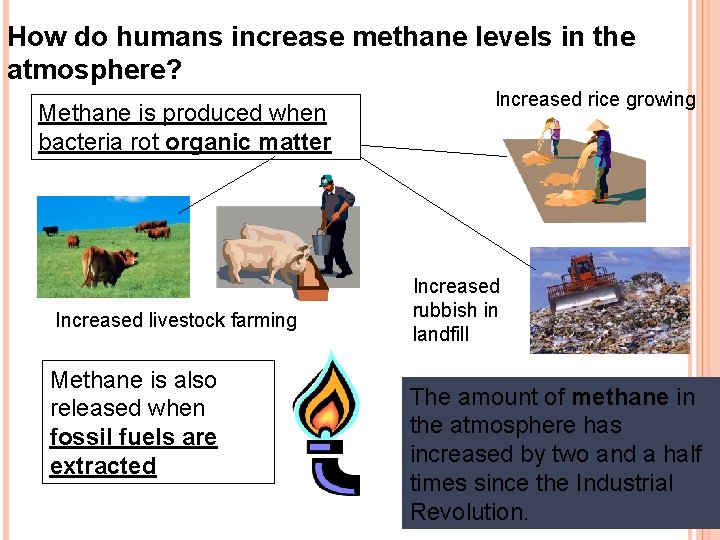
How do humans increase methane levels in the atmosphere? Methane is produced when bacteria rot organic matter Increased livestock farming Methane is also released when fossil fuels are extracted Increased rice growing Increased rubbish in landfill The amount of methane in the atmosphere has increased by two and a half times since the Industrial Revolution.
Imagine that… You are an intern working with a U. S. Senator who is required to make important decisions about legislation designed to limit the impacts of global climate change. 46
YOUR JOB IS TO HELP THESENATOR… ü Understand the science behind climate change. ü Appreciate the impact of global climate change. ü Assess the effects of human activities on global climate change. 47
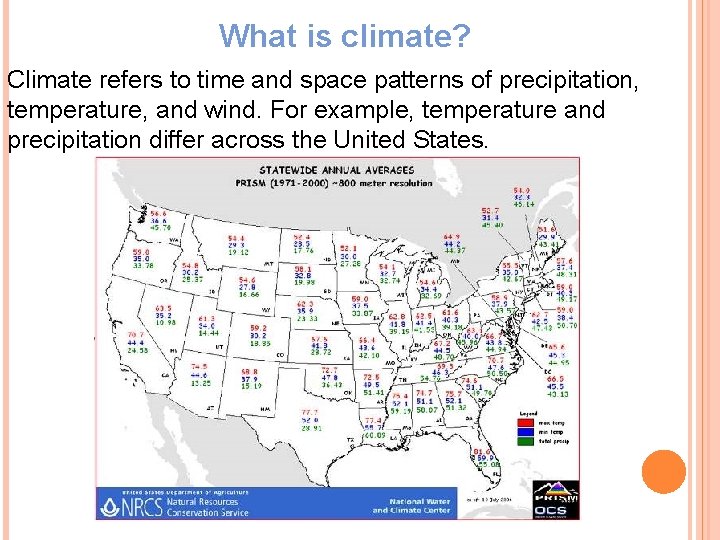
What is climate? Climate refers to time and space patterns of precipitation, temperature, and wind. For example, temperature and precipitation differ across the United States.
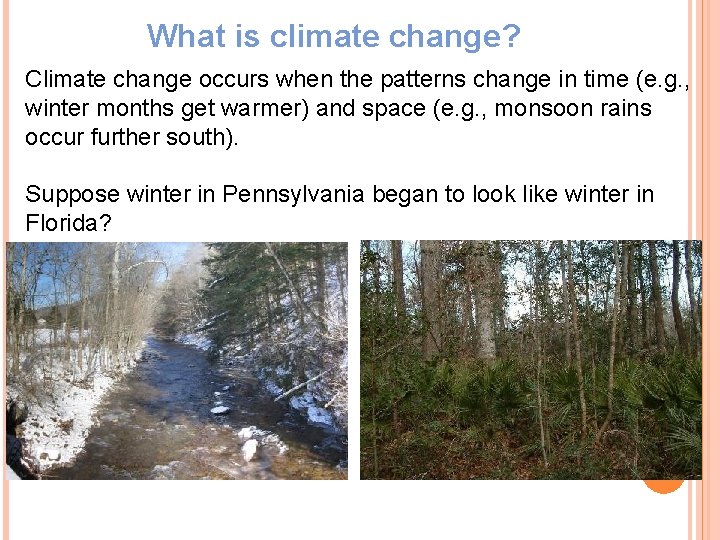
What is climate change? Climate change occurs when the patterns change in time (e. g. , winter months get warmer) and space (e. g. , monsoon rains occur further south). Suppose winter in Pennsylvania began to look like winter in Florida? 49
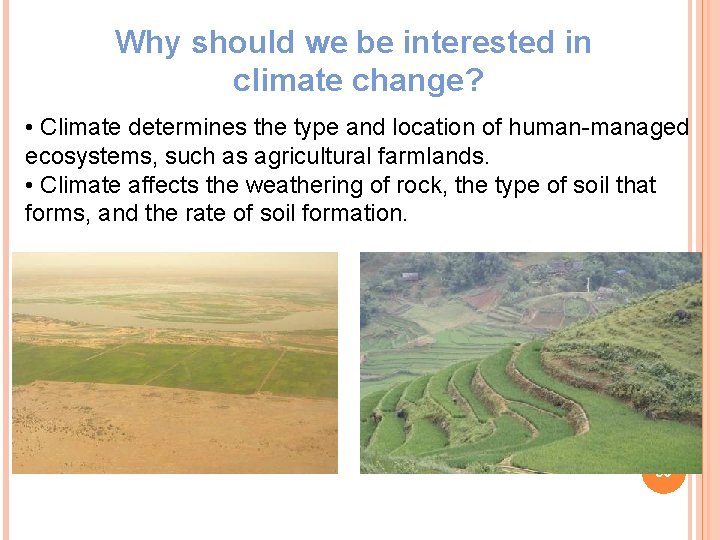
Why should we be interested in climate change? • Climate determines the type and location of human-managed ecosystems, such as agricultural farmlands. • Climate affects the weathering of rock, the type of soil that forms, and the rate of soil formation. 50
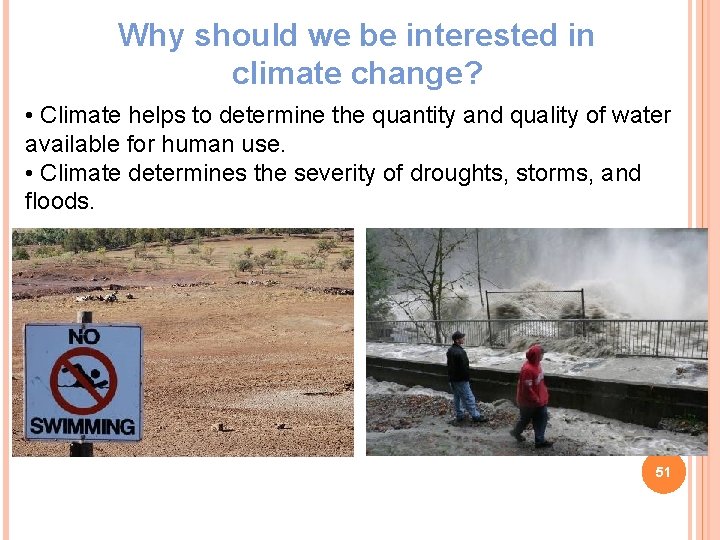
Why should we be interested in climate change? • Climate helps to determine the quantity and quality of water available for human use. • Climate determines the severity of droughts, storms, and floods. 51
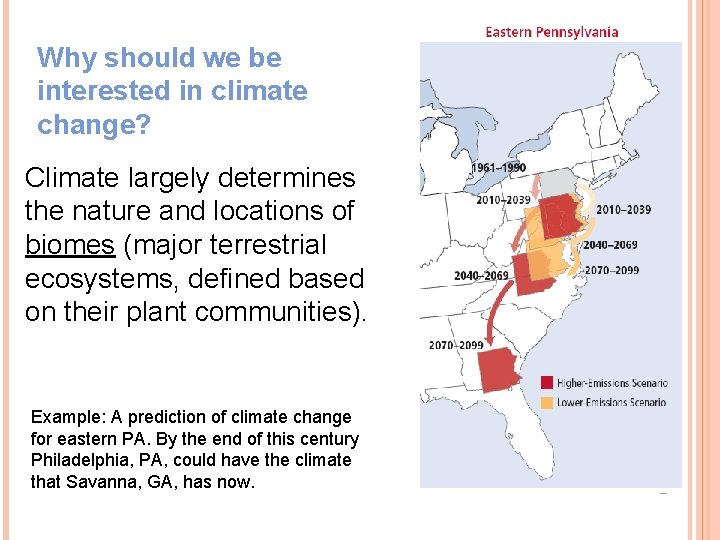
Why should we be interested in climate change? Climate largely determines the nature and locations of biomes (major terrestrial ecosystems, defined based on their plant communities). Example: A prediction of climate change for eastern PA. By the end of this century Philadelphia, PA, could have the climate that Savanna, GA, has now.
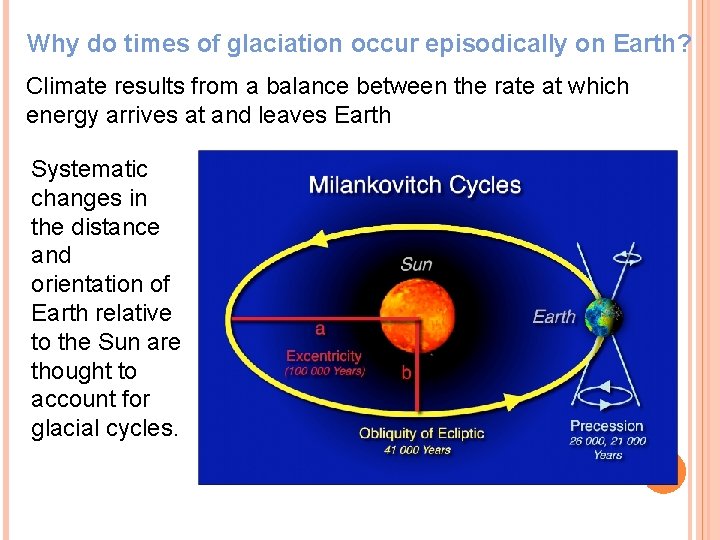
Why do times of glaciation occur episodically on Earth? Climate results from a balance between the rate at which energy arrives at and leaves Earth Systematic changes in the distance and orientation of Earth relative to the Sun are thought to account for glacial cycles.
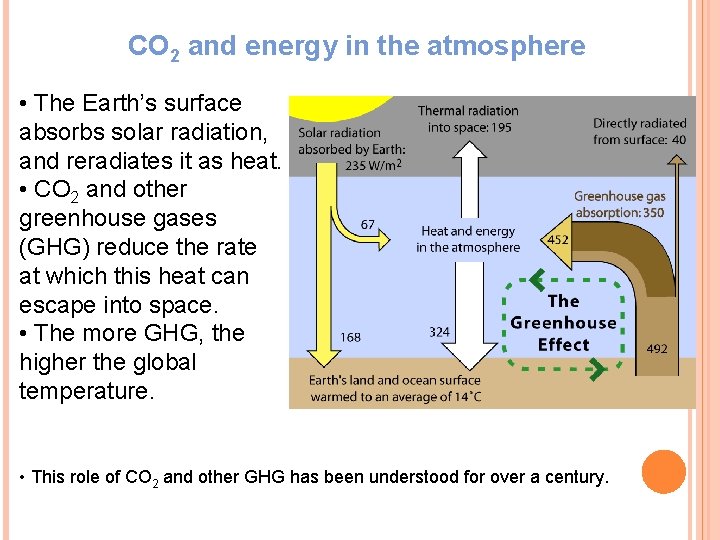
CO 2 and energy in the atmosphere • The Earth’s surface absorbs solar radiation, and reradiates it as heat. • CO 2 and other greenhouse gases (GHG) reduce the rate at which this heat can escape into space. • The more GHG, the higher the global temperature. • This role of CO 2 and other GHG has been understood for over a century.
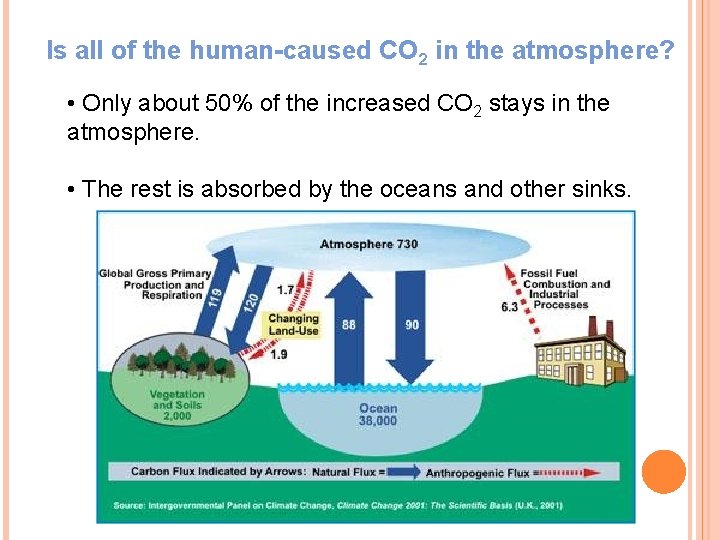
Is all of the human-caused CO 2 in the atmosphere? • Only about 50% of the increased CO 2 stays in the atmosphere. • The rest is absorbed by the oceans and other sinks.
WE HUMANS ARE THOUGHT TO BE THE MAIN CAUSE OF GLOBAL WARMING AND CLIMATE CHANGE……. . BUT WE STILL HAVE THE CHANCE TO DO SOMETHING ABOUT IT.
- Slides: 56