
HUMAN IMPACT ROUTE ASSESSMENT IDENTIFYING RISKS TO VULNERABLE
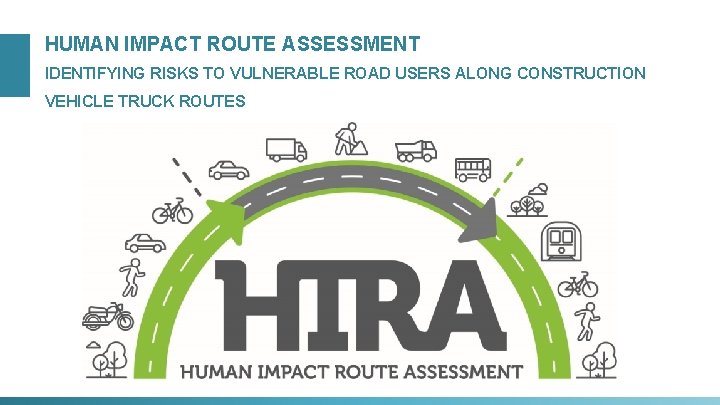
HUMAN IMPACT ROUTE ASSESSMENT IDENTIFYING RISKS TO VULNERABLE ROAD USERS ALONG CONSTRUCTION VEHICLE TRUCK ROUTES

ROUTE CHOICE WORKING GROUP Route Choice Working Group (core) • Jennifer Thompson, Vic. Roads • Victor Trumper, Vic. Roads • Lora Colussi, Aurecon With thanks to the following contributors: • Dane Miokovic, Melbourne Metro Rail Authority & Vic. Roads • Andrew Cron, City of Melbourne • Fu-Ho Chung, Vic. Roads • Ben Phillips, Vic. Roads • Simon Mcleish, Fulton Hogan • Ken Beer, Safe Systems Solutions • Johann Tay, Safe System Solutions • Matthew Bennett, RMIT (as independent reviewer)
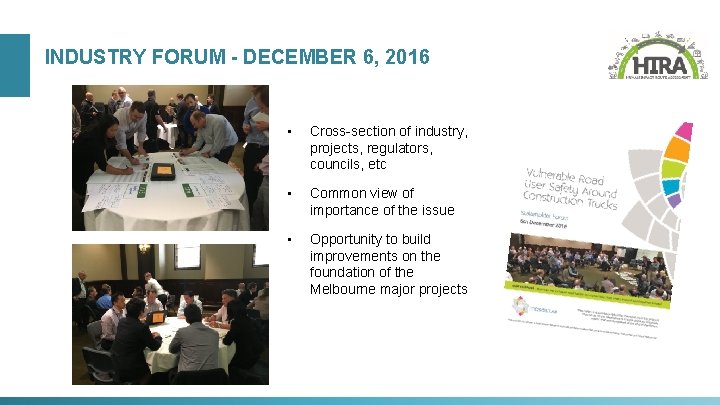
INDUSTRY FORUM - DECEMBER 6, 2016 • Cross-section of industry, projects, regulators, councils, etc • Common view of importance of the issue • Opportunity to build improvements on the foundation of the Melbourne major projects
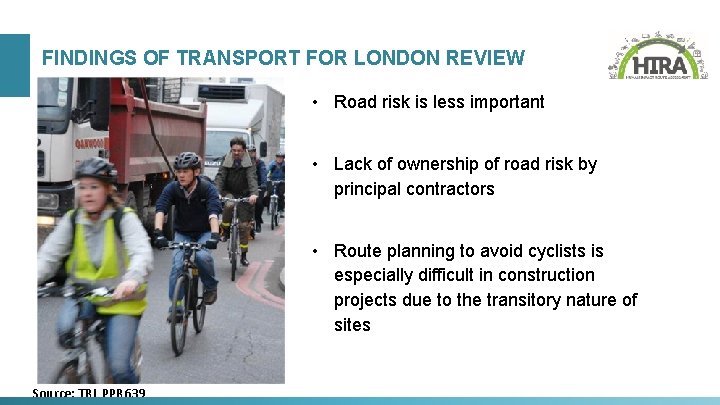
FINDINGS OF TRANSPORT FOR LONDON REVIEW • Road risk is less important • Lack of ownership of road risk by principal contractors • Route planning to avoid cyclists is especially difficult in construction projects due to the transitory nature of sites Source: TRL PPR 639

CURRENT PRACTICE

GAPS IN THE CURRENT ROUTE SELECTION PROCESS
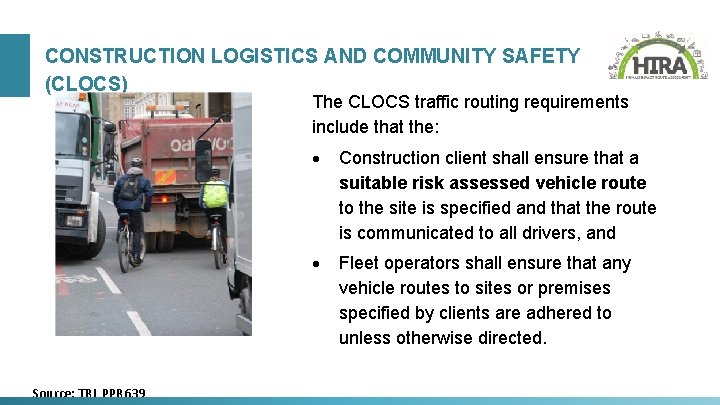
CONSTRUCTION LOGISTICS AND COMMUNITY SAFETY (CLOCS) The CLOCS traffic routing requirements include that the: Source: TRL PPR 639 Construction client shall ensure that a suitable risk assessed vehicle route to the site is specified and that the route is communicated to all drivers, and Fleet operators shall ensure that any vehicle routes to sites or premises specified by clients are adhered to unless otherwise directed.
INTRODUCING HIRA
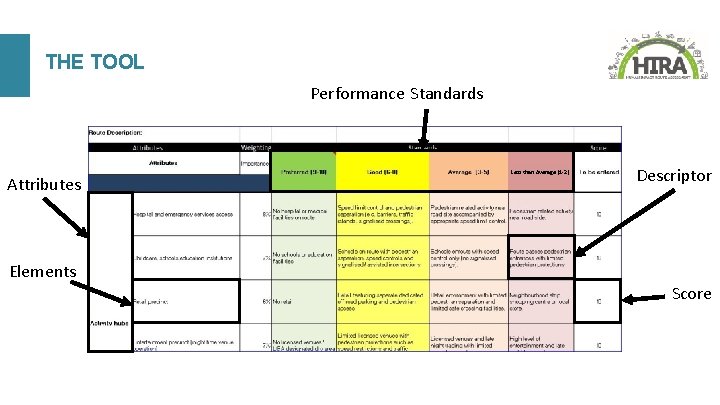
THE TOOL Performance Standards Attributes Elements Less than Average (1 -2) Descriptor Score

INTRODUCING HIRA – ATTRIBUTES AND ELEMENTS Activity Hubs Route Dynamics • • Hospital or emergency services access Childcare, schools, education institutions Retail precinct Entertainment precinct (night venue operation) Sporting and recreational precinct / facility Service access and trader deliveries Public Transport • • En route public transport Stops / station • • Flexibility – ease of access to alternatives Distance and directness (inc. number of turns required of trucks) Conflict with other construction projects Road types and function Active transport (cycling / skateboards etc) En route holding / staging areas Road Closures/Events • Intermittent road closures (LGA, Vic. Roads) – for events, protests, festival or works

PROCESS
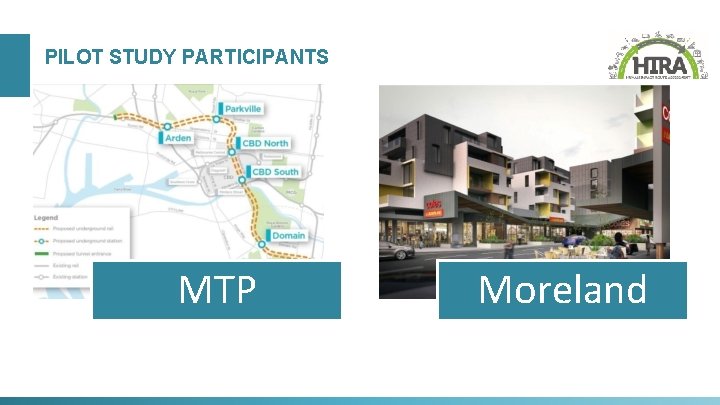
PILOT STUDY PARTICIPANTS MTP Moreland
PILOT STUDY KEY EVALUATION QUESTIONS Did HIRA Perform Positively in the Pilot Study? 1. Did HIRA support and affect collaborative decision-making on route selection? 2. Can HIRA be of value to participants? 3. How can HIRA be further developed?
PRE-WORKSHOP QUESTIONNAIRE 1. Diversity of stakeholders 2. Route preconceptions 3. Expected benefits 4. Perceived gaps
POST-WORKSHOP QUESTIONNAIRE 1. Perceived value of HIRA 2. Perceived gaps 3. Comparison with Business as Usual 4. Further development
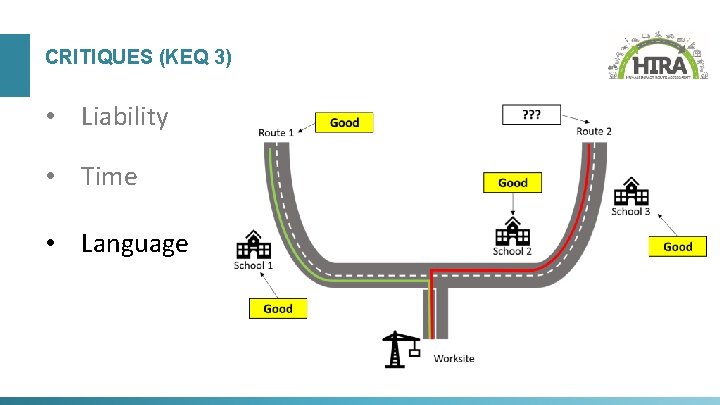
CRITIQUES (KEQ 3) • Liability • Time • Language
RECOMMENDATIONS 1. Improve introduction to HIRA 2. Re-word descriptors 3. Re-order attributes
KEQ 1 & 2 RESULTS Benefits of Collaborative Decision-making • Multi-agency discussion • Information sharing Value of HIRA • Risk identification • Proof of risk assessment • Inclusion of VRU safety in decisions
LOOKING HEAD…… • Tool refinement • Web interface linking to other government resources • Tool governance
- Slides: 19