
HUMAN IMPACT on the BIOSPHERE Chapter 6 2
HUMAN IMPACT on the BIOSPHERE Chapter 6 -2 Renewable and Non-renewable Resources
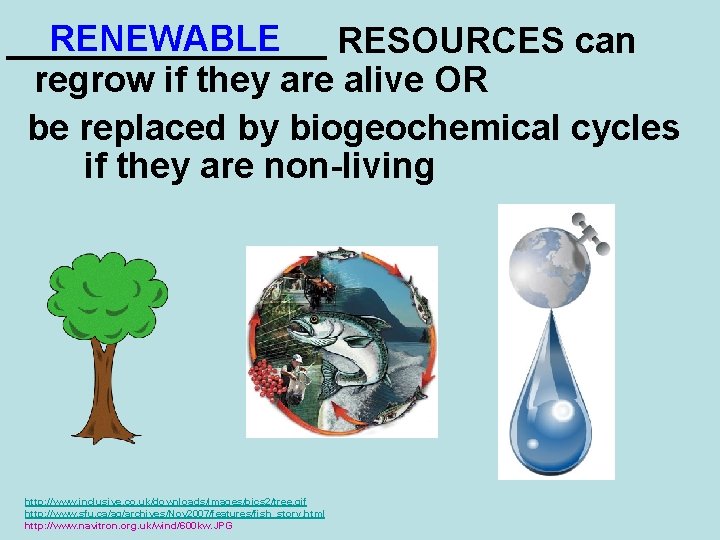
RENEWABLE ________ RESOURCES can regrow if they are alive OR be replaced by biogeochemical cycles if they are non-living http: //www. inclusive. co. uk/downloads/images/pics 2/tree. gif http: //www. sfu. ca/aq/archives/Nov 2007/features/fish_story. html http: //www. navitron. org. uk/wind/600 kw. JPG
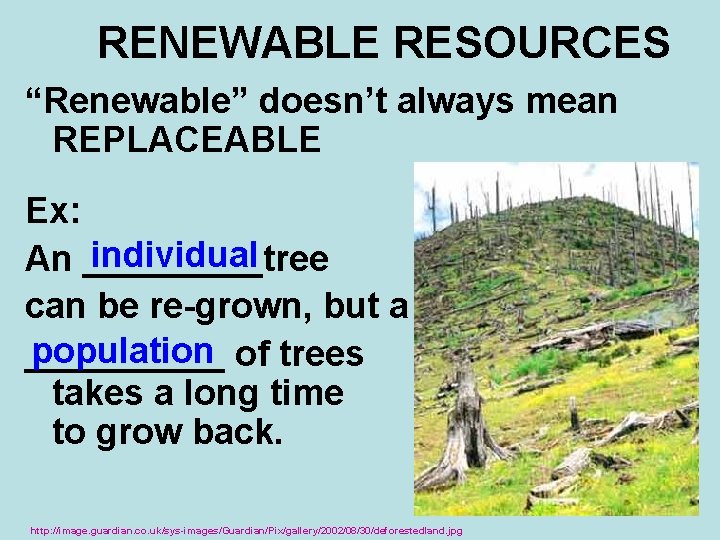
RENEWABLE RESOURCES “Renewable” doesn’t always mean REPLACEABLE Ex: individual An _____tree can be re-grown, but a population of trees _____ takes a long time to grow back. http: //image. guardian. co. uk/sys-images/Guardian/Pix/gallery/2002/08/30/deforestedland. jpg
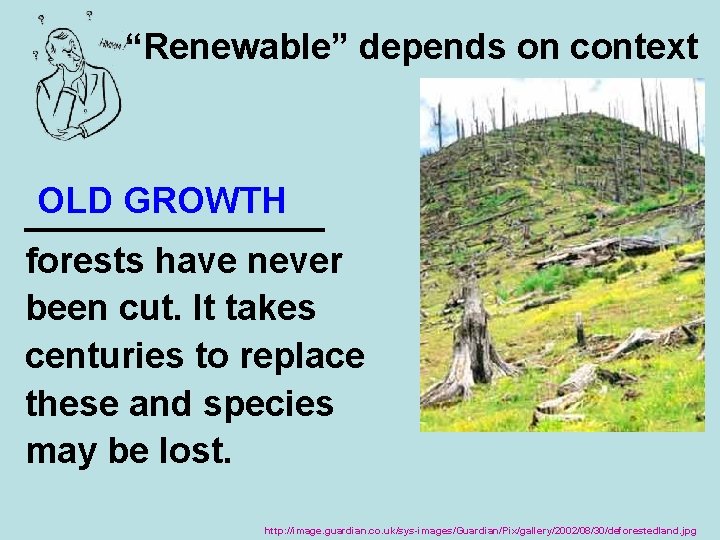
“Renewable” depends on context OLD GROWTH ________ forests have never been cut. It takes centuries to replace these and species may be lost. http: //image. guardian. co. uk/sys-images/Guardian/Pix/gallery/2002/08/30/deforestedland. jpg
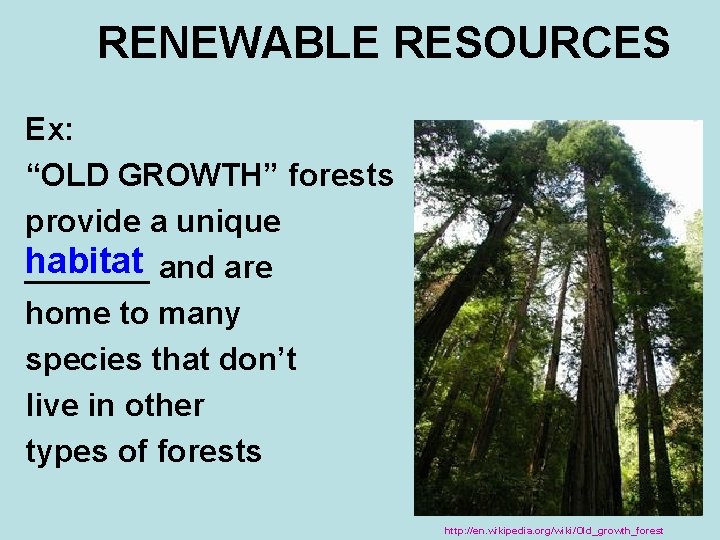
RENEWABLE RESOURCES Ex: “OLD GROWTH” forests provide a unique habitat _______ and are home to many species that don’t live in other types of forests http: //en. wikipedia. org/wiki/Old_growth_forest
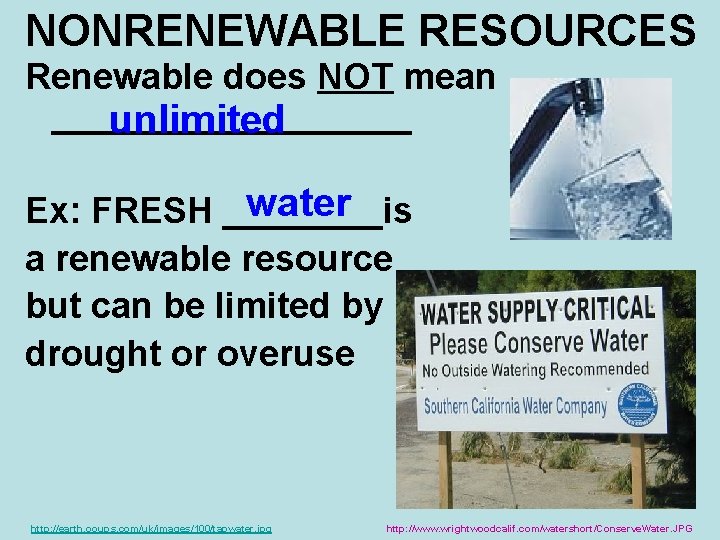
NONRENEWABLE RESOURCES Renewable does NOT mean _________ unlimited water Ex: FRESH ____is a renewable resource but can be limited by drought or overuse http: //earth. ooups. com/uk/images/100/tapwater. jpg http: //www. wrightwoodcalif. com/watershort/Conserve. Water. JPG
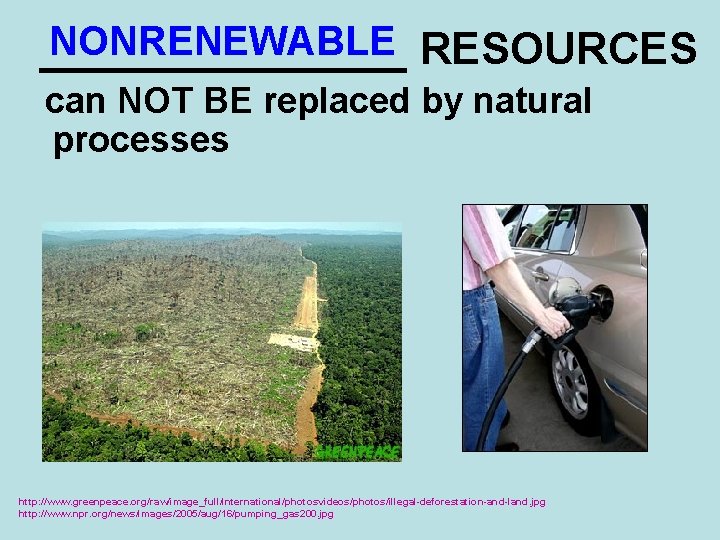
NONRENEWABLE RESOURCES ________ can NOT BE replaced by natural processes http: //www. greenpeace. org/raw/image_full/international/photosvideos/photos/illegal-deforestation-and-land. jpg http: //www. npr. org/news/images/2005/aug/16/pumping_gas 200. jpg
One ANSWER to ? SUSTAINABLE = __________DEVELOPMENT It’s a way of using natural resources without using them up AND without causing harm to the planet
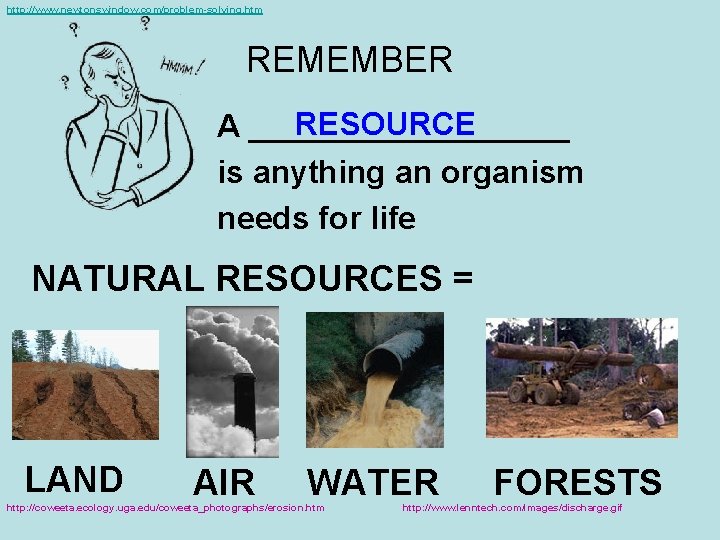
http: //www. newtonswindow. com/problem-solving. htm REMEMBER RESOURCE A _________ is anything an organism needs for life NATURAL RESOURCES = LAND AIR WATER http: //coweeta. ecology. uga. edu/coweeta_photographs/erosion. htm FORESTS http: //www. lenntech. com/images/discharge. gif
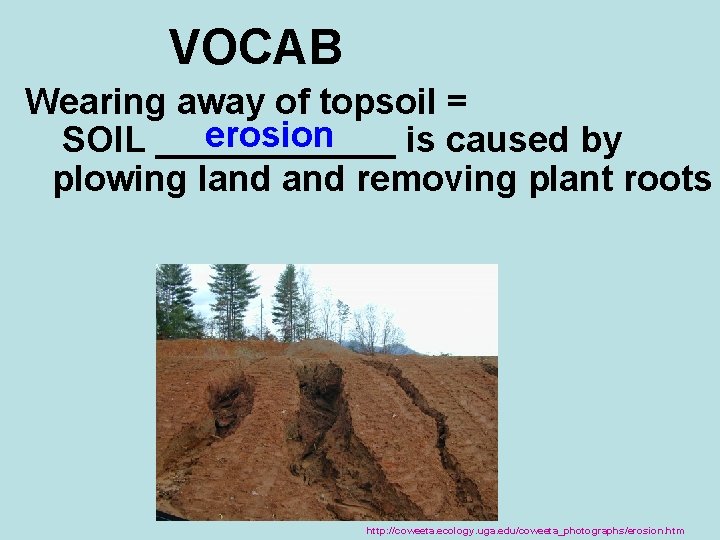
VOCAB Wearing away of topsoil = erosion SOIL ______ is caused by plowing land removing plant roots http: //coweeta. ecology. uga. edu/coweeta_photographs/erosion. htm
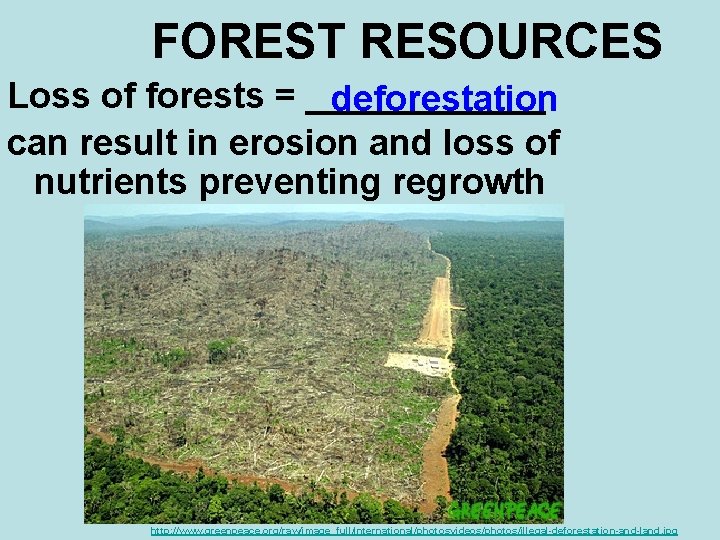
FOREST RESOURCES Loss of forests = ______ deforestation can result in erosion and loss of nutrients preventing regrowth http: //www. greenpeace. org/raw/image_full/international/photosvideos/photos/illegal-deforestation-and-land. jpg
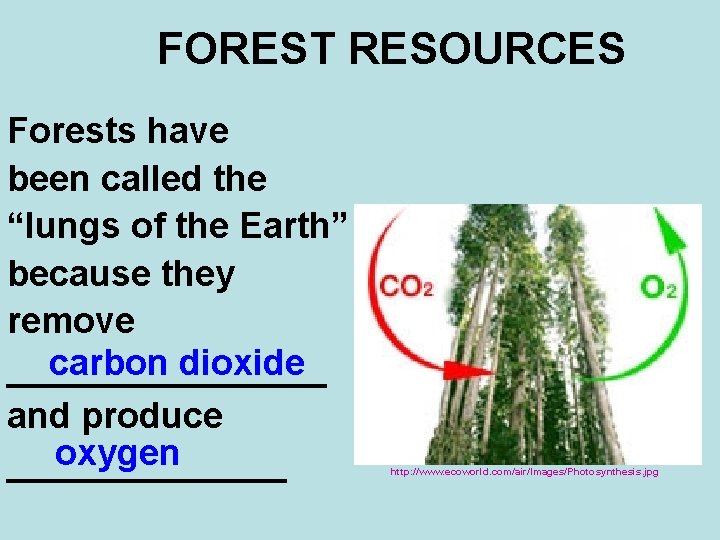
FOREST RESOURCES Forests have been called the “lungs of the Earth” because they remove carbon dioxide ________ and produce oxygen _______ http: //www. ecoworld. com/air/Images/Photosynthesis. jpg
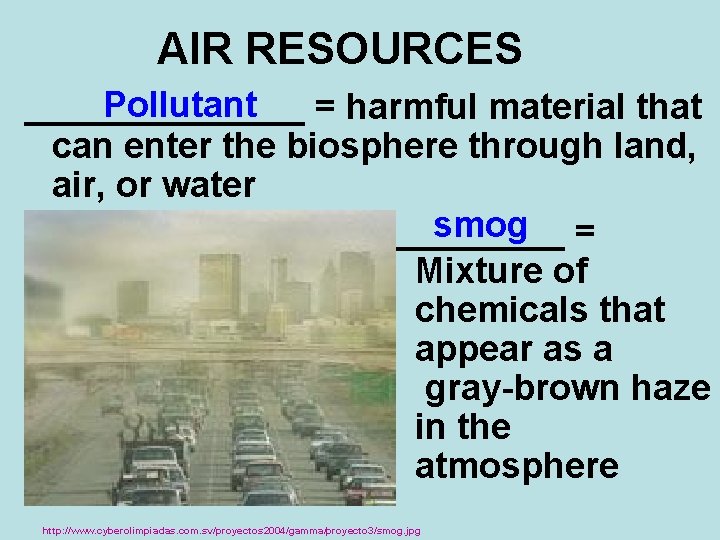
AIR RESOURCES Pollutant _______ = harmful material that can enter the biosphere through land, air, or water smog = _____ Mixture of chemicals that appear as a gray-brown haze in the atmosphere http: //www. cyberolimpiadas. com. sv/proyectos 2004/gamma/proyecto 3/smog. jpg
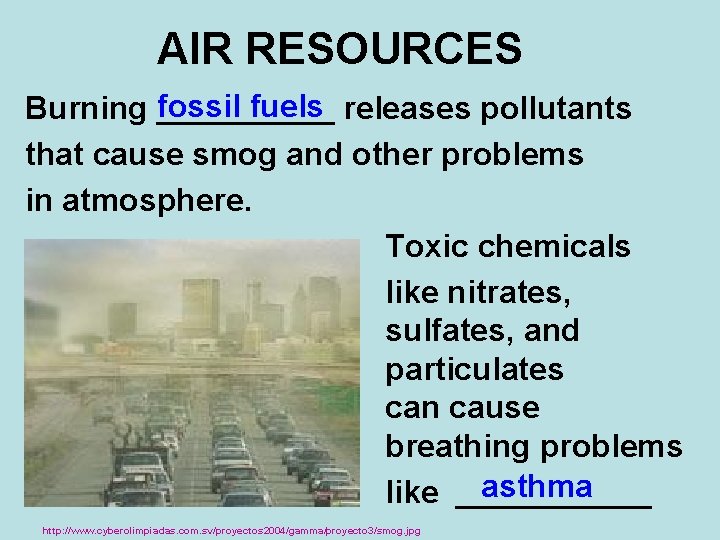
AIR RESOURCES fossil fuels releases pollutants Burning _____ that cause smog and other problems in atmosphere. Toxic chemicals like nitrates, sulfates, and particulates can cause breathing problems asthma like ______ http: //www. cyberolimpiadas. com. sv/proyectos 2004/gamma/proyecto 3/smog. jpg
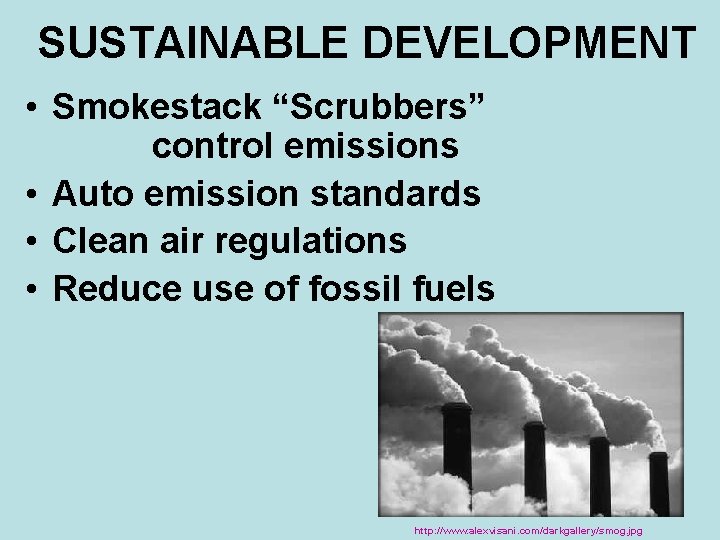
SUSTAINABLE DEVELOPMENT • Smokestack “Scrubbers” control emissions • Auto emission standards • Clean air regulations • Reduce use of fossil fuels http: //www. alexvisani. com/darkgallery/smog. jpg
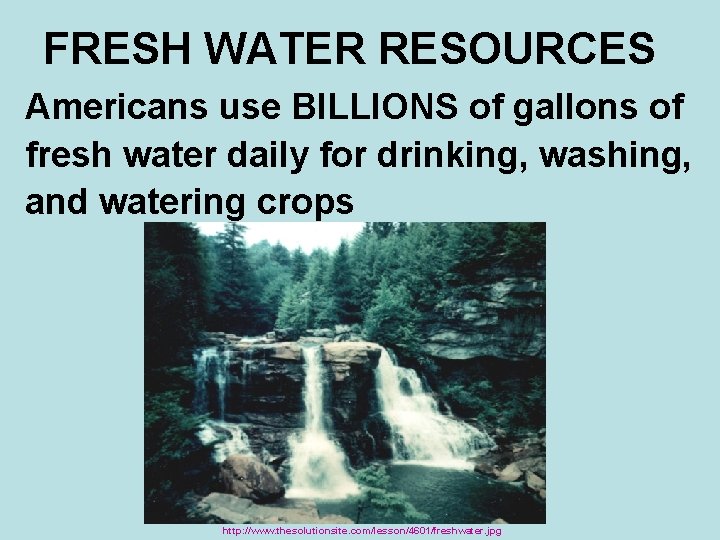
FRESH WATER RESOURCES Americans use BILLIONS of gallons of fresh water daily for drinking, washing, and watering crops http: //www. thesolutionsite. com/lesson/4601/freshwater. jpg
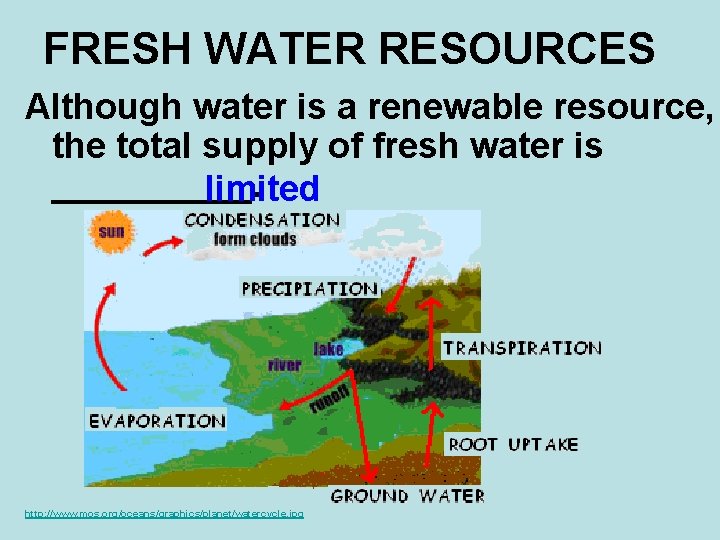
FRESH WATER RESOURCES Although water is a renewable resource, the total supply of fresh water is _____. limited http: //www. mos. org/oceans/graphics/planet/watercycle. jpg
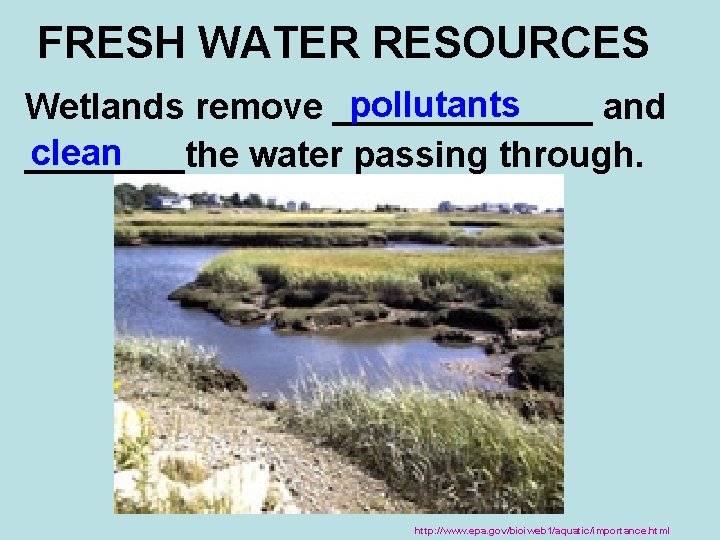
FRESH WATER RESOURCES pollutants Wetlands remove _______ and clean ____the water passing through. http: //www. epa. gov/bioiweb 1/aquatic/importance. html
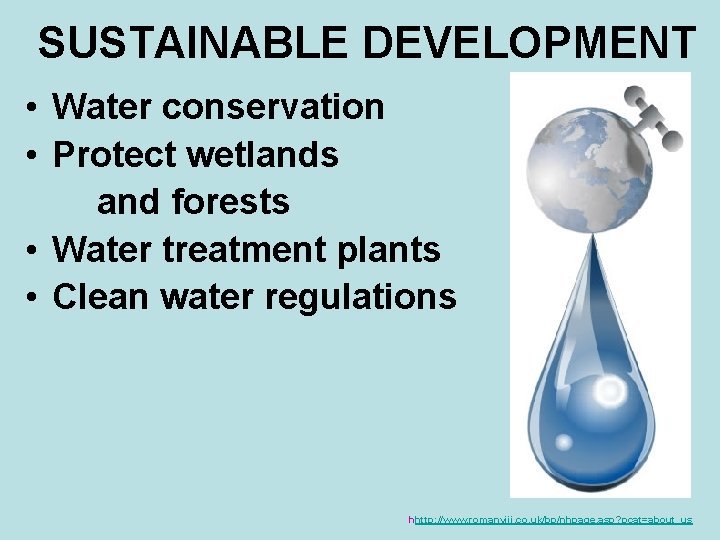
SUSTAINABLE DEVELOPMENT • Water conservation • Protect wetlands and forests • Water treatment plants • Clean water regulations hhttp: //www. romanviii. co. uk/bp/nhpage. asp? pcat=about_us
DON’T FORGET THE WATER WE CAN’T SEE! The PRODUCTION OF: • 1 kg wheat costs 1, 300 L water • 1 kg rice costs 3, 400 L water • 1 kg eggs costs 3, 300 L water • 1 kg beef costs 15, 000 L water • 1 cotton shirt costs 2, 500 L water • 1000 g of blue jeans costs 10, 850 liters water • 1 ton passenger car costs 400, 000 liters of water • Building a house uses about 6 million liters of water
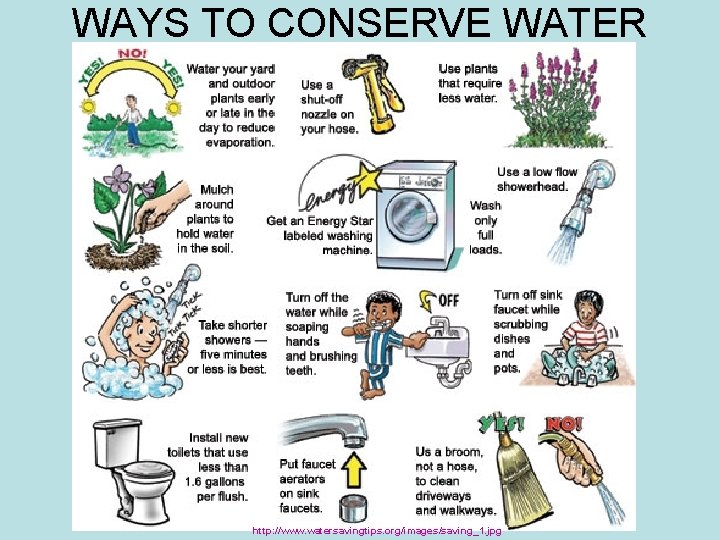
WAYS TO CONSERVE WATER http: //www. watersavingtips. org/images/saving_1. jpg
SOUTH DAKOTA CORE SCIENCE STANDARDS NATURE OF SCIENCE: Indicator 1: Understand the nature and origin of scientific knowledge 9 -12. N. 1. 1. Students are able to evaluate a scientific discovery to determine and describe how societal, cultural, and personal beliefs influence scientific investigations and interpretations • Recognize scientific knowledge is not merely a set of static facts but is dynamic and affords the best current explanations. • Discuss how progress in science can be affected by social issues.
SOUTH DAKOTA CORE SCIENCE STANDARDS NATURE OF SCIENCE: Indicator 1: Understand the nature and origin of scientific knowledge 9 -12. N. 1. 2. Students are able to describe the role of observation and evidence in the development and modification of hypotheses, theories, and laws. • Recognize and analyze alternative explanations and models. • Evaluate the scientific accuracy of information relevant to a specific issue
SOUTH DAKOTA CORE SCIENCE STANDARDS LIFE SCIENCE: Indicator 3: Analyze how organisms are linked to one another and the environment. 9 -12. L. 3. 1. Students are able to identify factors that can cause changes in stability of populations, communities, and ecosystems. • Predict the results of biotic and abiotic interactions. Examples: Fluctuation in available resources (water, food, shelter) Human activity Response to external stimuli
SOUTH DAKOTA CORE SCIENCE STANDARDS EARTH SCIENCE: Indicator 1: Analyze the various structures and processes of the Earth system. 9 -12. E. 1. 2. Students are able to describe how atmospheric chemistry may affect global climate. Examples: Greenhouse Effect, ozone depletion, ocean’s effects on weather 9 -12. E. 1. 3. Students are able to assess how human activity has changed the land, ocean, and atmosphere of Earth. Examples: forest cover, chemical usage, farming, urban sprawl, grazing
SOUTH DAKOTA CORE SCIENCE STANDARDS TECHNOLOGY, ENVIRONMENT, & SOCIETY: Indicator 1: Analyze various implications/effects of scientific advancement within the environment and society. 9 -12. S. 1. 2. Students are able to evaluate and describe the impact of scientific discoveries on historical events and social, economic, and ethical issues. Examples: nuclear power, global warming, and alternative fuels
SOUTH DAKOTA ADVANCED SCIENCE STANDARDS LIFE SCIENCE: Indicator 3: Analyze how organisms are linked to one another and the environment. 9 -12. L. 3. 1 A. Students are able to relate genetic, instinct, and behavior patterns to biodiversity and survival of species. (SYNTHESIS) • Relate the introduction of non-native species to the disruption of an ecosystem. Examples: zebra mussels
SOUTH DAKOTA CORE SCIENCE STANDARDS TECHNOLOGY, ENVIRONMENT, & SOCIETY: Indicator 2: Analyze the relationships/interactions among science, technology, environment, and society. 9 -12. S. 2. 1. Students are able to describe immediate and long-term consequences of potential solutions for technological issues. Examples: environmental, power and transportation, energy sources, issues 9 -12. S. 2. 2. Students are able to analyze factors that could limit technological design. Examples: ethics, environmental impact, manufacturing processes, operation, maintenance, replacement, disposal, and liability 9 -12. S. 2. 3. Students are able to analyze and describe the benefits, limitations, cost, and consequences involved in using, conserving, or recycling resources. Examples: agriculture, energy
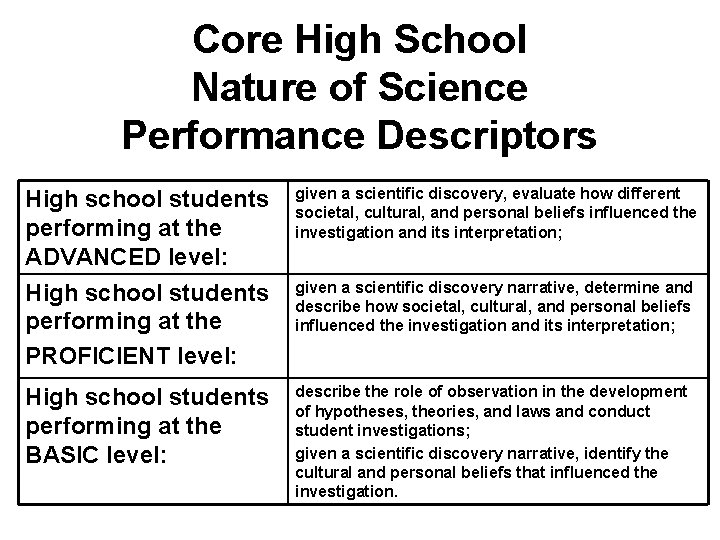
Core High School Nature of Science Performance Descriptors High school students performing at the ADVANCED level: High school students performing at the PROFICIENT level: given a scientific discovery, evaluate how different societal, cultural, and personal beliefs influenced the investigation and its interpretation; High school students performing at the BASIC level: describe the role of observation in the development of hypotheses, theories, and laws and conduct student investigations; given a scientific discovery narrative, identify the cultural and personal beliefs that influenced the investigation. given a scientific discovery narrative, determine and describe how societal, cultural, and personal beliefs influenced the investigation and its interpretation;
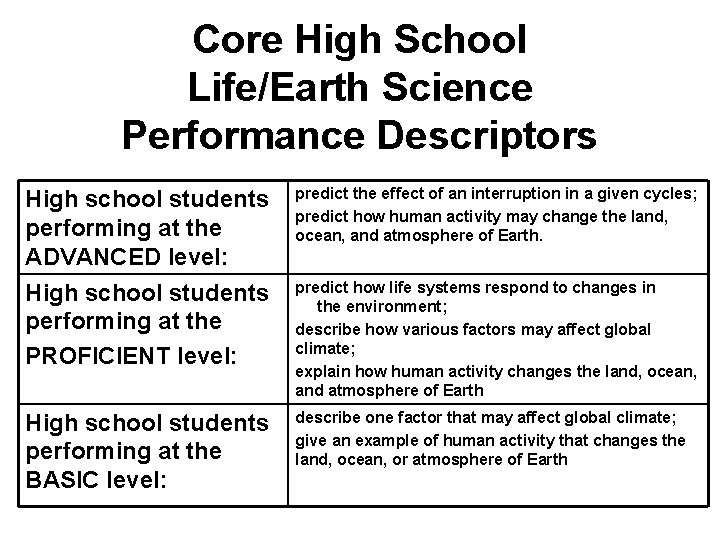
Core High School Life/Earth Science Performance Descriptors High school students performing at the ADVANCED level: High school students performing at the PROFICIENT level: predict the effect of an interruption in a given cycles; predict how human activity may change the land, ocean, and atmosphere of Earth. High school students performing at the BASIC level: describe one factor that may affect global climate; give an example of human activity that changes the land, ocean, or atmosphere of Earth predict how life systems respond to changes in the environment; describe how various factors may affect global climate; explain how human activity changes the land, ocean, and atmosphere of Earth
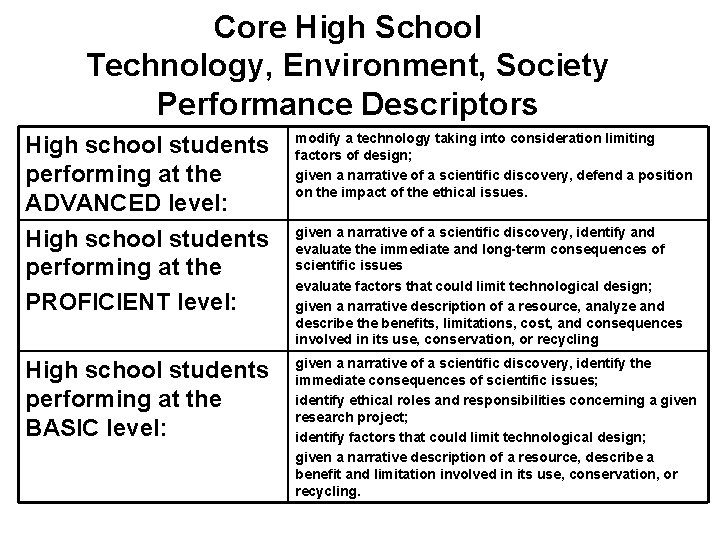
Core High School Technology, Environment, Society Performance Descriptors High school students performing at the ADVANCED level: High school students performing at the PROFICIENT level: modify a technology taking into consideration limiting factors of design; given a narrative of a scientific discovery, defend a position on the impact of the ethical issues. High school students performing at the BASIC level: given a narrative of a scientific discovery, identify the immediate consequences of scientific issues; identify ethical roles and responsibilities concerning a given research project; identify factors that could limit technological design; given a narrative description of a resource, describe a benefit and limitation involved in its use, conservation, or recycling. given a narrative of a scientific discovery, identify and evaluate the immediate and long-term consequences of scientific issues evaluate factors that could limit technological design; given a narrative description of a resource, analyze and describe the benefits, limitations, cost, and consequences involved in its use, conservation, or recycling
SOURCES http: //www. animation-station. com/smileys/index. php? page=17 http: //mff. dsisd. net/Environment/Cycles. htm http: //www. romanviii. co. uk/bp/nhpage. asp? pcat=about_us
SOURCES http: //www. oldetimecooking. com/Images/Fruits/Apple. jpg http: //vilenski. org/science/safari/classifyall/eukaryotic. html http: //dustconnection. com/images/stories/cleaning_bucket_sm. jpg
- Slides: 33