
Human Heredity Chapter 14 1 14 2 14
- Slides: 20
Human Heredity Chapter 14 -1, 14 -2, 14 -3
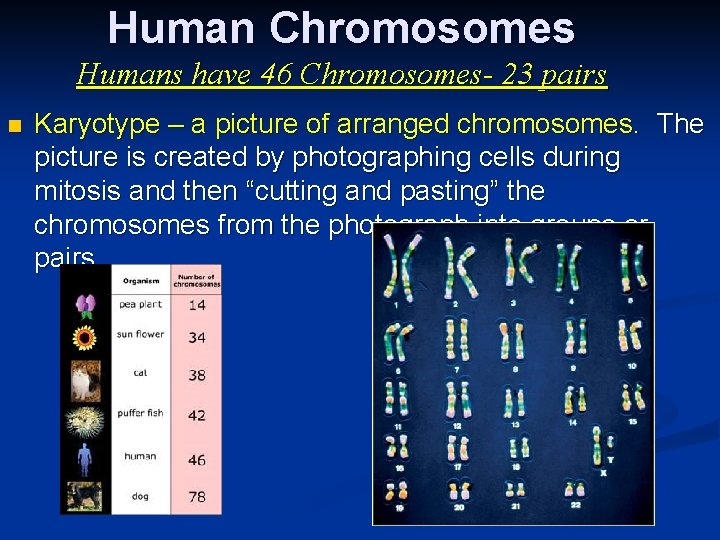
Human Chromosomes Humans have 46 Chromosomes- 23 pairs n Karyotype – a picture of arranged chromosomes. The picture is created by photographing cells during mitosis and then “cutting and pasting” the chromosomes from the photograph into groups or pairs.
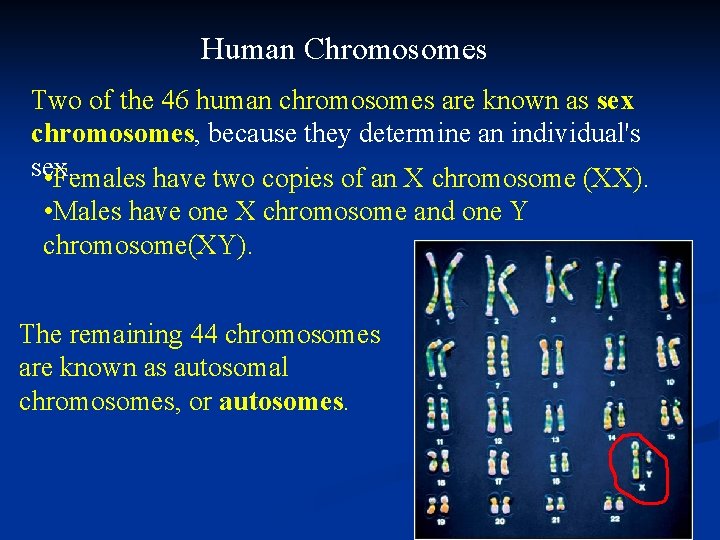
Human Chromosomes Two of the 46 human chromosomes are known as sex chromosomes, because they determine an individual's sex. • Females have two copies of an X chromosome (XX). • Males have one X chromosome and one Y chromosome(XY). The remaining 44 chromosomes are known as autosomal chromosomes, or autosomes.
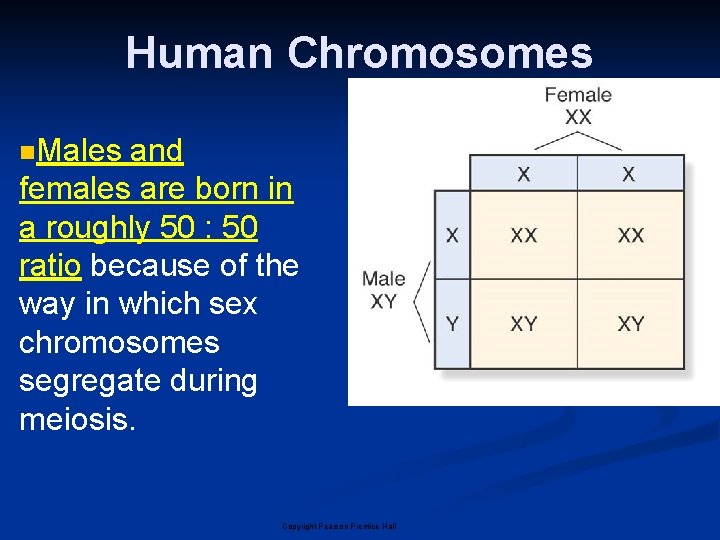
Human Chromosomes n. All human egg cells carry a single X chromosome (23, X). n. Half of all sperm cells carry an X chromosome (23, X) and half carry a Y chromosome (23, Y). n. About half of the zygotes will be 46, XX (female) and half will be 46, XY (male). Copyright Pearson Prentice Hall
Human Chromosomes n. Males and females are born in a roughly 50 : 50 ratio because of the way in which sex chromosomes segregate during meiosis. Copyright Pearson Prentice Hall
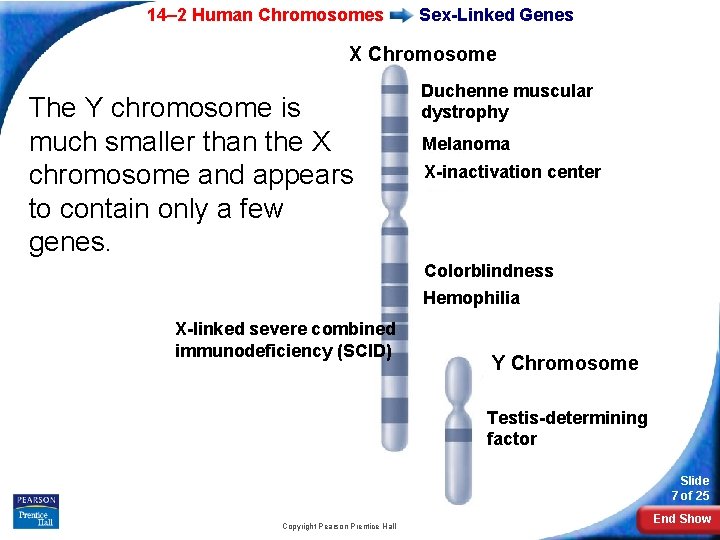
Sex-Linked Genes n Genes located on the X or Y chromosomes are called sex-linked genes. n There are more than 100 disorders that have been mapped on the X chromosome. Many of these are recessive traits. Because men only have one X chromosome, these disorders are more common in men.
14– 2 Human Chromosomes Sex-Linked Genes X Chromosome The Y chromosome is much smaller than the X chromosome and appears to contain only a few genes. Duchenne muscular dystrophy Melanoma X-inactivation center Colorblindness Hemophilia X-linked severe combined immunodeficiency (SCID) Y Chromosome Testis-determining factor Slide 7 of 25 Copyright Pearson Prentice Hall End Show
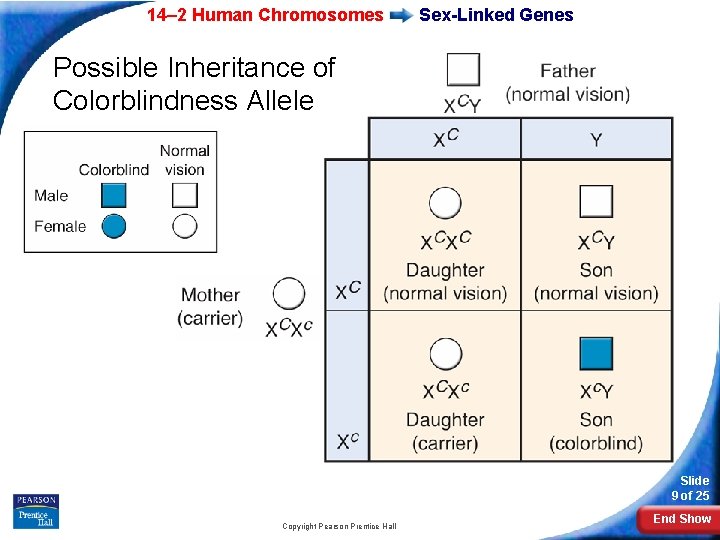
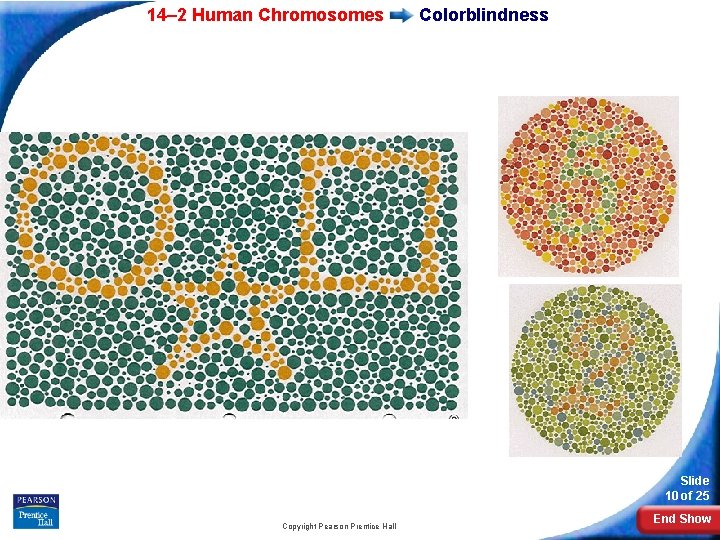
Sex-Linked Genes n. Hemophilia n In hemophilia, a protein necessary for normal blood clotting is missing. n Hemophiliacs can bleed to death from cuts and may suffer internal bleeding if bruised. n Color n The Blindness gene for color blindness is located on the X chromosome
14– 2 Human Chromosomes Sex-Linked Genes Possible Inheritance of Colorblindness Allele Slide 9 of 25 Copyright Pearson Prentice Hall End Show
14– 2 Human Chromosomes Colorblindness Slide 10 of 25 Copyright Pearson Prentice Hall End Show
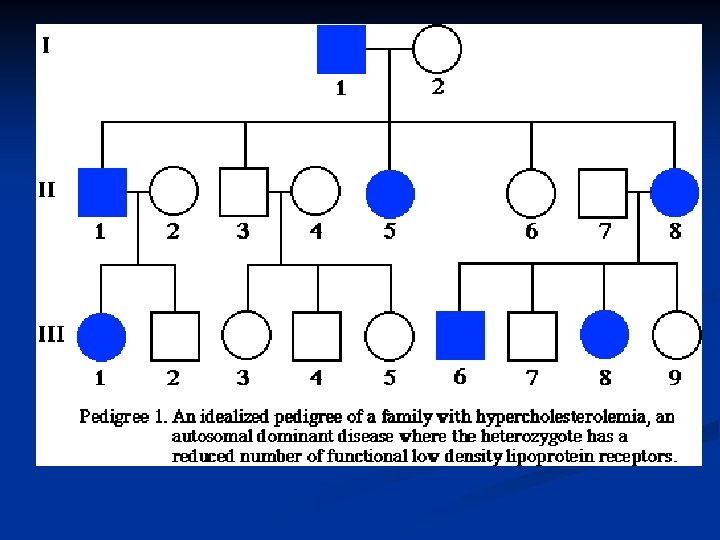
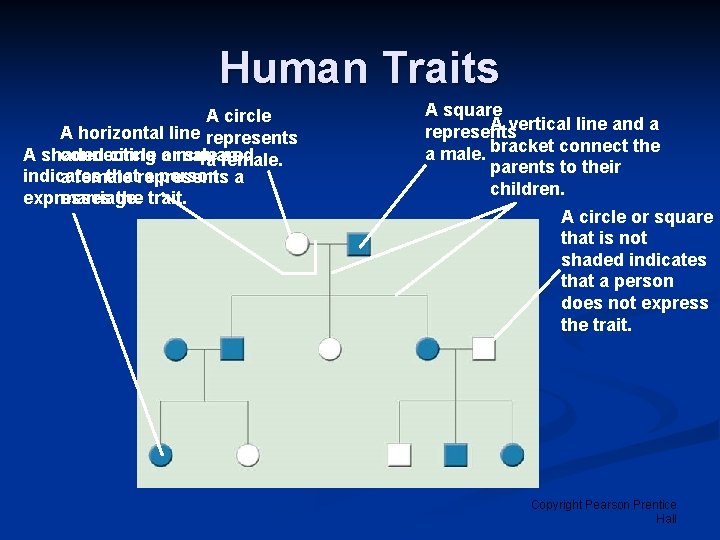
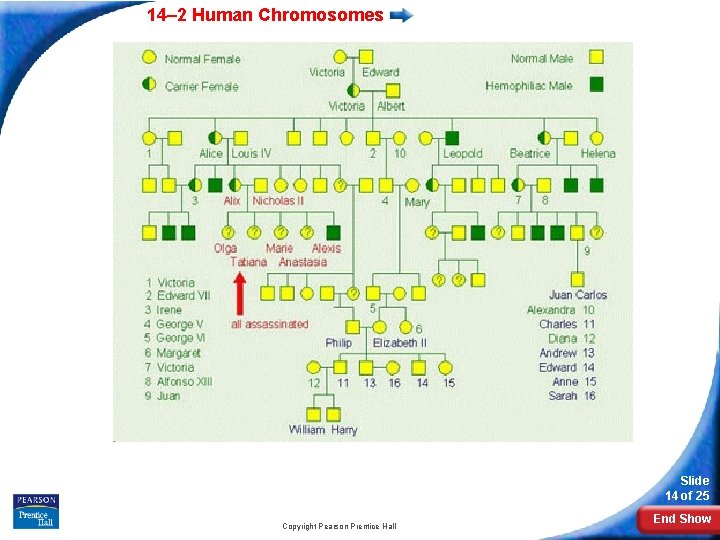
Human Traits One can study how a trait is passed from one generation to the next. n A pedigree chart, which shows the relationship within a family of a single trait. n One can infer the genotypes of family members based on when and how a trait is passed from one generation to the next. n A pedigree is not useful when dealing with polygenic traits or some genes that are influenced by nature. n
Human Traits A circle A horizontal line represents A shaded circle or square connecting a male and a female. indicates that a person a female represents a expresses the trait. marriage. A square A vertical line and a represents a male. bracket connect the parents to their children. A circle or square that is not shaded indicates that a person does not express the trait. Copyright Pearson Prentice Hall
14– 2 Human Chromosomes Slide 14 of 25 Copyright Pearson Prentice Hall End Show
Recessive Allele Disorders These are genetic disorders that are only expressed when the individual has both the recessive alleles. n Examples n Albinism – Lack of pigment n Cystic fibrosis – excess mucus in the lungs n PKU – unable to break down phenylalanine, can cause many problems including mental retardation. n Tay-Sachs disease – lipid accumulation in brain cells, death in early childhood. n
Dominate Allele Disorders n These are disorders that occur based on a dominate allele. Therefore it will be expressed even if you only have a single allele. n Example n Dwarfism – achondroplaia n Huntington’s disease – mental deterioration and uncontrollable movements
Codominant Alleles Disease n Disorders that are caused when two alleles contribute to the phenotype. n Example n Sickle Cell Disease – red blood cells twisted and bent. n In sickle cell disease, a small change in the DNA of a single gene affects the structure of the protein hemoglobin, causing a serious genetic disorder.
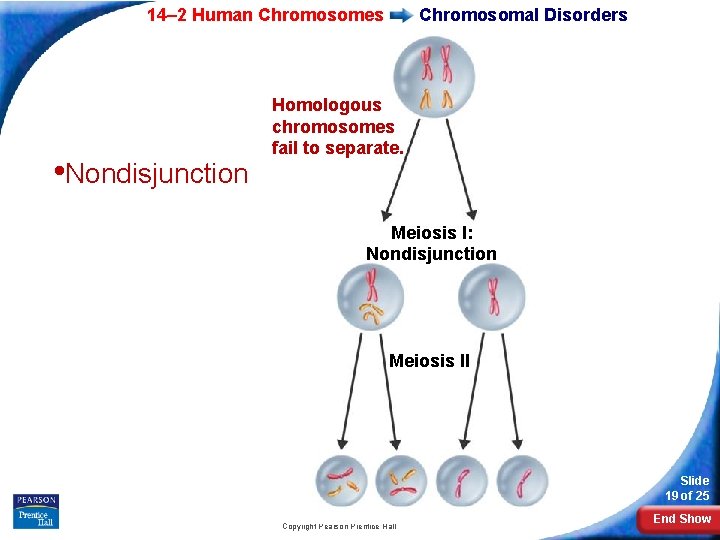
Chromosomal Disorders n n The most common error in meiosis occurs when homologous chromosomes fail to separate. n This is known as nondisjunction, which means, “not coming apart. ” Example n Down Syndrome – 3 copies of chromosome 21. (Trisomy 21) n Sex Chromosomal disorder – improper number of either X or Y chromosomes. n Turner’s syndrome – only one X chromosome.
14– 2 Human Chromosomes • Nondisjunction Chromosomal Disorders Homologous chromosomes fail to separate. Meiosis I: Nondisjunction Meiosis II Slide 19 of 25 Copyright Pearson Prentice Hall End Show
Human Molecular Genetics n DNA Analysis – biologist study DNA to better understand ourselves. Allele testing – testing to see if an individual carries an allele that might carry a genetic disorder. n DNA fingerprinting – DNA is unique to each person, so it can be used to identify individuals. n Human Genome – the mapping of all approx. 6 billion base pairs, that make up human DNA. n