
Human Growth Social Environment Lecture 8 Middle Adulthood
![2. Physical Development Common symptoms: n headaches, feelings of dizziness (頭昏眼花), heart palpitations (心跳不規則[過速]](https://slidetodoc.com/presentation_image/38efcbf2fa44c06c5e084d456f00190b/image-6.jpg "2. Physical Development Common symptoms: n headaches, feelings of dizziness (頭昏眼花), heart palpitations (心跳不規則[過速]")
- Slides: 48
Human Growth & Social Environment Lecture 8: Middle Adulthood (Age 40 – 65) 1
1. Nature of Middle Adulthood ¨ Definitions of “middle-age” keep changing. ¨ Statistically, midlife is 38 years old, but no one age 38 thinks of themselves as “middle-aged. ” n For many, middle age is a time for: ¨ A decline of physical skills. ¨ Increasing responsibility. ¨ Transmitting knowledge to the next generation. ¨ Reaching and maintaining career satisfaction. ¨ Balancing work and relationships. ¨ A reassessment of life’s priorities. ¨ both gains and losses ¨ taking stock and making decisions about the remaining years 2
2. Physical Development Height: - Bones attached to the spinal (脊椎的) column become less dense / close together. Women loss 2 inches in height, men loss 1 inch Osteoporosis (骨質疏鬆): - greater risk for women, a condition in which the bones become weak, breakable, and thin Often brought about by a lack of calcium in the diet Milk, yogurt, cheese, and exercise regularly Weight: - Body fat tends to grow, ‘middle-age spread’ Put on weight (長胖或增加若干體重) 3
2. Physical Development n Age-related loss of muscle mass and strength can be reduced by regular exercise. n Joint stiffness (僵硬) and difficulty of movement usually accompany a progressive loss of bone in middle age. n The sharpest decline in vision occurs between ages 40 and 59 as the eye’s blood supply diminishes. n Hearing starts to decline about age 40, with men losing sensitivity to high-pitched sounds earlier than women. 4
2. Physical Development Female climacteric (更年期): n n the period that marks the transition from being able to bear children to being unable to do so Starting at around age 45, and lasts for 15 to 20 years Menopause (絕經期): the cessation of menstruation n Production of estrogen (雌(甾)激素) and progesterone (黃體激素)begins to drop n At menopause, a woman’s blood pressure rises sharply, remaining higher than that of men into the later years. “Hot flashes”: n a woman senses an unexpected feeling of heat from the waist up, afterwards, she may feel relaxed n 5
2. Physical Development Common symptoms: n headaches, feelings of dizziness (頭昏眼花), heart palpitations (心跳不規則[過速] ), and aching (心痛) joints n Linked directly to depression, anxiety, crying spells (一段時間), lack of concentration, and irritability (易怒) 6
2. Physical Development Male climacteric: n the period of physical and psychological change in the reproductive system n occurs during late middle age, typically in a man’s 50 s n By 40, 10% of men have enlarged prostates (前列 腺) n Produces problems with urination (撒尿), including difficulty starting urination or a need to urinate frequently at night 7
2. Physical Development : Wellness and Illness n n n Middle age is a period of health Between the ages of 45 and 65, people are less likely than younger adults to experience infections, allergies (過敏症), respiratory diseases, and digestive problems Immunities built up Chronic diseases begin to appear: n n n Arthritis(關節炎), diabetes (糖尿病), hypertension (high blood pressure) Risk factors for heart disease Environment and lifestyle choices e. g. cigarette smoking, a diet high in fats and cholesterol a relative lack of physical exercise 8
2. Physical Development : Wellness and Illness n Midlife is often a time for high blood pressure, high cholesterol (膽固 醇) , and cardiovascular (心血管的) disease. n Sleep has more wakeful periods, with more time expended lying in bed—more tiredness in the mornings. n Men have higher rates of fatal (長期) chronic (慢性病) conditions, while women have higher rates of nonfatal chronic conditions. n Stress is a key factor in disease, especially if cumulative. n Acute stressors cause poor immune system functioning, but chronic stressors can cause an increasing weakening of the immune system 9
2. Physical Development : Wellness and Illness Personality characteristics Type A behaviour pattern: n n competitiveness, impatience, and a tendency toward frustration and hostility multitasks easily angered verbally and nonverbally hostile if they are prevented from reaching a goal they seek to accomplish Type B behaviour pattern: n noncompetitiveness, patience, and a lack of aggression, little 10 sense of time urgency, rarely hostile
2. Physical Development : Memory n Minimal memory losses n Types of memory 1. Sensory memory: an initial, quick storage of information that lasts only an instant Short-term memory: holds for 15 to 25 seconds Long-term memory: where information is stored on a relatively permanent basis when the information is rehearsed 2. 3. - 11
2. Physical Development : Memory - No failing on sensory and short-term memory Long-term memory declines with age for some people Not a failing or a complete loss of memory, but people register and store information less efficiently Become less efficient in retrieving (locate or isolate) information 12
3. Cognitive Development : n Some theorists propose that cognition takes distinctive forms at midlife. Advances in expertise, or specialized knowledge, have been attributed to encapsulation(概 括) of fluid abilities within a person’s chosen field n Encapsulation means progressive dedication (敬業)of information processing and fluid thinking to specific knowledge systems, making knowledge more readily accessible n Postformal though seems especially useful in stuations calling for integrative thinking
3. Cognitive Development : n Integrative thought means mature adults integrate logic with intuition and emotion; they integrate conflicting facts and ideas; and they integrate new information with what they already know. n They interpret what they read, see, or hear in terms of its meaning for them. Instead of accepting something at face value, they filter it through their life experience and previous learning.
3. Cognitive Development : n Creativity begins with talent, but talent is not enough. Children may show creative potential, but in adults, what counts is creative performance; what, and how much, a creative mind produces. n Creative develops in a social context, and not necessarily in nurturing environments. Instead, it seems to emerge from diverse experiences that weaken conventional constraints and from challenging experiences that strength the ability to persevere and overcome obstacles
4. Social and Personality Development - 2 perspectives 1. Normative-Crisis models: - the approach to personality development that is based on fairly universal stages tied to a sequence of age-related crises - e. g. Erikson’s psychosocial theory 1. Life events models: - the approach to personality development that is based on the timing of particular events in an adult’s life rather than on age. 16
4. Social and Personality Development: Psycho-social Model Erikson – Generatively (生產)versus Stagnation (停滯) Generatively: n making a personal contribution to family, community, work, and society n Strive to play a role in guiding and encouraging future generations n e. g. through parenting, mentorship or teaching, productivity or creativity, self-development. n the focus is beyond themselves as they look toward the continuation of their own lives through others 17
4. Social and Personality Development: Psycho-social Model Stagnation: n focus on the worthlessness of their own activity, people may come to feel that they have made only limited contributions to the world n find themselves flailing, still seeking new and potentially more fulfilling careers n become frustrated and bored - strength/virtue: care 18
4. Social and Personality Development: Normative-stage models : Carl G. Jung Individuation (賦予個性) and Transcendence (卓絕) n The Swiss psychologist Carl Jung held that healthy midlife development calls for individuation, the emergency of the true self through balancing or integrating conflicting parts of the personality, including those parts that previously have been neglected.
4. Social and Personality Development: Normative-stage models : Carl G. Jung n Until about age 40, adults concentrate on obligations to family and society and develop aspects of personality that will help them reach external goals. At midlife, people shift their preoccuption to their inner, spiritual, selves.
4. Social and Personality Development: Daniel Levinson – Midlife transition n n A time of questioning People begin to focus on the limited nature of life Begin to question some of their everyday, fundamental assumptions Experience the first signs of aging, and confront the knowledge Will be unable to accomplish all their aims before they die 21
4. Social and Personality Development: Daniel Levinson – Midlife Crisis May lead to a midlife crisis n A stage of uncertainty and indecision (優柔寡斷) brought about by the realization that life is finite / limieted n However, evidence is lacking n Majority of people regard midlife as a rewarding time n Focus on the present, seeking to maximize their ongoing involvement with family, friends, and other social groups n For some, midlife may not bring many changes at all 22
4. Social and Personality Development: Daniel Levinson – Midlife Crisis n n Changes in personality and lifestyle during the early to middle 40 are often attributed to the midlife crisis, a supposedly stressful period triggered by review and re-evaluation of one’s life. Midlife is just one of life’s turning points – psychological transitions that involve significant change or transformation in the perceived meaning, purpose, or direction of a person’s life.
4. Social and Personality Development: Daniel Levinson – Midlife Review Turning points may be triggered by major life events, normative changes new understanding of past experience, either positive or negative, and they may be stressful. n The midlife review can be a time of stocktaking, yielding new insights into the self and encouraging midcourse (中途) corrections in the design and route of one’s life. n
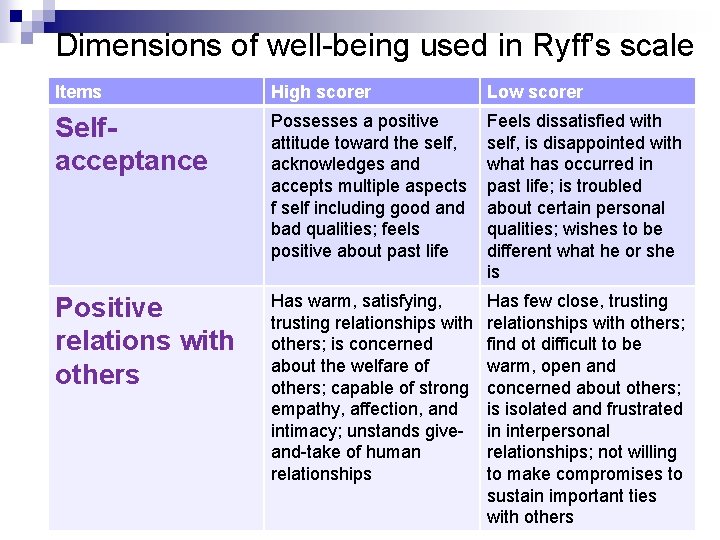
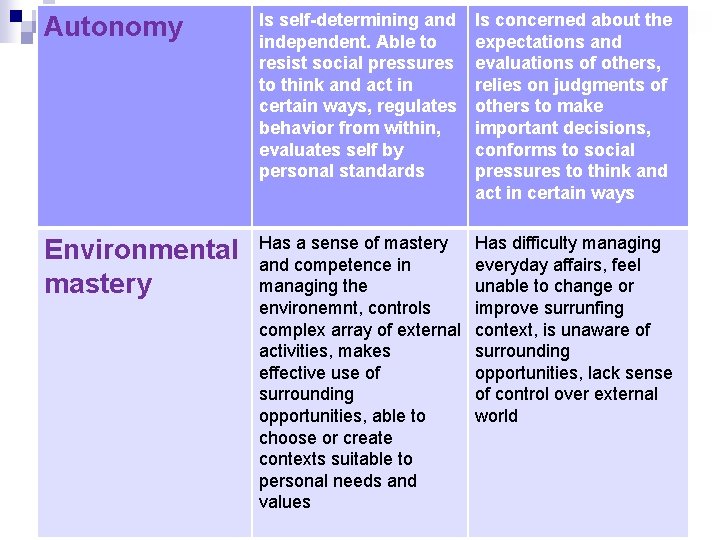
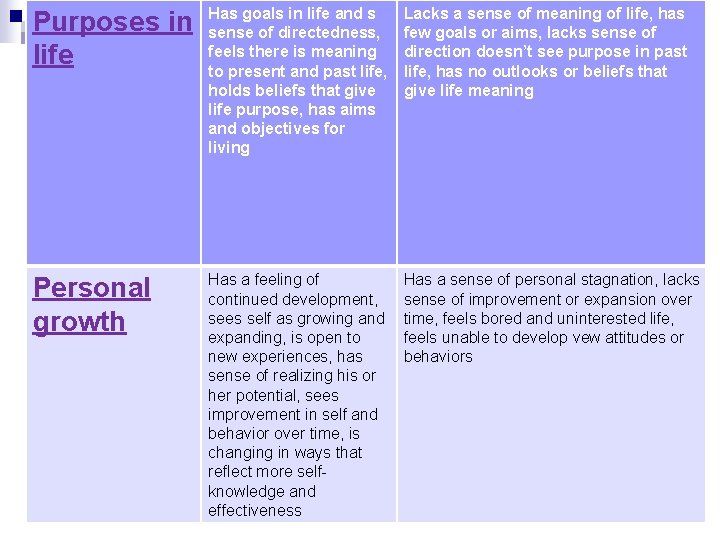
4. Social and Personality Development: Psychological well-being and positive mental health Emotionality and personality are related to psychological well-being n Research based on Ryff’s six-dimensional scale has found that midlife is generally a period of positive mental health and well being, though socio-economic status is a factor. n
Dimensions of well-being used in Ryff’s scale Items High scorer Low scorer Selfacceptance Possesses a positive attitude toward the self, acknowledges and accepts multiple aspects f self including good and bad qualities; feels positive about past life Feels dissatisfied with self, is disappointed with what has occurred in past life; is troubled about certain personal qualities; wishes to be different what he or she is Positive relations with others Has warm, satisfying, trusting relationships with others; is concerned about the welfare of others; capable of strong empathy, affection, and intimacy; unstands giveand-take of human relationships Has few close, trusting relationships with others; find ot difficult to be warm, open and concerned about others; is isolated and frustrated in interpersonal relationships; not willing to make compromises to sustain important ties with others
Autonomy Is self-determining and independent. Able to resist social pressures to think and act in certain ways, regulates behavior from within, evaluates self by personal standards Is concerned about the expectations and evaluations of others, relies on judgments of others to make important decisions, conforms to social pressures to think and act in certain ways Environmental mastery Has a sense of mastery and competence in managing the environemnt, controls complex array of external activities, makes effective use of surrounding opportunities, able to choose or create contexts suitable to personal needs and values Has difficulty managing everyday affairs, feel unable to change or improve surrunfing context, is unaware of surrounding opportunities, lack sense of control over external world
Purposes in life Has goals in life and s sense of directedness, feels there is meaning to present and past life, holds beliefs that give life purpose, has aims and objectives for living Lacks a sense of meaning of life, has few goals or aims, lacks sense of direction doesn’t see purpose in past life, has no outlooks or beliefs that give life meaning Personal growth Has a feeling of continued development, sees self as growing and expanding, is open to new experiences, has sense of realizing his or her potential, sees improvement in self and behavior over time, is changing in ways that reflect more selfknowledge and effectiveness Has a sense of personal stagnation, lacks sense of improvement or expansion over time, feels bored and uninterested life, feels unable to develop vew attitudes or behaviors
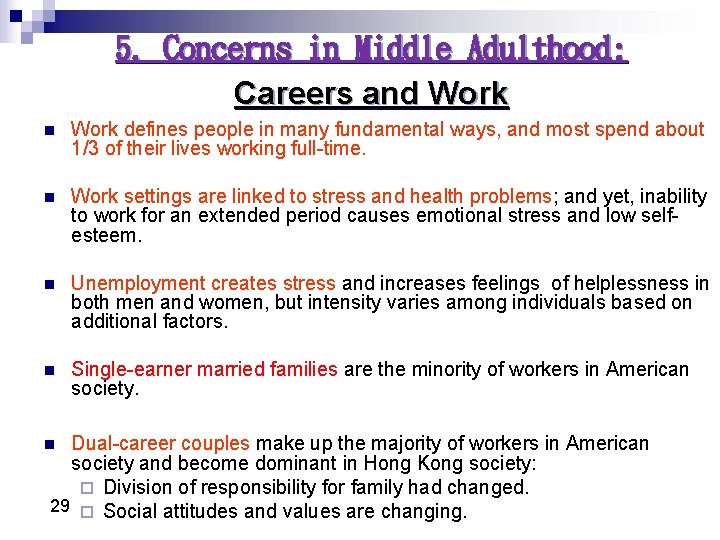
5. Concerns in Middle Adulthood: Careers and Work n Work defines people in many fundamental ways, and most spend about 1/3 of their lives working full-time. n Work settings are linked to stress and health problems; and yet, inability to work for an extended period causes emotional stress and low selfesteem. n Unemployment creates stress and increases feelings of helplessness in both men and women, but intensity varies among individuals based on additional factors. n Single-earner married families are the minority of workers in American society. Dual-career couples make up the majority of workers in American society and become dominant in Hong Kong society: ¨ Division of responsibility for family had changed. 29 ¨ Social attitudes and values are changing. n
5. Concerns in Middle Adulthood: Careers and Work n Midlife is a time of evaluation, assessment, and reflection about work roles and future goals. n Currently, middle-aged workers face many challenges: ¨ Globalization and exporting of jobs. ¨ Rapid development in technologies. ¨ Downsizing (縮減開支) and restructuring of companies. ¨ Early retirement—forced or due to buyouts. n Leisure is an important aspect of middle adulthood due to changes in relationships and career. 30
5. Concerns in Middle Adulthood: Careers, Work & Education n n A shift away from early retirement and toward more flexible options is occurring Complex work may improve cognitive flexibility Many adults go to college at a non-traditional age or participate in other educational activities, often to improve work-related skills and knowledge Mature adults have special educational needs and strengths Reading ability training is an urgent need in the US and globally.
5. Concerns in Middle Adulthood: Careers, Work & Education Roles and career changes and other experiences typical of middle age can be stressful, but resilience is common n Personality and negative emotionally can affect health. Positive emotions tend to be associated with good health n Psychological distress becomes more prevalent in middle age n
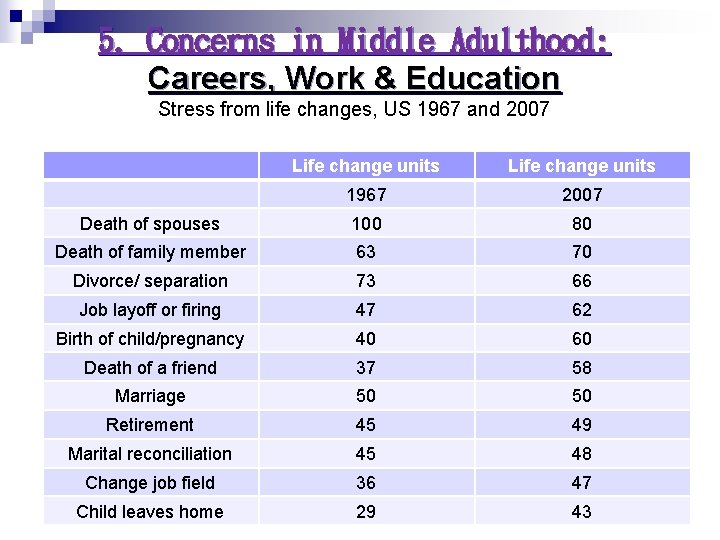
5. Concerns in Middle Adulthood: Careers, Work & Education Stress from life changes, US 1967 and 2007 Life change units 1967 2007 Death of spouses 100 80 Death of family member 63 70 Divorce/ separation 73 66 Job layoff or firing 47 62 Birth of child/pregnancy 40 60 Death of a friend 37 58 Marriage 50 50 Retirement 45 49 Marital reconciliation 45 48 Change job field 36 47 Child leaves home 29 43
6. Concerns in Middle Adulthood Attraction, Love, and Close Relationships n 34 Marriage in the United States: ¨ Adults are delaying marriage. ¨ Adult marriages are not lasting as long. ¨ Percentage of married persons who said they were “very happy” declined from 1970 s to 1990 s, but recently began to increase. ¨ Men report being happier in marriage than women.
6. Concerns in Middle Adulthood Attraction, Love, and Close Relationships Marriage: n More varied, more people are single, living alone or with a partner. n For heterosexuals, some have divorced, lived alone, and then remarried. 35
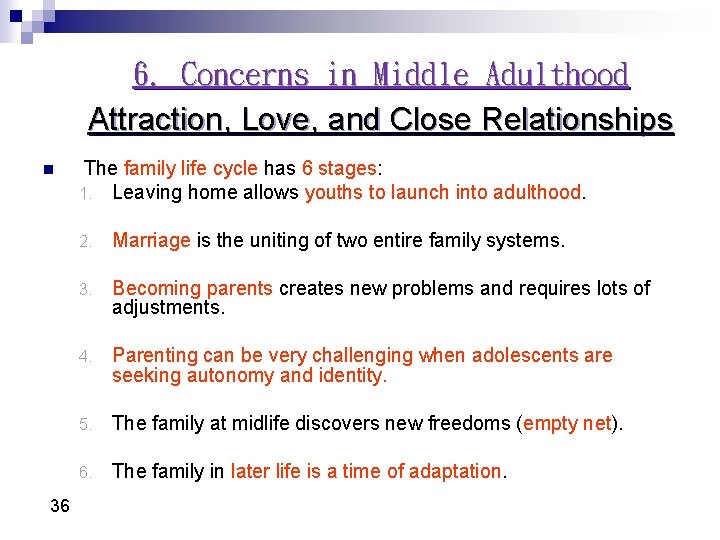
6. Concerns in Middle Adulthood Attraction, Love, and Close Relationships n 36 The family life cycle has 6 stages: 1. Leaving home allows youths to launch into adulthood. 2. Marriage is the uniting of two entire family systems. 3. Becoming parents creates new problems and requires lots of adjustments. 4. Parenting can be very challenging when adolescents are seeking autonomy and identity. 5. The family at midlife discovers new freedoms (empty net). 6. The family in later life is a time of adaptation.
6. Concerns in Middle Adulthood Attraction, Love, and Close Relationships l Love is a very complex area of human emotion and comes in different types of expressions. l Intimacy should occur after one is well into establishing a stable and successful identity: Ø Failure to achieve intimacy results in social isolation. Ø Intimacy’s most important aspect is commitment. Ø Attempts to establish intimacy occur at the same time that one is seeking personal autonomy. 37
6. Concerns in Middle Adulthood Attraction, Love, and Close Relationships n Cohabitation: ¨ is more acceptable in today’s society. ¨ Has its advantages and disadvantages. ¨ Tends to be short-lived. ¨ Involves relationships that tend to be more equal than those between husbands and wives. n Whether cohabitation is a harm or help toward later marital quality is controversial. 38
6. Concerns in Middle Adulthood Attraction, Love, and Close Relationships n n n 39 Remarried couples face many changes and challenges: ¨ Negotiating rules for reconstituted families and stepfamilies. Many remarriages occur to reduce loneliness and improve financial circumstances. Negative behaviors from earlier marriages may carry over into the remarriage.
6. Concerns in Middle Adulthood Attraction, Love, and Close Relationships n Making Marriage Work: ¨ Nurture fondness / love and admiration / respect. ¨ Turn toward, rather than away from, each other. ¨ Let your partner influence you—share power. ¨ Solve solvable conflicts. 40
6. Concerns in Middle Adulthood Attraction, Love, and Close Relationships n 41 Strategies for Dealing with Divorce: ¨ Think of divorce as a chance to grow personally. ¨ Make decisions about work, lovers, and children carefully. ¨ Focus more on future than the past. ¨ Use your strengths and resources to cope with difficulties. ¨ Don’t expect to be successful and happy in everything. ¨ You are never trapped in just one pathway, but moving on to a better life usually requires some effort.
7. Concerns in Middle Adulthood Family Empty Nest Family Evolutions: n n From Full House to Empty Nest Empty nest refers to a transitional phase of parenting following the last child’s leaving the parents’ home. Middle-aged parents tend to remain involved with their adult children, and most are generally happy with the way their children turned out. Conflict may arise over grown children’s need to be treated as adults and parents continuing concern about them 42
7. Concerns in Middle Adulthood Family Empty Nest Empty nest syndrome: n n n n refers to instances in which parents experience unhappiness, worry, loneliness, and depression from their children’s departure from home Major adjustments are required For women who have stayed home to rear their children, the loss can be difficult Some are quite positive, even mothers who have not worked outside the home find they have time for other outlets for their physical and psychological energies such as community or recreational activities, when the children leave Have the opportunity to get a job or to go back to school May feel liberated (不受約束) from a comparatively difficult set of responsibilities 43
7. Concerns in Middle Adulthood Family Empty Nest n n n Feelings of sadness and distress are only temporary Married spouses have more time for one another The house stays neater, and the telephone rings less often Research suggests that men also experience feelings of loss although the nature of that loss may be different from that experienced by women About a quarter felt unhappy, tend to mention lost opportunities, apologize for things that they had not done with their children e. g. had been too busy for their children or hadn’t been sufficiently nurturing or caring. 44
8. Concerns in Middle Adulthood Boomerang / Return Children n Today, more young adults are delaying departure from their childhood home or are returning to it, sometimes with their own families. Adjustment tends to be smoother if the parents see the adult child as moving toward autonomy n Cluttered nest / turning door syndrome means increasing numbers of young adults, especially men, return to their parents’ home, sometimes more than once, and sometimes with their own families.
8. Concerns in Middle Adulthood Boomerang / Return Children Boomerang /Return Children n n n n Young adults who return, after leaving home for some period, to live in the homes of their middle-aged parents Cite economic issues as the main reason for returning such as difficult economy Breakup of a marriage Reactions of parents vary unemployed – nuisance (麻煩事) mothers tend to be more sympathetic single mothers may welcome the help and security provided by returning children both fathers and mothers feel fairly positive about returning sons and daughters who work contribute to the functioning of the household 46
9. Concerns in Middle Adulthood The Sandwich Generation n n Couples who in middle adulthood must fulfill the needs of both their children and their aging parents. Both men and women are marrying later and having children at an older age People are living longer Simultaneously have children who still require a significant amount of nurturing and parents who are still alive and in need of care. 47
9. Concerns in Middle Adulthood The Sandwich Generation Multigenerational household n n n parental and children’s roles are re-negotiated, the adult children in the middle generation are in charge of the household elderly parents may find the loss of independence particularly difficult middle-aged women tend to be more involved in the day-today care of aging parents Discussion: How would you describe your relationship with your parents? 48