
Human Geography People Place and Culture 11 th

- Slides: 19
Human Geography: People, Place, and Culture, 11 th Edition Copyright © 2015 John Wiley & Sons, Inc. All rights reserved.
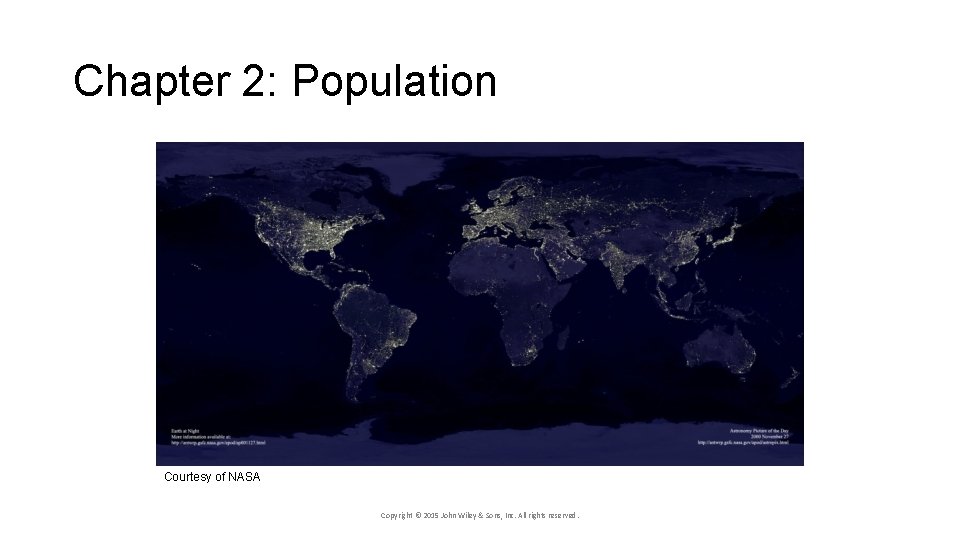
Chapter 2: Population Courtesy of NASA Copyright © 2015 John Wiley & Sons, Inc. All rights reserved.
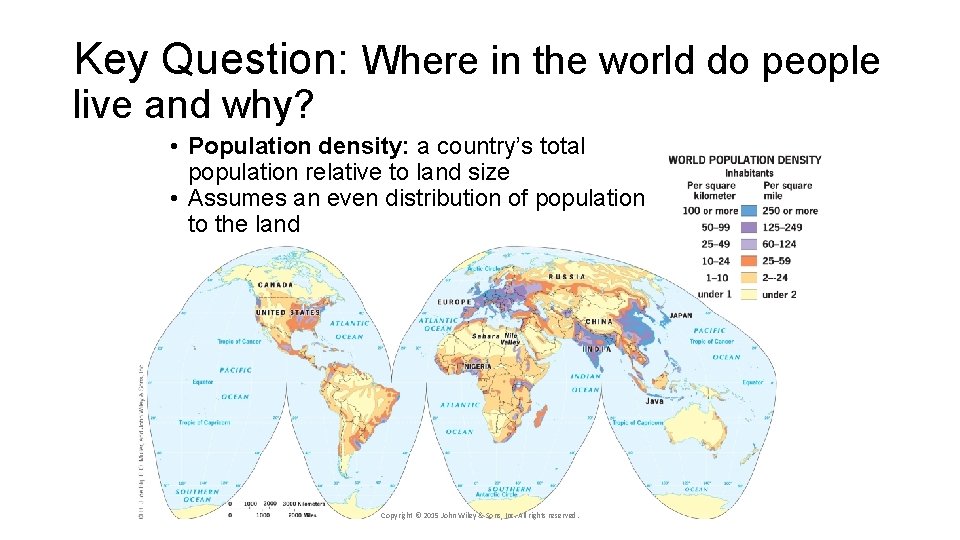
Key Question: Where in the world do people live and why? • Population density: a country’s total population relative to land size • Assumes an even distribution of population to the land Copyright © 2015 John Wiley & Sons, Inc. All rights reserved.
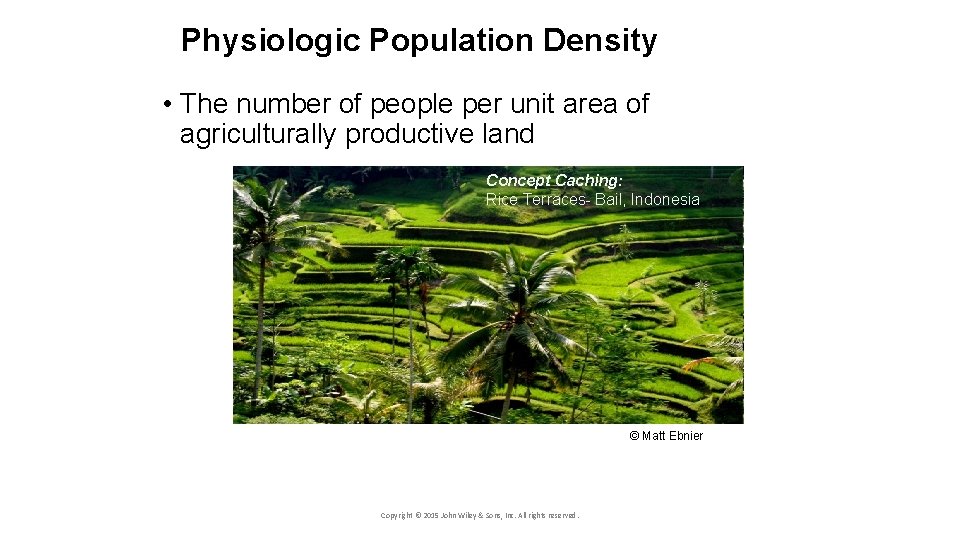
Physiologic Population Density • The number of people per unit area of agriculturally productive land Concept Caching: Rice Terraces- Bail, Indonesia © Matt Ebnier Copyright © 2015 John Wiley & Sons, Inc. All rights reserved.
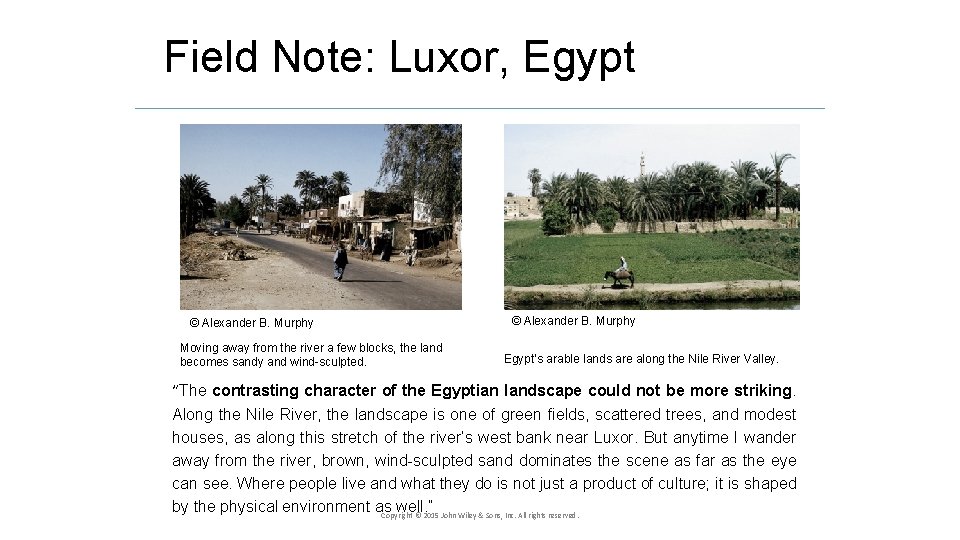
Field Note: Luxor, Egypt © Alexander B. Murphy Moving away from the river a few blocks, the land becomes sandy and wind-sculpted. © Alexander B. Murphy Egypt’s arable lands are along the Nile River Valley. “The contrasting character of the Egyptian landscape could not be more striking. Along the Nile River, the landscape is one of green fields, scattered trees, and modest houses, as along this stretch of the river’s west bank near Luxor. But anytime I wander away from the river, brown, wind-sculpted sand dominates the scene as far as the eye can see. Where people live and what they do is not just a product of culture; it is shaped by the physical environment as well. ” Copyright © 2015 John Wiley & Sons, Inc. All rights reserved.
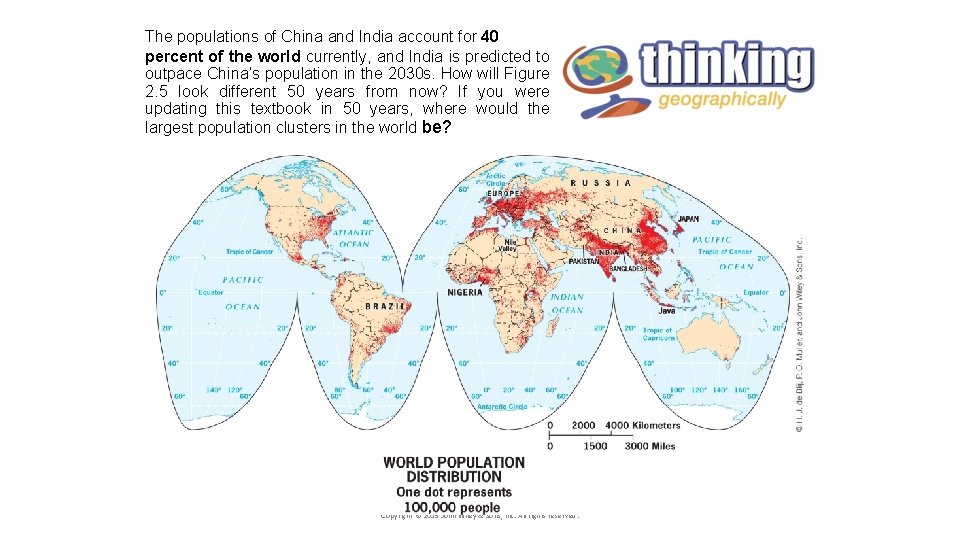
Population Distribution • Descriptions of locations on the Earth’s surface where individuals or groups (depending on the scale) live. • Geographers often represent population distributions on dot maps, in which one dot represents a certain number of a population. Copyright © 2015 John Wiley & Sons, Inc. All rights reserved.
The populations of China and India account for 40 percent of the world currently, and India is predicted to outpace China’s population in the 2030 s. How will Figure 2. 5 look different 50 years from now? If you were updating this textbook in 50 years, where would the largest population clusters in the world be? Copyright © 2015 John Wiley & Sons, Inc. All rights reserved.
Reliability of Population Data • Census: Federal government funding depends on population data. • Political implications of under-representation of populations. • United Nations, World Bank, and Population Reference Bureau collect data on world populations. Copyright © 2015 John Wiley & Sons, Inc. All rights reserved.
East Asia • Almost 25% of world’s population • Population concentrated in Korea, Japan, China • Over 1. 36 billion people in China Copyright © 2015 John Wiley & Sons, Inc. All rights reserved.
South Asia • Physical geography barriers separate population clusters Himalaya Mountains; Indus River Valley Confined region with rapidly growing population • Bangladesh: 156 million people in an area the size of Iowa Copyright © 2015 John Wiley & Sons, Inc. All rights reserved.
Europe • 715 million • Not clustered in river valleys but coal fields (Industrial Revolution) • Highly Urbanized • 80% in UK, 78% in France, 73% in Germany • East and South Asia are 45% urbanized • Copyright © 2015 John Wiley & Sons, Inc. All rights reserved.
North America • Megalopolis Huge urban agglomerations; Boston, NYC, Philadelphia, Baltimore, Washington, D. C This accounts for more than 20% of US population Copyright © 2015 John Wiley & Sons, Inc. All rights reserved.
Key Question: Why Do Populations Rise and Fall in Particular Places? • Thomas Malthus: An Essay on the Principles of Population • Grows faster than food supply; food grows linearly, population grows exponentially Copyright © 2015 John Wiley & Sons, Inc. All rights reserved.
Population Growth: World, Regional, National Scales • Births – Deaths = Natural Increase Does not factor immigration (in-migration) or emigration (outmigration) into the equation Copyright © 2015 John Wiley & Sons, Inc. All rights reserved.
Regional and National • Crude Birth Rate (CBR) Number of births in a year per 1000 • Crude Death Rate (CDR) Number of deaths in a year per 1000 • Total Fertility Rate (TFR) Average number of children born to a woman of childbearing age Copyright © 2015 John Wiley & Sons, Inc. All rights reserved.
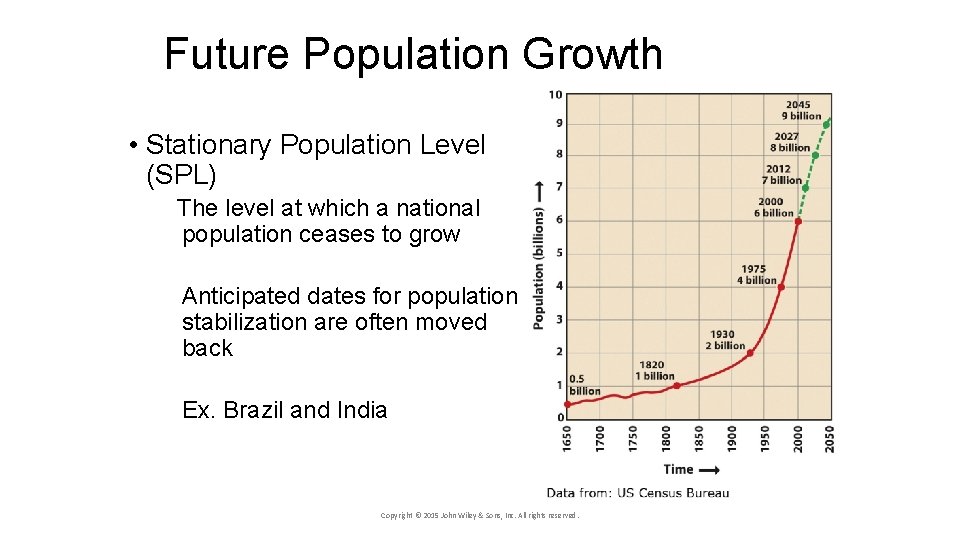
Future Population Growth • Stationary Population Level (SPL) The level at which a national population ceases to grow Anticipated dates for population stabilization are often moved back Ex. Brazil and India Copyright © 2015 John Wiley & Sons, Inc. All rights reserved.
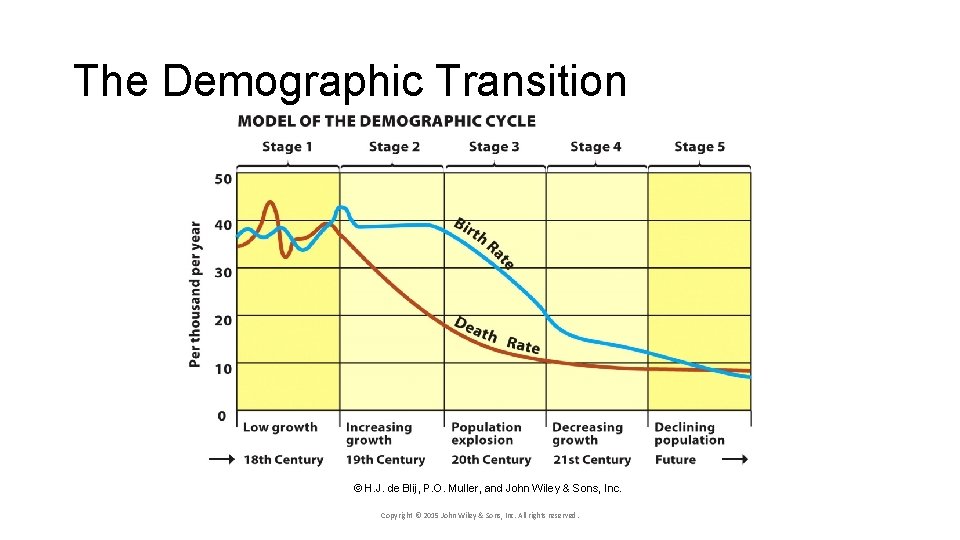
The Demographic Transition © H. J. de Blij, P. O. Muller, and John Wiley & Sons, Inc. Copyright © 2015 John Wiley & Sons, Inc. All rights reserved.
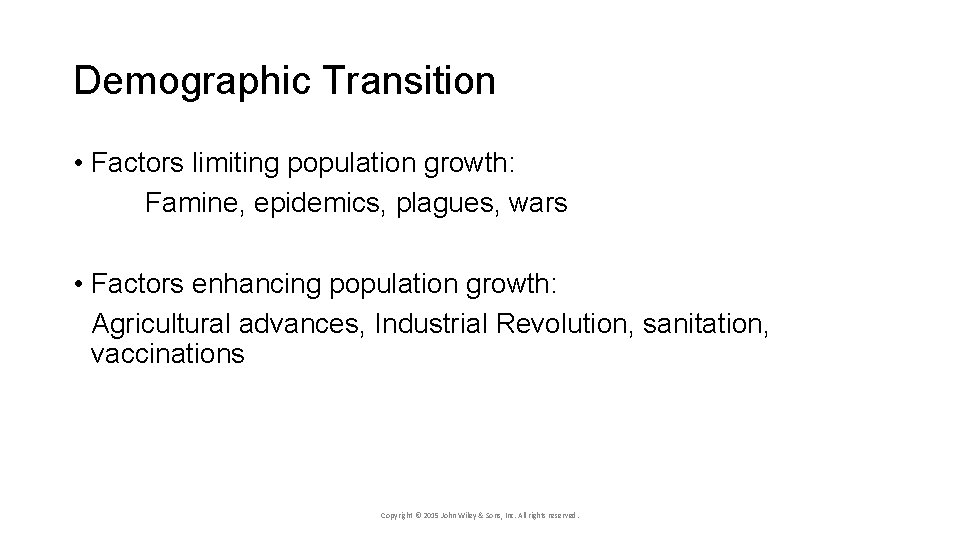
Demographic Transition • Factors limiting population growth: Famine, epidemics, plagues, wars • Factors enhancing population growth: Agricultural advances, Industrial Revolution, sanitation, vaccinations Copyright © 2015 John Wiley & Sons, Inc. All rights reserved.