
Human Genetics Polygenic and Sex influenced traits Autosomal

- Slides: 21
Human Genetics Polygenic and Sex influenced traits, Autosomal Dominant, Autosomal Recessive, and Sex-linked Disorders and Pedigrees Lab Biology
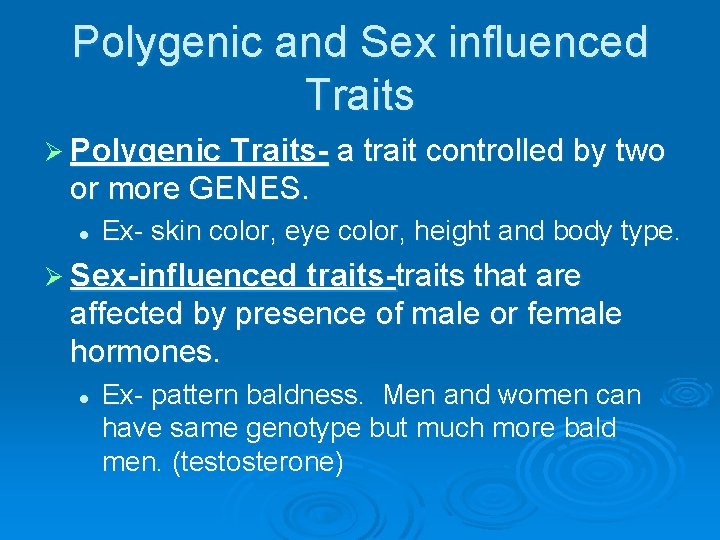
Polygenic and Sex influenced Traits Ø Polygenic Traits- a trait controlled by two or more GENES. l Ex- skin color, eye color, height and body type. Ø Sex-influenced traits-traits that are affected by presence of male or female hormones. l Ex- pattern baldness. Men and women can have same genotype but much more bald men. (testosterone)
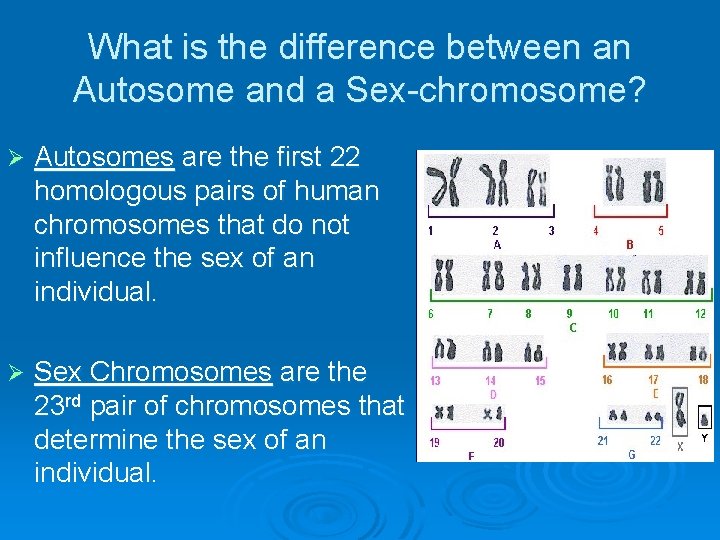
What is the difference between an Autosome and a Sex-chromosome? Ø Autosomes are the first 22 homologous pairs of human chromosomes that do not influence the sex of an individual. Ø Sex Chromosomes are the 23 rd pair of chromosomes that determine the sex of an individual.
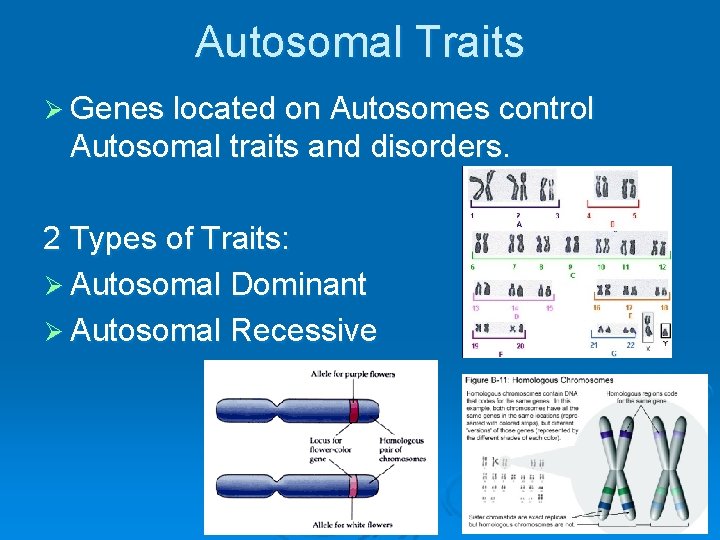
Autosomal Traits Ø Genes located on Autosomes control Autosomal traits and disorders. 2 Types of Traits: Ø Autosomal Dominant Ø Autosomal Recessive
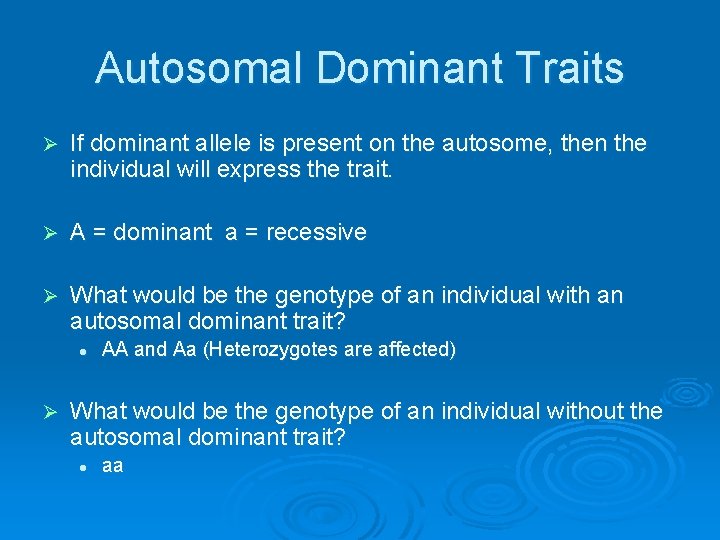
Autosomal Dominant Traits Ø If dominant allele is present on the autosome, then the individual will express the trait. Ø A = dominant a = recessive Ø What would be the genotype of an individual with an autosomal dominant trait? l Ø AA and Aa (Heterozygotes are affected) What would be the genotype of an individual without the autosomal dominant trait? l aa
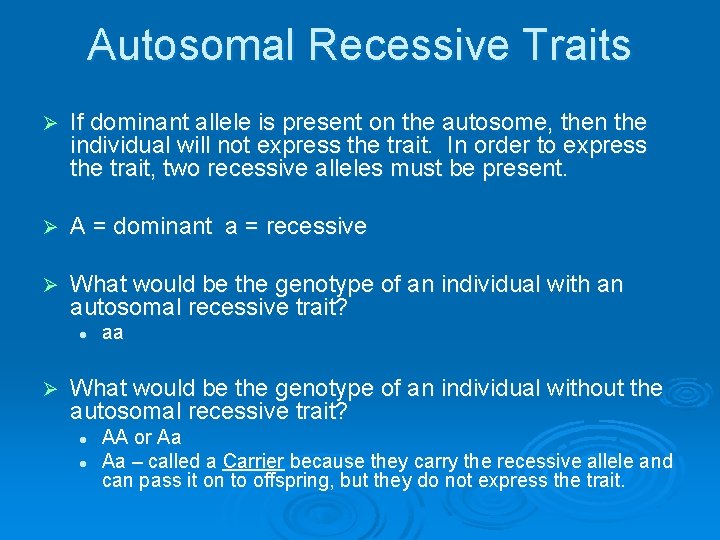
Autosomal Recessive Traits Ø If dominant allele is present on the autosome, then the individual will not express the trait. In order to express the trait, two recessive alleles must be present. Ø A = dominant a = recessive Ø What would be the genotype of an individual with an autosomal recessive trait? l Ø aa What would be the genotype of an individual without the autosomal recessive trait? l l AA or Aa Aa – called a Carrier because they carry the recessive allele and can pass it on to offspring, but they do not express the trait.
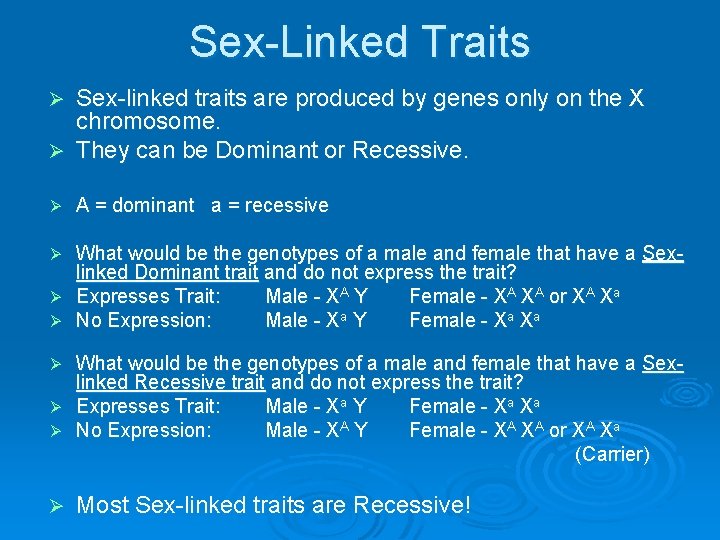
Sex-Linked Traits Sex-linked traits are produced by genes only on the X chromosome. Ø They can be Dominant or Recessive. Ø Ø A = dominant a = recessive What would be the genotypes of a male and female that have a Sexlinked Dominant trait and do not express the trait? Ø Expresses Trait: Male - XA Y Female - XA XA or XA Xa Ø No Expression: Male - Xa Y Female - Xa Xa Ø What would be the genotypes of a male and female that have a Sexlinked Recessive trait and do not express the trait? Ø Expresses Trait: Male - Xa Y Female - Xa Xa Ø No Expression: Male - XA Y Female - XA XA or XA Xa (Carrier) Ø Ø Most Sex-linked traits are Recessive!
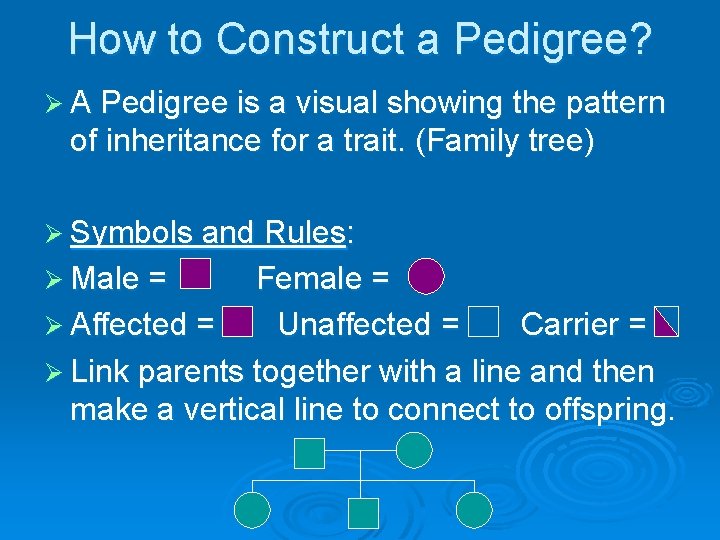
How to Construct a Pedigree? Ø A Pedigree is a visual showing the pattern of inheritance for a trait. (Family tree) Ø Symbols and Rules: Ø Male = Female = Ø Affected = Unaffected = Carrier = Ø Link parents together with a line and then make a vertical line to connect to offspring.
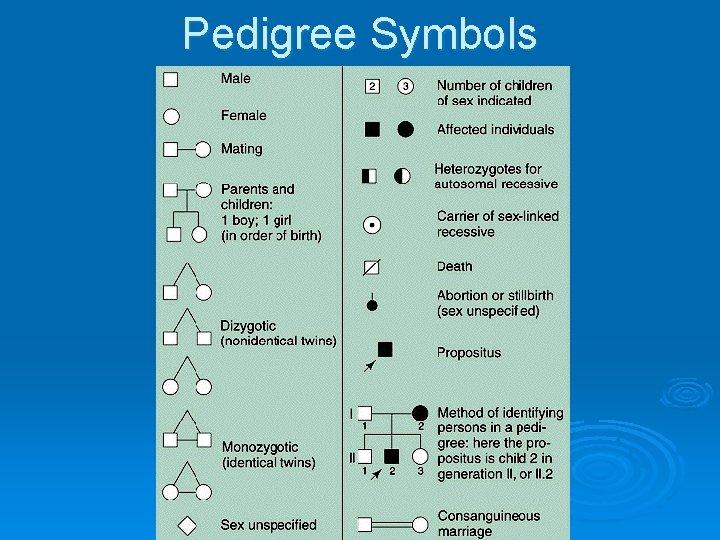
Pedigree Symbols
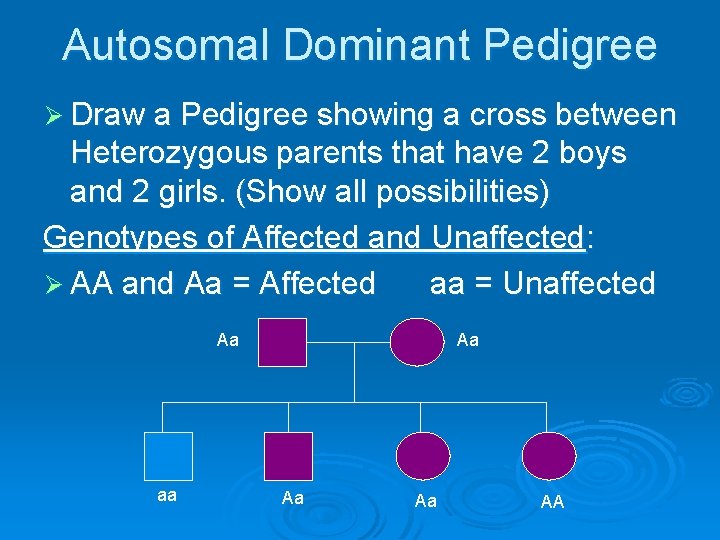
Autosomal Dominant Pedigree Ø Draw a Pedigree showing a cross between Heterozygous parents that have 2 boys and 2 girls. (Show all possibilities) Genotypes of Affected and Unaffected: Ø AA and Aa = Affected aa = Unaffected Aa aa Aa AA
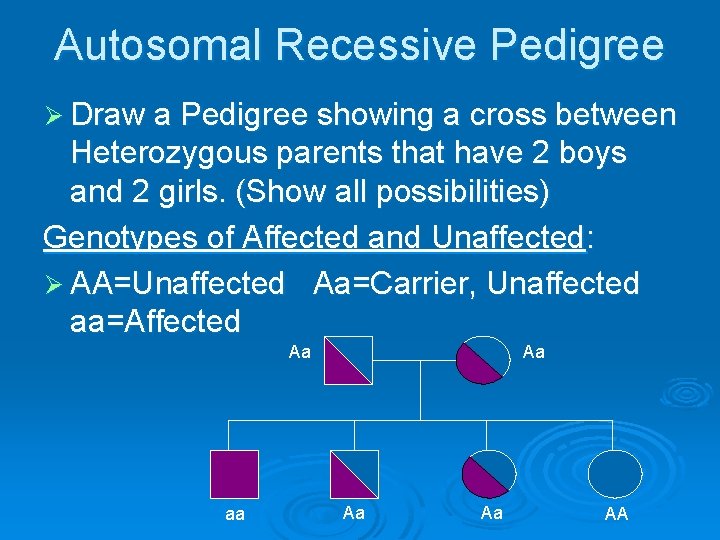
Autosomal Recessive Pedigree Ø Draw a Pedigree showing a cross between Heterozygous parents that have 2 boys and 2 girls. (Show all possibilities) Genotypes of Affected and Unaffected: Ø AA=Unaffected Aa=Carrier, Unaffected aa=Affected Aa aa Aa AA
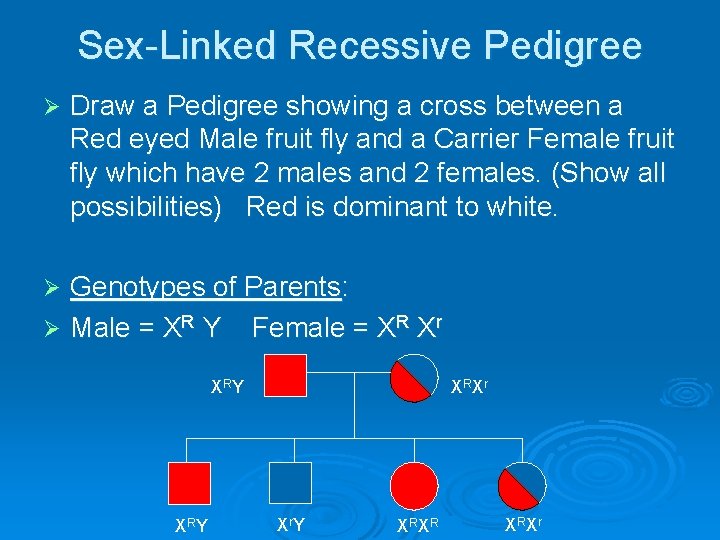
Sex-Linked Recessive Pedigree Ø Draw a Pedigree showing a cross between a Red eyed Male fruit fly and a Carrier Female fruit fly which have 2 males and 2 females. (Show all possibilities) Red is dominant to white. Genotypes of Parents: Ø Male = XR Y Female = XR Xr Ø XR Y XR Xr Xr Y XR XR XR Xr
Autosomal Dominant Traits Heterozygotes are affected Ø Affected children usually have affected parents. Ø Two affected parents can produce an unaffected child. (Aa x Aa) Ø Two unaffected parents will not produce affected children. (aa x aa) Ø Both males and females are affected with equal frequency. Ø Pedigrees show no Carriers. Ø
Autosomal Recessive Traits Ø Ø Ø Ø Heterozygotes are Carriers with a normal phenotype. Most affected children have normal parents. (Aa x Aa) Two affected parents will always produce an affected child. (aa x aa) Two unaffected parents will not produce affected children unless both are Carriers. (AA x AA, AA x Aa) Affected individuals with homozygous unaffected mates will have unaffected children. (aa x AA) Close relatives who reproduce are more likely to have affected children. Both males and females are affected with equal frequency. Pedigrees show both male and female carriers.
Sex-Linked Recessive Traits More males than females are affected. An affected son can have parents who have the normal phenotype. (XAY x XAXa) Ø For a daughter to have the trait, her father must also have it. Her mother must have it or be a carrier. (Xa. Y, Xa. Xa, XAXa) Ø The trait often skips a generation from the grandfather to the grandson. Ø If a woman has the trait (Xa. Xa), all of her sons will be affected. Ø Pedigrees show only female carriers but no male carriers. Ø Ø
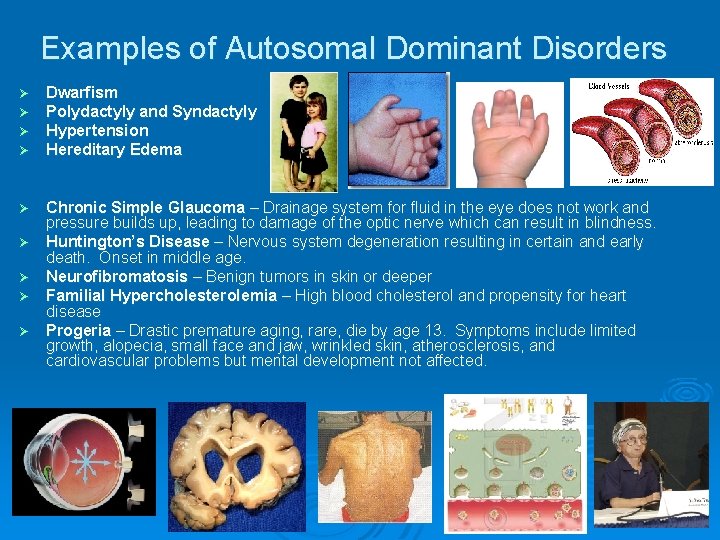
Examples of Autosomal Dominant Disorders Ø Ø Dwarfism Polydactyly and Syndactyly Hypertension Hereditary Edema Ø Chronic Simple Glaucoma – Drainage system for fluid in the eye does not work and pressure builds up, leading to damage of the optic nerve which can result in blindness. Huntington’s Disease – Nervous system degeneration resulting in certain and early death. Onset in middle age. Neurofibromatosis – Benign tumors in skin or deeper Familial Hypercholesterolemia – High blood cholesterol and propensity for heart disease Progeria – Drastic premature aging, rare, die by age 13. Symptoms include limited growth, alopecia, small face and jaw, wrinkled skin, atherosclerosis, and cardiovascular problems but mental development not affected. Ø Ø
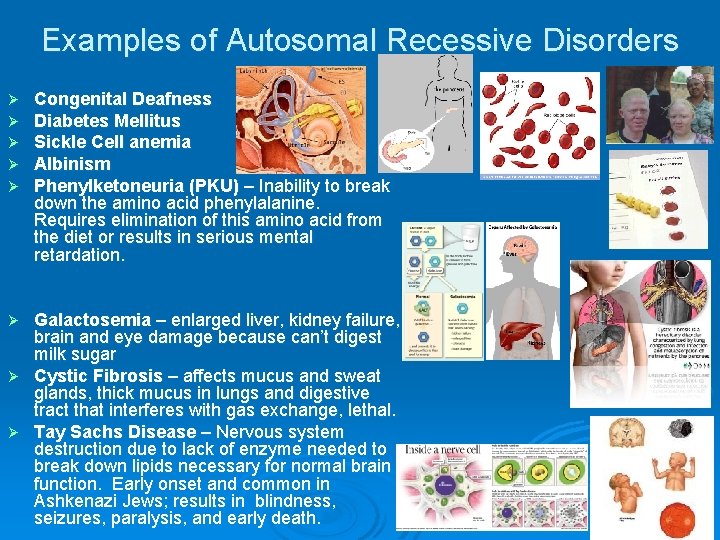
Examples of Autosomal Recessive Disorders Ø Ø Ø Congenital Deafness Diabetes Mellitus Sickle Cell anemia Albinism Phenylketoneuria (PKU) – Inability to break down the amino acid phenylalanine. Requires elimination of this amino acid from the diet or results in serious mental retardation. Galactosemia – enlarged liver, kidney failure, brain and eye damage because can’t digest milk sugar Ø Cystic Fibrosis – affects mucus and sweat glands, thick mucus in lungs and digestive tract that interferes with gas exchange, lethal. Ø Tay Sachs Disease – Nervous system destruction due to lack of enzyme needed to break down lipids necessary for normal brain function. Early onset and common in Ashkenazi Jews; results in blindness, seizures, paralysis, and early death. Ø
Examples of Sex-Linked Recessive Disorders Ø Ø Ø Ø Red/Green Colorblindness – Difficulty perceiving differences between colors (red or green, blue or yellow). Hemophilia – Absence of one or more proteins necessary for normal blood clotting. Deafness Cataracts – opacity in the lens that can lead to blindness Night blindness – (Nyctalopia) rods do not work so that can not see in the dark Glaucoma – pressure in the eye that can lead to optic nerve damage and blindness Duchenne Muscular Dystrophy – progressive weakness and degeneration of skeletal muscles that control movement due to absence of dystrophin (protein that maintains muscle integrity). Mainly in boys, onset 3 -5 yrs, by 12 years can’t walk, and later needs respirator.
More Mutations? Germ cell mutations(gametes)- can be passed on to offspring, but no effect on individual with mutation. Ø Somatic cell mutations(body cells)- affect the organism with mutation, not offspring. Ø Lethal mutations- cause miscarriage. Ø
Problems with Chromosome Number 1. Monosomy – only one of a particular type of chromosome (2 n -1) 2. Trisomy – having three of a particular type of chromosome (2 n + 1) 3. Polyploidy – having more than two sets of chromosomes; triploids (3 n = 3 of each type of chromosome), tetraploids (4 n = 4 of each type of chromosome).
Genetic Screening Ø Examining a person’s genetic make-up. Ø Amniocentesis- removing a small amount of amniotic fluid analyzing. Ø Chorionic villi sampling- removing a small amount of tissue that is between the uterus and placenta.