
Human Genetics Phenotype observed physical and functional traits

Human Genetics • Phenotype: observed physical and functional traits • Genotype: complete set of genes and alleles • Alleles: Different versions of homologous genes ex. B and b
Human genetics • How are gametes made? • How does chromosome behavior affect inheritance of traits?
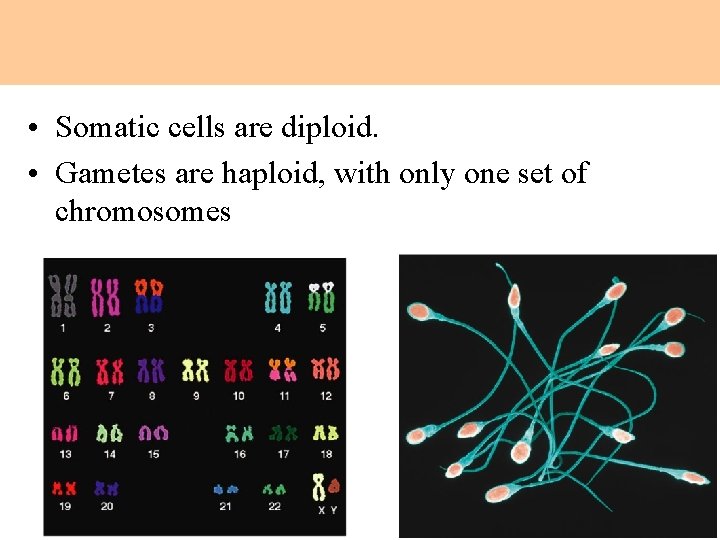
• Somatic cells are diploid. • Gametes are haploid, with only one set of chromosomes
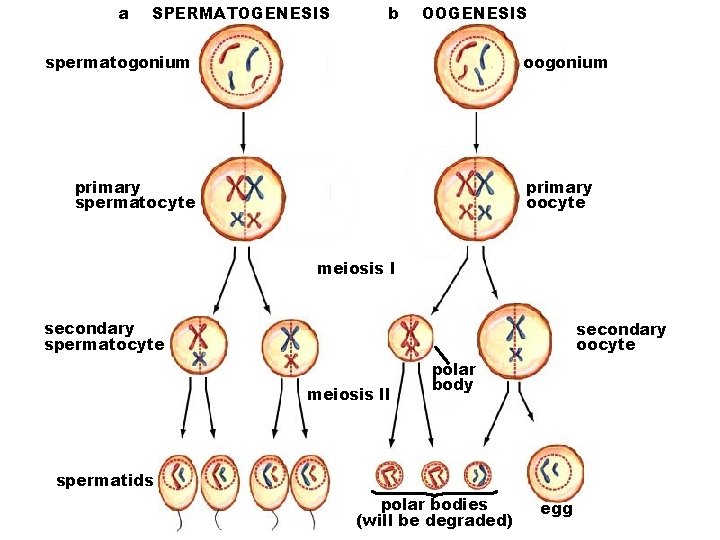
a SPERMATOGENESIS b OOGENESIS spermatogonium oogonium primary spermatocyte primary oocyte meiosis l secondary spermatocyte secondary oocyte meiosis ll polar body spermatids polar bodies (will be degraded) egg
1 st law - segregation of alleles • Cells contain 2 copies (alleles) of each gene • Alleles separate during gamete formation (meiosis) • gametes carry only one copy of each gene
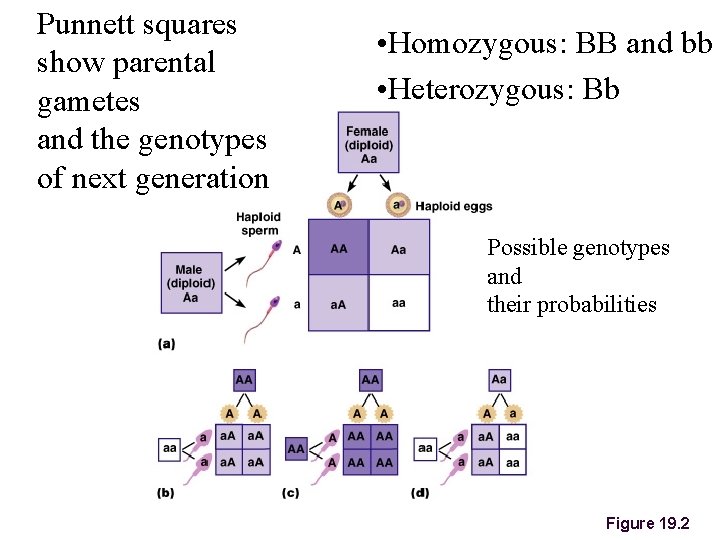
Punnett squares show parental gametes and the genotypes of next generation • Homozygous: BB and bb • Heterozygous: Bb Possible genotypes and their probabilities Figure 19. 2
Law of Independent Assortment • During gamete formation, genes for different traits separate independently into gametes • Why? random alignment of homologues at Meiosis I
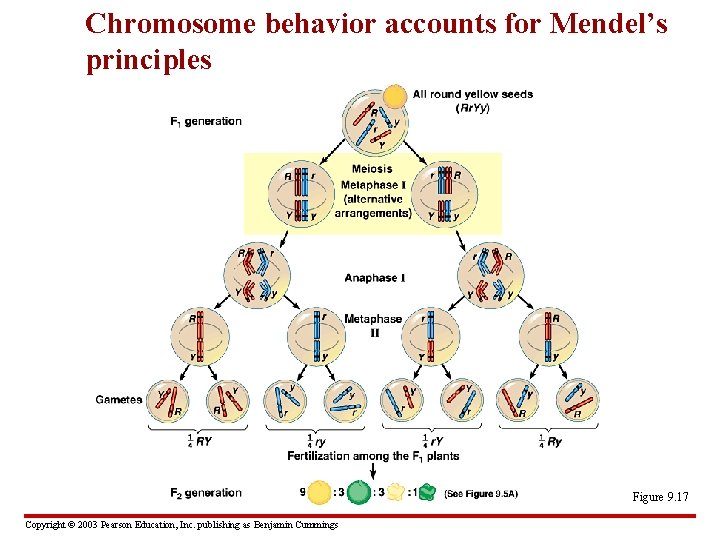
Chromosome behavior accounts for Mendel’s principles Figure 9. 17 Copyright © 2003 Pearson Education, Inc. publishing as Benjamin Cummings
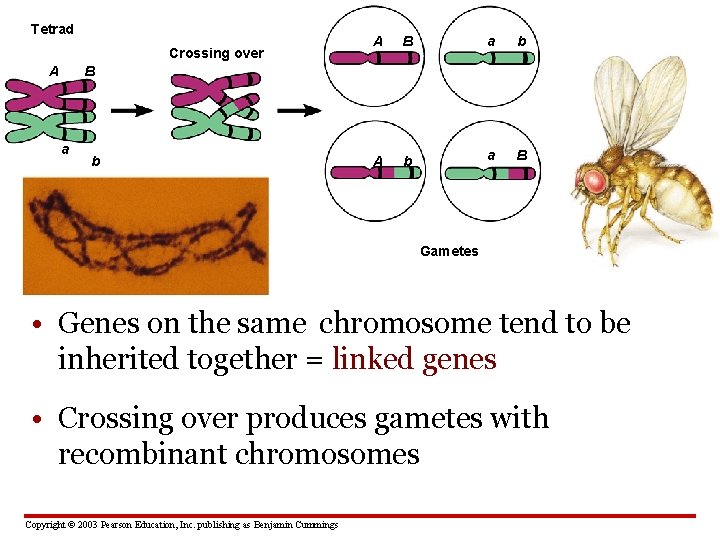
Tetrad Crossing over A A B a b A b a B B a b Gametes • Genes on the same chromosome tend to be inherited together = linked genes • Crossing over produces gametes with recombinant chromosomes Copyright © 2003 Pearson Education, Inc. publishing as Benjamin Cummings
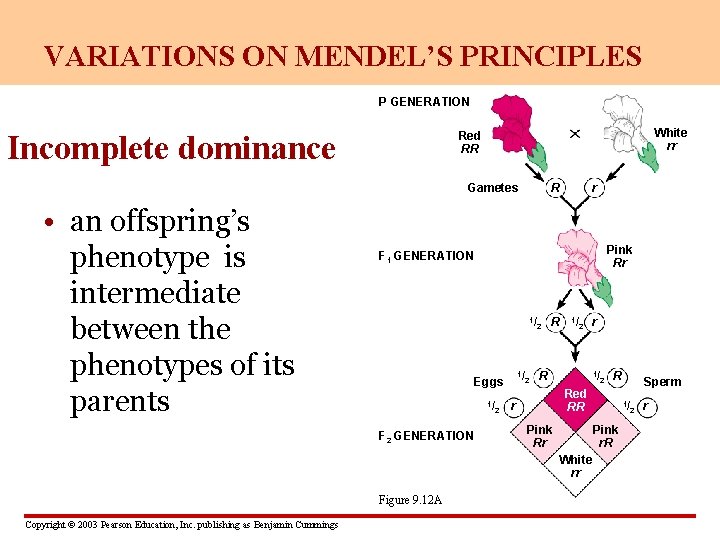
VARIATIONS ON MENDEL’S PRINCIPLES P GENERATION Incomplete dominance White rr Red RR Gametes • an offspring’s phenotype is intermediate between the phenotypes of its parents R r Pink Rr F 1 GENERATION 1/ 1/ Eggs 1/ F 2 GENERATION 2 2 2 R 1/ 2 r R 1/ Copyright © 2003 Pearson Education, Inc. publishing as Benjamin Cummings R Red RR r Pink Rr Sperm 1/ Pink r. R White rr Figure 9. 12 A 2 2 r
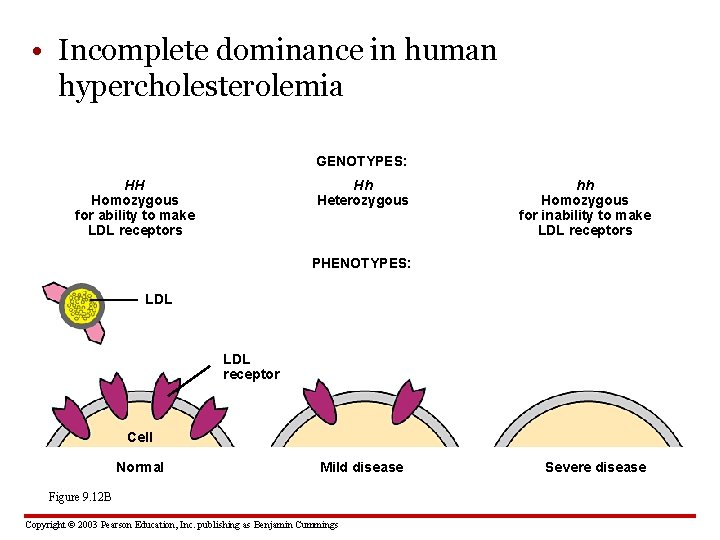
• Incomplete dominance in human hypercholesterolemia GENOTYPES: HH Homozygous for ability to make LDL receptors Hh Heterozygous hh Homozygous for inability to make LDL receptors PHENOTYPES: LDL receptor Cell Normal Mild disease Figure 9. 12 B Copyright © 2003 Pearson Education, Inc. publishing as Benjamin Cummings Severe disease
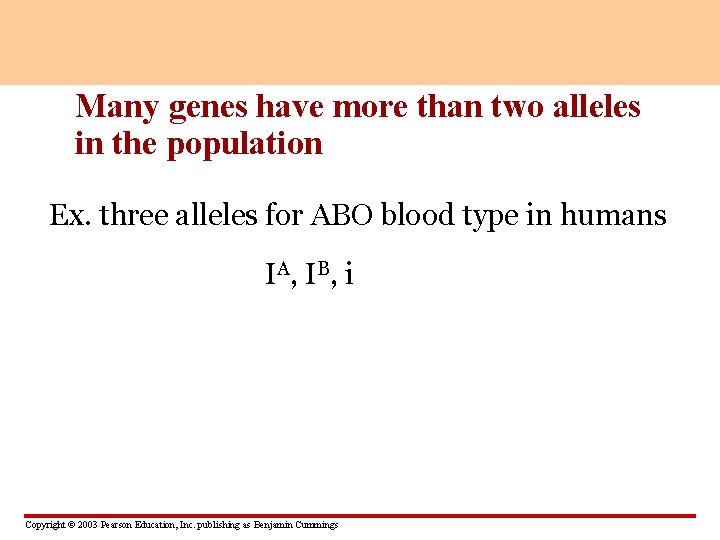
Many genes have more than two alleles in the population Ex. three alleles for ABO blood type in humans IA, I B, i Copyright © 2003 Pearson Education, Inc. publishing as Benjamin Cummings
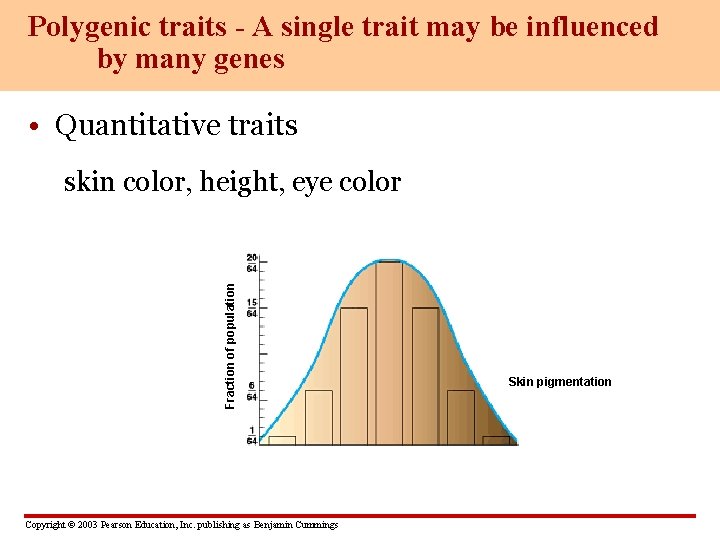
Polygenic traits - A single trait may be influenced by many genes • Quantitative traits Fraction of population skin color, height, eye color Copyright © 2003 Pearson Education, Inc. publishing as Benjamin Cummings Skin pigmentation
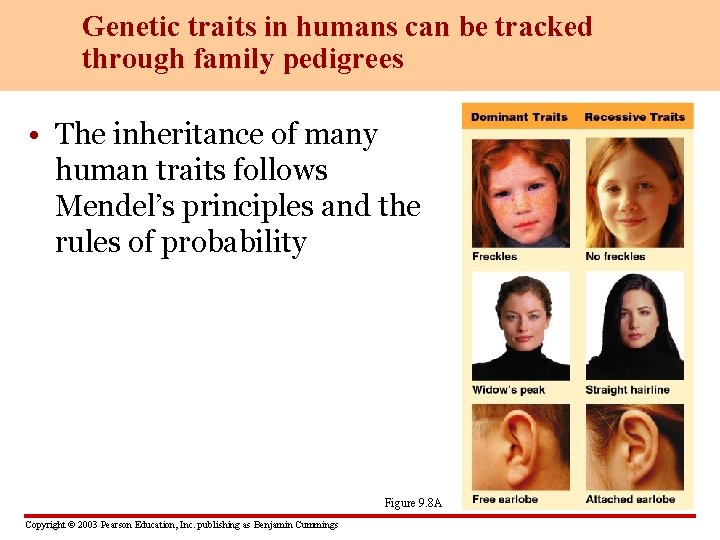
Genetic traits in humans can be tracked through family pedigrees • The inheritance of many human traits follows Mendel’s principles and the rules of probability Figure 9. 8 A Copyright © 2003 Pearson Education, Inc. publishing as Benjamin Cummings
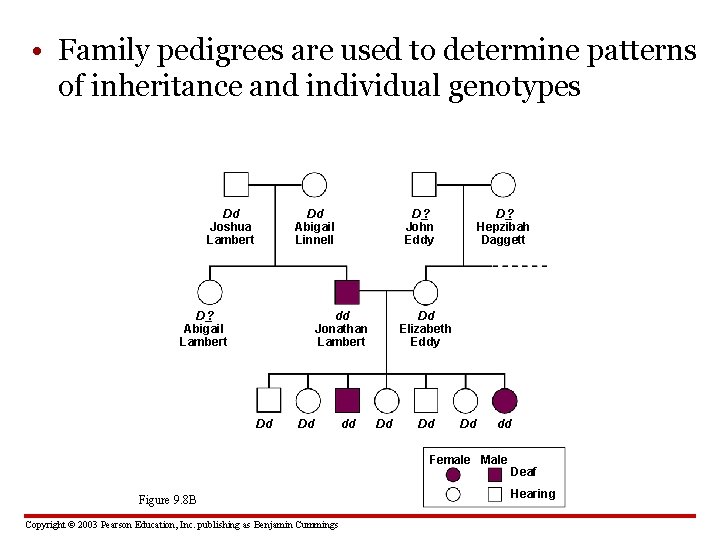
• Family pedigrees are used to determine patterns of inheritance and individual genotypes Dd Joshua Lambert Dd Abigail Linnell D_? Abigail Lambert D_? John Eddy dd Jonathan Lambert Dd Dd dd D_? Hepzibah Daggett Dd Elizabeth Eddy Dd Dd Dd dd Female Male Figure 9. 8 B Copyright © 2003 Pearson Education, Inc. publishing as Benjamin Cummings Deaf Hearing
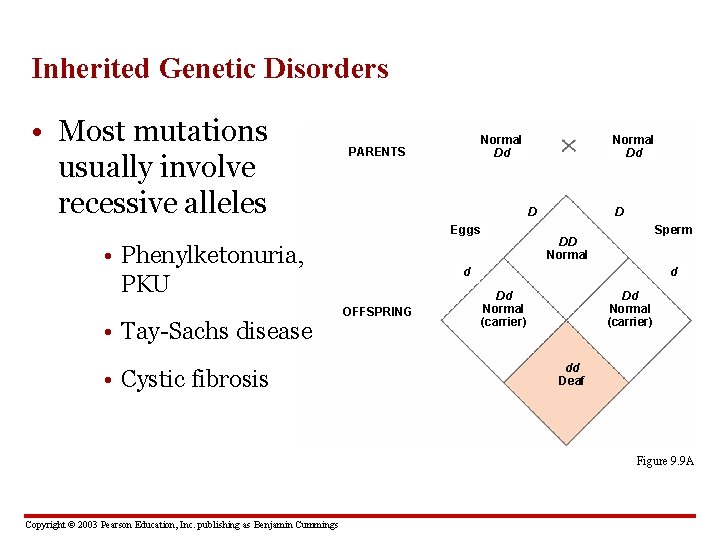
Inherited Genetic Disorders • Most mutations usually involve recessive alleles Normal Dd PARENTS D Eggs • Phenylketonuria, PKU • Tay-Sachs disease • Cystic fibrosis Normal Dd D Sperm DD Normal d OFFSPRING d Dd Normal (carrier) dd Deaf Figure 9. 9 A Copyright © 2003 Pearson Education, Inc. publishing as Benjamin Cummings
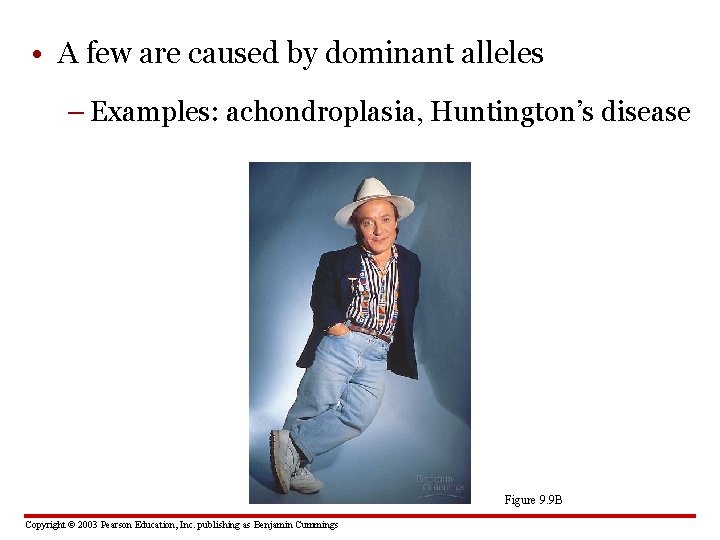
• A few are caused by dominant alleles – Examples: achondroplasia, Huntington’s disease Figure 9. 9 B Copyright © 2003 Pearson Education, Inc. publishing as Benjamin Cummings
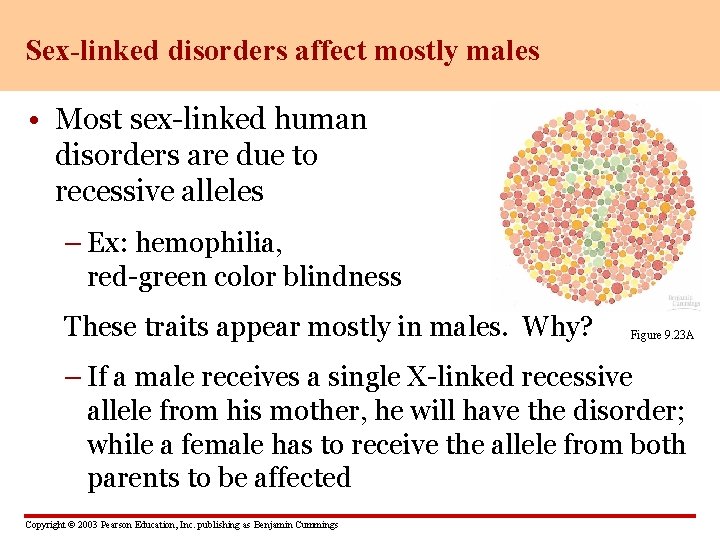
Sex-linked disorders affect mostly males • Most sex-linked human disorders are due to recessive alleles – Ex: hemophilia, red-green color blindness These traits appear mostly in males. Why? Figure 9. 23 A – If a male receives a single X-linked recessive allele from his mother, he will have the disorder; while a female has to receive the allele from both parents to be affected Copyright © 2003 Pearson Education, Inc. publishing as Benjamin Cummings
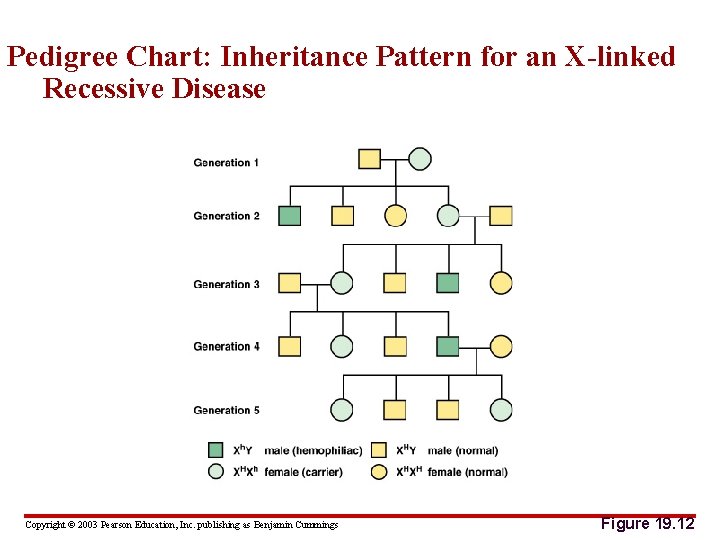
Pedigree Chart: Inheritance Pattern for an X-linked Recessive Disease Copyright © 2003 Pearson Education, Inc. publishing as Benjamin Cummings Figure 19. 12
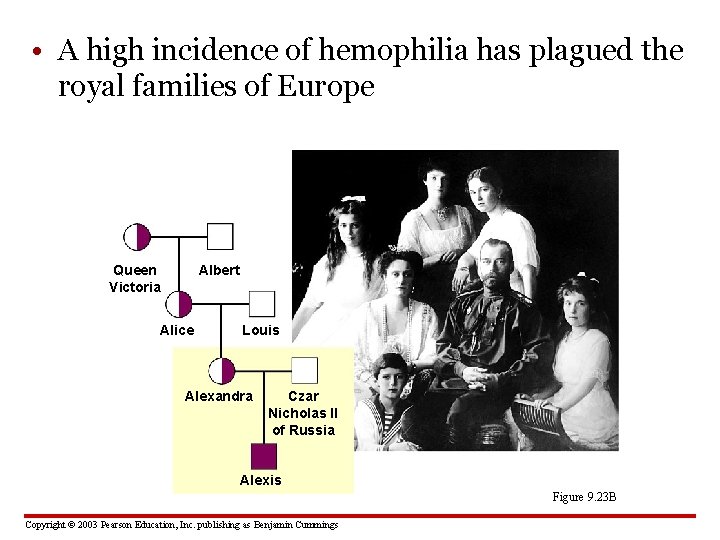
• A high incidence of hemophilia has plagued the royal families of Europe Queen Victoria Albert Alice Louis Alexandra Czar Nicholas II of Russia Alexis Figure 9. 23 B Copyright © 2003 Pearson Education, Inc. publishing as Benjamin Cummings
Variations on Mendel’s Principles • Codominance, multiple alleles • Pleiotropy • Polygenic traits • Sex-linked genes • Environmental effects Copyright © 2003 Pearson Education, Inc. publishing as Benjamin Cummings
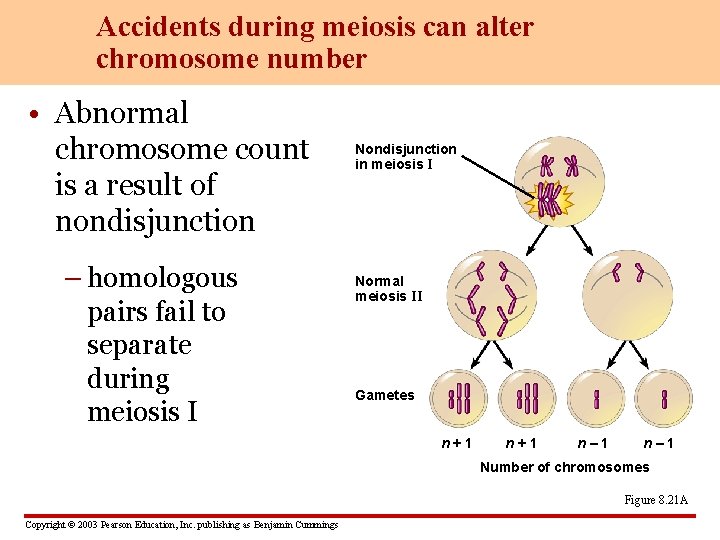
Accidents during meiosis can alter chromosome number • Abnormal chromosome count is a result of nondisjunction – homologous pairs fail to separate during meiosis I Nondisjunction in meiosis I Normal meiosis II Gametes n+1 n– 1 Number of chromosomes Figure 8. 21 A Copyright © 2003 Pearson Education, Inc. publishing as Benjamin Cummings
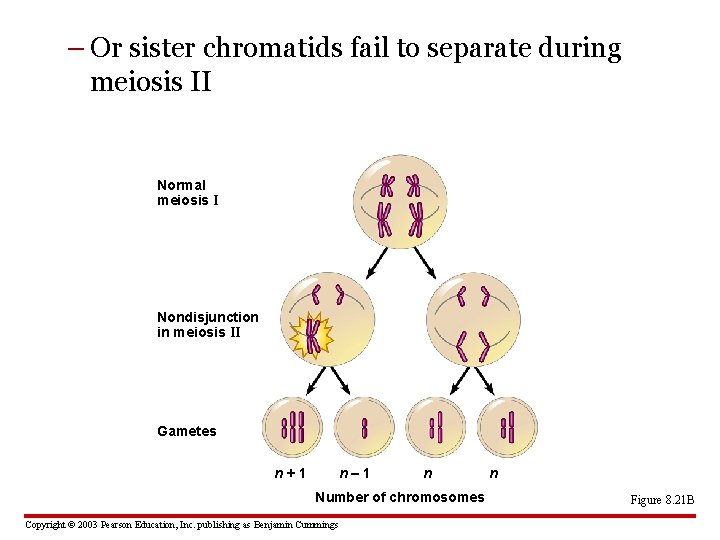
– Or sister chromatids fail to separate during meiosis II Normal meiosis I Nondisjunction in meiosis II Gametes n+1 n– 1 n Number of chromosomes Copyright © 2003 Pearson Education, Inc. publishing as Benjamin Cummings n Figure 8. 21 B
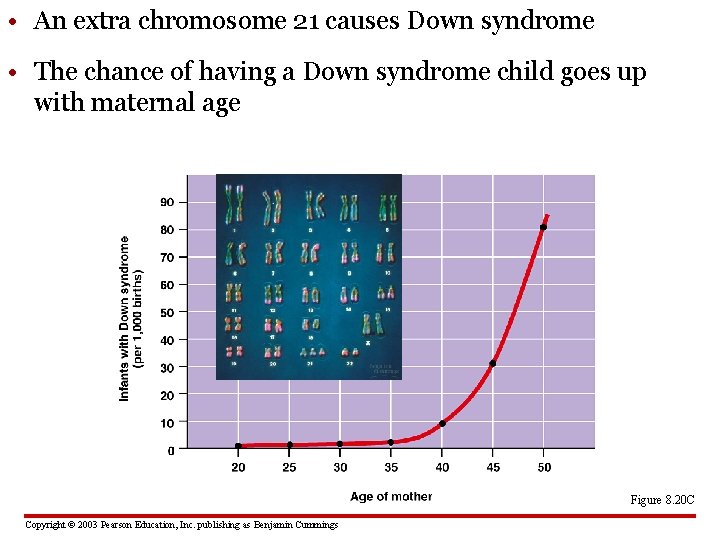
• An extra chromosome 21 causes Down syndrome • The chance of having a Down syndrome child goes up with maternal age Figure 8. 20 C Copyright © 2003 Pearson Education, Inc. publishing as Benjamin Cummings
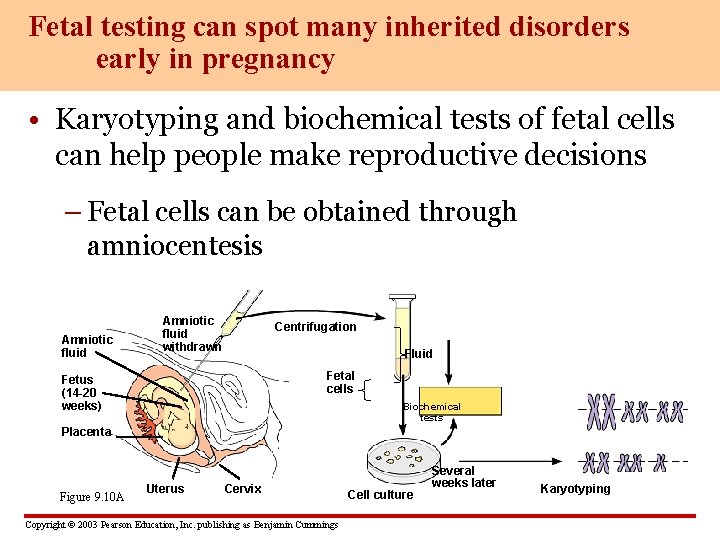
Fetal testing can spot many inherited disorders early in pregnancy • Karyotyping and biochemical tests of fetal cells can help people make reproductive decisions – Fetal cells can be obtained through amniocentesis Amniotic fluid withdrawn Centrifugation Fluid Fetal cells Fetus (14 -20 weeks) Biochemical tests Placenta Figure 9. 10 A Uterus Cervix Copyright © 2003 Pearson Education, Inc. publishing as Benjamin Cummings Cell culture Several weeks later Karyotyping
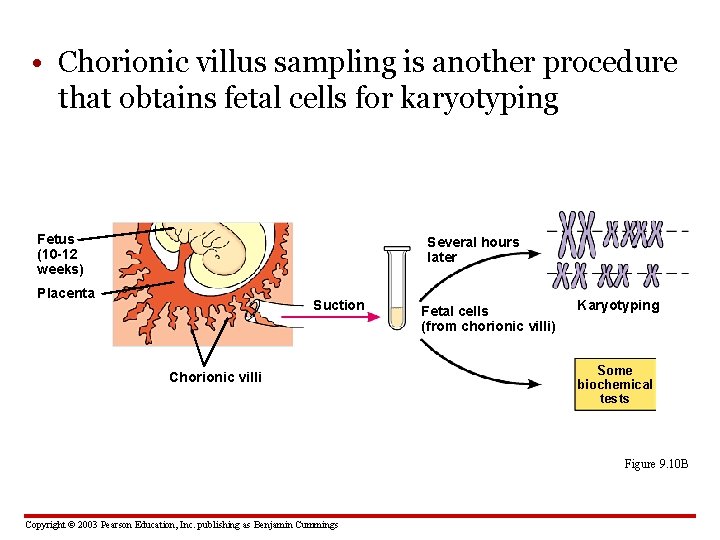
• Chorionic villus sampling is another procedure that obtains fetal cells for karyotyping Fetus (10 -12 weeks) Several hours later Placenta Suction Chorionic villi Fetal cells (from chorionic villi) Karyotyping Some biochemical tests Figure 9. 10 B Copyright © 2003 Pearson Education, Inc. publishing as Benjamin Cummings
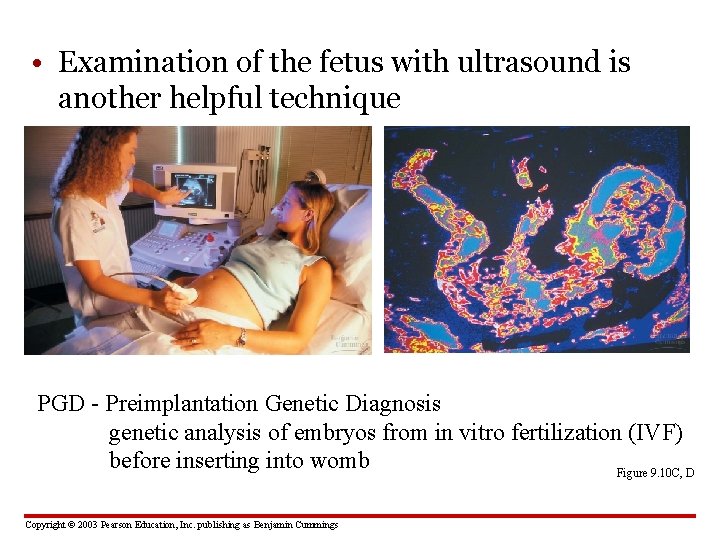
• Examination of the fetus with ultrasound is another helpful technique PGD - Preimplantation Genetic Diagnosis genetic analysis of embryos from in vitro fertilization (IVF) before inserting into womb Figure 9. 10 C, D Copyright © 2003 Pearson Education, Inc. publishing as Benjamin Cummings
Genes and Behavior • Mechanism – Product from gene-specific proteins – Proteins have specific functions leading to phenotypes: hormones, enzymes, transport, neurotransmitters Copyright © 2003 Pearson Education, Inc. publishing as Benjamin Cummings
- Slides: 28