
Human genetics Mode Of Inheritance For revision only
- Slides: 30
Human genetics: Mode Of Inheritance For revision only • Important • Notes
Objectives: • Asses Mendel’s laws of inheritance • Understand the bases of Mendelian inheritance • Define various patterns of single gene inheritance using family pedigree and Punnett’s squares
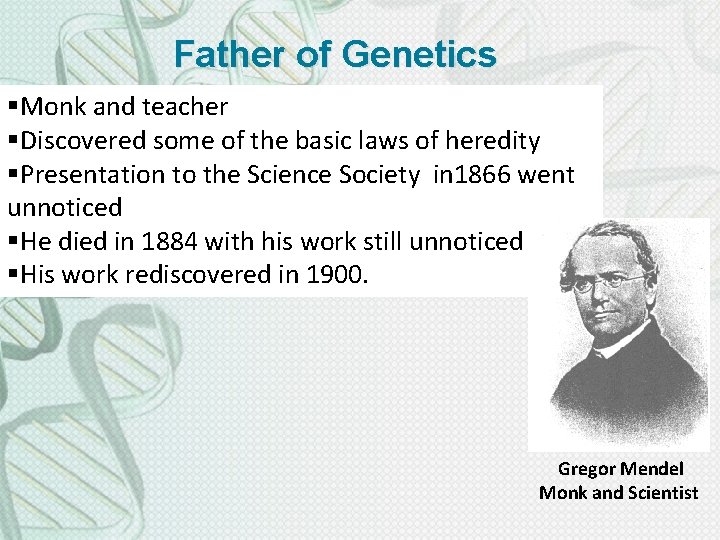
Father of Genetics §Monk and teacher §Discovered some of the basic laws of heredity §Presentation to the Science Society in 1866 went unnoticed §He died in 1884 with his work still unnoticed §His work rediscovered in 1900. Gregor Mendel Monk and Scientist
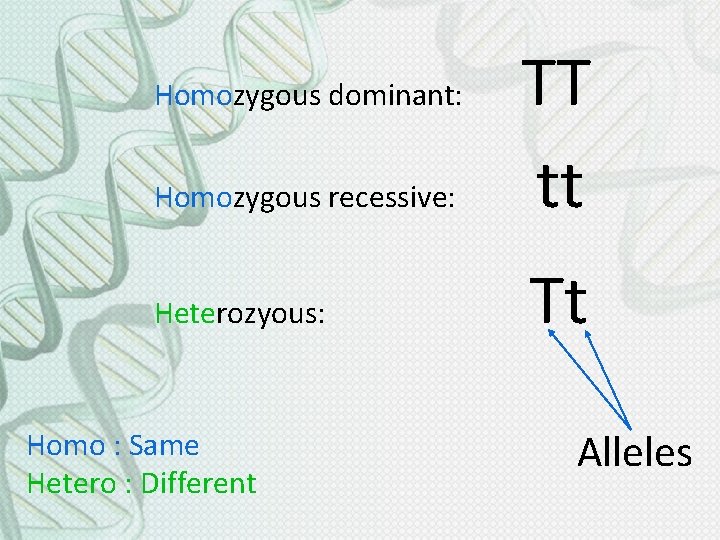
Mendel’s breeding experiments : Interpretation of his results • The plant characteristics being studied were each controlled by a pair of factors, one of which was inherited from each parent. • The pure-bred plants, with two identical genes, used in the initial cross would now be referred to as homozygous. • The hybrid F 1 plants, each of which has one gene for tallness and one for shortness, would be referred to as heterozygous. • The genes responsible for these contrasting characteristics are referred to as allelomorphs, or alleles for short.
Homozygous recessive: TT tt Heterozyous: Tt Homozygous dominant: Homo : Same Hetero : Different Alleles
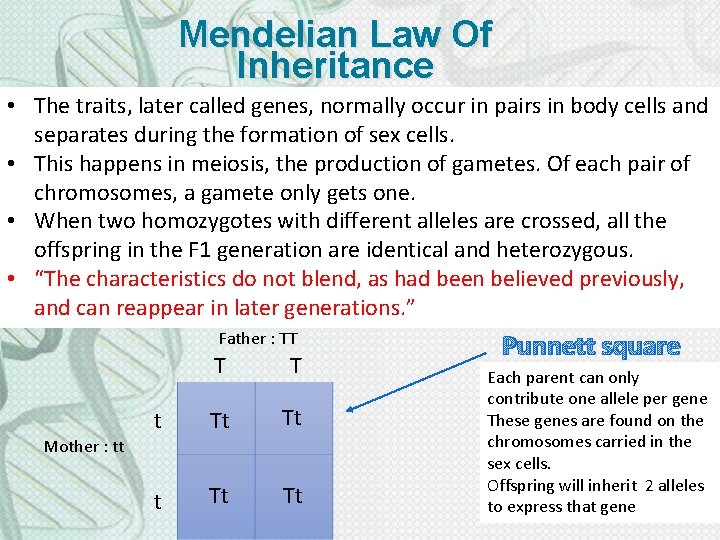
Mendelian Law Of Inheritance • The traits, later called genes, normally occur in pairs in body cells and separates during the formation of sex cells. • This happens in meiosis, the production of gametes. Of each pair of chromosomes, a gamete only gets one. • When two homozygotes with different alleles are crossed, all the offspring in the F 1 generation are identical and heterozygous. • “The characteristics do not blend, as had been believed previously, and can reappear in later generations. ” Father : TT Mother : tt T T t Tt Tt Punnett square Each parent can only contribute one allele per gene These genes are found on the chromosomes carried in the sex cells. Offspring will inherit 2 alleles to express that gene
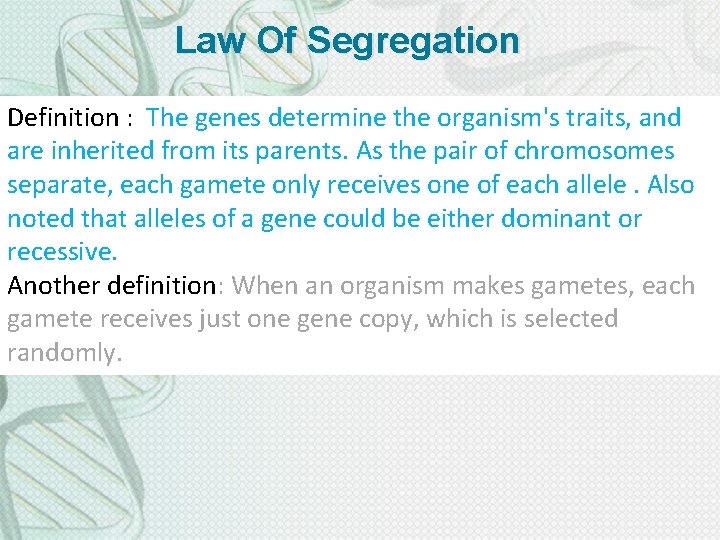
Law Of Segregation Definition : The genes determine the organism's traits, and are inherited from its parents. As the pair of chromosomes separate, each gamete only receives one of each allele. Also noted that alleles of a gene could be either dominant or recessive. Another definition: When an organism makes gametes, each gamete receives just one gene copy, which is selected randomly.
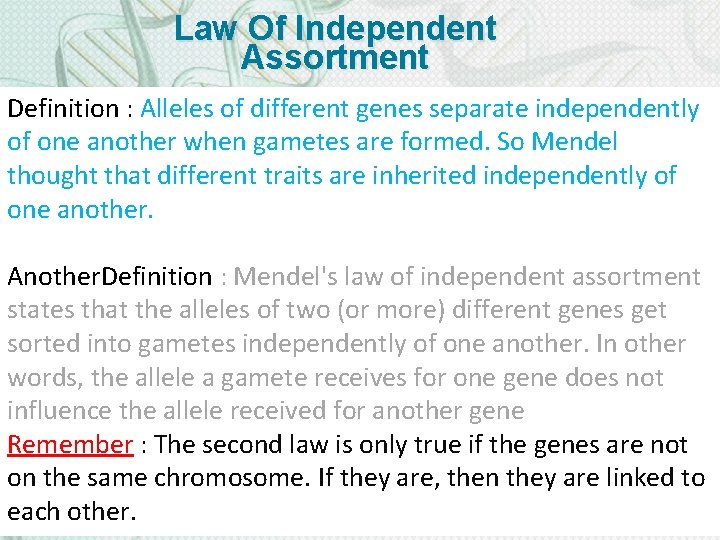
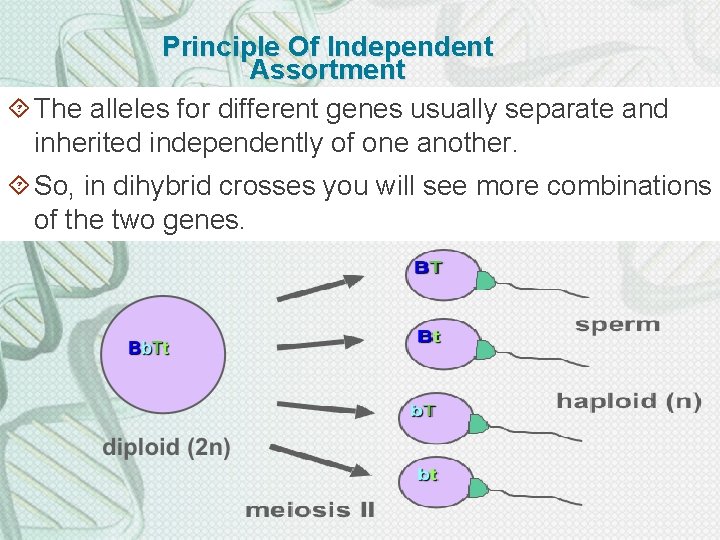
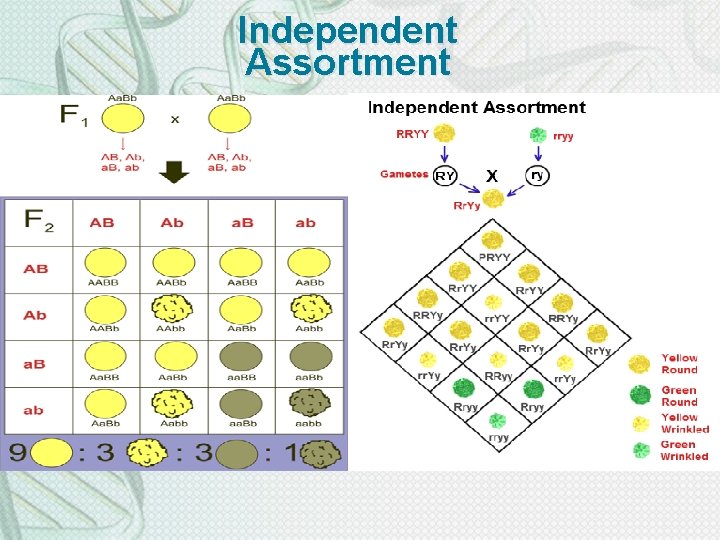
Law Of Independent Assortment Definition : Alleles of different genes separate independently of one another when gametes are formed. So Mendel thought that different traits are inherited independently of one another. Another. Definition : Mendel's law of independent assortment states that the alleles of two (or more) different genes get sorted into gametes independently of one another. In other words, the allele a gamete receives for one gene does not influence the allele received for another gene Remember : The second law is only true if the genes are not on the same chromosome. If they are, then they are linked to each other.
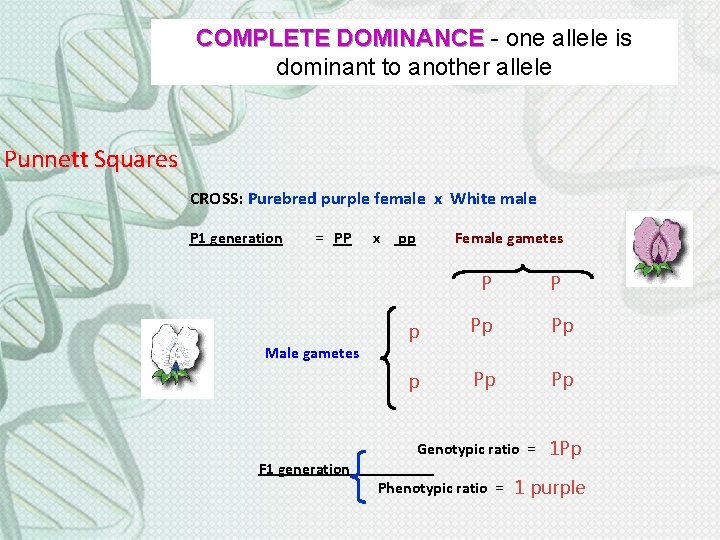
COMPLETE DOMINANCE - one allele is dominant to another allele Punnett Squares CROSS: Purebred purple female x White male P 1 generation = PP x pp Female gametes P P p Pp Pp Male gametes F 1 generation Genotypic ratio = 1 Pp Phenotypic ratio = 1 purple
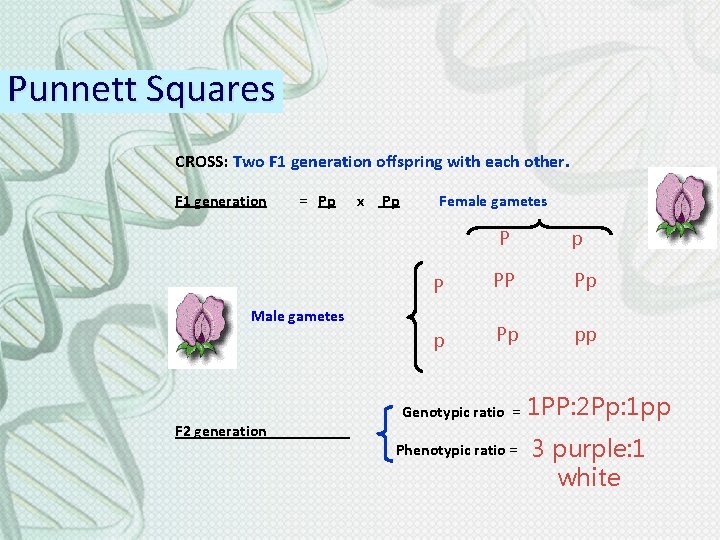
Punnett Squares CROSS: Two F 1 generation offspring with each other. F 1 generation = Pp x Pp Female gametes P P PP Pp pp Male gametes F 2 generation p Genotypic ratio = Phenotypic ratio = 1 PP: 2 Pp: 1 pp 3 purple: 1 white
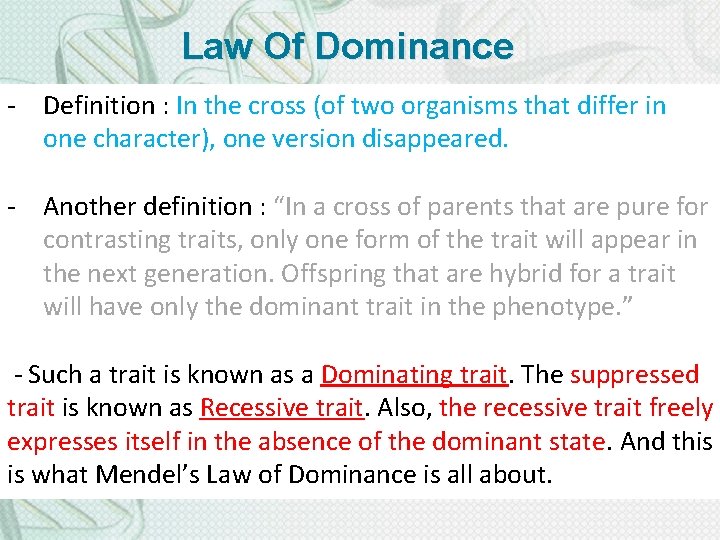
Law Of Dominance - Definition : In the cross (of two organisms that differ in one character), one version disappeared. - Another definition : “In a cross of parents that are pure for contrasting traits, only one form of the trait will appear in the next generation. Offspring that are hybrid for a trait will have only the dominant trait in the phenotype. ” - Such a trait is known as a Dominating trait. The suppressed trait is known as Recessive trait. Also, the recessive trait freely expresses itself in the absence of the dominant state. And this is what Mendel’s Law of Dominance is all about.
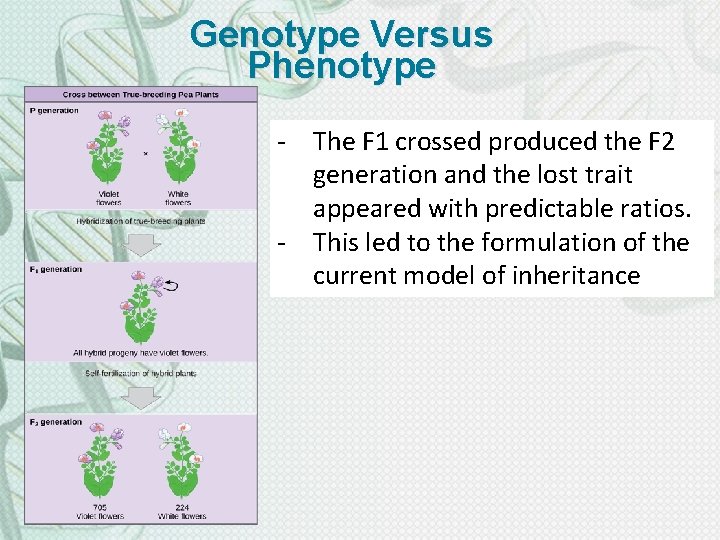
Genotype Versus Phenotype - The F 1 crossed produced the F 2 generation and the lost trait appeared with predictable ratios. - This led to the formulation of the current model of inheritance
Principle Of Independent Assortment The alleles for different genes usually separate and inherited independently of one another. So, in dihybrid crosses you will see more combinations of the two genes.
Independent Assortment
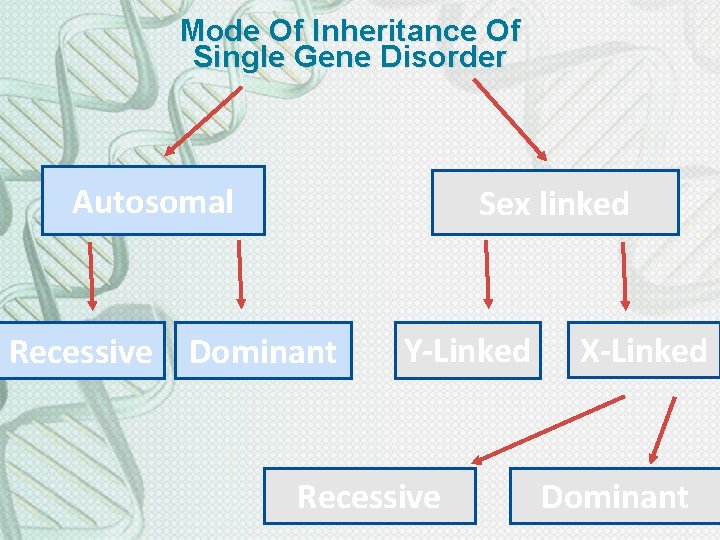
Mendelian Inheritance Over 11, 000 traits/disorders in humans exhibit single gene unifactorial or Mendelian inheritance. A trait or disorder that is determined by a gene on an autosome is said to show autosomal inheritance. A trait or disorder determined by a gene on one of the sex chromosomes is said to show sexlinked inheritance.
Mode Of Inheritance Of Single Gene Disorder Autosomal Sex linked Recessive Dominant Y-Linked Recessive X-Linked Dominant
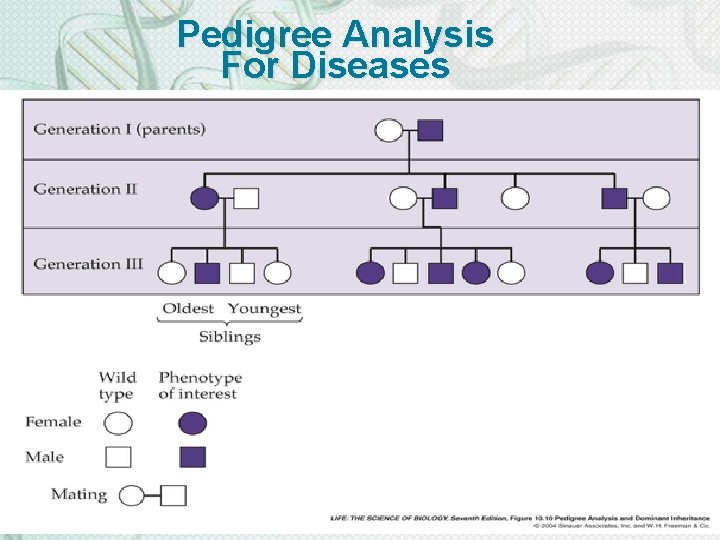
Pedigree Analysis For Diseases
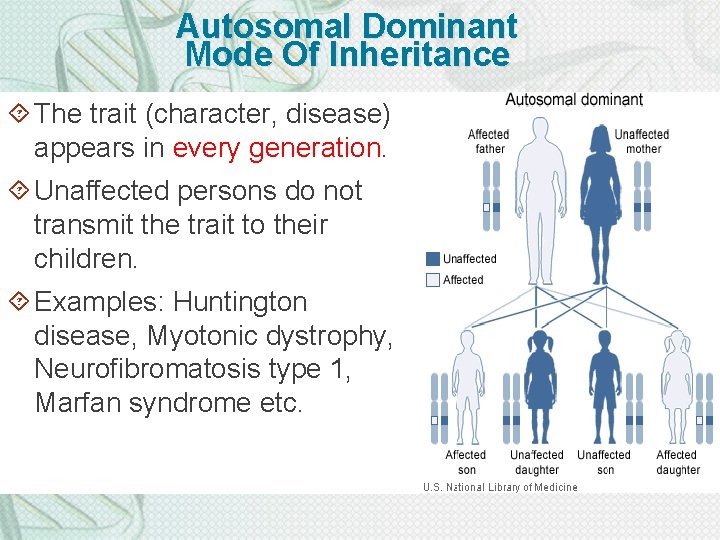
Autosomal Dominant Mode Of Inheritance The trait (character, disease) appears in every generation. Unaffected persons do not transmit the trait to their children. Examples: Huntington disease, Myotonic dystrophy, Neurofibromatosis type 1, Marfan syndrome etc.
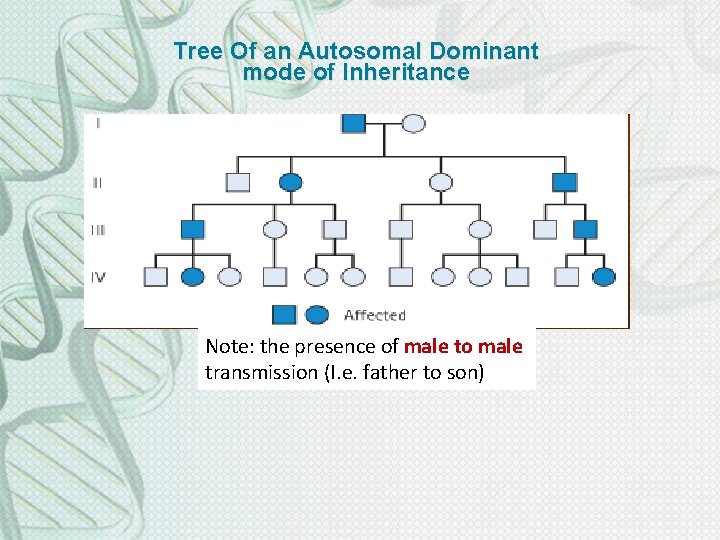
Tree Of an Autosomal Dominant mode of Inheritance Note: the presence of male to male transmission (I. e. father to son)
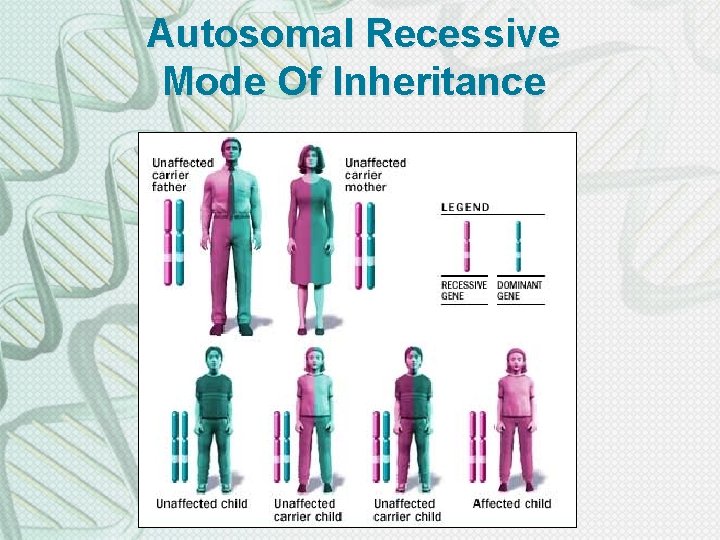
Autosomal Recessive Mode Of Inheritance § The trait is recessive § The trait expresses itself only in homozygous state § Unaffected persons(heterozygous)may have affected children (if the other parent is heterozygous) § The parents of the affected child maybe related(consanguineous) ﺗﺮﺑﻄﻬﻢ ﺻﻠﺔ ﻗﺮﺍﺑﺔ § Males and females are equally affected § Ex : Cystic fibrosis, Phenylketonuria, Sickle cell anemia, Thalassemia etc.
Autosomal Recessive Mode Of Inheritance
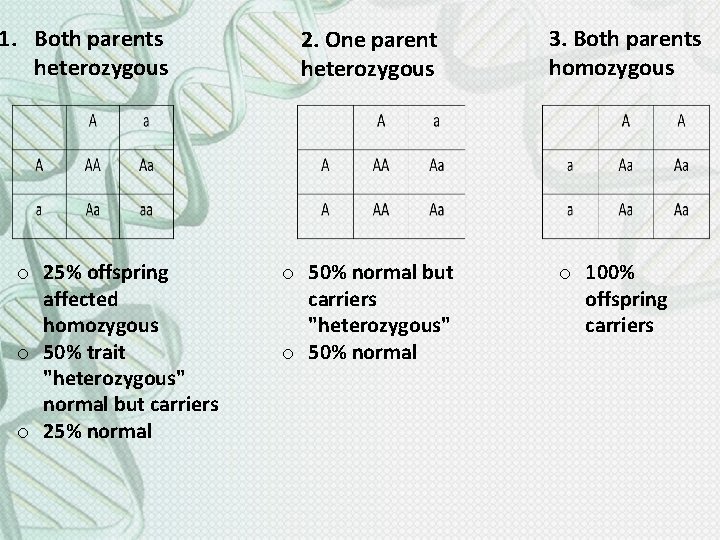
1. Both parents heterozygous o 25% offspring affected homozygous o 50% trait "heterozygous" normal but carriers o 25% normal 2. One parent heterozygous o 50% normal but carriers "heterozygous" o 50% normal 3. Both parents homozygous o 100% offspring carriers
Sex-Linked Inheritance • This is the inheritance of a gene present on the sex chromosomes. • The Inheritance Pattern is different from the autosomal inheritance. • Inheritance is different in the males and females.
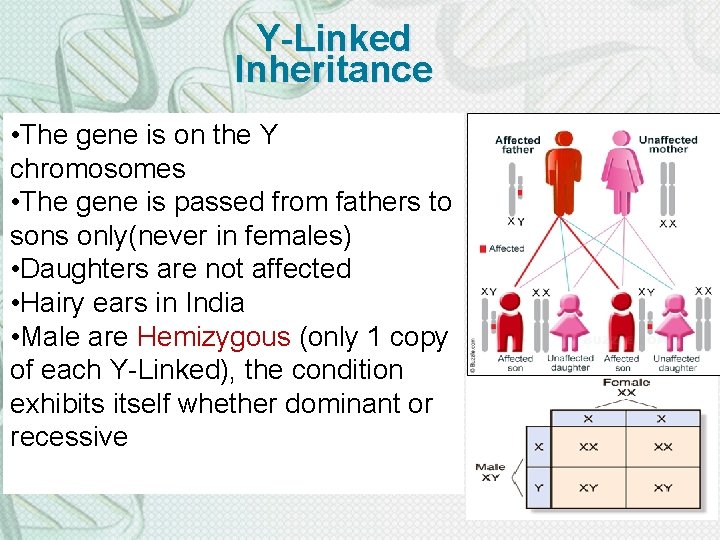
Y-Linked Inheritance • The gene is on the Y chromosomes • The gene is passed from fathers to sons only(never in females) • Daughters are not affected • Hairy ears in India • Male are Hemizygous (only 1 copy of each Y-Linked), the condition exhibits itself whether dominant or recessive
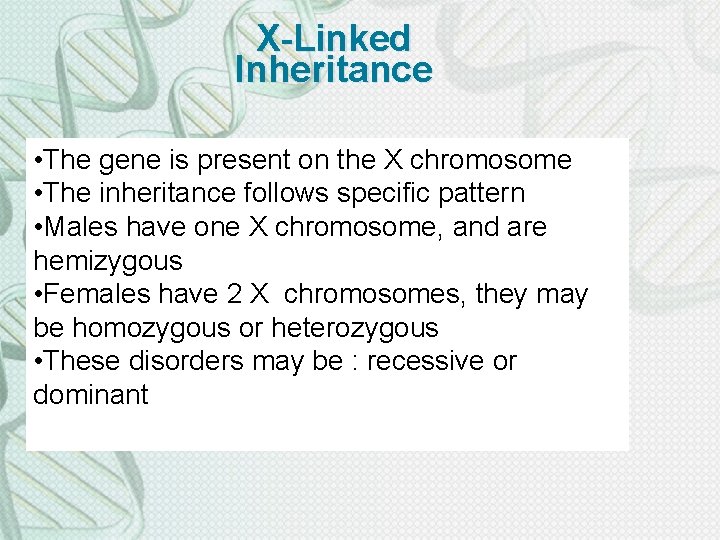
X-Linked Inheritance • The gene is present on the X chromosome • The inheritance follows specific pattern • Males have one X chromosome, and are hemizygous • Females have 2 X chromosomes, they may be homozygous or heterozygous • These disorders may be : recessive or dominant
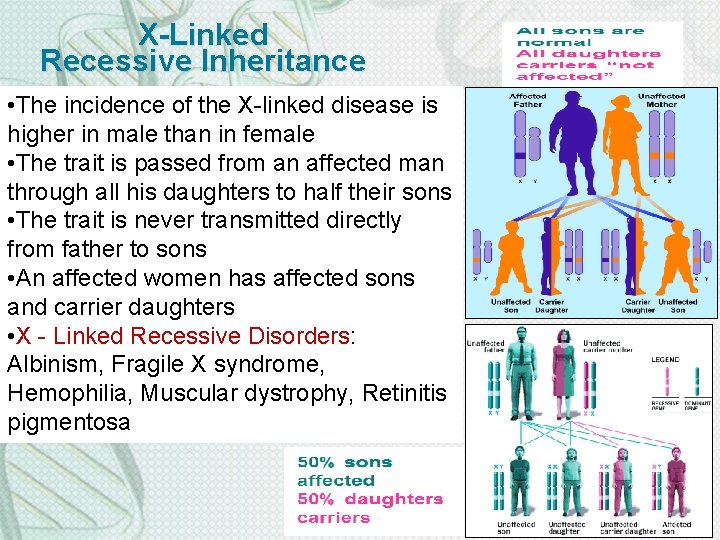
X-Linked Recessive Inheritance • The incidence of the X-linked disease is higher in male than in female • The trait is passed from an affected man through all his daughters to half their sons • The trait is never transmitted directly from father to sons • An affected women has affected sons and carrier daughters • X - Linked Recessive Disorders: Albinism, Fragile X syndrome, Hemophilia, Muscular dystrophy, Retinitis pigmentosa
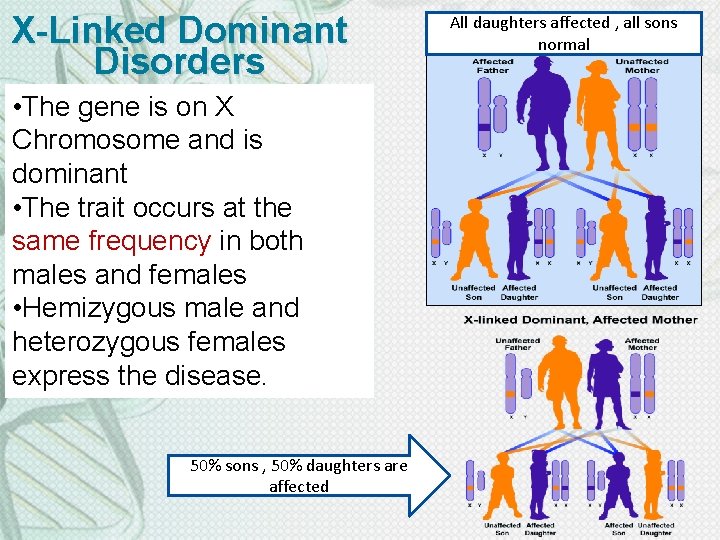
X-Linked Dominant Disorders • The gene is on X Chromosome and is dominant • The trait occurs at the same frequency in both males and females • Hemizygous male and heterozygous females express the disease. 50% sons , 50% daughters are affected All daughters affected , all sons normal
NOTES • An accurate determination of the family pedigree is an important part of the workup of every patient • Pedigrees for single-gene disorders may demonstrate a straightforward, typical mendelian inheritance pattern • These patterns depend on the chromosomal location of the gene locus, which may be autosomal or sex chromosome-linked, and whether the phenotype is dominant or recessive • Other atypical mode of inheritance will be discussed next lecture.
Online Quiz ! Here
Boys team: • Abdulrahman ALrajhi (Leader) • Abdulmohsen Alghannam • Abdulmalik Alghannam • Saleh Altwaijri • Abdullah Alharbi @HGteam 46 Email: humangenetics 436@gmail. com