
Human genetics Atypical Patterns of Inheritance For revision
- Slides: 23
Human genetics: Atypical Patterns of Inheritance For revision only • Important • Notes
Objectives: By the end of this lecture, students should be able to appreciate the possibility of atypical patterns of inheritance with special emphasis on: 1. Codominant traits 2. Pseudo-dominant inheritance 3. The mitochondrial inheritance 4. Anticipation 5. Pleiotropy 6. Variable expressivity 7. Heterogeneity 8. New mutation 9. Complex trait: multifactorial/Polygenic
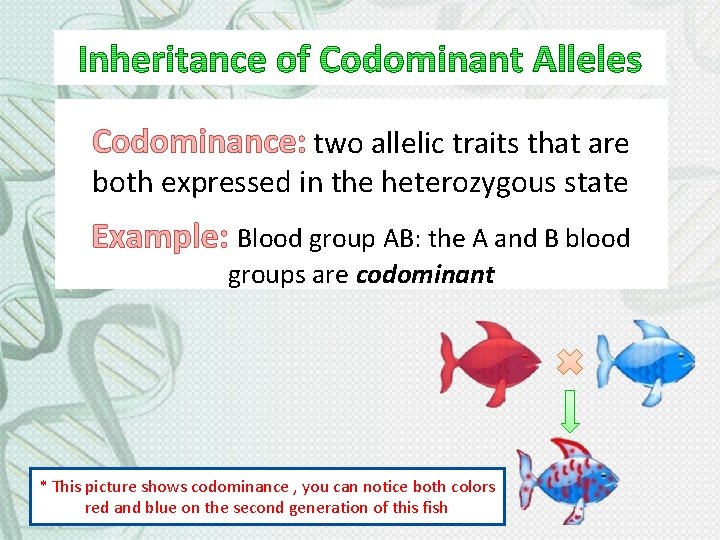
Codominance: two allelic traits that are both expressed in the heterozygous state Example: Blood group AB: the A and B blood groups are codominant * This picture shows codominance , you can notice both colors red and blue on the second generation of this fish
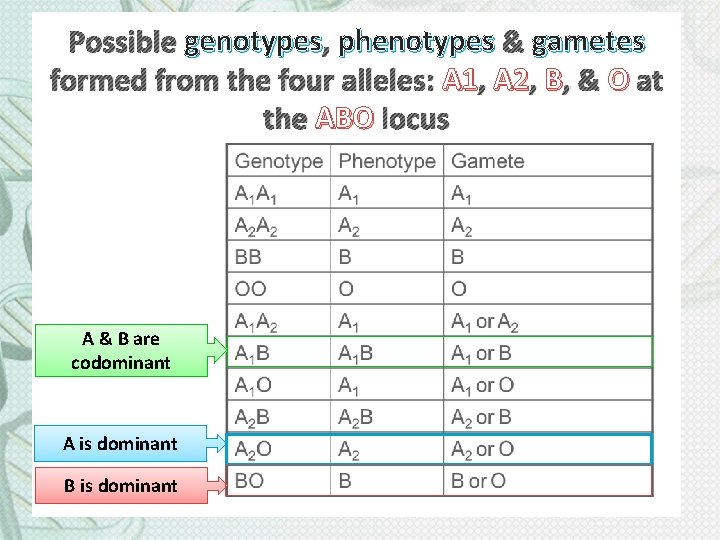
Possible genotypes , phenotypes & gametes formed from the four alleles: A 1 , A 2 , B , & O at the ABO locus A & B are codominant A is dominant B is dominant
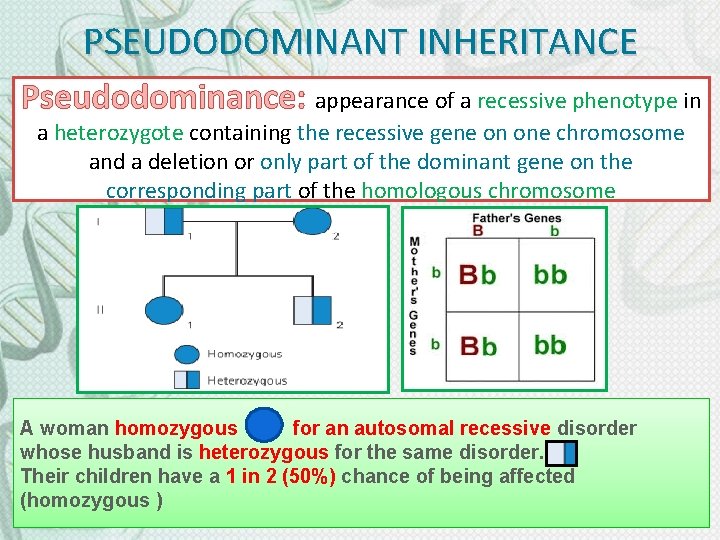
PSEUDODOMINANT INHERITANCE Pseudodominance: appearance of a recessive phenotype in a heterozygote containing the recessive gene on one chromosome and a deletion or only part of the dominant gene on the corresponding part of the homologous chromosome A woman homozygous for an autosomal recessive disorder whose husband is heterozygous for the same disorder. Their children have a 1 in 2 (50%) chance of being affected (homozygous )
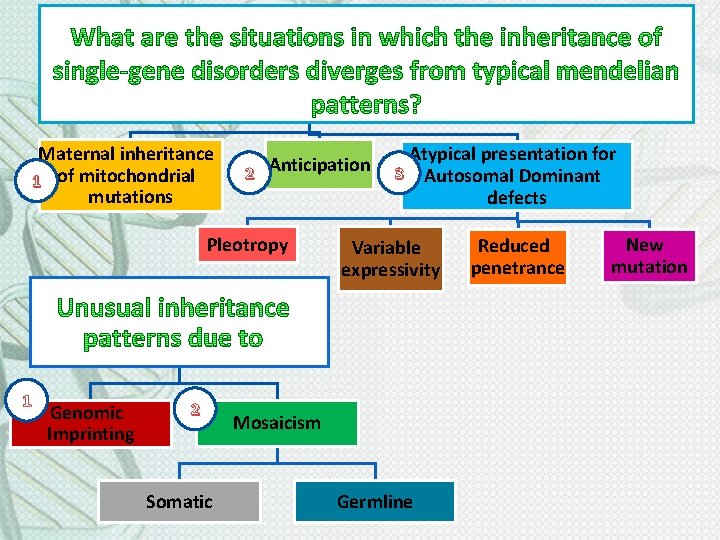
Maternal inheritance 1 of mitochondrial mutations 2 Anticipation Pleotropy 1 Genomic Imprinting 2 Somatic Atypical presentation for 3 Autosomal Dominant defects Variable expressivity Mosaicism Germline Reduced penetrance New mutation
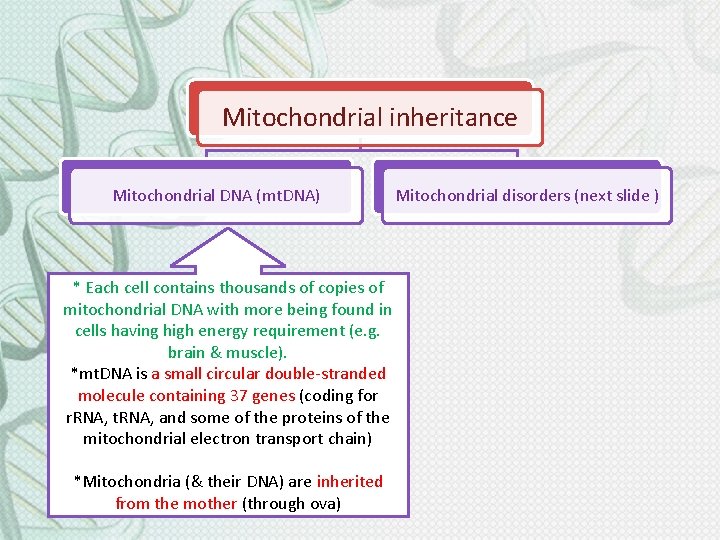
Mitochondrial inheritance Mitochondrial DNA (mt. DNA) * Each cell contains thousands of copies of mitochondrial DNA with more being found in cells having high energy requirement (e. g. brain & muscle). *mt. DNA is a small circular double-stranded molecule containing 37 genes (coding for r. RNA, t. RNA, and some of the proteins of the mitochondrial electron transport chain) *Mitochondria (& their DNA) are inherited from the mother (through ova) Mitochondrial disorders (next slide )
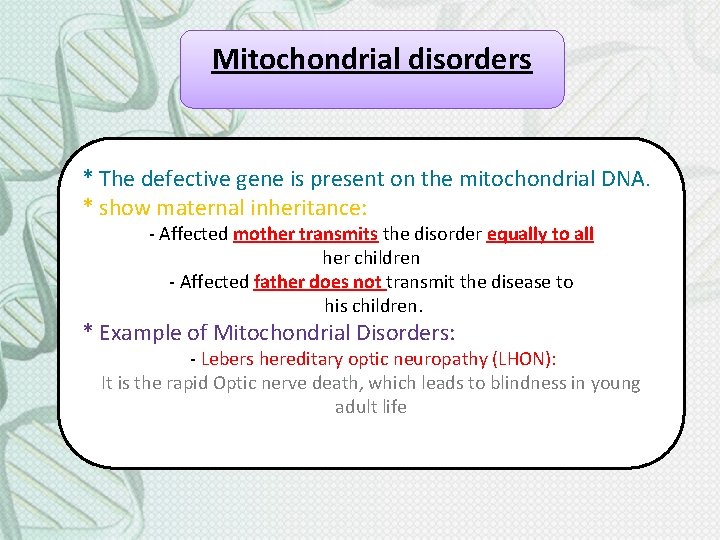
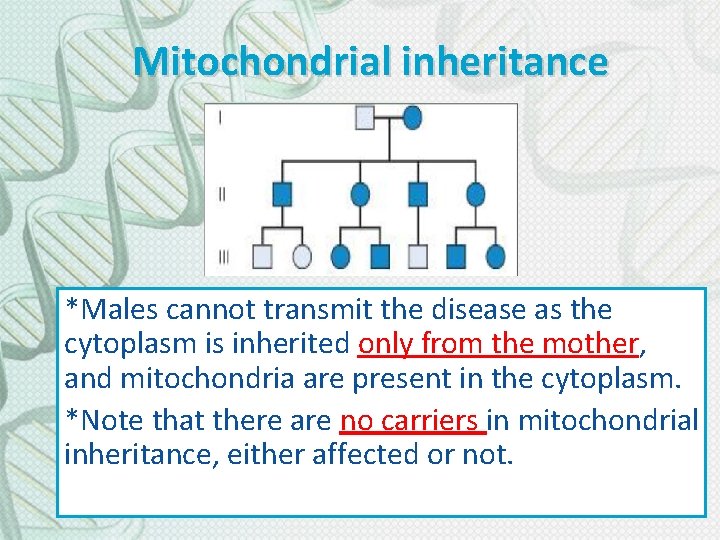
Mitochondrial disorders * The defective gene is present on the mitochondrial DNA. * show maternal inheritance: - Affected mother transmits the disorder equally to all her children - Affected father does not transmit the disease to his children. * Example of Mitochondrial Disorders: - Lebers hereditary optic neuropathy (LHON): It is the rapid Optic nerve death, which leads to blindness in young adult life
Mitochondrial inheritance *Males cannot transmit the disease as the cytoplasm is inherited only from the mother, and mitochondria are present in the cytoplasm. *Note that there are no carriers in mitochondrial inheritance, either affected or not.
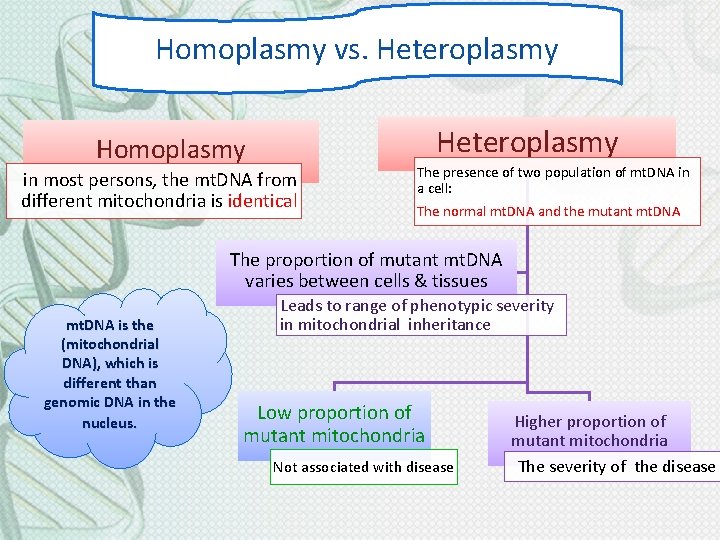
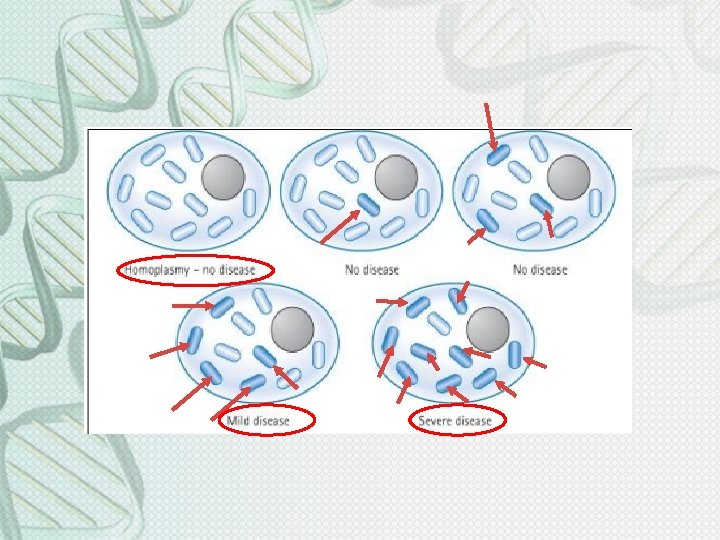
Homoplasmy vs. Heteroplasmy Homoplasmy in most persons, the mt. DNA from different mitochondria is identical The presence of two population of mt. DNA in a cell: The normal mt. DNA and the mutant mt. DNA The proportion of mutant mt. DNA varies between cells & tissues mt. DNA is the (mitochondrial DNA), which is different than genomic DNA in the nucleus. Leads to range of phenotypic severity in mitochondrial inheritance Low proportion of mutant mitochondria Not associated with disease Higher proportion of mutant mitochondria The severity of the disease
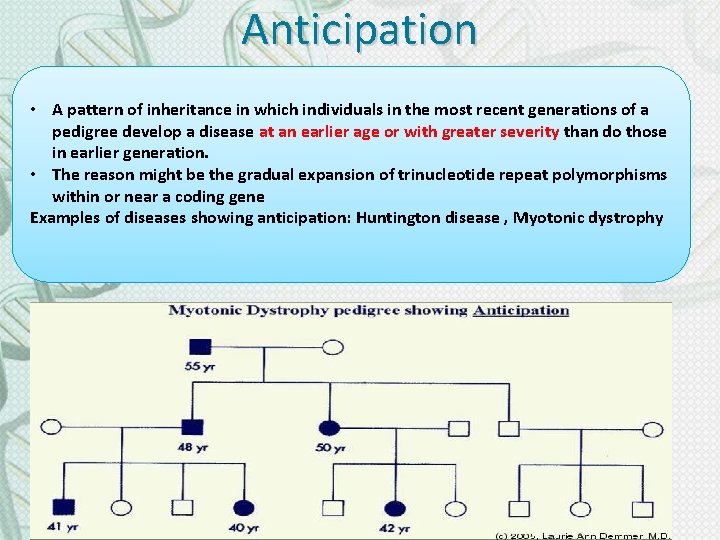
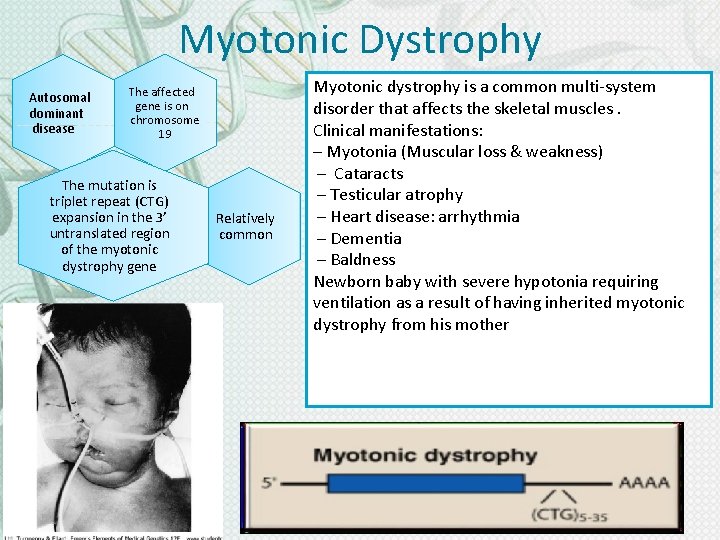
Anticipation • A pattern of inheritance in which individuals in the most recent generations of a pedigree develop a disease at an earlier age or with greater severity than do those in earlier generation. • The reason might be the gradual expansion of trinucleotide repeat polymorphisms within or near a coding gene Examples of diseases showing anticipation: Huntington disease , Myotonic dystrophy
Myotonic Dystrophy Autosomal dominant disease The affected gene is on chromosome 19 The mutation is triplet repeat (CTG) expansion in the 3’ untranslated region of the myotonic dystrophy gene Relatively common Myotonic dystrophy is a common multi-system disorder that affects the skeletal muscles. Clinical manifestations: – Myotonia (Muscular loss & weakness) – Cataracts – Testicular atrophy – Heart disease: arrhythmia – Dementia – Baldness Newborn baby with severe hypotonia requiring ventilation as a result of having inherited myotonic dystrophy from his mother
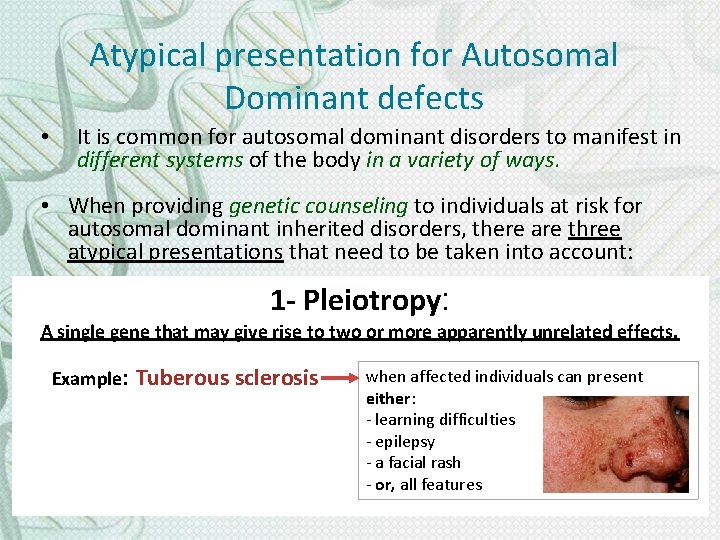
Atypical presentation for Autosomal Dominant defects • It is common for autosomal dominant disorders to manifest in different systems of the body in a variety of ways. • When providing genetic counseling to individuals at risk for autosomal dominant inherited disorders, there are three atypical presentations that need to be taken into account: 1 - Pleiotropy: A single gene that may give rise to two or more apparently unrelated effects. Example: Tuberous sclerosis when affected individuals can present either: - learning difficulties - epilepsy - a facial rash - or, all features
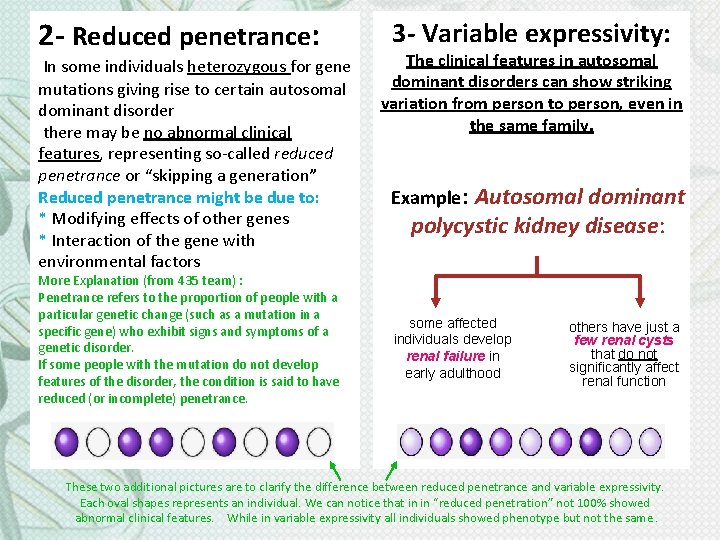
2 - Reduced penetrance: In some individuals heterozygous for gene mutations giving rise to certain autosomal dominant disorder there may be no abnormal clinical features, representing so-called reduced penetrance or “skipping a generation” Reduced penetrance might be due to: * Modifying effects of other genes * Interaction of the gene with environmental factors More Explanation (from 435 team) : Penetrance refers to the proportion of people with a particular genetic change (such as a mutation in a specific gene) who exhibit signs and symptoms of a genetic disorder. If some people with the mutation do not develop features of the disorder, the condition is said to have reduced (or incomplete) penetrance. 3 - Variable expressivity: The clinical features in autosomal dominant disorders can show striking variation from person to person, even in the same family. Example: Autosomal dominant polycystic kidney disease: some affected individuals develop renal failure in early adulthood others have just a few renal cysts that do not significantly affect renal function These two additional pictures are to clarify the difference between reduced penetrance and variable expressivity. Each oval shapes represents an individual. We can notice that in in “reduced penetration” not 100% showed abnormal clinical features. While in variable expressivity all individuals showed phenotype but not the same.
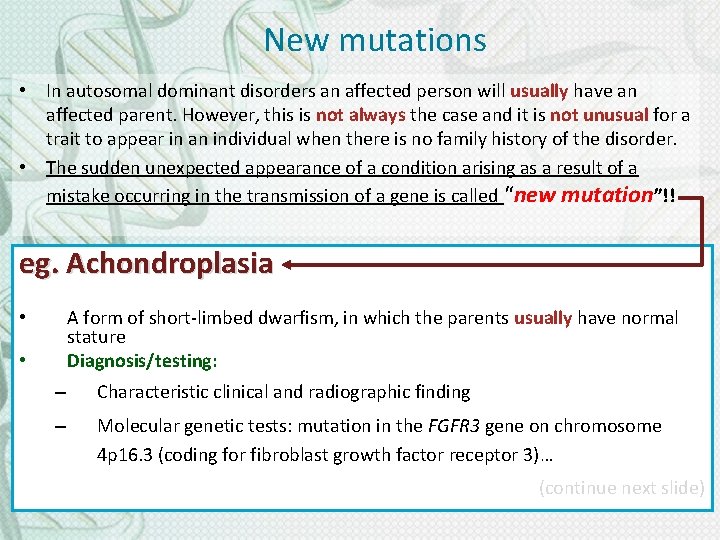
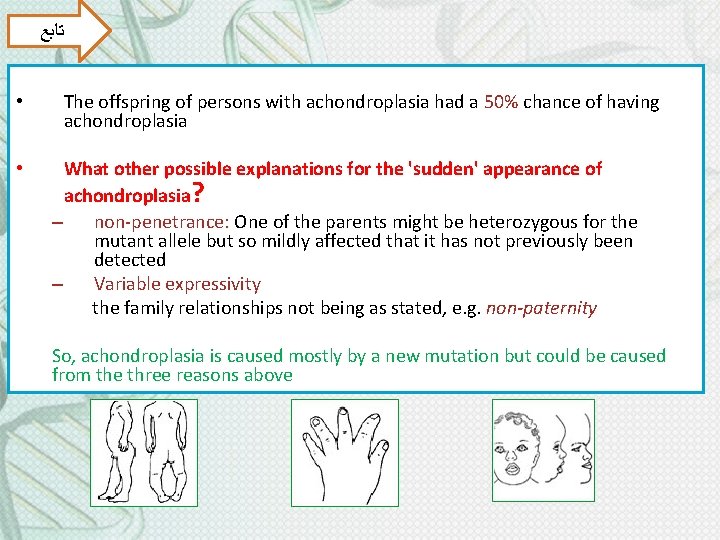
New mutations • In autosomal dominant disorders an affected person will usually have an affected parent. However, this is not always the case and it is not unusual for a trait to appear in an individual when there is no family history of the disorder. • The sudden unexpected appearance of a condition arising as a result of a mistake occurring in the transmission of a gene is called “new mutation”!! eg. Achondroplasia A form of short-limbed dwarfism, in which the parents usually have normal stature Diagnosis/testing: • • – Characteristic clinical and radiographic finding – Molecular genetic tests: mutation in the FGFR 3 gene on chromosome 4 p 16. 3 (coding for fibroblast growth factor receptor 3)… (continue next slide)
ﺗﺎﺑﻊ • • The offspring of persons with achondroplasia had a 50% chance of having achondroplasia What other possible explanations for the 'sudden' appearance of achondroplasia? – non-penetrance: One of the parents might be heterozygous for the mutant allele but so mildly affected that it has not previously been detected – Variable expressivity the family relationships not being as stated, e. g. non-paternity So, achondroplasia is caused mostly by a new mutation but could be caused from the three reasons above
Complex traits -What is it? A condition which are likely to be due to the interaction of more than one gene. The effects may be additive, one may be ratelimiting over the action of another, or one may enhance or multiply the effect of another -Examples: 1 - Digenic inheritance where a disorder has been shown to be due to the additive effects of heterozygous mutations at two different gene loci.
ﺗﺎﺑﻊ Complex traits 2 - retinitis pigmentosa: a disorder of progressive visual impairment, is caused by double heterozygosity for mutations in two unlinked genes , which both encode proteins present in photoreceptors. Individuals with only one of these mutations are not affected
Multifactorial/polygenic disprders • Human characteristics such as height, skin color and intelligence could be determined by the interaction of many genes, each exerting a small additive effect. • quantitative inheritance is a model that can explain the pattern of inheritance for many relatively common conditions , including : congenital malformations such as : cleft lip and palate-onset condition such as: - Hypertension -Diabetes mellitus -Alzheimer disease • The prevailing view is that genes at several loci interact to generate a susceptibility to the effects of adverse environmental trigger factors
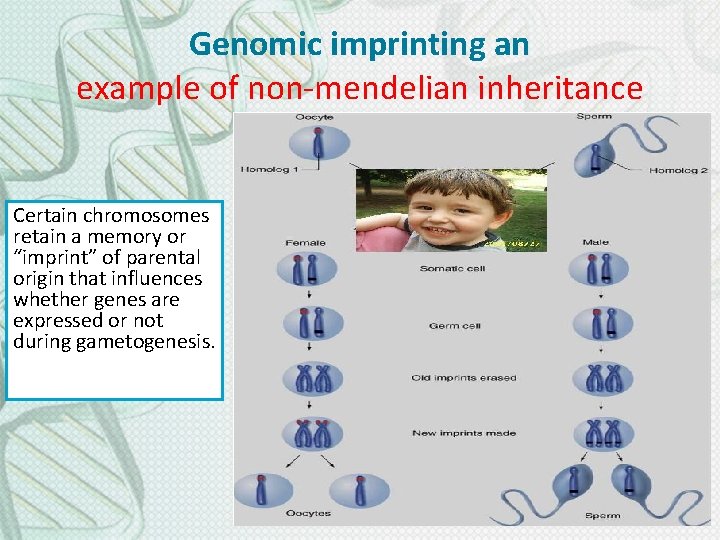
Genomic imprinting an example of non-mendelian inheritance Certain chromosomes retain a memory or “imprint” of parental origin that influences whether genes are expressed or not during gametogenesis.
Quiz: • what is the phenotype for (A 1 B) 1 - A 1 B 2 - A 2 B 3 -A 4 -B • The affected gene in Myotonic dystrophy is on chromosome 1 - 21 2 - 19 3 - 11 4 - 9 • The sudden unexpected appearance of a condition arising as a result of a mistake occurring in the transmission of a gene is called: 1 - Reduced penetrance 2 - New mutation 3 -Variable expressivity 4 - Pleiotropy • Another one! https: //www. onlineexambuilder. com/huamangenetics-lecture-4/exam-43318
Girls team: Boys team: • Jumana Alghtani (Leader) • Abdulrahman Alrajhi (Leader) • Haifaa Saud Bin Taleb • Abdulmohsen Alghannam • Dania Alkelabi • Abdulmalik Alghannam • Nada Alsomali • Saleh Altwaijri • Leen Altamimi • Abdullah Alharbi • Nora Almohideb @HGteam 46 Email: humangenetics 436@gmail. com