
HUMAN GENETIC DISEASES Human Genetic Diseases 3 basic
HUMAN GENETIC DISEASES
Human Genetic Diseases 3 basic types: 1. Inherited traits due to a gene mutation on the autosomes. 2. Inherited traits due to a gene mutation on the sex chromosomes. 3. Chromosome number error.
Type 1 Inherited traits from a gene mutation on the autosomes. Examples: Sickle cell anemia, cystic fibrosis, Huntington’s disease What is the problem? There can be one of several reasons for a gene mutation…
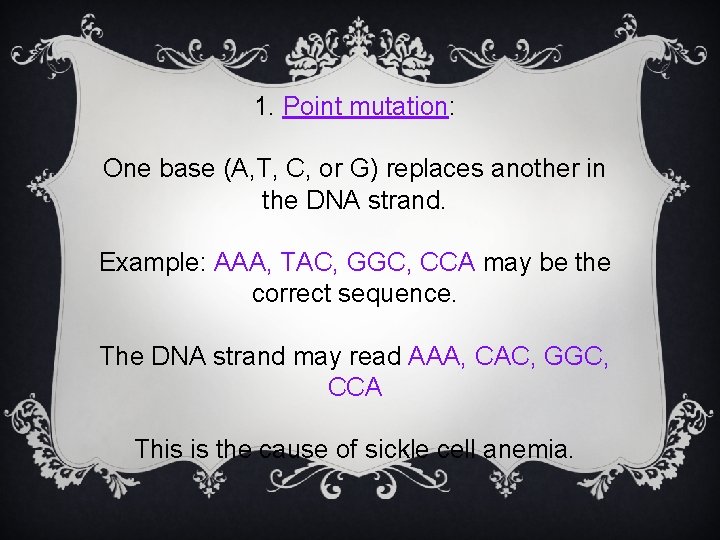
1. Point mutation: One base (A, T, C, or G) replaces another in the DNA strand. Example: AAA, TAC, GGC, CCA may be the correct sequence. The DNA strand may read AAA, CAC, GGC, CCA This is the cause of sickle cell anemia.
What would cause a point mutation? X-rays, pesticides, or other mutagen cause the nucleotide to change.
2. Frame-shift mutation This occurs when the DNA deletes a base & the entire code for the protein being coded for gets off sequence.
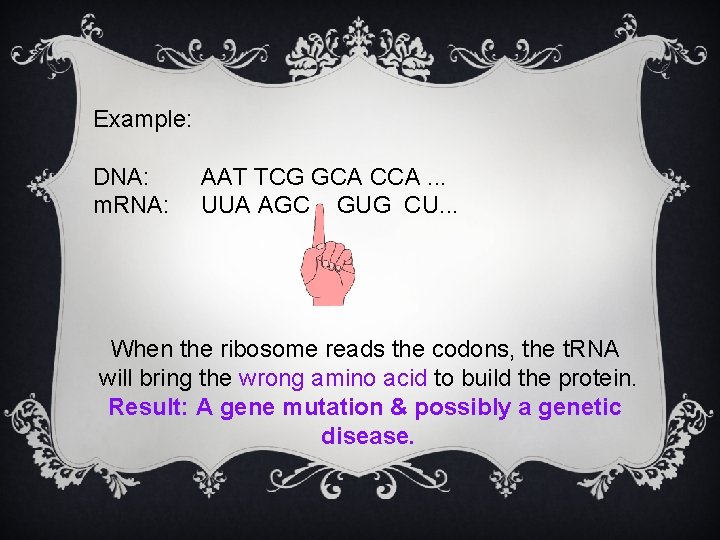
Example: DNA: m. RNA: AAT TCG GCA CCA. . . UUA AGC GUG CU. . . When the ribosome reads the codons, the t. RNA will bring the wrong amino acid to build the protein. Result: A gene mutation & possibly a genetic disease.
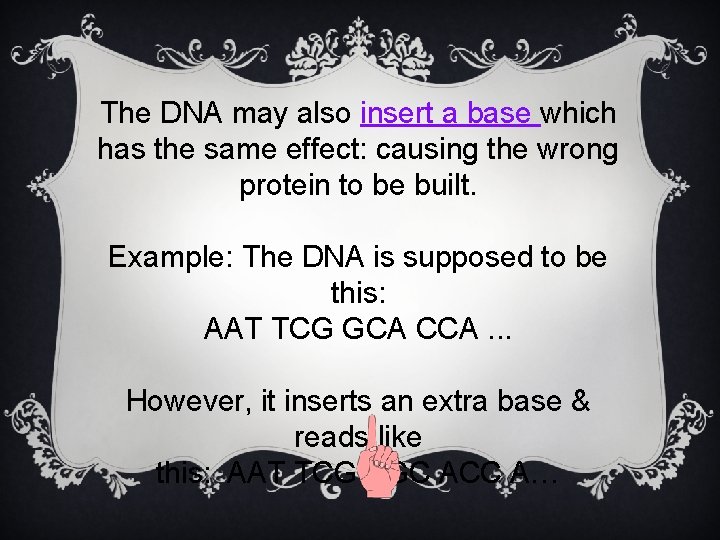
The DNA may also insert a base which has the same effect: causing the wrong protein to be built. Example: The DNA is supposed to be this: AAT TCG GCA CCA. . . However, it inserts an extra base & reads like this: AAT TCG AGC ACC A…
Type 2 If any of these gene mutations occur on the sex chromosomes, they are called SEX-LINKED GENES. Some of these diseases are: 1. Hemophilia 2. Colorblindness 3. ALD (Lorenzo’s disease) 4. Duchenne’s muscular dystrophy
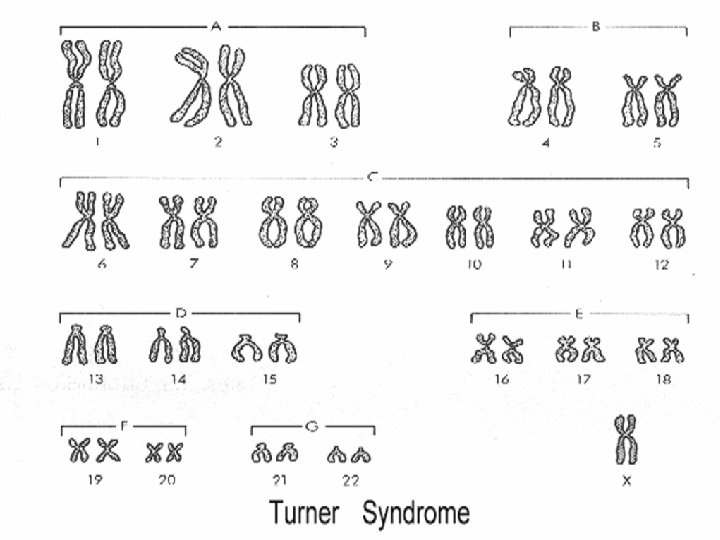
Type 3 The 3 rd way genetic diseases can be caused is by abnormal numbers of chromosomes. Examples of these diseases are: Turner’s syndrome Klinefelter’s syndrome Down’s syndrome Edward’s syndrome
These diseases are caused when the chromosomes fail to separate properly during the division of the sex cells. Geneticists can get a picture of the chromosomes before a child is born to determine if all the chromosomes are present or if extra ones are there. This picture is called a KARYOTYPE.



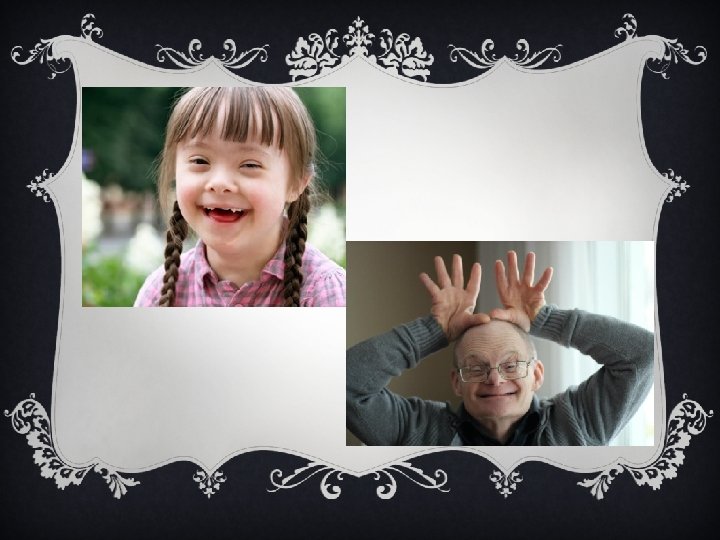
The signs and symptoms of Down syndrome are characterized by the neotenization of the brain and body. [12] Down syndrome is characterized by decelerated maturation (neoteny), incomplete morphogenesis (vestigia) and atavisms. [13] Individuals with Down syndrome may have some or all of the following physical characteristics: microgenia (abnormally small chin), [14] oblique eye fissures on the inner corner of the eyes, [15][16] muscle hypotonia (poor muscle tone), a flat nasal bridge, a single palmar fold, a protruding tongue (due to small oral cavity, and an enlarged tongue near the tonsils) or macroglossia, [15][16] "face is flat and broad", [17] a short neck, white spots on the iris known as Brushfield spots, [18] excessive joint laxity including atlanto-axial instability, excessive space between large toe and second toe, a single flexion furrow of the fifth finger, a higher number of ulnar loop dermatoglyphs and short fingers. [16] Wikipedia. com
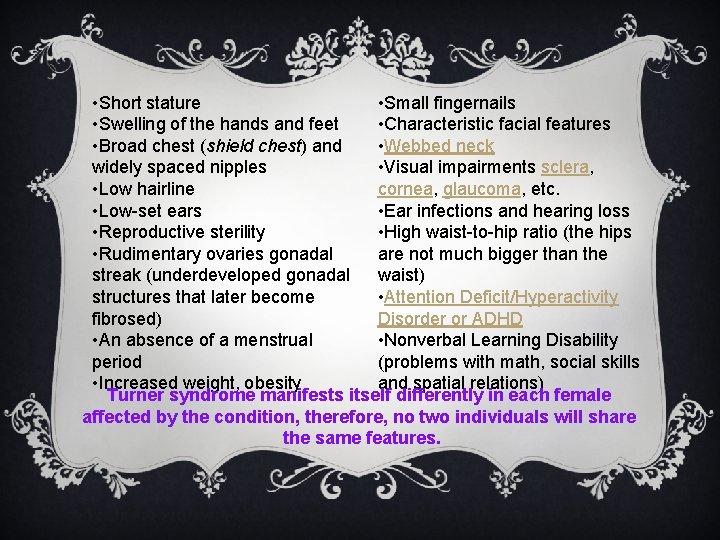
• Short stature • Small fingernails • Swelling of the hands and feet • Characteristic facial features • Broad chest (shield chest) and • Webbed neck widely spaced nipples • Visual impairments sclera, • Low hairline cornea, glaucoma, etc. • Low-set ears • Ear infections and hearing loss • Reproductive sterility • High waist-to-hip ratio (the hips • Rudimentary ovaries gonadal are not much bigger than the streak (underdeveloped gonadal waist) structures that later become • Attention Deficit/Hyperactivity fibrosed) Disorder or ADHD • An absence of a menstrual • Nonverbal Learning Disability period (problems with math, social skills • Increased weight, obesity and spatial relations) Turner syndrome manifests itself differently in each female affected by the condition, therefore, no two individuals will share the same features.

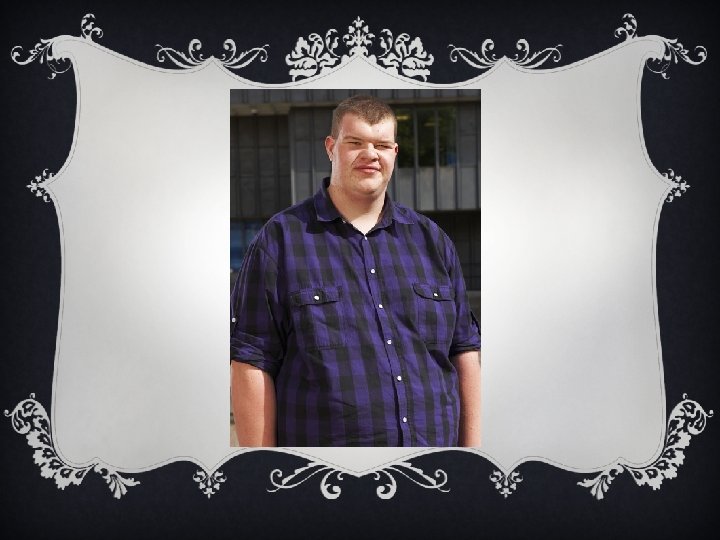
• Symptoms often subtle, and many people do not realize they are affected • Typically sterile • Weaker muscles • Greater height • Poor coordination • Less body hair • Smaller genitals • Breast growth • Less interest in sex • Intelligence is usually normal, though reading difficulties and problems with speech are common

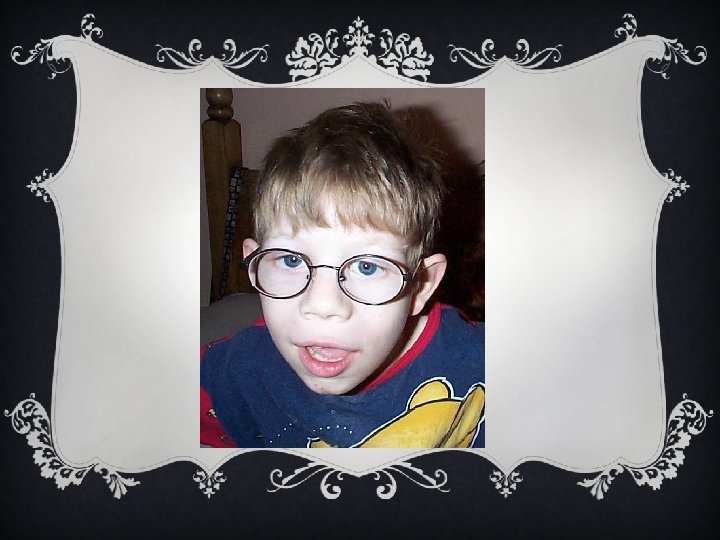
The syndrome gets its name from the characteristic cry of affected infants, which is similar to that of a meowing kitten, due to problems with the larynx and nervous system. About 1/3 of children lose the cry by age 2. Other symptoms of cri du chat syndrome may include: feeding problems because of difficulty swallowing and sucking; low birth weight and poor growth; severe cognitive, speech, and motor delays; behavioral problems such as hyperactivity, aggression, tantrums, and repetitive movements; unusual facial features which may change over time; excessive drooling; constipation; small head and jaw; wide eyes; skin tags in front of eyes. Wikipedia. com
- Slides: 25