
Human Factors Fundamentals Ch 3 By Lucas Calabrese
Human Factors Fundamentals Ch 3 By Lucas Calabrese
Human Factors • • • Capability Characteristics Limitations Senses Thinking -This chapter is the foundation for most of the upcoming chapters.
Information Processing • Users constantly are taking in information. • process this information • Execute an action • Receive Feedback on the action, and start the process over again
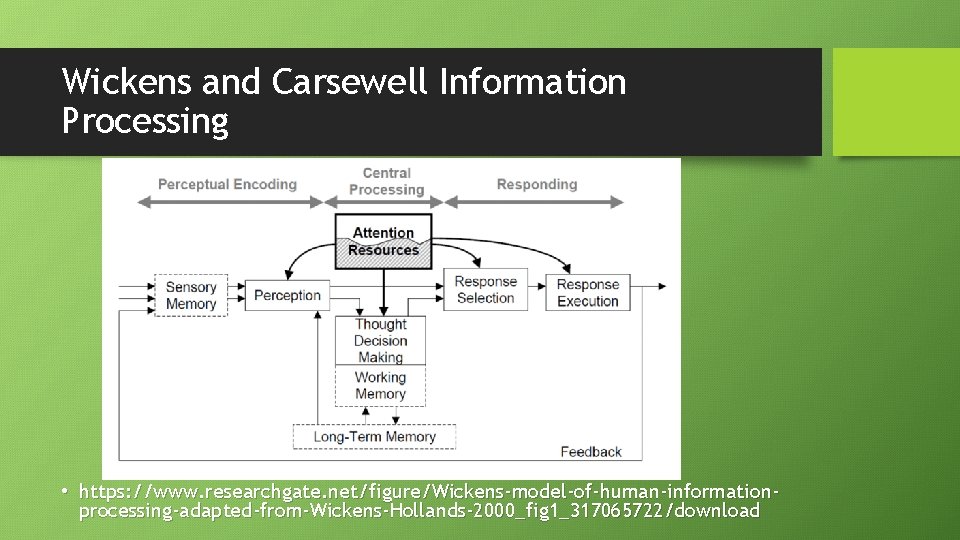
Wickens and Carsewell Information Processing • https: //www. researchgate. net/figure/Wickens-model-of-human-informationprocessing-adapted-from-Wickens-Hollands-2000_fig 1_317065722/download
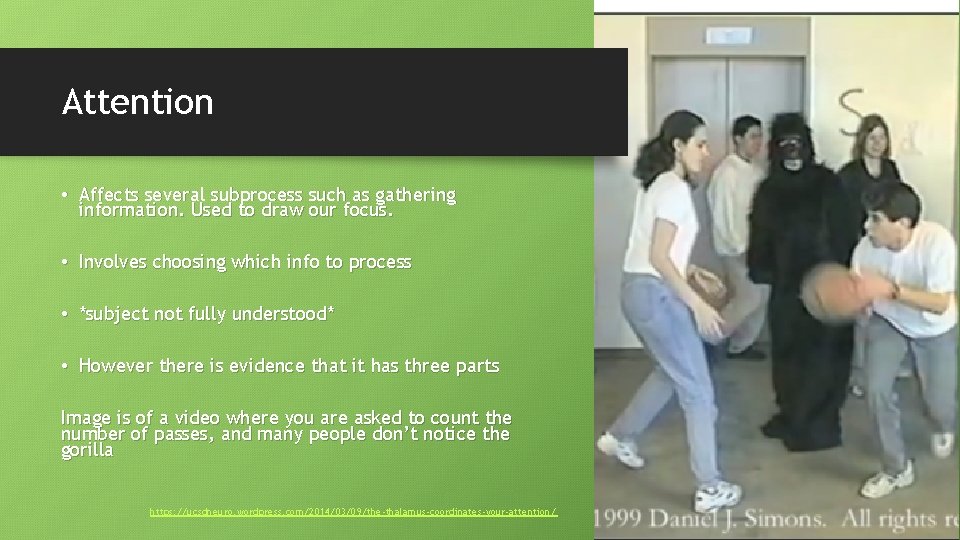
Attention • Affects several subprocess such as gathering information. Used to draw our focus. • Involves choosing which info to process • *subject not fully understood* • However there is evidence that it has three parts Image is of a video where you are asked to count the number of passes, and many people don’t notice the gorilla https: //ucsdneuro. wordpress. com/2014/03/09/the-thalamus-coordinates-your-attention/
3 Components of Attention • Selective attention: what information to process • Focused attention is the effort to continue processing information while trying to not be distracted • Divided Attention process more than on event at once
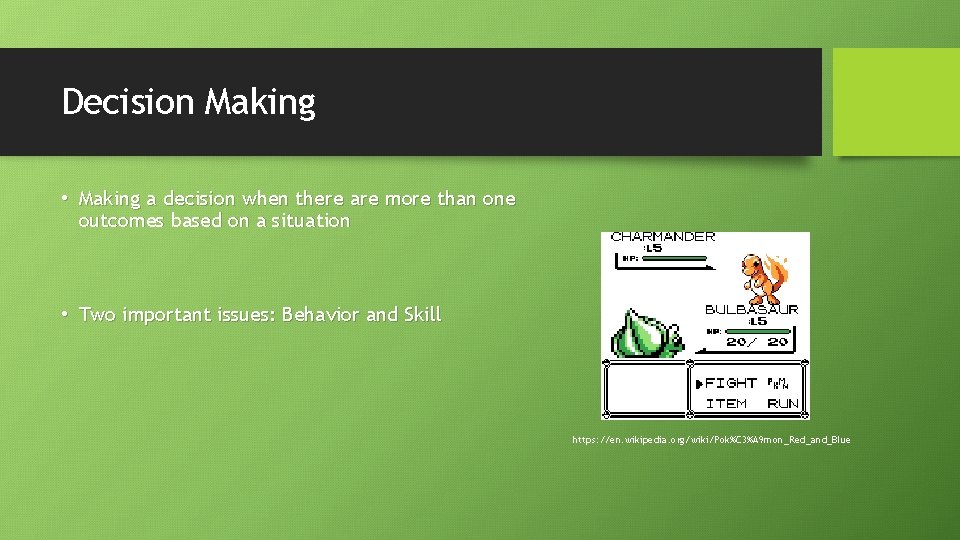
Decision Making • Making a decision when there are more than one outcomes based on a situation • Two important issues: Behavior and Skill https: //en. wikipedia. org/wiki/Pok%C 3%A 9 mon_Red_and_Blue
Behavior • Use of strategies that can be based on the following factors: Culture, Beliefs, Habits, Social Norms, Attitudes • Can be affected by your current emotions • Can be affected by conditioning which can affect behavior. It is where “responses are triggered by specific stimuli” • Can be affected by skills
Skills • Are what allows users to be accurate or fast. • Can be acquired after more use/practice • Skills include decision making, memory, and motor
3 Stages in Acquiring Skills • Cognitive stage – represents declarative knowledge/info stored in memory (https: //trainingindustry. com/glossary/declarativeknowledge/) • Associative stage – behavior is adjusted to reduce errors • Autonomous stage – When actions can be made quickly and accurately.
Selection and Control of Action • Closely tied to decision making, almost seamless • Lower level than decision making. More automatic and requires less thought.
Stimulus-Response Compatibility • Combinations of stimuli and responses • Can be affected by uncertainty
Visual Cues • Important to allow user to properly interpret the scene • Depth Cues are important so that the user can tell where objects are in the scene
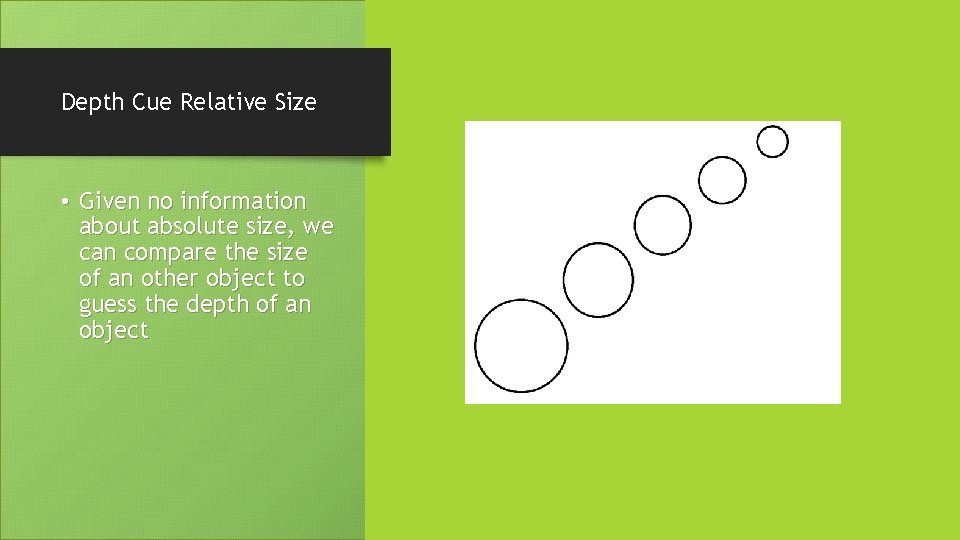
Depth Cue Relative Size • Given no information about absolute size, we can compare the size of an other object to guess the depth of an object
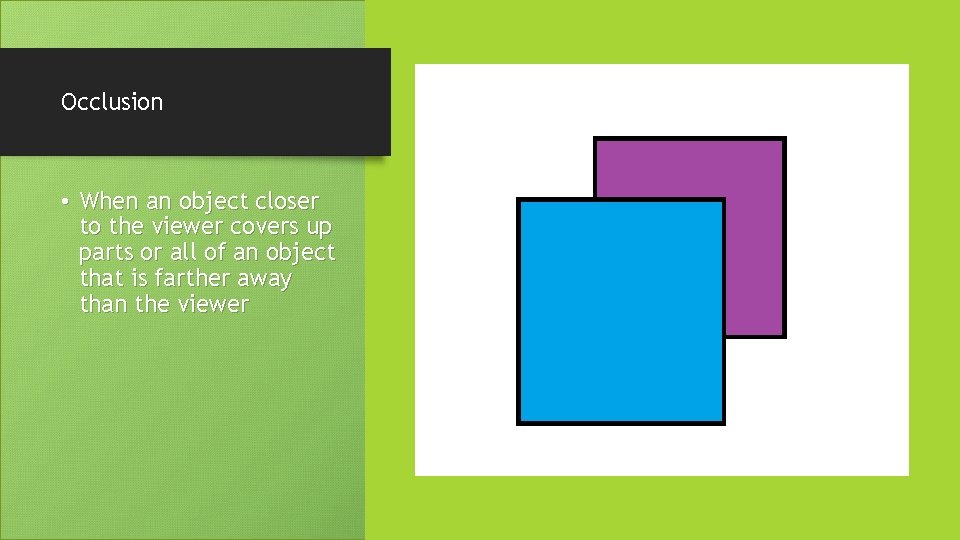
Occlusion • When an object closer to the viewer covers up parts or all of an object that is farther away than the viewer
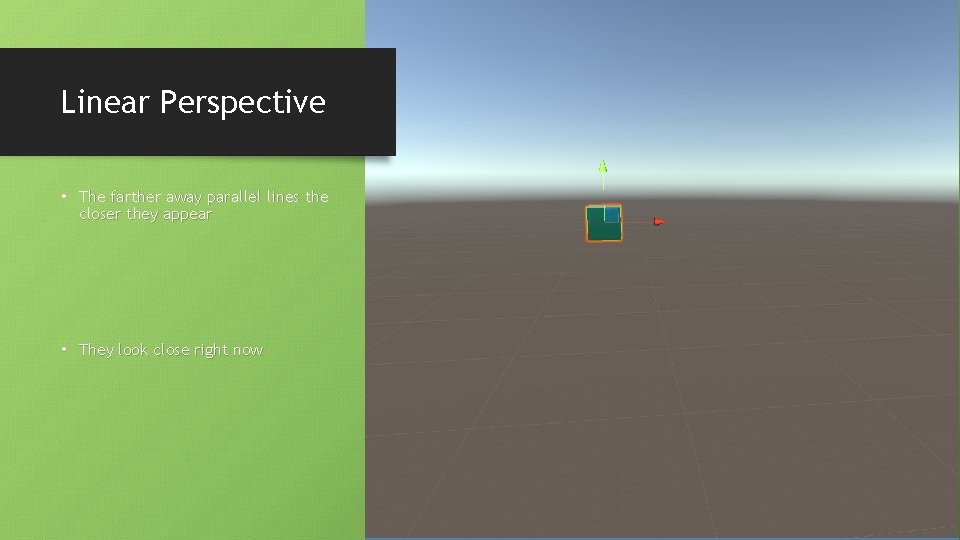
Linear Perspective • The farther away parallel lines the closer they appear • They look close right now
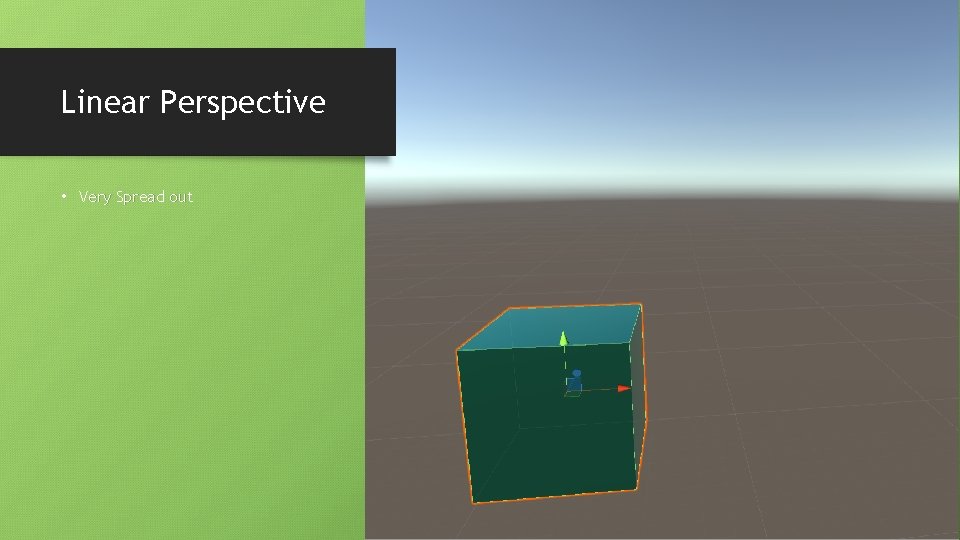
Linear Perspective • Very Spread out
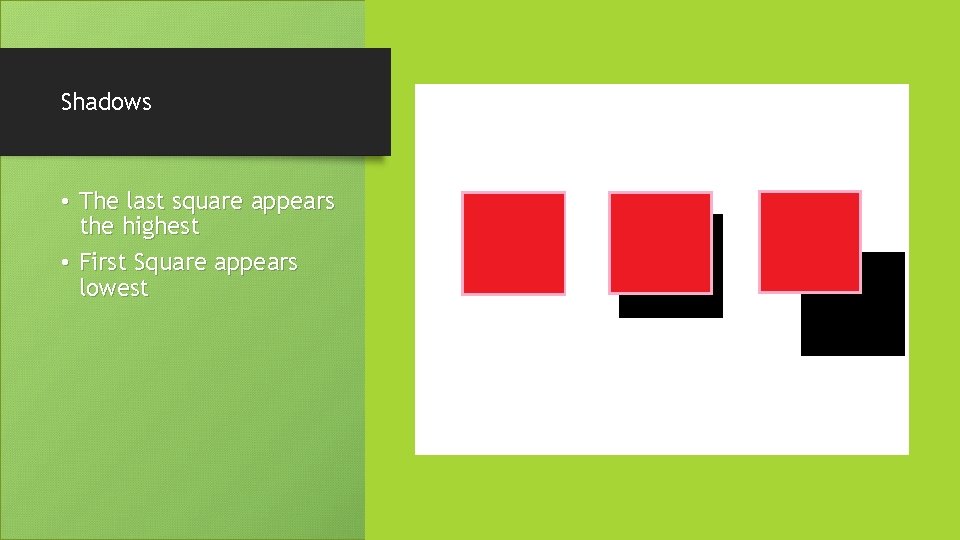
Shadows • The last square appears the highest • First Square appears lowest
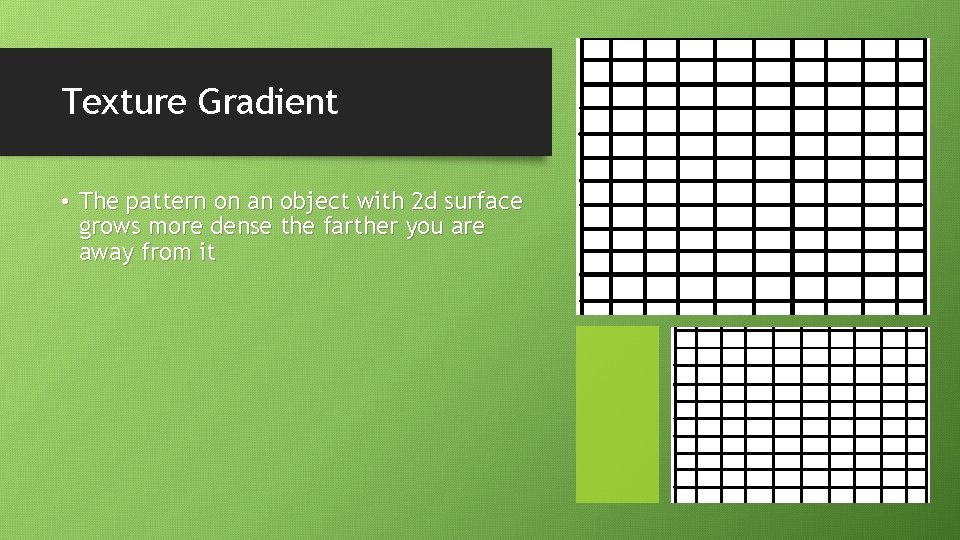
Texture Gradient • The pattern on an object with 2 d surface grows more dense the farther you are away from it
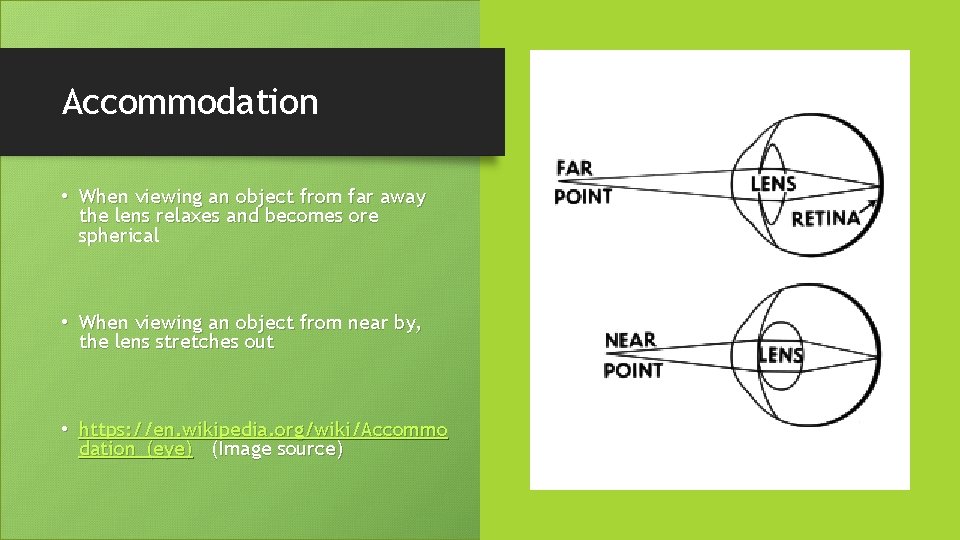
Accommodation • When viewing an object from far away the lens relaxes and becomes ore spherical • When viewing an object from near by, the lens stretches out • https: //en. wikipedia. org/wiki/Accommo dation_(eye) (Image source)
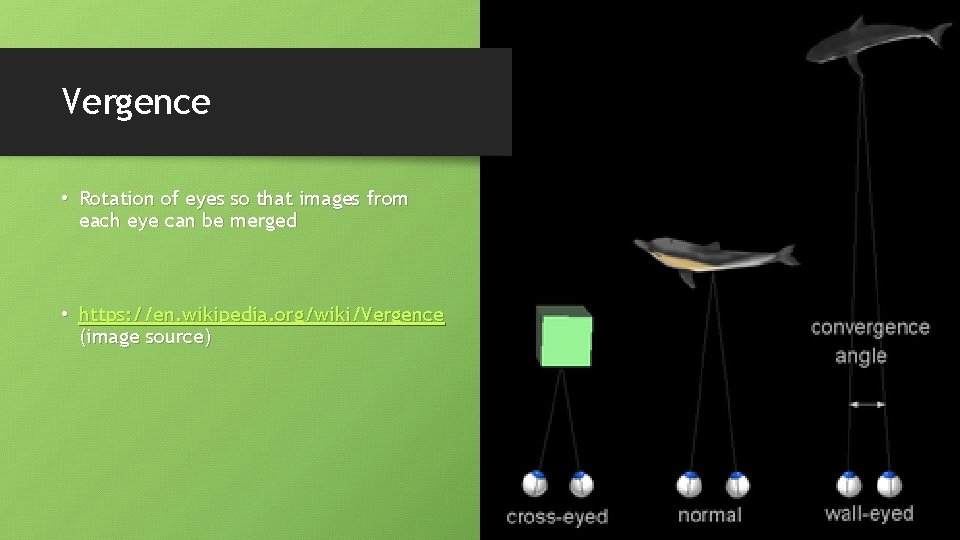
Vergence • Rotation of eyes so that images from each eye can be merged • https: //en. wikipedia. org/wiki/Vergence (image source)
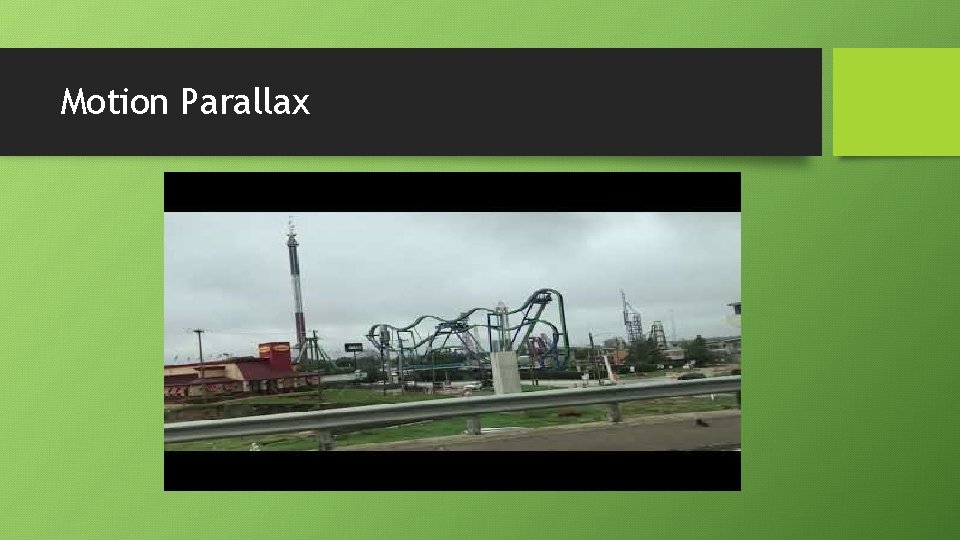
Motion Parallax
Binocular Disparity • The difference between the two images between both eyes • You can check this by holding a pencil in front of you and switch between looking at it with your left eye only or right eye only
Stereopsis • The fusion of the two images from your eyes
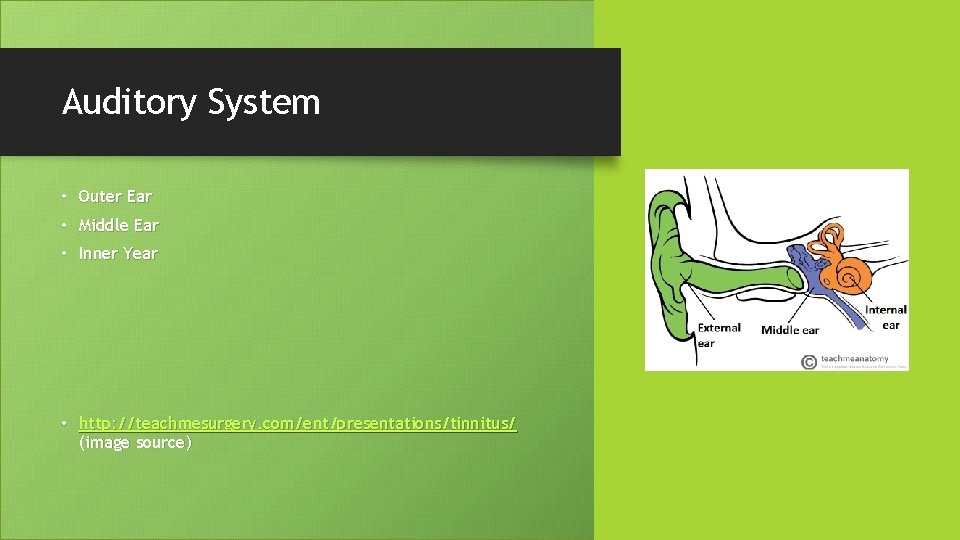
Auditory System • Outer Ear • Middle Ear • Inner Year • http: //teachmesurgery. com/ent/presentations/tinnitus/ (image source)
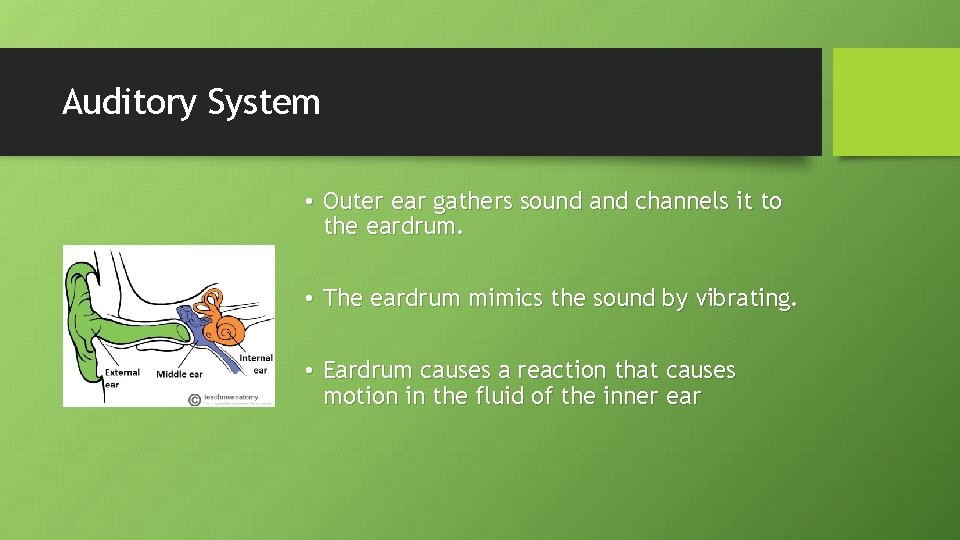
Auditory System • Outer ear gathers sound and channels it to the eardrum. • The eardrum mimics the sound by vibrating. • Eardrum causes a reaction that causes motion in the fluid of the inner ear
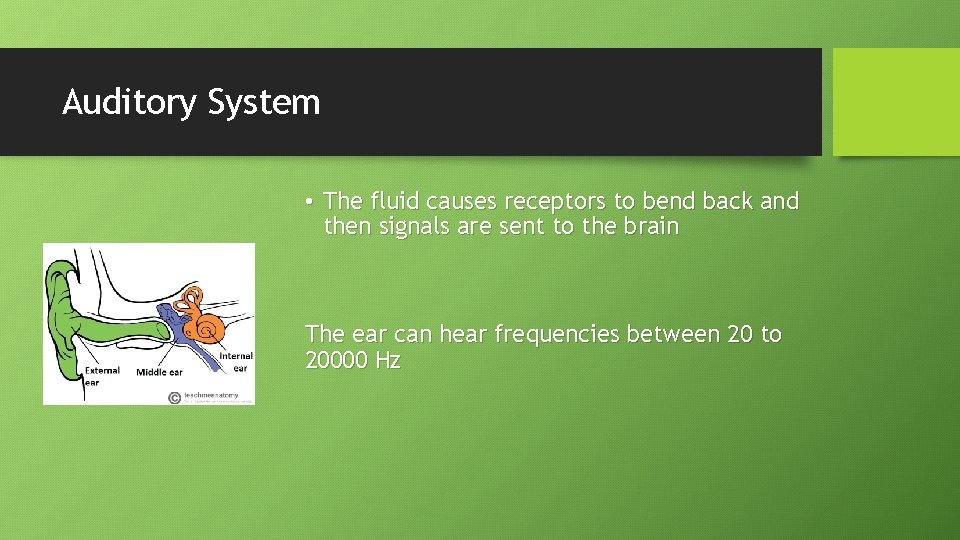
Auditory System • The fluid causes receptors to bend back and then signals are sent to the brain The ear can hear frequencies between 20 to 20000 Hz
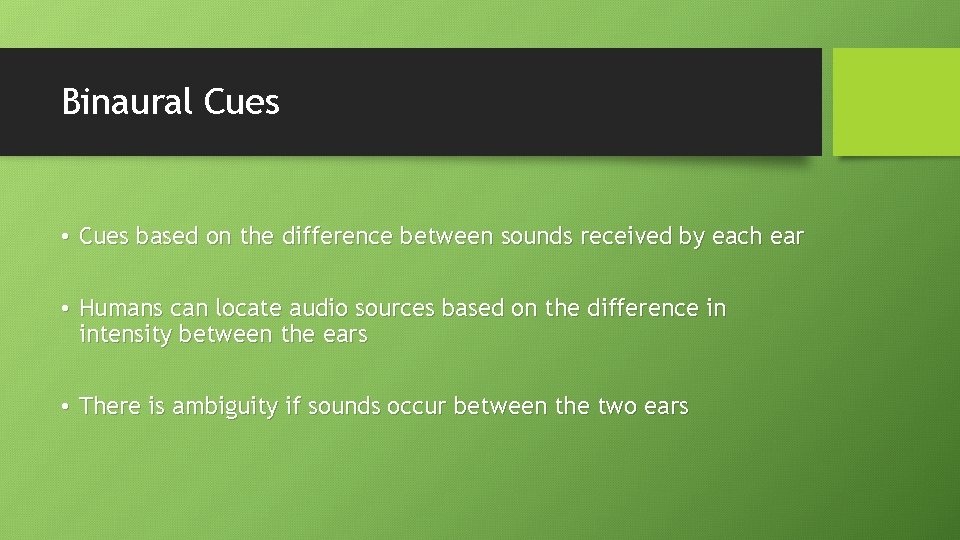
Binaural Cues • Cues based on the difference between sounds received by each ear • Humans can locate audio sources based on the difference in intensity between the ears • There is ambiguity if sounds occur between the two ears
Interneural Time Difference • The difference in time between sound reaching each ear • Helps to tell if the sound is on the left or right. • Ambiguity can be caused at certain points at least 3 ft away from the listener since those points have similar differences in intensities and time.
Head-Related Transfer Functions • Spatial filters that modify sounds based on how they interact with certain parts of the body • When sounds modified provide a cue for the location of the source
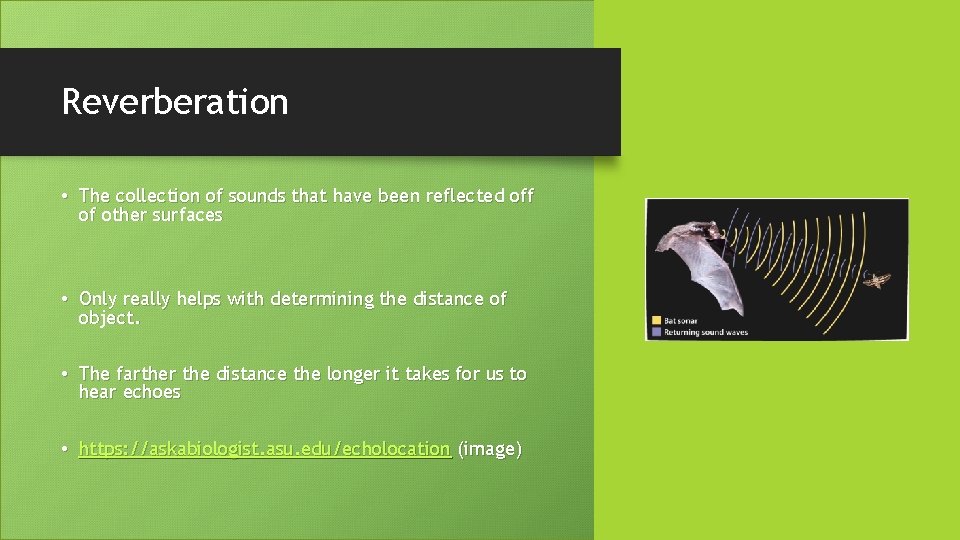
Reverberation • The collection of sounds that have been reflected off of other surfaces • Only really helps with determining the distance of object. • The farther the distance the longer it takes for us to hear echoes • https: //askabiologist. asu. edu/echolocation (image)
Sound Intensity • The farther away a sound source is the softer sound
Vestibular Cues • Related to balance • Cybersickness can be caused by mismatched visual and vestibular cues
Other Senses the Book Goes Over • Somatosensory – feel. Cues include tactile thermal and pain, and kinesthetic and proprioceptive • Chemical Sensing – taste and smell. Underrepresented in most 3 DUI.
Mechanoreceptors • Exist throughout the body • Send signals to brain through two paths: -Lemnsical: carries signals related to sensing limbs and perceiving touch -Spinothalamic : transmit signals related to temperature and pain
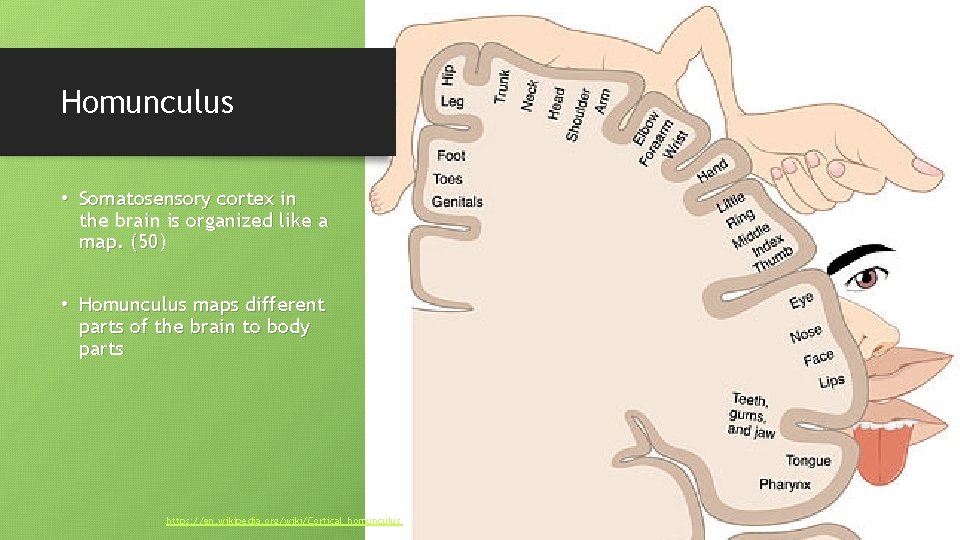
Homunculus • Somatosensory cortex in the brain is organized like a map. (50) • Homunculus maps different parts of the brain to body parts https: //en. wikipedia. org/wiki/Cortical_homunculus
Thermoreceptors • Send temperature info to the hypothalamus and receptors that deal with pain called nociceptors.
Proprioception • Sense of the position of the body and limbs. • In sync with vestibular cues • Proprioceptive cues tell about the position and angle of body joints (52).
Kinesthetic Cues • Muscular tension is used to tell the relationship between the body and another object.
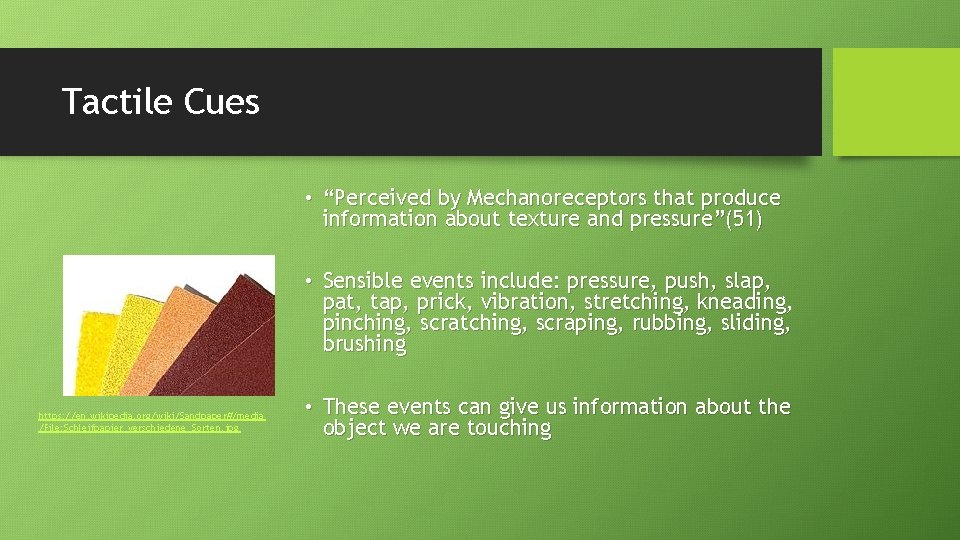
Tactile Cues • “Perceived by Mechanoreceptors that produce information about texture and pressure”(51) • Sensible events include: pressure, push, slap, pat, tap, prick, vibration, stretching, kneading, pinching, scratching, scraping, rubbing, sliding, brushing https: //en. wikipedia. org/wiki/Sandpaper#/media /File: Schleifpapier_verschiedene_Sorten. jpg • These events can give us information about the object we are touching
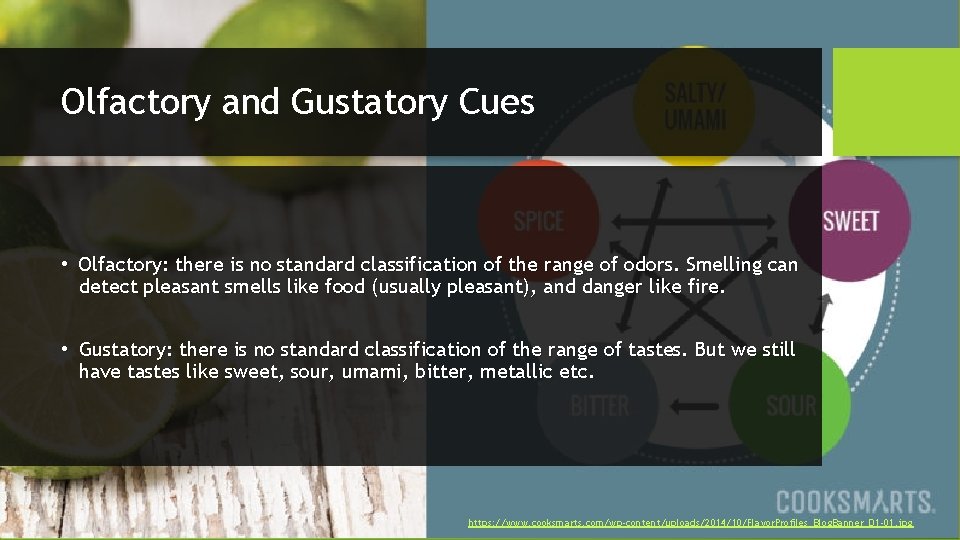
Olfactory and Gustatory Cues • Olfactory: there is no standard classification of the range of odors. Smelling can detect pleasant smells like food (usually pleasant), and danger like fire. • Gustatory: there is no standard classification of the range of tastes. But we still have tastes like sweet, sour, umami, bitter, metallic etc. https: //www. cooksmarts. com/wp-content/uploads/2014/10/Flavor. Profiles_Blog. Banner_D 1 -01. jpg
Flavor • Flavor is caused by both olfactory and gustatory cues.
Sensory Substitution and Multisensory Processing • Sensory Substitution – Translating sensory information to another. Can occur from changing sensory information between different channels or the same systems. • Multisensory interface – Use sensory channels together which can be more effective than using a channel by itself.
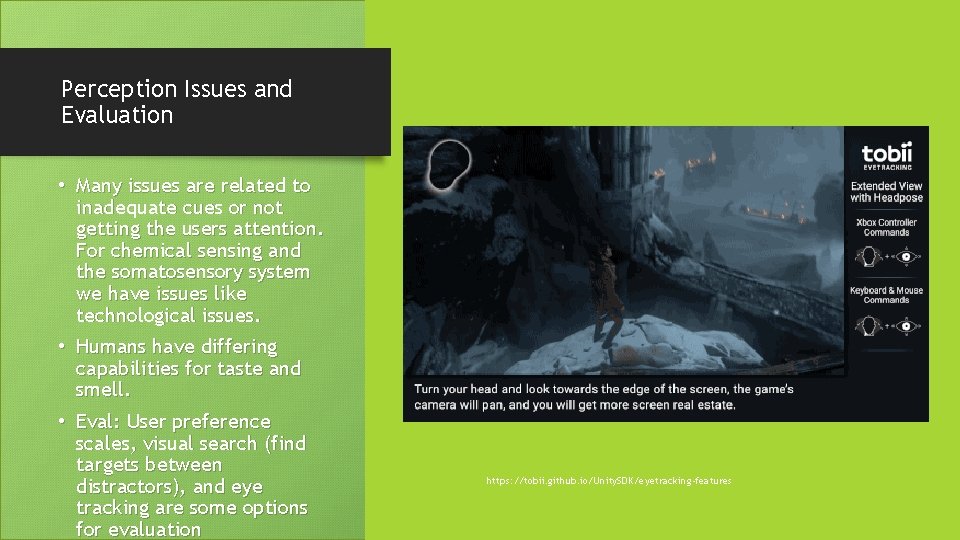
Perception Issues and Evaluation • Many issues are related to inadequate cues or not getting the users attention. For chemical sensing and the somatosensory system we have issues like technological issues. • Humans have differing capabilities for taste and smell. • Eval: User preference scales, visual search (find targets between distractors), and eye tracking are some options for evaluation https: //tobii. github. io/Unity. SDK/eyetracking-features
Cognition • Governs memory, language, and thought • We often think about knowledge when we think of cognition
Declarative and Nondeclarative Knowledge • Declarative knowledge – facts or events • Nondeclarative knowledge – skills, habits, associative and nonassociative memory
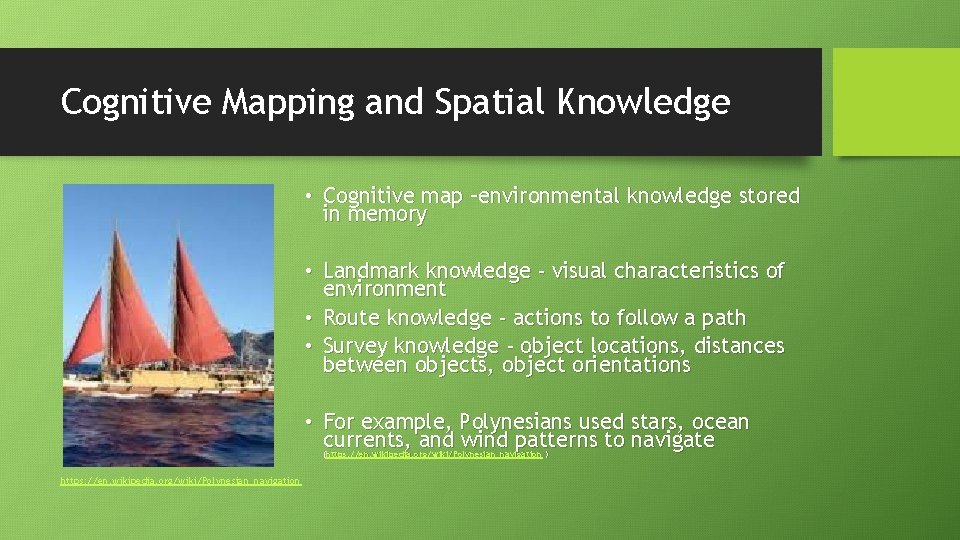
Cognitive Mapping and Spatial Knowledge • Cognitive map –environmental knowledge stored in memory • Landmark knowledge - visual characteristics of environment • Route knowledge - actions to follow a path • Survey knowledge - object locations, distances between objects, object orientations • For example, Polynesians used stars, ocean currents, and wind patterns to navigate (https: //en. wikipedia. org/wiki/Polynesian_navigation ) https: //en. wikipedia. org/wiki/Polynesian_navigation
Cognitive Issues • Mental Load – amount of cognitive work required to meet the demands of task difficulty, priority, attention, and processing resources • Human Error – failure in task • Both are related since if when there are unavailable mental resources the user may make human errors
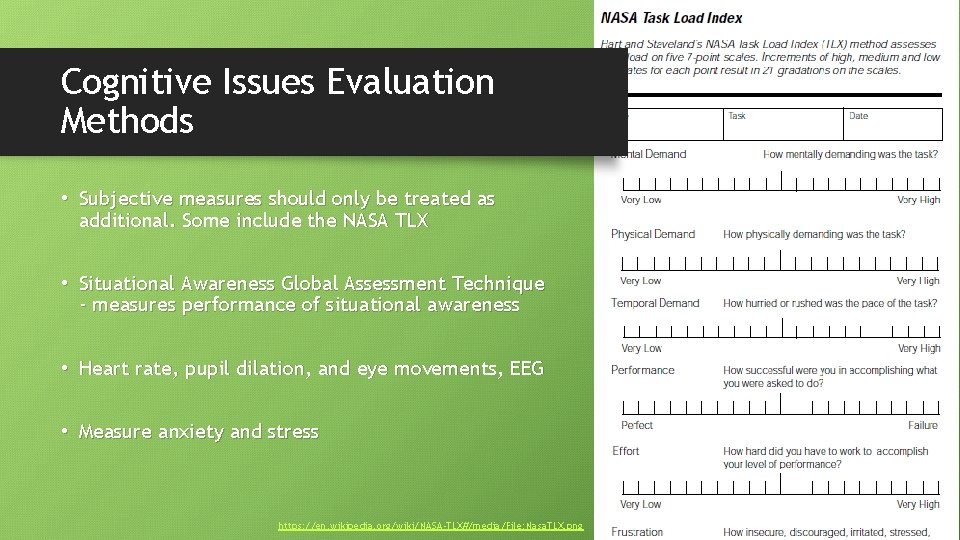
Cognitive Issues Evaluation Methods • Subjective measures should only be treated as additional. Some include the NASA TLX • Situational Awareness Global Assessment Technique - measures performance of situational awareness • Heart rate, pupil dilation, and eye movements, EEG • Measure anxiety and stress https: //en. wikipedia. org/wiki/NASA-TLX#/media/File: Nasa. TLX. png
Human Motion • Hands allow you to for many tasks such as gripping, holding, squeezing or bending. “virtually endless number of tasks”(70) • Feet and legs are usually used for walking through environments
More on hands • Grip design of controllers is important to consider as we do not want to cause discomfort to the user. • Humans can use a power grip (for example the pistol grip) or a precision grip
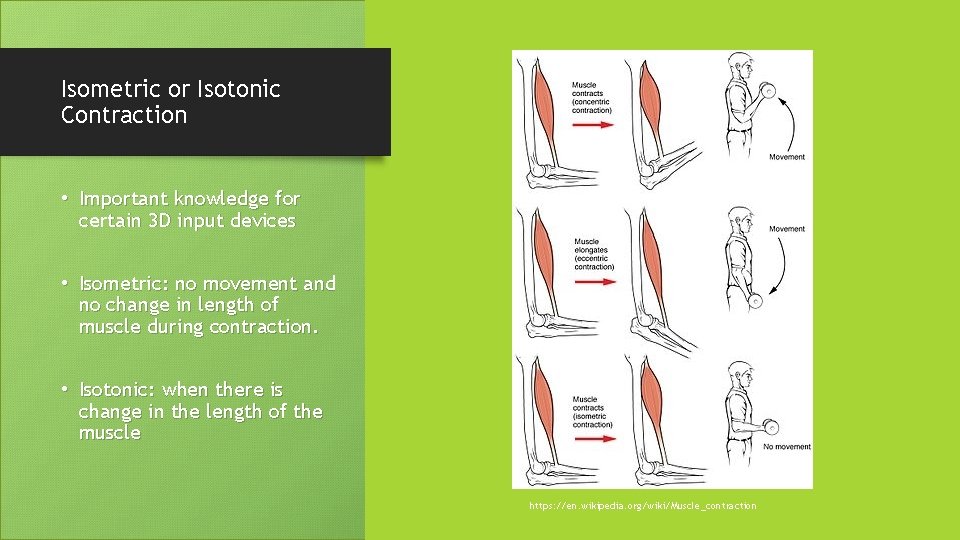
Isometric or Isotonic Contraction • Important knowledge for certain 3 D input devices • Isometric: no movement and no change in length of muscle during contraction. • Isotonic: when there is change in the length of the muscle https: //en. wikipedia. org/wiki/Muscle_contraction
Fatigue • Occurs when the tolerance to physical stress is exceeded • Signs of this are regripping the controller, change of pose, and lowered arms.
Assessing Comfort • Questionnaires may be of use to see how the user feels • Check if user performance has reduced over time as user performance and fatigue are correlated • Physiological methods such as using an EMG
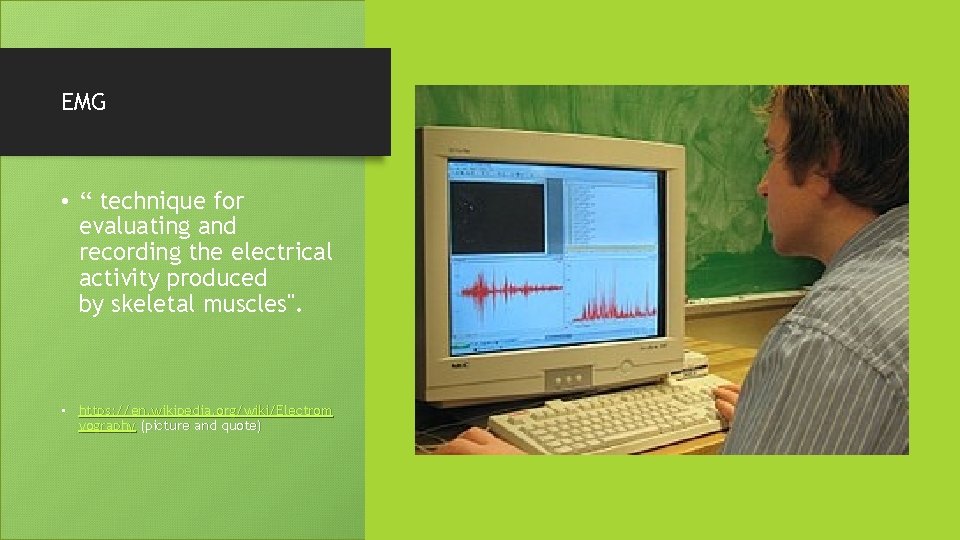
EMG • “ technique for evaluating and recording the electrical activity produced by skeletal muscles". • https: //en. wikipedia. org/wiki/Electrom yography (picture and quote)
Conclusion • Attention • Decision Making • Perception: Senses: Visual, Audio, Chemical Sensing, and Somatosensory • Cognition • Human Motion
- Slides: 56