
Human Factors Concerns for Design Performance of Warnings

- Slides: 15
Human Factors Concerns for Design & Performance of Warnings J. L. Harbluk & P. C. Burns Ergonomics & Crash Avoidance, Transport Canada Human Factors Forum on Advanced Vehicle Safety Technologies 25 -26 January 2007
Overview 1. 2. 3. 4. 5. 6. 7. Introduction Importance of HMI for Warnings Guidelines for Warning Displays Standardization Assessment Procedures for Warnings Research Needs Additional Issues
1. Introduction Advanced Vehicle Safety Technologies can assist drivers in preventing crashes & minimizing harm. To be effective, warnings need to lead the driver to a timely and appropriate response.
2. Importance of the Human-Machine Interface for Warnings
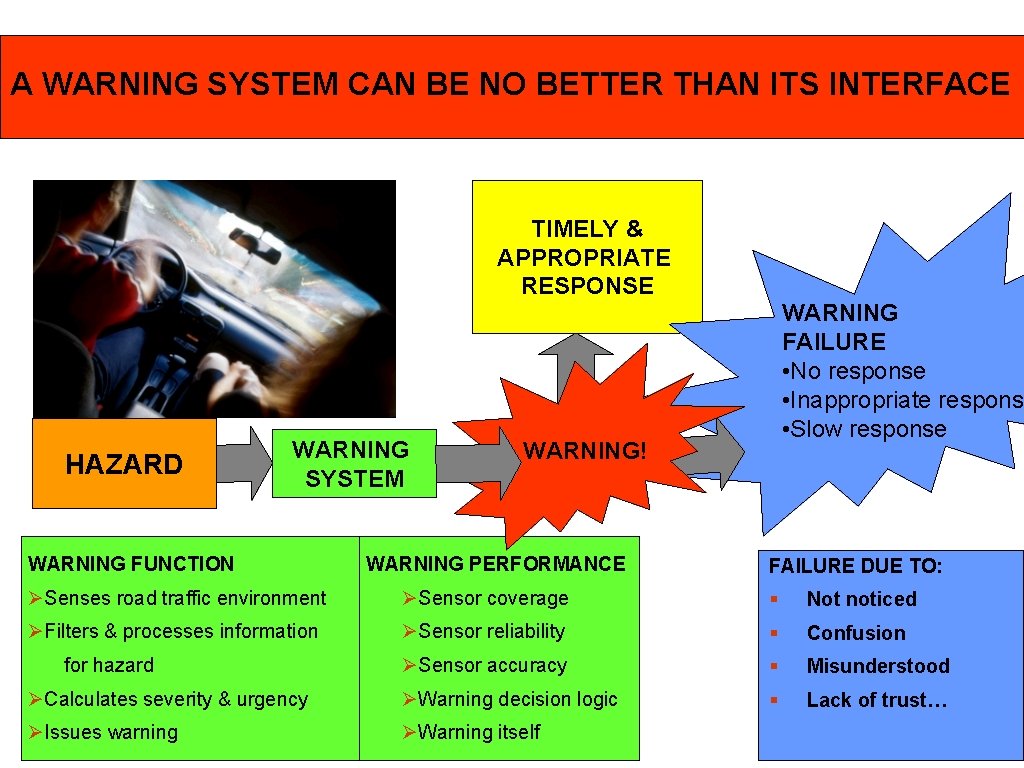
A WARNING SYSTEM CAN BE NO BETTER THAN ITS INTERFACE TIMELY & APPROPRIATE RESPONSE HAZARD WARNING SYSTEM WARNING FUNCTION WARNING FAILURE • No response • Inappropriate response • Slow response WARNING! WARNING PERFORMANCE FAILURE DUE TO: ØSenses road traffic environment ØSensor coverage § Not noticed ØFilters & processes information ØSensor reliability § Confusion ØSensor accuracy § Misunderstood ØCalculates severity & urgency ØWarning decision logic § Lack of trust… ØIssues warning ØWarning itself for hazard
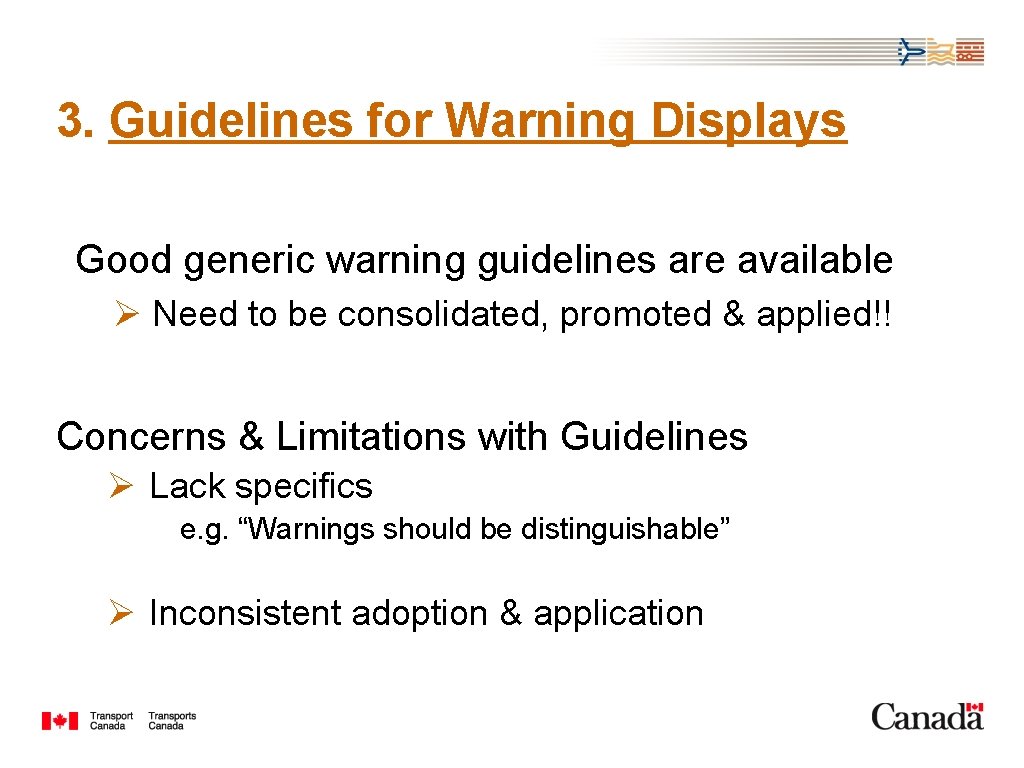
3. Guidelines for Warning Displays Good generic warning guidelines are available Ø Need to be consolidated, promoted & applied!! Concerns & Limitations with Guidelines Ø Lack specifics e. g. “Warnings should be distinguishable” Ø Inconsistent adoption & application
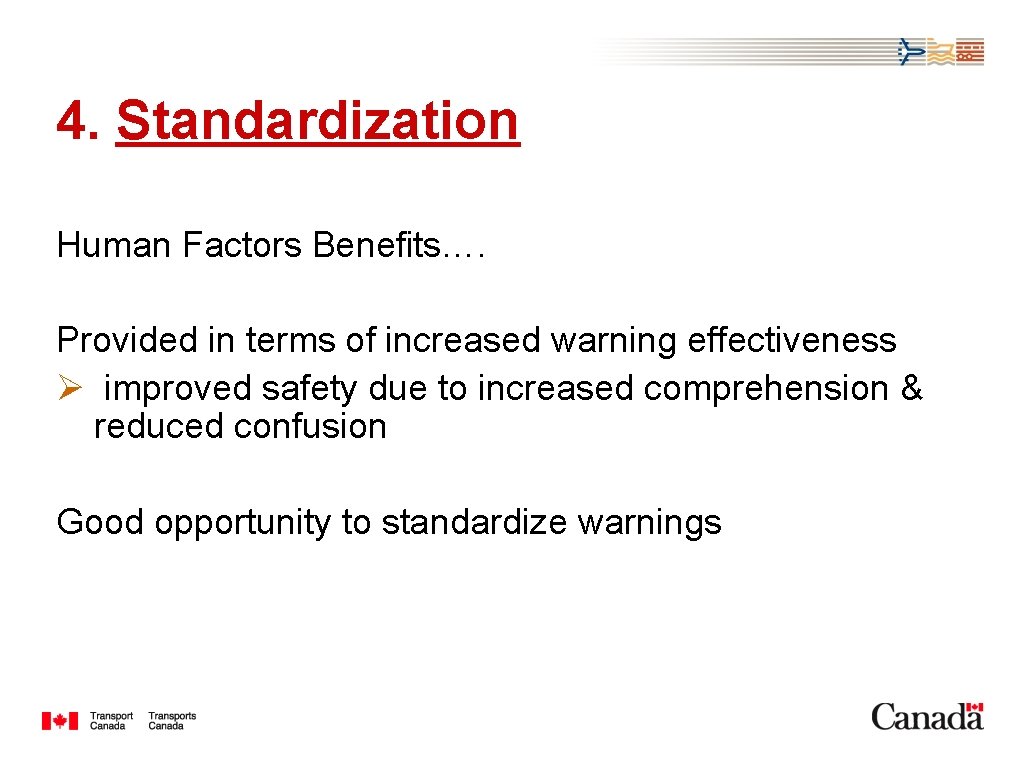
4. Standardization Human Factors Benefits…. Provided in terms of increased warning effectiveness Ø improved safety due to increased comprehension & reduced confusion Good opportunity to standardize warnings
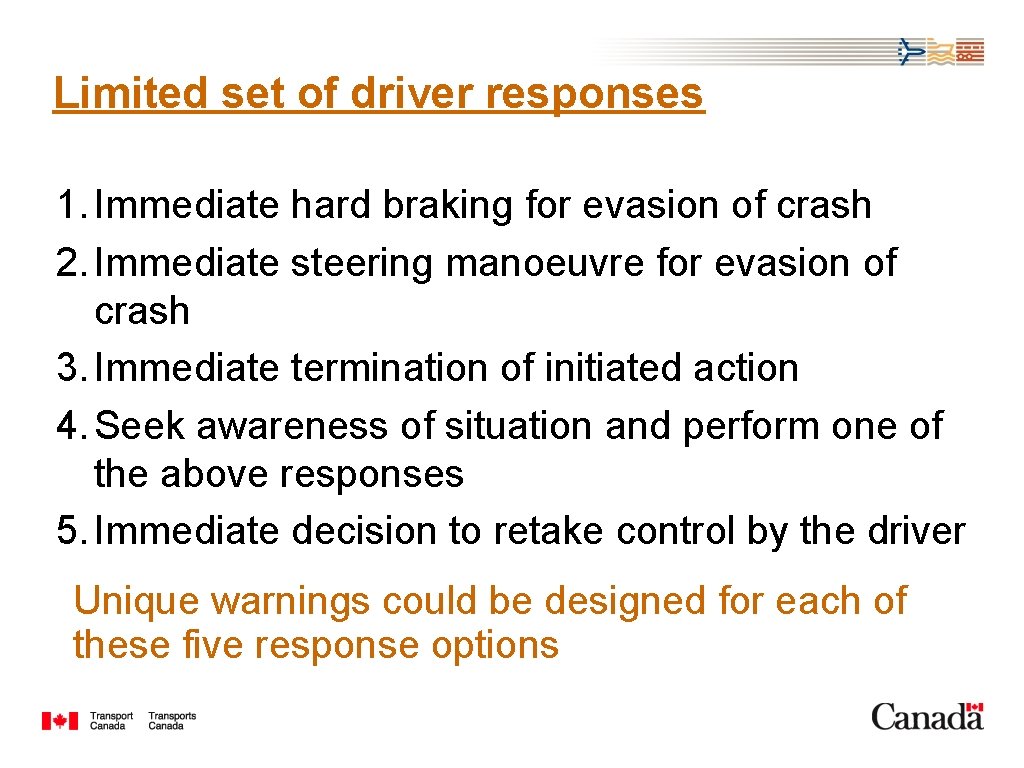
Limited set of driver responses 1. Immediate hard braking for evasion of crash 2. Immediate steering manoeuvre for evasion of crash 3. Immediate termination of initiated action 4. Seek awareness of situation and perform one of the above responses 5. Immediate decision to retake control by the driver Unique warnings could be designed for each of these five response options
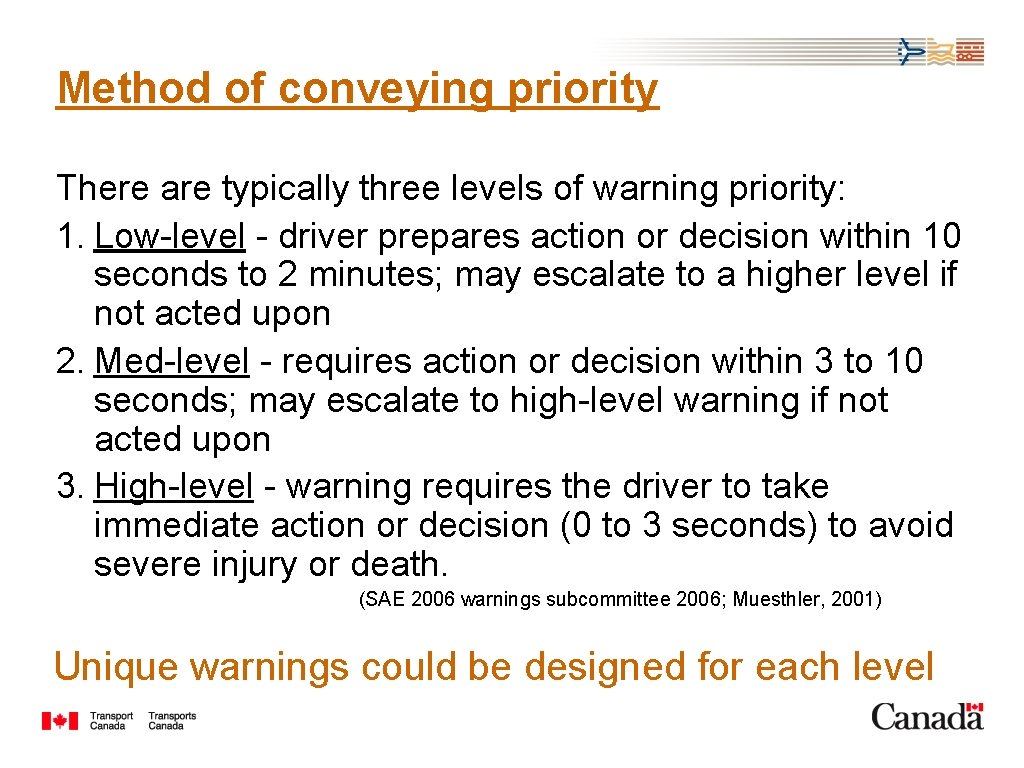
Method of conveying priority There are typically three levels of warning priority: 1. Low-level - driver prepares action or decision within 10 seconds to 2 minutes; may escalate to a higher level if not acted upon 2. Med-level - requires action or decision within 3 to 10 seconds; may escalate to high-level warning if not acted upon 3. High-level - warning requires the driver to take immediate action or decision (0 to 3 seconds) to avoid severe injury or death. (SAE 2006 warnings subcommittee 2006; Muesthler, 2001) Unique warnings could be designed for each level
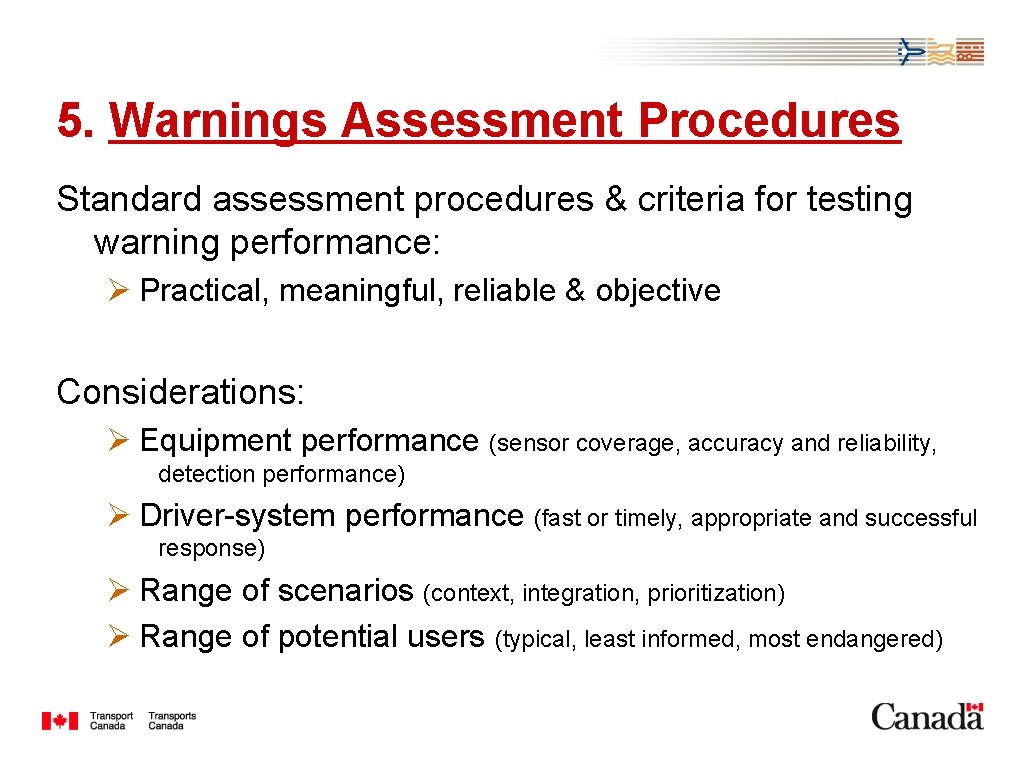
5. Warnings Assessment Procedures Standard assessment procedures & criteria for testing warning performance: Ø Practical, meaningful, reliable & objective Considerations: Ø Equipment performance (sensor coverage, accuracy and reliability, detection performance) Ø Driver-system performance (fast or timely, appropriate and successful response) Ø Range of scenarios (context, integration, prioritization) Ø Range of potential users (typical, least informed, most endangered)
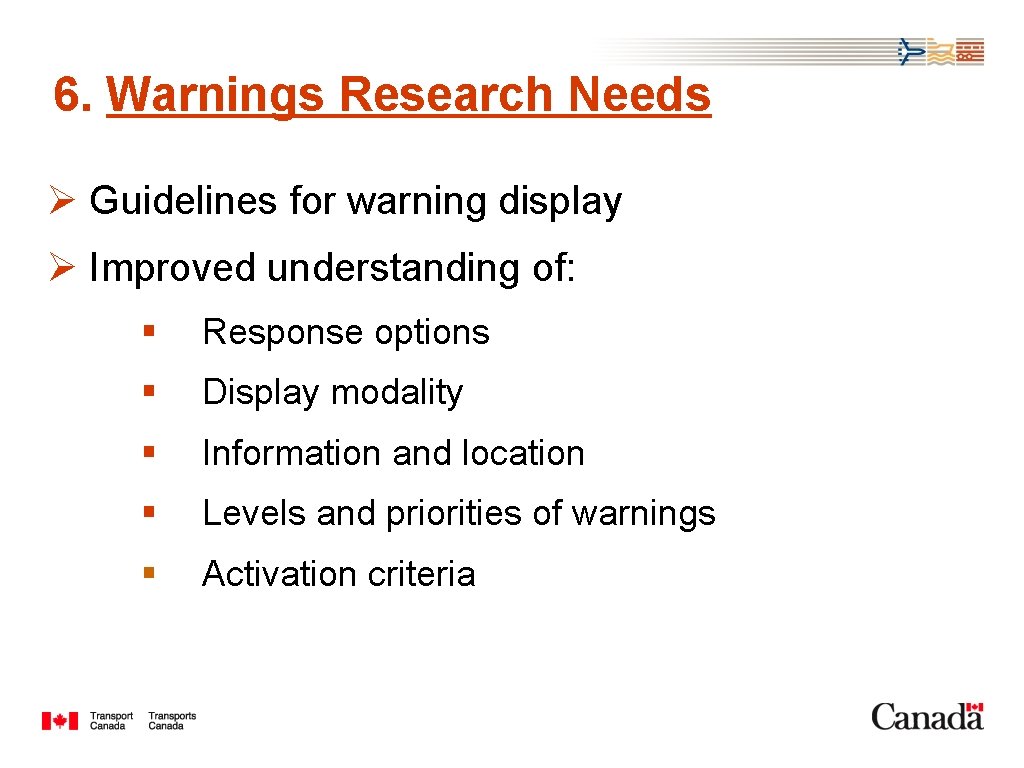
6. Warnings Research Needs Ø Guidelines for warning display Ø Improved understanding of: § Response options § Display modality § Information and location § Levels and priorities of warnings § Activation criteria
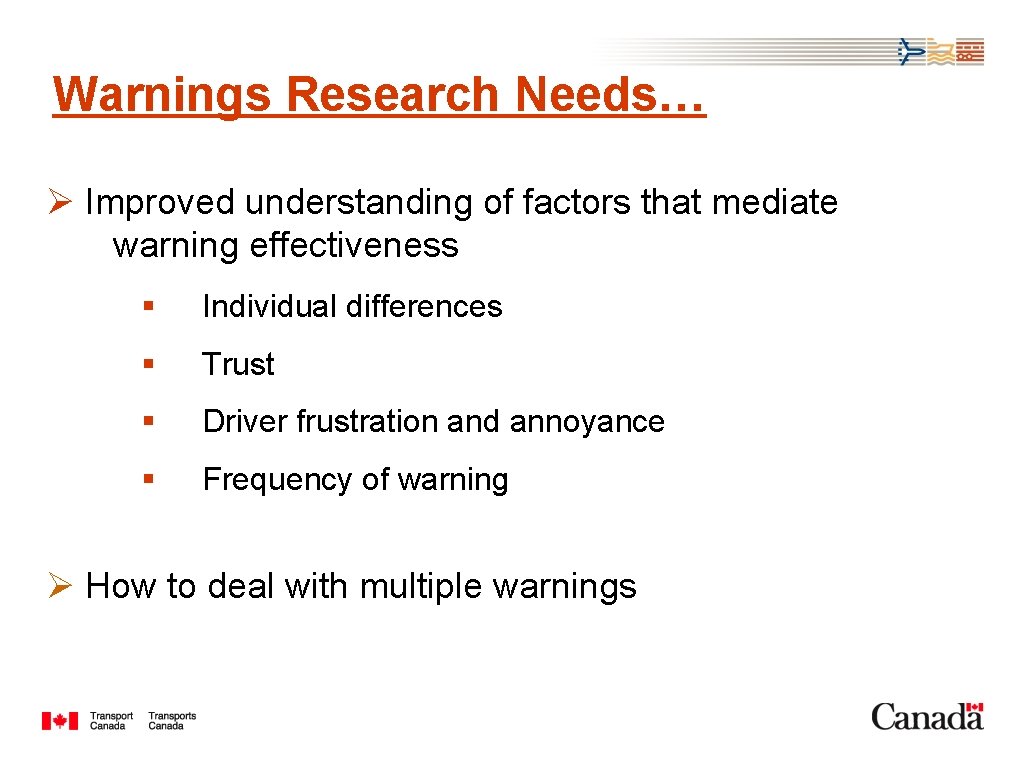
Warnings Research Needs… Ø Improved understanding of factors that mediate warning effectiveness § Individual differences § Trust § Driver frustration and annoyance § Frequency of warning Ø How to deal with multiple warnings
Warnings Research Needs… Ø Theory and comprehensive science-based models are needed to support the development of effective warning systems Ø Standard assessment procedures and criteria for testing the performance of warnings
7. Additional Issues Ø Research must be needs-driven by driver needs Ø Discrimination between assistance systems & warnings Ø HMI must be integrated from the concept Ø Research must be harmonized (International, Industry & Gov’t)
Thank You_________ harbluj@tc. gc. ca