
HUMAN ECOLOGY MAPPING A tool for incorporating social
![2012 RULE - PUBLIC PARTICIPATION 2012 RULE MINIMUM REQUIREMENTS [§ 219. 4(a)(1)] TASK •](https://slidetodoc.com/presentation_image_h2/be21518a8c7a7d4907d37db579dd2372/image-7.jpg "2012 RULE - PUBLIC PARTICIPATION 2012 RULE MINIMUM REQUIREMENTS [§ 219. 4(a)(1)] TASK •")
- Slides: 18
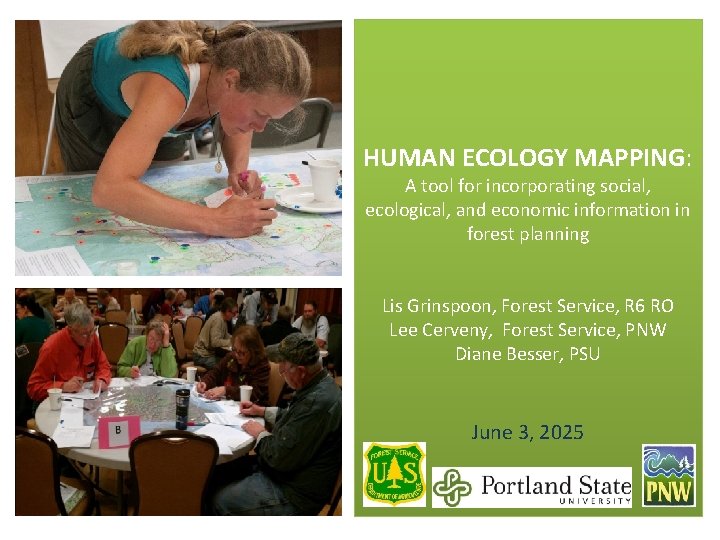
HUMAN ECOLOGY MAPPING: A tool for incorporating social, ecological, and economic information in forest planning Lis Grinspoon, Forest Service, R 6 RO Lee Cerveny, Forest Service, PNW Diane Besser, PSU June 3, 2025
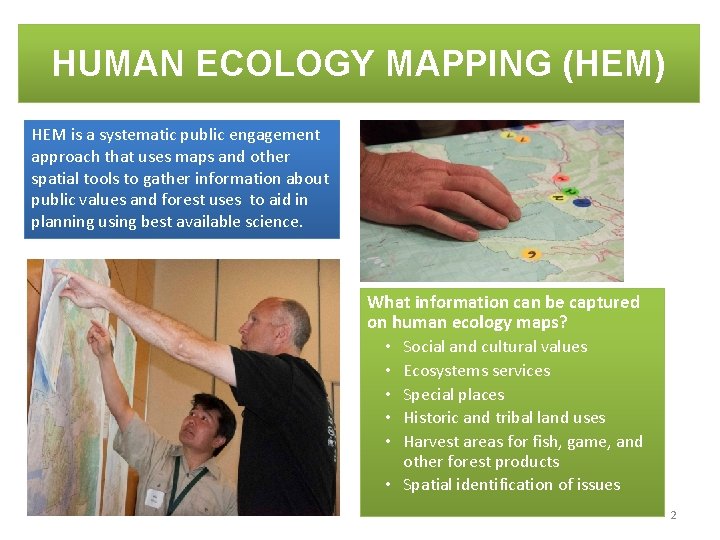
HUMAN ECOLOGY MAPPING (HEM) HEM is a systematic public engagement approach that uses maps and other spatial tools to gather information about public values and forest uses to aid in planning using best available science. What information can be captured on human ecology maps? • Social and cultural values • Ecosystems services • Special places • Historic and tribal land uses • Harvest areas for fish, game, and other forest products • Spatial identification of issues 2
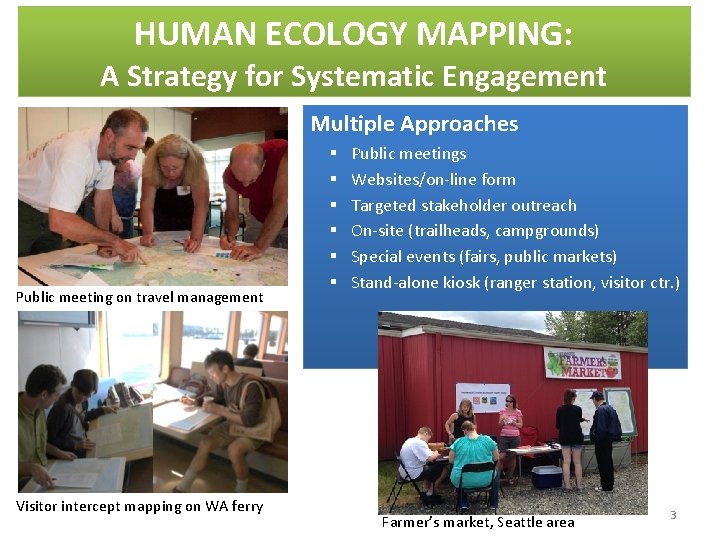
HUMAN ECOLOGY MAPPING: A Strategy for Systematic Engagement Multiple Approaches Public meeting on travel management Visitor intercept mapping on WA ferry § § § Public meetings Websites/on-line form Targeted stakeholder outreach On-site (trailheads, campgrounds) Special events (fairs, public markets) Stand-alone kiosk (ranger station, visitor ctr. ) Farmer’s market, Seattle area 3
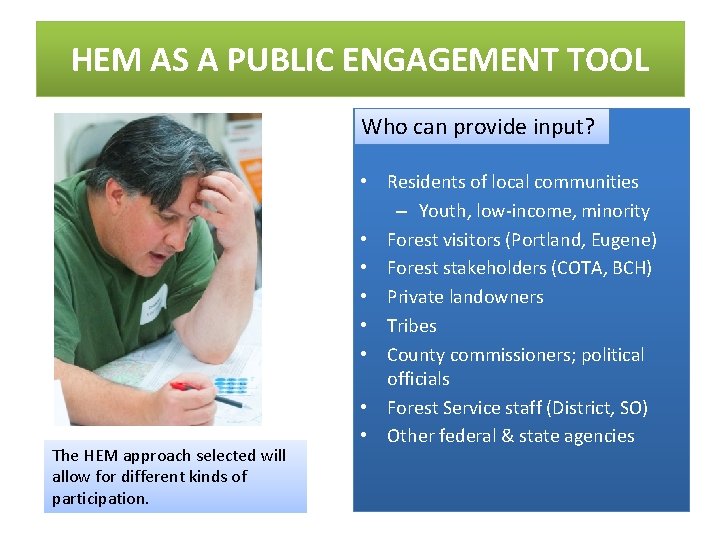
HEM AS A PUBLIC ENGAGEMENT TOOL Who can provide input? The HEM approach selected will allow for different kinds of participation. • Residents of local communities – Youth, low-income, minority • Forest visitors (Portland, Eugene) • Forest stakeholders (COTA, BCH) • Private landowners • Tribes • County commissioners; political officials • Forest Service staff (District, SO) • Other federal & state agencies
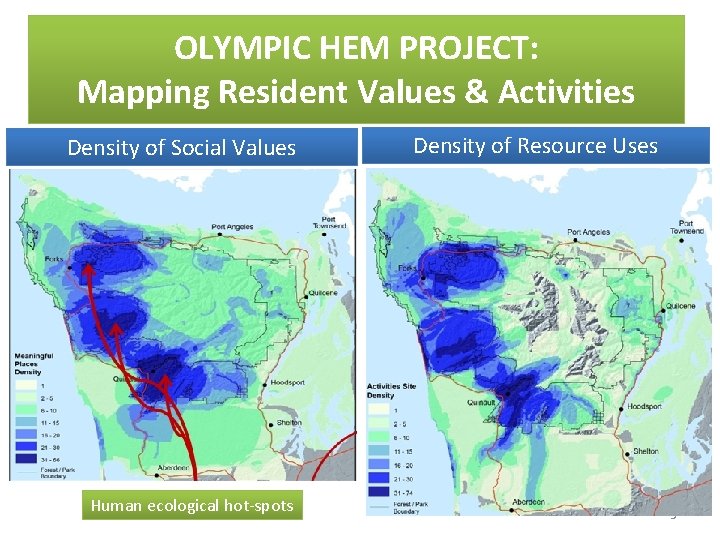
OLYMPIC HEM PROJECT: Mapping Resident Values & Activities Density of Social Values Human ecological hot-spots Density of Resource Uses 5
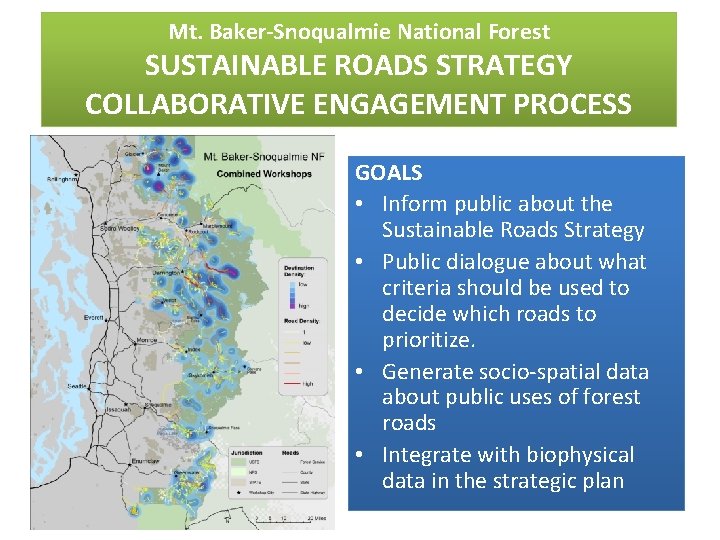
Mt. Baker-Snoqualmie National Forest SUSTAINABLE ROADS STRATEGY COLLABORATIVE ENGAGEMENT PROCESS GOALS • Inform public about the Sustainable Roads Strategy • Public dialogue about what criteria should be used to decide which roads to prioritize. • Generate socio-spatial data about public uses of forest roads • Integrate with biophysical data in the strategic plan
2012 RULE - PUBLIC PARTICIPATION 2012 RULE MINIMUM REQUIREMENTS [§ 219. 4(a)(1)] TASK • Engage the public in all stages of the planning process, including assessment, plan development and monitoring. Develop a strategy to engage the public in meaningful and transparent ways. • Engage interested parties (local, regional, national), private landowners, youth, minorities and low-income populations. 7
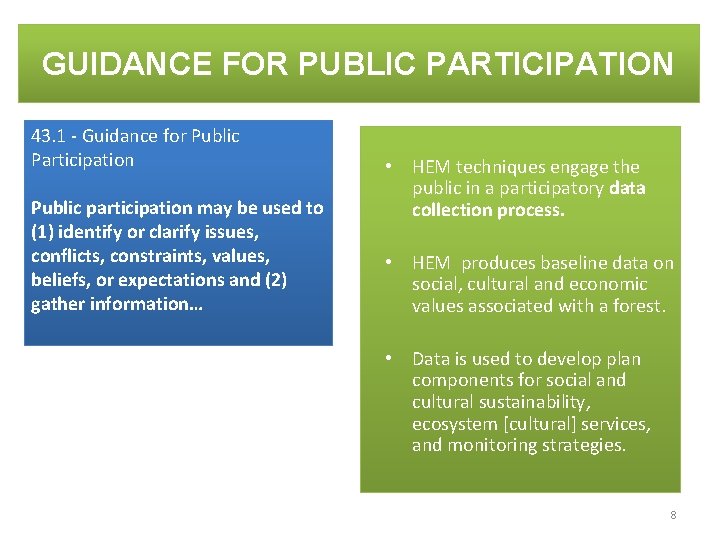
GUIDANCE FOR PUBLIC PARTICIPATION 43. 1 - Guidance for Public Participation Public participation may be used to (1) identify or clarify issues, conflicts, constraints, values, beliefs, or expectations and (2) gather information… • HEM techniques engage the public in a participatory data collection process. • HEM produces baseline data on social, cultural and economic values associated with a forest. • Data is used to develop plan components for social and cultural sustainability, ecosystem [cultural] services, and monitoring strategies. 8
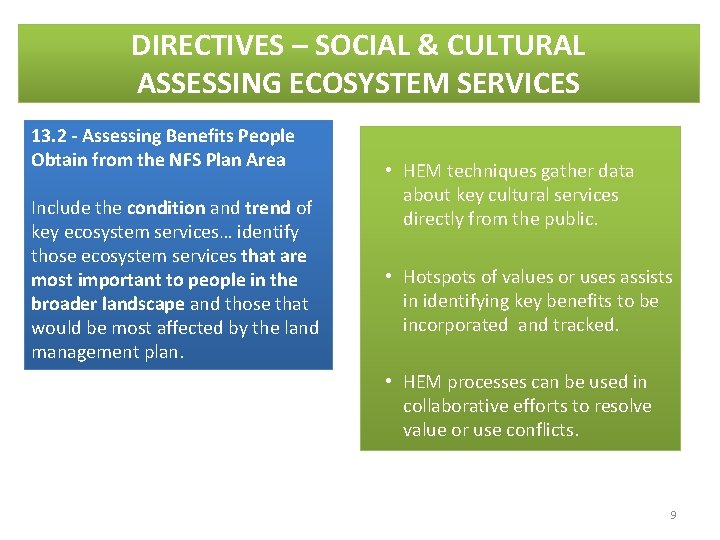
DIRECTIVES – SOCIAL & CULTURAL ASSESSING ECOSYSTEM SERVICES 13. 2 - Assessing Benefits People Obtain from the NFS Plan Area Include the condition and trend of key ecosystem services… identify those ecosystem services that are most important to people in the broader landscape and those that would be most affected by the land management plan. • HEM techniques gather data about key cultural services directly from the public. • Hotspots of values or uses assists in identifying key benefits to be incorporated and tracked. • HEM processes can be used in collaborative efforts to resolve value or use conflicts. 9
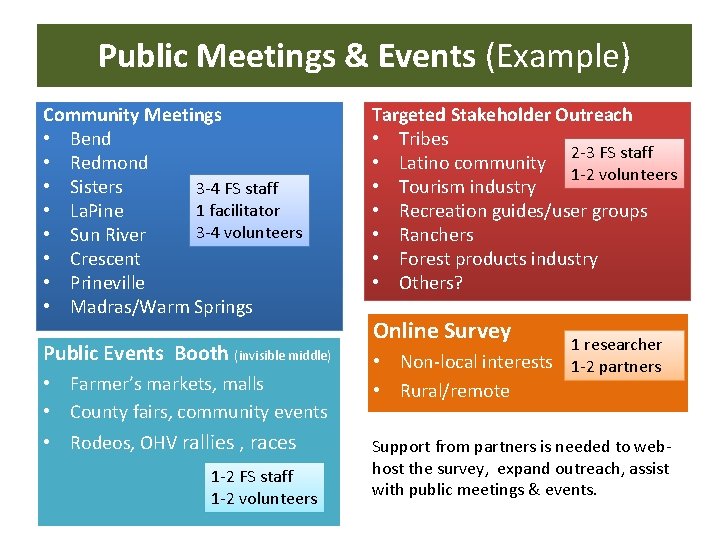
Public Meetings & Events (Example) Community Meetings • Bend • Redmond • Sisters 3 -4 FS staff 1 facilitator • La. Pine 3 -4 volunteers • Sun River • Crescent • Prineville • Madras/Warm Springs Public Events Booth (invisible middle) • Farmer’s markets, malls • County fairs, community events • Rodeos, OHV rallies , races 1 -2 FS staff 1 -2 volunteers Targeted Stakeholder Outreach • Tribes • Latino community 2 -3 FS staff 1 -2 volunteers • Tourism industry • Recreation guides/user groups • Ranchers • Forest products industry • Others? Online Survey • Non-local interests • Rural/remote 1 researcher 1 -2 partners Support from partners is needed to webhost the survey, expand outreach, assist with public meetings & events.
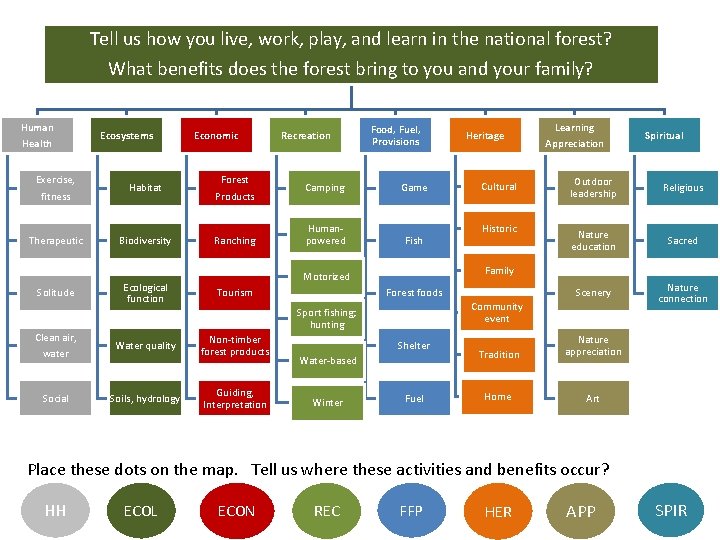
Tell us how you live, work, play, and learn in the national forest? What benefits does the forest bring to you and your family? Human Health Exercise, fitness Therapeutic Solitude Clean air, water Social Ecosystems Habitat Biodiversity Ecological function Economic Forest Products Ranching Recreation Food, Fuel, Provisions Camping Game Humanpowered Fish Forest foods Sport fishing; hunting Water quality Soils, hydrology Non-timber forest products Guiding, Interpretation Shelter Water-based Winter Cultural Historic Learning Appreciation Spiritual Outdoor leadership Religious Nature education Sacred Scenery Nature connection Family Motorized Tourism Heritage Fuel Community event Tradition Nature appreciation Home Art Place these dots on the map. Tell us where these activities and benefits occur? HH ECOL ECON REC FFP HER APP SPIR
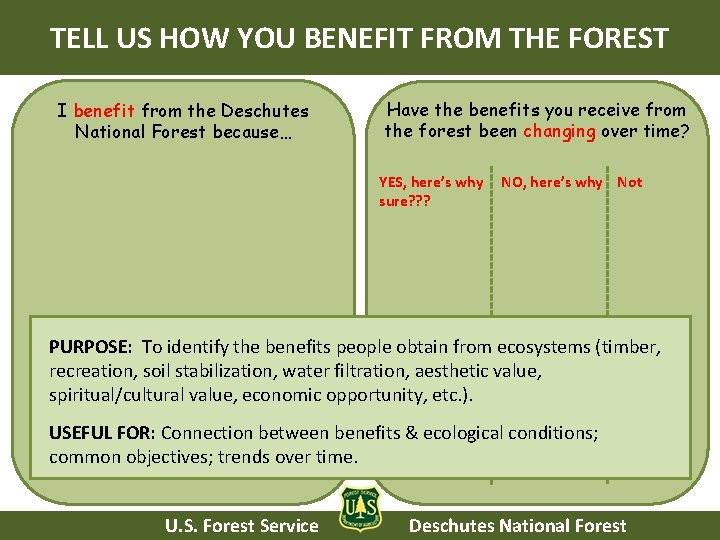
TELL US HOW YOU BENEFIT FROM THE FOREST I benefit from the Deschutes National Forest because… Have the benefits you receive from the forest been changing over time? YES, here’s why sure? ? ? NO, here’s why Not PURPOSE: To identify the benefits people obtain from ecosystems (timber, recreation, soil stabilization, water filtration, aesthetic value, spiritual/cultural value, economic opportunity, etc. ). USEFUL FOR: Connection between benefits & ecological conditions; common objectives; trends over time. U. S. Forest Service Deschutes National Forest
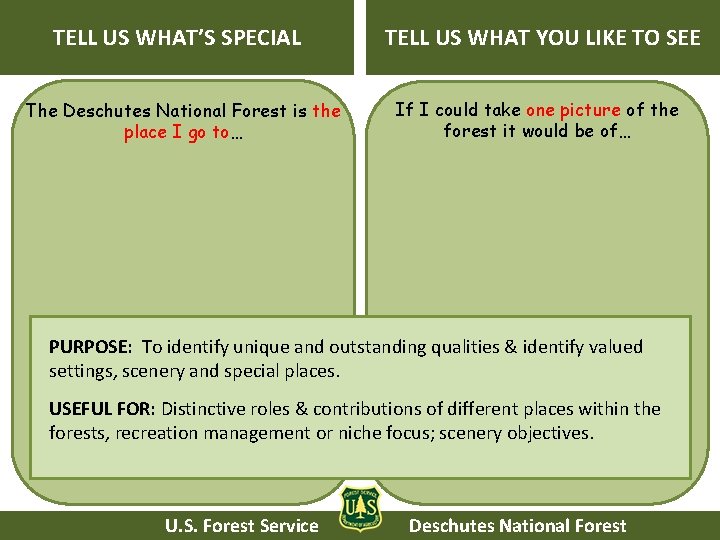
TELL US WHAT’S SPECIAL The Deschutes National Forest is the place I go to… TELL US WHAT YOU LIKE TO SEE If I could take one picture of the forest it would be of… PURPOSE: To identify unique and outstanding qualities & identify valued settings, scenery and special places. USEFUL FOR: Distinctive roles & contributions of different places within the forests, recreation management or niche focus; scenery objectives. U. S. Forest Service Deschutes National Forest
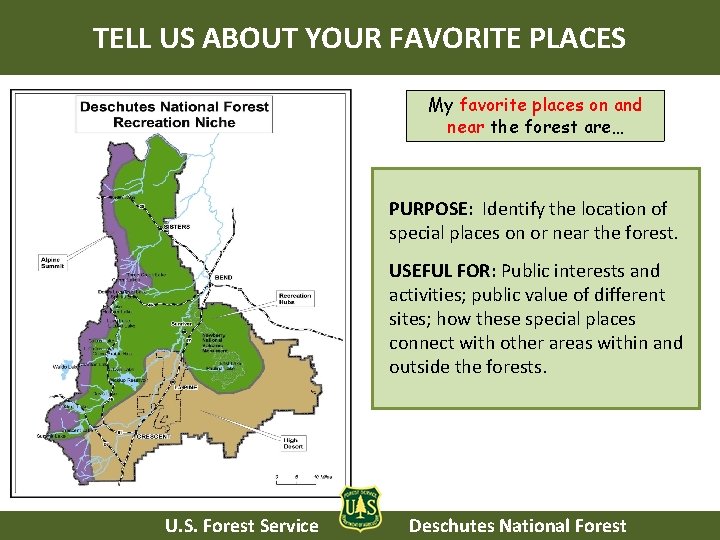
TELL US ABOUT YOUR FAVORITE PLACES My favorite places on and near the forest are… PURPOSE: Identify the location of special places on or near the forest. USEFUL FOR: Public interests and activities; public value of different sites; how these special places connect with other areas within and outside the forests. U. S. Forest Service Deschutes National Forest
TELL US WHAT YOU THINK My visit to the Deschutes National Forest would be better if… My use of the Deschutes National Forest would be greater if… PURPOSE: Identification of ways to better connect people with the forests. USEFUL FOR: Changes in management & offerings; compatibility or incompatibility of different activities and uses of the forests. U. S. Forest Service Deschutes National Forest
HEM APPROACH TO ASSESSING SOCIAL, CULTURAL, AND ECONOMIC CONDITIONS • What are some ways you use or rely on the forest? OR What activities connect you to the forest? (SERVICES) • Why is this use/activity important to you? (VALUES) • What places are important to satisfy these needs or uses? (PLACES) • What particular assets do these places have that you need or use? (ASSETS) • What forest conditions do you require to maintain these activities or uses? (CONDITIONS)
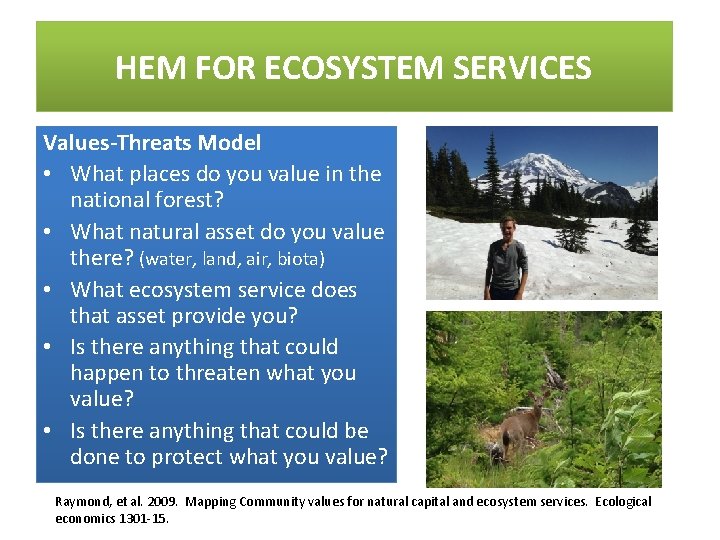
HEM FOR ECOSYSTEM SERVICES Values-Threats Model • What places do you value in the national forest? • What natural asset do you value there? (water, land, air, biota) • What ecosystem service does that asset provide you? • Is there anything that could happen to threaten what you value? • Is there anything that could be done to protect what you value? Raymond, et al. 2009. Mapping Community values for natural capital and ecosystem services. Ecological economics 1301 -15.
Questions 18