
HUMAN DIVERSITY WHAT IS HUMAN DIVERSITY The state

- Slides: 8
HUMAN DIVERSITY
WHAT IS HUMAN DIVERSITY? • The state of being different , of being unique, is known as Diversity includes such factors as age, gender, ability, race, religion, education, occupation and food. • Diversity need not mean that each of us does different things all the time. Very often we might be doing the same thing , but we do it differently.
THE NEED FOR DIVERSITY • Diversity or variety is one of the most beautiful aspect of life on Earth as well as very necessary. • Humans have different skills. If everyone had the same skill, could we survive? No , humans with diverse interest and skills are a necessity for society. • Diversity also enriches our lives. When you live with a diverse group of people, you will learn from them. You absorb different cultures; you become more tolerant and broad – minded.
INDIA- UNITY IN DIVERSITY • India is one of the most diverse countries in world. India is heir to a civilisation that is more than 5000 years old. Different groups of people from different places of the world migrated to India over the years adding to its richness. • Today, India is a land of varied cultures, religions and communities. More than 1600 languages are spoken here. A wide range of ethnically different people populate our land. We find people following different customs, traditions and lifestyle. Despite it there has always been interaction, exchange and an underlying unity among Indians.
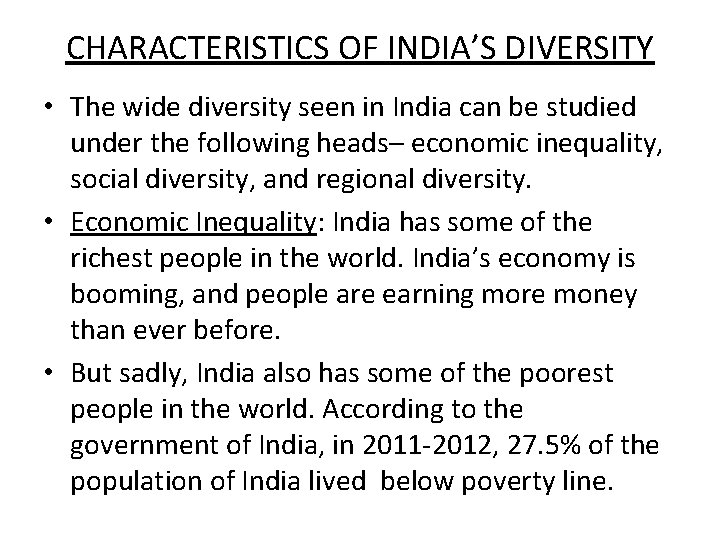
CHARACTERISTICS OF INDIA’S DIVERSITY • The wide diversity seen in India can be studied under the following heads– economic inequality, social diversity, and regional diversity. • Economic Inequality: India has some of the richest people in the world. India’s economy is booming, and people are earning more money than ever before. • But sadly, India also has some of the poorest people in the world. According to the government of India, in 2011 -2012, 27. 5% of the population of India lived below poverty line.
• The poverty line is the minimum level of income needed to achieve an adequate standard of living. • The poverty line for rural areas is Rs 672. 8 per month and Rs 859. 6 per month in urban areas. In other words , more than one-fourth of Indians earn less than Rs 25 a day. Of these, more than 75% live in rural areas. The people living below the poverty line are mainly engaged as daily wage earners, self employed householders or landless labourers. Economic inequalities are closely connected to social inequalities.
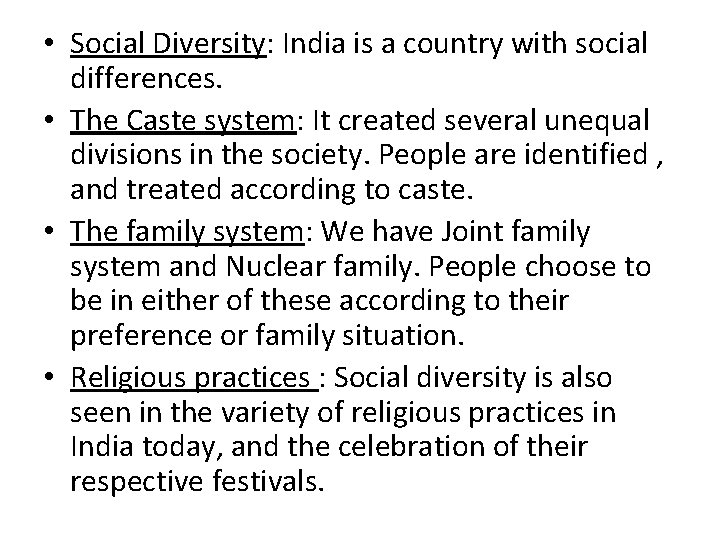
• Social Diversity: India is a country with social differences. • The Caste system: It created several unequal divisions in the society. People are identified , and treated according to caste. • The family system: We have Joint family system and Nuclear family. People choose to be in either of these according to their preference or family situation. • Religious practices : Social diversity is also seen in the variety of religious practices in India today, and the celebration of their respective festivals.
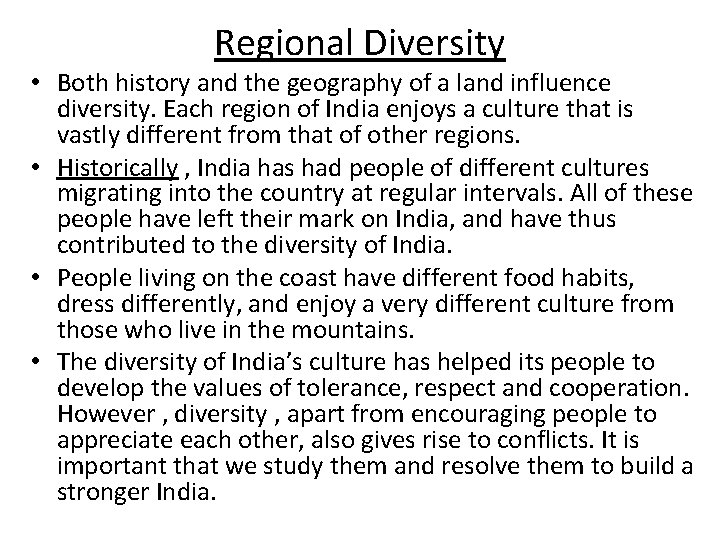
Regional Diversity • Both history and the geography of a land influence diversity. Each region of India enjoys a culture that is vastly different from that of other regions. • Historically , India has had people of different cultures migrating into the country at regular intervals. All of these people have left their mark on India, and have thus contributed to the diversity of India. • People living on the coast have different food habits, dress differently, and enjoy a very different culture from those who live in the mountains. • The diversity of India’s culture has helped its people to develop the values of tolerance, respect and cooperation. However , diversity , apart from encouraging people to appreciate each other, also gives rise to conflicts. It is important that we study them and resolve them to build a stronger India.