
Human Development Issues in Developmental Psychology The study








- Slides: 72
Human Development
Issues in Developmental Psychology – The study of how humans grow, develop, and change throughout the lifespan Nature and Nurture • Heredity imposes some limits on what a person can become. • Home, education, nutrition, etc. can evoke positive and negative influences. – Resilience: the ability to bounce back – Vulnerabilities • Difficult temperament, genetic disorders – Protective factors • High intelligence, good coordination, easy-going personality Copyright © 2011 Pearson Education, Inc. All rights reserved
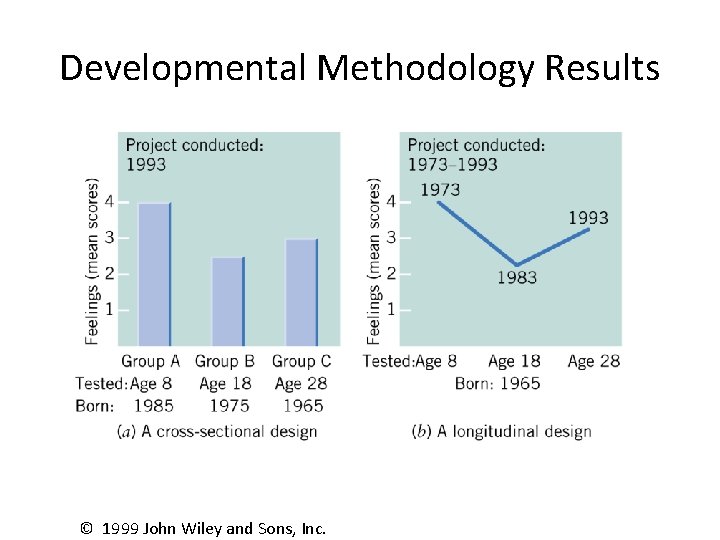
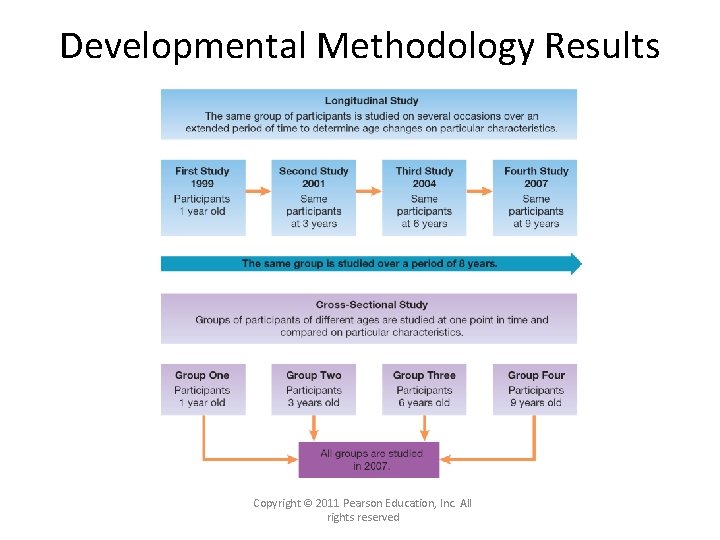
Studying Development • Cross-sectional method compares groups of different ages at the same time – Useful for assessing age differences – Not useful for examining age changes • The problem is that each age group (cohort) has different life experiences • Longitudinal method compares same group at multiple time points © 1999 John Wiley and Sons, Inc.
Developmental Methodology Results © 1999 John Wiley and Sons, Inc.
Developmental Methodology Results Copyright © 2011 Pearson Education, Inc. All rights reserved
Prenatal Development from conception to birth n Conception – Marks beginning of prenatal period – Usually takes place in the fallopian tubes – Fertilization of an egg by a sperm n Zygote – Cell that results from union of sperm and an ovum – During first two weeks after conception, rapid cell division occurs – A zygote is about the size of the period at the end of a sentence. Copyright © 2011 Pearson Education, Inc. All rights reserved
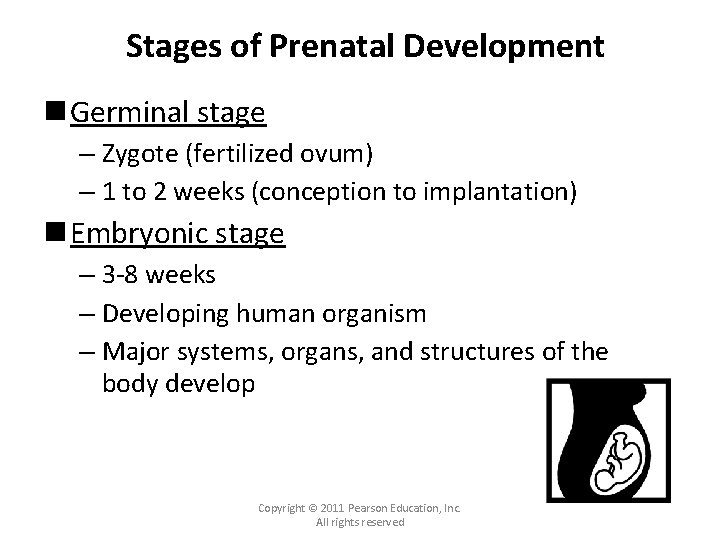
Stages of Prenatal Development n Germinal stage – Zygote (fertilized ovum) – 1 to 2 weeks (conception to implantation) n Embryonic stage – 3 -8 weeks – Developing human organism – Major systems, organs, and structures of the body develop Copyright © 2011 Pearson Education, Inc. All rights reserved
Stages of Prenatal Development n Fetal stage – From week 9 to birth – Rapid growth occurs n Organs, structures, and body systems – Fetus can respond to outside stimuli n Especially sounds n De. Casper & Spence research – Infants showed preference for story that had been read during final 6 weeks of pregnancy. n Critical Period – Period so important to development that a harmful environmental influence at this time: n Can prevent a bodily structure from developing normally – Body structure will not form properly, nor will it develop later n Can impair later intellectual or social development Copyright © 2011 Pearson Education, Inc. All rights reserved
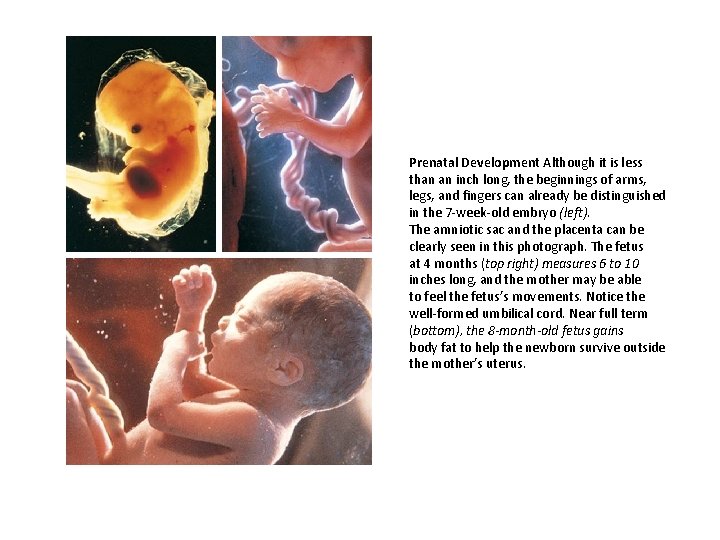
Prenatal Development Although it is less than an inch long, the beginnings of arms, legs, and fingers can already be distinguished in the 7 -week-old embryo (left). The amniotic sac and the placenta can be clearly seen in this photograph. The fetus at 4 months (top right) measures 6 to 10 inches long, and the mother may be able to feel the fetus’s movements. Notice the well-formed umbilical cord. Near full term (bottom), the 8 -month-old fetus gains body fat to help the newborn survive outside the mother’s uterus.
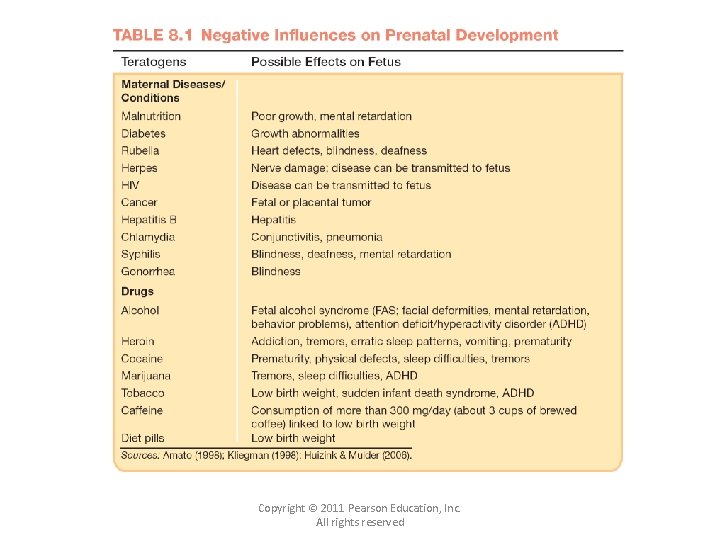
Negative Influences on Prenatal Development n Teratogens – Harmful agents in the prenatal environment that can negatively impact prenatal development or even cause birth defects n. Impact depends on both intensity and the time at which it is present during prenatal development n. Most devastating consequences occur during the embryonic period. Copyright © 2011 Pearson Education, Inc. All rights reserved
Negative Influences on Prenatal Development n Teratogens – Fetal Alcohol Syndrome n Condition caused by maternal alcohol intake during pregnancy n Baby is born: – Mentally retarded – With a small head – With facial and/or organ deformities n Commonly includes wide-set eyes and a short nose – With behavioral abnormalities n Hyperactivity and short attention span n Alcohol crosses the placental barrier – Alcohol levels in the fetus almost match those levels in the mother’s blood – Fetal Alcohol Effects n Children prenatally exposed to alcohol with some characteristics of FAS but in less severe form Copyright © 2011 Pearson Education, Inc. All rights reserved
n Teratogens Negative Influences on Prenatal Development – Smoking n. Decreases the amount of oxygen in placental barrier n. Increases the amount of carbon monoxide in placental barrier n. Exposes embryo or fetus to nicotine and thousands of chemicals n. Increases probability of prematurity or low birth weight – Caffeine n. Researchers disagree on effect of high caffeine intake n. Recommend restricting caffeine to less than 300 milligrams (3 cups of coffee) daily Copyright © 2011 Pearson Education, Inc. All rights reserved
Copyright © 2011 Pearson Education, Inc. All rights reserved
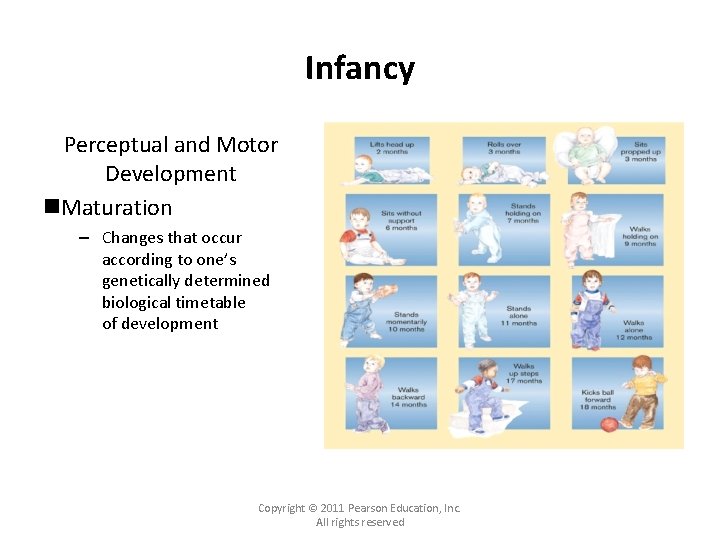
Infancy Perceptual and Motor Development n. Maturation – Changes that occur according to one’s genetically determined biological timetable of development Copyright © 2011 Pearson Education, Inc. All rights reserved
Sensory and Perceptual Development Temperament n A person’s behavioral style or characteristic way of responding to the environment – Thomas, Chess, and Birch (1970) studied 2 - to 3 month-old infants into adolescence and into adulthood. n Children show distinct individuality in temperament in the first weeks of life independently of their parents’ handling or personality style Copyright © 2011 Pearson Education, Inc. All rights reserved
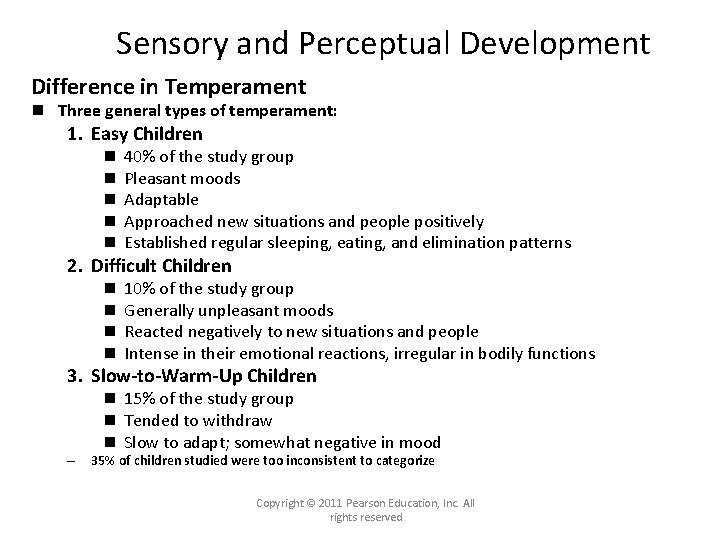
Sensory and Perceptual Development Difference in Temperament n Three general types of temperament: 1. Easy Children n n 40% of the study group Pleasant moods Adaptable Approached new situations and people positively Established regular sleeping, eating, and elimination patterns 2. Difficult Children n n 10% of the study group Generally unpleasant moods Reacted negatively to new situations and people Intense in their emotional reactions, irregular in bodily functions 3. Slow-to-Warm-Up Children – n 15% of the study group n Tended to withdraw n Slow to adapt; somewhat negative in mood 35% of children studied were too inconsistent to categorize Copyright © 2011 Pearson Education, Inc. All rights reserved
Attachment The early, close relationship formed between infant and caregiver n Attachment in infant monkeys – Harry Harlow rhesus monkey experiment – Contact Comfort n. Comfort supplied by bodily contact develops attachment n. Who provides nourishment is not as important as contact comfort n‘Comforting’ figure allowed monkeys to explore new items Copyright © 2011 Pearson Education, Inc. All rights reserved
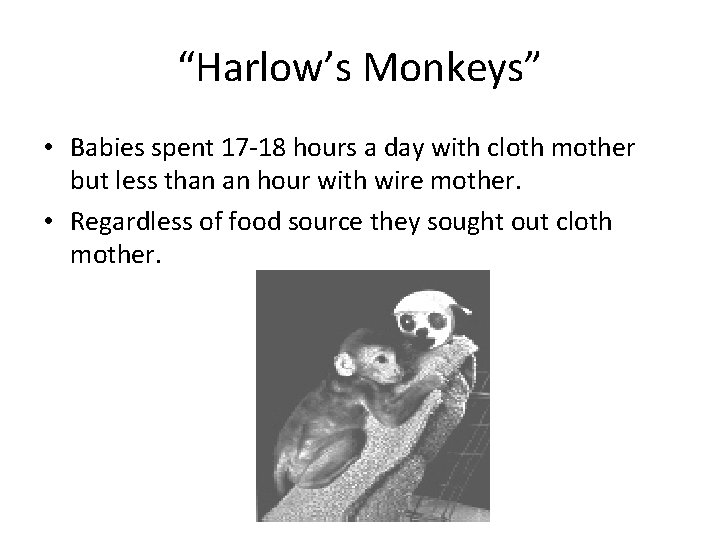
“Harlow’s Monkeys” • Babies spent 17 -18 hours a day with cloth mother but less than an hour with wire mother. • Regardless of food source they sought out cloth mother.
Attachment – Separation Anxiety n. Fear and distress shown by a toddler when the parent leaves – Occurs from 8 to 24 months – Reaches a peak between 12 and 18 months – Stranger Anxiety n. Common in infants at about 6 months n. Increases in intensity until about 12 months n. Declines in intensity in the second year n. Greater in an unfamiliar setting, when a parent is not close at hand, and when a stranger abruptly approaches or touches the child Copyright © 2011 Pearson Education, Inc. All rights reserved
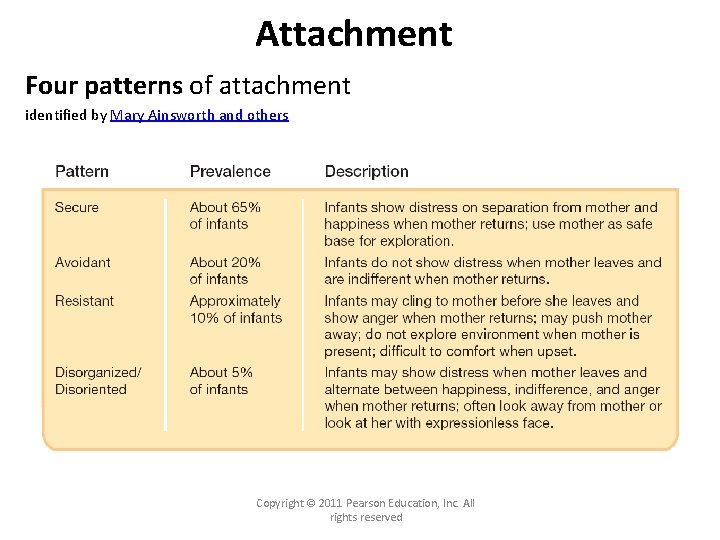
Attachment Four patterns of attachment identified by Mary Ainsworth and others Copyright © 2011 Pearson Education, Inc. All rights reserved
Attachment n The Father-Child Relationship – Can be as responsive as mothers – Attachments can be just as strong – Many enduring positive influences on children n Children who regularly interact with fathers: – Have higher IQs – Do better in social relationships – Cope with frustration better – Persist longer in solving problems – Less impulsive and less likely to do something violent n Father-son relationships associated with higher quality parenting behavior by sons with own children – Engage in more exciting and arousing physical play n Mothers more likely to cushion against overstimulation and injury – More supportive of a child’s confidence and identity development n Fathers remain further away, allowing more individual exploration and contact with novel situations – Ideally children need both mother’s and father’s influences Copyright © 2011 Pearson Education, Inc. All rights reserved
Attachment Fathers tend to engage in more physical play with their children than mothers. However, many fathers today share basic childcare responsibilities such as feeding and diaper changing with mothers. Copyright © 2011 Pearson Education, Inc. All rights reserved
Parenting Styles • Baumrind studied parenting style: – Authoritarian: Parent places a high value on obedience as well as respect for authority – Permissive: Parent imposes minimal controls on their children – *Authoritative: Parent enforce standards, but encourages verbal give-and-take with the child • Parenting style affects children’s behavior – Authoritarian parents produce children with low independence, low self-esteem, and an external locus of control
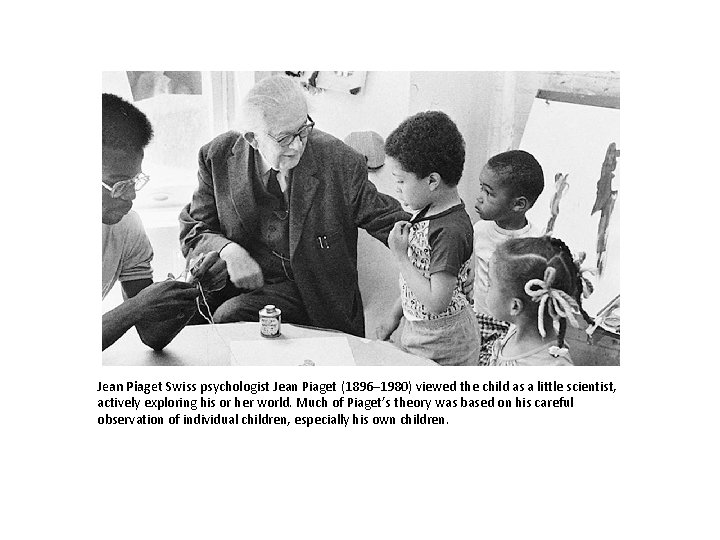
Jean Piaget Swiss psychologist Jean Piaget (1896– 1980) viewed the child as a little scientist, actively exploring his or her world. Much of Piaget’s theory was based on his careful observation of individual children, especially his own children.
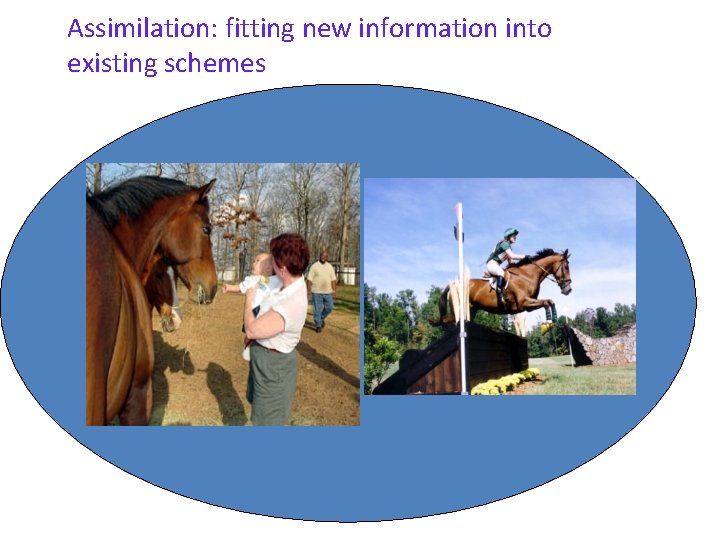
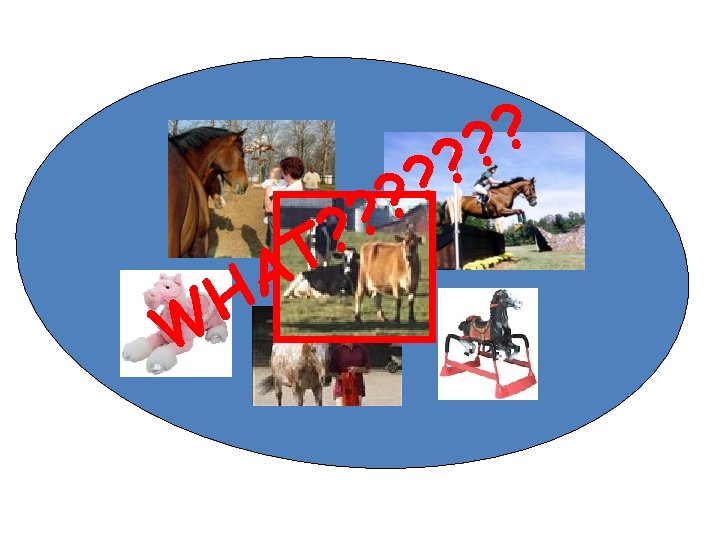
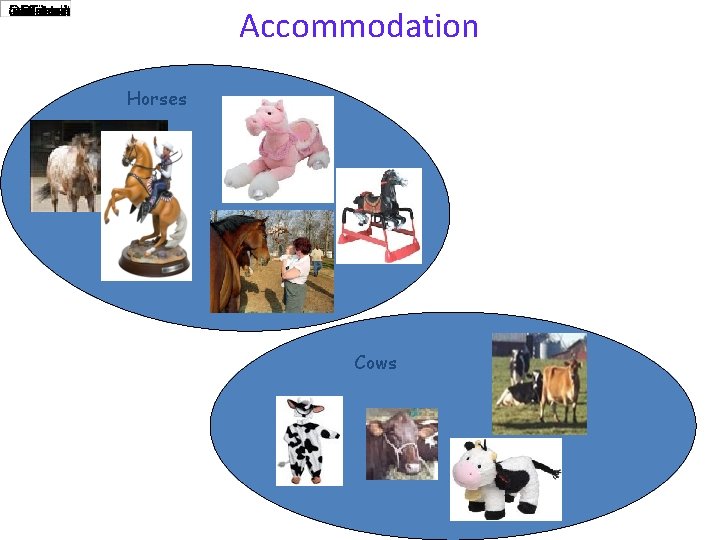
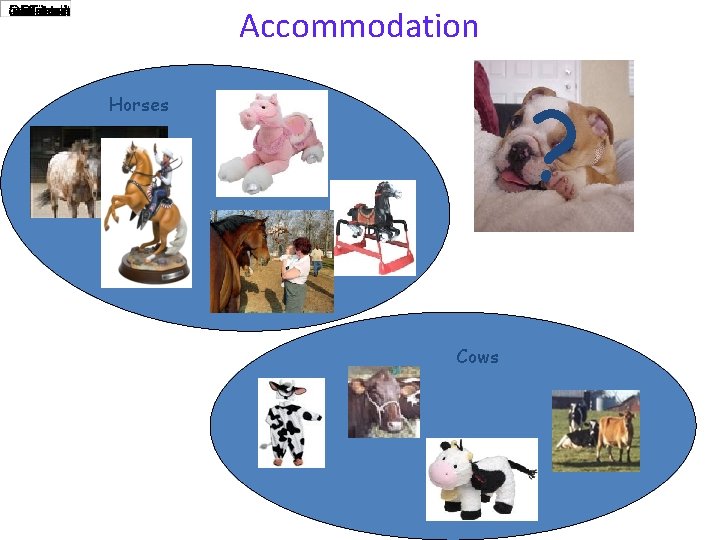
Piaget and Cognition • Cognitive reasoning is primitive at birth and changes from infancy to adulthood • Schemas are the basic units of intellect – Organization of ideas • Cognitive adaptation reflects the actions of two complementary processes: – Assimilation allows an existing schema to adapt to the environment – Accommodation allows the schema to change in order to handle a new environmental situation
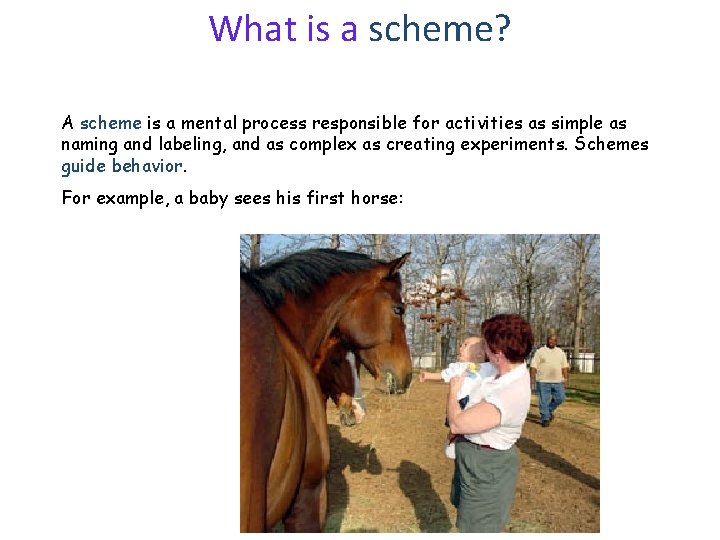
What is a scheme? A scheme is a mental process responsible for activities as simple as naming and labeling, and as complex as creating experiments. Schemes guide behavior. For example, a baby sees his first horse:
Then he sees…
Assimilation: fitting new information into existing schemes
Assimilation
Accommodation Horses Cows
Accommodation ? Horses Cows
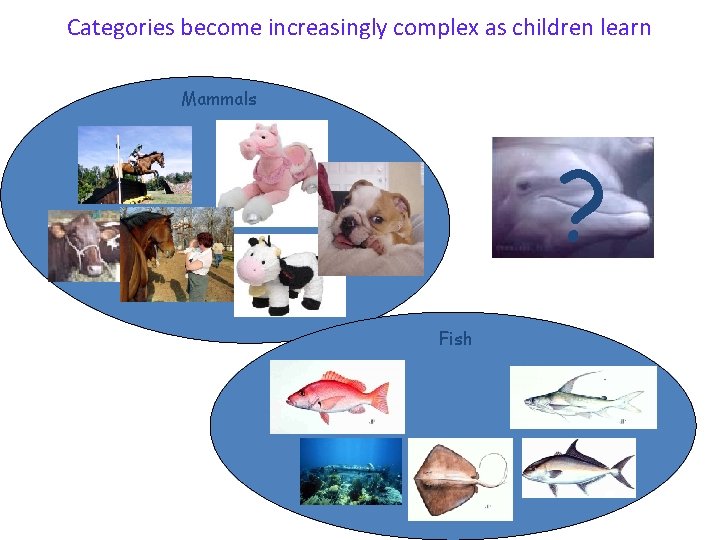
Categories become increasingly complex as children learn Mammals ? Fish
Piaget’s Theory of Cognitive Development Important Concepts: n Changes in schemes underlie four stages of cognitive development n Each stage reflects a qualitatively different way of reasoning and understanding the world n Stages occur in fixed sequence n Accomplishments of one stage provide the foundation for the next stage n Children throughout the world seem to progress through the stages in the same order, but they show individual differences in the rate they pass through them n Each child’s rate is influenced by the level of maturation and experience n Transition from one stage to another is gradual, not abrupt n Children often show aspects of two stages while going through transitions Copyright © 2011 Pearson Education, Inc. All rights reserved
Piaget’s Theory of Cognitive Development n Schemes – A cognitive structure or concept used to identify and interpret information n Assimilation – The process by which new objects, events, or experiences, or information is incorporated into existing schemes n. A child who calls any male stranger “Daddy” n Accommodation – The process by which existing schemes are modified and new schemes are created – Incorporates new objects, events, experiences, or information Copyright © 2011 Pearson Education, Inc. All rights reserved
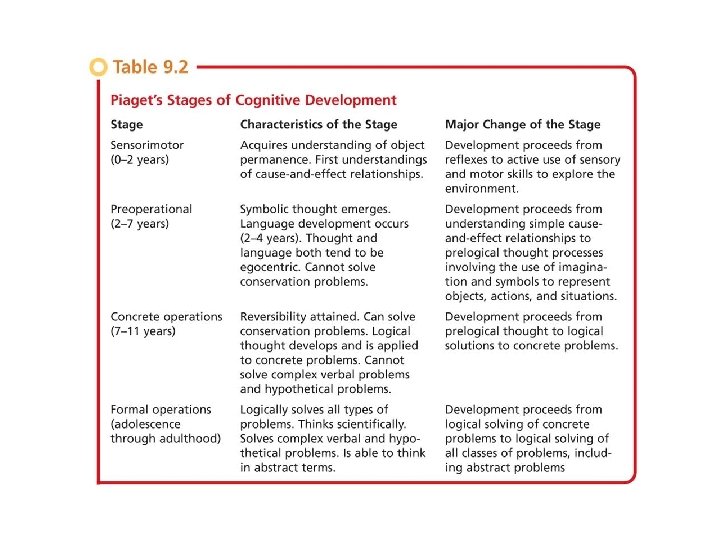
Piaget’s Stages of Cognitive Development n Sensorimotor Stage (0 -2 years) – Infants gain an understanding of the world through their senses and their motor activities n. Actions and body movements n. Infant’s behavior gradually moves from mostly reflexive to complex and intelligent n. Infant learns to respond to and manipulate objects and use them in goal-directed activity – Object Permanence n. Realization that objects continue to exist, even when they can no longer be perceived Copyright © 2011 Pearson Education, Inc. All rights reserved
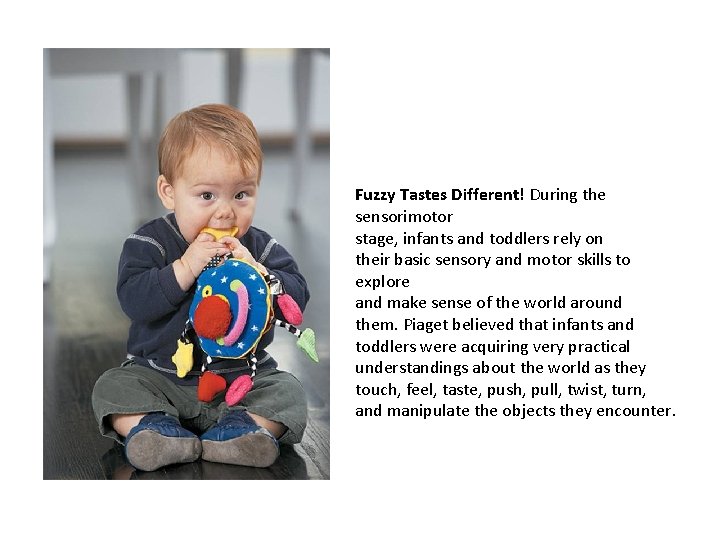
Fuzzy Tastes Different! During the sensorimotor stage, infants and toddlers rely on their basic sensory and motor skills to explore and make sense of the world around them. Piaget believed that infants and toddlers were acquiring very practical understandings about the world as they touch, feel, taste, push, pull, twist, turn, and manipulate the objects they encounter.
Piaget’s Stages of Cognitive Development n Preoperational Stage (2 -7 years) – Symbolic Function n The understanding that one thing can stand for another – An object, a word, a drawing – The use of words to present object n Orange - both a color and a fruit n Pretend Play – Imagining a block is a car – Imagining a doll is a real baby – Egocentricism n Child’s belief that everyone sees what he/she sees, thinks as he/she thinks, and feels as he/she feels – Results in illogical thinking n “A cookie is only good if it is unbroken. ” Copyright © 2011 Pearson Education, Inc. All rights reserved
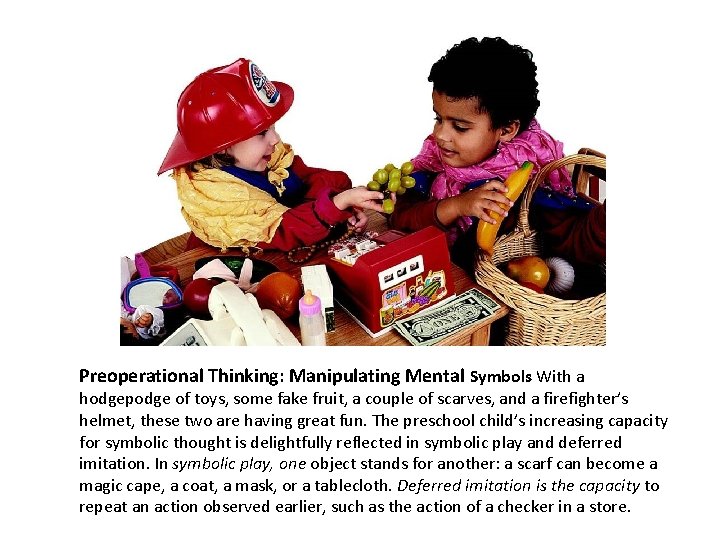
Preoperational Thinking: Manipulating Mental Symbols With a hodgepodge of toys, some fake fruit, a couple of scarves, and a firefighter’s helmet, these two are having great fun. The preschool child’s increasing capacity for symbolic thought is delightfully reflected in symbolic play and deferred imitation. In symbolic play, one object stands for another: a scarf can become a magic cape, a coat, a mask, or a tablecloth. Deferred imitation is the capacity to repeat an action observed earlier, such as the action of a checker in a store.
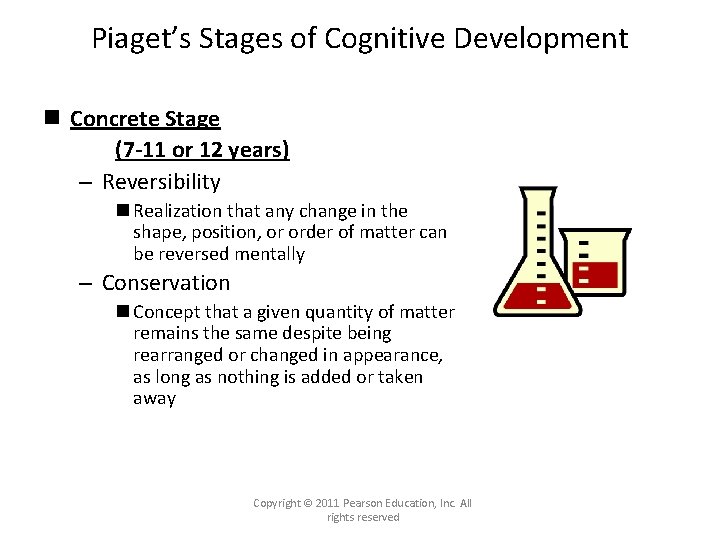
Piaget’s Stages of Cognitive Development n Concrete Stage (7 -11 or 12 years) – Reversibility n Realization that any change in the shape, position, or order of matter can be reversed mentally – Conservation n Concept that a given quantity of matter remains the same despite being rearranged or changed in appearance, as long as nothing is added or taken away Copyright © 2011 Pearson Education, Inc. All rights reserved
Piaget’s Conservation Task Five-year-old Laura compares the liquid in the two short beakers, then watches as Sandy pours the liquid into a tall, narrow beaker. When asked which has more, Laura insists that there is more liquid in the tall beaker. As Piaget’s classic task demonstrates, the average 5 -year-old doesn’t grasp this principle of conservation. Even though Laura repeated this demonstration several times for the photographer, she persisted in her belief that the tall beaker had more liquid. We tried the demonstration again when Laura was almost 7. Now in the concrete operational stage, Laura immediately understood that both beakers held the same amount of liquid—just as Piaget’s theory predicts.
Conservation
Piaget’s Stages of Cognitive Development n Formal Operations (11 or 12 years and beyond) – Preadolescents and adolescents can apply logical thought to abstract, verbal, and hypothetical situations and to problems in the past, present, or future – Hypothetic-Deductive Thinking n Ability to base logical reasoning on a hypothetical premise n Comprehend abstract subjects like philosophy and politics and become interested in the world of ideas n Begin to formulate their own theories and think of what might be – Conceive of “perfect” solutions to the world’s and their own problems Copyright © 2011 Pearson Education, Inc. All rights reserved
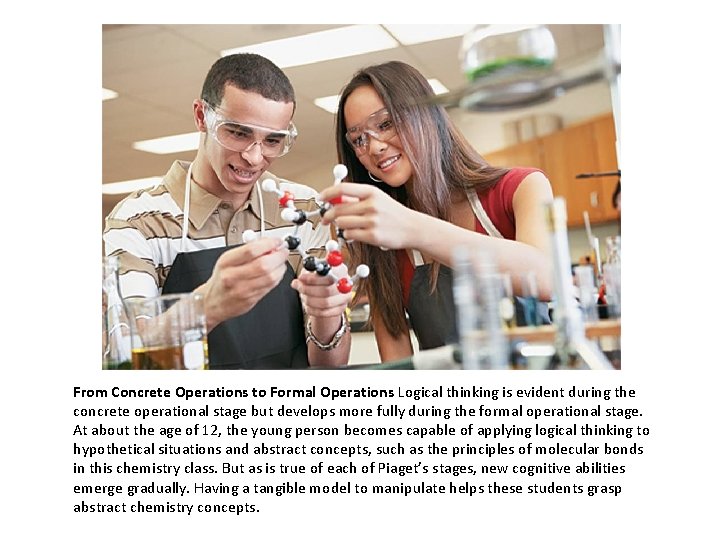
From Concrete Operations to Formal Operations Logical thinking is evident during the concrete operational stage but develops more fully during the formal operational stage. At about the age of 12, the young person becomes capable of applying logical thinking to hypothetical situations and abstract concepts, such as the principles of molecular bonds in this chemistry class. But as is true of each of Piaget’s stages, new cognitive abilities emerge gradually. Having a tangible model to manipulate helps these students grasp abstract chemistry concepts.
Piaget's Cognitive Stages of Development - You. Tube
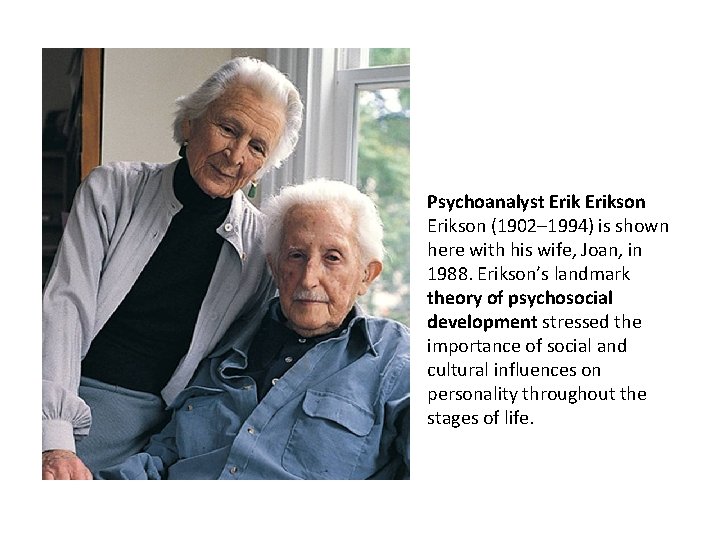
Psychoanalyst Erikson (1902– 1994) is shown here with his wife, Joan, in 1988. Erikson’s landmark theory of psychosocial development stressed the importance of social and cultural influences on personality throughout the stages of life.
The Lifespan Perspective Developmental changes happen throughout the lifespan and that interdisciplinary research is required to fully understand human development Erikson’s Theory of Psychosocial Development n Individuals progress through eight psychosocial stages n Each one is defined by a conflict involving the individual’s relationship with the social environment n Each must be satisfactorily for health development to occur n The stages are named for a series of “alternative basic attitudes” n Adult personality foundations are laid in the four childhood stages Copyright © 2011 Pearson Education, Inc. All rights reserved.
Erikson’s Theory of Psychosocial Development n Trust vs. Mistrust (Birth-1 year) – Depends on the degree and regularity of care, love, and affection they receive from the mother or primary caregiver – Basic trust is the cornerstone of a healthy personality n Autonomy vs. Shame and Doubt (1 -3 years) – Children demonstrate independence by saying “No!” – Physical and mental abilities develop n Initiative vs. Guilt (3 -6) – Initiate activities, plan tasks, develop motor skills n Industry vs. Inferiority (6 -11) – Children begin to enjoy and take pride in accomplishments – Sense of inferiority develops if child rebuffed by parents and teachers Copyright © 2011 Pearson Education, Inc. All rights reserved.
Erikson’s Theory n Identity vs. Role Confusion (11 -22) – Identity crisis should lead teens to an idea of how they fit into the adult world – A healthy identity leads to next stage n Intimacy vs. Isolation (22 -40) – Leads to finding a life partner or acceptance of single life n Generativity vs. Stagnation (40 -65) – Desire to guide the next generation via parenting, teaching, or mentoring n Ego Integrity vs. Despair (65+) – Acceptance of one’s life in preparation for facing death Copyright © 2011 Pearson Education, Inc. All rights reserved.
Adolescence n Stage that begins at puberty and encompasses the period from the end of childhood to the beginning of adulthood n Puberty – A period of several years with rapid growth, physical changes culminating in sexual maturity – The physical changes of puberty n 10 -13 years old for girls – Ranges from 7 to 14 years of age n 12 years old for boys – Ranges from 9 to 16 years of age – Begins with hormone surge followed by growth spurt n Girls growth spurt between ages 10 -13 years of age n Boys growth spurt between ages 12 -15 years of age n Girls reach full height between ages 16 -17 n Boys reach full height between ages 18 -20 Copyright © 2011 Pearson Education, Inc. All rights reserved.
Sex & Gender: Important/Confusing Terms • Sex: biological maleness or femaleness including chromosomal sex • Gender: psychological & sociocultural meanings added to biological sex
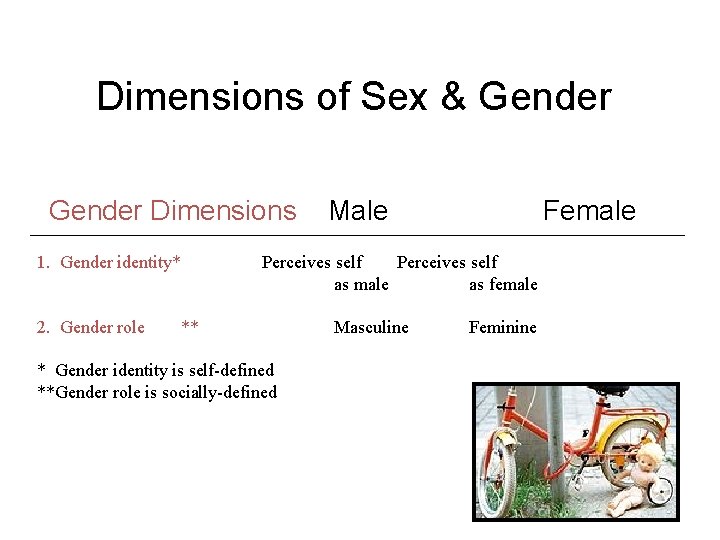
Dimensions of Sex & Gender Dimensions 1. Gender identity* 2. Gender role Male Female Perceives self as male as female ** * Gender identity is self-defined **Gender role is socially-defined Masculine Feminine
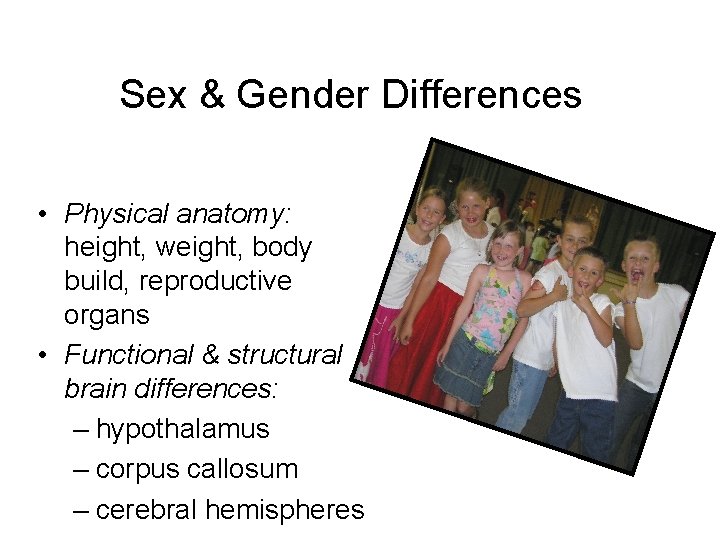
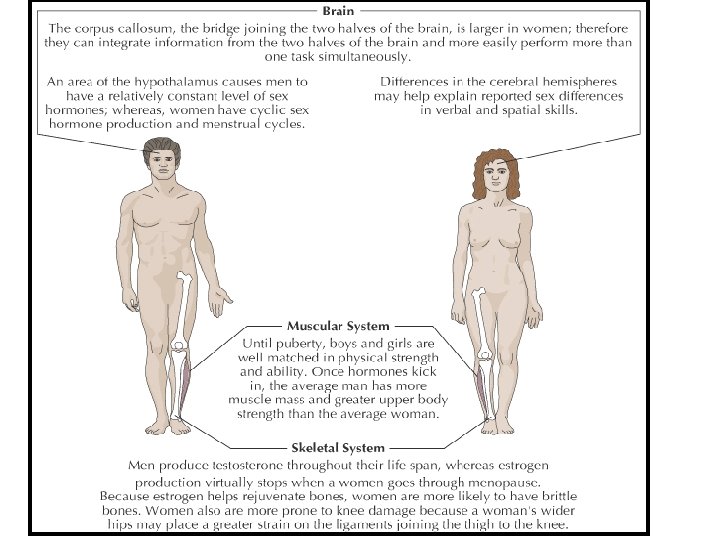
Sex & Gender Differences • Physical anatomy: height, weight, body build, reproductive organs • Functional & structural brain differences: – hypothalamus – corpus callosum – cerebral hemispheres
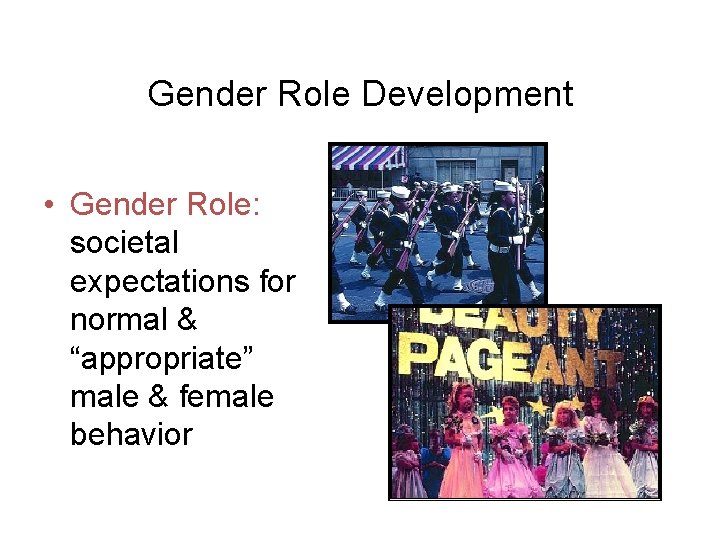
Gender Role Development • Gender Role: societal expectations for normal & “appropriate” male & female behavior
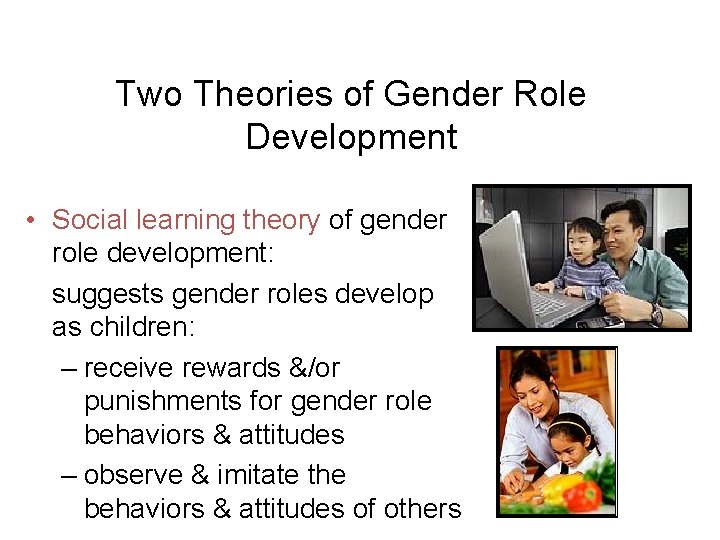
Two Theories of Gender Role Development • Social learning theory of gender role development: suggests gender roles develop as children: – receive rewards &/or punishments for gender role behaviors & attitudes – observe & imitate the behaviors & attitudes of others
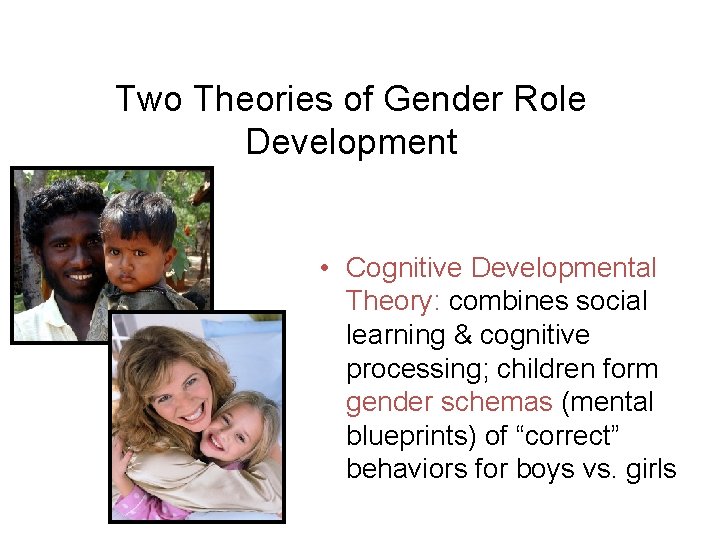
Two Theories of Gender Role Development • Cognitive Developmental Theory: combines social learning & cognitive processing; children form gender schemas (mental blueprints) of “correct” behaviors for boys vs. girls
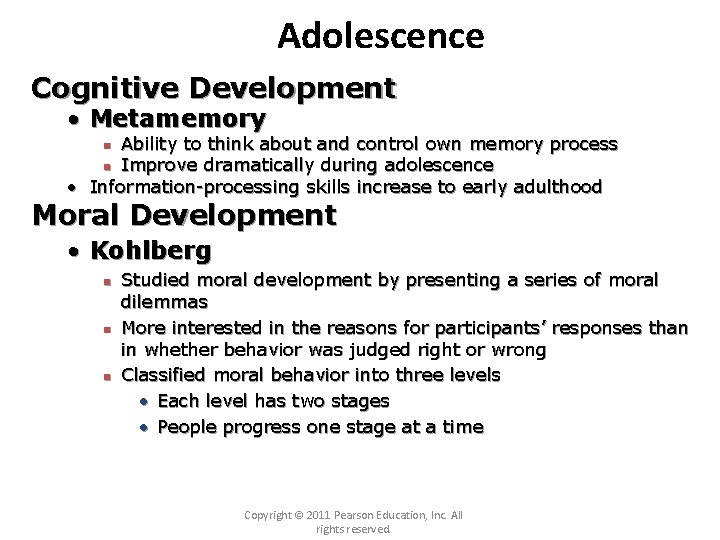
Adolescence Cognitive Development • Metamemory Ability to think about and control own memory process n Improve dramatically during adolescence • Information-processing skills increase to early adulthood n Moral Development • Kohlberg n n n Studied moral development by presenting a series of moral dilemmas More interested in the reasons for participants’ responses than in whether behavior was judged right or wrong Classified moral behavior into three levels • Each level has two stages • People progress one stage at a time Copyright © 2011 Pearson Education, Inc. All rights reserved.
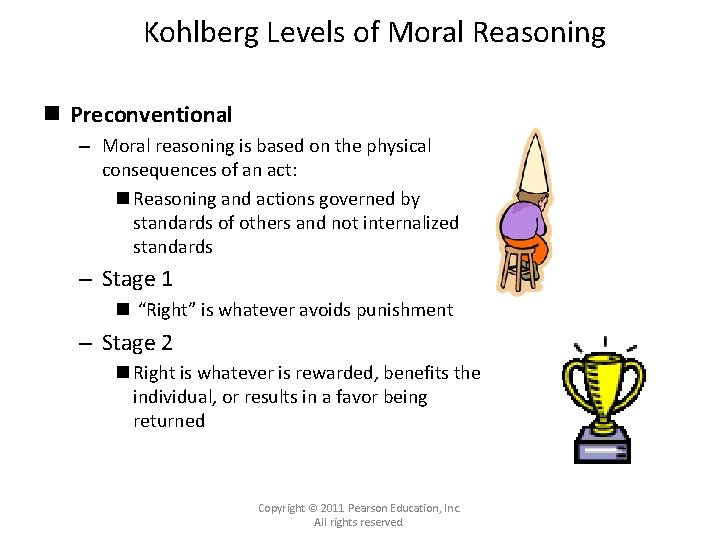
Kohlberg Levels of Moral Reasoning n Preconventional – Moral reasoning is based on the physical consequences of an act: n Reasoning and actions governed by standards of others and not internalized standards – Stage 1 n “Right” is whatever avoids punishment – Stage 2 n Right is whatever is rewarded, benefits the individual, or results in a favor being returned Copyright © 2011 Pearson Education, Inc. All rights reserved.
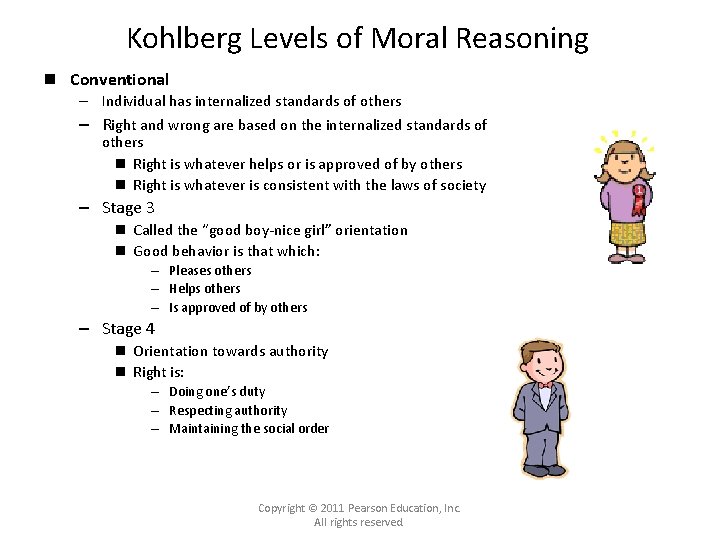
Kohlberg Levels of Moral Reasoning n Conventional – Individual has internalized standards of others – Right and wrong are based on the internalized standards of others n Right is whatever helps or is approved of by others n Right is whatever is consistent with the laws of society – Stage 3 n Called the “good boy-nice girl” orientation n Good behavior is that which: – Pleases others – Helps others – Is approved of by others – Stage 4 n Orientation towards authority n Right is: – Doing one’s duty – Respecting authority – Maintaining the social order Copyright © 2011 Pearson Education, Inc. All rights reserved.
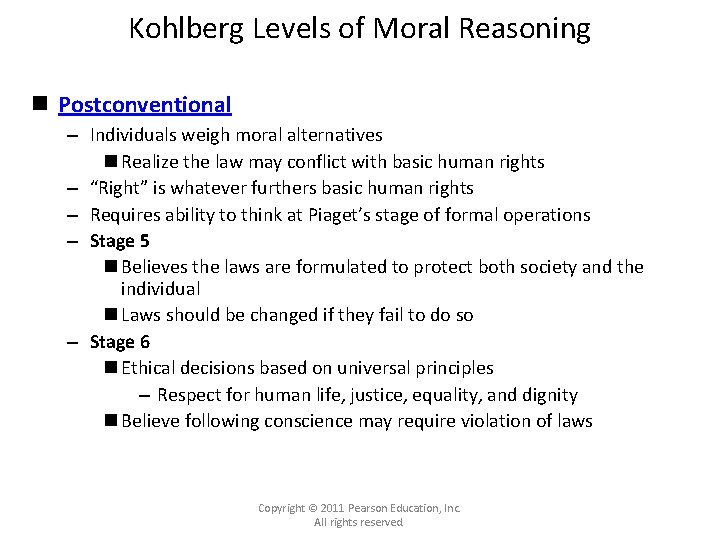
Kohlberg Levels of Moral Reasoning n Postconventional – Individuals weigh moral alternatives n Realize the law may conflict with basic human rights – “Right” is whatever furthers basic human rights – Requires ability to think at Piaget’s stage of formal operations – Stage 5 n Believes the laws are formulated to protect both society and the individual n Laws should be changed if they fail to do so – Stage 6 n Ethical decisions based on universal principles – Respect for human life, justice, equality, and dignity n Believe following conscience may require violation of laws Copyright © 2011 Pearson Education, Inc. All rights reserved.
Parental Relationships n Adolescents with permissive parents were more likely to – use alcohol and drugs – to have conduct problems – Less likely to be engaged in school n Adolescents with authoritarian parents are more likely to have – Psychological distress – Less self-reliance and self-confidence n Adolescents with authoritative parents are associated with – Psychosocial competence for all racial and ethnic groups n Relationship between parenting style and developmental outcomes is complex Copyright © 2011 Pearson Education, Inc. All rights reserved.
Early and Middle Adulthood Intellectual Abilities n Young Adults – Outperform middle and older adults on speed or rote memory tests n Middle- and Older Adults – Outperform young adults in general information, vocabulary, reasoning ability, and social judgment – Likely due to greater experiences and education n Gaining knowledge and skills through adult years n Verbal meaning n Spatial orientation n Inductive reasoning n Number and word fluency – Modest gains from young adulthood to mid-40 s – Decline did not occur until after age 60 – Modest declines until 80 s – Half showed no decline at age 81 – Perceptual speed only element to decline from mid 20 s to 80 s Copyright © 2011 Pearson Education, Inc. All rights reserved.
Lifestyle Patterns in Adulthood n Myths of Middle Age – Mid-life crisis refuted – Stress overload n Balancing demands of work, home, family, and retirement n Successful management leads to sense of competence – Empty nest syndrome n Parents appreciate reexamination of life and identity Copyright © 2011 Pearson Education, Inc. All rights reserved.
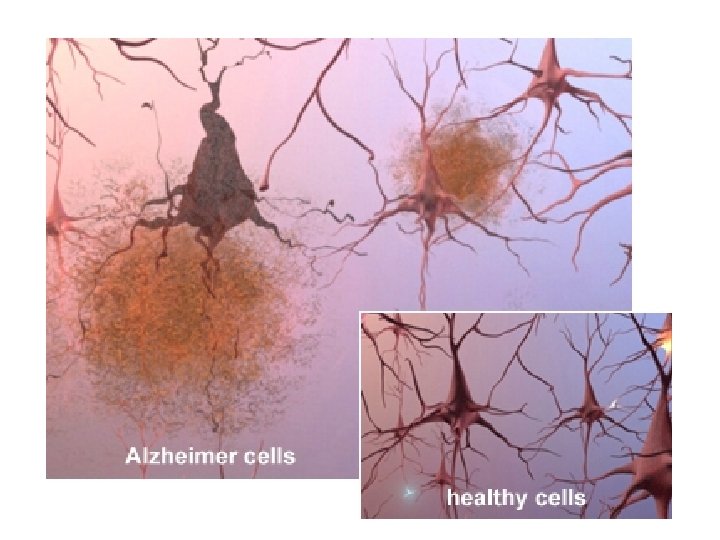
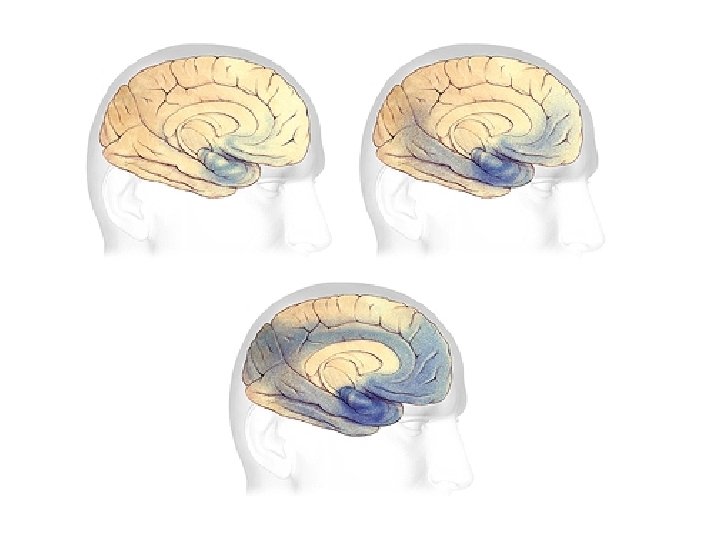
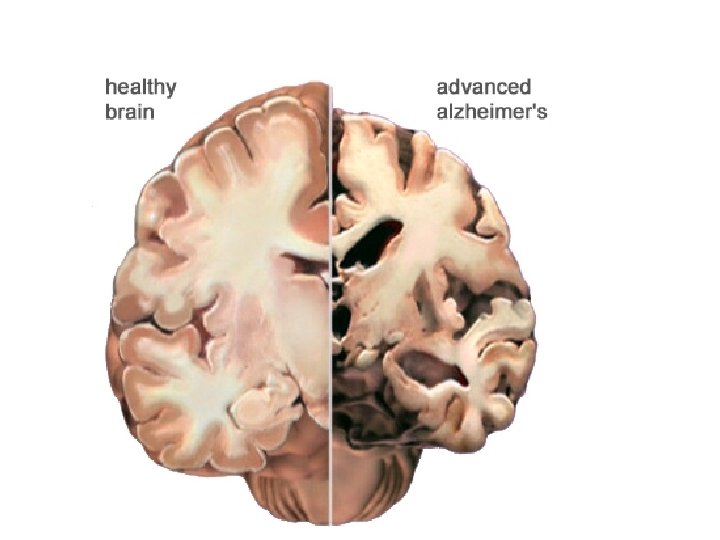
Later Adulthood Alzheimer’s Disease – Most common dementia (Accounts for about 60%) n Progressive deterioration of intellect and personality n Widespread degeneration of brain cells n Autopsy reveals that neurons of cerebral cortex are clogged with twisted, stringy masses (neurofibrillary tangles) and surrounded by plaques. – At first, victims show: n Gradual impairment in memory and reasoning n Loss of efficiency in carrying out everyday tasks – As disorder progresses, patients: n Become confused and irritable n Wander away from home n Become increasingly unable to take care of themselves n Develop unintelligible speech n Lose the ability to control bladder and bowel functioning n May not respond to spoken words n No longer recognize even spouse or children Copyright © 2011 Pearson Education, Inc. All rights reserved.
Later Adulthood Alzheimer’s Disease n Risk Factors n. Age n. Family history of Alzheimer’s Disease – Delaying or Lessening Onset n. High IQ coupled with life long intellectual activity n. Anti-inflammatory drugs and antioxidant vitamin E Copyright © 2011 Pearson Education, Inc. All rights reserved.
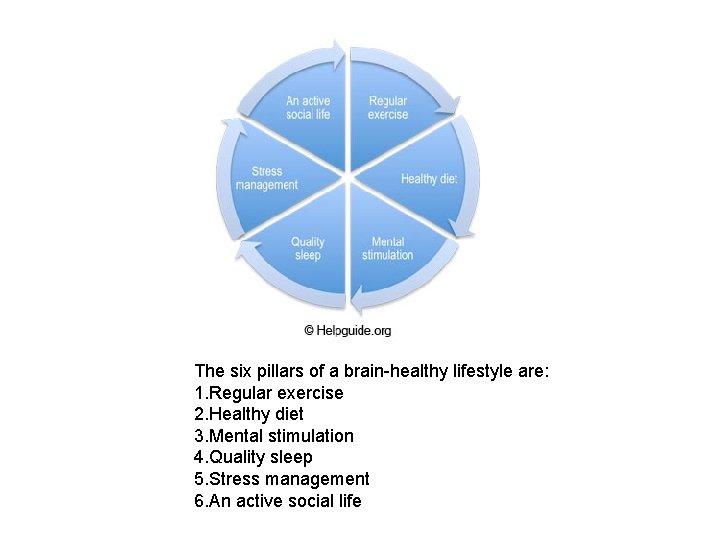
The six pillars of a brain-healthy lifestyle are: 1. Regular exercise 2. Healthy diet 3. Mental stimulation 4. Quality sleep 5. Stress management 6. An active social life