
Human Development Continuous process from fertilization until death
- Slides: 28
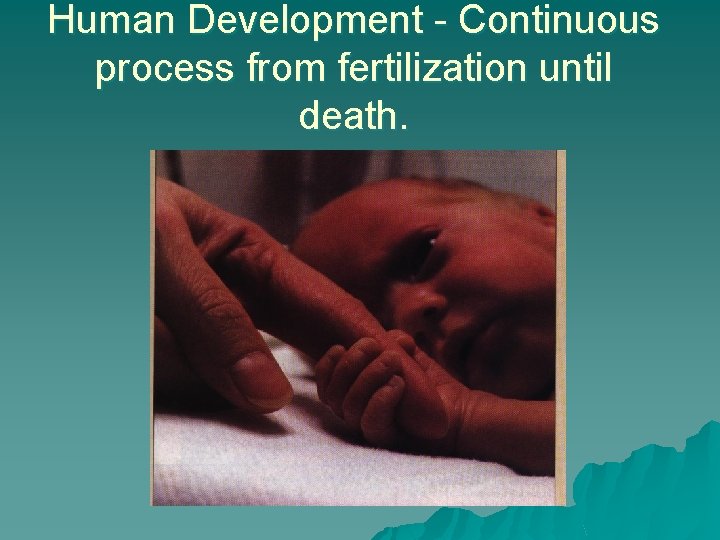
Human Development - Continuous process from fertilization until death.
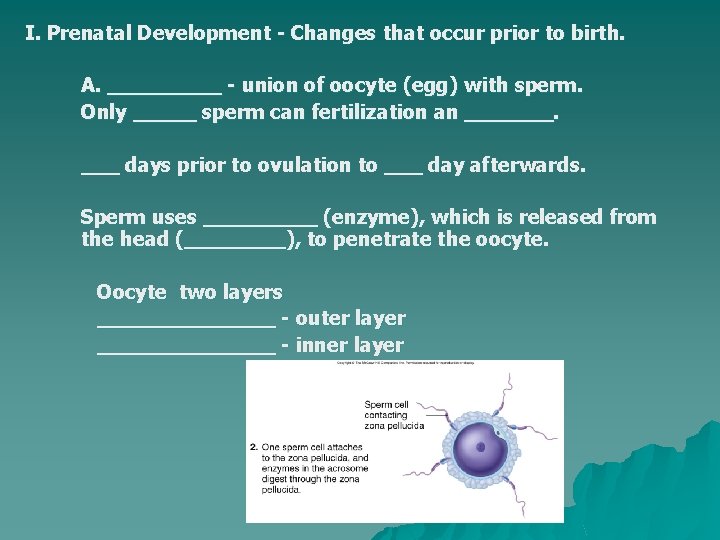
I. Prenatal Development - Changes that occur prior to birth. A. _____ - union of oocyte (egg) with sperm. Only _____ sperm can fertilization an _______. ___ days prior to ovulation to ___ day afterwards. Sperm uses _____ (enzyme), which is released from the head (____), to penetrate the oocyte. Oocyte two layers _______ - outer layer _______ - inner layer
Blastocyte
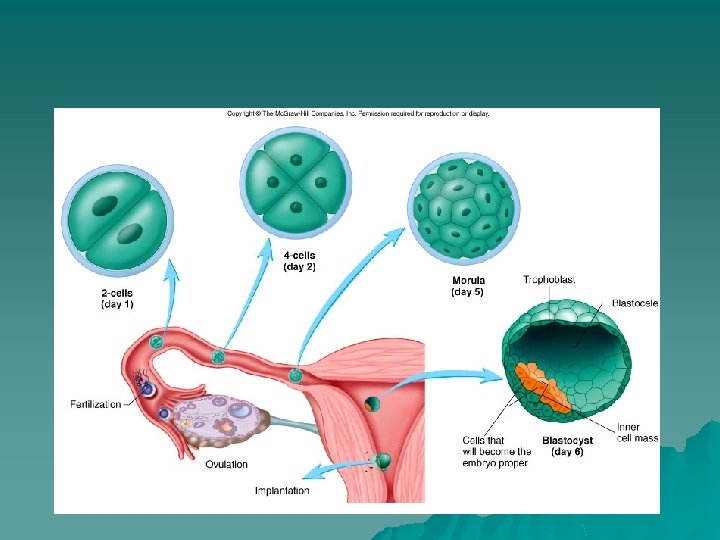
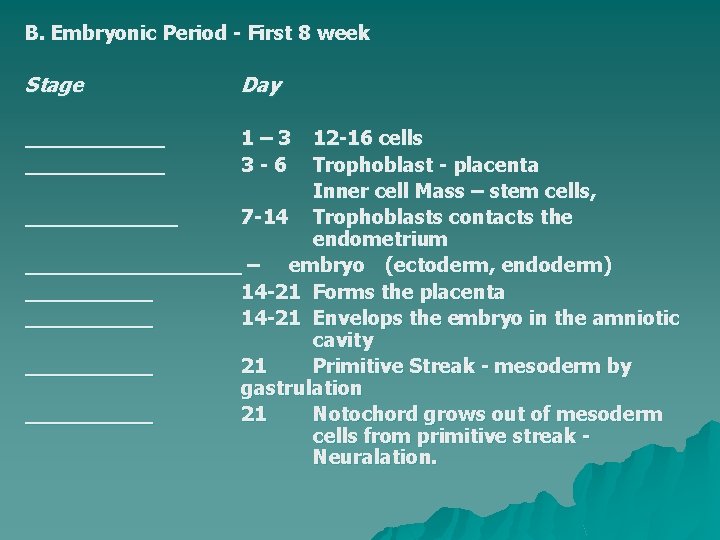
B. Embryonic Period - First 8 week Stage Day ___________ 1– 3 3 -6 12 -16 cells Trophoblast - placenta Inner cell Mass – stem cells, ______ 7 -14 Trophoblasts contacts the endometrium _________ – embryo (ectoderm, endoderm) _____ 14 -21 Forms the placenta _____ 14 -21 Envelops the embryo in the amniotic cavity _____ 21 Primitive Streak - mesoderm by gastrulation _____ 21 Notochord grows out of mesoderm cells from primitive streak Neuralation.
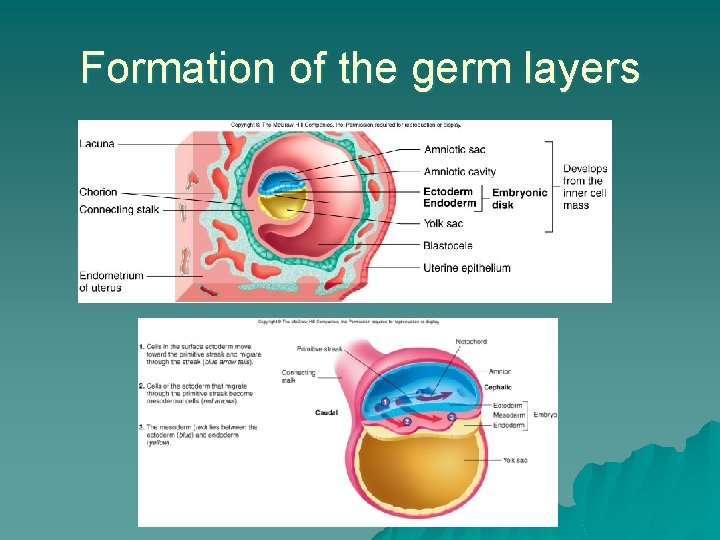
Formation of the germ layers
Mapping Cell Fate
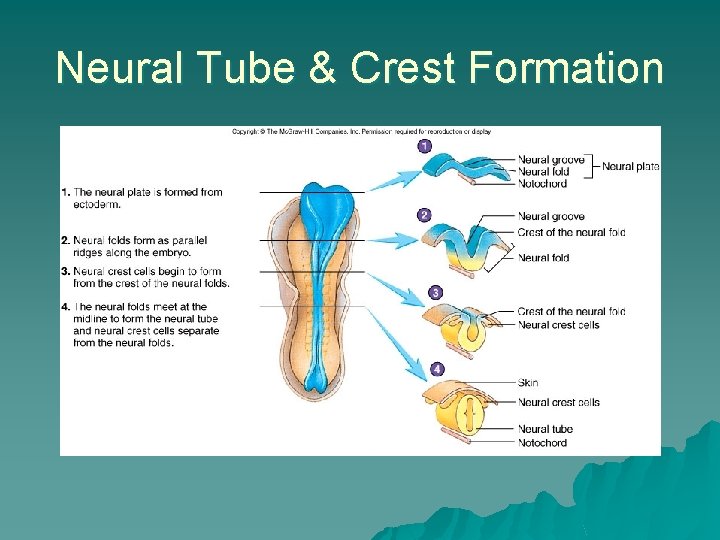
Neural Tube & Crest Formation
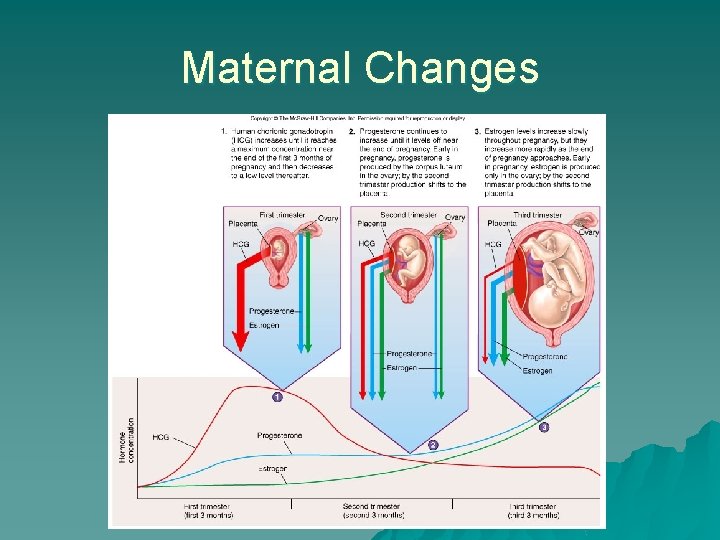
Maternal Changes
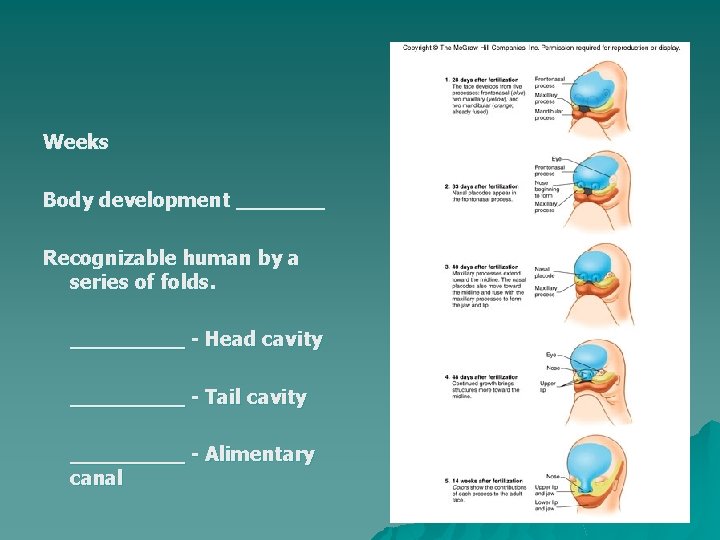
Weeks Body development _______ Recognizable human by a series of folds. _____ - Head cavity _____ - Tail cavity _____ - Alimentary canal
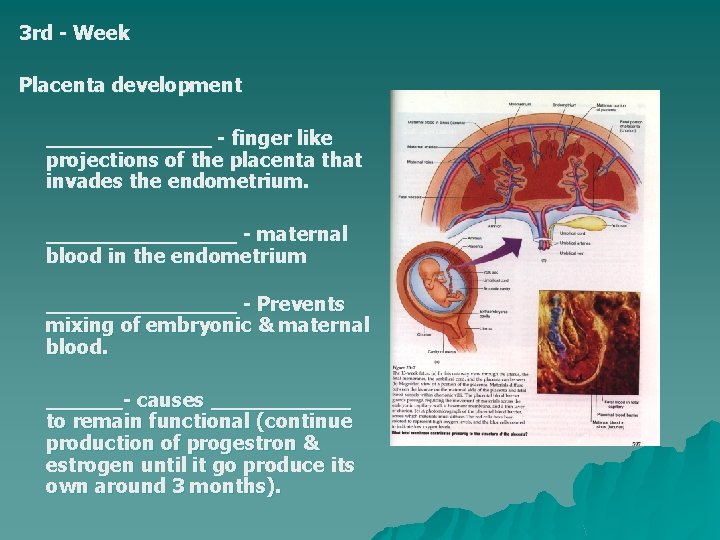
3 rd - Week Placenta development _______ - finger like projections of the placenta that invades the endometrium. ________ - maternal blood in the endometrium ________ - Prevents mixing of embryonic & maternal blood. ______- causes ______ to remain functional (continue production of progestron & estrogen until it go produce its own around 3 months).
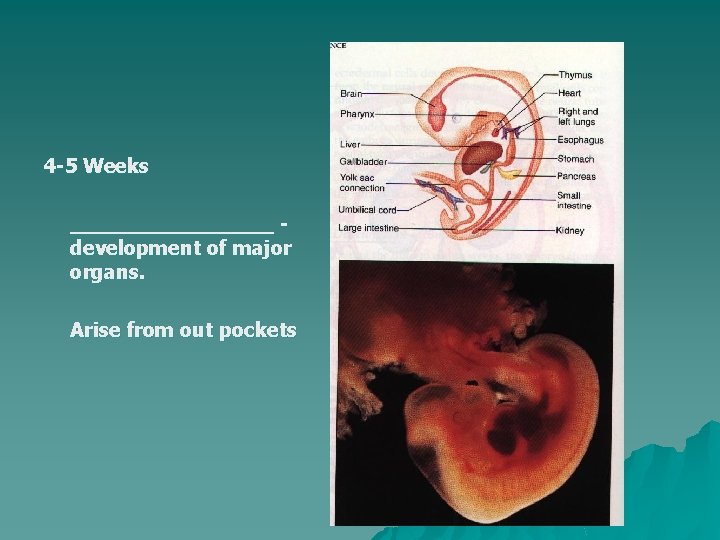
4 -5 Weeks ________ development of major organs. Arise from out pockets
Cell to Embryo
C. Growth of the ____ Fetus ____ wks until _______ Start of bone _____ Organs _____ Covered by _____ - fine, soft hair _________of fat for insulation & nutrient reserve. Slough of epithelial cells that protect the fetus from wastes that may be found in the amniotic fluid.
______ wks - able to live outside the mother ______wks - full term, lost lanugo, but still covered by waxy coat. 2. 5 g - 3500 g 0. 01 ounce - 7 pounds, 11 ounces Mitosis 1 inch - 20 inches
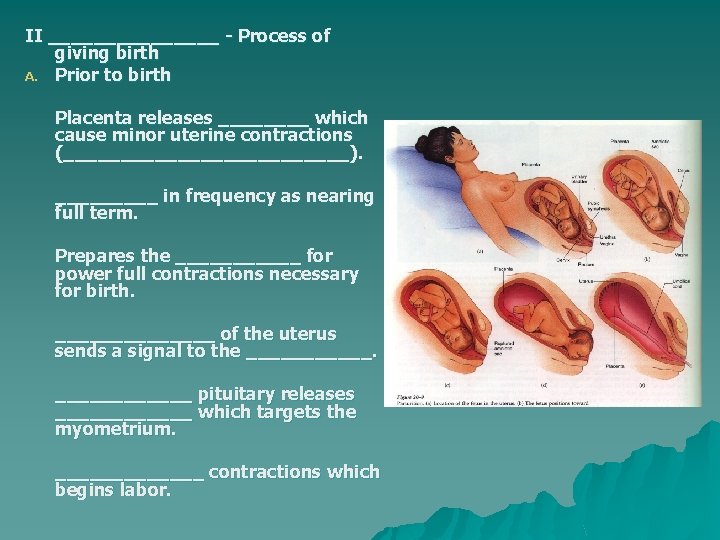
II ________ - Process of giving birth A. Prior to birth Placenta releases ____ which cause minor uterine contractions (_____________). _____ in frequency as nearing full term. Prepares the ______ for power full contractions necessary for birth. _______ of the uterus sends a signal to the ______ pituitary releases ______ which targets the myometrium. _______ contractions which begins labor.
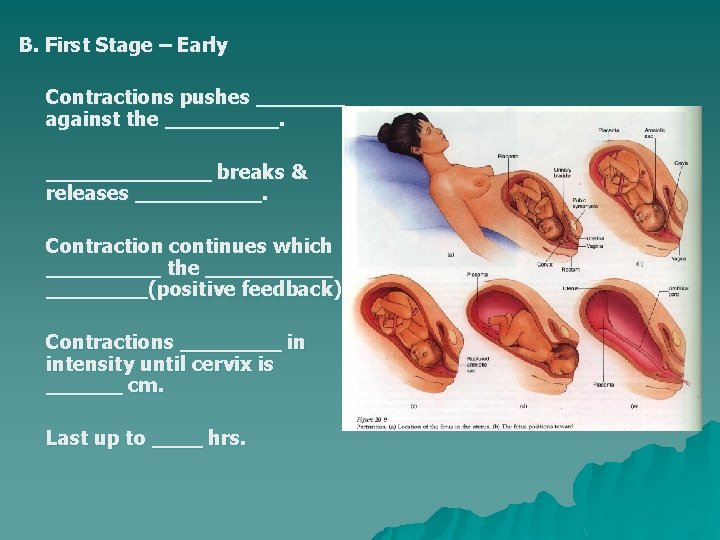
B. First Stage – Early Contractions pushes _______ against the _______ breaks & releases _____. Contraction continues which _____ the _____(positive feedback). Contractions ____ in intensity until cervix is ______ cm. Last up to ____ hrs.
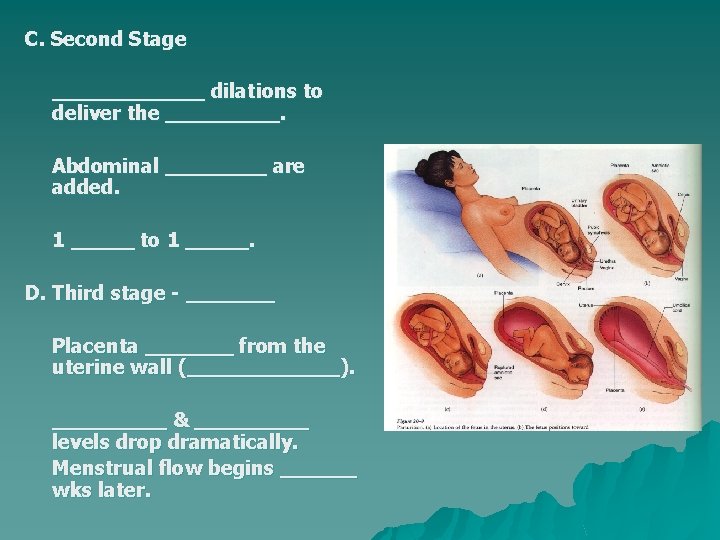
C. Second Stage ______ dilations to deliver the _____. Abdominal ____ are added. 1 _____ to 1 _____. D. Third stage - _______ Placenta _______ from the uterine wall (______). _____ & _____ levels drop dramatically. Menstrual flow begins ______ wks later.
III Postnatal Development - Birth until Death. A. ______ - Production of milk by the mammary glands. Begins at ____ & may last up to 2/3 years (regular suckling). _______ - estrogen & progestrone stimulate the ducts in the breast Accumulation of ______ Prolactin is ______ during _____, but its effects are _______ by the _______ levels of _____ & _______. & Once placenta _____ the body (_______ levels of estrogne progestrone), the effect of ______ is felt (increase in milk production). _____ is produced for the first few days which is high in ______ & low in ____& lactose. _______, antibodies levels _______, fat & lactose levels _____.
B. Flow of milk requires ___________. 1. Suckling triggers nerve impulse to release ____. 2. Oxytocin cause cells to _____ (milk let down). 3. _____, ___________ of schedule feeding. 4. _________ as long as ________ continues, will stop after several days of non -nursing.
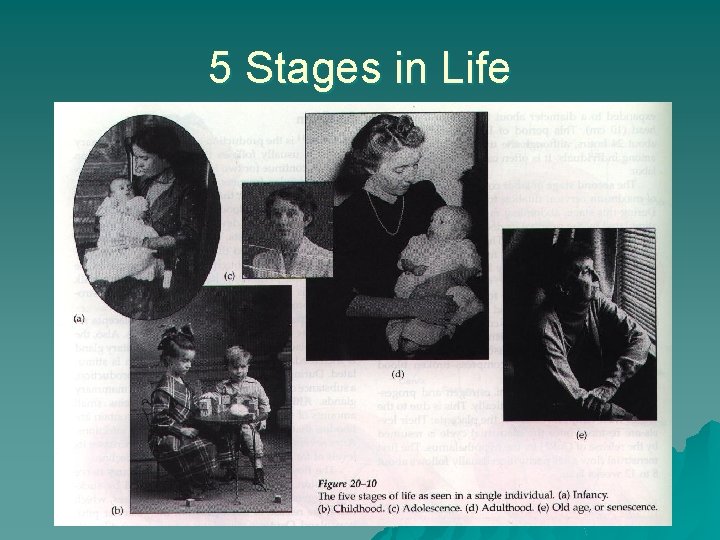
5 Stages in Life
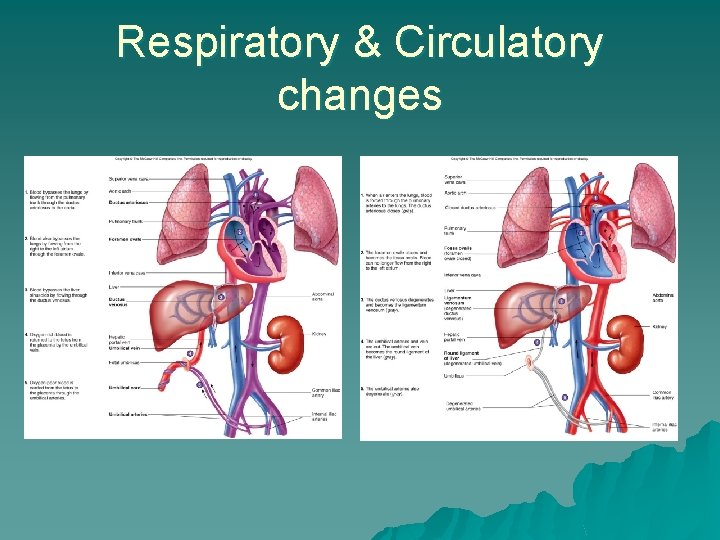
Respiratory & Circulatory changes
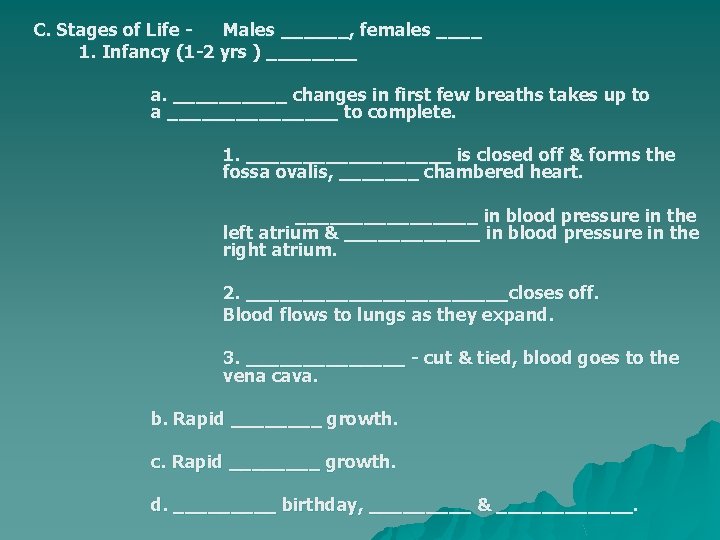
C. Stages of Life Males ______, females ____ 1. Infancy (1 -2 yrs ) ____ a. _____ changes in first few breaths takes up to a ________ to complete. 1. _________ is closed off & forms the fossa ovalis, _______ chambered heart. ________ in blood pressure in the left atrium & ______ in blood pressure in the right atrium. 2. ____________closes off. Blood flows to lungs as they expand. 3. _______ - cut & tied, blood goes to the vena cava. b. Rapid ____ growth. c. Rapid ____ growth. d. _____ birthday, _____ & ______.
2. Childhood (_____ to ____) ________ to the world around them. __________________ in the brain. Learns _________at the ____________ than the rest of the body.
3. Adolescence male 10 -12 - 18 yr female 8 -11 – 16 a. Physiological changes ________________ reaches _________________ develop. ____________ Males max. height is reach ______ yrs. old. Female max. height is reached _______ yrs old.
5. __________ - old age __________________ Loss of posture Muscle of ___________ nerve impulses Skin becomes _______, ______ pigmented. Immune response, _________ pneumia, tumurs, & infections
6. Death ______ body functions stops _______ of _____ or ________ organs